The problem with starting a landscaping business is that it looks too easy, and that illusion is exactly what makes it expensive. Buy a mower, print some flyers, knock on doors, and you are in business. That part is true, and it is exactly the problem, because the barrier to entry is so low that you compete against every teenager with a push mower and every crew that undercuts on price. The cost of starting a landscaping business breakdown is therefore not a single number but a choice between three different businesses, which are a lean solo start at $8,000 to $20,000, a standard solo operation at $15,000 to $30,000, and a full crew operation at $42,000 to $168,500.
The owners who survive treat it like a real company from day one, not a summer hustle, and they budget for insurance, licensing, and the quiet winter before the first mower is bought.
The Three Startup Tiers, and Which One You Actually Are
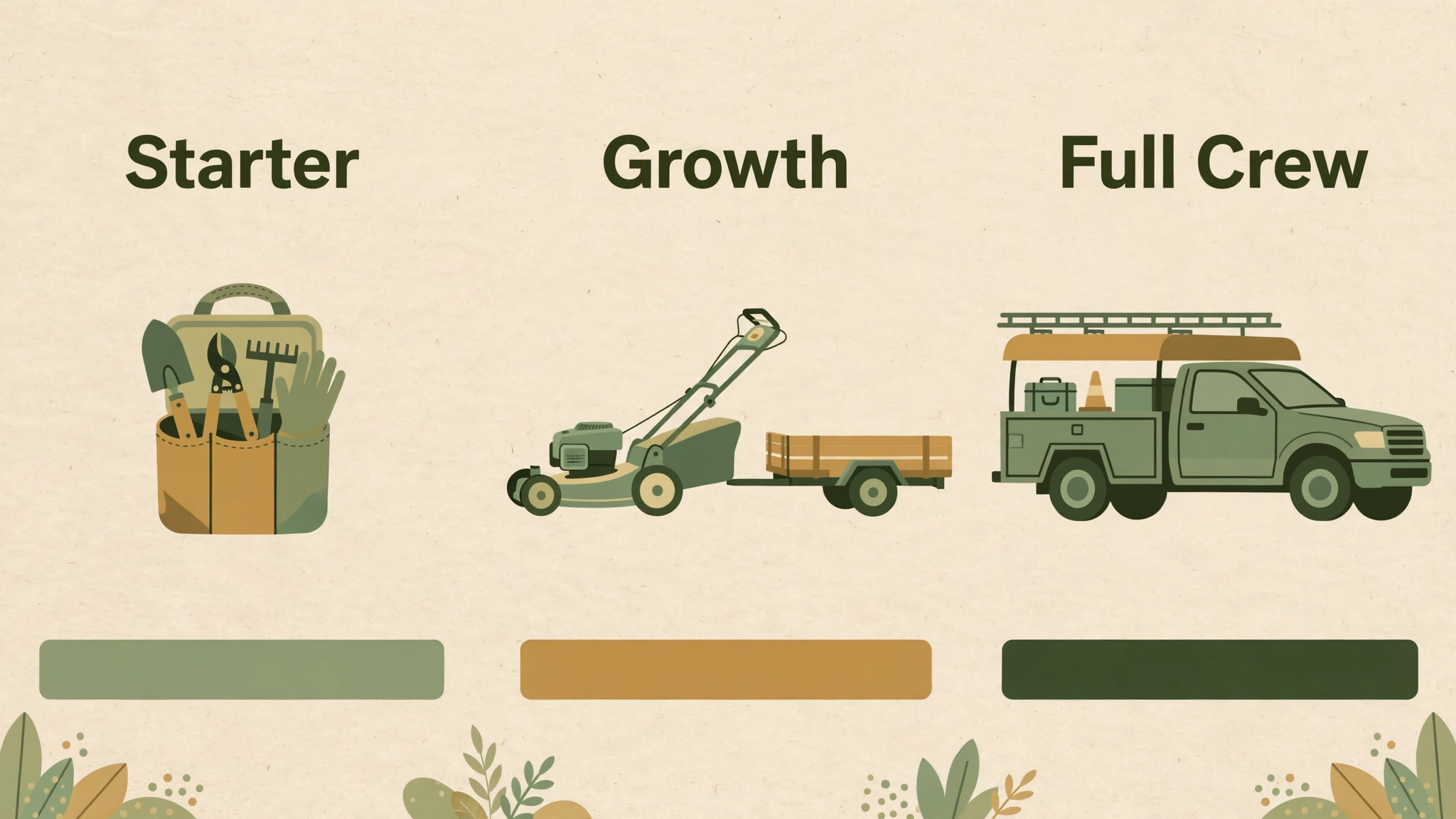
Published guides disagree wildly on startup totals, from a few hundred dollars with used gear to more than $50,000 for a full commercial start, and both can be true, because they describe different tiers. The lean tier is a solo operator with used equipment, a used truck or an existing vehicle, basic insurance, and flyers, landing near $8,000 to $20,000 all in. The standard tier is a solo operator with professional grade equipment, a reliable truck and trailer, proper insurance, a website, and a marketing launch, landing near $15,000 to $30,000.
The full tier is a crew operation with new equipment, a new or specialised vehicle, a storage yard or shop, initial staffing, and comprehensive marketing, landing at $42,000 to $168,500 in franchise disclosure based estimates. A detailed breakdown of that full tier puts equipment and tools at $5,000 to $20,000, a vehicle at $15,000 to $50,000, a trailer at $2,000 to $10,000, licensing and permits at $500 to $2,500, insurance at $1,500 to $6,000, marketing at $1,000 to $5,000, office supplies and software at $500 to $3,000, training and certification at $500 to $3,000, rent or storage at $6,000 to $24,000, and three months of employee salaries at $10,000 to $40,000.
The tier decision should follow your first year honestly, not your ambition. A solo operator targeting residential mowing in one neighbourhood needs the lean or standard tier, and buying the full tier’s equipment before the route exists is capital sitting in a garage. A crew operation targeting commercial contracts needs the full tier, because commercial clients check insurance, equipment, and staffing before awarding work, and a solo setup will not pass that check. The middle mistake is the most common, which is buying crew grade equipment for a solo route, or taking commercial work with solo grade capacity. Both versions end the same way, with either idle equipment or an overwhelmed owner.
Choose the tier that matches the customers you can actually sign in the first 90 days, and upgrade when the route, not the enthusiasm, demands it.
The cost of starting a landscaping business breakdown by category
The cost of starting a landscaping business breakdown below uses a standard solo start as the middle column, with the lean and full tiers beside it, so the table reads as a decision tool rather than a single budget. All figures come from published 2026 guides, and all vary by city, services offered, and whether equipment is bought new or used.
| Cost category | Lean solo start | Standard solo start | Full crew operation |
|---|---|---|---|
| Equipment and tools | $2,000 to $5,000 | $5,000 to $15,000 | $5,000 to $20,000 |
| Truck and trailer | $5,000 to $10,000 used | $10,000 to $25,000 | $17,000 to $60,000 |
| Business registration and licences | $100 to $500 | $150 to $600 | $500 to $2,500 |
| Insurance, first year | $500 to $1,500 | $1,500 to $4,000 | $1,500 to $6,000 |
| Marketing and website | $200 to $500 | $500 to $2,000 | $1,000 to $5,000 |
| Storage or yard rent, annual | $0, home based | $1,200 to $3,600 | $6,000 to $24,000 |
| Training and certification | $0 to $250 | $250 to $1,500 | $500 to $3,000 |
| Working capital reserve | $1,000 to $3,000 | $2,700 to $8,100 | $10,000 to $40,000 |
| Total planning range | $8,800 to $20,750 | $21,300 to $59,700 | $41,500 to $160,500 |
Two lines in that table deserve a closer look, because they are the ones beginners underestimate. The first is working capital. Published guidance suggests a safety net of $2,700 to $8,100 to buffer cash flow through seasonal cycles for a solo start, and that reserve is what keeps a business alive when rain cancels a week of routes or when a commercial client pays at 45 days rather than 14. The second is the vehicle.
A used pickup at $5,000 to $20,000 and a trailer at $500 to $2,000 will start a solo route, but a crew operation needs a reliable truck and trailer combination that does not break down on the way to a contracted job, and vehicle downtime is lost revenue plus a damaged reputation in the same afternoon. Buy the vehicle for the work you have contracted, not the work you hope to win, and budget maintenance from the first month, because a work truck earns its maintenance schedule whether you fund it or not.
Equipment, what each piece really costs
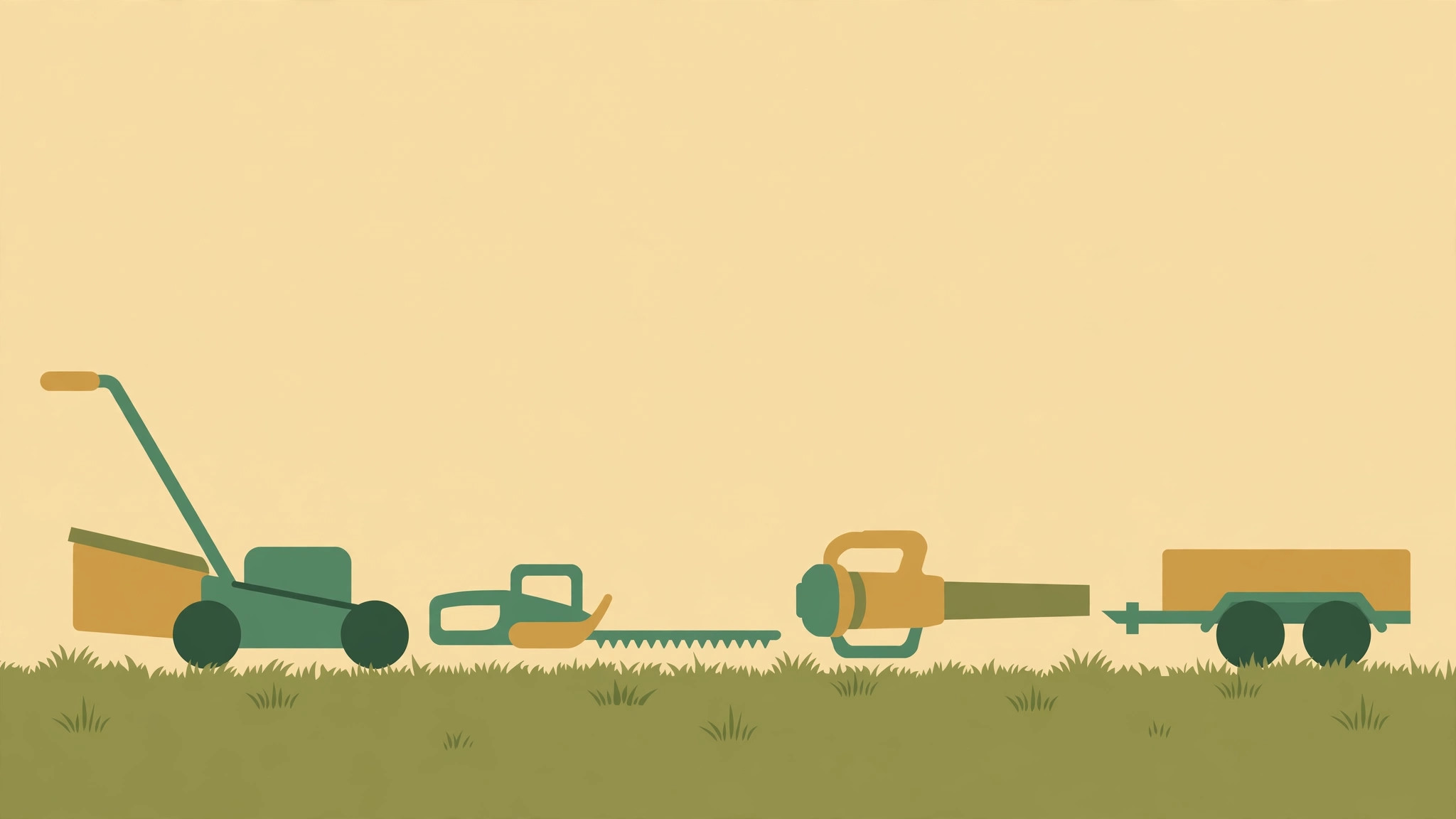
Equipment pricing rewards buyers who understand the difference between homeowner grade and professional grade, because the price gap reflects a durability gap that matters daily. A residential push mower runs $200 to $500, while a professional grade walk behind or zero turn mower runs $800 to $2,000 at the smaller end and $3,000 to $15,000 for a full commercial setup. Trimmers run $100 to $300 for basic models and $100 to $400 for professional units. Blowers run $100 to $300, or $80 to $200 on average for standard units. Edgers run $100 to $400. Weed sprayers run $70 to $345.
Hand tools, meaning shovels, rakes, and pruning shears, run $50 to $200, and safety gear adds $500 to $2,000 when bundled with hand tools in a full setup. The commercial equipment package of mowers, trimmers, blowers, and edgers lands at $3,000 to $15,000 in published California guidance, and that figure is the realistic planning number for a professional solo start, before the truck and trailer.
Buy used for the first season where it makes sense, and be selective about where it does not. Used mowers from a reputable dealer with a service history are a genuine saving, since commercial mowers are built to be rebuilt. Used trimmers and blowers are cheaper still, but their working life is shorter and their failure cost is a lost route day, so price the risk rather than just the saving. Buy new for safety gear, for anything where failure injures someone, and for the trailer, where a failed axle or lighting system creates road risk.
The equipment decision is also a service decision, because a dealer who services what they sell is worth a premium over an online bargain with no local support, and a mower in the shop for two weeks during peak season costs more than the saving on its purchase price.
Insurance, the Line That Protects Everything Else
Insurance is the line beginners skip and professionals never do, because green industry risk comes from four directions at once, which are thrown debris and property damage, vehicles and trailers, expensive equipment that lives outdoors, and crews doing physical work in the heat. Published 2026 figures using Insureon median data put general liability near $51 a month, commercial auto near $204 a month, tools and equipment near $38 a month, workers compensation near $169 a month, a business owner policy near $94 a month, a commercial umbrella near $88 a month, and licence and permit bonds near $9 a month.

Other guides put general liability at $45 to $85 a month, workers compensation at $100 to $250, commercial auto at $150 to $250 per vehicle, tools and equipment at $30 to $50, a business owner policy at $90 to $120, and an umbrella at $75 to $100. A full programme with workers compensation, commercial auto, and equipment coverage typically runs $300 to $600 a month for a small crew, while a solo operator’s general liability alone runs about $500 to $1,500 a year.

| Coverage | Typical monthly cost | What it covers |
|---|---|---|
| General liability | $45 to $85 | Injury or property damage caused at a client site |
| Commercial auto | $150 to $250 per vehicle | Accidents involving the truck and the trailer it tows |
| Tools and equipment | $30 to $50 | Theft of mowers, trimmers, and blowers from trailer or site |
| Workers compensation | $100 to $250 | Crew injuries, including cuts, heat illness, and strains |
| Business owner policy | $90 to $120 | Liability plus property for a shop, yard, or storage building |
| Commercial umbrella | $75 to $100 | Extra limits when contracts demand more than $1 million |
The coverage that matters most depends on the work. A solo mowing operator needs general liability and commercial auto first, because a rock through a window and a trailer accident are the two most likely claims. A crew operation needs workers compensation next, because crew injuries are a matter of when rather than if, and published California figures put workers compensation at $4,000 to $9,000 per $100,000 of payroll, which is a line that grows directly with hiring. Commercial clients and municipalities commonly require $1 million or $2 million of liability, which is where the umbrella policy earns its premium.
Personal auto policies almost never cover business accidents, so a truck used for work without commercial auto cover is an uninsured risk wearing a familiar paint job. Get quotes from an agent who knows outdoor trades, because a generic policy often excludes the exact work a crew does, such as tree work above a certain height or pesticide application.
Licensing, and why it varies by state
Licensing requirements vary widely by state and sometimes by city, and the variation is the reason a national guide cannot give a single licence figure. Most communities require at least a general business licence, with published costs of $50 to $200 for a basic licence, $100 to $500 for business licences and certifications in a lean start, and $100 to $1,000 in broader guides. Work with fertilisers, pesticides, irrigation, waste removal, or general contracting triggers additional requirements, especially pesticide applicator licences, which vary significantly by state and are mandatory before chemical treatments are sold.
California’s C-27 contracting licence illustrates the upper end, with application and exam fees of $650 to $800, fingerprinting at $75, and a $25,000 surety bond carrying a premium of $100 to $500 a year. Check state rules before advertising services, because advertising a regulated service without the licence is a liability that arrives faster than the first customer. The cost of starting a landscaping business breakdown that treats licensing as a single $100 line is a plan written for a state the owner does not live in.
Marketing, and the Cost of Winning a Route
Marketing for a landscaping business is local, repetitive, and cheaper than owners fear, provided it starts with the free channels. A Google Business Profile costs nothing and puts the business on the map where nearby customers search, and it is the single highest return marketing action for a local service business. A basic website costs $100 to $500 and above, yard signs and door hangers cost $50 to $300, and referral discounts cost $0 to $100 and above in foregone revenue.
Paid options scale from there, with local online ads at $100 to $300 and above a month and Google Local Service Ads at $150 to $500 and above a month, charging per lead rather than per click, which makes costs more predictable. A full truck wrap costs $3,000 to $6,500, with partial wraps at $1,000 to $2,500, and the truck itself is a moving advertisement on every route, which makes the wrap one of the few marketing spends that works while the business is earning.
Many small businesses set aside 2 to 5 percent of revenue for marketing, and that percentage is flexible, but the discipline is not, since a route that stops marketing stops growing, and a route that stops growing starts shrinking as customers move, sell, or switch.
Pricing is the companion to marketing, because a route priced below cost cannot be marketed into profit. Published guidance prices mowing at $50 to $80 per visit, and advises selling recurring maintenance contracts rather than one time jobs, because a mowing customer pays 25 to 30 times a year without being sold again. Recurring revenue is the reason landscaping economics work at all, since it converts a single sale into a year of income, and it is the reason route density matters more than route size.
Ten lawns on one street beat twenty lawns scattered across a county, because drive time is unpaid time, and a route with five extra unpaid driving hours a week can cut the effective hourly rate nearly in half. Price by the route, not by the lawn, and charge for the drive, the disposal, and the season, not just the mowing hour.

A First Season Budget, From Spring to Winter
The table below is the overview proof for this guide, giving a first season budget for a standard solo start. It separates one time startup costs from monthly running costs and from the winter reserve, because the first season’s real test is not spring demand but winter cash flow. A business that earns well from April to October and has no plan for November to March is a seasonal job, not a company.
| First season line | Planning figure | Notes |
|---|---|---|
| Equipment and tools, professional grade | $5,000 to $15,000 | Mowers, trimmers, blowers, edgers, hand tools |
| Truck and trailer, used | $5,500 to $22,000 | Reliable truck plus trailer, not showroom new |
| Registration, licences, first year insurance | $2,000 to $5,500 | General liability, commercial auto, licences |
| Marketing and website launch | $500 to $2,000 | Profile, site, signs, door hangers, first ads |
| Fuel and vehicle maintenance, monthly | $300 to $800 | Published recurring range for a solo start |
| Equipment maintenance, monthly | $50 to $200 | Blades, oil, filters, small repairs |
| Software and phone, monthly | $50 to $200 | Scheduling, invoicing, communications |
| Monthly running total, in season | $400 to $1,200 | Before owner drawings and taxes |
| Winter reserve, three months | $1,200 to $3,600 | Covers running costs when routes pause |
| First season all in planning range | $14,700 to $49,100 | Startup plus in season running plus reserve |
Winter is the season that sorts serious operators from summer hustles. Options include snow removal where climate allows, holiday lighting installation, leaf cleanups extending into late autumn, gutter cleaning, and maintenance contracts that spread payments across twelve months rather than billing only in season. A maintenance contract billed monthly across the year is the single best winter defence, because it converts seasonal income into annual income without new customers. Expect 12 to 18 months before the business pays a stable full time income, and judge the first season on route retention and referral rate rather than on total revenue, since a route that renews is an asset and a route that churns is a treadmill.
The cost of starting a landscaping business breakdown that ends at the equipment purchase is a budget for a summer, not for a business.

Hiring Your First Crew Member, the Cost Step Change
Hiring the first crew member is the most expensive decision in a landscaping business, not because of the wage but because of everything the wage triggers. Published recurring guides put payroll for a small operation at $1,000 to $10,000 a month and for a lawn care operation at $2,000 to $5,000 a month, and the range reflects whether the hire is part time seasonal help or a full time crew member with benefits. The wage itself is only the visible part. Workers compensation rises with payroll, at published California rates of $4,000 to $9,000 per $100,000 of payroll, and at national guide rates of $100 to $250 a month for a small crew.
Commercial auto costs rise if the crew member drives, tools and equipment costs rise with a second set of gear, and the vehicle may need upgrading from a pickup that carries one person’s equipment to a setup that carries two. Uniforms add $300 to $1,000, training and certification add $250 to $1,500, and payroll administration, whether software or a service, adds its own monthly line. A hire that costs $3,000 a month in wages commonly costs $3,800 to $4,200 a month all in, and that all in figure is the one to compare against the revenue the hire enables.
The revenue test for a first hire is route capacity. A solo operator can typically service 20 to 30 residential lawns a week on a dense route, depending on lawn size and drive time. Adding a crew member should add a second route or double the capacity of the existing route, not merely make the existing route more comfortable. If the hire only makes the same lawns easier, it is a lifestyle purchase, not a business investment, and it should be judged as one.
If the hire enables a second route that adds 20 lawns at $50 to $80 a visit, the hire adds $4,000 to $6,400 a month of recurring revenue against $3,800 to $4,200 of all in cost, and the hire pays, provided the route actually fills. Hire against signed contracts or a waiting list, not against a forecast, because a crew member hired on hope is a fixed cost waiting for revenue that may arrive three months late. The cost of starting a landscaping business breakdown that includes crew payroll from day one is a plan for a business that already has crew sized demand, and most new businesses do not.
Timing the hire matters as much as pricing it. Hiring in early spring, when routes are forming and demand is visible, gives the new crew member a full season to learn and the business a full season to judge the hire. Hiring in midsummer, when the owner is already overwhelmed, usually means a rushed hire, minimal training, and a crew member who learns bad habits while the owner is too busy to correct them. Seasonal hires are a useful middle step, since they add capacity for the peak without a year round commitment, but they carry the same insurance and training costs for a shorter return, so price them on the peak months they actually work.
Retention is the final cost lever. A crew member who stays three seasons is dramatically cheaper than one replaced every season, once recruiting, training, and the customers lost to unfamiliar faces are counted. Pay fairly, schedule predictably, and treat the first hire as the beginning of a team culture, because the second hire will be recruited by the first hire’s experience of working for you, for better or worse.
Commercial Versus Residential, Two Different Cost Profiles
Residential and commercial work are different businesses that share equipment, and choosing between them changes the startup budget in ways that surprise new owners. Residential work means smaller lawns, more customers, more scheduling, and payment that usually arrives quickly, often by card or bank transfer within days. The cost profile is marketing heavy and administration heavy, because twenty residential customers need twenty relationships, twenty invoices, and twenty chances to cancel. Commercial work means larger sites, fewer customers, formal contracts, and payment terms of 30 to 45 days, which means the business funds a month or more of labour and fuel before the first invoice is paid.
The cost profile is working capital heavy and compliance heavy, because commercial clients check insurance limits, require higher liability cover, and often demand an umbrella policy before work begins.
Commercial work also changes the equipment and staffing profile. A commercial site may need wider mowers, larger trailers, and a crew that can work as a team on a schedule set by the client rather than by the route. A residential route can be built one lawn at a time with a solo operator. A commercial contract usually needs the full capacity on day one, which means hiring and equipping before the revenue arrives. That timing gap is why commercial work suits established operators with reserves, while residential work suits new operators building a route. Many successful businesses run both, using residential routes for steady weekly cash and commercial contracts for larger monthly invoices, but the mix should be deliberate.
A business that is 90 percent commercial with no residential base has no cushion when a contract is lost, and a business that is 90 percent residential with one large commercial contract has a scheduling problem every time the contract site demands a full crew day. Build the residential base first, add commercial work when the crew and the reserve can carry its payment terms, and price commercial work for the payment delay as well as the labour, because a contract paid at 45 days costs more to service than the same work paid at 7 days.
More Reading on Stratilyze
Landscaping startup costs sit beside the other outdoor and service trade budgets owners compare, so readers weighing the trade usually check the neighbouring guides next. The guide to using AI for landscaping business quote estimates shows how the startup numbers in this guide turn into quotes customers accept, the guide to the cost of starting a cleaning business covers the closest service-trade comparison, with the same equipment and crew math, and the guide to home cleaning service pricing packages explains the package pricing that keeps a service trade profitable after launch.
Frequently Asked Questions
How much does it cost to start a landscaping business?
A lean solo start costs $8,000 to $20,000, a standard solo start $15,000 to $30,000, and a full crew operation $42,000 to $168,500. The cost of starting a landscaping business breakdown depends most on equipment grade, vehicle choice, crew size, and whether storage or a shop is rented, with the vehicle and the first months of payroll driving the top end.
Do I need a licence to start a landscaping business?
It depends on the state and the services offered. Most communities require at least a general business licence at $50 to $200, while pesticide application, irrigation, and contracting work trigger additional licences. California’s contracting licence illustrates the upper end, with $650 to $800 of application and exam fees plus bonding. Check state and city rules before advertising regulated services.
How much does landscaping business insurance cost per month?
General liability runs $45 to $85 a month, commercial auto $150 to $250 per vehicle, tools and equipment $30 to $50, and workers compensation $100 to $250. A full programme for a small crew typically runs $300 to $600 a month. Solo operators often pay $500 to $1,500 a year for general liability alone.
How should I price mowing services?
Published guidance prices mowing at $50 to $80 per visit, and advises selling recurring maintenance contracts rather than one time jobs, since a mowing customer pays 25 to 30 times a year. Price by the route rather than the lawn, because drive time is unpaid time, and build route density so ten lawns on one street replace twenty scattered across a county.
Unpaid drive time, winter downtime, and equipment downtime are the three hidden costs beginners miss. Liability insurance at $500 to $1,500 a year, a business licence at $50 to $200, repairs, fuel, and quiet winters all sit outside the mower purchase price. A first season budget that includes a winter reserve and monthly maintenance is a budget that survives its first year.
Should I buy new or used landscaping equipment?
Buy used for mowers from a reputable dealer with a service history, since commercial mowers are built to be rebuilt, and buy new for safety gear and for anything where failure injures someone. A dealer who services what they sell is worth a premium, because a mower in the shop for two weeks during peak season costs more than the saving on its purchase price.
The Verdict on Landscaping Startup Costs
The cost of starting a landscaping business breakdown comes down to a single discipline, which is buying the tier your route can carry and selling the contract that keeps it. Start lean if you are solo, buy professional grade where durability pays, insure before you mow, price for the route rather than the lawn, and hold a winter reserve before the first spring invoice. Landscaping rewards owners who treat a route like an asset, because a route that renews for 25 to 30 visits a year is the closest thing a service business has to a subscription, and it is built one kept customer at a time.