

The short answer is that a small commercial salon usually needs between 40,000 dollars and 100,000 dollars to open properly, while a home based studio can start for 2,000 dollars to 10,000 dollars and a high end salon can pass 200,000 dollars. That wide range is exactly why a careful cost of starting a nail salon breakdown matters more than a single headline number. Two salons with the same number of chairs can differ by tens of thousands of dollars because of plumbing, ventilation, location, product lines and the cash reserve held for slow early months.
This guide separates one time opening costs from monthly running costs, shows where owners most often under budget, and gives you a planning method you can take to a landlord, a lender or a contractor without guessing.
What the cost of starting a nail salon breakdown Really Shows
The most useful lesson from published cost guides is that rent and build out, not polish, drive the budget. Square reported a mid range salon at 42,000 dollars to 98,000 dollars in total, with equipment at 15,000 dollars to 30,000 dollars and working capital at 15,000 dollars to 40,000 dollars. Booksy, in a detailed line item budget for a small six station salon, put build out and renovation at 15,000 dollars to 240,000 dollars depending on whether the space was already fitted out or needed full construction. That gap is not an error.
A second generation space with pedicure plumbing already in place is a different project from a bare retail shell that needs new drains, water lines, electrical work and ventilation. When you compare quotes, always ask what state the space is in, what the landlord will contribute, and what is included in each contractor price. A low build out quote that excludes plumbing or ventilation is not a saving. It is a cost that will appear later, usually at the worst moment.
A second lesson is that working capital belongs in the opening budget, not as an afterthought. A salon rarely fills its appointment book in week one. Regular clients take time to find, rebooking habits take time to build, and staff still need to be paid while chairs sit empty for part of the day. Guides that include three to six months of rent, payroll and supplies in the opening total are more honest than guides that stop at the day the doors open. If your total only covers furniture and stock, you have not budgeted for the business. You have budgeted for a room.
Keep a separate reserve for slow weeks, a broken pedicure chair, a product recall or a quiet season, and treat that reserve as untouchable until the salon is consistently covering its monthly costs from revenue.
The third lesson is about format. A home based studio, a salon suite, a small storefront and a luxury spa salon are not the same business at different prices. They have different license needs, different client expectations, different staffing models and different break even points. A solo technician working from a suite can test demand, build a client list and learn pricing with far less risk. A storefront with six stations needs walk in traffic, a reception system, a cleaning routine and a team that can cover sick days. A luxury salon needs design, retail, refreshments, longer appointments and a higher average ticket just to justify its rent.
Choose the format that matches the clients you can actually reach in your first year, not the format that looks best in photographs.
Choosing a Format Before You Price Anything
Start with the client, not the chair. A neighborhood salon near homes, schools and grocery shops lives on repeat local clients, convenience and sensible prices. A salon in a busy shopping district lives on foot traffic, visibility and speed. A salon inside a larger beauty or wellness center lives on referrals and shared clients. Each location changes rent, marketing, hours and the services that sell. A salon that depends on walk ins needs a visible sign, clear prices in the window or online, and staff available without long waits. A salon that depends on bookings needs a booking system that clients trust, reminders that reduce no shows, and a rebooking prompt at the end of every appointment.
Size follows the same logic. Four manicure stations and two pedicure chairs suit a small storefront of about 1,000 to 1,500 square feet, which is the size used in the Booksy line item example. That size gives room for a reception desk, a small retail display, a clean storage area and a waiting area without paying for space you cannot fill. Add stations only when bookings show that clients are waiting, not because empty chairs look impressive. Every extra station adds furniture cost, product cost, cleaning time and, if staffed, payroll cost. An empty station is not an asset in the early months. It is a reminder that demand has not caught up with ambition.
Staffing model is the other early decision that changes cost more than most owners expect. A solo owner operator keeps payroll low but limits hours and income. Employees give control over hours, pricing and standards, but add payroll taxes, scheduling work and training. Booth rental or commission arrangements shift some risk to technicians, but they change who owns the client relationship, who sets prices and who pays for products. Put every arrangement in writing, including sanitation standards, product use, client ownership, cancellation rules and what happens when someone leaves. A verbal deal that works when the salon is quiet can become a dispute when it is busy, and disputes cost far more than a clear contract.
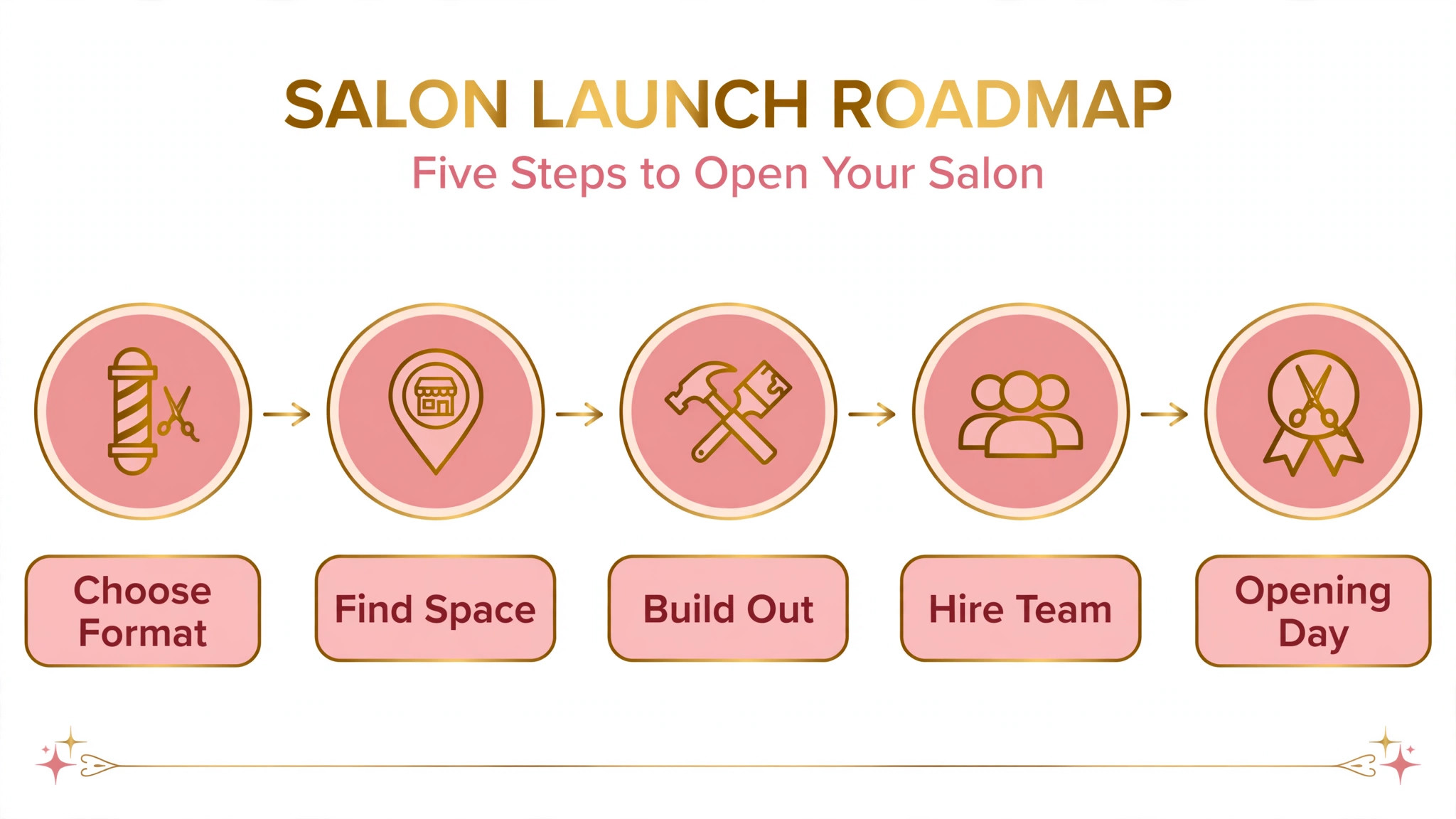
The Main Cost Table for a Small Commercial Salon
Use the table below as a planning range for a small leased storefront, not as a quote for your city. Prices move with rent levels, contractor rates, product brands and local permit fees. Get three local quotes for build out and equipment before you finalize a loan or a lease.
| Cost item | Low planning figure | High planning figure | What moves the figure |
|---|---|---|---|
| Lease deposit and first month rent | 2000 dollars | 20000 dollars | Location, size, landlord terms |
| Build out and renovation | 5000 dollars | 50000 dollars | Plumbing, ventilation, existing fit out |
| Ventilation and air handling | 8000 dollars | 30000 dollars | Local exhaust, HVAC changes, table ventilation |
| Equipment and furniture | 10000 dollars | 50000 dollars | New or used chairs, stations, reception desk |
| Initial supplies and inventory | 1000 dollars | 5000 dollars | Polish range, gels, acrylics, disposables |
| Licenses and permits | 200 dollars | 4500 dollars | State rules, number of technicians, inspections |
| Insurance for the first year | 500 dollars | 1500 dollars | Coverage level, claims history, location |
| Booking software and payment hardware | 500 dollars | 3000 dollars | Features, card reader, monthly fees |
| Marketing and signage | 1000 dollars | 10000 dollars | Sign type, website, launch campaign |
| Working capital for three months | 10000 dollars | 50000 dollars | Rent, payroll, supplies, slow start |
Add the low figures and you reach about 48,700 dollars. Add the high figures and you pass 236,500 dollars. Most small commercial salons land between those extremes, and the published mid range of 40,000 dollars to 100,000 dollars remains a sensible planning band when the space needs only a refresh rather than full construction. The value of the table is not the total. It is the discipline of pricing each line separately. When a line is missing, the budget is incomplete. When a line is vague, the risk is hidden.
Build Out, Plumbing and Ventilation in Detail
Build out is where first time owners lose control of a budget. Pedicure chairs need drains and water supply in the right places, and moving plumbing after floors are finished is expensive. Manicure stations need good lighting, comfortable seating and a surface that can be cleaned between clients. Reception needs space for a desk, a payment terminal and a small retail display that does not block the entrance. Storage needs to be separate from client areas, with room for clean towels, back stock and chemicals stored according to their safety instructions.
A contractor who has fitted salons before will spot problems a general builder may miss, such as floor falls for drainage, access panels for maintenance and ventilation routes that do not blow fumes toward waiting clients.
Ventilation deserves its own budget line because it affects health, comfort and staff retention. Nail products release vapors, dust from filing creates particles, and a salon that smells strongly will lose both staff and clients. Local exhaust at manicure tables, good general air exchange and a system that can be maintained without shutting the salon for a day are worth paying for. Ask the contractor how filters are changed, how often the system needs service, and what the running cost will be. A cheap system that is noisy, hard to clean or ineffective will be switched off, and then the salon has paid for equipment that provides no benefit.
Check local rules early, because ventilation, plumbing and waste disposal requirements vary by city and state, and an inspection failure can delay opening by weeks.
Negotiate with the landlord before you sign. A tenant improvement allowance, a rent free fit out period, a longer lease with staged rent increases, or a landlord contribution to plumbing can change the opening budget by thousands of dollars. Get the agreement in writing, with clear dates for when work starts, when rent starts, and who owns the improvements at the end of the lease. Walk the space with your contractor and a tape measure, photograph existing damage, and list what the landlord will repair before handover. A salon that opens late because the space was not ready still owes rent, wages and loan payments, so the handover date matters as much as the monthly rent figure.
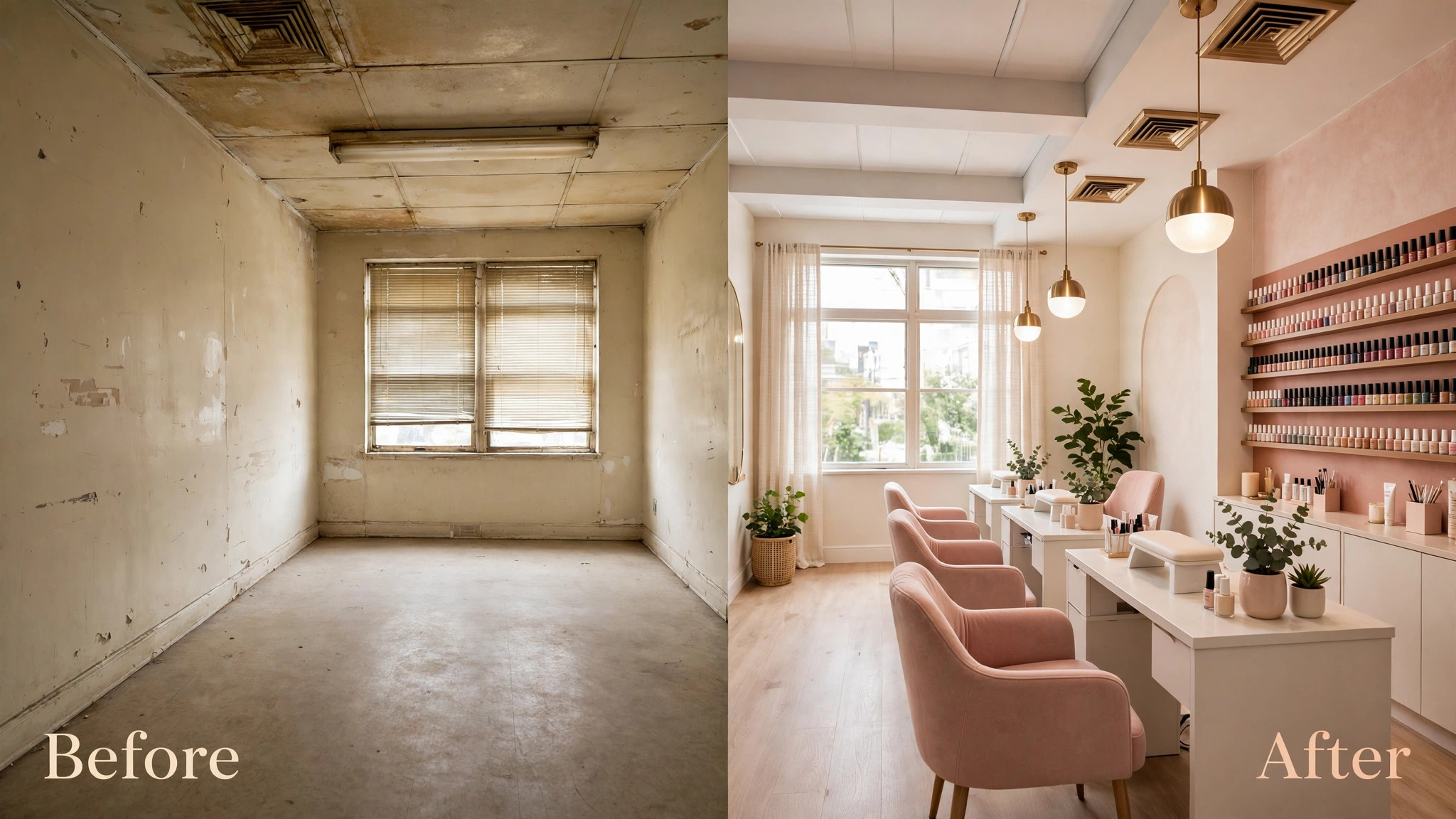
Equipment, Furniture and Opening Stock
Equipment choices should follow the service menu, not the catalog. A salon that offers gel manicures, acrylic extensions, dip powder and pedicures needs curing lamps that match its gel systems, files and buffers in the right grits, e-files with dust extraction where appropriate, and pedicure chairs that can be cleaned and serviced locally. A salon that offers only natural nail care can spend less and still look professional. Buy the core items new or from a reputable refurbisher with a warranty, and be cautious about used pedicure chairs. A used chair may look clean, but hidden plumbing problems, worn jets and missing service history can turn a saving into a repair bill and a closed station.
Plan furniture for cleaning as well as comfort. Manicure tables need a smooth, non porous surface. Pedicure chairs need removable, cleanable parts. Waiting chairs need fabric or material that survives daily cleaning. Reception needs a counter that clients can lean on while paying without knocking over retail stock. Lighting matters more than decoration. Clients judge color under your lights, and technicians need to see cuticle work clearly. Test polish colors under the actual salon lighting before you order a full wall of stock, because a shade that looks warm at home can look cold under bright salon lights.
Opening stock should be wide enough to offer choice, but narrow enough to avoid dead inventory. Start with a core polish range in neutrals, reds, pinks and seasonal shades, plus the gel, acrylic and dip systems you actually trained in. Add single use items in generous quantities, because running out of files, buffers, gloves or toe separators during a busy Saturday is worse than holding a little extra stock. Track usage from week one. Record how many sets of each product you use per ten appointments, and reorder on that evidence rather than on a supplier promotion. Suppliers will offer deals on slow moving shades and bulk packs.
Take the deal only when the product will be used before it expires or goes out of fashion.
Do not forget the small items that add up. Towels, laundry, disinfectants, sterilization pouches, autoclave maintenance, waste disposal, hand soap, paper towels, client forms, appointment cards and a first aid kit all cost money. A salon that budgets only for polish and chairs will be surprised by its first supply order. Create a starter list, price it from two suppliers, and add a ten percent buffer for items you forgot. That buffer is cheaper than an emergency order with delivery charges in the middle of a busy week.

Licenses, Permits and the Hygiene Checklist
Licensing is not a single fee. It is a set of permissions that can come from the state, the city and the building owner, and each one has its own timing. A business registration, a salon license, individual technician licenses, a health permit, a fire inspection, a certificate of occupancy and a sign permit may all be needed, depending on where you operate. Booksy puts business side license and permit costs at 400 dollars to 4,500 dollars, with professional license fees of 70 dollars to 500 dollars per person before training costs. Training itself can add 3,000 dollars to 6,000 dollars for a program of around 600 hours, plus textbooks and a kit.
Those figures are planning ranges, not a promise for your state. Check the state board for cosmetology or nail technology, the city business office and the health department before you sign a lease, because a location that cannot be licensed for salon use is a costly mistake.
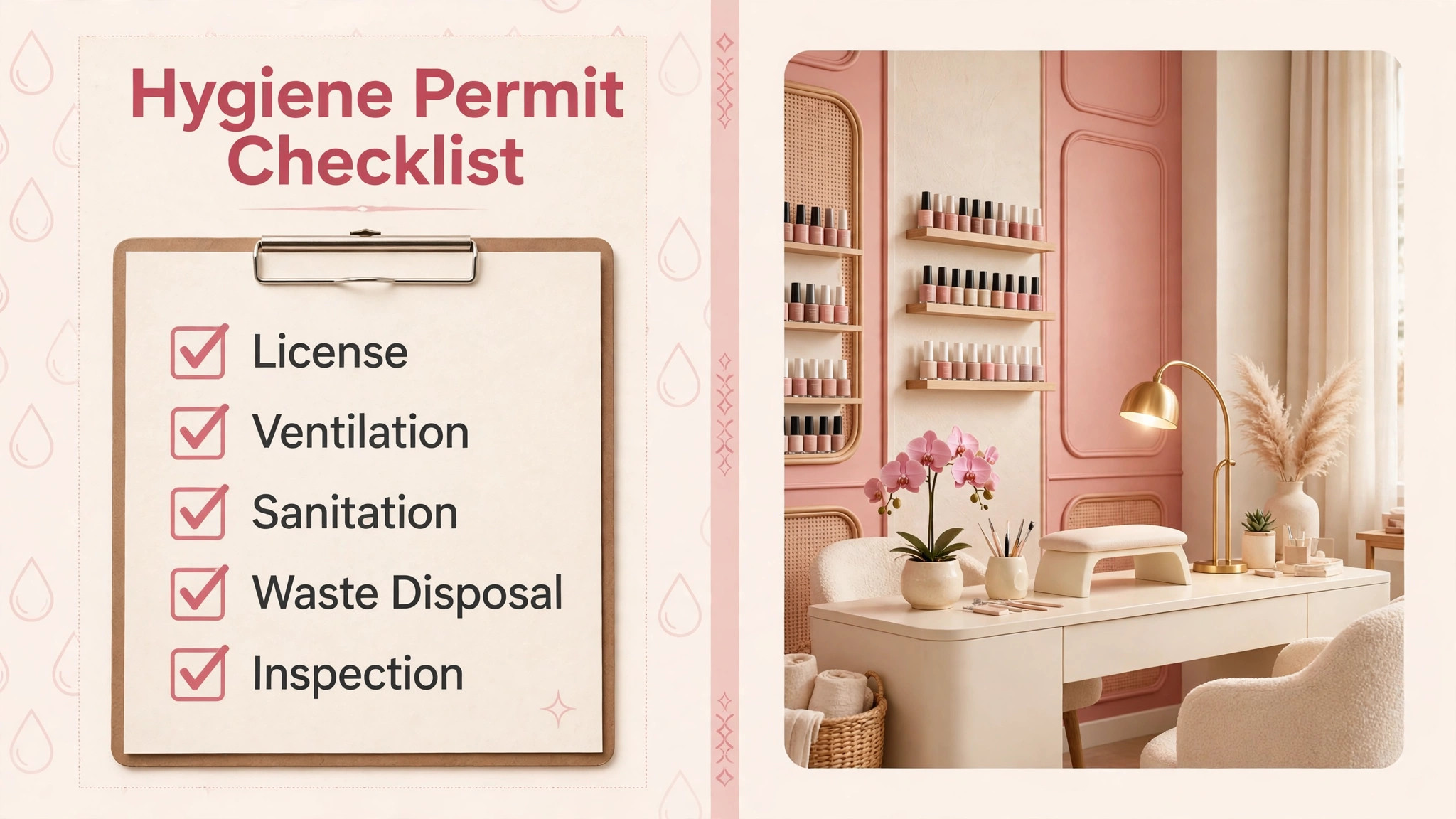
Use the hygiene permit checklist below as a working list, not as legal advice. Tick each item only when you have the document, the inspection result or the supplier record in hand.
| Checklist item | What to confirm before opening |
|---|---|
| Technician licenses | Every working technician holds a current license for your state |
| Salon license | Salon license is issued for the exact address and services offered |
| Health permit | Health department permit is approved and displayed as required |
| Ventilation inspection | Ventilation system meets local rules and is documented |
| Water and plumbing approval | Pedicure plumbing passes inspection and backflow rules are met |
| Sterilization routine | Autoclave or approved disinfection system is tested and logged |
| Single use policy | Single use files, buffers and implements are discarded after each client |
| Chemical storage | Safety data sheets are filed and chemicals are stored correctly |
| Waste disposal | Sharps, chemicals and general waste follow local disposal rules |
| Insurance certificate | Liability and property cover is active and matches the lease |
| Fire and safety check | Exits, extinguishers and electrical work pass inspection |
| Sign permit | Storefront sign is approved and installed to code |
Hygiene is also a marketing asset. Clients notice clean tools, fresh towels, a tidy station and a technician who washes hands and opens a new file in front of them. Build those habits into training, not just into a policy document. When in doubt, follow the stricter of the manufacturer instruction and the local rule, and keep records. Records are boring until they are needed, and then they are priceless.
Monthly Running Costs After Opening
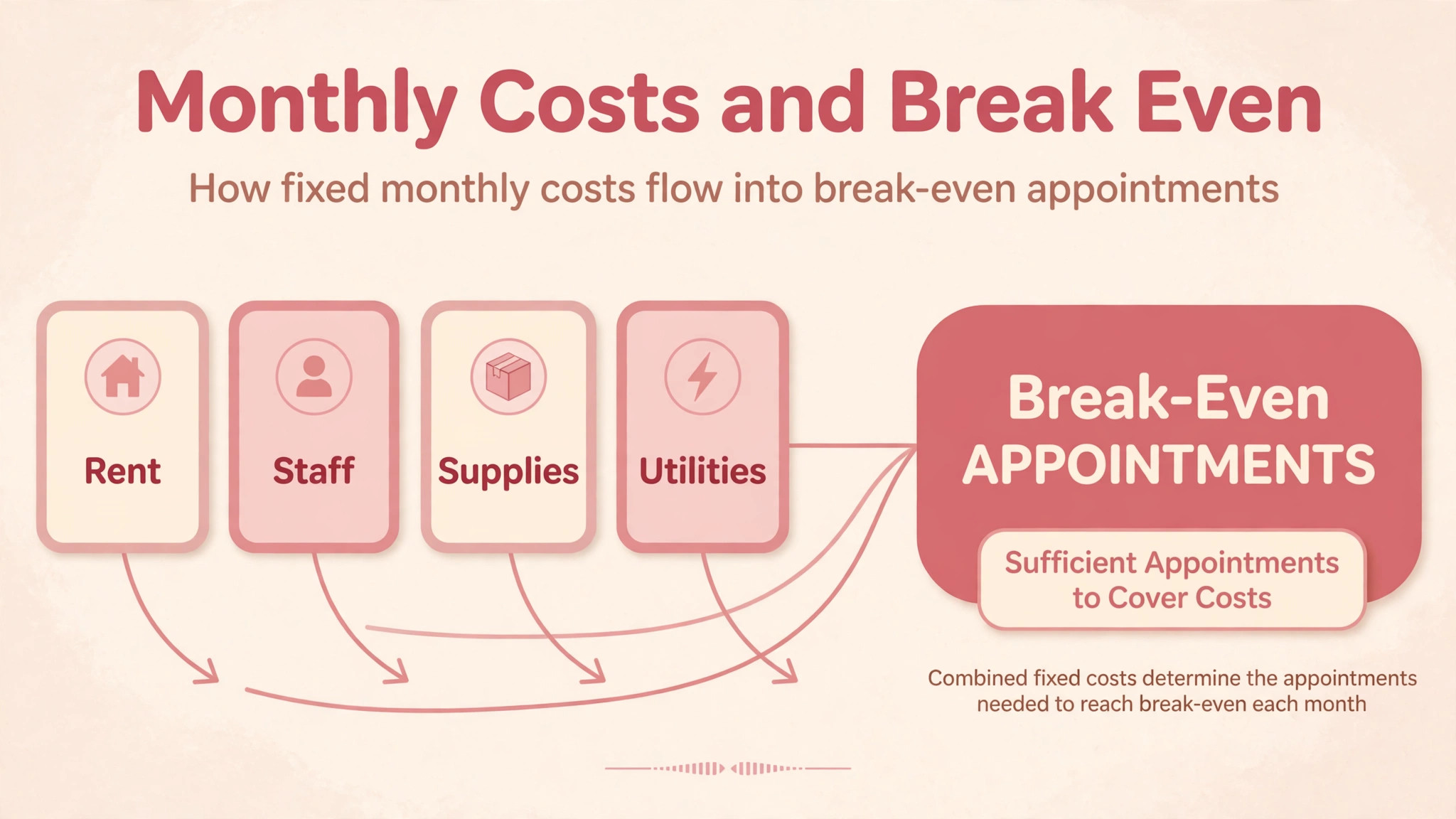
Opening costs get attention, but monthly costs decide whether the salon survives. Rent is usually the largest fixed cost, followed by payroll, utilities, supplies, insurance spread across the year, software, laundry and marketing. A small salon with rent of 1,400 dollars to 5,300 dollars a month for 1,200 square feet, as in the Booksy rent example, will have a very different break even point from a suite at a fraction of that rent. Add utilities, which rise with pedicure water use, laundry and air conditioning, and add a realistic supply cost per appointment. If you do not know your supply cost per set, track it for a month.
Divide total product and disposable spend by the number of appointments, and you have a figure you can use in pricing.
Payroll needs careful thought. Hourly pay, commission, booth rent and hybrid models all create different incentives. Hourly pay gives stability but needs strong booking management to avoid paying for empty hours. Commission links pay to revenue but needs clear rules for product costs, no shows and rework. Booth rent gives predictable income to the owner but less control over pricing and standards. Whichever model you choose, budget for employer taxes, training time, holiday cover and the cost of recruiting a replacement when someone leaves. A salon that loses a popular technician can lose clients too, so retention matters. Fair pay, predictable schedules, clean working conditions and respect for breaks are retention tools, not luxuries.
Pricing Services So the Salon Can Pay Itself
Pricing is where many opening budgets fail, because the price list is set from competitor prices without checking whether those prices cover your costs. Start from your own numbers. Add monthly fixed costs, add variable cost per appointment, add the time each service takes, and then check what price leaves a margin after product, labor and overhead. A service that looks popular can still lose money if it takes ninety minutes, uses expensive product and is priced like a forty five minute service. A service that looks expensive can be profitable if it fills a chair efficiently, uses standard product and brings clients back every two to three weeks.
Mistakes That Push Opening Costs Higher
The most common mistake is signing a lease before checking license, plumbing and ventilation feasibility. A beautiful space that cannot be plumbed for pedicures, cannot be ventilated properly, or cannot be licensed for the services you planned is not a bargain at any rent. The second mistake is underestimating build out time. Contractors, inspections and deliveries slip, and every week of delay is a week of rent without revenue. Build a buffer into both the timeline and the budget, and do not announce an opening date until inspections are passed and staff are trained.
The third mistake is buying too much stock and too much furniture before demand is proven. A full polish wall looks impressive, but shades that do not sell tie up cash that could pay rent or marketing. Start with a core range, watch what clients choose, and expand the range from sales data. The fourth mistake is hiring too many staff too early. A full team with empty chairs burns cash quickly. Start lean, cover peak hours first, and add staff when bookings show a pattern of waiting lists or turned away clients. The fifth mistake is forgetting the owner salary.
An owner who works full time without pay is subsidizing the business, and that subsidy hides the true break even point. Even if you take a low salary at first, record it in the budget so you know what the salon must earn to be truly viable.
A Practical Opening Budget in Three Tiers
A lean solo studio in a suite can open with a modest budget if the owner already holds a license, owns basic tools and needs little build out. The main costs are suite rent and deposit, a manicure table and chair, curing lamps, opening stock, license fees, insurance and a small marketing budget. The risk is lower, but income is capped by one pair of hands. Growth comes from raising prices, improving rebooking, adding higher value services and, later, moving to a larger space with staff.
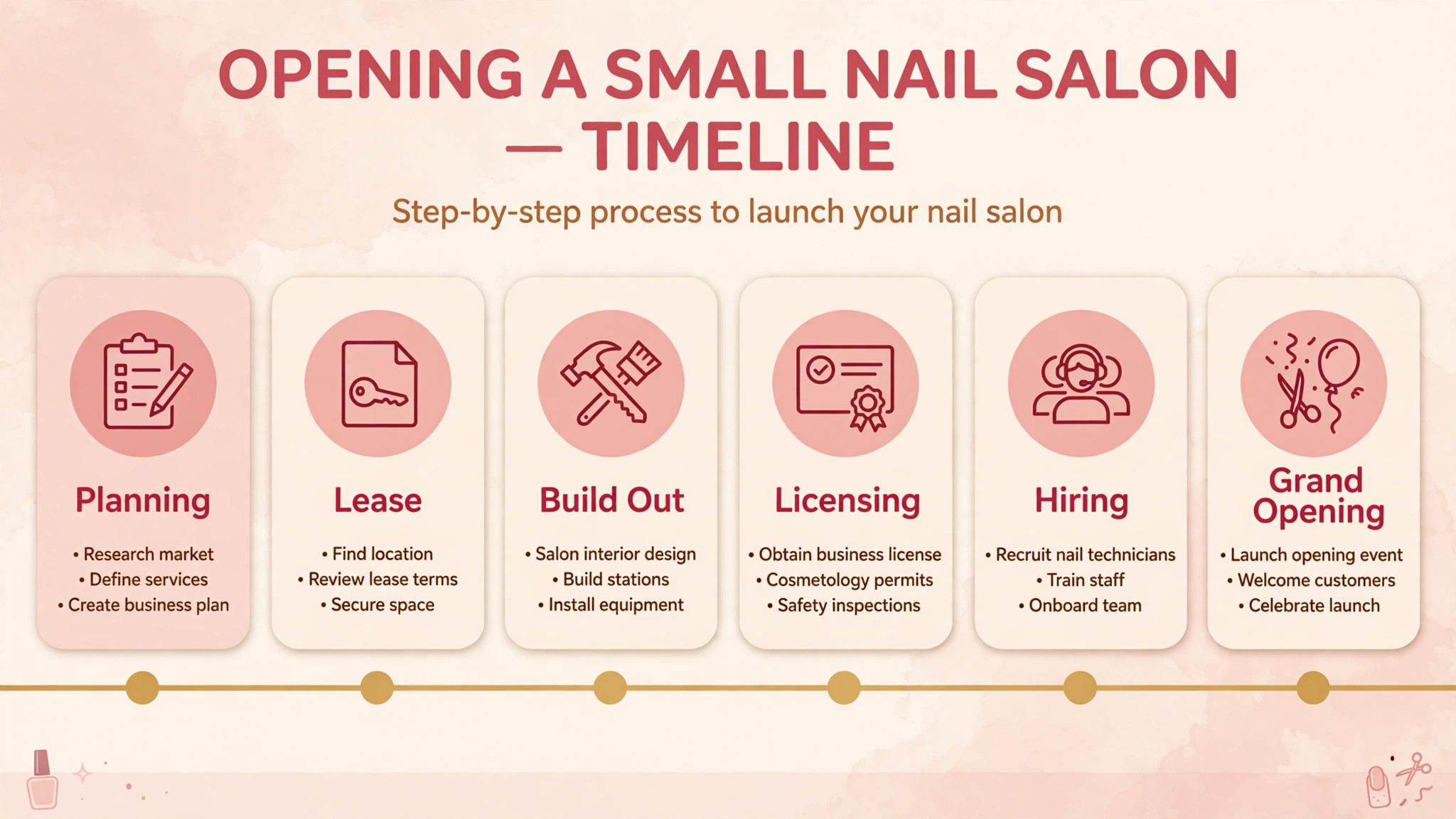
A small commercial salon is the middle tier and the most common path for owners who want a team. Budget for lease deposit, build out, ventilation, six stations, opening stock, licenses, insurance, booking software, signage and three months of working capital. The total in published guides sits around 40,000 dollars to 100,000 dollars for a refresh of an existing space, and higher when full construction is needed. The key discipline is to price build out and ventilation from local quotes, not from national averages, and to hold working capital separately.
A luxury salon is a different business, not just a larger version of a small salon. Design, premium furniture, spa pedicure suites, retail, refreshments, longer appointments and a higher marketing budget all push the total above 100,000 dollars and often above 200,000 dollars. The average ticket must be high enough to cover rent, payroll and product, and the client experience must justify the price at every visit. A luxury salon that cuts corners on cleanliness, staff training or product quality will lose clients faster than a budget salon, because expectations are higher. If you choose this tier, budget for design and training as seriously as for furniture.
How to Fund the Opening Without Overstretching
Funding options include personal savings, a small business loan, a loan from family, equipment financing and a landlord contribution to build out. Each option has a cost. Savings carry no interest but put personal money at risk. A loan adds monthly payments that must be covered even in slow months. Equipment financing spreads the cost of chairs and stations but may carry higher interest and a lien on the equipment. A landlord contribution reduces upfront cash but may come with a longer lease or higher rent. Compare the total cost over the lease term, not just the first month, and check what happens if the business closes early.
Before borrowing, test demand at low cost. Work from a suite, take bookings in a rented chair, run a pop up service, or survey local clients about prices and services. Evidence of demand makes a lender more confident and makes your own budget more realistic. Prepare a simple business plan with the service menu, prices, expected appointments per week, monthly costs and a break even calculation. A plan that shows how many appointments per week cover rent, payroll and supplies is more useful than a plan that only lists total opening cost. Lenders, landlords and partners all ask the same question in different ways.
How many paying clients, at what price, will cover the monthly costs, and how will you find them.
Keep a contingency of at least ten percent on top of the build out budget and a separate reserve for the first three months. If the contingency is not needed, it becomes a buffer for the next slow season. If it is needed, it prevents a half finished salon, a delayed opening or a loan taken in a panic. The cheapest time to fix a budget problem is before you sign a lease. The most expensive time is after the salon is fitted out, staff are hired and clients are waiting for an opening date that keeps moving.

A Final Check Before You Commit
Before you sign, write down your answers to five questions. How many appointments per week, at your planned prices, cover rent, payroll, supplies and loan payments. What happens if bookings are half that level for the first three months. Which costs are fixed, which rise with bookings, and which can be cut without hurting hygiene or quality. Who will cover the salon if a key technician is sick for two weeks. And what is your walk away point, the date or cash level at which you pause, renegotiate or change format rather than borrowing more. A clear cost of starting a nail salon breakdown should make those answers easy to find.
If the answers are vague, the budget is not finished yet, even if the total looks tidy. Take the budget to an accountant or a salon owner you trust, and ask them to challenge the rent, build out and working capital lines first, because those lines cause most failures. A second pair of eyes on a cost of starting a nail salon breakdown is cheaper than a second fit out, and a cost of starting a nail salon breakdown that survives challenge is a plan you can act on with confidence.
More Reading on Stratilyze
Salon costs sit beside the booking and marketing tools a new salon pays for. Readers usually check setting up a small salon booking system first, then the best AI tools for nail salons for software, and marketing a bakery on Instagram for the local playbook that transfers to salons.
Frequently Asked Questions
How much does it cost to open a small nail salon
A small commercial salon usually needs 40,000 dollars to 100,000 dollars when the space needs only a refresh, and more when full construction, plumbing and ventilation are required. A solo suite can start for far less, while a luxury salon can pass 200,000 dollars.
Build out and ventilation are the most common surprises, especially pedicure plumbing and air handling in a bare retail space. A cost of starting a nail salon breakdown that lumps build out into one vague line is likely to miss these items, so price plumbing and ventilation separately from general decoration.
Do I need a license before I sign a lease
Check licensing feasibility before you commit to a space. Confirm that the address can be licensed for salon use, that technicians can be licensed in your state, and that health, fire and sign approvals are realistic for that building. A lease signed first can lock you into a space that cannot open on time.
How much working capital should I hold
Hold enough to cover three to six months of rent, payroll and supplies, plus a small buffer for repairs and slow weeks. A cost of starting a nail salon breakdown without working capital describes a fitted room, not a business that can survive its first quiet months.
Is it cheaper to buy used salon equipment
Used furniture can save 30 percent to 70 percent, but used pedicure chairs carry plumbing and hygiene risks. Buy core items with a warranty or a trusted service history, and have a technician inspect any used chair before you pay.
Should I start in a suite or a storefront
Start in a suite if you are solo, testing demand or keeping risk low. Choose a storefront when bookings, staffing and local foot traffic support a team, and when you can cover rent and payroll even in a slow month. Format should follow proven demand, not ambition alone.
The Bottom Line for New Salon Owners
Open the salon you can afford to run for six months, not just the salon you can afford to fit out. Price plumbing and ventilation separately, hold working capital apart from build out money, choose a format that matches real demand, and set prices from your own costs rather than from a competitor window. A careful cost of starting a nail salon breakdown will not remove risk, but it will show you where risk sits, and that clarity is what turns a hopeful opening into a business with a chance to last.
Use this guide as a checklist, get local quotes for the lines that matter most, and do not sign until the numbers, the license path and the cash reserve all line up. The cost of starting a nail salon breakdown is only useful when it is honest about slow months, and the cost of starting a nail salon breakdown that includes those months is the one worth following.