A solo groomer working from home and a full salon in a prime urban location are both pet grooming businesses, and their startup bills barely overlap. The solo setup can start near $5,000. A small commercial salon with two to three grooming stations typically costs $55,000 to $65,000 to open in a mid sized US city. A full salon with premium fit out can reach $150,000. The cost of starting a pet grooming business breakdown is therefore a story of format first and figures second, because the choice between home based, mobile, and salon determines every other line, from rent to plumbing to how many dogs a day the business can groom.
The comparison that matters is not cheap versus expensive. It is capacity versus cost, since a salon that can groom eight dogs a day at $70 each grosses $560 a day, while a solo groomer grooming four dogs at the same price grosses $280, and the salon only wins if its extra costs stay below its extra revenue.
The Four Formats, and What Each One Costs
Home based grooming is the cheapest entry, with published totals from $5,000 for a basic solo setup upward, covering a table, a tub, dryers, clippers, and initial supplies, with no commercial rent and minimal fit out. The trade is capacity and professionalism, since a home setup grooms fewer dogs, faces zoning and neighbour constraints in some areas, and must convince customers that a home salon is as safe and hygienic as a commercial one. Mobile grooming is the next format, with van setup at $30,000 to $75,000, and published mobile startup totals of $15,000 to $40,000 for leaner operations, trading rent for vehicle costs, fuel, generator maintenance, and water capacity.
Mobile wins on convenience pricing, since customers pay a premium for grooming at their door, and loses on volume, since drive time between appointments caps the daily dog count.
A small commercial salon is the standard format, and the published ranges cluster usefully. One guide puts a salon at $20,000 to $70,000, with premium locations reaching $100,000. Another puts a fully equipped salon in a mid sized city at $40,000 to $150,000. A detailed 2026 line item model for a two to three station salon totals about $28,610 to $99,800 excluding monthly rent and ongoing staff payroll. The spread reflects fit out scope more than anything else, since plumbing, drainage, flooring, and electrical work for wet rooms is the largest variable by far, and a space that already has suitable plumbing costs a fraction of a raw space that needs it installed.
The fourth format is a shared or veterinary space, with rent at $800 to $2,000 a month, which buys a professional address and shared foot traffic at a fraction of standalone rent, and suits a groomer building a client base before committing to a full salon.
The cost of starting a pet grooming business breakdown by category
The cost of starting a pet grooming business breakdown below uses a two to three station commercial salon as the middle column, with a solo setup and a premium salon beside it, so the table reads as a format decision rather than a single budget. All figures come from published 2026 guides, and all vary by city, station count, and equipment grade.

| Cost category | Solo setup | Small commercial salon | Premium salon |
|---|---|---|---|
| Grooming equipment and tools | $2,000 to $10,000 | $10,000 to $25,000 | $30,000 to $60,000 |
| Lease deposit and first rent | $0 | $3,000 to $12,000 | $6,000 to $24,000 |
| Renovation and buildout | $0 to $2,000 | $15,000 to $30,000 | $20,000 to $40,000 |
| Initial inventory and supplies | $300 to $800 | $2,000 to $5,000 | $8,000 to $15,000 |
| Licences, permits, insurance | $500 to $2,500 | $1,000 to $3,000 | $3,000 to $6,000 |
| Booking software and technology | $0 to $600 a year | $1,000 to $3,000 | $3,000 to $6,000 |
| Marketing and signage | $200 to $3,000 | $1,500 to $8,000 | $10,000 to $20,000 |
| Staffing and training, launch | $0 | $6,000 to $12,000 | $15,000 to $25,000 |
| Working capital reserve | $1,000 to $5,000 | $18,000 to $50,000 | $20,000 to $40,000 |
| Total planning range | $5,000 to $26,400 | $53,500 to $148,000 | $105,000 to $236,000 |
The working capital line deserves emphasis, because it is the line that separates salons that survive their first year from salons that open well and close quietly. Published guides put working capital at $5,000 to $15,000 in a lean salon model, $15,000 to $50,000 in a standard model, and $18,000 to $50,000 for three to six months of operating expenses in a full model. A salon’s monthly operating expenses run $3,000 to $10,000 depending on scale and staffing, so a reserve of three to six months is $9,000 to $60,000, and the realistic figure for a staffed salon sits at the upper half of that range.
Grooming demand builds by reputation and repeat booking, which takes months, and a salon that opens with no reserve is betting that reputation arrives before the rent does. It sometimes does. It usually does not, and the reserve is the cheapest insurance in the whole budget.
Rent by location, the line that sets the ceiling
Rent for a grooming salon varies more by location type than by city alone, and published tables make the pattern clear. Small city and suburban spaces run $1,000 to $2,500 a month with deposits of $2,000 to $7,500. Mid sized urban areas run $2,000 to $4,000 with deposits of $4,000 to $12,000. Prime urban locations run $3,000 to $8,000 with deposits of $6,000 to $24,000. Shopping centre spaces run $2,500 to $5,000 with deposits of $5,000 to $15,000. Standalone buildings run $1,500 to $4,000 with deposits of $3,000 to $12,000. Shared veterinary spaces run $800 to $2,000 with deposits of $1,600 to $6,000.
Industrial and warehouse areas run $600 to $1,500 with deposits of $1,200 to $4,500, and they suit grooming well, since customers drive to appointments rather than walking past, and a warehouse unit’s lower rent can fund better equipment. The rent decision should follow the customer journey. Grooming customers book ahead and drive to the salon, so a slightly out of the way unit with parking and easy access often outperforms a prime high street unit whose rent assumes walk in trade that grooming rarely generates.
Andis, Wahl, Kenchii, and the tools that earn their price
Grooming equipment is specialised, and quality matters because the groomer holds sharp blades next to a moving animal. Cheap clippers overheat, dull scissors pull hair instead of cutting it, and flimsy tables wobble, and all of those produce stressed dogs, slower work, and potential injuries. A professional grade clipper from Andis or Wahl costs $150 to $300, and a salon needs at least two, one for body work and a backup for when the primary overheats. Blade sets cost $15 to $40 each, with 8 to 12 blades in various sizes totalling $150 to $400.
A good set of straight, curved, thinning, and blending shears runs $200 to $800, with Kenchii and Geib Buttercut among the industry favourites, and precision scissors make faster, cleaner cuts and last for years. A hydraulic or electric grooming table costs $200 to $600, plus a grooming arm and loop at $30 to $80, and a table that adjusts to the groomer’s height and rotates for access protects the groomer’s back across a career of long working days.
Bathing equipment completes the station. A professional bathing tub costs $300 to $2,000 depending on whether it is a standalone elevated tub or a custom built station, and a full salon’s bathing stations run $2,000 to $8,000 for two to three tubs, with stainless steel offering superior durability and hygiene over fibreglass at a higher upfront cost. A high velocity dryer costs $200 to $500 and gets dogs dry in about 15 minutes rather than 45, and a second dryer, meaning a stand dryer or cage dryer at $150 to $400, lets dogs finish drying while the groomer starts the next one. Dryers for a full salon run $1,000 to $4,000 across stand, cage, and velocity types.
Hydraulic and electric grooming tables for two to three stations run $1,500 to $6,000, with hydraulic units at the top end. Clippers, blades, and shears run $500 to $2,000 for professional grade. Opening product supply, meaning shampoos, conditioners, and grooming sprays, runs $300 to $1,500. The station economics are straightforward. A well equipped station grooms more dogs per day at higher quality, and the equipment pays for itself in weeks when the appointment book is full.
The Grooming Station Checklist, What One Complete Station Needs
A grooming station is a workstation, a bathing area, and a drying setup combined, and the checklist below is the overview proof for this guide. Price one station completely before multiplying by station count, because a salon budget built on a vague equipment total always misses something, and the missing item is usually discovered on opening week when it costs the most to fix.

- Hydraulic or electric grooming table, $200 to $600, with grooming arm and loop, $30 to $80
- Professional clipper, $150 to $300, plus a backup clipper, with blade sets at $15 to $40 each
- Shear set, meaning straight, curved, thinning, and blending shears, $200 to $800 for the set
- Bathing tub, $300 to $2,000, with sprayer and bathing system at $50 to $200
- High velocity dryer, $200 to $500, plus a stand or cage dryer at $150 to $400 for finishing
- Brushes, combs, de matting tools, nail grinders, and ear cleaning supplies
- Shampoos, conditioners, and grooming sprays for the opening stock, $300 to $800 per salon initially
- Towels, blade coolant, styptic powder, bandanas, and bows for finishing touches
- Non slip flooring and drainage at the bathing area, plus storage for tools and products
- Reception setup, meaning crates, waiting area seating, booking software, and signage
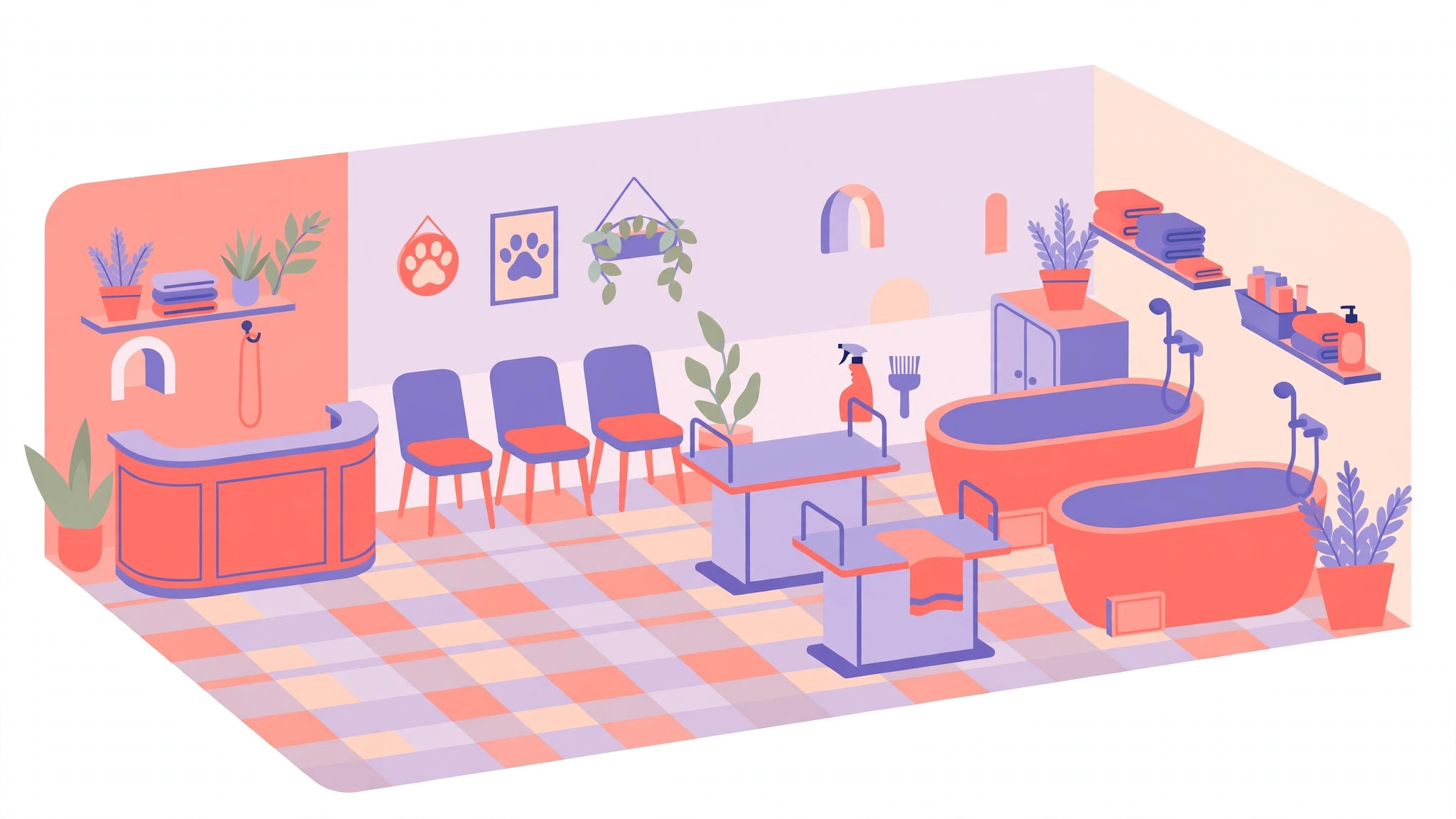
Multiply the station list by the number of stations, then add shared items once, meaning the reception area, crates, and signage at $1,500 to $6,000, and point of sale and booking software at $360 to $1,800 for the first year, or $30 to $150 a month depending on platform. A two station salon therefore needs two of everything on the station list but only one reception, and that distinction is where salon budgets go wrong in both directions, either doubling shared items or forgetting that each station needs its own dryer.
The station checklist also sets the hiring plan, since each station supports roughly one groomer per shift, and a three station salon with one groomer is paying rent on two idle stations. Open with the station count your appointment book justifies, and add stations as the book fills, rather than fitting out for a demand that has not arrived yet.
Licences, permits, and insurance for a grooming salon
Licensing for a grooming salon is lighter than for a food business but heavier than for a home service, and the published ranges reflect that middle position. Business licences and permits run $50 to $500 in lean guides, $500 to $1,000 in basic salon guides, and $1,000 to $3,000 when combined with insurance in fuller guides, with variation by city and county explaining the spread. Liability insurance for the first year runs $400 to $2,000 for general plus professional liability combined, and $500 to $1,500 in another guide’s salon breakdown.
The licences to confirm are the general business licence, any grooming specific permit the city requires, a health department permit where applicable, signage permits, and building permits for plumbing and electrical work in the wet areas. Some areas require no specific grooming licence at all, which makes the general business licence and insurance the whole compliance picture, but that should be confirmed with the city rather than assumed, because operating without a required permit risks a closure order in the first month.
Insurance should cover public liability for animals in care, professional liability for grooming injuries, and property cover for equipment, and the policy should be read for exclusions around large breeds, aggressive animals, and animals with medical conditions, since those exclusions define the customers the salon can safely accept.
Monthly Operating Costs Once the Doors Open
Monthly operating costs for a grooming salon run $3,000 to $10,000 depending on scale and staffing, and the published breakdown of those costs is consistent across guides. Rent and utilities run $1,500 to $5,000, employee wages $2,000 to $6,000, grooming supplies $300 to $800, equipment maintenance and replacement $500 to $2,500 in one guide’s monthly accounting, marketing and advertising $200 to $600, insurance $100 to $300, taxes and permits $100 to $300, furniture and decor $200 to $800, employee benefits $200 to $600, maintenance and repairs $100 to $400, and miscellaneous items such as client refreshments, cleaning supplies, and pet treats $50 to $200.

Other guides put rent at $1,000 to $3,000, utilities at $200 to $500, salon supplies at $300 to $600, marketing at $500 to $1,000, and payroll at $2,000 to $5,000, and the difference is scale and staffing rather than disagreement. The cost of starting a pet grooming business breakdown that stops at opening day misses the monthly reality, which is that a salon’s costs arrive every month while its reputation builds slowly, and the reserve is what bridges the two.

Pricing is what makes those monthly costs workable. Grooming prices vary by breed, coat, size, and service, with full grooms commanding substantially more than bath and tidy services, and premium salons in affluent areas achieving margins near 40 percent, against 15 to 25 percent for budget focused operations that compensate with higher volume. The pricing discipline is to price by dog and coat, not by hour alone, because a matted large breed takes three times the work of a short coated small breed, and a flat price either overcharges the easy dogs or loses money on the hard ones.
Build a price list by size and coat type, add charges for matting, aggressive behaviour handling, and flea treatment, and review prices quarterly against supply costs, since shampoo and product prices move and a price list fixed for two years quietly loses margin every month. Rebooking at checkout is the cheapest revenue in grooming, because a customer who leaves with their next appointment booked is a customer who does not need to be won again, and a salon with a 70 percent rebooking rate needs far less marketing than one with a 40 percent rate.
Mobile grooming, the format that changes the monthly shape
Mobile grooming deserves a direct comparison, because its monthly shape is the mirror image of a salon’s. A mobile operation avoids commercial rent but pays fuel, vehicle maintenance, generator servicing, water supply, and waste disposal, and its daily capacity is capped by drive time, typically four to six dogs a day against a salon’s eight or more across multiple stations. The startup cost of $15,000 to $40,000 for a lean mobile setup or $30,000 to $75,000 for a full van build looks attractive beside a salon, but the monthly cost per dog is higher, because every appointment carries travel time that a salon appointment does not.
Mobile wins where customers pay a convenience premium, such as elderly owners, anxious dogs that travel badly, and multi dog households where a groomer at the door saves the owner two car trips. Mobile loses where density is low, because a 30 minute drive between appointments destroys the daily economics. The choice should follow the customer map. Dense neighbourhoods with high pet ownership suit mobile. Sparse areas suit a salon that customers drive to. A groomer who starts mobile and later opens a salon keeps the client base and adds capacity, which is the most common successful path in the industry.
Staffing a Salon, Groomers, Reception, and the Pay Model
Staffing is where a grooming salon’s monthly costs become real, and where its reputation is made or lost, because customers return for a groomer, not for a building. Published monthly breakdowns put employee wages at $2,000 to $6,000 for a small salon, with payroll at $2,000 to $5,000 in another guide’s accounting, and the difference is headcount and hours rather than disagreement. A solo salon has no wage line, only the owner’s drawings. A two station salon with one employed groomer and part time reception help carries a wage line that can exceed rent, and a three station salon with two groomers and a receptionist carries a wage line that dominates the monthly budget. The hiring sequence matters.
Hire the second groomer when the appointment book consistently overflows, not when a single busy week suggests it, because a groomer hired for a busy week and idle for the next three is a cost without revenue and a morale problem in the making.
The pay model shapes behaviour as surely as the wage level does. Salons commonly pay groomers by salary, by hourly wage, or by commission, often 40 to 60 percent of the grooming fee, and each model creates different incentives. Salary gives stability and suits a salon with steady bookings, but it pays the same in a quiet week as in a busy one, which strains cash flow in slow months. Hourly pay matches cost to hours worked, but it can discourage groomers from taking on difficult dogs that take longer, since the extra time is not extra pay.
Commission aligns groomer income with salon revenue, since a groomer who grooms more dogs or higher priced dogs earns more, but it can encourage rushing, which damages quality and dog welfare. The most durable model for a growing salon is often a base plus commission hybrid, meaning a guaranteed hourly floor plus a commission share above a threshold, which gives the groomer income security and the salon a cost that flexes with revenue. Whatever the model, pay fairly and on time, because skilled groomers are scarce, and a groomer who leaves takes customers with them.
The cost of replacing a groomer, counting recruiting, training, and lost rebookings, dwarfs the cost of a retention raise, and the cheapest wage bill is often the one that keeps the same groomers for years.
Reception and administration deserve a short, firm paragraph, because they are the roles owners cut first and regret fastest. A receptionist who answers the phone, manages the booking software, confirms appointments, greets dogs and owners, and handles rebooking at checkout is the person who keeps the appointment book full and the no show rate low. Without that role, the groomer answers the phone between dogs, bookings slip, reminders go unsent, and the salon’s capacity quietly falls. Part time reception cover during peak phone hours, meaning mornings and late afternoons, buys most of the benefit at a fraction of a full time cost, and it is one of the highest return hires a salon can make.
The cost of starting a pet grooming business breakdown that includes a reception line from the start is a plan that understands grooming is a booking business as much as a cutting business, and the salons that grow fastest are usually the ones whose phones are answered by someone who is not holding clippers.
Retail and Add-On Services, the Margin Layer
Retail and add-on services are the margin layer that can lift a grooming salon from break-even to comfortable, provided they are kept small and deliberate. Add-ons that fit naturally into a grooming appointment include de shedding treatments, flea baths, teeth cleaning, nail grinding, coat conditioning treatments, and puppy introduction grooms, each adding $10 to $40 to a ticket without adding an appointment slot. A salon grooming eight dogs a day that adds an average of $15 of add-ons per dog earns $120 a day of high margin revenue, or roughly $2,600 a month across a 22 day working month, against minimal extra product cost.
The discipline is to offer add-ons that the groomer can deliver within the existing appointment time, not services that need a separate slot, a separate staff member, or a separate room, because those are new businesses wearing an add-on label.
Retail, meaning shampoos, brushes, treats, and accessories sold from reception, follows the same logic at smaller scale. A small, well chosen range beside reception can add a few hundred dollars a month of margin, and it serves customers who trust the groomer’s recommendation more than a pet store shelf. A large retail wall, by contrast, ties up cash in stock that expires, goes out of fashion, or simply sits, and it needs display space and staff time to sell. Start with the products the salon already uses, since the groomer can recommend them honestly and the stock turns over naturally, and expand only when a product repeatedly sells out.
The cost of starting a pet grooming business breakdown that includes a large retail inventory from day one is a plan that spends working capital on shelves before the appointment book proves the salon can sell grooming itself.
More Reading on Stratilyze
Pet grooming startup costs sit beside the other appointment-based service budgets owners compare, so readers weighing a salon usually check the neighbouring guides next. The guide to using AI for pet grooming appointments covers the booking workflow that fills the chairs this budget pays for, the guide to setting up a pet sitting business booking system shows the same appointment math from the pet-care side, and the guide to setting up a small salon booking system explains the salon booking setup that applies to grooming chairs as well as hair chairs.
Frequently Asked Questions
How much does it cost to start a pet grooming business?
A solo setup costs $5,000 to $26,400, a small commercial salon $53,500 to $148,000, and a premium salon $105,000 to $236,000. The cost of starting a pet grooming business breakdown depends most on format, station count, fit out scope, and location, with plumbing and drainage for wet rooms the largest variable in a salon build.
What equipment does a grooming station need?
One complete station needs a hydraulic or electric table at $200 to $600, a professional clipper at $150 to $300 plus a backup, blade sets at $15 to $40 each, a shear set at $200 to $800, a bathing tub at $300 to $2,000, a high velocity dryer at $200 to $500, and brushes, combs, and consumables. Budget the station completely before multiplying by station count, since each station needs its own dryer and tools.
How much does it cost to run a grooming salon per month?
Monthly operating costs run $3,000 to $10,000 depending on scale and staffing, with rent and utilities at $1,500 to $5,000, wages at $2,000 to $6,000, supplies at $300 to $800, and marketing at $200 to $600 in published breakdowns. A staffed salon sits at the upper half of that range, and a solo salon at the lower half.
Do I need a licence to groom pets?
Requirements vary by city and county. Most areas require a general business licence, and some require a grooming specific permit or a health department permit, with licence and permit costs of $50 to $1,000 in lean guides and $1,000 to $3,000 combined with insurance in fuller guides. Confirm requirements with the city before opening, and carry general plus professional liability insurance of $400 to $2,000 for the first year.
Is mobile grooming cheaper than opening a salon?
Mobile startup costs $15,000 to $40,000 for a lean setup or $30,000 to $75,000 for a full van build, against $53,500 to $148,000 for a small salon. Mobile avoids rent but pays fuel, vehicle maintenance, and drive time, and grooms fewer dogs per day. Mobile wins where customers pay a convenience premium, and a salon wins where volume and multiple stations matter.
How many dogs can a grooming salon handle per day?
A solo groomer typically handles four to six dogs a day, while a two to three station salon with matching staff handles eight or more. Capacity depends on station count, groomer count, dog size and coat, and appointment spacing. Open with the station count the appointment book justifies, and add stations as the book fills rather than fitting out for demand that has not arrived.
The Verdict on Pet Grooming Startup Costs
The cost of starting a pet grooming business breakdown rewards format discipline above all. Start solo or mobile if you are proving demand, open a salon when the appointment book proves the capacity is needed, price by dog and coat rather than by hour, and hold three to six months of operating reserve before the first appointment. Grooming is a reputation business, and reputation is built one dog at a time, which means the salon that opens within its means and grows with its book will outlast the salon that opens impressively and runs out of cash before its regulars arrive.