
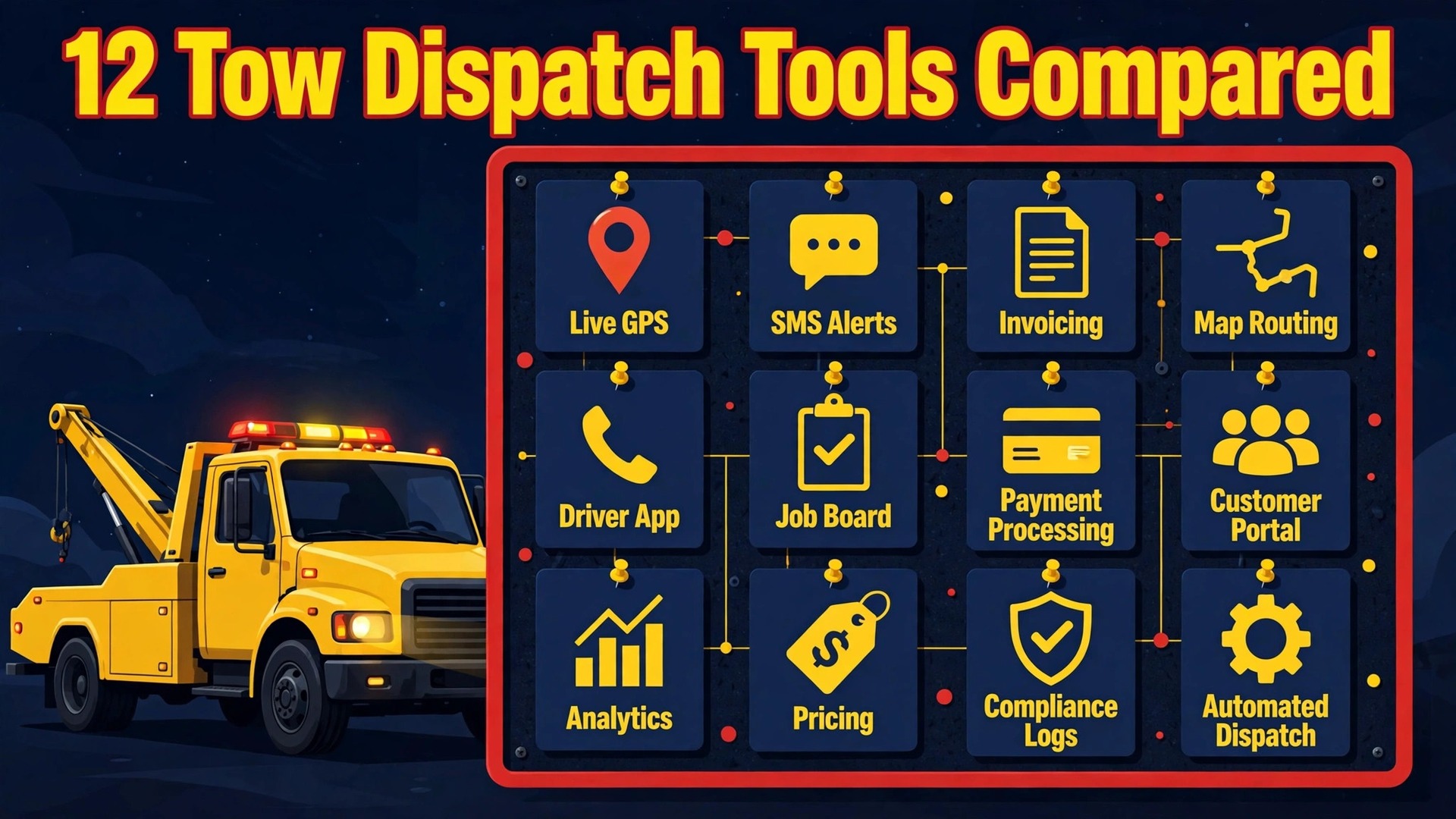
TRAXERO reports that its towing software dispatches 50,125 jobs every day, and that scale explains why the best dispatch software for tow truck companies is an operations decision rather than a simple software purchase. That number is useful because it shows what dispatch really is for a towing company. It is not a calendar with trucks on it. It is a high volume, time critical operation where a missed call, a wrong truck, or a slow invoice can cost more than a month of software. For mid sized operators, motor club work alone can represent 40 to 60 percent of revenue, according to a Towing and Recovery Association of America industry survey cited in recent dispatch guides.
That is the test for the best dispatch software for tow truck companies. The software must take a call, choose the right truck, keep the driver and the customer informed, record the tow correctly, and turn the completed job into a bill that the right payer will accept. A general scheduling tool can book a job. It cannot handle impound holds, lien notices, police rotation rules, and motor club rate tables in the same workflow.
This guide compares twelve tools, from single truck systems to municipal grade platforms. Prices are starting prices where published, and several enterprise tools do not publish pricing at all. Check the vendor’s current pricing page before you budget, since dispatch pricing often depends on trucks, users, locations, and add-on modules.
Why Towing Dispatch Breaks General Scheduling Tools
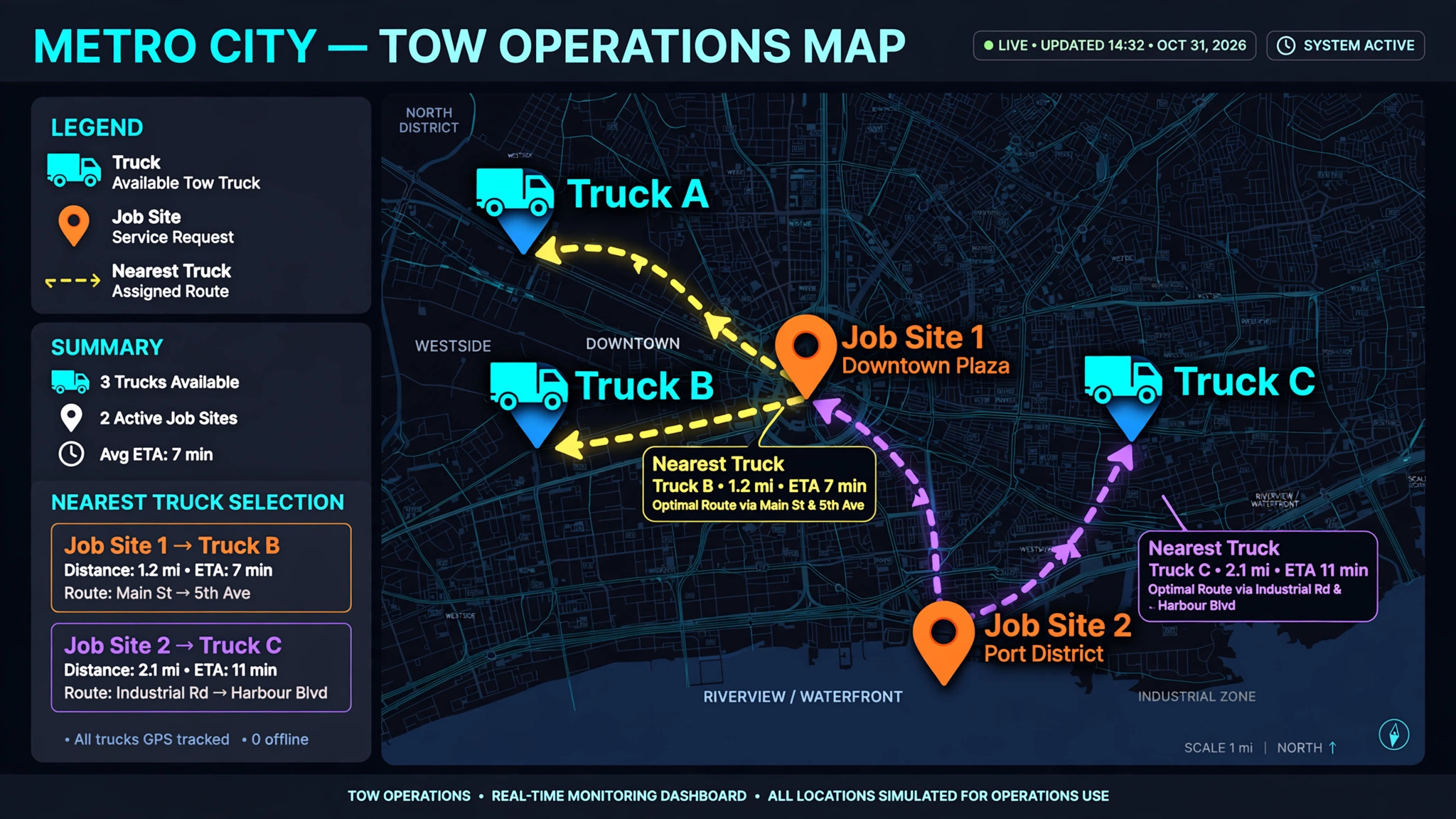
A towing call arrives with details that a normal appointment does not have. The vehicle type, the location risk, the winch or flatbed requirement, the destination, and the payer all change which truck should go. A dispatcher who sends a light duty truck to a medium duty recovery wastes a trip and delays the customer. A dispatcher who sends the wrong truck to a police call can breach rotation rules and lose future work.
Billing adds a second layer of complexity. A cash customer, a motor club, an insurer, a fleet account, and a police agency do not pay on the same terms, and they do not want the same paperwork. Motor clubs in particular use different formats, rate schedules, and mileage rules. A dispatch tool that cannot keep those rules separate will create rejected claims and hours of rework at month end.
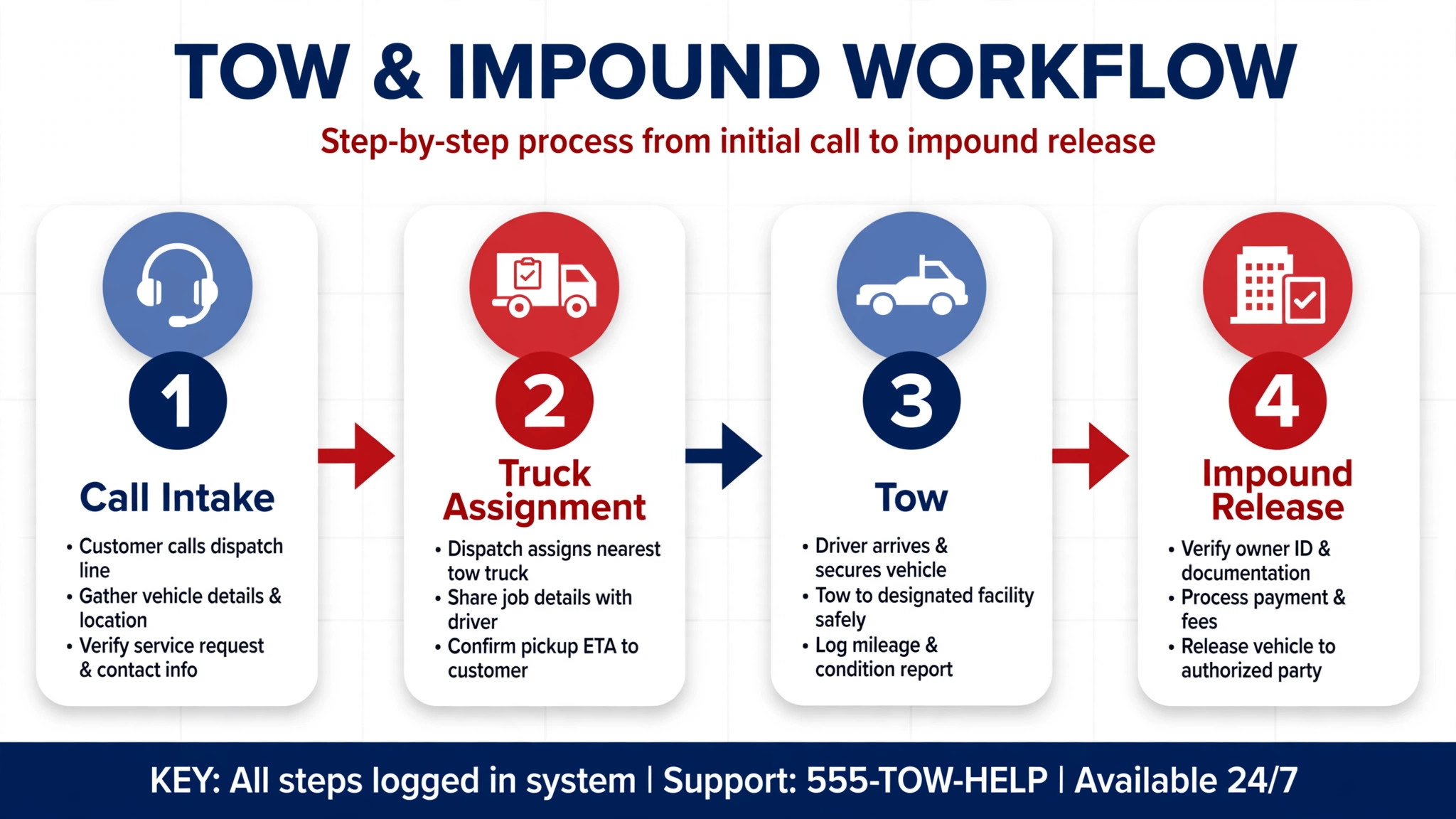
Impound work adds a third layer. Once a vehicle enters the lot, the clock starts on storage charges, owner notification, lien deadlines, and release paperwork. A tool that treats an impound like a completed tow will miss those steps. The strongest towing platforms follow the vehicle from dispatch to release, not only from call to hook.
The 12 Tools at a Glance
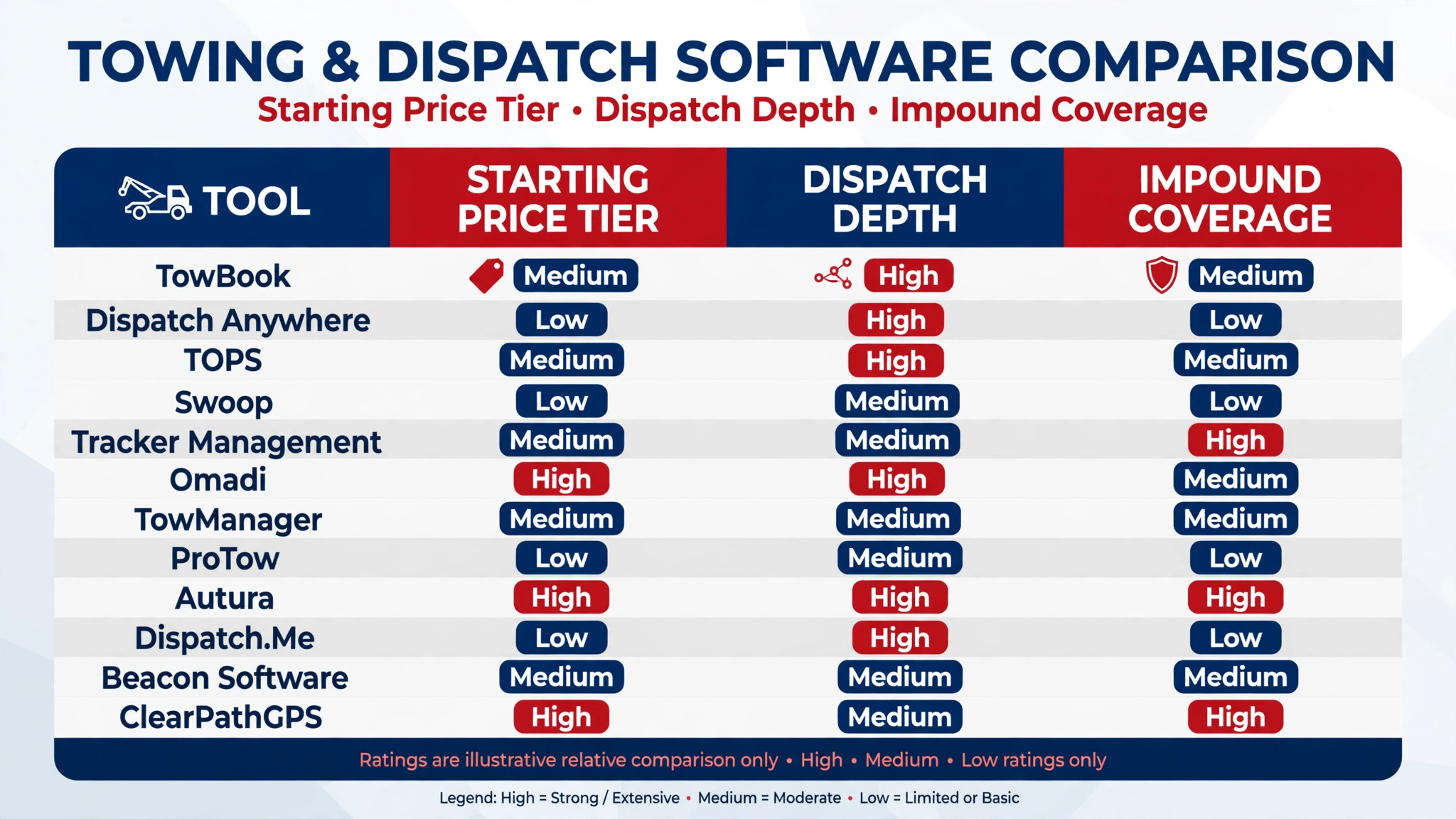
| Tool | Starting price | Best for | Dispatch depth |
|---|---|---|---|
| TowBook | 49 dollars per month | Small to mid sized towing companies | Strong |
| Dispatch Anywhere | 175 dollars per month | Established motor club operators | Strong |
| TOPS | Check the vendor pricing page | Municipal and large operators | Strong |
| Swoop | 49 dollars per month | Motor club providers | Strong |
| Tracker Management | 50 dollars per month | Full lifecycle towing operations | Good |
| Omadi | 75 dollars per month | Visibility across dispatch and fleet | Good |
| TowManager | Check the vendor pricing page | Reporting led operations | Good |
| ProTow | Check the vendor pricing page | Long established towing operations | Good |
| Autura | Check the vendor pricing page | Government and police linked work | Strong |
| Dispatch.Me | Check the vendor pricing page | Simple dispatch for small yards | Good |
| Beacon Software | Check the vendor pricing page | Motor club dispatch workflows | Good |
| ClearPathGPS | Check the vendor pricing page | GPS tracking to support dispatch | Good |
Starting prices above come from directory listings and vendor adjacent comparisons, not from a single vendor price book. When you compare the best dispatch software for tow truck companies, compare the quoted module list as well as the headline price, since impound and GPS modules change the total quickly. Treat them as a starting point for a quote, and confirm seats, trucks, and modules in writing. A low starting price can still grow quickly once impound, lien, auction, and GPS modules are added.
Best Pick by Job
| Job type | First pick | Why it fits | Watch out for |
|---|---|---|---|
| Single truck | TowBook | Low starting price with towing specific billing | Limited depth for municipal work |
| Small fleet | Dispatch Anywhere | Motor club reporting and multi call handling | Higher starting price than entry tools |
| Police rotation work | Autura | Government linked dispatch and impound flow | Enterprise scope for a small yard |
| Motor club heavy work | Swoop | Built around motor club dispatch | Check terms for non club jobs |
| Impound heavy yard | TOPS | Compliance, auction, and multi location depth | Implementation effort for a small team |
Use the job that brings most of your revenue as the primary filter. A company that earns most of its income from police rotation should not choose the best dispatch software for tow truck companies on the strength of its cash customer booking page. A single truck operator should not pay for municipal auction modules that will sit unused for a year.
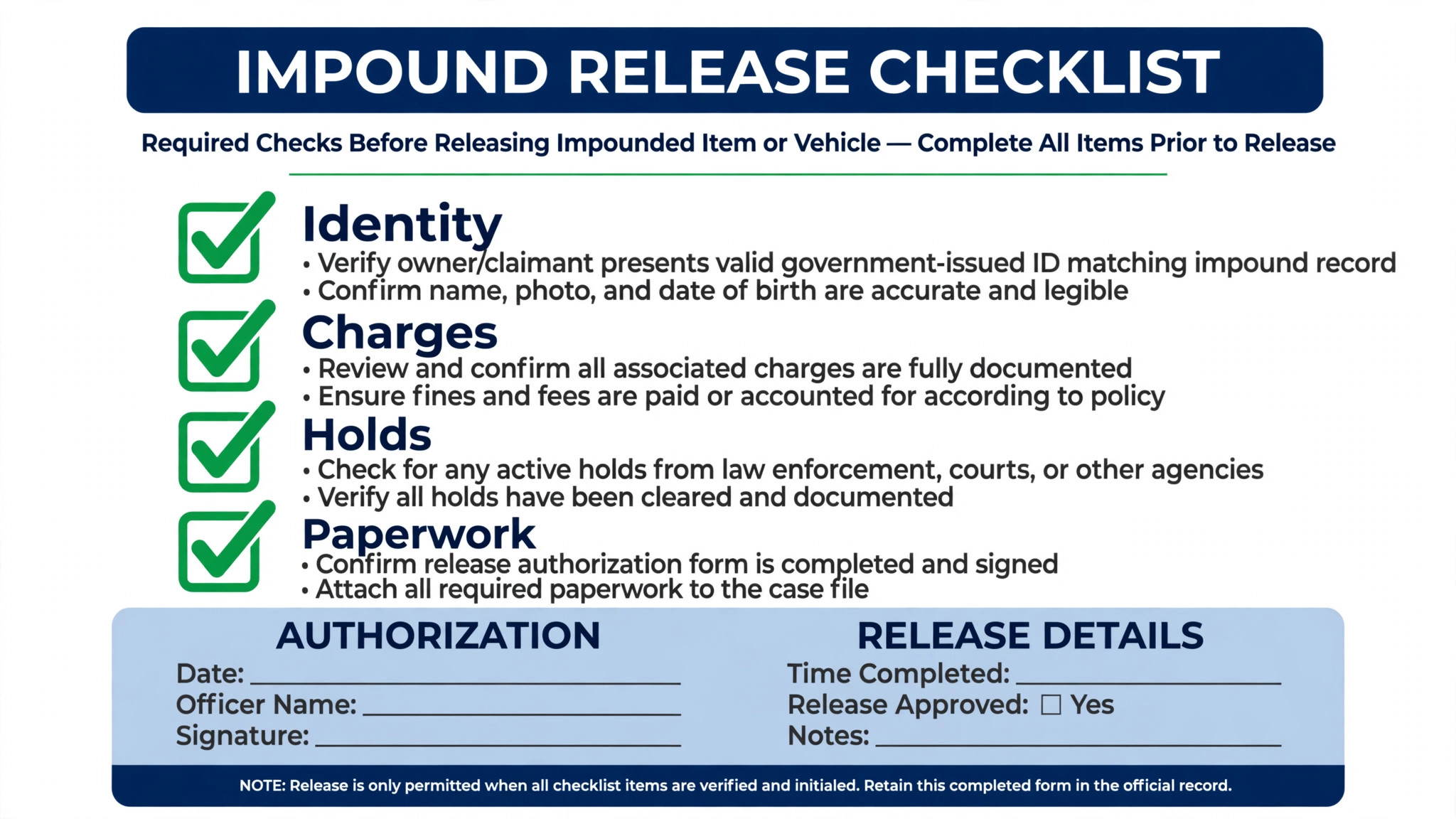
Impound Release Checklist
Use this checklist every time a vehicle leaves the lot. It protects revenue, and it protects the company when a release is later questioned.
– Confirm the identity of the person collecting the vehicle and match it to the release authorisation on file. – Verify that all tow charges, storage charges, and any gate or after hours fees are calculated to the release time. – Check for holds, including police holds, insurance holds, and lien related holds, before any keys change hands. – Record the vehicle condition and mileage at release, with photos where your lot procedure requires them. – Collect payment through the approved method and issue a receipt that lists each charge separately. – Confirm that the correct notification and paperwork steps are complete for the jurisdiction and the tow type. – Update the vehicle status in the dispatch system immediately, so the lot record and the billing record match. – File the release paperwork where the next dispatcher, auditor, or agency can find it without asking the driver.
Software helps this checklist only if the impound record is linked to the original dispatch record. If release paperwork lives in a separate spreadsheet, the checklist becomes a memory test. Test the full journey in a trial, from call to release, before you judge a tool on its dispatch screen alone.
The 12 Tools in Detail
1. TowBook
TowBook is the best known cloud based towing management system for small to mid sized companies. It covers dispatch to driver phones, impound and vehicle storage, lien processing, invoicing, payroll, and private property work, with mobile apps for Android and iOS. Directory listings put the starting price at 49 dollars per month, though the right tier depends on trucks, users, and modules, so check the vendor’s current pricing page.
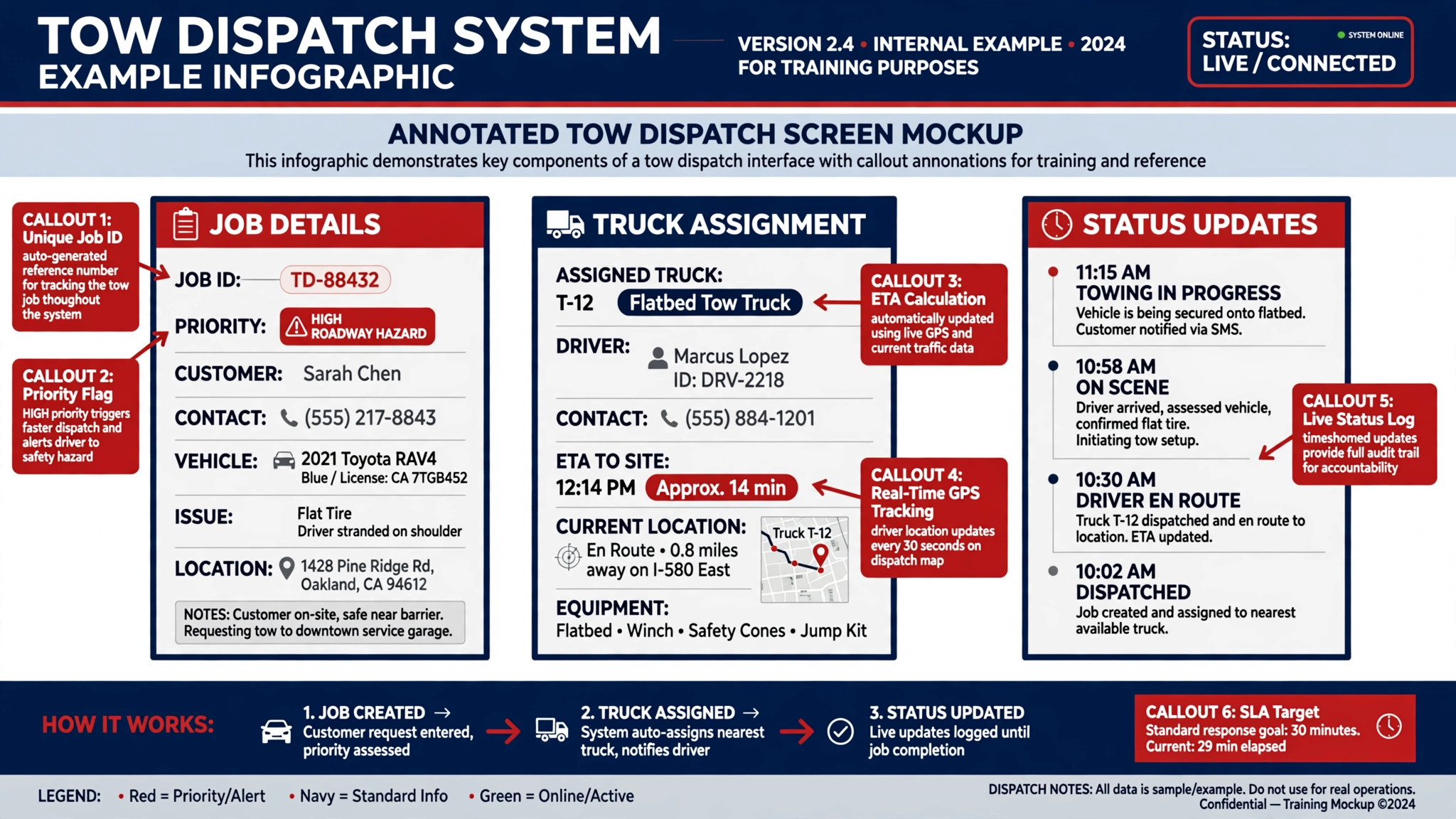
The strength is breadth at an accessible entry price. A small yard can run dispatch, billing, and impound in one system without an enterprise implementation. The limit is depth at the top end. Very large municipal operations and complex multi location compliance work may need a heavier platform, or add-on modules that change the total cost.
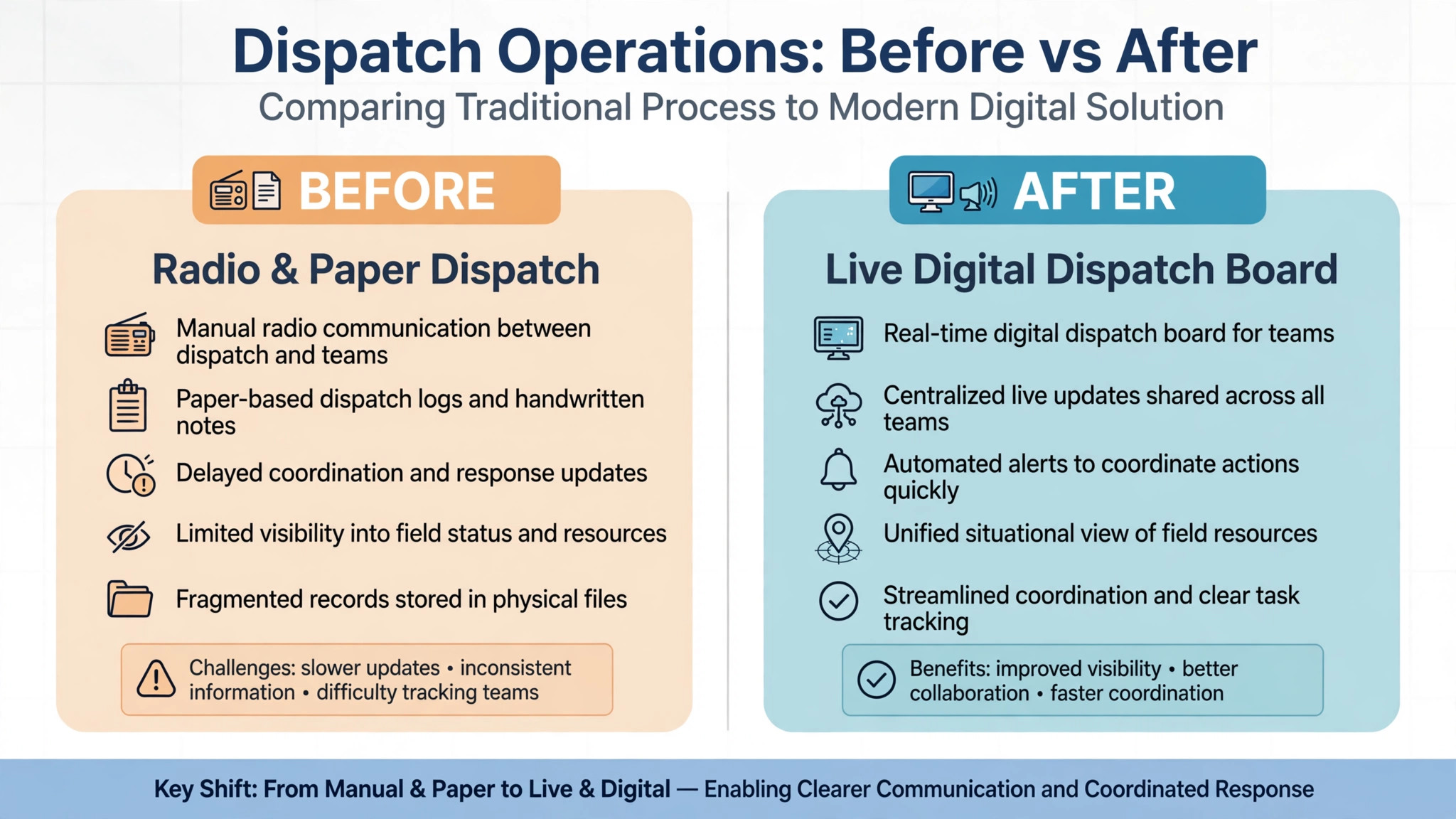
Best for a single truck operator moving off phones and spreadsheets, and for a small fleet that wants towing specific billing without enterprise pricing.
2. Dispatch Anywhere by TRAXERO
Dispatch Anywhere is built for established towing and roadside assistance companies that mainly perform motor club and light to medium duty jobs and that need strong reporting. It handles multi call dispatch, driver tracking, and performance reporting, and it connects to the wider TRAXERO family for GPS, lien notices, auctions, and roadside payments. Directory listings put the starting price at 175 dollars per month.
The strength is operational reporting. A dispatcher can see which calls are open, which trucks are committed, and which jobs are waiting on paperwork, without digging through separate systems. The cost is higher than entry level tools, so a very small operator should test whether the reporting depth earns its fee on real call volume.
Best for a small fleet with steady motor club volume that needs reporting a dispatcher can act on during a shift, not only at month end.
3. TOPS by TRAXERO
TOPS is the enterprise end of the TRAXERO family, used by recognised towing companies and municipalities. It is customisable to fit complex operations, with depth on compliance, multi location coordination, training, and support. Pricing is not published as a simple starting price, so a quote depends on scope, locations, and modules.
The strength is scale. A company running several yards, handling government contracts, or managing auctions needs rules and reporting that a small yard tool cannot enforce. The weakness for a small buyer is implementation effort. Customisation, training, and migration take time, and a small team should not buy enterprise depth it will not configure properly.
Best for larger operators, multi yard companies, and municipal work where compliance and reporting are part of the contract.
4. Swoop
Swoop is the dispatch platform built by motor club interests for motor club work. It offers digital dispatching, configurable workflows, and provider tools for roadside assistance management. Directory listings put the starting price at 49 dollars per month, and sources note that Agero providers can access it at no cost, which is a material difference for a provider whose volume is heavily motor club based.
The strength is the fit with motor club workflows, where job intake, status updates, and billing formats must match the club’s requirements. The question to test is how well non club work fits the same system. A yard that also does cash, fleet, and police work needs a clean way to run those jobs without forcing them through a motor club shaped workflow.
Best for providers whose revenue is dominated by motor club work, and for operators who want the club dispatch flow to be the default rather than an add-on.
5. Tracker Management
Tracker Management has served the towing industry for more than 30 years, covering dispatch, impound, and auctions in one business system. Directory listings put the starting price at 50 dollars per month. Its dispatch tools focus on clear communication between dispatcher and driver, with back office information visible to the team that needs it.
The strength is longevity and lifecycle coverage. A yard that wants dispatch, lot management, and auction support from one vendor can avoid stitching together several tools. The trade-off is that a long established system may feel less modern than a newer cloud tool, so the trial should focus on the driver app and the dispatcher screen, since those are used every hour.
Best for a yard that values a complete lifecycle system and a vendor with deep towing history over the newest interface.
6. Omadi
Omadi is an all in one towing management platform covering dispatch, fleet, employee management, payments, and back office operations, with flexible reporting across the business. Directory listings put the starting price at 75 dollars per month. Its pitch is visibility, giving owners and managers a clearer view of operations, costs, and performance in one place.
The strength is the breadth of the operations view. A manager can connect dispatch decisions to fleet costs and employee workload without exporting data between systems. The risk is the same as with any all in one tool. Dispatch depth, fleet depth, and reporting depth must each be tested, because a platform can be strong on visibility and still be awkward on the dispatch screen during a busy shift.
Best for an owner who wants one operations view across dispatch, fleet, and back office, and who will use the reporting weekly rather than only at tax time.
7. TowManager
TowManager is a complete management system for towing businesses, with dispatching, messaging to pagers, phones, and internet connected devices, and advanced reporting and analytics. Pricing is not published as a simple starting price, so check the vendor’s current pricing page for the package that matches your truck count and module needs.
The strength is reporting. A company that wants to track response times, revenue per truck, and dispatcher performance can use TowManager’s analytics to make staffing and pricing decisions. The weakness to test is the day to day dispatch experience. Reporting only helps if the underlying dispatch data is entered accurately during a shift, so the driver workflow must be fast enough to use under pressure.
Best for an operator who will act on performance data and who wants reporting built into the towing system rather than bolted on later.
8. ProTow
ProTow is a long established towing software built by professional towing companies, in use since 1992, with modules for dispatching, impound management, and lien processing. Pricing is not published as a simple starting price, so a quote should be requested for the modules and truck count you actually need.
The strength is towing specific depth built from operator experience. Impound and lien workflows are not afterthoughts, and that matters for a yard that earns a large share of revenue from stored vehicles. The question for a new buyer is the modern workflow. Test the mobile experience, the customer updates, and the integration with accounting, since a 1992 origin does not guarantee a 2026 driver app.
Best for an impound heavy yard that wants a one stop system for dispatch, lot, and lien work, and that will test the mobile workflow before signing.
9. Autura
Autura connects state and local governments, towing and recovery businesses, and vehicle owners across the full towing lifecycle, from incident or crash dispatch through impound, auction, and vehicle return. Its automated dispatching reduces radio traffic for 911 dispatchers and speeds tow truck arrival, while modules cover impound management, lien processing, payments, and vehicle remarketing.
The strength is the government linked workflow. For police rotation and municipal work, the dispatch, hold, and release rules are part of the system rather than a manual overlay. The scope is enterprise grade, so a small cash focused yard would be buying far more platform than it needs. Pricing is quoted by scope, so check the vendor’s current pricing page and request a scoped quote.
Best for police rotation work, municipal contracts, and multi agency operations where the dispatch system must talk to government workflows.
10. Dispatch.Me
Dispatch.Me is the simpler dispatch option that appears in build versus buy guides as the alternative to TowBook for single yard operations. It focuses on the core dispatch job, taking a call, assigning a truck, and tracking the job through to completion, without the full lifecycle weight of an enterprise platform. Pricing is not published as a simple starting price, so check the vendor’s current pricing page.
The strength is simplicity. A small yard can train a dispatcher and a driver quickly, and the system does not demand a long implementation. The limit is depth. Impound, lien, auction, and complex motor club billing may need companion tools or manual processes, so a growing yard should check how far Dispatch.Me stretches before it needs a second system.
Best for a single yard operator who wants clean dispatch first and who can accept manual steps on the less common job types.
11. Beacon Software
Beacon Software is a towing management system covering dispatching, impound lot management, and driver tracking, with integrations to popular accounting tools including QuickBooks. Pricing is not published as a simple starting price, so check the vendor’s current pricing page for the tier that matches your operation.
The strength is the combination of dispatch and lot management with an accounting link, which keeps billing closer to the job record. The test is the motor club workflow. A yard with heavy club volume should run a full club job through the trial, from intake to accepted billing, and confirm that rate tables and status updates behave as the club requires.
Best for a small to mid sized yard that wants dispatch, lot, and accounting in one workflow and that does not need municipal grade compliance depth.
12. ClearPathGPS
ClearPathGPS is a GPS tracking and fleet management solution rather than a standalone towing dispatch system, and it earns its place here because dispatch quality depends on knowing where trucks really are. It provides real time vehicle tracking, fleet management, and driver behaviour data that a dispatcher can use to choose the nearest suitable truck. Pricing is quoted by vehicle and scope, so check the vendor’s current pricing page.
The strength is location accuracy and fleet visibility. A dispatcher who guesses truck locations will send the wrong truck, especially on a busy night. The limit is that GPS alone does not dispatch, bill, or manage an impound. ClearPathGPS works best paired with a towing dispatch tool, not as a replacement for one.
Best for a fleet that already has a dispatch tool but still dispatches by radio guesswork, and for an owner who wants fleet data to support dispatch decisions.
How to Choose the Best Dispatch Software for Tow Truck Companies
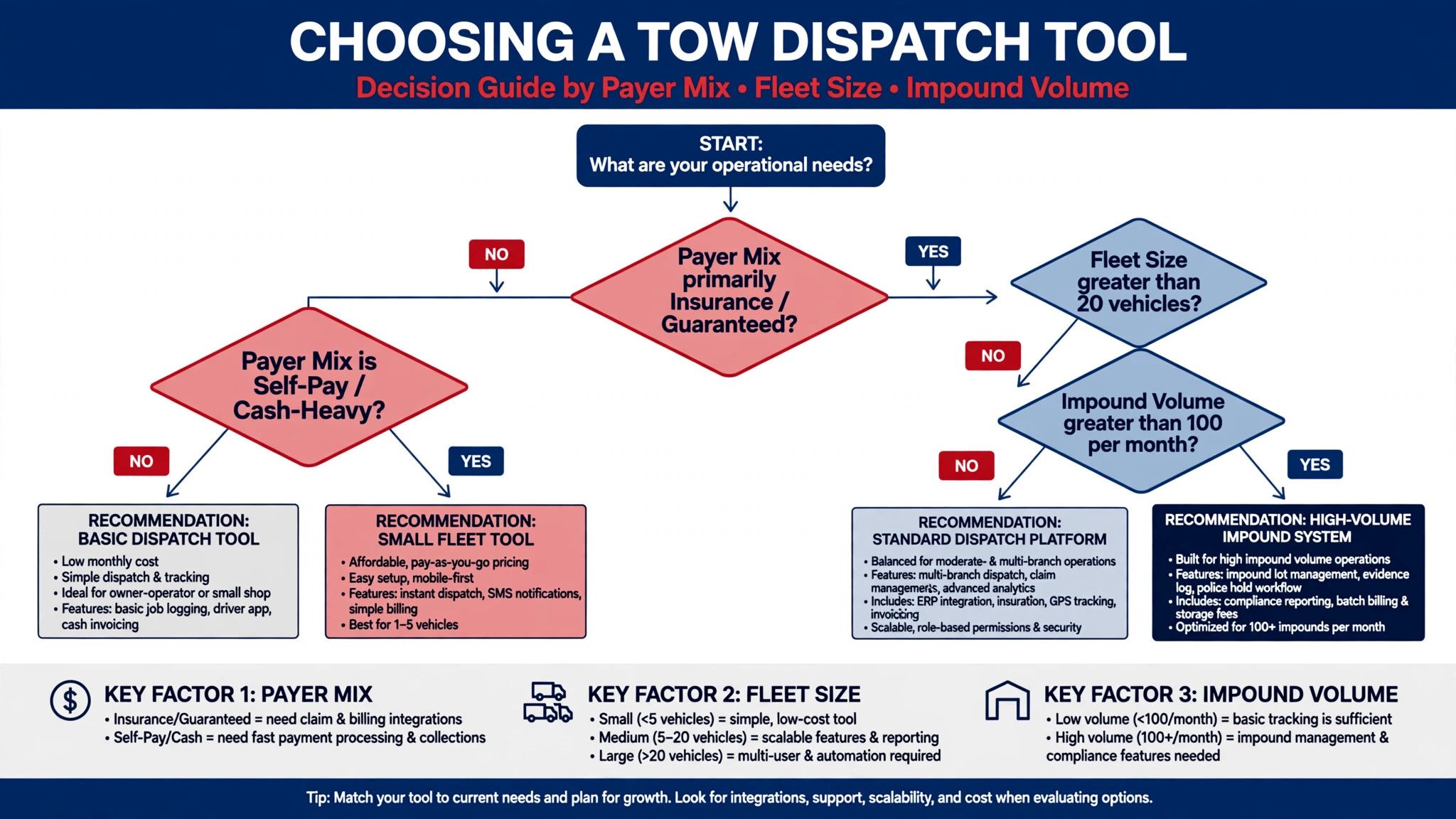
Start with your payer mix. List the share of jobs from cash customers, motor clubs, insurers, fleets, and police agencies. Then score each tool on the largest payer first. A tool that handles cash jobs beautifully but rejects motor club claims will cost you more than its subscription saves.
Next, run a live shift test with the best dispatch software for tow truck companies on your shortlist. Give the trial tool to the dispatcher on the busiest night, not on a quiet afternoon. Test a multi truck call, a vehicle that needs a specific truck type, a job that changes destination mid tow, and a job that enters the impound lot. Watch how long each step takes, and whether the driver can complete it from the truck without calling the office.
Then check the billing handoff in full. A completed tow is not revenue until the payer accepts it. Run a job for each major payer type through to invoice, and confirm that rate tables, mileage rules, photos, signatures, and status updates are captured at the right step. If billing requires retyping job details into a second system, add that labour cost to the software price.
Finally, price the modules you will actually use. Dispatch, impound, lien, auction, GPS, and payments are often separate modules or integrations. A starting price that covers dispatch only is not comparable to a price that covers the full lifecycle. Get a written quote for your truck count, user count, and module list before you compare totals.
Common Mistakes When Buying Towing Dispatch Software
The first mistake is buying on the dispatch screen alone. A clean map and a fast assign button feel good in a demo, but the money is made or lost in billing, impound, and lien workflows. Judge the whole job lifecycle, from call to release and payment, before you sign.
The second mistake is ignoring motor club rules. Each club has its own formats, rate schedules, and mileage methods. A tool that handles one club well may handle another poorly. Test each club you actually serve, and ask how rejected claims are corrected and resubmitted inside the tool.
The third mistake is underestimating driver adoption. If drivers find the app slow, confusing, or unreliable in poor coverage areas, they will revert to radio and paper, and the office will lose the data the software was bought to capture. Test the driver app on a real truck, on a real road, with poor signal, not only in the office.
The fourth mistake is buying for peak capacity you never reach. Enterprise compliance and multi location modules are valuable for a municipal operator, but they add cost and training burden for a single yard. Buy the depth your current contracts require, and check that the tool can grow when a new contract arrives.
The fifth mistake is forgetting the lot. Impound storage, holds, notifications, and release paperwork generate revenue and risk long after the tow ends. A dispatch tool that cannot follow the vehicle into the lot will leave the yard managing its most regulated work in spreadsheets.
Frequently Asked Questions
How much does tow truck dispatch software cost?
Starting prices for the best dispatch software for tow truck companies range from 49 dollars per month for entry tools to 175 dollars per month for established motor club platforms, with enterprise tools quoted by scope. The final cost depends on trucks, users, locations, and modules for impound, lien, auction, GPS, and payments. Get a written quote for your full module list before comparing prices.
Is TowBook good for a single truck operator?
For many single truck operators, yes, because it covers dispatch, impound, lien, and billing in one cloud system at a low starting price, with a driver mobile app. The main check is whether your payer mix needs deeper motor club or municipal features that a larger platform handles better. A trial on your own job types will answer that faster than a feature list.
What is the difference between dispatch software and GPS tracking?
Dispatch software assigns jobs, tracks job status, and turns completed work into billing and lot records. GPS tracking shows where trucks are in real time and records driving behaviour. Dispatch works better with GPS, because the dispatcher can choose the nearest suitable truck, but GPS alone does not assign jobs, manage impounds, or bill a motor club.
Do I need separate software for impound management?
It depends on volume and regulation. Some dispatch tools include impound, lien, and auction modules, while others treat the lot as a separate system. If impound work is a large share of revenue, choose a tool where the impound record is linked to the original dispatch record, so charges, holds, and release paperwork stay consistent.
How does motor club dispatch work in these tools?
Motor club dispatch starts with a job sent by the club or entered by the dispatcher, followed by truck assignment, status updates, and billing in the club’s required format. Tools differ in how much of that flow is automated, and in how rate tables and mileage rules are applied. Test each club you serve through the full flow, including a rejected claim, before you commit.
Can dispatch software handle police rotation work?
Some tools are built for it, especially platforms that connect to government dispatch and impound workflows, while others handle rotation as a manual list. If police work matters to your revenue, test rotation assignment, hold management, and release paperwork explicitly, and confirm that the tool records the audit trail an agency may request.
What should I check in a free trial of towing dispatch software?
Check a busy shift, a multi truck job, a job that changes destination, an impound entry and release, and a billing run for each major payer. Check the driver app in poor coverage, and check how long a dispatcher needs to train a new hire. A trial that only tests a single easy tow will hide the workflows that cause most of the rework.
How long does it take to switch dispatch software?
A small yard can switch in two to four weeks if job types, rate tables, and lot procedures are prepared in advance. A multi yard or municipal operator should allow six to ten weeks, including data migration, training, and parallel running on live calls. The slowest part is usually cleaning up rate tables and impound records, not learning the new dispatch screen.
Verdict in One Page
If you run a single truck, start with TowBook and test Dispatch.Me as the simpler alternative. If you run a small fleet with steady motor club volume, Dispatch Anywhere and Swoop deserve the first trials, with the choice turning on whether motor club work or general fleet reporting matters more. If you run police rotation or municipal work, Autura and TOPS are the serious candidates, and the decision should turn on the agency workflow you must support.
Do not choose the best dispatch software for tow truck companies on price alone, and do not choose on the dispatch map alone. Choose on the full job, from the first call to the accepted payment and the released vehicle. Run your two finalists on the same busy week, with the same dispatcher and the same drivers, and let the billing results decide. The tool that gets paid fastest, with the fewest rejected claims and the cleanest lot records, is the tool worth keeping.
More Reading on Stratilyze
– Best Dispatch Software for Pest Control Companies – Best Field Service Software for Appliance Repair Companies – Best Booking Software for Outdoor Rental Businesses – Cost of Jobber for Small Business Monthly – How to Choose a Payment Processor for Small Business – Best CRM for Franchise Owners Small Business