
Start with the verdict. If you run a nail salon and you want more repeat visits, use AI for nail salon client retention offers as a timed, personal follow-up system, not as a blast of random discounts. The salons that win repeat business do three things well. They notice when a client is due back, they send one clear offer at the right moment, and they make rebooking easy in a single reply. AI helps with the noticing, the drafting, and the timing. Your staff still controls the offer, the tone, and the final send. That balance is the whole point of this guide.
How to use AI for nail salon client retention offers in a small salon
A small salon does not need a large marketing team to run this well. It needs clean visit data, a short list of offer rules, and a weekly routine that takes less than an hour once the setup is done. The system in this post works for a solo nail technician, a two chair studio, and a larger salon with several technicians. The difference is only scale. A solo technician reviews a shorter list and sends fewer messages. A larger salon reviews segments by technician, service, and visit gap, then sends in batches with the same personal tone.
The verdict in plain terms
For most nail salons, the best starting point is a simple way to use AI for nail salon client retention offers, built on the booking system you already use. Add one win-back offer, one rebooking offer, and one birthday offer. Run them for eight weeks. Measure how many clients return within 21 days of the message. If the return rate beats your normal rate for quiet clients, keep the system and add a package offer. If it does not, change the timing or the offer value before you change the tool.
| Situation | Best first move | What to avoid |
|---|---|---|
| Client is one week overdue | Short reminder plus a small rebooking perk | A large discount that trains clients to wait |
| Client is silent for eight weeks | Warm win-back message plus a clear service offer | A generic blast sent to the whole list |
| Client just had a great visit | Thank you note plus a next visit booking link | Another offer on the same day |
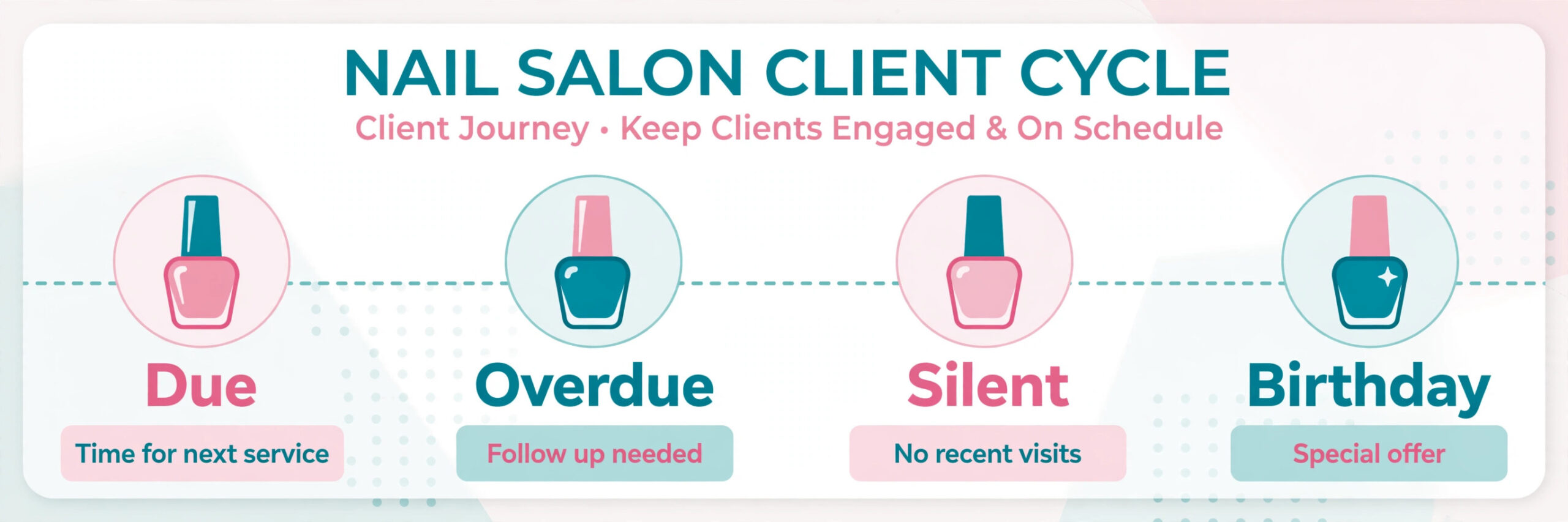
The table above is the decision shortcut for the whole workflow. Every step that follows supports one of those three moves. Keep the table near your front desk routine until the habit is automatic. Staff should be able to answer one question for any client. Is this client due, overdue, or lost. The answer decides the message.
What counts as a retention offer
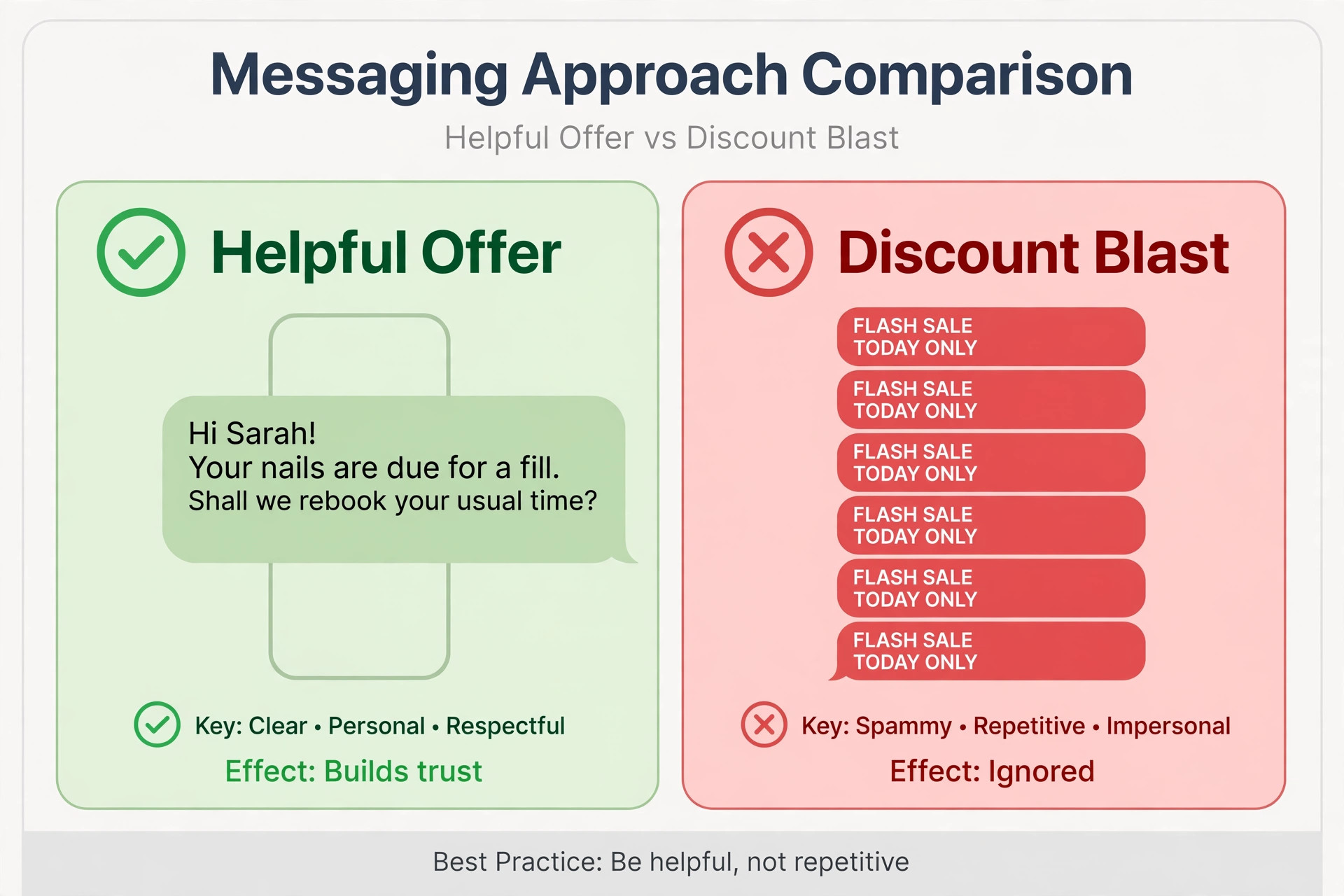
A retention offer is a specific reason to book again, given at a moment when the client is likely to act. It is not a permanent price cut and it is not a coupon handed to everyone who walks in. The best offers feel earned. They reference the last service, the usual cycle, or a date that matters to the client. They also have a clear expiry date, a simple way to book, and a value that still leaves the salon a healthy margin.
An offer can be a service add on, a small price saving, a priority booking slot, or a bundle saving on a package. A free nail art accent, a soak off included with a full set, or a hand massage added to a pedicure can feel more premium than a flat discount. The perceived value matters as much as the cash value. Clients remember a thoughtful extra. They forget a five dollar saving within a week. Choose offers that protect your price position while still feeling generous.
When an offer helps
An offer helps when it removes friction. A client who loved her last set but has not booked may only need a booking link and a nudge. An offer helps when it rewards loyalty without punishing full price clients. A client who books every three weeks should hear thanks first and an offer second. An offer also helps when it fills a quiet slot. A Tuesday morning gap is a good place to direct a win-back offer, because the salon gains a visit that might not have happened at all.
When an offer hurts
An offer hurts when it is sent too often, too widely, or with no expiry date. Clients learn to wait for the next discount if every message contains one. An offer hurts when the margin disappears. A deep discount on a full set plus a free add on can turn a returning client into a loss making visit. An offer also hurts when it feels impersonal. A message that names the wrong service, the wrong technician, or a birthday that already passed does more damage than silence. Check every detail before you send.
The retention workflow, step by step
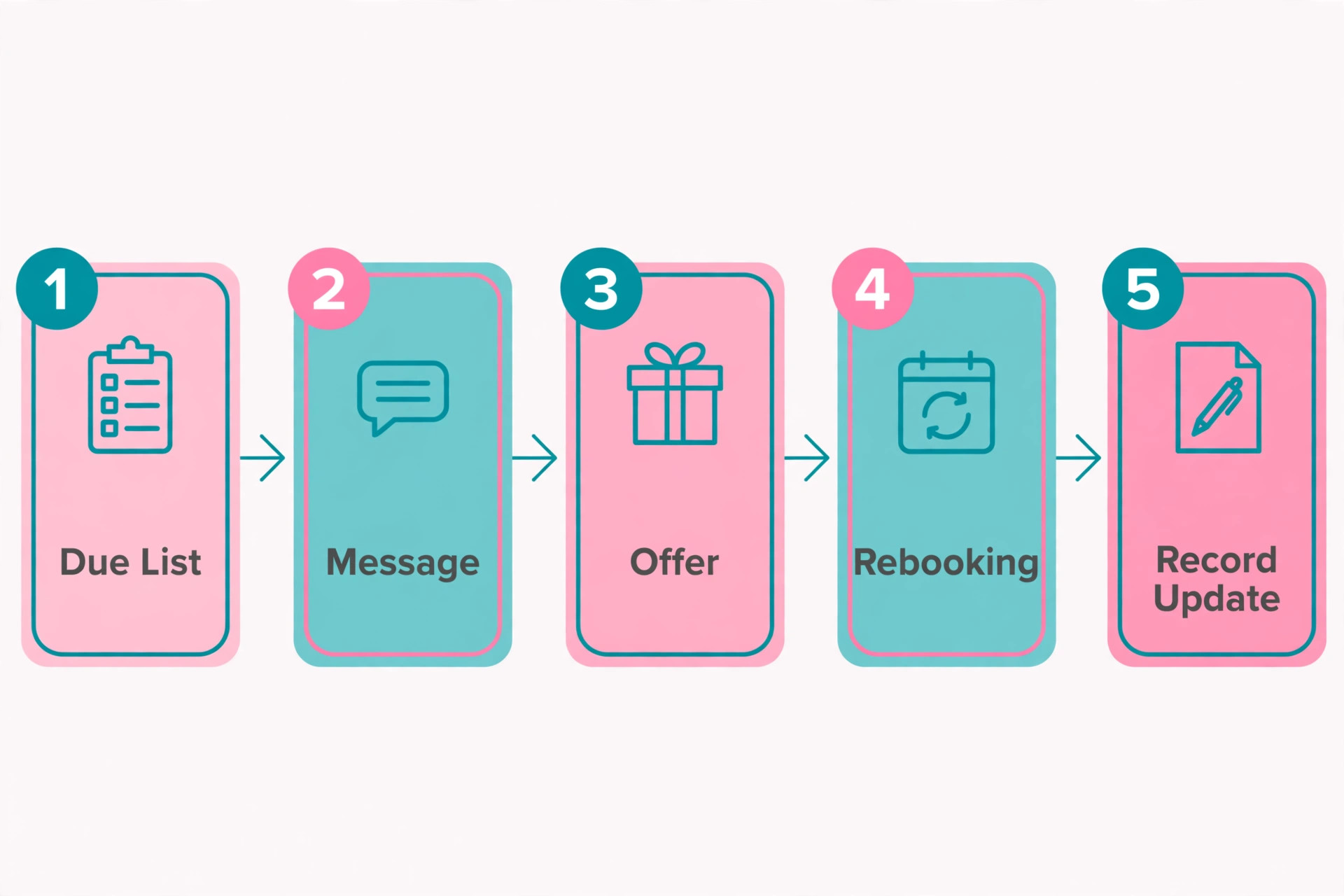
This workflow shows how to use AI for nail salon client retention offers in seven steps. It runs once a week, takes about 45 minutes after setup, and repeats every week without reinventing the message. Read it once in full, then use the checklist near the end of this post as your weekly routine. Each step names the job, the tool that does it, and the human check that keeps it safe.
Step 1. Pull the due and overdue list
Start in your booking system. Filter clients by last visit date and by service type. Build three lists. Due this week means the usual cycle is ending in the next seven days. Overdue means the cycle ended one to three weeks ago with no booking. Silent means no visit for eight weeks or more. Export the lists or view them in your CRM dashboard. Do not message from memory. Memory misses quiet clients and repeats messages to clients who already booked. Good client records matter as much as the booking tool, as shown in a guide to client management software for travel advisors.
Most salons already have this data in MoeGo, Booksy, Square, or GlossGenius. If your booking tool holds visit history, start there. If your payment tool holds it, pull from there and match names by phone number. The tool matters less than the habit. The same list, pulled the same way every week, is what makes the results easy to compare. Keep the list short enough to review by eye. A list of 40 names with no review is worse than a list of 20 names checked carefully.
Step 2. Segment by service and cycle
Split each list by service. Gel clients, acrylic clients, pedicure clients, and manicure only clients have different cycles and different price points. A gel client due in three weeks needs a different message from a pedicure client due in five weeks. Split by technician as well when clients are loyal to one person. A message that says your usual technician has a slot open feels personal. A message from a generic salon account feels like advertising.
Use AI here to draft segment summaries, not to decide the segments for you. Ask it to group the list by service, last visit date, and average spend, then read the result. You will spot errors fast. A client listed under the wrong service, a duplicate name, or a client who already rebooked should be removed before any message is written. Clean segments are the difference between a system that feels thoughtful and a system that feels like spam. For a related look at appointment reminders, see this guide to scheduling software for mobile massage therapists.
Step 3. Choose one offer per segment
Pick one offer for each segment, not one offer per client. Due clients get a rebooking perk. Overdue clients get a gentle reminder plus a small saving or add on. Silent clients get a win-back offer with a clear reason to return. Birthday clients get a birthday offer in their birthday week, regardless of segment. Limiting the choice keeps the work manageable and the results measurable. If every client gets a different offer, you will never learn which offer worked.
Step 4. Draft messages with AI, then edit by hand
Feed AI the segment, the offer, and three facts. The facts are the last service, the usual technician when known, and the booking link. Ask for three short versions in a warm, professional tone. Then edit. Cut anything that sounds stiff. Fix any detail the AI guessed. Add one human sentence that only your salon could write, such as a note about a new shade range or a quieter morning slot. Send the edited version, never the raw output.
Step 5. Send through the channel clients already answer
Most nail clients answer text messages faster than email. Use SMS or the messaging tool inside your booking system when that is your normal channel. Use email only for longer package offers or for clients who prefer email. Use social direct messages only when the client has messaged you there before. The channel rule is simple. Send where the client already talks to you. A new channel feels intrusive, even when the offer is good.
Send in small batches and watch replies for the first hour. A wrong name, a broken link, or an offer sent to a client who visited yesterday will show up fast in replies. Pause the batch, fix the error, and continue. Sending to 200 clients at once without a check is how a small mistake becomes a salon wide embarrassment. Small batches also let staff answer booking replies promptly, which is part of the retention effect.
Step 6. Make rebooking a one reply job
Every message must end with one clear booking step. A booking link is best. A reply word such as BOOK, followed by staff confirming a time, also works when your system supports it. Do not ask the client to call during opening hours, check a website, and then choose a service from a long menu. Each extra step loses clients. The offer creates the motive. The booking link removes the friction. Both must be present.
Step 7. Record the result and learn
Log four numbers for every send. How many messages went out, how many clients booked, how many booked visits were completed, and how much revenue those visits produced. Record them in a simple sheet or in your CRM notes. After four weeks, compare segments. You will see which offer, which timing, and which service group responds best. That comparison is the real value of the system. It turns retention from guesswork into a repeatable routine.
Review the log with staff once a month. Ask which messages got warm replies, which offers caused desk confusion, and which clients returned but did not use the offer. Those details matter. A client who returns without using the offer still counts as a win for the reminder, but not as proof the offer worked. Keep the two results separate in your notes so you do not over credit discounts for visits that would have happened anyway.
Offer types that earn a second visit
Four offer types cover almost every nail salon situation. Use them in rotation, not all at once. A salon that sends all four to the same client in one month looks desperate. A salon that sends the right one at the right time looks attentive. That judgement is central when you use AI for nail salon client retention offers at scale. Match the offer to the gap, the service, and the client history.
Win-back offers for silent clients
A win-back offer targets clients who have not visited for eight weeks or more. The message should acknowledge the gap warmly, without guilt. Offer a clear saving on a full service or a valued add on, such as a soak off included with a new set or a nail art accent on two nails. Set an expiry of 14 days. That window is long enough to fit a busy schedule and short enough to prompt action.
Birthday offers for loyal clients
A birthday offer is the easiest retention win in a nail salon, because the date is personal and the timing is predictable. Send the offer three to five days before the birthday, not on the day itself, so the client can book ahead. Offer a treat that feels celebratory, such as a free accent nail set upgrade, a hand massage with a manicure, or a saving on a pedicure and manicure pair. Keep the expiry to 21 days from the birthday so the client is not rushed.
Rebooking offers for due clients
A rebooking offer rewards clients who book their next visit before they leave, or within a few days of the last visit. The simplest version is a small saving or an add on applied to the next visit when it is booked within seven days. Another version is a priority slot for the next appointment, which matters when a popular technician books out fast. The goal is to lock in the habit before the cycle breaks.
Package top-up offers for regulars
A package offer suits clients who visit at least every four weeks and who already trust the salon. Offer a bundle, such as four manicures for the price of a set number of visits, or a pedicure package with a bonus soak treatment on the fourth visit. Price the package so the salon keeps a healthy margin and the client sees a real saving against paying visit by visit. State the expiry clearly, usually 90 days, so the package encourages regular visits rather than sitting unused. Clear package billing also helps, as explained in a guide to invoicing software for creative freelancers.
AI prompts and message templates you can copy
Prompts work when you use AI for nail salon client retention offers with real facts and clear limits. Vague prompts produce vague messages. The prompts below are written for a salon owner to paste, fill in the bracketed facts, and edit. Replace every bracketed detail with real data from your booking system. Never let AI invent a service, a price, or a technician name.
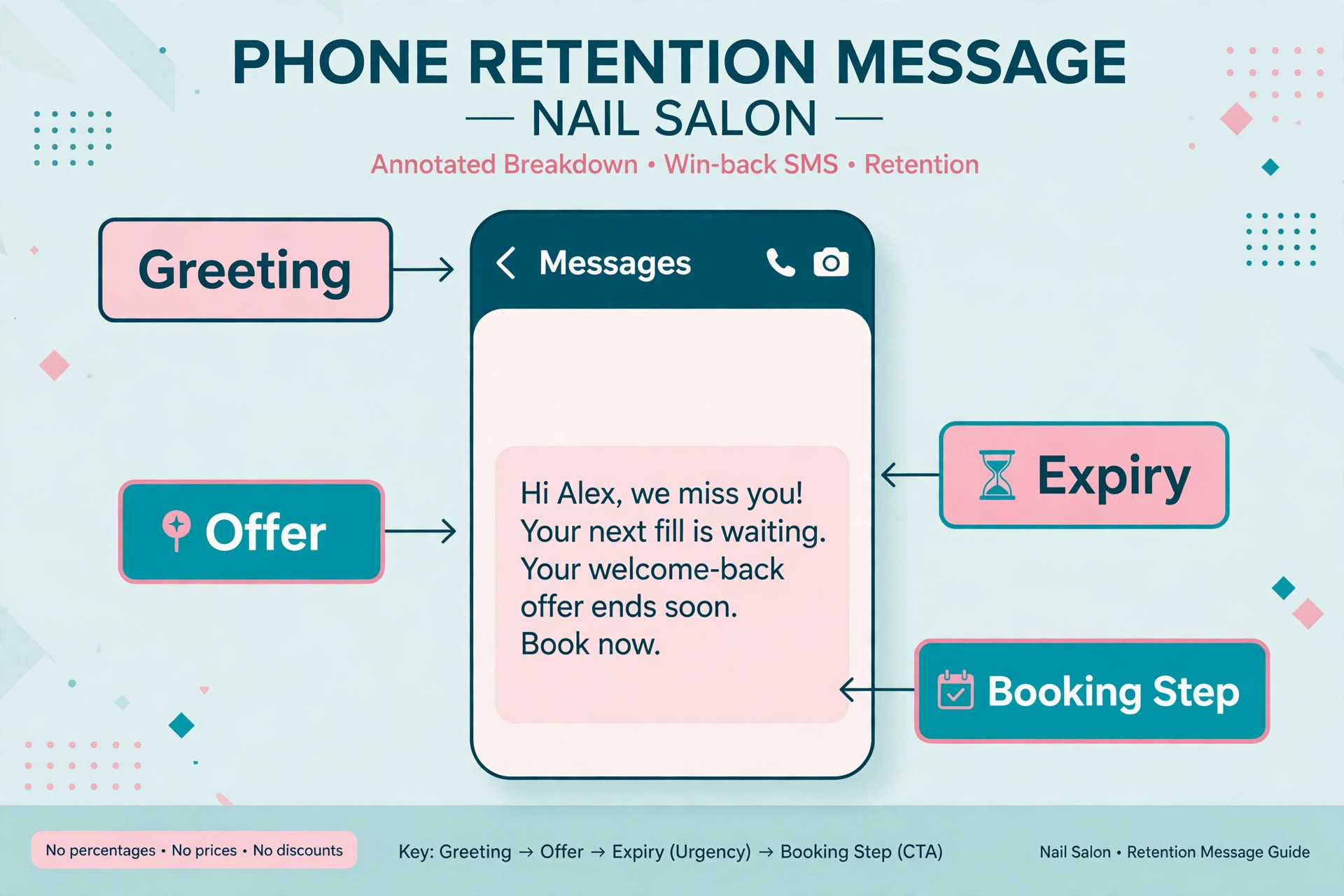
Win-back prompt. Write a warm text message under 45 words for a nail client who last visited eight weeks ago for a gel manicure. Offer a soak off included with a new full set if booked within 14 days. End with a booking link placeholder. Use a friendly professional tone and no pressure language.
Rebooking prompt. Write a short thank you message under 40 words for a client who had acrylics today. Invite her to book the next visit within seven days to receive a free nail art accent on two nails. Mention the usual technician by name. End with a booking link placeholder.
Birthday prompt. Write a cheerful birthday message under 45 words for a loyal pedicure client. Offer a hand massage added to a manicure booked within 21 days of her birthday. Keep the tone celebratory and personal. End with a booking link placeholder.
Package reminder prompt. Write a helpful message under 45 words for a client with one visit left on a manicure package. Remind her of the remaining visit, suggest two quiet morning slots, and invite her to top up the package at the visit. Keep the tone helpful, not sales heavy.
Timing and cadence that does not annoy clients
Timing decides whether a good offer feels helpful or pushy. The table below gives a starting cadence for a typical nail service cycle. Adjust it by service. A gel client on a three week cycle needs an earlier nudge than a pedicure client on a five week cycle. A client who books irregularly for events needs a different rhythm from a client who books like clockwork. Getting that rhythm right is what lets you use AI for nail salon client retention offers without annoying clients.
| Client group | First message | Follow up | Stop after |
|---|---|---|---|
| Due this week | Three days before the usual cycle ends | None, unless no booking after seven days | One follow up |
| Overdue by two weeks | At the two week mark | One reminder after seven days | Two messages total |
| Silent for eight weeks | At the eight week mark | One reminder after seven days | Two messages total |
| Birthday client | Three to five days before the birthday | None | One message |
Send messages during business hours when staff can answer replies. Late evening messages get read but cannot be acted on until morning, and the client may forget by then. Mid morning and early afternoon sends work well for most salons, because clients can reply and book while the desk is staffed. Avoid sending on a day the salon is closed, unless your booking link works without staff help and you say so in the message.
How to measure repeat rate and offer profit
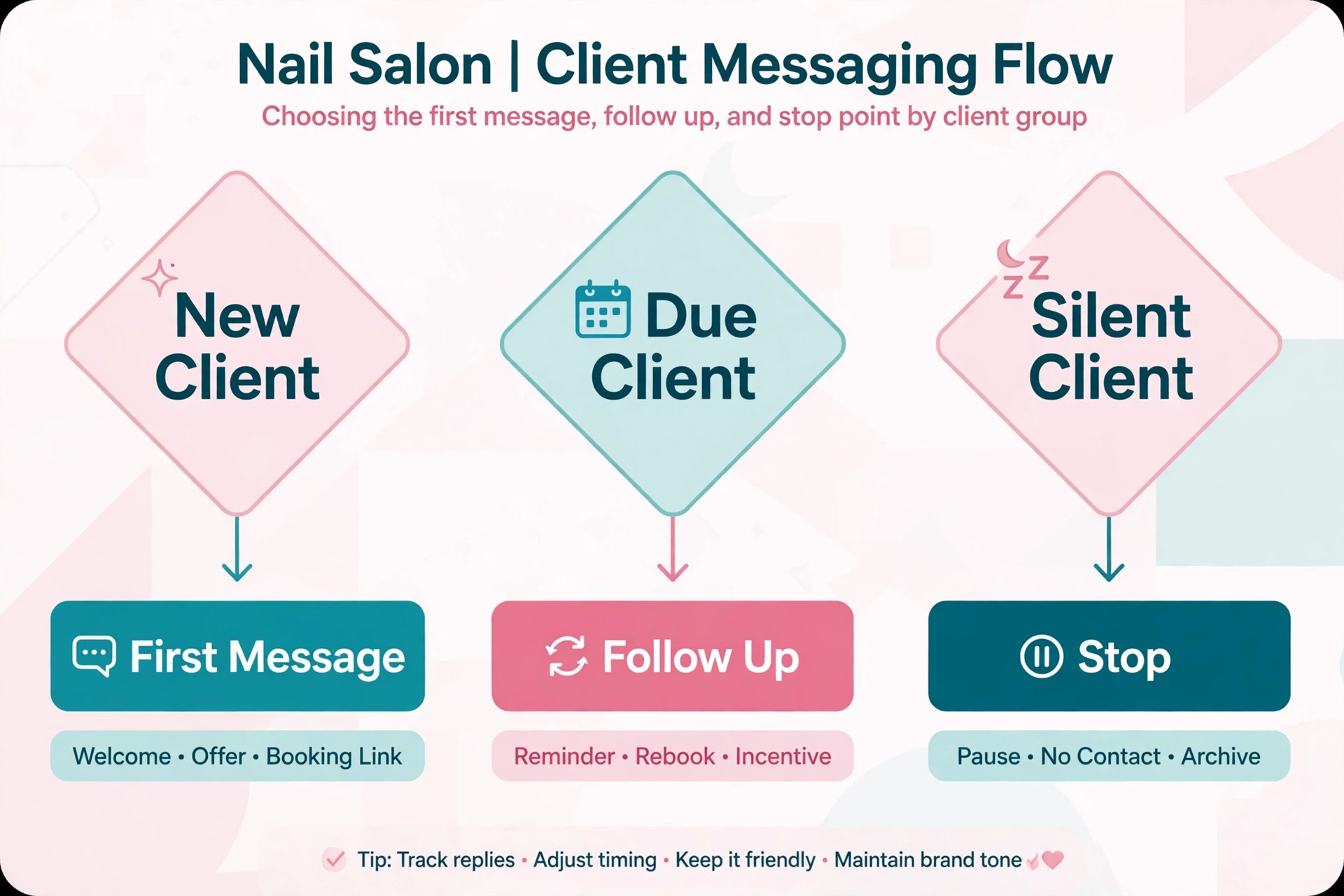
Measurement starts with a simple definition when you use AI for nail salon client retention offers. Repeat rate is the share of clients who return within a set window after a message. Pick one window and use it every time. A 21 day window works well for nail services, because it covers the next cycle for most clients without waiting so long that other factors take over. Count a return only when the visit is completed, not when it is merely booked and then cancelled.
Work out the numbers in this order. First, record how many messages were sent to a segment. Second, record how many of those clients completed a visit within 21 days. Third, divide completed visits by messages sent and multiply by 100 for the repeat rate. Fourth, record the revenue from those completed visits and subtract the cost of the offers redeemed. The result is the offer profit for that segment. A high repeat rate with a large discount cost can still be a poor result.
| Measure | What it tells you | Healthy sign |
|---|---|---|
| Repeat rate within 21 days | Whether the message brought clients back | Higher than the rate for clients who got no message |
| Offer redemption rate | Whether the offer itself motivated the visit | Steady, not close to 100 percent |
| Revenue per returned client | Whether returns are profitable | Above the average visit value after offer cost |
| Unsubscribe or opt out rate | Whether the cadence annoys clients | Low and stable week to week |
Track offer cost honestly. A free add on costs technician time and product. A price saving costs margin directly. A package saving costs margin across several visits. Add those costs to your sheet. If a win-back offer brings back ten clients but costs more than the profit on their visits, change the offer. Try a smaller saving, a lower cost add on, or a priority slot with no price cut. Profit, not only return count, decides whether an offer stays.
Use your booking and payment data together for this review. Booking data shows who returned and when. Payment data shows what they spent and which offer was redeemed. When the two sources disagree, trust the payment record for revenue and the booking record for visit timing, then fix the client record so the next report is cleaner. Checkout data habits are covered in a guide to a point of sale system for farmers market vendors. A monthly review of 30 minutes is enough once the sheet is set up. The review is where the system improves. Without it, the same offer repeats whether it works or not.
Mistakes that quietly cost repeat clients
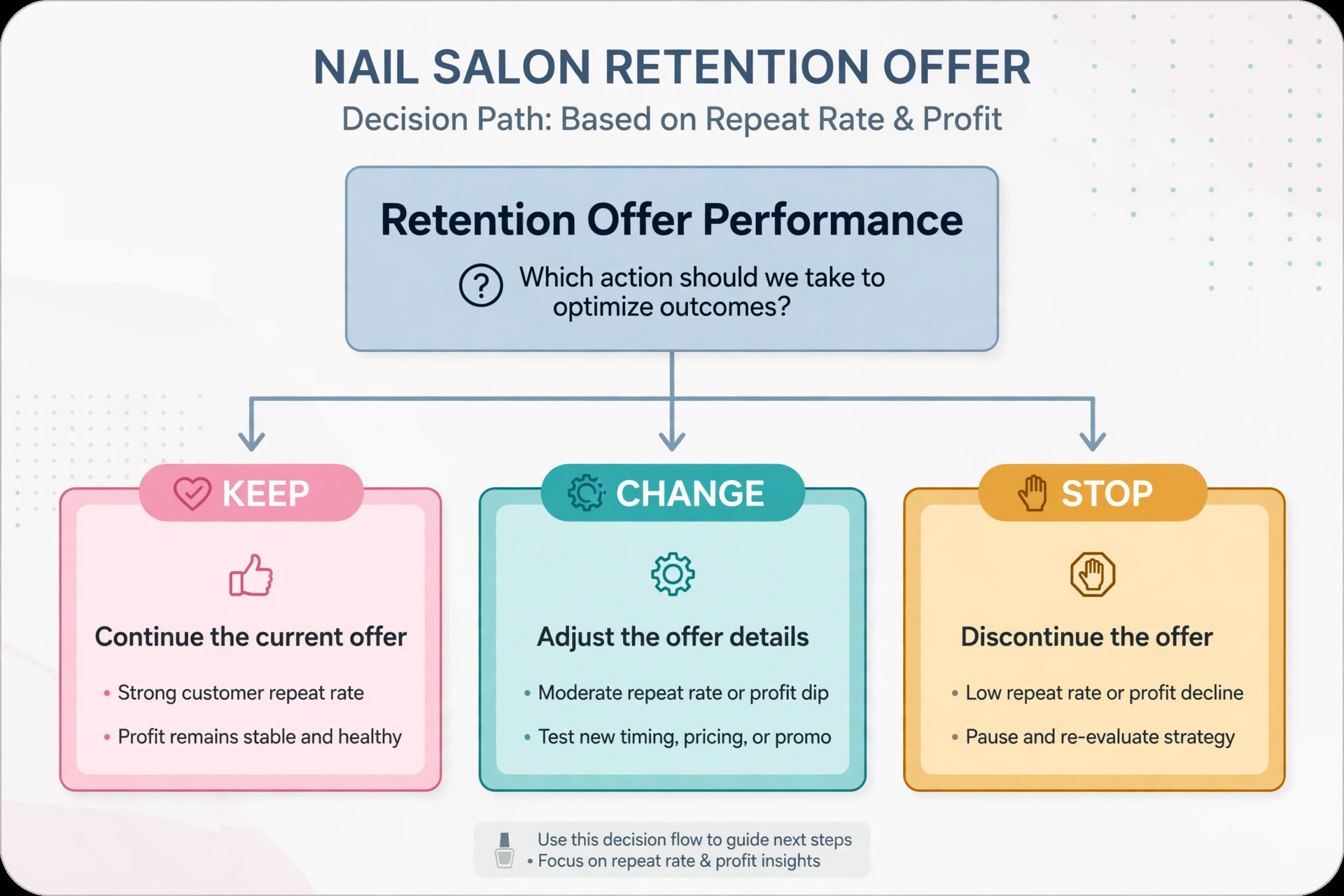
- Sending the same discount to every client, every week, until clients learn to wait for it. – Naming the wrong service, technician, or visit date in a message that was meant to feel personal. – Offering a deep discount that wipes out margin on the most popular full set service. – Sending a win-back message to a client who visited yesterday because the list was not refreshed.
- Forgetting the expiry date, so clients argue at the desk about an offer that never ended. – Asking clients to call, visit a website, and choose from a long menu instead of tapping one link. – Messaging clients late at night, on a closed day, or twice in the same week with two different offers.
Each mistake has the same root cause. The message went out before a human checked it. Build the check into the routine. One person pulls the list, a second person or the owner reviews names, services, and links, and only then does the batch go out. That review takes ten minutes for a small list. It prevents the errors that cost trust, and trust is the asset a retention system is meant to build.
The win-back checklist
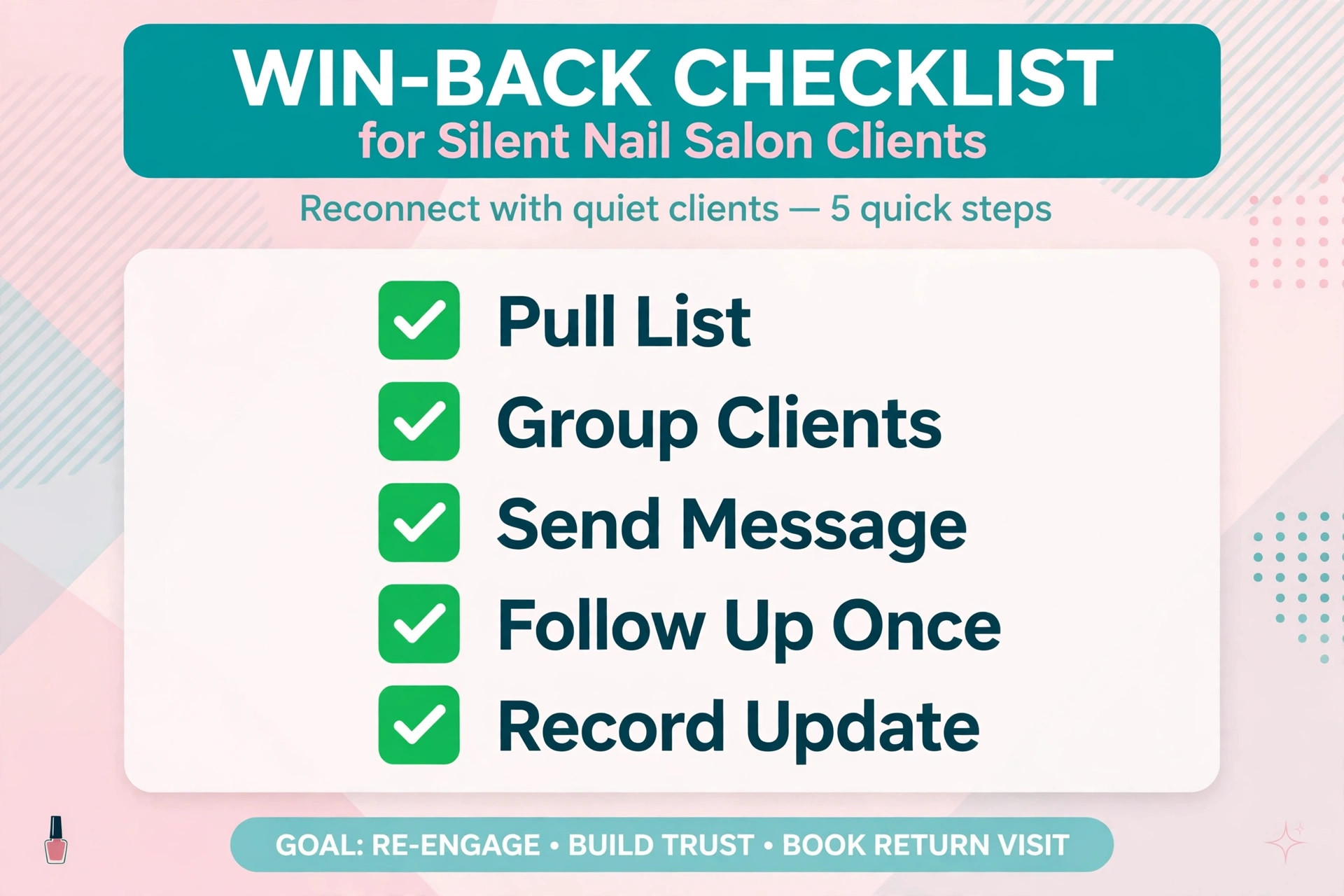
Use this checklist every week for silent clients. Work through it in order. Do not skip the review step, even when the list looks familiar. Familiar lists hide the errors, because the eye skips names it has seen before.
- [ ] Pull the silent list from the booking system, defined as no visit for eight weeks or more. – [ ] Remove clients who already booked, clients who asked to stop messages, and duplicate names. – [ ] Split the list by service and by usual technician, and note the last service for each client. – [ ] Choose one win-back offer for the week, with a saving or add on, and a 14 day expiry date.
- [ ] Draft three short message versions with AI, using real service and technician facts only. – [ ] Edit the chosen version by hand, read it aloud, and remove any guessed detail or extra praise. – [ ] Test the booking link on a phone, and confirm it shows real availability for the offer period. – [ ] Send in a small batch during business hours, and watch replies for the first hour.
- [ ] Log messages sent, bookings made, visits completed, and offers redeemed in the tracking sheet. – [ ] Send one follow up after seven days to non responders, then stop and mark the rest for next month. – [ ] Review opt outs and warm replies with staff, and note one change for the next win-back send. – [ ] Update client records with the new visit, the offer used, and the next due date for each returner.
Frequently Asked Questions
How often should a nail salon send retention offers?
Send a retention message only when a client is due, overdue, silent, or celebrating a birthday. For most clients, that means one message per cycle, not one per week. A due client gets one reminder. An overdue client gets one reminder plus one follow up. A silent client gets a win-back message plus one follow up. Rest rules matter. A client who just received a promotion should wait at least seven days before a retention message, and a client who just booked should receive no win-back message at all.
What is a good win-back offer for a nail salon?
A good win-back offer has a clear service, a real but modest value, and a 14 day expiry. A soak off included with a new full set, a nail art accent on two nails, or a small saving on a full service all work. The offer should also include a reason beyond price, such as a new shade range or a slot with the usual technician. Avoid deep discounts that erase margin. A win-back visit that loses money does not help the salon, even when it fills a chair for one day.
Can AI write retention messages without sounding impersonal?
AI can draft the structure and the wording, but the personal feel comes from human editing. Feed AI real facts, such as the last service and the usual technician, and set a short word limit. Then edit by hand. Fix any guessed detail, cut extra praise, and add one sentence only your salon could write. Read the result aloud. If it sounds like a generic coupon, rewrite the first line. The combination of AI drafting and human editing is what keeps messages fast and personal at the same time.
Which booking tools work best with this workflow?
The best tool is the one that already holds your visit history and can send messages or connect to a messaging tool. MoeGo, Booksy, Square, and GlossGenius all hold the core data this workflow needs, which is last visit date, service, and client contact details. Choose the tool your staff already uses well, rather than switching tools to chase a feature. A familiar tool with clean data beats a new tool with messy records. Review your booking software options in a dedicated guide to booking software for nail salons before you change systems.
How do I stop clients waiting for discounts?
Stop training clients to wait by limiting offer frequency, varying the offer type, and never discounting the same service every cycle. Mix price savings with add ons and priority slots. Give loyal clients thanks and early booking access, not only price cuts. Set clear expiry dates and honour them. When an offer ends, it ends. Clients who learn that offers are occasional and time limited will book on cycle, rather than holding out for the next discount.
Should small salons use packages for retention?
Packages suit regular clients who visit at least every four weeks and who already trust the salon. A package with a clear visit count, a 90 day expiry, and a tracked balance can lock in habit and smooth revenue. Packages do not suit new or irregular clients, who may feel locked in. Start with rebooking and win-back offers, add packages only for proven regulars, and track every package visit carefully. A package dispute at the desk costs more trust than the package ever earned.
Final verdict
The verdict from the opening still stands, with one addition. Start small, measure honestly, and let the data choose your next offer. A weekly list, one offer per segment, a short edited message, and a single booking step will beat a complex system that staff never run. AI removes the drafting and sorting burden. It does not remove the need for a human check, a fair margin, and a message that respects the client.
If you run this workflow for eight weeks, you will learn something no generic guide can tell you. You will learn which of your clients respond to a reminder, which respond to an add on, and which need a stronger win-back reason. That knowledge is the real asset. It lets you spend less on broad discounts and more on the clients who actually return. Use AI for nail salon client retention offers in that disciplined way, and retention stops being a hope. It becomes a routine, a number you can track, and a habit your clients can rely on.