
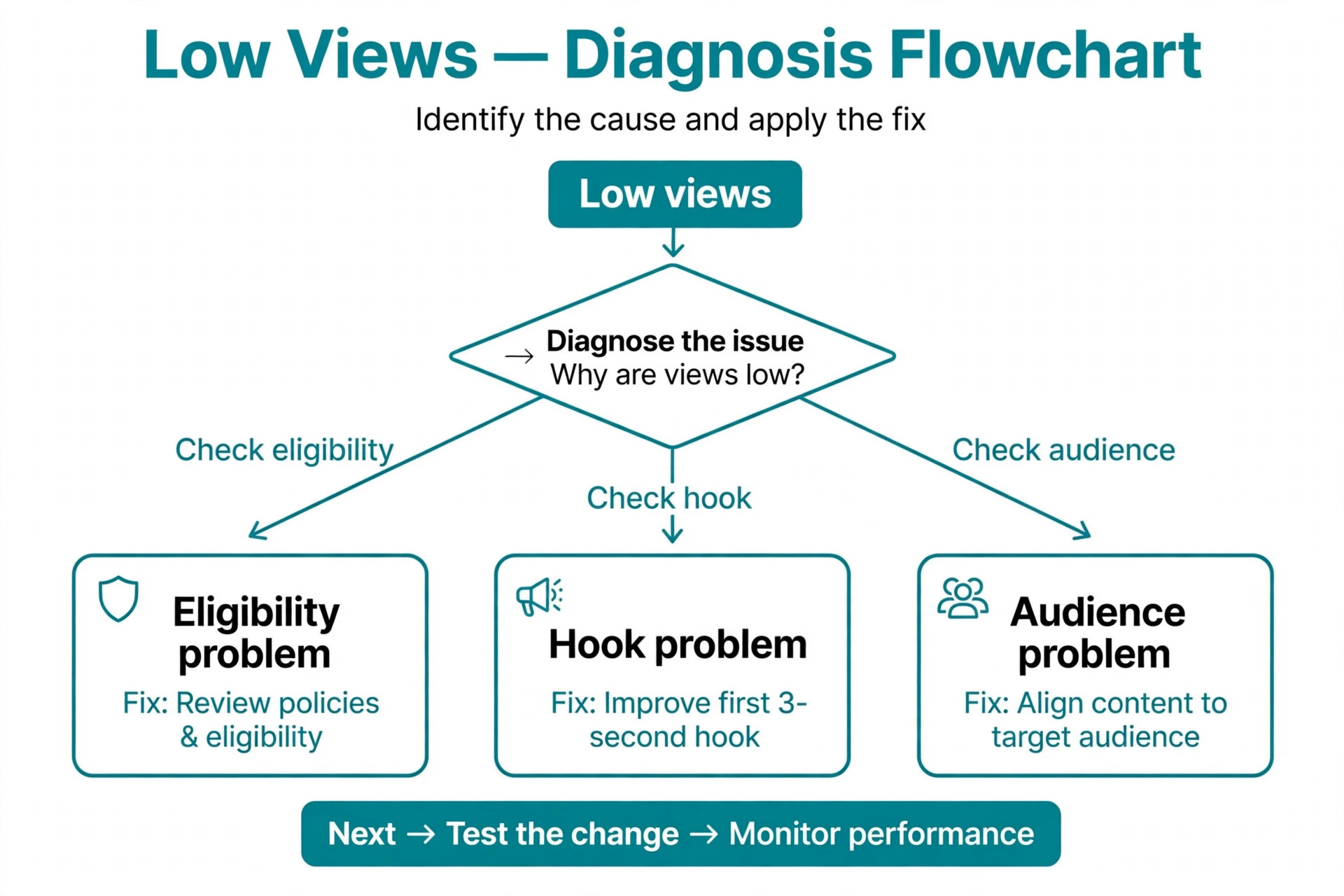
A small business video climbs to a few hundred views, then stops dead. The next video does the same, and the one after that does worse. The owner checks the follower count, posts more often, and tries a trending sound, but the pattern does not change. That stall at a few hundred views is the most common complaint small businesses have about TikTok, and it usually has a fixable cause. If you want to fix TikTok videos not getting views small business owners struggle with, start by diagnosing the video, not by blaming the algorithm.
TikTok does not show a new video to everyone at once. It shows the video to a small initial audience, watches what happens, and then decides whether to show it to more people. A video that people skip in the first seconds, watch only briefly, or never interact with will not earn wider distribution, however good the product behind it may be. That test audience mechanism explains why two similar videos can perform very differently, and why the fix is usually found in the opening seconds, the audience match, or the account setup rather than in posting volume.
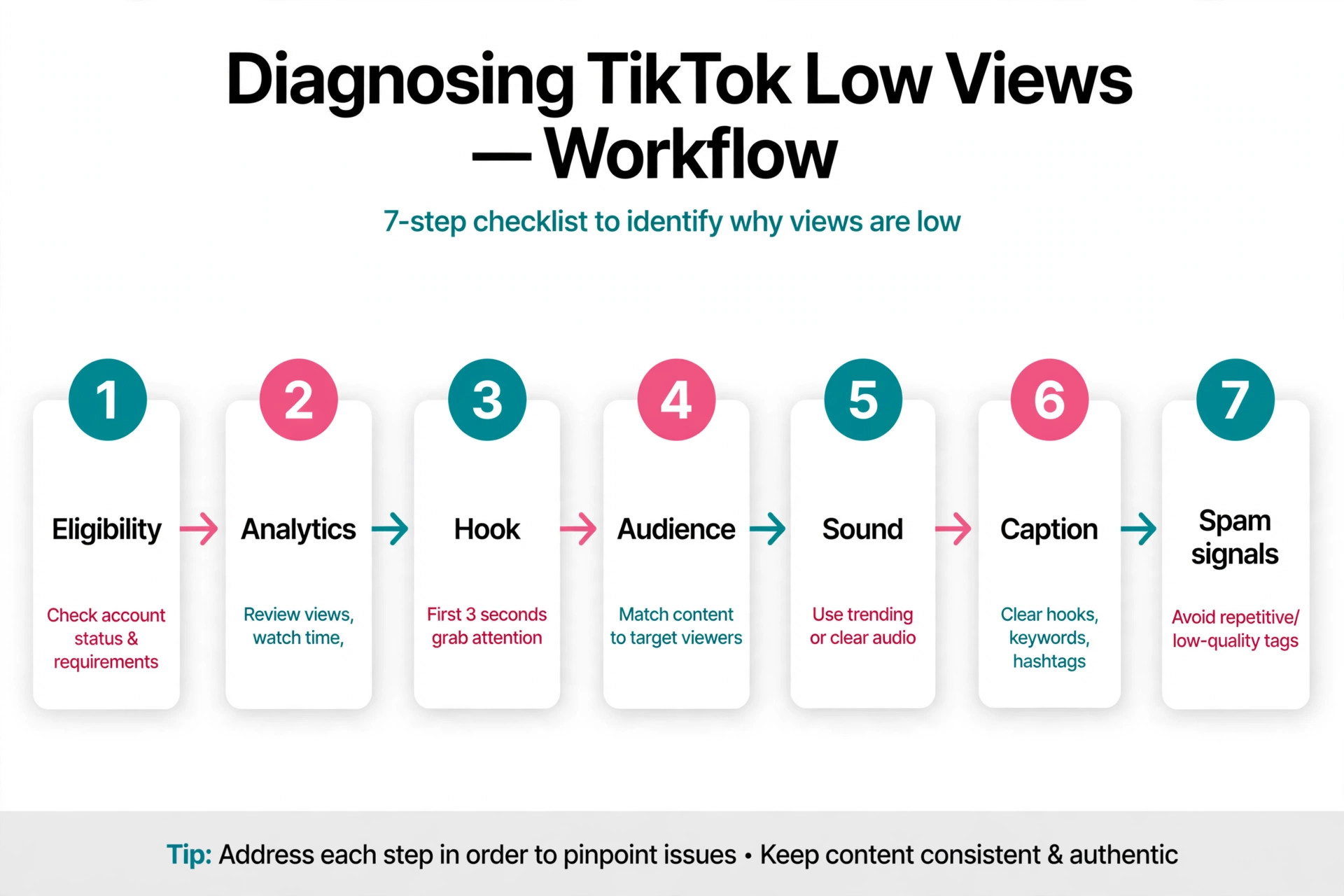
This guide works through diagnosis in order, from the most common and easiest causes to the deeper content problems. Check each step before moving to the next, because fixing step six while step one is still broken wastes a week of posts. Each step includes what to check, what the fix looks like, and how to tell whether it worked.
Step 1. Check Whether the Video Was Ever Eligible for the For You Feed
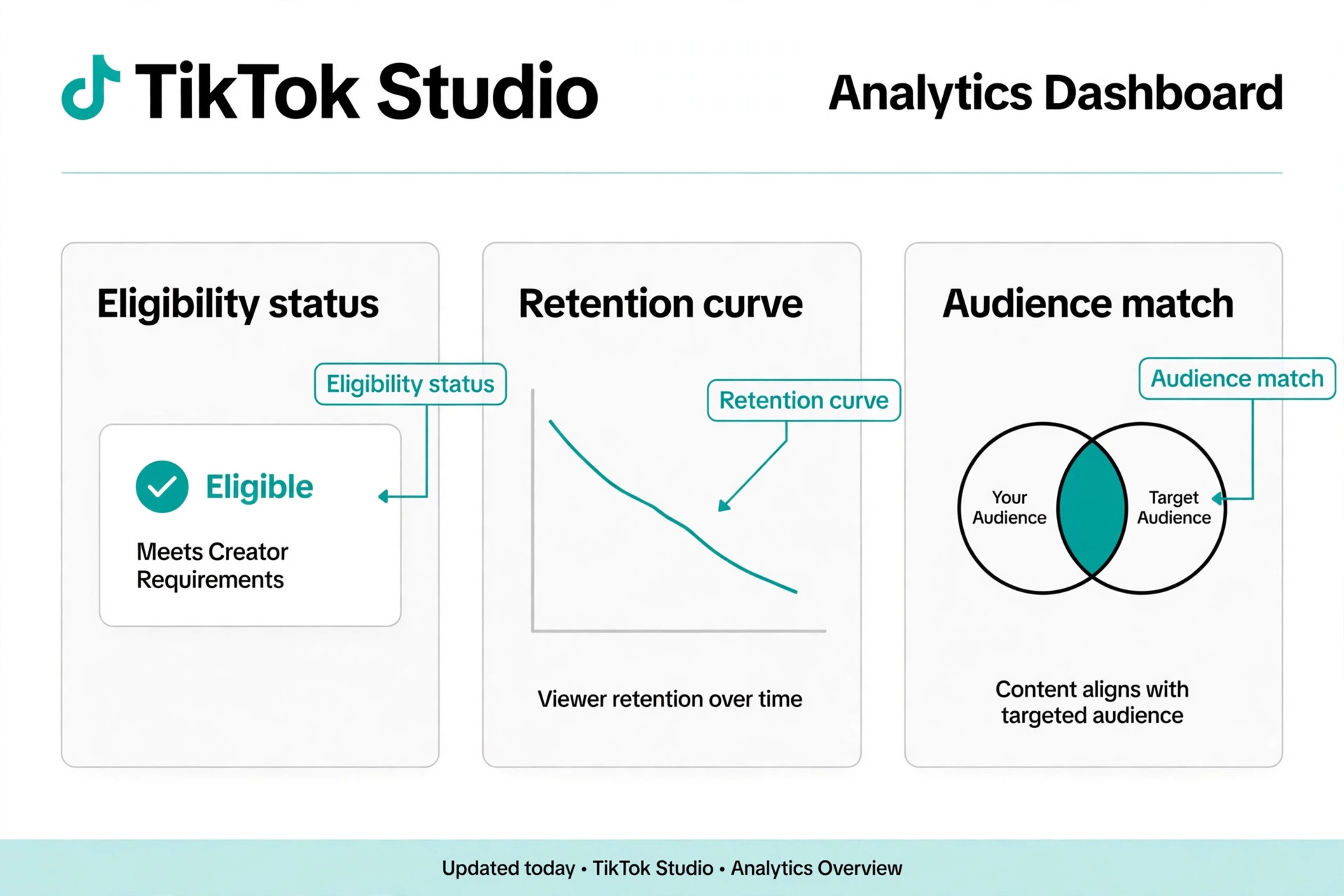
Before changing content, check whether TikTok made the video eligible for recommendation at all. Open TikTok Studio, look at the video analytics, and check for any eligibility note or restriction notice. TikTok also offers an Account Check tool that audits the account and recent posts for issues. If a video was marked ineligible, the fix is in the content or the account, not in hashtags or posting times, and no amount of reposting will help until the cause is addressed.
Common eligibility problems include reused material with nothing new added, content TikTok considers unsuitable for a broad audience, and engagement that was bought or swapped. A business that reposts a supplier video unchanged, or clips a television advert into a TikTok, risks an unoriginal material flag. The fix is to film original material, add genuine commentary or demonstration, and remove anything that looks copied. Originality does not mean expensive production. A phone video of the owner demonstrating a product is original, while a polished repost is not.
Account settings matter here too. A private account, or a video set to a friends only audience, keeps strangers out by design, so check both before assuming a deeper problem. Business accounts should also use music from the Commercial Music Library, because a commercial sound that gets muted or restricted can limit a video. If the sound was the problem, reposting with a cleared sound or the clip’s own audio is a legitimate fix.
TikTok Studio Checks to Run First
Open the video in TikTok Studio and read the analytics panel fully, not just the view count. Look for the eligibility note, the average watch time, and the traffic source breakdown. A video with almost all traffic from the profile page rather than the For You feed was never recommended widely, which points to eligibility or a weak opening. A video with For You traffic that stops early points to audience response, which is a different diagnosis covered in step four.
Step 2. Check the Account for Warnings, Restrictions, and Age Limits
Next, check the account itself. Open Account Check and read any warnings, and check whether any recent post was removed or restricted. Repeated guideline issues can limit how widely later videos are recommended, even when a new video itself breaks no rule. If a warning exists, read the rule it names, remove or edit the offending material where TikTok allows it, and change the habit that caused it before posting again.
Age and region limits also affect eligibility. TikTok states that content from accounts under sixteen is not eligible for recommendation to the For You feed, and age restricted videos may be shown only to adults. A business account should therefore be registered with accurate owner details and kept clearly separate from any personal account used by younger family members. Accuracy here is not bureaucracy. It decides whether the account can be recommended at all.
Avoid the temptation to start a fresh account to escape a restriction. TikTok states that creating a new account to get around a restriction on another account can lead to the new account being banned as well. Fix the existing account, wait for restrictions to lift where applicable, and build back with compliant posts. A fresh account also loses the followers, watch history, and audience signals the old account built, so it rarely performs better even when it survives.
Step 3. Check the First Two Seconds and the Hook
If the video is eligible and the account is clean, the most likely problem is the opening. Most small business videos open with a logo, a slow pan of the shop, or a greeting that assumes the viewer already cares. A stranger scrolling the For You feed does not care yet, and will skip within two seconds if nothing gives them a reason to stay. The hook is not the introduction. The hook is the most interesting sentence, spoken aloud and shown on screen, in the first two seconds.
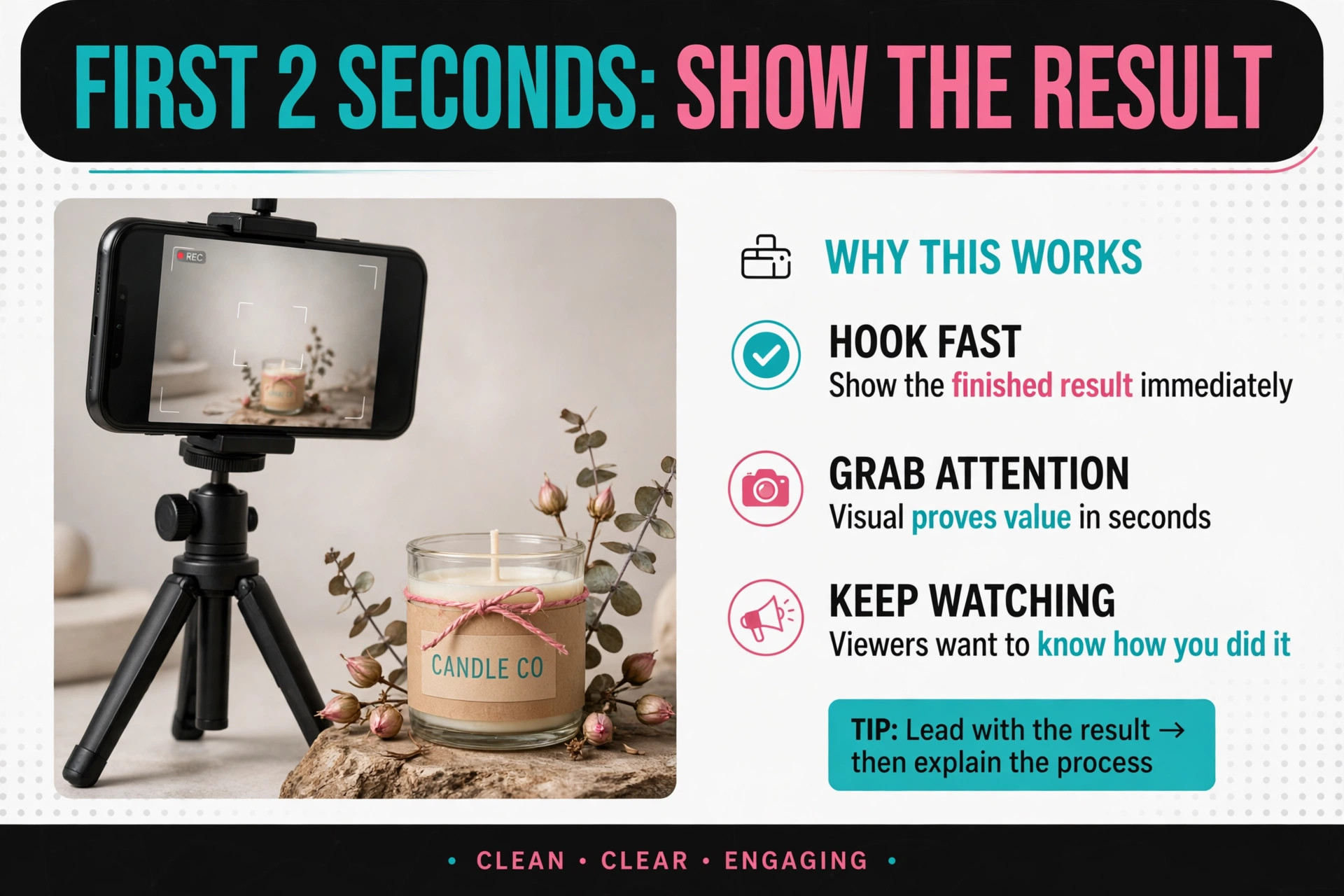
Strong hooks for small businesses lead with a result, a price, a problem, or a transformation. A salon can open with what a stated price buys. A bakery can open with the finished cake before showing the mixing. A repair shop can open with the broken item working again. In each case the viewer sees the payoff first and stays to learn how it happened, which is the opposite order from a traditional advert that builds up to the payoff.
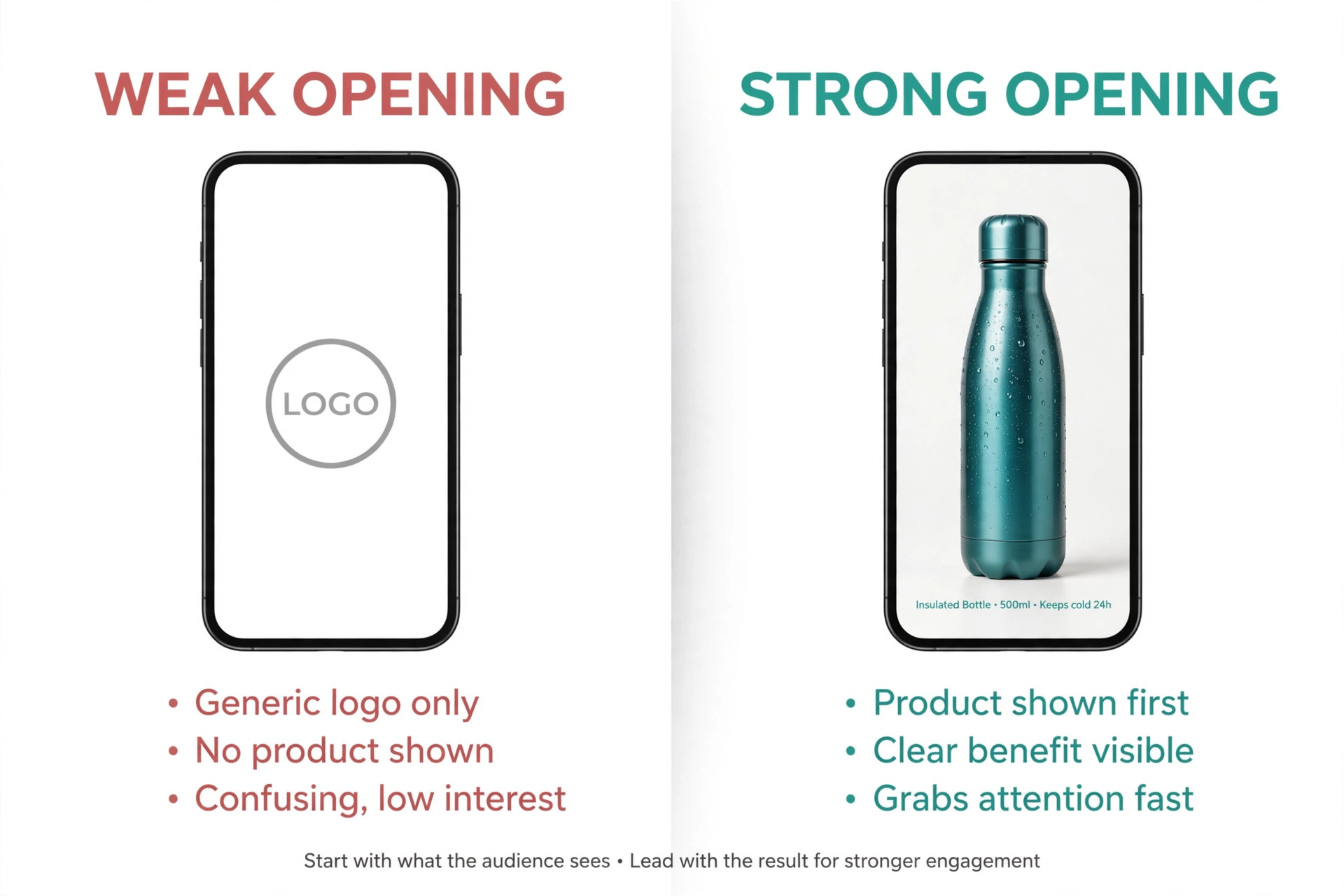
Test hooks by filming the same video with three different openings and posting them on different days. Compare average watch time and completion rate, not just views, because a hook that holds viewers for five seconds longer is the hook that earns wider distribution. Keep the winning structure and vary the product, so the account builds a recognisable style without repeating the same video.
Hooks That Work for Different Small Businesses
A service business hook should name the customer’s problem in their own words, such as a drain that keeps blocking or a dog that hates bath time. A product business hook should show the product solving a visible problem in the first shot. A food business hook should show the finished dish, the first bite, or the most satisfying step of preparation. In all three cases the viewer understands the video’s value before deciding whether to keep watching, which is the whole job of a hook.
A common question at this stage is whether a business should change its topic entirely, and the answer is usually no. A business that wants to fix TikTok videos not getting views small business accounts suffer from should first tighten the topic it already serves, because a clear topic with a good hook beats a new topic with the same weak opening. Change the hook, the first shot, and the caption clarity before considering a topic change, and give the tightened version at least five videos to prove itself.
Step 4. Check Whether the Right Audience Ever Saw the Video
TikTok ranks a video for each viewer based on what that person watches, likes, shares, comments on, and skips, plus details of the video itself such as its caption, sound, hashtags, and length. A video that reaches the wrong audience will perform badly even with a good hook, because the initial viewers have no interest in the topic. Audience mismatch is especially common for businesses that mix personal content, broad trends, and product videos on one account, leaving TikTok unsure who the account serves.
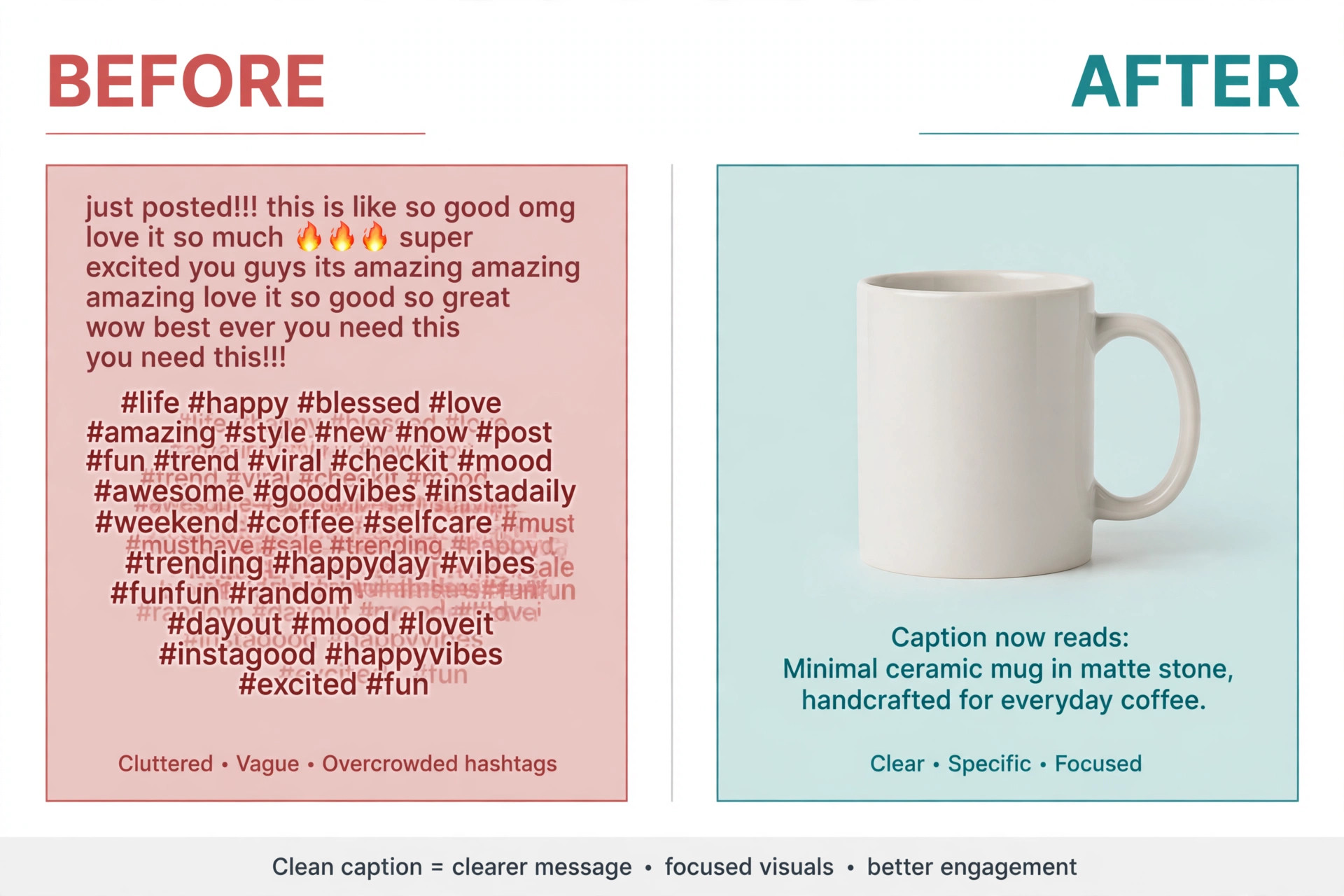
Fix audience mismatch by making the topic obvious in every element of the video. The caption should name the product or problem plainly. The spoken words should name it too, because TikTok uses speech and captions as signals. Hashtags should be specific to the niche, such as a town plus a trade, rather than a pile of broad tags that describe nobody in particular. Three specific hashtags beat fifteen generic ones, because specific tags help TikTok find the people who actually want the video.
Consistency also teaches the audience system. Posting three short videos a week, every week, on a clear topic gives TikTok a pattern to learn from, while three videos one week followed by silence for three weeks teaches nothing. A business does not need to post daily. It needs a rhythm it can sustain, with each video serving the same kind of customer. Over a month, that rhythm produces a far clearer audience signal than a burst of unrelated posts.
Step 5. Check Watch Time, Completion, and the Next Step
Once the right audience sees a good hook, the next question is whether they stay. Average watch time and completion rate matter more than likes, because a viewer who watches to the end signals interest far more strongly than a viewer who double taps and scrolls on. Short videos have a natural advantage here, since a thirty second video is easier to finish than a three minute one, but length alone does not fix a video that repeats itself or buries the point.
Cut ruthlessly. Remove the slow intro, the repeated explanation, and the five seconds of walking to the product. Keep one idea per video, deliver it, and end with one clear next step, such as saving the video, commenting a keyword, following for part two, or booking through the bio link. A video with five calls to action gives the viewer five reasons to do nothing, while a video with one clear step gives them a single easy action.
Watch the retention graph in TikTok Studio for the exact second viewers leave. If most viewers leave at the same point, something at that point is the problem, such as a dull explanation, a jump cut that confuses, or a sound change that jars. Fix that moment in the next video rather than rebuilding the whole format. Small, specific edits based on the retention graph improve videos faster than wholesale format changes based on guesswork.
Sound choice deserves a second look for any owner trying to fix TikTok videos not getting views small business pages report, because a sound that worked for a personal account may be restricted on a business account. Test the same video idea with a cleared commercial sound and with the clip’s own audio, and compare retention rather than guessing which sounds better. The version that holds viewers longer is the right sound choice, even if it feels less trendy than the original pick.
Step 6. Check Posting Rhythm, Sound, and Caption Problems
Posting several videos at once hurts distribution, because the feed avoids showing the same creator twice in a row, so simultaneous posts end up competing with each other. Space posts out across days, and give each video time to find its audience before posting the next. A business that films in batches should still publish on a spaced schedule, not upload the whole batch on Sunday night.
Sound problems are easy to miss. A trending sound that is not cleared for business use, a muted clip, or a voiceover drowned by music can all limit a video. For talking clips, the speech is the point, so keep it clear and let the music sit underneath rather than over it. If a sound is restricted in a region, the video may underperform there for reasons that have nothing to do with content quality, so check sound availability before blaming the idea.
Captions deserve the same care. A caption that names the product, the town, and the benefit helps both viewers and the recommendation system, while a caption full of unrelated trending tags confuses both. Write captions for humans first, with the key information in the first line, since many viewers read only that far. Avoid engagement bait and misleading claims, because both can draw guideline attention that costs far more than a few extra comments are worth.
Engagement shortcuts are tempting precisely because they promise fast numbers, but an owner who wants to fix TikTok videos not getting views small business owners face must resist them completely. Bought followers never buy products, never visit a shop, and never leave useful comments, yet they distort every metric the owner uses to judge content. A clean account with a small real audience is a far stronger asset than a large account whose numbers describe nobody who can become a customer.
Step 7. Check for Spam Signals and Engagement Shortcuts
Buying followers, joining engagement pods, using automation to mass follow, or reposting the same video repeatedly can all make a video ineligible for the For You feed, and can damage the account beyond a single post. These shortcuts also fill analytics with people who will never buy, which makes every later diagnosis harder, because the numbers no longer describe real customers. If a business used any of these tactics, stop them completely before judging new content.
Reposting deserves special care. Deleting and reposting the same underperforming video rarely helps, because TikTok may treat it as unoriginal material, and the repost carries no new audience signal. Instead, film a genuinely new version with a better hook, a clearer topic, and a tighter edit, and let that version earn its own distribution. A new version also gives the business a fair test, since the old video’s failure may have been caused by a fixable element rather than the idea itself.
Spam signals also include posting behaviour, such as dozens of hashtags, repetitive comments on other accounts, and follow and unfollow cycles. A business account should behave like a business, posting its own content, replying genuinely to comments, and engaging with a small number of relevant accounts. Genuine engagement builds an audience that buys, while artificial engagement builds numbers that impress nobody who matters.
Before starting the recovery plan, record a baseline for the last five videos, covering views, average watch time, completion rate, and traffic source. An owner who wants to fix TikTok videos not getting views small business accounts show should be able to prove improvement with numbers, not feelings, and a baseline makes that proof possible. Without a baseline, a modest improvement feels like failure, and a lucky video feels like a strategy, and both misreadings lead to bad decisions.
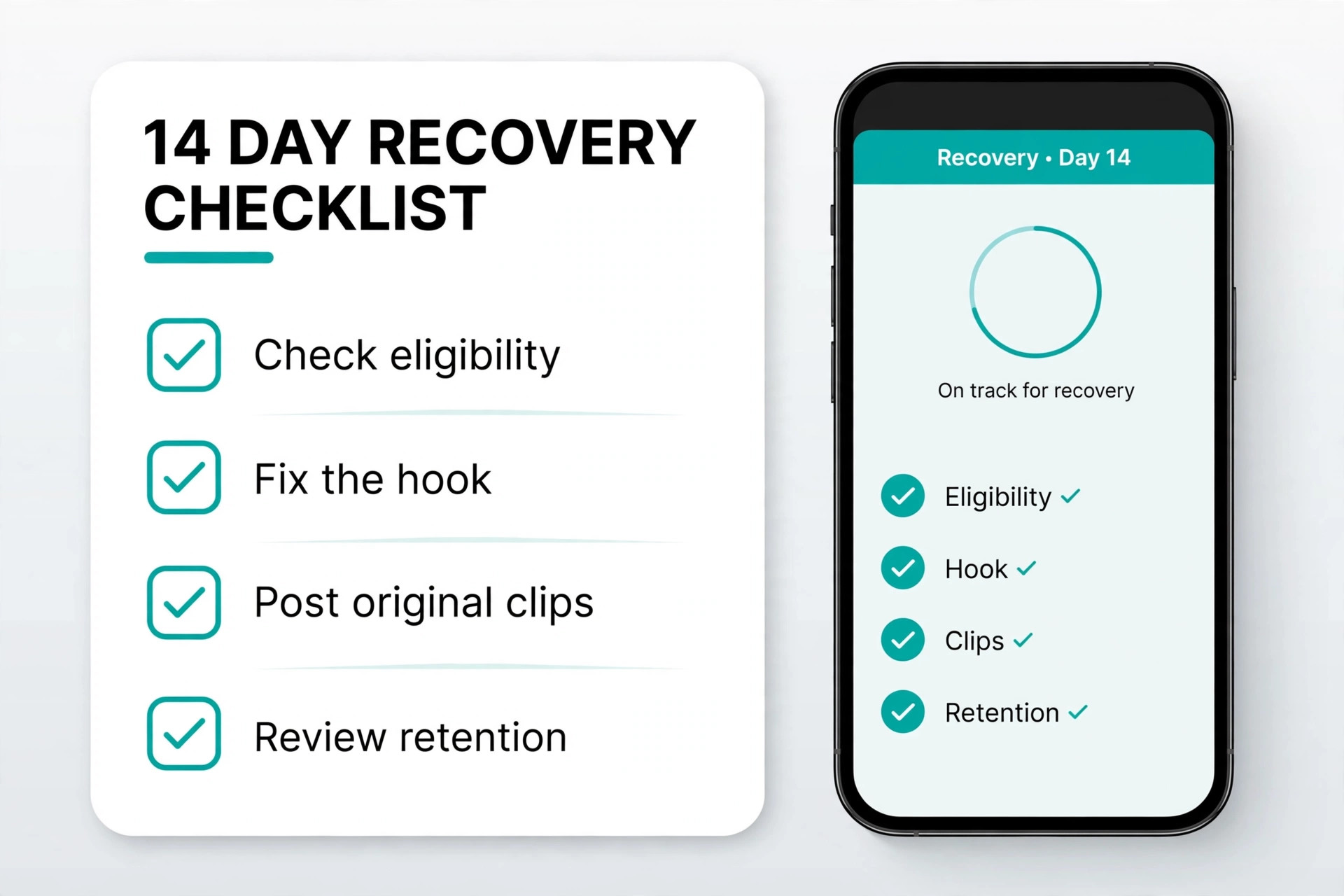
Reach Recovery Checklist for the Next Fourteen Days
This checklist is the copyable recovery plan. Follow it in order for fourteen days, and judge the result on watch time and completion rate as well as views, because reach recovery shows up in retention first. Do not change the plan halfway through, since a diagnosis needs a stable test to mean anything.
Run Account Check and confirm no warning or restriction is active.
Confirm the account is public and each video audience is set to everyone.
Check the last five videos in TikTok Studio for eligibility notes.
Rewrite the hook for the next video to lead with a result or problem.
Film one idea per video and cut the length to the shortest version that works.
Name the product and town in speech, caption, and on screen text.
Use three specific hashtags instead of a pile of broad tags.
Post three videos in the week, spaced across different days.
End each video with one clear next step for the viewer.
Reply to every genuine comment within a day of posting.
Stop all bought engagement, pods, and automation immediately.
Compare retention graphs and keep the hook structure that holds viewers longest.
A checklist only helps if the business resists adding extra tactics during the test period. A new trending sound, a new format, and a new posting time all at once make it impossible to tell what worked. Change one element at a time after the fourteen day test, keep what improves retention, and drop what does not. Recovery is usually gradual, with watch time improving first and views following, so judge the test on the full picture rather than a single video.
Another mistake worth naming is filming without a plan for the first shot, since an owner trying to fix TikTok videos not getting views small business pages struggle with often films a good demonstration and then discovers the opening is dull. Plan the first two seconds before filming anything else, write the hook sentence down, and film that shot first while energy is highest. A video built around a planned hook needs far less editing than a video that searches for a hook in the edit.
Mistakes That Keep Small Business Videos Stuck
The most damaging mistake is treating TikTok like a television advert slot. A polished advert that talks about the business for thirty seconds, shows a logo, and ends with a phone number will be skipped, because viewers came to TikTok for entertainment and useful content, not adverts. A video that teaches something, shows a satisfying process, or answers a real customer question will hold viewers, and holding viewers is what earns distribution. Teach first, sell second, and let the bio link do the selling.
The second mistake is copying a viral format without adapting it to the business. A dance trend, a trending sound, or a popular format only helps if it carries the business message clearly, and a forced trend that confuses viewers about what the business sells does more harm than good. Adapt trends sparingly, keep the product visible, and drop any trend that makes the business look like it is trying too hard. Shoppers trust a business that looks comfortable, not one chasing every trend.
The third mistake is ignoring comments. Comments are both an audience signal and a source of video ideas, since the questions shoppers ask in comments are the topics the next videos should answer. Replying promptly, answering honestly, and turning a good question into a follow up video builds a loop where each video creates the next one. A business that never replies looks absent, and an absent business rarely earns repeat viewers.
Businesses facing a related account problem should check the right guide for that problem rather than applying this diagnosis blindly. A suspended account follows a different path, covered in a guide to fixing a suspended TikTok account for small business, and a crashing app needs a technical fix first, as explained in a guide to fixing TikTok app crashes on Android. Short video production skills also help, and a guide to CapCut for TikTok product demos covers editing that keeps viewers watching. Diary problems elsewhere in the business, such as two clients booked at once, are covered in a guide to fixing Calendly double booking, while seasonal demand ideas appear in a guide to booking software for outdoor rental businesses.
How to fix TikTok videos not getting views small business Owners Can Test in One Month
A one month test gives the diagnosis time to work, because audience signals build over weeks rather than days. In week one, fix eligibility and account issues and post three videos with planned hooks. In week two, tighten topic clarity and captions based on the retention graphs from week one. In week three, test one new hook structure against the winner from the first two weeks. In week four, keep the winning structure and answer the best comments as new videos, so the account ends the month with a format that is proven rather than guessed.
The monthly review should compare the first five videos of the month with the last five, using average watch time, completion rate, and For You traffic share. An owner who wants to fix TikTok videos not getting views small business accounts experience should look for steady improvement in those three numbers, not for a single breakout video. Steady improvement means the system works, and a working system can be repeated, while a single viral video that cannot be repeated teaches the owner nothing about what to film next.
Frequently Asked Questions
How long should a business wait before judging a video?
Wait at least twenty four hours, and judge a pattern across five or more videos rather than one. A single video can underperform for reasons that have nothing to do with strategy, while five videos with the same weakness reveal a real problem. New accounts may also need time before TikTok has enough signal to match videos to an audience.
Does posting more often fix low views?
No, posting more often usually makes the problem worse, because rushed videos have weaker hooks and thinner ideas. Three well made videos a week beat ten rushed ones, and spaced posting gives each video room to find its audience. Fix the hook and the audience match first, then consider frequency.
Should a small business delete low performing videos?
Generally no. Deleting videos removes the data that shows what went wrong, and reposting the same video rarely improves performance. Keep low performers, study their retention graphs, and film a new version with the weakness fixed. Delete only material that breaks a guideline or contains an error that misleads customers.
Hashtags matter as a topic signal, but they cannot rescue a weak video. Use a small number of specific tags that describe the product, the trade, and the town, and rely on speech, captions, and on screen text to carry the main topic signal. Broad trending tags add little, and a pile of unrelated tags can confuse the audience match.
Is a business account better than a personal account for reach?
A business account gives access to business tools and the Commercial Music Library, which matters for sound clearance, but the account type alone does not decide reach. The video’s hook, topic clarity, and retention decide reach. Choose the account type that fits the business needs, keep it public, and focus effort on the video itself.
When should a business seek help rather than keep testing?
Seek help when Account Check shows a restriction that does not lift, when videos remain ineligible after original content is posted, or when an appeal is needed. In those cases, document the issue with screenshots, follow the platform’s review path, and avoid workarounds such as new accounts. A documented, patient appeal beats repeated guessing.
One last habit separates businesses that recover from businesses that stay stuck, which is a short weekly review written down rather than kept in the owner’s head. Spend twenty minutes each Sunday recording the week’s views, watch time, completion rate, best hook, and best comment question, then choose one change for the next week based on those notes. A written review prevents the common trap of changing everything at once after a bad week, and it builds a record that shows which hooks, topics, and formats actually work for this business rather than for businesses in general.
What Recovery Looks Like in Practice
Recovery rarely arrives as a single viral video. It arrives as a gradual pattern, with average watch time rising, completion rates improving, and views climbing steadily across a month of consistent posts. A business that tracks those three numbers weekly will see recovery before it feels dramatic, and that early evidence keeps the owner posting through the quiet weeks. Patience with data beats panic with tactics.
Start with the diagnosis order in this guide, run the fourteen day checklist without adding extra tactics, and keep the hook structure that holds viewers longest. Build each new video from the comments and questions of the last, so the account becomes a conversation with real customers rather than a broadcast to strangers. A small business does not need a million views. It needs the right few thousand people in its town to watch, remember, and visit, and that audience is earned one clear, honest video at a time.