
A typical winery now pays 700 dollars a month or more for software that still does not talk to itself, according to Solera founder Kevin Nesgoda in June 2026. Vineyard records sit in one system, cellar logs in another, sales in a third, and the owner reconciles them by hand at the end of harvest. That fragmentation is the problem the best ai tools for winery owners are built to solve, and it is also why so many wineries buy the wrong system first.
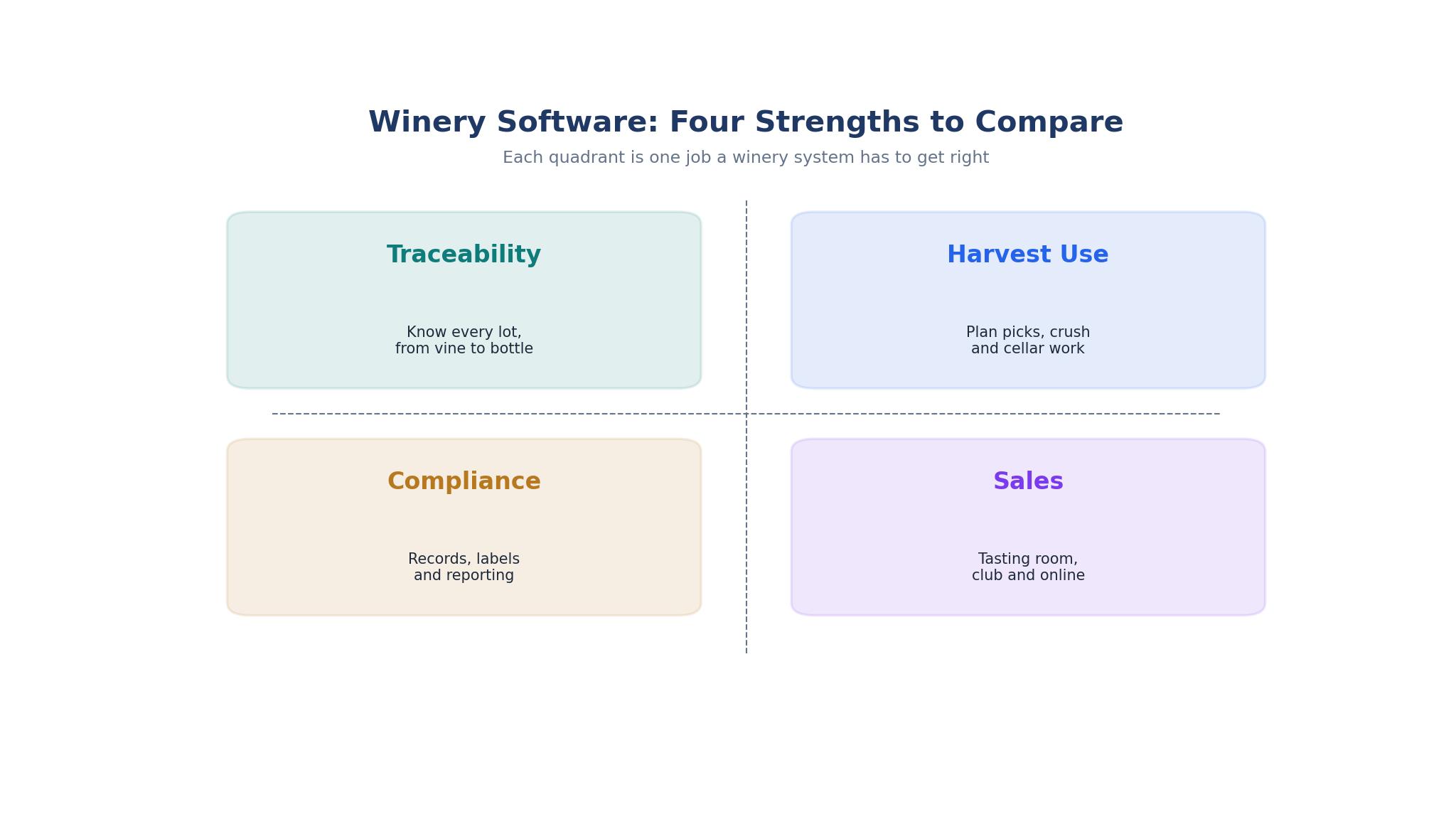
The market splits into two kinds of software. The first kind manages production, tracking grapes from the block to the bottle with lot traceability, lab results and TTB compliance reports. The second kind sells wine, running the tasting room, the wine club and the online store.
This guide compares fifteen tools that matter for a winery owner in 2026. Prices come from vendor pages and 2026 buyer guides checked in November 2026. InnoVint and vintrace do not publish prices, so this guide says custom quote rather than inventing a number. The verdict at the end names one pick for a small boutique winery and one for a larger operation that needs production depth.
A winery does not need the biggest system on the market. It needs the one that matches its case volume, its compliance burden and the hours its team can actually spend learning software during harvest.
What a Winery System Has to Get Right
Traceability comes first. Every lot needs a record from the vineyard block through fermentation, blending and bottling, because a recall, an audit or a customer question can arrive years after the vintage.
Second, the system has to survive harvest. That means a mobile app that works in a cellar with poor signal, a fast way to log additions and lab results, and a screen a tired cellar hand can use at midnight without training. A beautiful desktop dashboard that nobody opens during crush is decoration, not software.
Third, compliance has to be built in rather than bolted on. In the United States, the TTB 5120.17 report is the monthly chore every bonded winery must complete, and a system that generates it from the same lot data the cellar already entered removes a whole day of work each month. That built-in compliance is a core test for the best ai tools for winery owners. Buyers should ask every vendor to show the report generated from sample data before signing.
Why Small Wineries Keep Overpaying
The enterprise systems price by case volume, and the numbers are steep. Buyer guides in 2026 put InnoVint at roughly 15,000 to 45,000 dollars a year and vintrace at 12,000 to 60,000 dollars a year, depending on production. Those figures buy depth a 5,000-case winery will never use, and the vineyard module often costs extra on top. A small winery that signs an enterprise contract is paying for a system built for a producer ten times its size.
The newer tools changed that math. GrapeFlow charges 99 dollars a month with every module included and no per-seat fee, aimed squarely at boutique wineries producing up to 20,000 cases. Solera starts at 69 dollars a month with a free tier for home winemakers. Cepaos starts at 19 dollars a month for vineyard-only work. A 3,000-case winery can now run a real system for the price of a few cases of wine a month.
The trap is buying on price alone. A 99 dollar system that cannot produce a clean TTB report is more expensive than a quoted enterprise system that can. The right comparison is the cost per case against the hours saved, and this guide works that math in the cost section near the end.
The 15 Tools at a Glance
The table below gives the short version of the best ai tools for winery owners, with the starting price each vendor lists or a note where pricing is quote-only. Read it as a shortlist, then use the detailed sections to check traceability, compliance and the mobile app before choosing.
| Tool | Main job | Best for | Starting price |
|---|---|---|---|
| InnoVint | Cellar and production management | Mid-size and large wineries | Custom quote |
| vintrace | Winery and vineyard management | Larger producers with volume | Custom quote |
| Ekos | Brewery, winery and cider operations | Producers with taproom sales | Custom quote |
| Vinsight | Wine production and inventory | Small to mid-size wineries | Custom quote |
| GrapeFlow | Vineyard to bottle, all modules | Boutique wineries to 20,000 cases | $99 per month |
| Solera | Full lifecycle, vineyard to consumer | Small wineries wanting one login | $69 per month |
| Cepaos | Vineyard and winery records | Small certified wineries | $19 per month |
| WineDirect | DTC sales and wine club | Wineries selling direct | Custom quote |
| Commerce7 | DTC storefront and club | Wineries that sell online | Custom quote |
| ShipCompliant | Compliance and shipping | Wineries shipping across states | Custom quote |
| VineSpring | DTC sales and club management | Small wineries selling direct | Custom quote |
| OrderPort | Winery POS and ecommerce | Tasting room sales | Custom quote |
| Trellis | Vineyard analytics and AI | Growers using sensor data | Custom quote |
| Fruition Sciences | Vineyard data and irrigation | Vineyards managing water | Custom quote |
| VineView | Aerial vineyard imaging | Growers mapping vine health | Custom quote |
Best Pick by Job
No single system fits every winery, so the table below matches the best ai tools for winery owners to the five most common buying situations. Find the row that describes the operation, then test the two tools named there during a real harvest week before paying.
| Job type | First pick | Second tool | Why this pair works |
|---|---|---|---|
| Boutique winery under 5,000 cases | GrapeFlow | Solera | GrapeFlow covers production and compliance in one price, while Solera adds a storefront and AI assistant |
| Mid-size producer, cellar depth first | InnoVint | vintrace | InnoVint leads on cellar workflows, while vintrace adds vineyard tracking for larger teams |
| Selling direct, club and online | WineDirect | Commerce7 | WineDirect owns the club workflow, while Commerce7 gives a modern storefront |
| Shipping to many states | ShipCompliant | WineDirect | ShipCompliant handles the compliance maze, while WineDirect runs the sales side |
| Grower focused on the vineyard | Trellis | Fruition Sciences | Trellis turns sensor data into decisions, while Fruition Sciences focuses on water and vine balance |
How to Judge the Best AI Tools for Winery Owners
Judging the best ai tools for winery owners starts with a lot, not a brochure. Pick one real lot from last vintage, and ask each vendor to trace it from the vineyard block to the bottle on screen. The tools that show the full chain in under a minute are the ones that will survive an audit. The tools that need a support call to demo it will need one every month.
Next, test the mobile app where the work happens. Stand in the cellar, log a lab result and a barrel addition on a phone, and see how many taps it takes. A system that needs ten taps per entry will be abandoned by the second week of harvest, whatever the desktop demo promised.
Finally, ask the AI assistant a question it should answer from the data, like which lots are ready to bottle this week. A good assistant reads the live records and answers with numbers. A weak one gives a generic paragraph. The difference is the difference between a tool and a toy.
The 15 Tools in Detail
Each entry below covers what the tool does best, where it falls short, and who it fits, plus a practical test to run during the trial. The order follows the glance table, and the prices are the starting figures from the best ai tools for winery owners shortlist above.
1. InnoVint
InnoVint is the modern standard for cellar and production management, built mobile-first so the team logs work from the crush pad rather than a desk. It tracks wine from grape to bottle with lot traceability, work orders, lab analysis and inventory, and it generates the TTB reports from the same data.
The drawback is price and scope. InnoVint does not publish pricing, with buyer guides placing it at roughly 15,000 to 45,000 dollars a year by case volume, and the vineyard GROW module costs extra. There is no wine club or storefront, so a winery still needs a separate sales system.
InnoVint suits a mid-size or large winery that lives in the cellar and needs production depth above all. It is too much system, and too much money, for a 2,000-case boutique operation.
To test it honestly, hand a phone to the newest cellar hand, ask them to log a fermentation addition without help, and time the task. If it takes more than two minutes, the training cost will eat the first harvest.
2. vintrace
vintrace is the established cloud system for larger wine producers, covering winery management, vineyard tracking and mobile work in one platform.
The drawback is the same as its strength. Pricing is quote-only, with buyer guides placing it at roughly 12,000 to 60,000 dollars a year by volume, and the system carries the weight of an enterprise platform. A small team will use a fraction of what it offers while paying the full price.
vintrace suits a larger producer, a custom crush facility or a winery group that needs one system across several sites. It is the wrong first system for a boutique winery.
To test it honestly, ask the vendor to generate a TTB 5120.17 from sample data in the demo, and watch whether it comes from live lot records or a prepared export. The answer shows how much manual work the report really needs.
3. Ekos
Ekos manages production, inventory and sales for wineries, breweries and cider makers in one system, which matters for a producer with a taproom or tasting room alongside the cellar. It tracks raw materials, batches and finished goods, and it connects production costs to the sales that recover them.
The drawback is that Ekos is a general beverage platform rather than a wine specialist. Its wine compliance and vineyard features are thinner than InnoVint or vintrace, and pricing is quote-only, with buyer guides placing it at roughly 6,000 to 18,000 dollars a year.
Ekos suits a winery that also brews or pours cider, or a producer whose tasting room is half the business. A pure wine estate that needs deep vineyard tracking will find it light.
To test it honestly, trace one batch from raw material to a taproom sale, and check that the cost per unit follows the batch all the way through. If the numbers break at the sales step, the system is two systems pretending to be one.
4. Vinsight
Vinsight is a focused wine production and inventory system for small to mid-size wineries, covering fermentation, blending, bottling and stock without the enterprise weight.
The drawback is scope and price transparency. Pricing is quote-only, with buyer guides placing it at roughly 5,000 to 15,000 dollars a year, and it does not cover vineyard management or direct sales, so a winery still needs other tools for the field and the shop.
Vinsight suits a small to mid-size winery that wants production records done properly without buying an enterprise platform. It fits a team that already sells through a separate DTC system.
To test it honestly, enter a full vintage of blending trials and check that the system keeps every trial version without overwriting the last one. Blending history is where a weak system quietly loses the record that matters.
5. GrapeFlow
GrapeFlow is the clearest value in this guide for a boutique winery. One plan at 99 dollars a month covers vineyard records, cellar operations, lot traceability and the US compliance set, with unlimited users and no add-on modules.
The drawback is youth. GrapeFlow launched in late 2026, so its track record is short and its integration list is smaller than the established platforms. A winery that needs deep third-party connections may find gaps.
GrapeFlow suits a boutique or certified winery that wants everything in one price and no per-seat surprises. It is the first system to check for any winery under 10,000 cases.
To test it honestly, run the 90-day trial through a real harvest month, and generate the TTB report from live data at month end. A trial that covers harvest is the only trial that means anything.
6. Solera
Solera covers the full winery lifecycle in one login, from vineyard blocks and lab tracking through cellar management, TTB compliance and a direct-to-consumer storefront. Its Ask Solera AI assistant answers questions about the operation from live data, and pricing starts at 69 dollars a month for the Pro tier, with a free Hobbyist tier for home winemakers and Growth at 129 dollars a month.
The drawback is newness. Solera launched globally in June 2026, so the storefront and wine club features were still rolling out late in the year, and a buyer should confirm the exact features live before relying on them.
Solera suits a small winery that wants one system from vine to consumer and likes the idea of asking an AI assistant about the cellar. It is a strong alternative to buying two systems.
To test it honestly, ask the AI assistant three questions about live sample data, such as which tanks need attention this week, and check whether the answers cite real numbers or general advice. The numbers are the test.
7. Cepaos
Cepaos serves small certified wineries with a tiered price that starts at 19 dollars a month for vineyard-only work, rising to 49 dollars for winery-only, 149 dollars for a combined boutique plan, and higher tiers for larger estates. It covers vineyard treatments, winery operations and TTB-ready records, with a biodynamic calendar available as an add-on.
The drawback is scale. The tier limits on volume and users mean a growing winery will climb the price ladder, and the platform is smaller and less widely reviewed than the established names.
Cepaos suits a small organic or biodynamic winery that wants compliance records and vineyard logs at a low price. It fits a producer that values the sustainability records an audit will ask for.
To test it honestly, enter one season of vineyard treatments and check that the field log exports in the format an auditor expects. If the export needs rework, the cheap plan is not cheap.
8. WineDirect
WineDirect is the direct-to-consumer standard for wineries that sell through a wine club and an online store. It runs the storefront, the club, order management and the tasting room POS in one system, and it is built around the wine business rather than adapted from generic ecommerce.
The drawback is that it is a sales system, not a production system. It does not manage the cellar or the vineyard, and pricing is custom quote, so a buyer must go through sales to learn the real cost, which scales with order volume and features.
WineDirect suits a winery whose direct sales are the business, with a club of hundreds or thousands of members. It is the wrong first purchase for a winery that has not yet fixed its production records.
To test it honestly, run a club shipment end to end in the trial, from allocation to the packing list, and count the manual steps. Club season is where a weak system creates a week of extra work.
9. Commerce7
Commerce7 is the modern DTC platform many newer wineries choose, with a clean storefront, club management and customer data tools that feel built for 2026 rather than adapted from older software.
The drawback is price transparency. Commerce7 does not publish pricing, so the cost only appears after a sales conversation, and the platform is strongest on sales rather than production. A winery still needs a cellar system alongside it.
Commerce7 suits a winery building its direct sales from scratch with a modern store and a growing club. It fits a team that wants good design and good customer data without legacy baggage.
To test it honestly, build a club offer for one segment of customers and check how easily the system targets just those buyers. Segmentation is the feature that pays for this platform.
10. ShipCompliant
ShipCompliant solves the problem that stops many wineries from selling across state lines, which is compliance. It checks shipping rules, tax rates and license requirements for every destination, and it plugs into the sales systems a winery already runs.
The drawback is that it is a compliance layer, not a full system. It does not sell wine, manage the cellar or run a club, and pricing is custom quote based on volume. A winery that only ships within its home state does not need it.
ShipCompliant suits any winery that ships direct to consumers in more than a handful of states. It is essential insurance once interstate volume grows past a trickle.
To test it honestly, run ten real orders to ten different states through the checker and confirm the tax and license results match the winery compliance advisor. One wrong state is the whole reason this tool exists.
11. VineSpring
VineSpring is a DTC platform for small wineries, covering the online store, wine club and customer management at a scale that fits a boutique operation. It is simpler and faster to set up than the enterprise DTC platforms, and it focuses on the club and store workflows a small winery actually runs, without the features a large team needs.
The drawback is that it is sales-only and quote-priced, so a winery must ask for the number and still needs a production system.
VineSpring suits a small winery starting direct sales, with a club of dozens to a few hundred members. It is a sensible first DTC system before the operation grows into an enterprise platform.
To test it honestly, set up a club tier and a store product in the trial, then place a test order as a customer and follow it through fulfillment. The checkout experience is the product here.
12. OrderPort
OrderPort runs the tasting room and the online store together, with POS, ecommerce, club and inventory in one system built for wineries. It suits a winery where the tasting room is the main sales channel, because the same inventory serves the bar, the shelf and the website without double entry.
The drawback is that it is a sales and POS system, not a production tool, and pricing is custom quote. A winery that needs deep cellar tracking will still need InnoVint or GrapeFlow alongside it.
OrderPort suits a winery with a busy tasting room that wants one inventory across the bar and the web.
To test it honestly, sell the same bottle at the bar and online in the same hour, and check that the inventory count drops correctly in both places. One inventory is the promise being bought.
13. Trellis
Trellis turns vineyard sensor and imagery data into decisions, using AI to read vine health, water stress and yield signals across blocks. It helps a grower decide where to irrigate, where to thin and where to harvest first, rather than treating every block the same.
The drawback is that it is an analytics layer, not a management system. It does not run the cellar, the club or compliance, and pricing is custom quote, so the cost depends on acreage and data sources.
Trellis suits a grower with enough acreage that block-by-block decisions pay for the software. It is overkill for a two-acre estate vineyard.
To test it honestly, pick three blocks the grower already knows well, and check whether the system flags the same problems the grower sees on foot. If it misses what the eye sees, the models are not ready for that vineyard.
14. Fruition Sciences
Fruition Sciences measures vine water status and turns it into irrigation advice, helping a vineyard use less water while keeping fruit quality high. Its sap-flow sensors and data platform give a grower numbers where the old method was a guess and a walk through the rows.
The drawback is narrowness. It covers water and vine balance, not the whole vineyard operation, and pricing is custom quote. A winery still needs a management system for records, labor and compliance.
Fruition Sciences suits a vineyard in a dry climate where irrigation timing decides quality. It fits a grower who already measures and wants better numbers, not a grower who has never irrigated by data.
To test it honestly, compare its irrigation recommendation against the grower own plan for one block over a month, then check the vine readings at the end. The data should beat the guess, or the subscription is not earning its place.
15. VineView
VineView flies aerial imaging over a vineyard and maps vine vigor, gaps and stress block by block, turning a walk that takes days into a picture that takes minutes.
The drawback is that it is an imaging service, not daily management software. It does not track lots, run the cellar or sell wine, and pricing is custom quote based on acreage and flight frequency.
VineView suits a larger vineyard where seeing the whole property at once changes decisions. It is a luxury for a small estate that one person can walk in an afternoon.
To test it honestly, ask for a map of a block the grower knows is uneven, and check that the image shows the weak rows the grower already suspects. A map that only confirms the obvious is still useful, but a map that finds a hidden problem is the real value.
What a Winery Pays in Year One
Work the math per case, because that is how a winery thinks. A 3,000-case winery on GrapeFlow pays 99 dollars a month, or about 1,188 dollars a year, which is roughly 40 cents per case. The same winery on Solera Pro at 69 dollars a month pays about 28 cents per case.
The enterprise systems look different at the same volume. A winery paying 20,000 dollars a year for InnoVint or vintrace at 3,000 cases is paying more than 6 dollars per case, which only makes sense if the production depth saves real labor or prevents real errors. At 30,000 cases, the same 20,000 dollars is under 70 cents per case, and the enterprise depth starts to earn its price. Case volume, not the feature list, decides which tier is rational.
Add the sales side separately. WineDirect, Commerce7 and ShipCompliant are quote-priced, so a buyer should get written quotes for all three and add them to the production cost before comparing totals. A winery that budgets 2,000 dollars a year for production software and forgets the 5,000 dollar DTC and compliance bill has not budgeted at all.
Mistakes That Waste the First Vintage
The most common mistake is buying the sales system before the production system. A beautiful storefront cannot fix a cellar that cannot trace a lot, and the first compliance audit will expose the gap. Fix production records first, then buy the store that sells what the cellar can prove.
The second mistake is skipping the harvest trial. A system demoed in February can look perfect and fail in September, when the team is tired and the cellar has no signal. Any vendor that will not let the winery trial the system through harvest is a vendor to avoid. The best ai tools for winery owners prove themselves during crush, not during a sales call.
The third mistake is ignoring the exit. Ask how the data exports before signing, and test the export with real records.
Frequently Asked Questions
How much does winery management software cost?
A boutique winery can run a real system for 69 to 99 dollars a month with Solera or GrapeFlow, or about 40 cents per case at 3,000 cases a year. Enterprise systems like InnoVint and vintrace are quote-only, with 2026 buyer guides placing them at roughly 12,000 to 60,000 dollars a year depending on case volume. The sales side, including WineDirect, Commerce7 and ShipCompliant, adds a separate quote-priced bill on top.
Which winery software is best for a small winery?
GrapeFlow is the strongest pick for a boutique winery under 20,000 cases, because one 99 dollar monthly plan covers vineyard, cellar, traceability and compliance with unlimited users. Solera is the best alternative, starting at 69 dollars a month with a full lifecycle view and an AI assistant. Both are far cheaper than the enterprise systems, and both can be trialled through a real harvest month.
Do wineries need AI in their software?
AI helps most as an assistant that answers questions from live data, like which lots are ready to bottle or which blocks need water. Solera Ask Solera and Trellis vineyard analytics do this well. AI does not replace the core records, and a system with good AI but weak traceability is a bad buy. Buy the records first, then value the assistant on top of them.
What is TTB compliance software?
TTB compliance means the monthly 5120.17 report and the records behind it that a bonded winery must keep in the United States. Good winery software generates the report from the same lot data the cellar already entered, rather than asking the team to retype it.
Can one system run the vineyard, the cellar and the shop?
A few newer platforms try, and Solera is the closest to a single login from vine to consumer. Most wineries still run two systems, one for production and one for direct sales, connected by an integration. That split works fine when the integration is real, and it fails when the two systems only share data by spreadsheet. Check the integration in a trial, not in a brochure.
Is InnoVint or vintrace better for a large winery?
Both are strong, and the choice turns on the details. InnoVint leads on mobile-first cellar workflows and a modern interface, while vintrace carries the weight of an established platform inside Encompass Technologies with deep reporting. A large winery should trial both through a harvest month with the same lot, and pick the one the cellar team actually prefers using at midnight during crush.
Our Verdict for a Winery Owner Buying Software in 2026
For a boutique winery, GrapeFlow is the pick. One price, every module, unlimited users, and a trial that can cover harvest. A small winery that wants a storefront and an AI assistant in the same login should choose Solera instead, starting at 69 dollars a month.
A larger producer should trial InnoVint and vintrace side by side and let the cellar team decide. The enterprise price is only justified when the volume is there, and the team that lives in the system during crush is the team whose opinion matters most. Buy the records first, the store second, and the AI assistant on top, in that order.