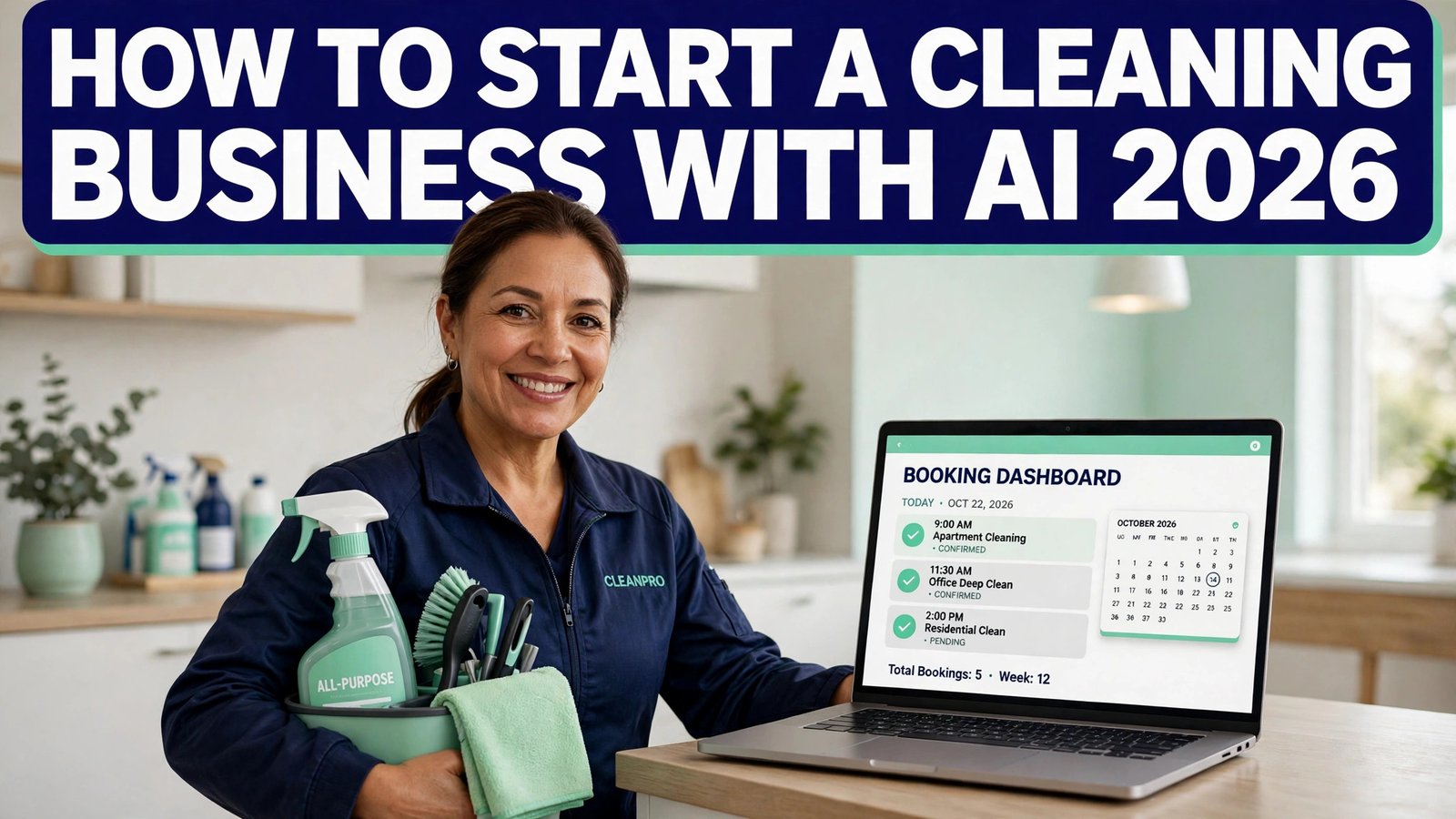
If you want to know how to start a cleaning business with AI, start with the number that surprises most new owners: most of the work is not cleaning. It is quoting, scheduling, chasing payments, answering messages, and keeping quality steady when you are not in the room. Cleaning skill gets you hired once. Systems get you hired again, and that is exactly where AI tools earn their place in a small cleaning business.
A cleaning business is still one of the lowest cost service businesses to start. You do not need a shop, a warehouse, or expensive stock. You need reliable transport, basic equipment, insurance, and a way for clients to find you, book you, and pay you without a long phone call. AI tools now handle the repetitive middle of that work: drafting quotes from a few details, writing service descriptions, answering common questions, building a weekly schedule, and sending reminders. They do not replace trust, and they do not clean a bathroom. They remove the admin drag that stops many good cleaners from growing past three or four regular clients.
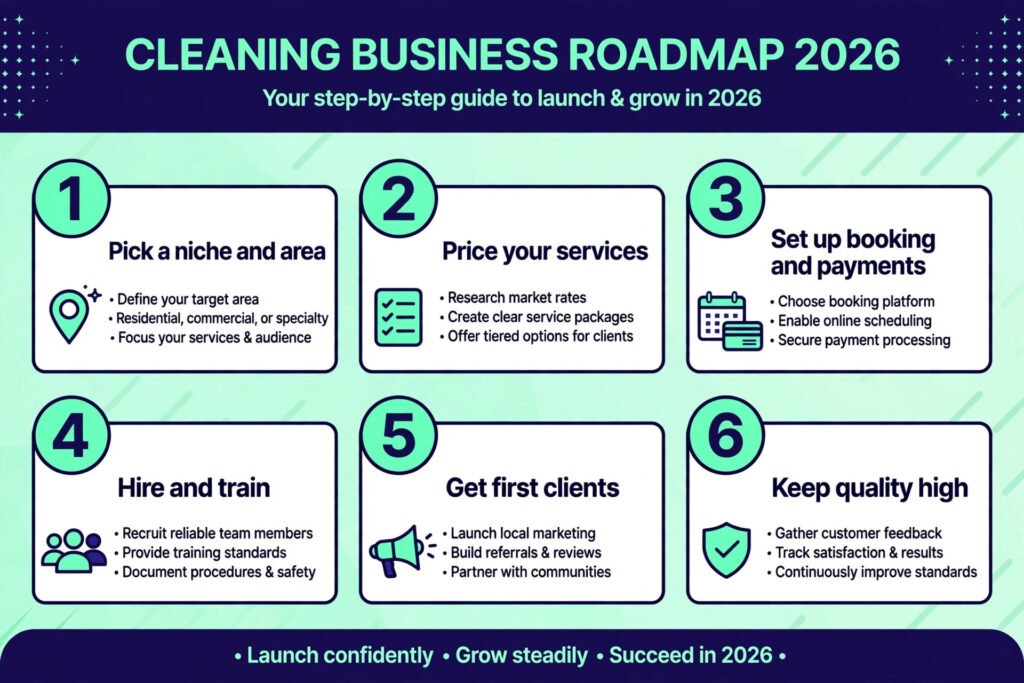
This guide gives you a practical plan. It covers startup costs, pricing, booking and payments, hiring, winning first clients, and keeping quality high. It also names the tools worth testing first and the mistakes that cost new owners money in year one.
how to start a cleaning business with AI: the quick answer
You can start a solo cleaning business for roughly $500 to $2,000 in the first month, depending on what equipment you already own and whether you need a vehicle. A small team with branded supplies, insurance, and paid booking software will more realistically need $2,000 to $5,000 before the first invoice lands. The biggest costs are usually insurance, supplies, transport, and marketing, not AI tools. Most AI tools used here cost little or nothing at entry level, and several offer free tiers.
A realistic timeline looks like this. Week one: choose your niche and area, check local rules, and get insurance quotes. Week two: set prices, build a simple booking page, and prepare your supplies. Week three: offer a small number of trial cleans at an opening rate and collect reviews. Week four onward: fill a weekly route, tighten your schedule, and add recurring clients one street at a time. Most owners who follow this pace land their first five recurring clients within four to eight weeks, provided they actually ask for bookings every day and not only when they feel ready.
The golden rule for using AI in this business is simple: let it draft, but you decide. AI can write a quote, but you set the price. AI can draft a reply, but you read it before sending. Clients forgive a plain message. They do not forgive a wrong price, a missed appointment, or a promise your team cannot keep.
Step 1: Pick a Niche and an Area
Do not try to serve everyone. A cleaning business that cleans homes, offices, carpets, windows, and post construction sites in its first month usually does none of them well. Pick one core service and one area, then expand only when your diary is full.
Good starting niches include:
- Regular home cleaning for busy households and landlords
- End of tenancy cleaning, which is priced per job and often booked at short notice
- Office cleaning for small businesses with weekly contracts
- Airbnb and short term rental turnovers, which need fast, reliable scheduling
- Specialist add ons later, such as oven cleaning or carpet cleaning, once you have the training and equipment
Your area matters as much as your niche. Cleaning is a travel business. Every extra 20 minutes between jobs eats profit and energy. Start with a radius you can cover without long drives, ideally one town or a cluster of nearby neighbourhoods. A dense route with five clients in one area beats ten scattered clients across a city, because you spend the day cleaning instead of driving.
AI helps at this stage in a quiet way. You can ask a chatbot to list the types of properties, landlords, and small businesses in your chosen area, then check each suggestion against real listings and local directories. Use it to brainstorm service names and descriptions, not to make the decision for you. Walk the area, check competitor prices, and talk to a few potential clients before you commit.
Step 2: Price Your Services So You Actually Profit
Pricing is where most new cleaning businesses fail. They charge what a neighbour charges, forget travel and supplies, and discover at month end that they worked full weeks for part time pay. Price from your costs upward, not from a guess downward.
Start with three numbers:
- Your target hourly rate after costs. For a solo cleaner this should cover your time, supplies, transport, insurance, tax, and a margin for quiet weeks.
- Your cost per job. Include travel time, cleaning products, wear on equipment, and any platform or payment fees.
- Your minimum job price. Small jobs that take an hour but cost 40 minutes of travel are often unprofitable unless priced accordingly.
Common pricing models:
| Model | How it works | Best for |
|---|---|---|
| Hourly rate | Client pays per cleaner per hour | Regular home cleaning, uncertain job sizes |
| Flat rate per job | Fixed price for a defined clean | End of tenancy, Airbnb turnovers |
| Per room or per property size | Price scales with bedrooms and bathrooms | Standardised home cleaning packages |
| Monthly contract | Fixed monthly fee for a set schedule | Offices and recurring commercial clients |
For regular home cleaning, an hourly or per property model usually works best at the start, because it is easy to explain and easy to adjust. For turnovers and end of tenancy work, flat rates protect you from jobs that run long. Whatever model you choose, write down exactly what is included and what costs extra. A client who expects oven cleaning inside a standard clean will be unhappy, and an unhappy client rarely rebooks.
AI tools can help you draft price lists, package descriptions, and quote templates, and they can turn a messy list of services into a clear page a client can understand in one minute. Feed the tool your real numbers and your real service list. If you let it invent prices, you will quote jobs you cannot afford to do. Check every figure before it reaches a client.
A simple pricing check before you launch: take your three most likely jobs, work out the full cost including travel, and confirm each one leaves a profit after tax. If one does not, raise the price or drop the job type. There is no prize for being the cheapest cleaner in town, only for being the one still trading in year two.
Step 3: Set Up Booking, Payments, and Messages
Clients now expect to book the way they order food: quickly, online, and without a phone call. You do not need a complex system on day one, but you do need three things working before you advertise: a way to be found, a way to book, and a way to get paid.
A simple setup that works:
- A one page website or booking page with your services, prices, area, and a booking form
- A business profile on Google and the main local directories, with photos of real work
- A booking tool or calendar that blocks travel time between jobs
- Online payment by card or bank transfer, with deposits for larger jobs
- Automated reminders by message or email the day before each clean
AI fits naturally here. Chat tools can draft your service pages, your booking confirmation messages, and your reminder texts. Some booking tools include AI replies that answer common questions, such as what is included, whether you bring supplies, and how cancellations work. Set clear rules for those replies. An automated answer that promises a same day clean you cannot deliver is worse than a slow human reply.
Keep your message templates short and specific. A good confirmation includes the date, arrival window, address, what will be cleaned, the price, and how to reschedule. A good reminder adds one line: please leave access instructions if you will be out. Clients who get clear messages complain less and cancel less, and that alone can add several paid hours to your month.
One caution: do not automate your way out of complaints. When a client reports a problem, a human reply within hours matters more than a perfect automated reply in seconds. Read every complaint yourself, fix what you can, and note the pattern. Three complaints about the same missed spot are a training problem, not three unlucky days.

Step 4: Hire and Train Without Losing Quality
Many owners start solo and hire only when the diary overflows. That is usually the right order. Hiring too early creates wage costs before revenue exists. Hiring too late creates missed bookings and burnt out owners. A good trigger to hire is a waiting list of at least two weeks for regular slots, or regular requests you keep turning down.
When you do hire, hire for reliability first and speed second. Cleaning technique can be taught in a week. Showing up on time, following a checklist, and telling you about a problem instead of hiding it cannot be taught as easily. A short paid trial clean tells you more than any interview question.
Training should be written down, not carried in your head. Build a checklist for each job type: what to clean, in what order, with which product, and what a finished room looks like. Photograph a finished room for each job type so new hires can see the standard. AI tools can turn your rough notes into clean checklists and training sheets, and can draft simple scripts for common situations, such as arriving when a client is home, or finding damage that was already there.
Pay attention to the legal side. Rules on employment, self employment, insurance, and background checks vary by country and region, so check your local requirements before you hire, and get insurance that covers your team as well as yourself. A cleaner working without proper cover is a risk to your business and to your clients, and no AI tool changes that.
Keep your first team small. One reliable helper you can train well beats three casual hires you cannot supervise. Grow the team one person at a time, and only when each new hire has a full enough diary to justify the cost.
Step 5: Get Your First Clients
Your first clients will almost never come from a beautiful website alone. They come from asking, from local visibility, and from doing one job so well that the client tells someone else. Plan your first month around direct action, not passive hope.
Ways to win early clients that actually work:
- Tell everyone you know, clearly and specifically: “I clean homes in [area], weekly slots from [day], prices from [amount].”
- Offer a small number of opening rate cleans in exchange for honest reviews and before and after photos, with permission to use them
- List on local directories and community groups, with real photos and a clear service list
- Leaflet the streets you want to work in, with a simple offer and a booking link, not a long essay
- Partner with landlords, letting agents, and Airbnb hosts who need reliable turnovers
- Ask every happy client for a review and a referral, on the day of the clean, not a month later
AI tools help most with the marketing that owners usually postpone. They can draft social media posts, leaflet text, and follow up messages, and they can turn one good review into several short posts. They can also help you write a simple script for asking for referrals without sounding pushy. What they cannot do is knock on doors, answer the phone with warmth, or clean a kitchen well enough that a client recommends you. Do the human work first, then let AI multiply it.
Track where each client came from. A simple spreadsheet with source, first booking date, and whether they rebooked will tell you within a month which channels deserve more effort. Most new owners discover that two channels produce most clients, and the rest only consume time. Double down on what works and stop paying for what does not.
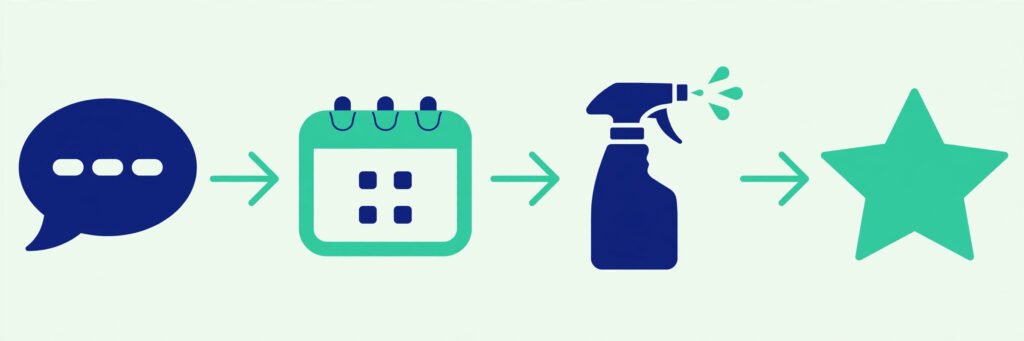
Step 6: Keep Quality High With Checklists and Feedback
Quality is your real marketing. A cleaning business with steady quality and honest communication keeps clients for years. A business with brilliant marketing and uneven cleaning loses them just as fast as it wins them.
Build quality into the job, not onto the end of it:
- A written checklist for every job type, followed in the same order each time
- A final walk through of each room before leaving, checking the spots clients notice first: sinks, mirrors, floors, and bins
- Photos of finished work for turnovers and end of tenancy jobs, taken with permission
- A short feedback message after the first three cleans with a new client, asking what to improve
- A monthly review of complaints and rebooking rates, looking for patterns
AI can summarise feedback across clients and spot patterns you might miss, such as repeated mentions of dusty shelves or streaked glass. It can also draft polite replies to critical reviews and help you rewrite a checklist after a recurring problem. Use it as a second pair of eyes on your quality data, not as a replacement for visiting a job yourself now and then.
Set one rule for your team: report problems early. A cleaner who tells you about a broken item on the day protects your reputation. A cleaner who hides it creates a dispute later. Reward honesty, fix problems quickly, and clients will trust you with their homes, which is the real asset of this business.
AI and Business Tools Compared
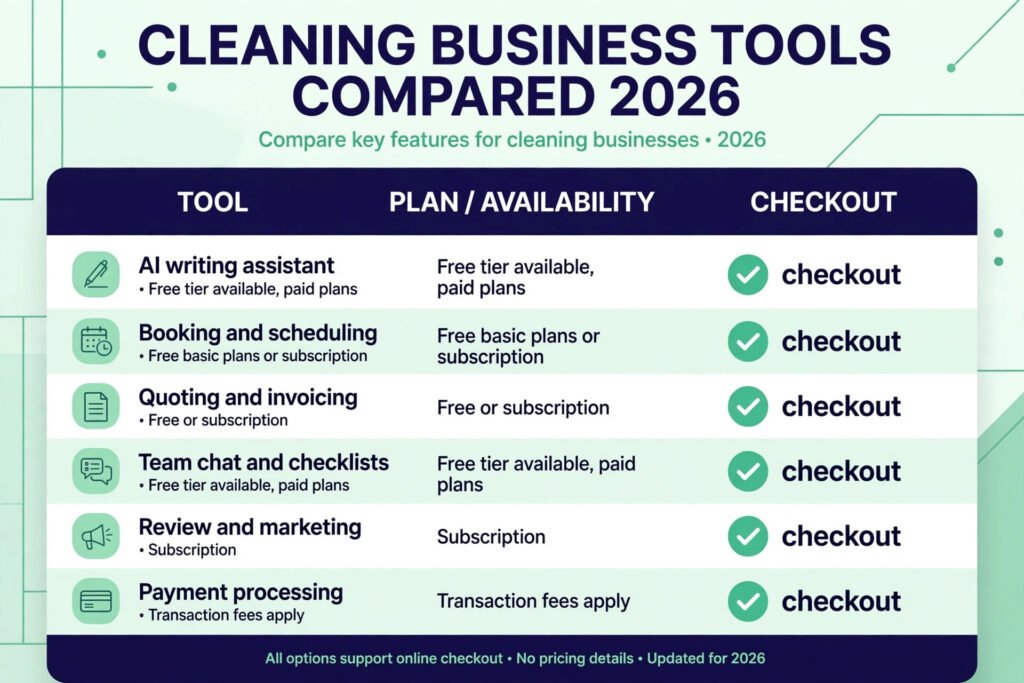
The table below compares tool types, not single products, because the best choice depends on your size and area. Prices are October 2026 guide figures only. Check the vendor checkout page before you buy, since plans and prices change.
| Tool type | What it does | Good starting options | Pricing guide |
|---|---|---|---|
| AI writing assistant | Drafts quotes, service pages, messages, and posts | ChatGPT, Claude | Free tier available, paid plans, check checkout |
| Booking and scheduling | Online booking, calendar, reminders, route planning | Calendly, BookingKoala, Jobber | Free basic plans or subscription, check checkout |
| Quoting and invoicing | Quotes, invoices, payment links, expense tracking | Wave, QuickBooks, Xero | Free or subscription, check checkout |
| Team chat and checklists | Job checklists, photo uploads, team messages | Google Workspace, Trello, Connecteam | Free tier available, paid plans, check checkout |
| Review and marketing | Review requests, local listings, social posts | NiceJob, Birdeye, Canva | Subscription, check checkout |
| Payment processing | Card payments, deposits, recurring billing | Stripe, Square, PayPal | Transaction fees apply, check checkout |
Start with one tool per job. A solo cleaner needs an AI writing assistant, a booking page, and a payment method. That is enough. Add scheduling software when you have a team, and review software when you have enough clients to make reviews a regular habit. Buying six tools before your first client is a common and expensive mistake.
When testing a tool, run it on real work for two weeks: real quotes, real bookings, real messages. A tool that looks good in a demo but adds steps to your day is not saving time. Keep the tools that remove work, and cancel the rest without guilt.

How to Choose Tools for Solo vs Team
Solo cleaners and small teams need different setups, and choosing for your current size saves money.
If you work solo: Keep it light. An AI writing assistant for quotes and posts, a simple booking page, card payments, and a checklist app are enough. Avoid team scheduling software until you actually have a team. Your biggest risk is spending evenings on admin, so pick tools that cut that time first.
If you run a small team of two to five: Scheduling and communication become the bottleneck. You need shared calendars, job checklists with photos, and a way to reassign jobs quickly when someone is ill. A job management tool pays for itself the first week it prevents a missed clean. Add review software once your team is stable, because reviews from a team need consistent quality behind them.
If you run a larger team or multiple areas: Reporting matters as much as scheduling. You need to see rebooking rates, complaint patterns, and revenue per cleaner, and you need clear roles for who handles bookings, quality checks, and complaints. AI summaries of feedback and schedules help here, but only if someone reads them and acts on them weekly.
Whatever your size, keep one rule: every tool must either win clients, save hours, or protect quality. If it does none of those three, cancel it.
Mistakes to Avoid
- Pricing too low to win work. Cheap prices attract price shoppers who leave for the next discount. Price for profit and sell reliability instead.
- Skipping insurance. One damaged item or one injury without cover can end a new business. Get cover before your first paid job.
- Taking jobs outside your area. Long drives quietly destroy your hourly rate. Stay inside a route you can defend.
- No written scope. “A full clean” means different things to different people. Write down what is included, every time.
- Hiring before the diary justifies it. Wages without bookings drain cash fast. Hire on a waiting list, not on optimism.
- Automating complaints. AI replies are fine for booking questions. Complaints need a human, quickly, and with a fix.
- Buying too many tools. Start with three: writing, booking, payments. Add more only when a real bottleneck appears.
- Never asking for reviews. Reviews are the cheapest marketing a cleaning business has. Ask on the day, while the client is happy.

Frequently Asked Questions
How much does it cost to start a cleaning business with AI?
A solo start typically costs $500 to $2,000 in the first month for supplies, insurance, transport, and a basic online presence. AI tools add little at entry level, since most offer free tiers. A small team with software and branded supplies should budget $2,000 to $5,000. Check local insurance and registration costs, since those vary by area.
Do I need experience to start a cleaning business?
No formal qualification is usually required, but practical experience helps a great deal. If you have never cleaned professionally, practise on friends or family homes, learn proper product use, and build checklists before charging clients. Specialist work such as carpet cleaning or oven cleaning needs training and the right equipment.
Can AI really help a cleaning business, or is it just hype?
It helps with admin, not with cleaning itself. AI drafts quotes, messages, posts, and checklists, and some tools answer common booking questions. That can save several hours a week. It does not inspect a room, judge quality, or handle a complaint with care. Treat it as an assistant for paperwork, and keep humans in charge of clients and quality.
How do I price cleaning services?
Price from your costs upward: time, travel, supplies, insurance, tax, and a margin. Use hourly rates for variable home cleans, flat rates for standardised jobs like turnovers, and monthly contracts for offices. Always state what is included and what costs extra, and test each price against a real job before you publish it.
How do I get my first cleaning clients?
Tell people directly, list on local directories, leaflet your target streets, and offer a small number of opening rate cleans for reviews. Partner with landlords and Airbnb hosts for recurring work. Ask every happy client for a review and a referral on the day of the clean. Track which channels bring rebooking clients and spend more time there.
Should I hire staff or stay solo?
Stay solo until you have a waiting list or regularly turn work away. Then hire one reliable person, train them with written checklists, and grow one hire at a time. A small, well trained team with steady quality beats a large team you cannot supervise, and it protects the reputation your reviews depend on.
Conclusion
Starting a cleaning business with AI in 2026 is less about technology and more about discipline: a tight area, honest prices, a booking system clients can use, and quality you can repeat. AI removes the admin that used to eat evenings, which leaves you more time for the work that actually wins clients: showing up on time, cleaning well, and communicating clearly.
Start small, price for profit, and let your first clients teach you what your area really wants. Add tools one at a time, only when they remove real work. Do that for six months, and you will have something many new owners never build: a diary full of recurring clients, a team you trust, and a business that grows without depending on you being in every room.