

A bar syllabus runs to thousands of rules, exceptions and distinctions, and a candidate who rereads notes for six months will still blank on the rule that matters in the exam hall. Consider a realistic week, with 200 new cards added, 150 reviews due each day and only 90 minutes available for flashcards, and the difference between a planned routine and a random one becomes obvious. The planned routine clears the due cards, suspends the leeches and protects new cards for high yield topics, while the random one drowns in backlog. That arithmetic is why candidates who use Anki for bar exam revision beat rereading for this kind of exam.
The rest of this guide shows you how to use Anki for bar exam revision in a way that holds up under real use.
You do not need to read this guide in one sitting, but you do need to work through it in order the first time. The early sections settle the goal and the options, the middle sections give you the workflow and the deck structure and daily routine template, and the later sections protect the result with cost checks, mistake guards and a simple review habit. Keep your own notes open as you go, since the decisions you write down matter more than any example in here.
Why This Deserves a Proper Setup
Most bar exam candidates lose more to a syllabus too large to reread and rules that fade within weeks than to any single big failure. A revision session that arrives late, gets missed or has to be chased by hand does not just cost one sale or one session. It breaks trust, creates extra messages and forces someone to redo work that should have happened once. The loss is rarely dramatic enough to notice on any single day, which is exactly why it keeps happening for months.
The gain from fixing this is steadier than it is spectacular. When rules return on schedule, weak topics surface early and study time goes where it helps, the bar exam candidates stops spending attention on chasing and starts spending it on the work itself. People notice the difference before they can name it, because replies arrive on time, details stop slipping and the experience feels considered rather than improvised.
There is also a staffing and sanity argument that owners often undervalue. A routine written down can be handed to a second person, which means holidays, sick days and busy weeks stop breaking the system. Any setup that only works while one person is watching it is not a system at all, and the sooner that weakness is fixed, the cheaper the fix turns out to be.
A final reason to write the routine down is that it makes improvement possible. A routine that exists only in someone head cannot be reviewed, because there is nothing to point at when a step fails. Once the steps sit on paper, the team can argue about a specific step, change it, and test the change, which is how good operations get better instead of merely getting busier.
Use Anki for bar exam revision in Practice
Start by writing down the outcome you want in one sentence, then work backwards from it. A useful outcome names the result, the time frame and the measure, such as every high yield rule reviewed at least three times before exam week, with no backlog. Once that sentence exists, every later choice can be tested against it, and choices that do not serve it can be dropped without argument.
Next, look at how the work happens today, before any new tool arrives. Watch one full week of the current routine, note where time is lost and where people get confused, and write those points down. Most setups have only two or three problems causing most of the pain, and fixing those well beats fixing ten things badly.
Options Worth Comparing
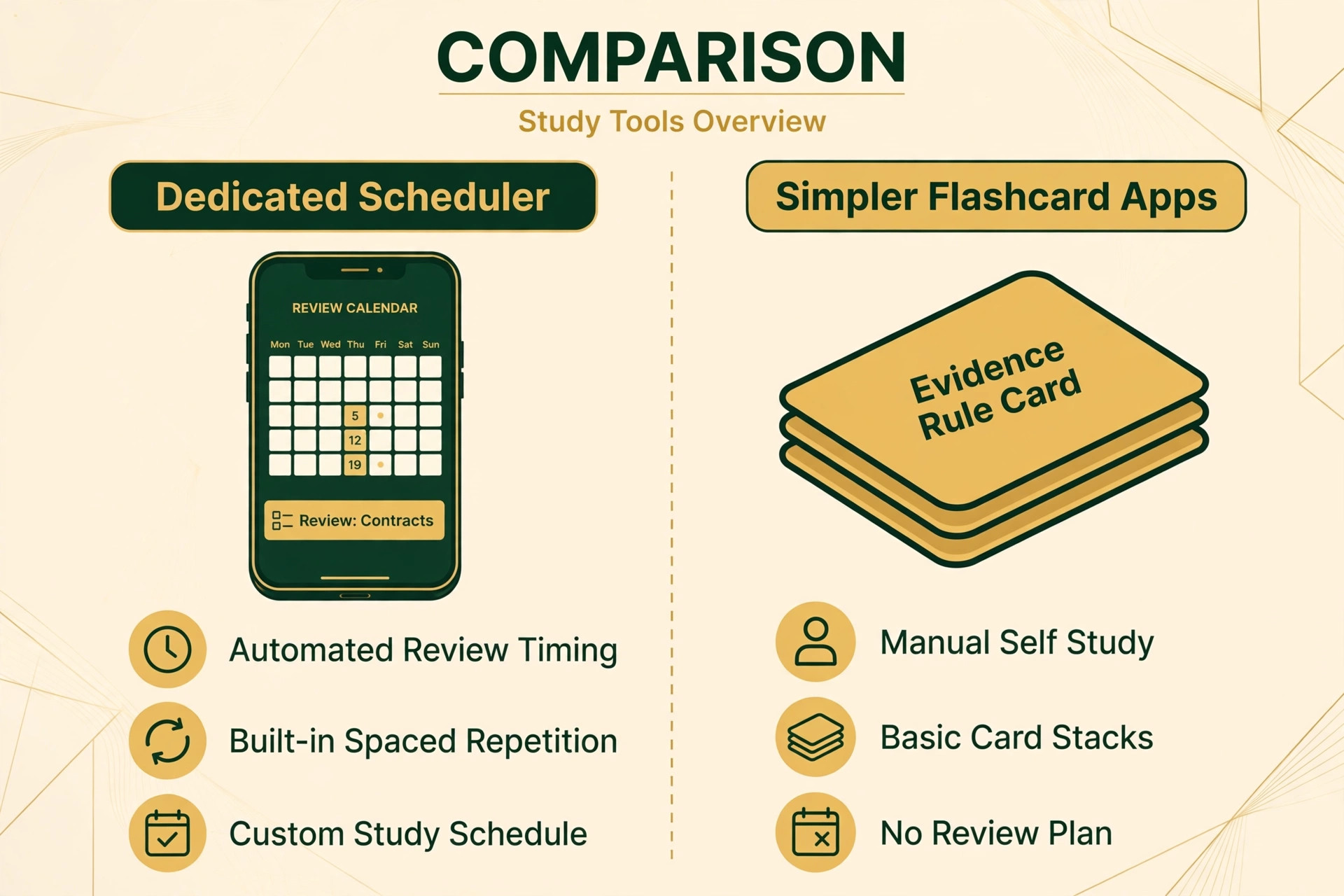
The table below gives the short version of the options. Start with the option that fits your current setup, run it for a month, and only add a second tool when a clear gap appears, because stacking tools before the routine is settled creates confusion that no software can fix.
| Option | What it does | Best for |
|---|---|---|
| Anki desktop plus mobile | free desktop app with paid mobile app and free sync | a candidate who studies on a computer and a phone |
| Anki plus a shared bar deck | community decks adapted to your own syllabus | a candidate who wants a head start on card writing |
| Quizlet | simpler flashcards with games and a polished interface | a candidate who values ease over scheduling power |
| RemNote | notes and flashcards combined in one app | a candidate who takes notes and reviews in the same place |
Trial the favourite option with the hardest realistic task you have, not with the demo data the vendor provides. A trial that uses real names, real volumes and real deadlines exposes slow screens, missing fields and confusing messages within days, while a trial with sample data flatters every product equally. Keep the trial to one week and one clear verdict, since an open-ended trial drifts into a second system running beside the old one.
Anki desktop plus mobile
The desktop app is free and powerful, the mobile app is paid on one platform and free on the other, and sync keeps both in step. The interface looks plain, but the scheduling algorithm and the add-on ecosystem are the reasons serious candidates choose it. Try it with real work for a week, judge it on whether people use it without prompting, and keep it only if it saves time or reduces errors compared with the old way.
Shared decks save weeks of card writing, though they rarely match your jurisdiction or your outline exactly. Treat a shared deck as raw material, edit cards to your own wording, and suspend anything that does not match the syllabus you will actually be tested on. Run a side by side trial against your current method for seven days, and keep the option that produces fewer errors, not the one with the longer feature list.
Quizlet
Quizlet feels friendlier and its study modes are engaging, but its spaced repetition is weaker than a dedicated scheduler. It suits short term memorisation, while a months long bar syllabus benefits from the stricter scheduling of a dedicated tool. Test it with the hardest realistic task you have, not the easiest demo task, since the hardest task reveals limits that a gentle trial hides completely.
RemNote
RemNote merges note taking with flashcard scheduling, so cards grow directly out of your notes. That integration saves duplication, though the scheduling controls are less mature than a dedicated flashcard app, so heavy users sometimes outgrow it. Check the total cost at the volume you expect in six months, and walk away if the pricing punishes the growth you are planning for.
The Workflow in Order
Use this workflow to use Anki for bar exam revision in order, because the order matters. Skipping ahead to messages or extras before the basics are recorded creates work that has to be redone, while following the steps in order means each step builds on a finished earlier step. Tick each step off, and do not move on until the current step works with a real task.
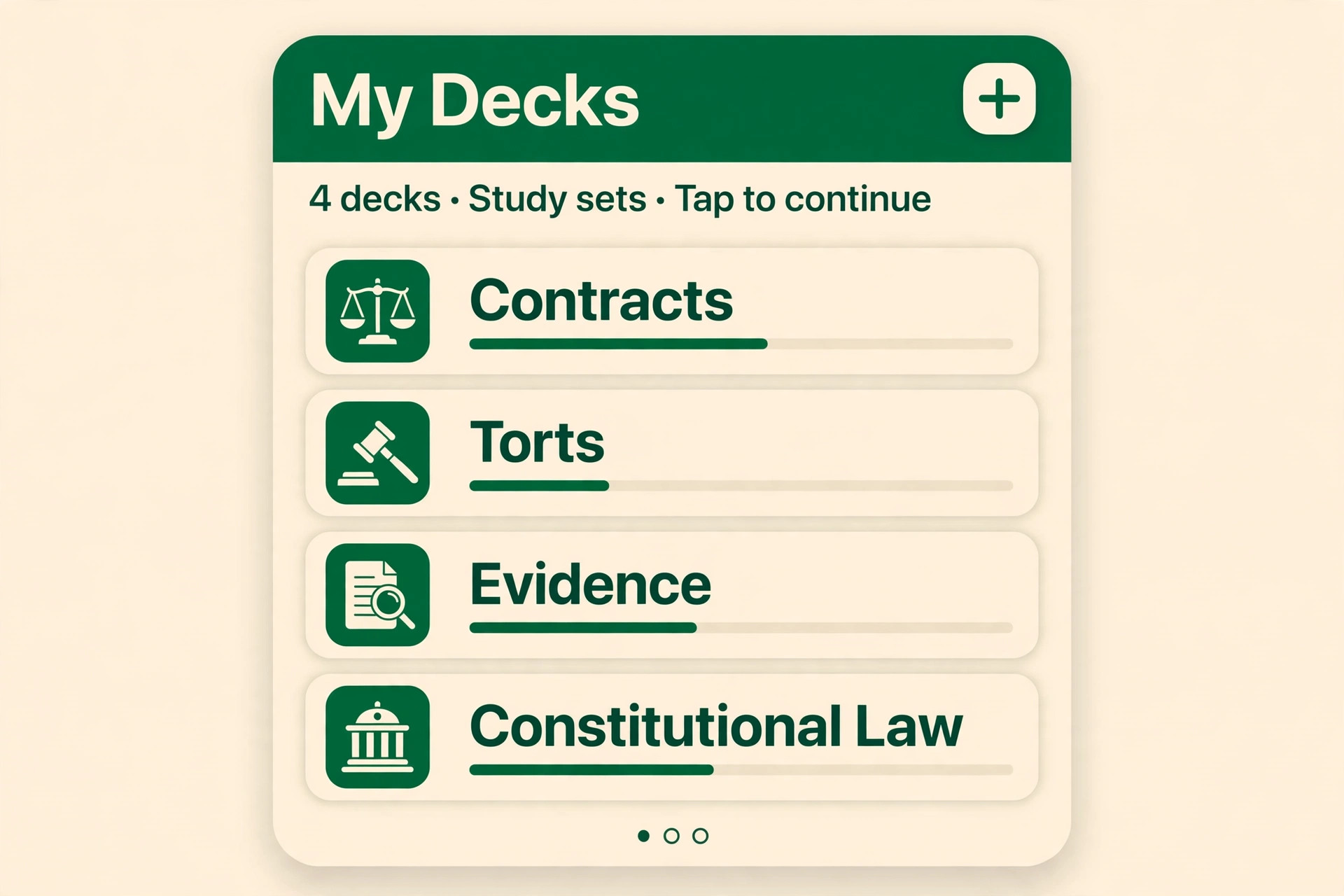
- **Split the syllabus into one deck per subject.** Create a parent deck for each subject and subdecks only for topics that are large enough to need separate review, such as hearsay within evidence. Too many tiny decks fragment the daily routine, while one giant deck hides weak topics until exam week. Write down who owns this step and what finished looks like, then test it once with a real task before rolling it out. A step that has never been tested with real work is a guess, and guesses have a habit of failing at the worst moment.
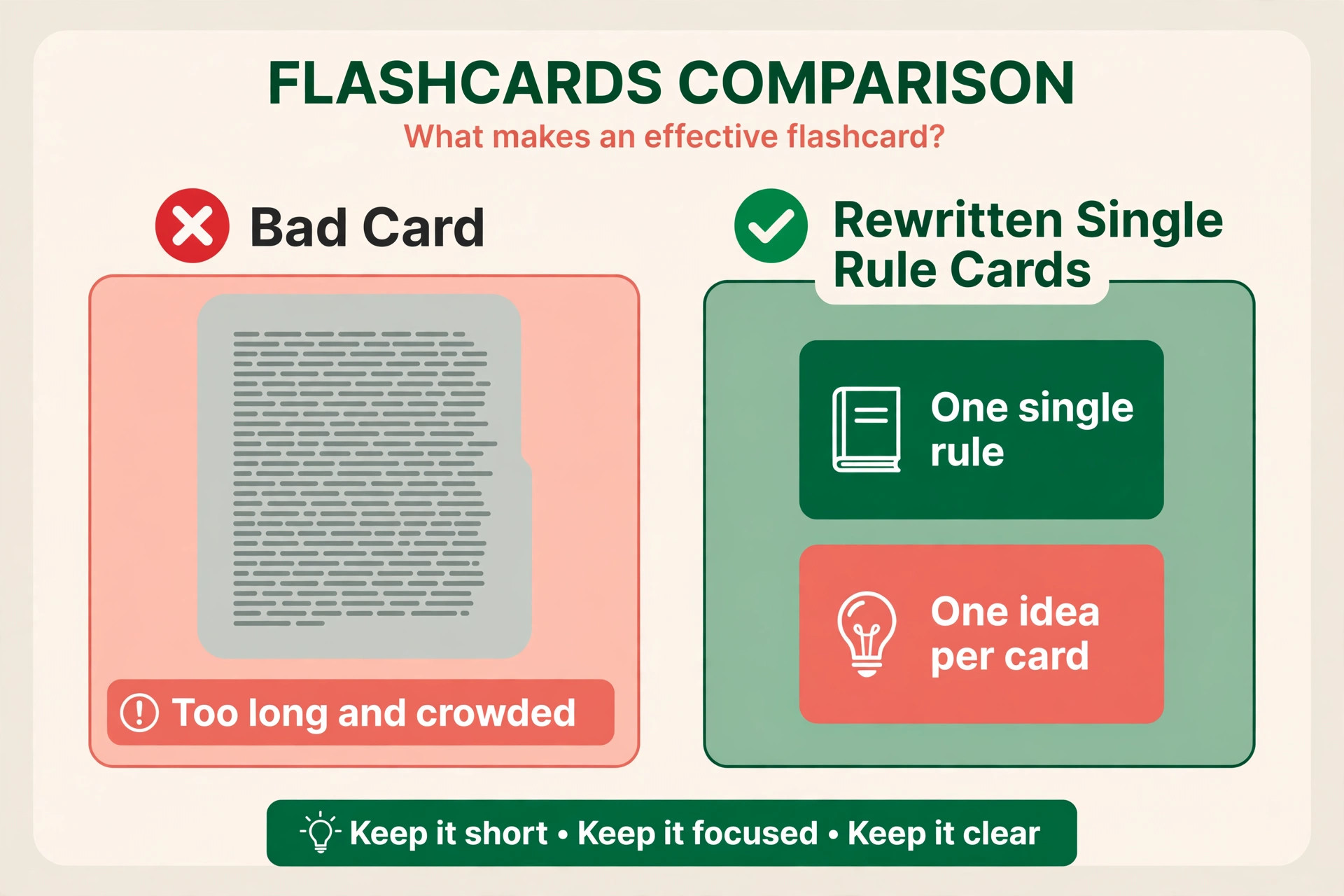
- **Write cards that ask for one rule each.** Put a single rule, element or distinction on each card, with the precise trigger on the front and the elements plus one key exception on the back. Cards that ask for three rules at once produce vague answers and unreliable scheduling, because you cannot honestly grade them. Note the time this step should take and the sign that it worked, then run it twice in one week. Two clean runs tell you more than a month of theory, because the second run exposes the details the first run flattered.
- **Set a daily new card limit you can sustain.** Choose a new card number that fits your real study day, often 30 to 50 for bar preparation, and protect it fiercely. A limit of 100 sounds ambitious for a week and collapses by week three, leaving a backlog that poisons the whole routine. Keep a short note of what went wrong the first time you tried this step, and fix that one thing before moving on. Small corrections made early compound into a reliable routine, while small problems ignored early grow into reasons to quit.
- **Do reviews before new cards, every day.** Clear due reviews first, even on tired days, and treat new cards as the reward for finishing them. Reviews protect what you already learned, while new cards without completed reviews just add to a pile you will never clear. Ask the person who will actually do this step whether the instruction makes sense to them, and rewrite any part they hesitate over. A routine that only its author understands will not survive a holiday, a handover or a busy week.
- **Grade honestly and suspend leeches fast.** Mark a card failed when you could not state the rule, even if the answer felt familiar, and suspend any card that fails eight times or more. Leeches are usually badly written cards, so rewrite them as two simpler cards rather than drilling a confusing one. Decide in advance what you will do if this step fails, and write that fallback beside the step itself. A fallback agreed calmly beforehand beats an improvised workaround invented under pressure, when mistakes cost the most.
- **Tag cards by topic and by exam frequency.** Tag every card with its topic and with a rough frequency marker for high, medium and low yield material. Tags let you build filtered reviews for weak topics in the final month without disturbing the main schedule. Measure this step once it runs, even roughly, so you know whether it helps or merely feels productive. A step with no measure can linger for months adding effort without adding value, and nobody notices until someone finally asks.
- **Run a weekly weak topic session.** Once a week, review the subdecks with the lowest retention and the longest leech lists, and write fresh cards for the rules that keep failing. This weekly pass is where the routine adapts to you, instead of blindly repeating the same schedule. Review this step after a month of real use and remove any part that nobody missed when it was skipped. A routine that shrinks toward its useful core stays alive, while one that only grows eventually collapses under its own weight.
The Deck Structure and Daily Routine Template
Use this deck structure and daily routine template to use Anki for bar exam revision without starting from a blank page each time. Copy it, fill it in with your own details, and keep the filled version where the people who use it can see it. A template that lives in a drawer helps nobody, while one that sits beside the work becomes the way the job actually gets done.
| Item | What to write down |
|---|---|
| Deck per subject | one parent deck per subject, with subdecks for topics that need separate review |
| Card types | rule statement on the front, elements and one exception on the back |
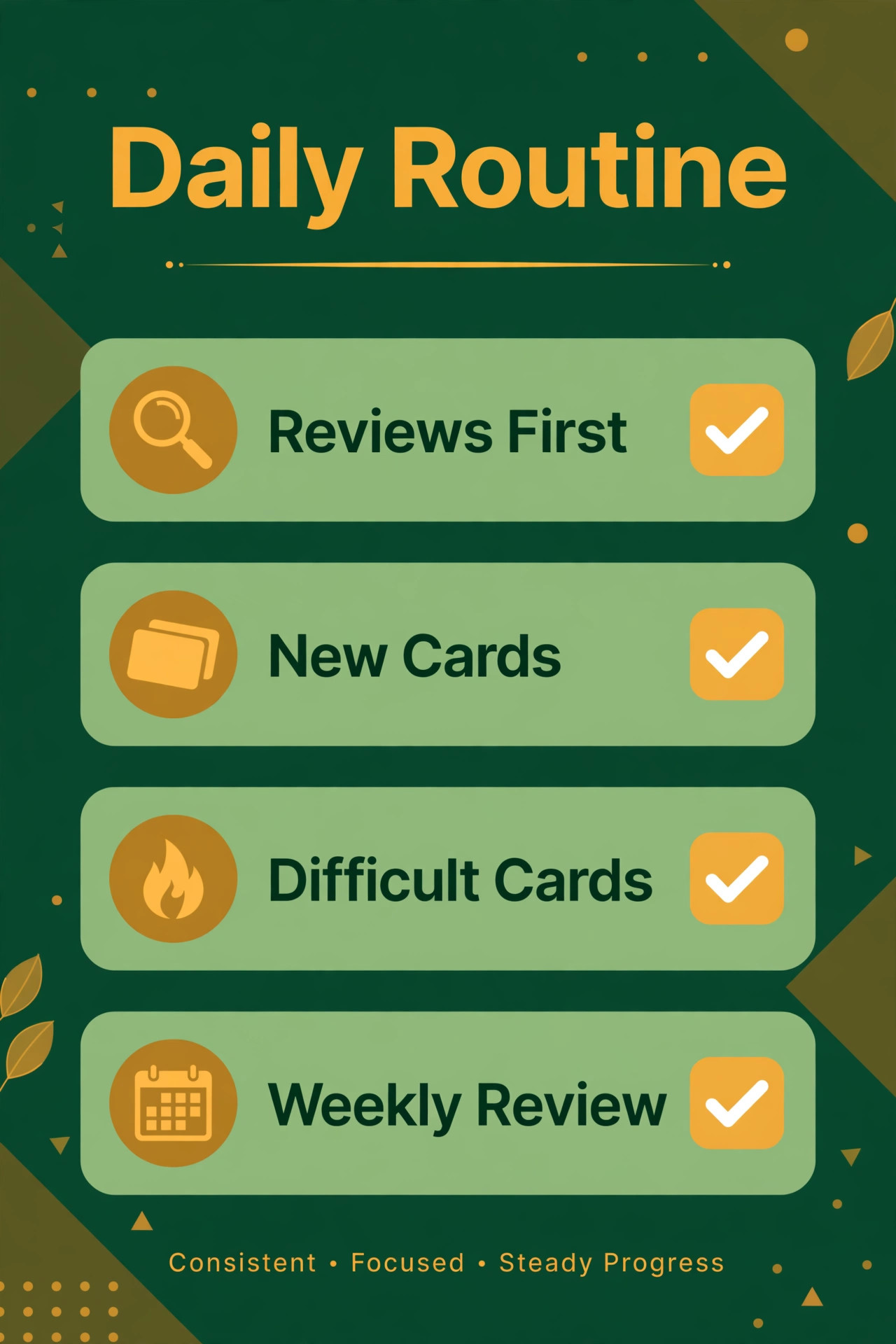
| Daily routine | reviews first, then new cards, then a short leech pass |
| Weekly review | suspended leeches rewritten, weak subdecks given extra new cards |
Fill the table in with real details from your own setup, not with guesses, because a plan filled with guesses gives confident answers that are wrong. If a detail is unknown, write unknown and find it before you act on that row, since a single guessed cost or time can undo an otherwise sound plan. Review the filled version every month for the first quarter, then every quarter after that, and update it when prices, people or suppliers change.
Keep the filled version where the work happens, whether that is a shared folder, a printed page or the tool itself, and name one person who owns updating it. Ownership matters because a template without an owner goes stale within a quarter, while one with a named keeper stays current through staff changes and price changes alike. When the owner changes, hand the template over explicitly, like any other responsibility.
Costs, Settings and Trade-Offs
Before you commit money or time, write down the costs of the current way of working, because when you use Anki for bar exam revision you need a baseline to judge the new way against. Count staff time, commercial outlines, prep courses and practice exam fees and the price of the tool itself, then compare that total with the same total after one month of the new routine. If the new total is not lower, or the experience is not clearly better for the people involved, change one thing and measure again rather than adding more tools.
Price the tool honestly, including the monthly fee, any per person fee and the time spent learning it. A cheap tool that needs hours of maintenance each month often costs more than a pricier one that runs itself, once time is priced at a realistic rate. Always ask what happens to your data if you stop paying, because your lists, history and templates should stay yours.
Watch for the cost that appears only after launch, such as paid sync services or add-ons that seem small until several are stacked. Read the pricing page for the tier you will actually land on in six months, not the starter tier you land on today, because a tool that is cheap at small volume and expensive at larger volume can punish growth. Set a calendar reminder to review the bill every quarter.
A final cost check is to price the time of the person who maintains this setup, since maintenance is the cost most budgets forget. If one person spends two hours a month keeping it running, that time belongs in the total, and a tool that needs a keeper should be compared honestly with one that runs itself.
Mistakes That Quietly Undo the Work
The mistakes below are common because each one feels reasonable at the time, and when you use Anki for bar exam revision it helps to name them before they happen. Read the list with anyone who will use the routine, agree which mistake your setup is most likely to make, and put one guard in place against it, because a named mistake is far easier to avoid than a vague warning to be careful.
- **Copying whole outlines onto cards.** A card that reproduces a paragraph cannot be answered in seconds. Break outlines into single rule cards, even though it takes longer to write them.
- **Setting an unsustainable new card limit.** Ambition in week one creates backlog in week three. A modest limit kept daily beats a heroic limit abandoned.
- **Grading easy when the answer was vague.** Generous grading inflates retention numbers and hides weak rules. If you could not state it cold, mark it failed.
- **Never suspending leeches.** A handful of bad cards can eat a large share of review time. Suspend, rewrite and move on.
- **Skipping reviews on busy days.** One skipped day doubles the next day load. Do a short review session even on the worst days, and protect the streak.
How to Tell Whether It Is Working
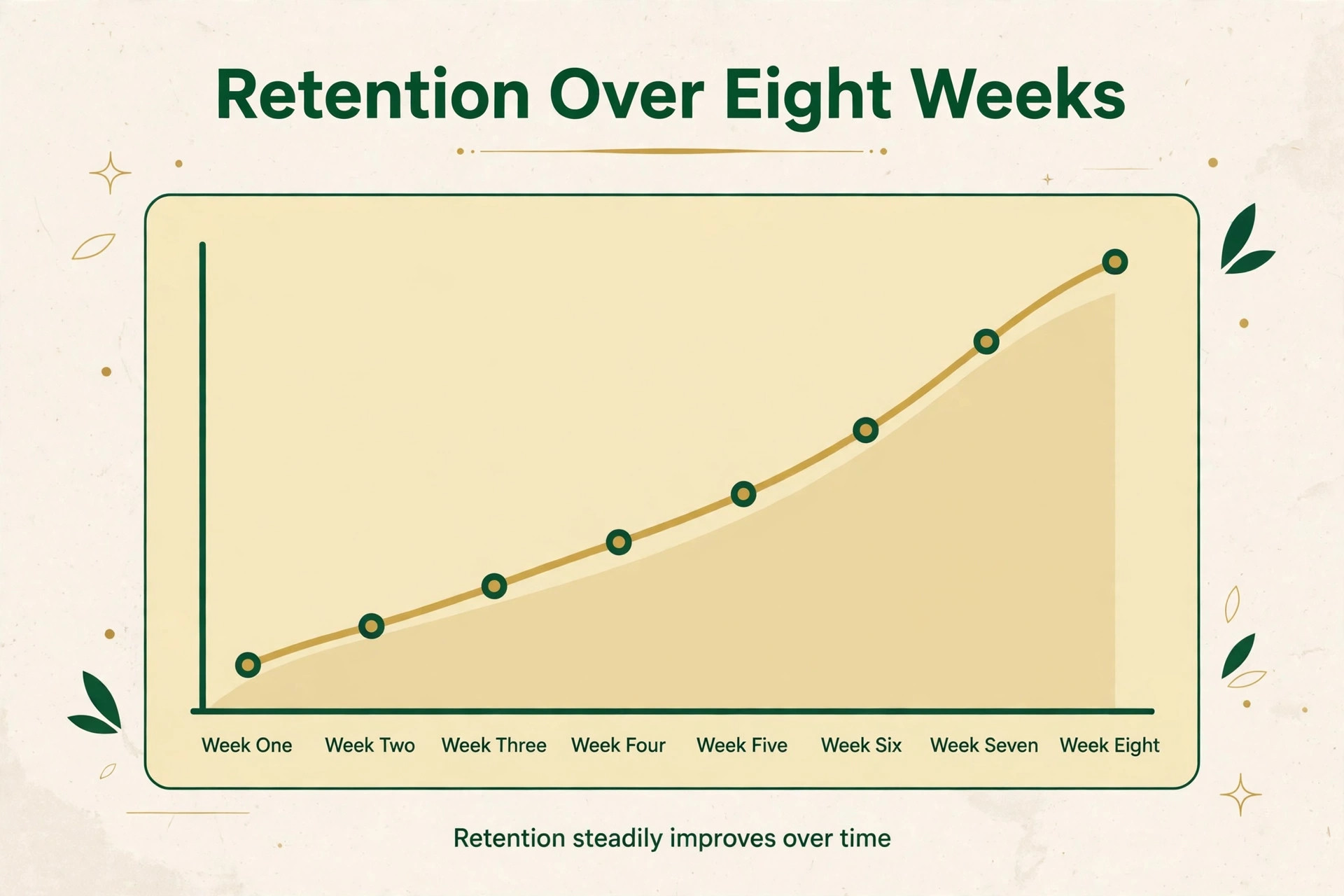
Pick a small set of numbers and track them monthly, because when you use Anki for bar exam revision you need evidence, not a feeling, about whether the change is paying. Choose numbers you can collect without extra admin, such as daily review completion, retention rate, leech count and practice question scores by topic, and record them in one place on the same day each month. A trend over three months tells you far more than a single good or bad week.
Compare the new numbers with the baseline you recorded before the change, and be honest about what they say. If a number improves, keep doing what caused it and say so to the people involved, because praised work gets repeated. If a number gets worse, change one thing, not five, so you can tell what helped.
Ask the people affected directly as well, with one short question such as could you state that rule without looking at the card. A number tells you what happened, while a short answer tells you why, and the why is what lets you fix a problem properly. Read the answers monthly and act on the most repeated point first, because that point is usually the cheapest fix with the largest effect.
Set the review date now, ninety days from launch, and put it in the calendar with the name of the person who owns the review. Without a named owner and a date, reviews slip, and a slipped review means a system that slowly stops matching the reality it was built for. The review itself need not take long, since one hour with the numbers and the answers is enough to decide what to keep, what to change and what to stop. Write the decision down in the same place as the routine, so the next review starts from the last decision rather than from scratch.

A Four-Week Rollout
In week one, focus only on building one deck per subject with a fixed daily new card limit, and resist the urge to build the full system at once. A single working piece gives the team or household something to trust, while a half built system gives everyone a reason to fall back on the old way. Write down what worked and what snagged, since those notes become the specification for week two.
In weeks two and three, expand to the full workflow and start tracking daily review completion, retention rate, leech count and practice question scores by topic once a week, in the same place and on the same day. Weekly tracking matters more than daily tracking at this stage, because it shows direction without turning measurement into a second job. If a number moves the wrong way, change one element and watch the next week before changing anything else.
By week four, compare the results with the outcome you wrote at the start, which was every high yield rule reviewed at least three times before exam week, with no backlog, and decide what to keep, what to change and what to stop. A rollout that ends without a decision drifts, while one that ends with a short written verdict gives the next quarter a clear starting point. Share that verdict with everyone involved, so the routine belongs to the group rather than to one enthusiast.
What Good Looks Like After 90 Days
After ninety days, a healthy setup shows up in small, boring ways, such as daily review completion, retention rate, leech count and practice question scores by topic trending in the right direction without heroic effort, and fewer messages asking where things stand. Nobody celebrates a routine that simply works, which is why it is worth naming those signs when they appear, so the team recognises the payoff and keeps funding the habit.
The warning sign is different, and it is worth watching for, which is when people start working around the setup instead of through it. Workarounds usually mean one step no longer fits reality, so ask what changed, fix that step, and prune anything the workaround replaced. A setup that adapts to one real change survives, while one that demands loyalty to an outdated step gets quietly abandoned.
When the First Version Does Not Work
If the first version disappoints, resist the urge to replace the tool immediately, since the fault usually sits in one step rather than in the whole approach. Return to the numbers you tracked, find the step where results diverged from the plan, and change that step alone. Tool swaps feel decisive, but they reset learning to zero, while a single step fix preserves everything that already worked.
If the problem persists after two single step fixes, ask the people who use the routine what they actually do instead of what the routine says. The gap between the written routine and the real routine is where the truth lives, and closing that gap, either by changing the routine or by retraining, resolves more failures than any new purchase. Document the change, test for two weeks, and only then judge whether the approach itself needs replacing.
More Reading on Stratilyze
For the systems around this one, Stratilyze also covers the history exam revision guide and the medical exam revision guide. Read the guide that matches your next bottleneck first, because fixing the biggest bottleneck next gives a larger gain than polishing a part of the setup that already works well.
Frequently Asked Questions

How many Anki cards does bar preparation need?
Most candidates land somewhere between two thousand and five thousand cards, depending on jurisdiction and how granular the cards are. The count matters less than coverage, since a smaller set of precise single rule cards beats a huge set of vague ones. Build steadily from the start of preparation rather than trying to write everything in the final month. If this answer raises a second question, test the small version first and let the result guide the bigger decision.
How much time should Anki take each day?
Plan for 60 to 90 minutes once the routine is established, split between reviews and new cards. Early weeks take less time, while later weeks take more as reviews accumulate, so protect the slot in your timetable before adding practice exams and essays. Keep the answer short in practice too, since a simple rule followed daily beats a perfect rule followed once.
Use a shared deck as a starting point if one matches your jurisdiction, but edit the cards into your own wording and suspend anything irrelevant. Writing cards yourself teaches the rule once, which is valuable, though writing everything from scratch costs weeks that practice questions could use. Write your own version of this answer for your setup, because a generic answer only becomes useful once it carries your numbers.
What is a leech and what should I do with it?
A leech is a card that fails repeatedly, usually because it asks for too much, uses confusing wording or tests a distinction you have not understood. Suspend it, rewrite it as simpler cards or relearn the underlying rule from your outline, then reintroduce it. Drilling the same bad card harder rarely fixes it. That result is the payoff for doing this in order, because you use Anki for bar exam revision step by step instead of changing everything at once. Revisit this question after a month of real use, since experience usually refines the answer in ways reading cannot.
Can Anki replace practice essays and questions?
No, flashcards build recall of rules, while essays and practice questions build application under time pressure. Treat flashcards as the foundation, and spend at least as much time applying rules to fact patterns, since the exam tests application, not recitation alone. When in doubt, choose the option that is easier to reverse, because reversible choices let you learn without paying for mistakes.
When should I stop adding new cards?
Stop adding new cards about two to three weeks before the exam, so the final period is pure review, practice questions and weak topic work. New cards added too late never mature through enough reviews to be reliable, and they steal time from the practice that matters most. Share this answer with anyone who will use the setup, so expectations match before the first real task arrives.
The Bottom Line
The reason this approach holds up is that you use Anki for bar exam revision with a routine behind it, not as a one-off task. A setup that runs the same way every week will serve you better than a fancier option with no routine, and that advantage grows every month the routine runs.
Start with building one deck per subject with a fixed daily new card limit this week, test it with a real task tomorrow, and let the numbers over the next 90 days tell you what to improve next. Pick the first step today rather than waiting for a quieter month, because a quieter month rarely arrives.