

In one survey of 165 medical students, 92 students, or 56 percent, reported using Anki every day, and daily use was linked with higher scores on the first United States licensing exam in that study. That number matters because medical revision is not mainly a test of intelligence. It is a test of retention under volume. A student can understand cardiology in a lecture on Monday and still fail to recall the same facts in an exam hall six months later, because the facts were never brought back at the right time. If you want to use Anki for medical exam revision, you need more than a downloaded deck and good intentions.
You need a deck structure you can maintain, interval settings that fit your exam date, and a daily target you can actually hit on a tired day as well as on a fresh one.
This guide gives you that system. It covers what Anki costs on each device, how to choose between a ready made deck and your own cards, how to set up decks by subject and exam topic, how to choose learning steps and review limits, and how to build a daily routine that protects new learning without letting reviews pile into an unmanageable backlog. Prices quoted here were checked against vendor and App Store listings at draft time, and you should check checkout before you pay, because app prices vary by region and change over time.
Why Spaced Repetition Fits Medical Exams So Well
Medical exams reward recall that survives delay. Most of the syllabus is factual and cumulative. Anatomy builds on earlier anatomy. Pharmacology builds on physiology. Rereading notes feels productive because the material looks familiar on the page, but familiarity is not the same as the ability to produce an answer from a blank prompt. Spaced repetition works in the opposite direction. It asks you to produce the answer first, then it schedules the next review just before you are likely to forget it, so each successful recall makes the memory stronger and the next gap longer.
That design fits a long medical course better than cramming, because the intervals do the scheduling work for you. A card you know well may not return for weeks or months. A card you struggle with returns the same day or the next day. Over a year, that difference compounds. Strong material takes less and less of your day, while weak material keeps getting attention until it improves. The risk is that the system only works if the daily review load stays honest. If you skip three days, the due cards do not disappear. They wait, and they arrive together.
That is why students who use Anki for medical exam revision well treat daily targets and backlog control as seriously as card quality. A perfect deck that you abandon in week three helps nobody.
What Anki Actually Costs on Each Device
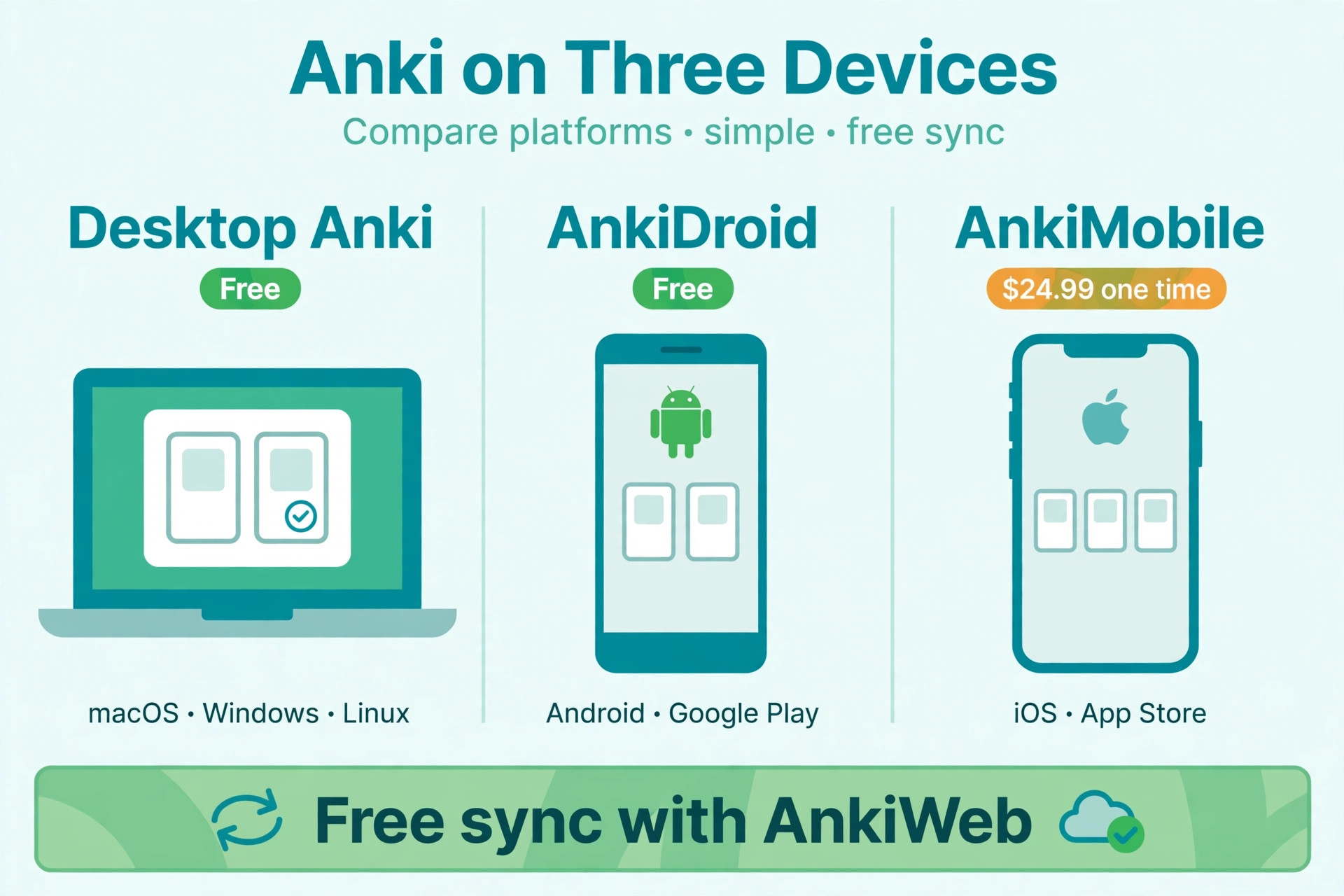
Anki is free on desktop and free on Android, and that fact surprises many new users who first meet the app through a paid listing. The desktop program for Windows, Mac and Linux is free and open source. AnkiDroid for Android is also free. AnkiWeb, the free sync service, keeps your decks, progress and media in step across devices, so you can create cards on a laptop and review them on a phone. The one paid version is AnkiMobile for iPhone and iPad, listed at 24.99 dollars as a one time purchase on the App Store at draft time.
If you already own a laptop, you can start for free and decide later whether phone reviews are worth the iOS price. If you study mainly on an iPhone and want offline reviews, the paid app is the official route, and it is worth avoiding unofficial apps that use a similar name. Those clones often charge a subscription, do not sync with the main Anki system, and can trap your cards in a separate app. If you use Android, you pay nothing for the official mobile app, and you can spend the money you save on a question bank or a textbook instead.
If money is tight on iOS, you can review for free through AnkiWeb in a browser when you have a connection, although offline review and the full mobile interface will be missing.
| Device | Version | Cost at draft time |
|---|---|---|
| Windows, Mac or Linux | Anki desktop | Free |
| Android phone or tablet | AnkiDroid | Free |
| iPhone or iPad | AnkiMobile | 24.99 dollars, one time |
| Any browser | AnkiWeb sync and review | Free |
Choose a Ready Made Deck or Build Your Own
A ready made deck, such as a well known community deck built around a standard textbook or exam syllabus, gives you coverage fast. You do not have to write thousands of cards before you can start reviewing. That speed matters when the exam is months away and the syllabus is broad. The weakness is fit. A ready made deck may cover topics your exam ignores, use terminology your course does not use, or test facts at a depth your exam never reaches. You also inherit someone else’s card quality, including cards that are too long, too vague or out of date.
The fix is to suspend what you do not need rather than deleting it, and to edit or suspend weak cards as you meet them, instead of trying to clean a deck of 20,000 cards before you start.
Your own cards fit your course exactly, because you write them from your lectures, your weak topics and your own mistakes. That fit is valuable for small, course specific exams and for clinical topics where your examiners favour certain presentations. The weakness is time. Writing good cards is slow, and a student who tries to card every lecture in full often falls behind on reviews. The fix is to card only what must be recalled cold, such as drug doses with narrow safety margins, red flag features, diagnostic criteria and management steps, and to leave understanding level material in notes.
A good rule is that if you can derive the answer from first principles in the exam, you may not need a card for it. If you must produce it instantly and exactly, you do need a card.
Most students do best with a combined approach, and that is the approach to use Anki for medical exam revision with the least waste. Use a ready made deck as the spine for broad subjects such as anatomy, physiology and pharmacology, and add your own cards for course specific material, for topics you keep getting wrong in practice questions, and for clinical reasoning steps that a generic deck misses. Tag your own cards clearly, so you can find them later and suspend them separately if your exam changes. That combination gives you speed where speed helps and precision where precision matters, without asking you to write everything from scratch.
How to Use Anki for Medical Exam Revision Without Burning Out
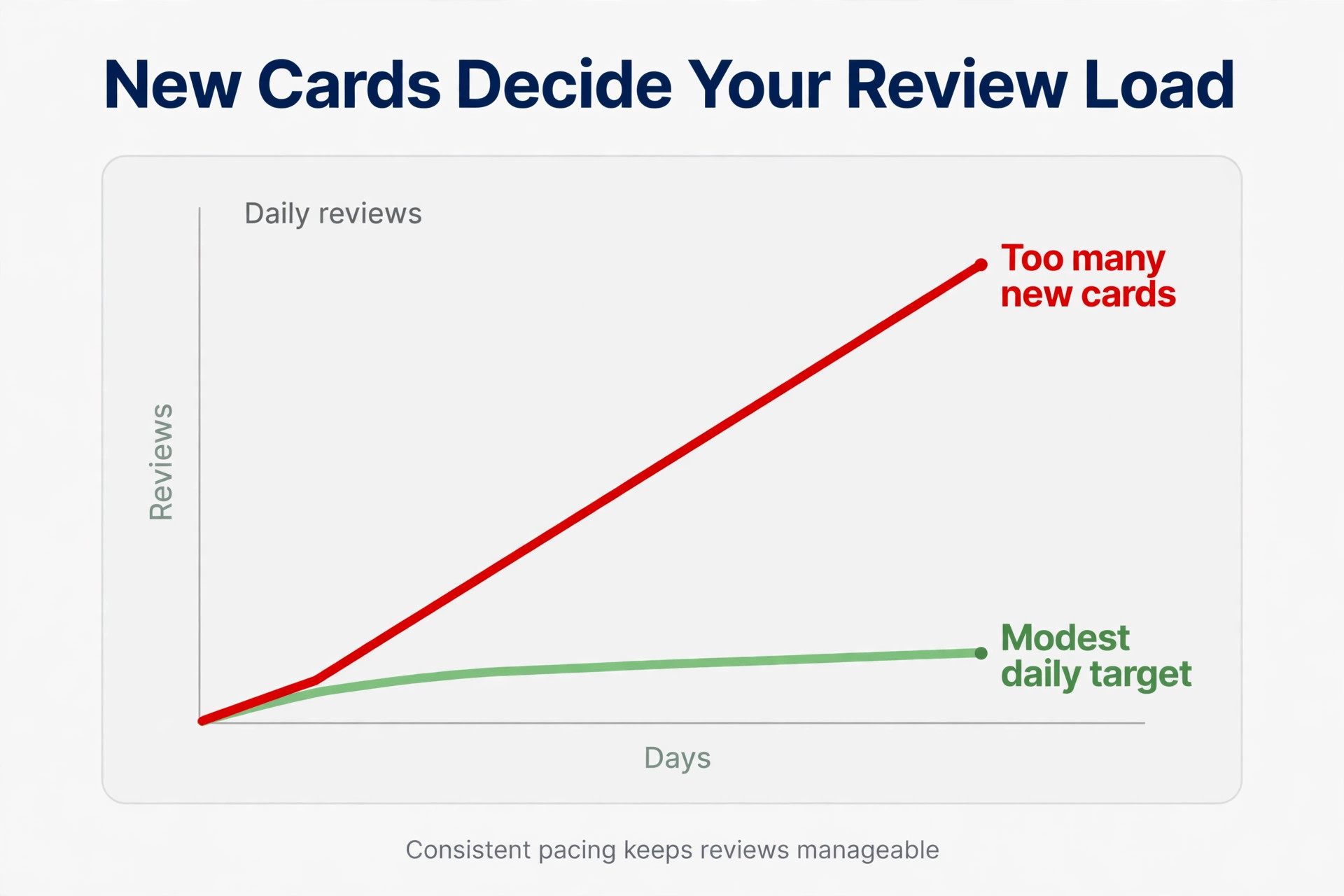
Burnout in Anki rarely comes from one bad day. It comes from a daily load that grows quietly until it takes over the whole study day. The pattern is familiar. A student adds 150 new cards a day for two weeks, feels productive, then discovers that each new card creates several future reviews. By week four, reviews alone take three hours, new cards stop, practice questions stop, and the student either skips days or quits the deck. The way to avoid that pattern is to set the daily target from the review load backwards, not from enthusiasm forwards.
Consistency beats intensity. Missing a day does not just add one day of reviews. It adds the reviews that were due that day plus the reviews that become due the next day, and it breaks the spacing that makes the system efficient. If you know a busy clinical week is coming, reduce new cards to zero or to a small number a few days early, rather than waiting until the backlog forces you to stop. A week with 20 new cards a day and zero missed reviews beats a week with 100 new cards a day followed by a week of catch up.
Build Your Deck Structure Before You Add Cards
Deck structure is the part of the system most students skip, and it is the part that saves the most time later. A single deck called Medicine with 15,000 unsorted cards is hard to study from, hard to suspend by topic, and hard to adjust when one subject falls behind. A clear structure lets you study one subject at a time, suspend a whole topic before a course exam, and see at a glance which subject is generating the most reviews. The template below is designed for a medical course, and you can adapt the subject names to your own syllabus without changing the logic.
A clear structure is also what lets you use Anki for medical exam revision across several terms without rebuilding the system each time a new block starts.
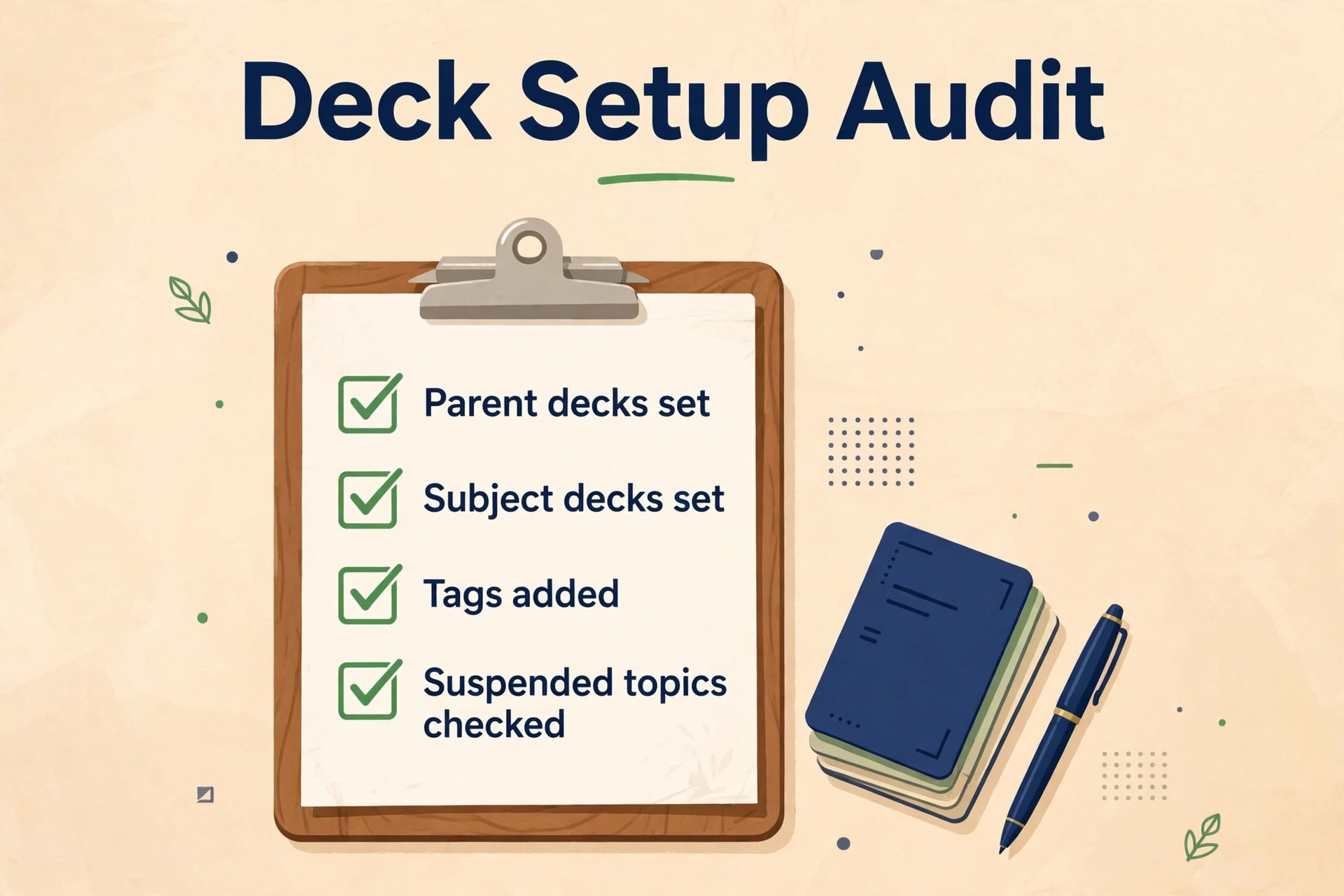
Keep the top level small. Four to six parent decks are enough for most students, such as Preclinical Sciences, Clinical Medicine, Surgery and Specialties, Pharmacology and Therapeutics, and Personal Weak Topics. Under each parent, add child decks by subject or system, such as Cardiology, Respiratory, Renal, Endocrine and Neurology under Clinical Medicine. Under each subject, add a further level only where it helps, such as Anatomy, Physiology, Pathology and Management within Cardiology. Three levels are plenty. More levels create clicking and confusion without adding study value.
Tags do the finer work that decks should not do. Use tags for exam relevance, for source, and for question type, such as high yield, exam favourite, image based, drug safety, and from practice questions. A card can carry several tags but it can live in only one deck, so tags let you build a custom study session, such as all high yield cardiology cards or all cards you created from missed questions, without moving cards around. Use a small set of tags consistently.
| Level | Example | Purpose |
|---|---|---|
| Parent deck | Clinical Medicine | Groups a broad area for weekly review |
| Subject deck | Cardiology | Lets you study or suspend one subject |
| Topic deck | Heart failure management | Focuses a short session on one topic |
| Personal deck | My cardiology cards | Holds your own cards, kept separate |
Set Intervals That Match Your Exam Date
Interval settings decide how often Anki shows you a card, and they are the difference between a system that feels light and a system that feels endless. Anki now offers two main scheduling approaches. The older SM-2 approach uses fixed steps and a simple ease factor. The newer FSRS approach, short for Free Spaced Repetition Scheduler, adjusts intervals from your actual review history and is now the recommended default for most users. If you are starting fresh, turn FSRS on and let it learn from your reviews for a few weeks before you judge it.
If you already have a large deck on SM-2 and it works, there is no urgent need to switch mid term, but a switch before a long revision period is usually worth the short adjustment. Either way, sensible intervals are central when you use Anki for medical exam revision over months rather than days.
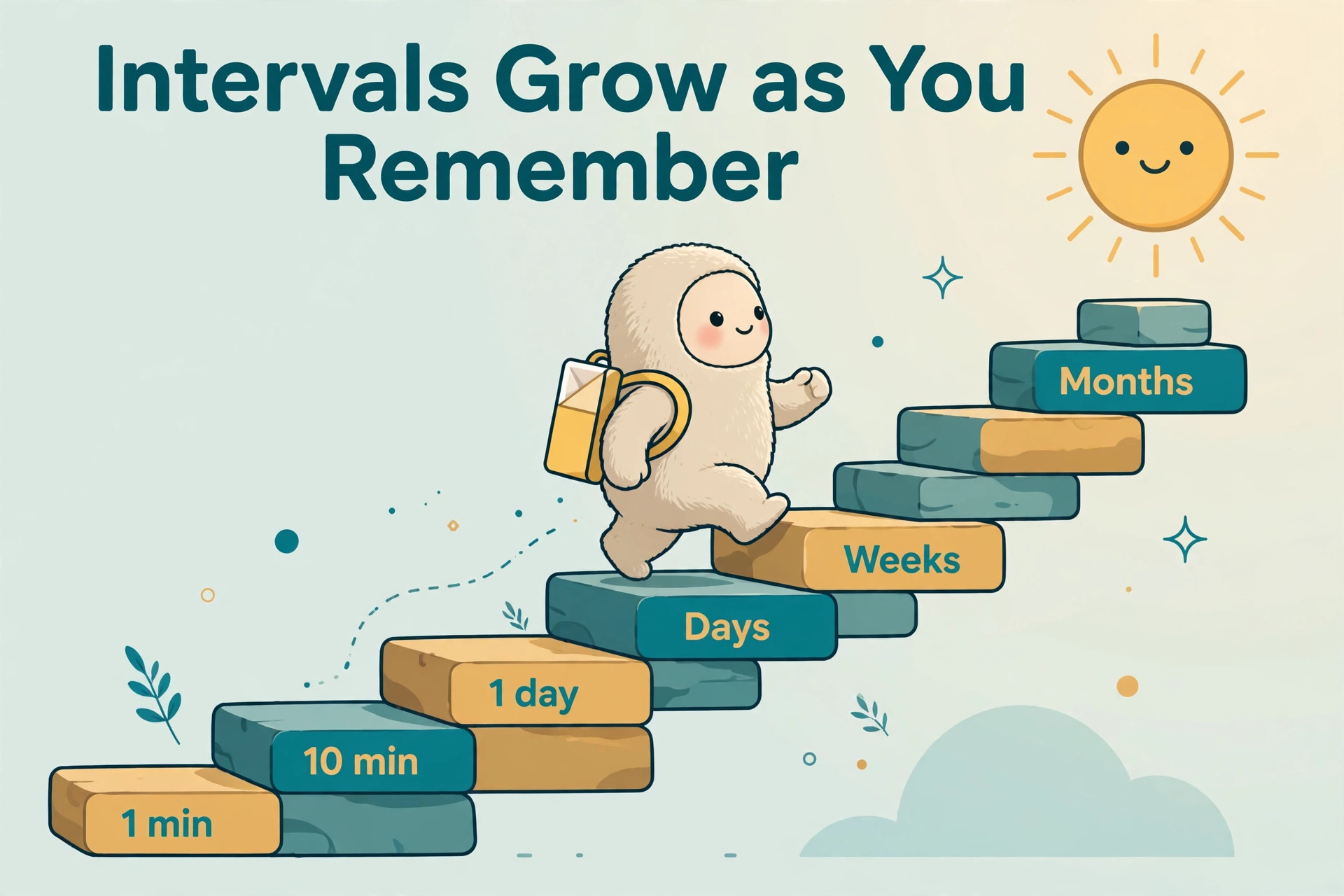
Learning steps control what happens when you first meet a card. A common starting point for medical cards is steps of 1 minute and 10 minutes, so a card you get wrong returns quickly, while a card you get right moves to a longer gap. A graduating interval of 1 day means a new card you answer correctly moves into the review pool the next day. With FSRS, a desired retention of 0.90, meaning you aim to recall about 90 percent of due cards, is a sensible balance for exam revision.
A higher target, such as 0.95, sounds safer but creates many more reviews for a small gain in recall, while a lower target, such as 0.85, cuts reviews but risks gaps on high stakes facts.
New cards per day and maximum reviews per day are the two limits that protect your timetable. Set new cards to the number you worked out from your available time, such as 40 a day, and set maximum reviews high enough that you never hide due cards by default, unless you deliberately need a cap for one busy week. Hiding reviews feels like relief, but it creates a hidden backlog that returns larger. A better busy week plan is to set new cards to zero, keep reviews going, and accept a shorter session. When time is short, protect reviews first.
A Daily Routine Template You Can Copy
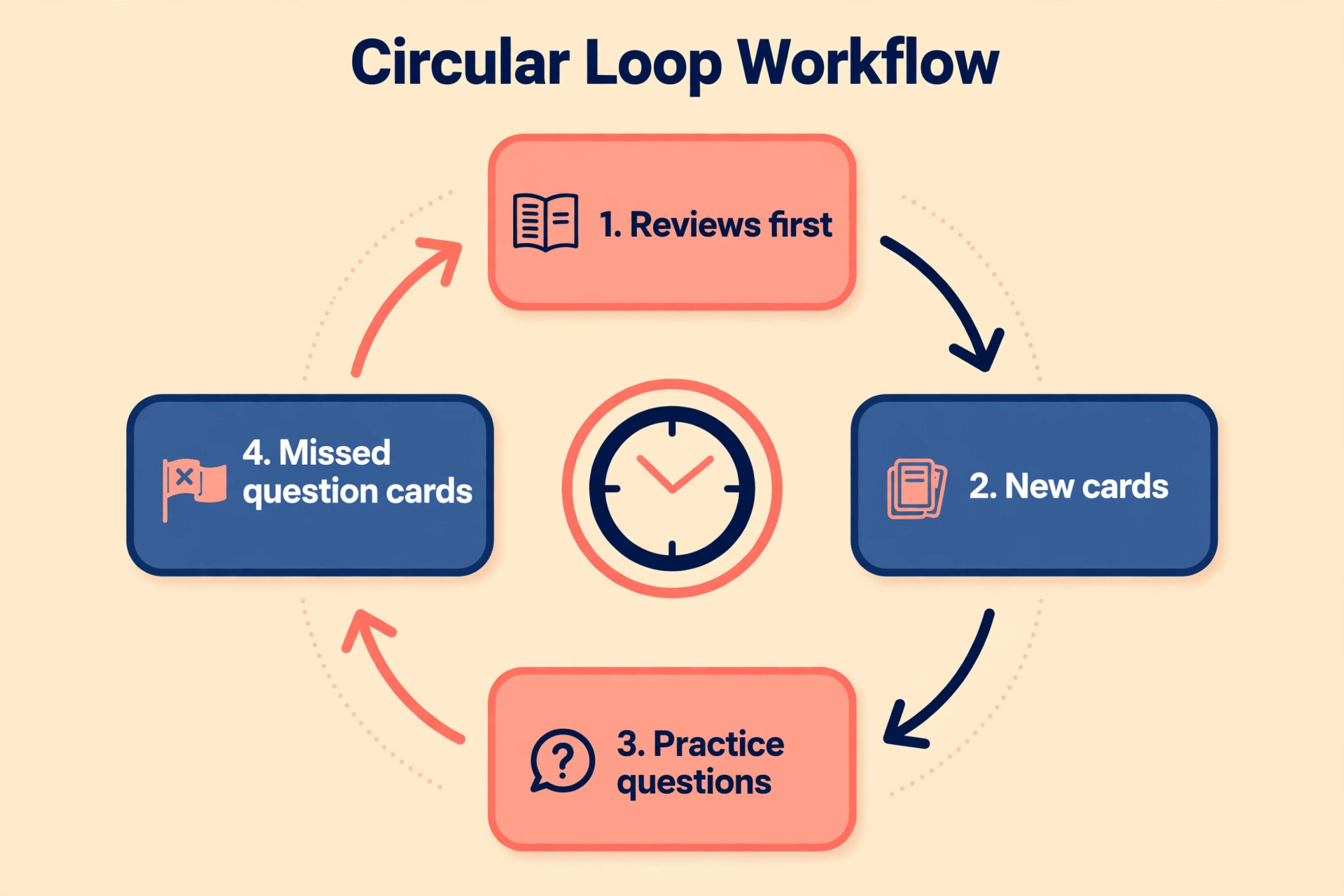
A routine template is more useful than a talk about discipline, because it turns a large system into a sequence of small decisions. The template below assumes 60 to 90 minutes for Anki and a separate slot for practice questions. It is designed for a normal teaching day, and it includes a shorter version for clinical days when time is tight. Copy it, adjust the times to your timetable, and keep the order the same, because the order protects the most valuable work from being squeezed out by the rest of the day. This is the daily half of the system you need when you use Anki for medical exam revision alongside lectures, clinics and question practice.
Start with reviews before new cards. Reviews are due today for a reason, and they protect what you have already learned. New cards are important, but they can wait a day without damage, while missed reviews damage retention directly. Do reviews in short blocks with a break between blocks, rather than in one unbroken session, because attention fades and review speed drops after about 25 to 30 minutes of continuous cards. After reviews, add your new cards, then take a short break before you move to practice questions or reading.
| Block | Time | What to do |
|---|---|---|
| Block 1 | 25 minutes | Reviews only, oldest due cards first |
| Short break | 5 minutes | Stand, drink water, step away from the screen |
| Block 2 | 25 minutes | Finish reviews, then start new cards |
| Block 3 | 20 minutes | Finish new cards, flag failed cards for review |
| Questions slot | Separate session | Practice questions on the same topic where possible |
On a clinical day, use the short version. Do 20 minutes of reviews in the morning, 20 minutes in a gap between clinics if you can, and set new cards to zero. On a weekend, use the extra time for practice questions and for rewriting weak cards, not for adding a large batch of new cards to catch up. Catch up by clearing reviews and fixing weak cards, rather than by adding a large batch of new cards.
How to Write Cards That Actually Stick
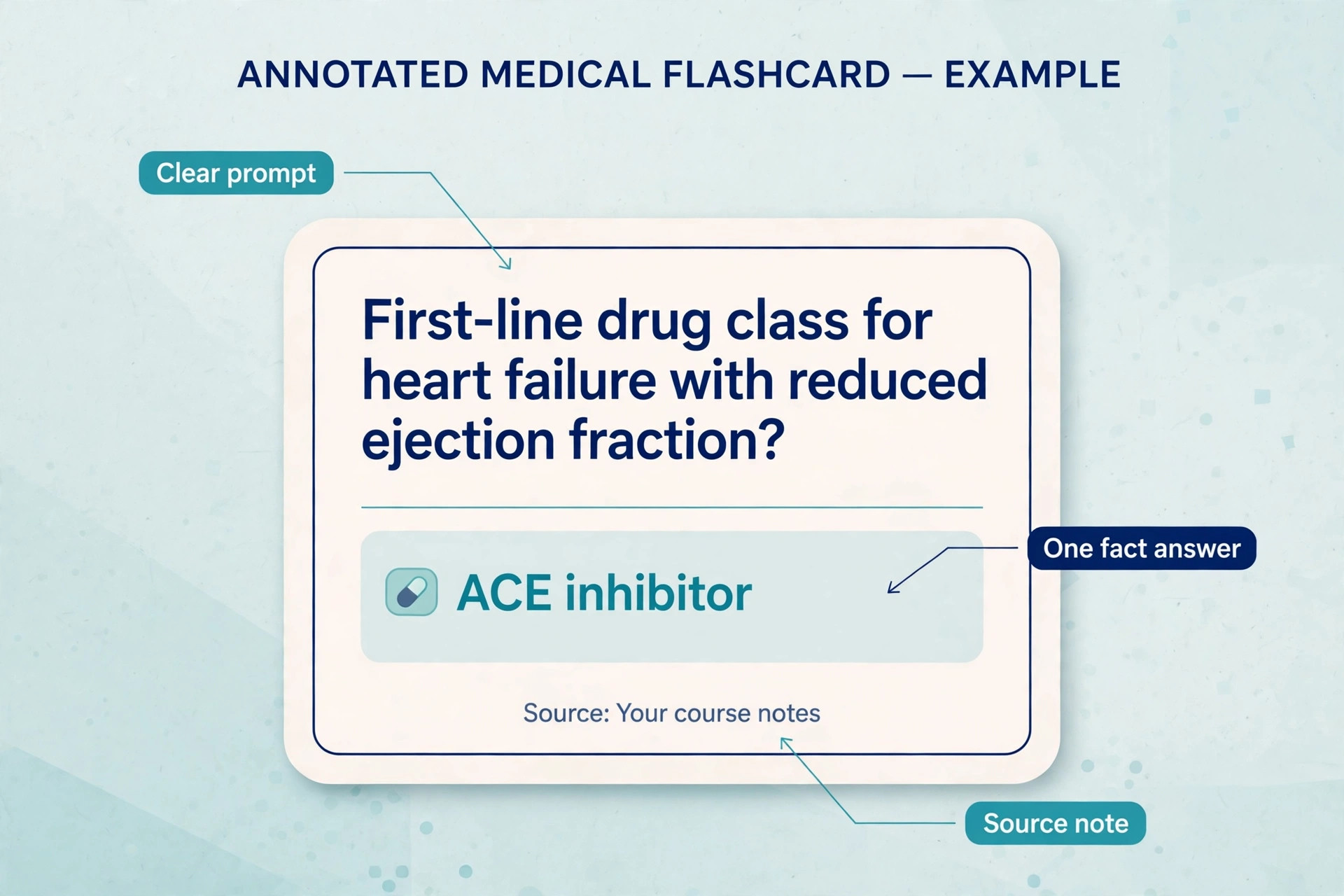
Card quality decides whether Anki feels like a fast recall drill or a slow reading exercise. The single most important rule is one fact per card. A card that asks for the causes, the presentation, the investigations and the management of a condition in one prompt will be failed often, because getting three parts right and one part wrong still counts as a failure. Split that material into four short cards, each with one clear answer, and your retention and your speed will both improve. Short cards are also easier to review on a phone, which matters when much of your revision happens in short gaps.
Good card writing is a skill you build every time you use Anki for medical exam revision, and it pays off in every subject you add.
Write the question so the answer is unambiguous. A prompt such as “Tell me about heart failure” has no single right answer, so you will hesitate, guess what the card wants, and mark yourself wrong even when your knowledge is sound. A prompt such as “Name the first line drug class for heart failure with reduced ejection fraction in a patient who is already on a beta blocker” has a clear target, and you can judge yourself honestly. Use cloze deletions for lists and sequences, such as a sentence with one missing word, but keep each cloze card to one deletion.
A card with five deletions is five cards hiding in one, and it will behave like five cards when you fail it.
Images help where words alone are weak, especially in anatomy, radiology, dermatology and pathology. An image occlusion card, where one label on a diagram is hidden, tests recognition in a way that a text description cannot. Keep the image clean, crop it tightly, and test one structure per card. Avoid copying large textbook pages into a card, because a wall of text slows reviews and hides the fact you need to recall.
Mix Anki With Questions and Clinical Practice
Anki alone will not pass a modern medical exam, because exams test application as well as recall. A student who knows every drug name but cannot choose between two similar drugs in a vignette will lose marks that a question bank would have taught them to win. The solution is to pair Anki with practice questions on the same topic, ideally on the same day or in the same week, so the factual base and the application skill reinforce each other.
A practical weekly pattern is to study a topic with Anki first, then do a set of practice questions on that topic, then turn every missed question into one or two Anki cards. That loop is powerful because it directs new cards exactly where you are weak, instead of adding cards evenly across topics you already know. Tag those cards as from practice questions, so you can review them as a group before a mock exam.
Track Progress and Fix a Growing Backlog
Anki gives you statistics, and those statistics are useful only if you check them with a clear question in mind. The three numbers that matter most are the daily review count, the retention rate on mature cards, and the number of new cards you added in the past week. If reviews are rising week by week, you added too many new cards. If mature retention is low, your cards may be too hard or your reviews may be irregular.
A backlog needs a plan, not panic. First, stop adding new cards until the backlog is under control. Second, work through due cards in order, oldest first, and accept that some old cards will be failed and relearned. Third, suspend cards that are duplicates, out of date or badly written, rather than failing them repeatedly. Fourth, if the backlog is very large, use a filtered deck for the most exam relevant cards first, such as high yield tags or cards from missed questions, and work through the rest over several days. Do not try to clear a backlog of 1,000 cards in one sitting.
That sitting will exhaust you, damage retention, and create a new backlog the next day when you are too tired to review.
Mistakes That Break Medical Revision With Anki
The first mistake is adding too many new cards too fast. Enthusiasm in week one creates a review load in week four that nobody can sustain, and the result is skipped days and a backlog. The fix is a modest daily new card target, set from your available time, and a rule that new cards drop to zero before reviews are ever skipped. The second mistake is writing long, vague cards that test several facts at once. Those cards are slow, they are failed often, and they teach you to recognise a paragraph rather than to recall a fact. The fix is one fact per card and a clear, testable prompt.
The third mistake is using Anki as a substitute for understanding. If you do not understand why a drug works, a card that asks for its name will help you recall the name and leave you unable to answer a question about its side effects or interactions. The fix is to learn the concept first from a lecture, a textbook or a question explanation, then card the facts that must be recalled exactly. The fourth mistake is reviewing only when you feel motivated. Motivation varies, but due cards do not wait, and irregular reviews break the spacing that makes the method work.
The fix is a fixed daily slot, even a short one, and a short version of the routine for busy days.
How to Choose Your Setup by Exam and Time Left
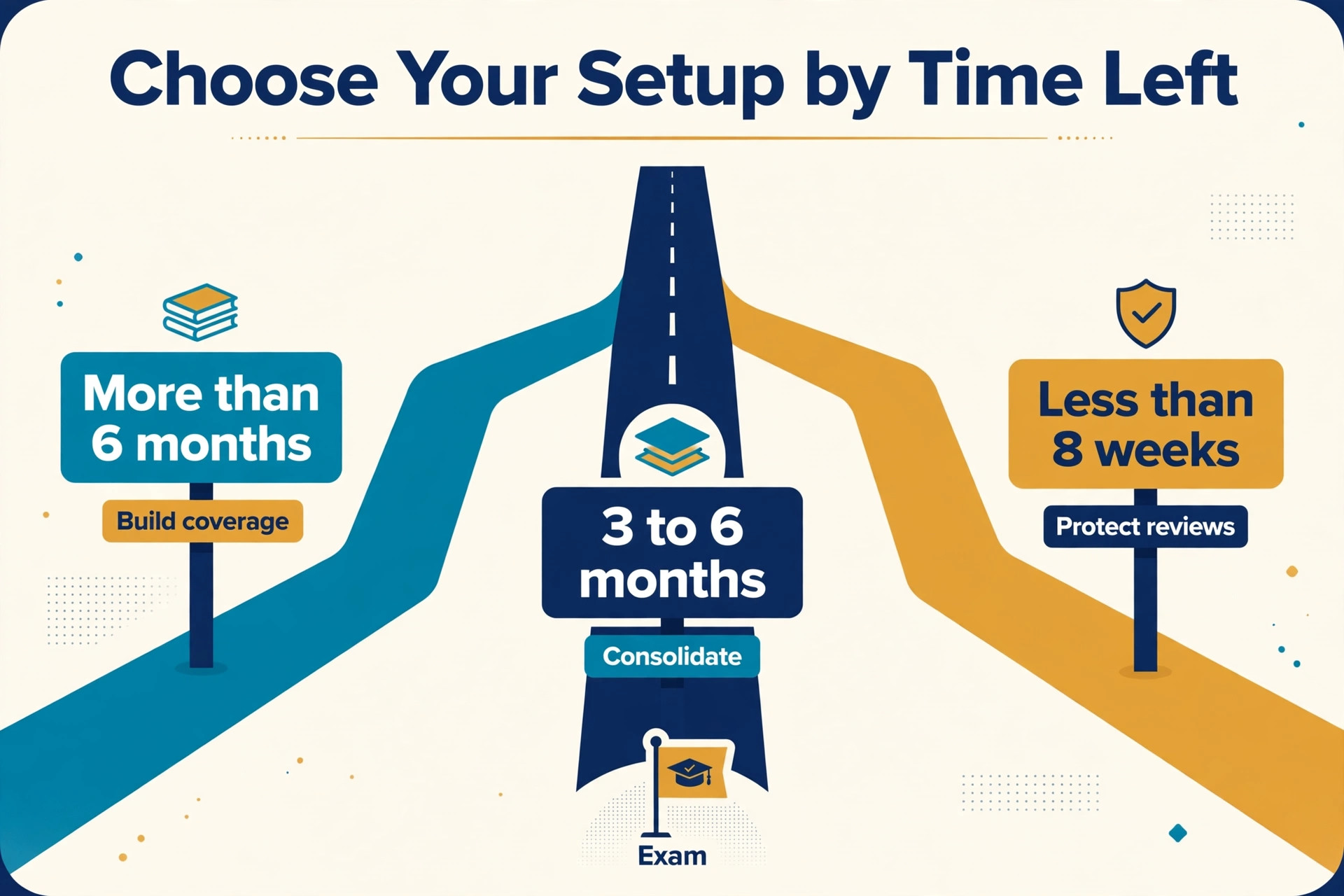
Your setup should change with the time left before the exam, because a system built for two years of learning is not the same as a system built for eight weeks of revision. With more than six months left, you can afford a broad deck, a moderate new card target, and time to write your own cards for weak topics. Focus on building coverage steadily, on learning how to write good cards, and on pairing each topic with practice questions. That long runway is also the best time to turn FSRS on and let it learn your patterns, because the benefit of personalised intervals grows with the amount of review data you give it.
With three to six months left, shift the balance from coverage to consolidation. Reduce new cards, increase the share of practice questions, and use tags to focus reviews on high yield topics and on cards created from missed questions. Suspend topics that are low yield for your specific exam, even if they are interesting, because time is now the limiting factor. A focused deck that you finish every day beats a complete deck that you abandon halfway through. With less than eight weeks left, stop adding new cards except for facts you keep missing in mocks, and protect reviews and question practice above all else.
In the final weeks, a filtered review of high yield tags and missed question cards is more valuable than starting a new subject from scratch.
For students who want to plan the wider exam season, not just the flashcard system, related reading on this site includes how to use AI to prepare for an exam for study planning, AI tools for students for comparing study tools, and best note taking apps for keeping lecture notes organised alongside your decks.
Frequently Asked Questions
How many new Anki cards should a medical student do per day?
A safe starting point is 30 to 50 new cards a day if you have 60 minutes for Anki, or 50 to 80 if you have 90 minutes and your cards are short. The right number is the one that keeps your total daily reviews under the time you can sustain every day, including clinical days.
Is Anki free for medical students?
Anki desktop for Windows, Mac and Linux is free, AnkiDroid for Android is free, and AnkiWeb sync is free. The only paid official version is AnkiMobile for iPhone and iPad, listed at 24.99 dollars as a one time purchase at draft time. Avoid unofficial apps with a similar name that charge a subscription and do not sync with the main Anki system. Check the official site and the App Store listing for regional pricing before you buy.
Should I use a ready made deck or make my own cards?
Use both. A ready made deck gives you fast coverage for broad subjects, while your own cards give you exact fit for course specific topics and for facts you miss in practice questions. Suspend parts of a ready made deck that your exam does not cover, tag your own cards clearly, and keep your own cards in a separate child deck so they are easy to find when a ready made deck is updated.
What are the best Anki settings for medical exams?
If you are starting fresh, turn FSRS on and set a desired retention of about 0.90 as a starting point. Use learning steps of 1 minute and 10 minutes and a graduating interval of 1 day, then check your mature retention and daily review time after two weeks. A higher retention target creates many more reviews for a small gain, while a lower target risks gaps on high stakes facts.
How do I clear a large Anki backlog without quitting?
Stop adding new cards, work through due cards oldest first, and suspend duplicates, outdated cards and badly written cards instead of failing them repeatedly. If the backlog is very large, use a filtered deck for high yield and missed question cards first, then clear the rest over several days. Do not try to clear 1,000 cards in one sitting, because exhaustion will create a new backlog the next day. Reduce new cards to zero until reviews are back under control.
Can Anki replace practice questions for medical exams?
No. Anki builds fast factual recall, while practice questions teach you to apply facts to vignettes, to choose between similar options, and to work under time pressure. The strongest pattern is to study a topic with Anki, do questions on the same topic, and turn each missed question into one or two short Anki cards. That loop uses each method for what it does best, and it directs new cards exactly where you are weak.
The Revision System That Survives Exam Week
A good Anki system is not the one with the most cards. It is the one you still use in exam week, when time is short, stress is high, and every study method competes for the same hours. That system has a clear deck structure, a daily target set from real available time, interval settings that you have tested for at least two weeks, and a routine that protects reviews before new cards. It also has a habit of suspending weak cards, turning missed questions into new cards, and pairing recall with practice questions and clinical exposure, so factual knowledge becomes exam performance rather than staying as isolated facts.
Start this week with three concrete steps. First, set up your deck structure and tags before you add another card, using the template in this guide as the pattern. Second, set a modest new card target and a fixed daily slot, and keep that slot for two weeks without increasing the target. Third, do a set of practice questions on the same topic as your reviews, and add cards only for what you missed.
If you use Anki for medical exam revision in that disciplined way, the tool stops being a source of backlog anxiety and becomes what it was designed to be, a quiet system that brings back the right fact at the right time, so you can spend exam week thinking, not relearning.