
A chair sits empty on a Tuesday. The phone rings while you are mid colour, a client no-shows on Saturday, and the booking book is a paper diary that nobody else can read, and that is the exact pain the best ai tools for salons are built to remove. The tools do not replace the stylist. They fill the chairs, take the payments, and remind the clients.
This guide compares ten tools that salons actually use in 2026, judged on booking, payments, client reminders, and price. Prices here come from vendor pages and comparisons checked in late 2026, so confirm the current price before you commit, because salon tool pricing changes with chair count and add-ons.
The ten tools split into three jobs. Fresha, Booksy and Vagaro bring new clients through marketplaces. GlossGenius, Square Appointments and Schedulicity run the booking and payments for your own clients. Mangomint, Boulevard, Zenoti and Salon Iris run the whole business, from payroll to inventory.
Why Empty Chairs Cost More Than Any Subscription
An empty chair is lost revenue that never comes back. A stylist who sits idle for two hours on a Tuesday has lost a hundred dollars or more, and a salon with four chairs loses that four times over. The booking tool is not an admin expense, it is the thing that decides whether the chairs are full.
The second problem is no-shows. A client who books and never arrives costs the slot and the stylist time, and a salon without deposits and reminders eats that cost every week. The tools in this list cut no-shows with deposits, text reminders and waitlists, and the difference shows up in the first month.
The third problem is the hidden bill. A cheap subscription with a 20 percent marketplace commission costs more than an expensive subscription with none, once the new clients start arriving. The real price of a salon tool is the subscription plus commissions plus payment processing plus add-ons, and this guide works it out honestly.
The best ai tools for salons below are judged on the job each tool does, not on the demo it shows.
The 10 AI Tools for Salons at a Glance
The table below is the short version. Read it to narrow the list to two or three tools, then read the detail section before you pay for anything. Use it to shortlist the best ai tools for salons worth testing on your own work.
| Tool | Main job | Best for | Starting paid price |
|---|---|---|---|
| Fresha | Booking plus marketplace | New client discovery | about 20 dollars a month |
| Booksy | Booking plus marketplace | Barbers and stylists | about 30 dollars a month |
| GlossGenius | All in one salon platform | Solo stylists and small teams | about 24 dollars a month billed yearly |
| Vagaro | All in one salon platform | Multi staff value | about 30 dollars a month |
| Square Appointments | Free booking and payments | Starting at zero cost | free |
| Mangomint | Premium salon platform | Premium salons with a front desk | about 130 dollars a month |
| Boulevard | Premium booking platform | High end salons and spas | pricing on the vendor site |
| Zenoti | Enterprise salon and spa platform | Spas and multi location | pricing on the vendor site |
| Salon Iris | Salon management software | Small salons that want depth | about 40 dollars a month |
| Schedulicity | Booking and payments | Budget solo operators | about 35 dollars a month |
The table above narrows the field, but the right answer for most readers is a pair of tools, not one. The detail section shows what each tool actually does, what it costs, and where it falls short, so the choice follows the job rather than the marketing.
Best Pick by Job
| Job type | First pick | Second tool | Why this pair works |
|---|---|---|---|
| Solo stylist, starting out | GlossGenius | Square Appointments | One predictable bill plus a genuinely free option if you already use Square |
| New clients needed fast | Fresha | Booksy | Big marketplaces that send bookings, with commissions to budget for |
| Three to seven chairs | Vagaro | GlossGenius | Broad features with a cost ceiling against predictable per user billing |
| Premium salon, front desk | Mangomint | Boulevard | Designed for salons with a front desk and a premium experience |
| Spa and multi location | Zenoti | Vagaro | Enterprise features for spas and chains, with Vagaro as the cheaper route |
| Tightest budget | Square Appointments | Schedulicity | Free tier plus a low cost plan for a solo operator |
A salon owner running the best ai tools for salons as a single platform gets further than one juggling three apps. Pick the tool that matches your chair count, since per staff pricing compounds fast. A solo stylist and a seven chair salon need different tools, and the wrong one costs more every month you keep it.
Commissions change the answer. Fresha takes 20 percent of a new marketplace client first booking, and Booksy Boost takes 30 percent of a first visit. A salon that gets twenty new clients a month on 80 dollar tickets pays hundreds in commissions, which dwarfs the subscription saving.
How to Judge the Best AI Tools for Salons
Judge every option on total cost at your chair count first. The best ai tools for salons are only cheap if they stay cheap when you add staff, so price each tool for one, three and five chairs before you compare. A 24 dollar solo plan that becomes 150 dollars at five chairs is not the cheap option.
Next, test no-show protection and deposits on your own work. A tool that looks strong on a feature list but stumbles on no-show protection and deposits will cost more time than it saves, so run it on a real task before you compare anything else. The test should use your files, your audience and your deadline, not the vendor demo data.
Then weigh marketplace reach against commissions against payments, payroll and reporting. A tool that wins on marketplace reach against commissions but fails on payments, payroll and reporting is a bad buy, and a tool that handles both is worth paying for. Check the marketplace reach against commissions first, because a failure there shows up in the first week, while a failure on payments, payroll and reporting shows up in the first month.
Finally, check payments, payroll and reporting before you sign. A tool that handles tips, commissions and payroll in one place saves hours a week, and a tool that exports clean reports saves an argument with your accountant. The admin time matters as much as the subscription price.
What to Check Before You Pay for a Salon Platform
Check the free tier on your real work first. A free tier that covers a full week of real tasks tells you more than any demo, and a free tier that runs out in a day tells you the paid plan is the real price. Run the trial on the job you will actually do, not on the sample data the vendor provides.
The 10 AI Tools for Salons in Detail
1. Fresha
Fresha combines online booking with a large consumer marketplace, so new clients find the salon rather than the other way round. It is the strongest discovery tool in this list, and the reason many new salons choose it first.
Independent costs about 20 dollars a month for a solo operator, with team plans at about 15 dollars per member. The catch is a 20 percent commission on new marketplace clients, with a minimum fee per client.
Fresha fits salons that need new clients more than they need cost predictability. The trade off is the commission bill, which can dwarf the subscription.
List your salon on Fresha for a month and track where new clients come from. The marketplace should bring people who would never have found you. If the new bookings outweigh the twenty percent commission, the discovery is worth the bill. If the commission grows larger than the subscription and most bookings come from your own regulars, the marketplace is taxing clients you already had, and a booking tool without commission keeps more of each appointment.
2. Booksy
Booksy pairs booking software with a marketplace of tens of millions of users, and it is strongest with barbers and stylists who already have a book. Its Boost feature promotes the salon to new clients on demand.
Booksy Biz costs about 30 dollars a month for a solo operator, plus 20 dollars per extra team member. Boost takes 30 percent of a new client first visit, capped at 100 dollars.
Booksy fits established stylists who want more clients on tap. The trade off is the per staff pricing and the Boost commission, which both grow with the team.
Run Booksy with your existing book and switch Boost on for a slow week. The test is whether Boost fills empty chairs that would otherwise stay empty, and whether the thirty percent of a first visit, capped at a hundred dollars, is less than the chair was earning idle. If the chairs fill, the commission is the cost of a client you did not have. If Boost mostly reaches people who would have booked anyway, a flat rate tool without a marketplace cut is cheaper.
3. GlossGenius
GlossGenius runs booking, payments, marketing and client management in one polished app, and it is the favourite of solo stylists for a reason. Setup takes minutes, and the marketing tools are included rather than sold as add-ons.
Standard costs about 24 dollars a month billed yearly, Gold about 48 dollars for teams up to nine, and Platinum about 148 dollars. There is no marketplace commission at any tier.
GlossGenius fits solo stylists and small teams that want one predictable bill. The trade off is less depth than Vagaro on payroll and inventory.
Move a solo chair or a small team onto GlossGenius for a month and run booking, payments, marketing and client management from one app. The test is the bill at the end of the month. Standard at twenty four dollars should cover a solo stylist and Gold at forty eight a team up to nine, with nothing extra, since there is no marketplace commission at any tier. If the month ends on one predictable number with the marketing tools included, stay.
4. Vagaro
Vagaro is the workhorse of this list, covering booking, POS, payroll, marketing automation, inventory and loyalty for around 30 dollars a month per calendar. It is the broadest platform at its price, and the best value for a multi staff salon.
The base plan costs about 30 dollars a month for one bookable calendar, plus 10 dollars per extra calendar, with a cap around 85 dollars. A 30 day free trial covers full feature access.
Vagaro fits salons with three to seven chairs that want everything in one place. The trade off is an interface that feels busier than GlossGenius.
Run Vagaro through a full week with three to seven chairs, using booking, POS, payroll, marketing, inventory and loyalty together. The thirty day free trial covers full access, so the test costs nothing. If the broad platform at thirty dollars a calendar holds the whole salon together and the cap near eighty five dollars keeps the bill sane, it is the best value for a multi staff salon. If the interface feels busier than GlossGenius and your team only uses booking and payments, you are paying for unused depth.
5. Square Appointments
Square Appointments is the only genuinely free option in this list, with online booking, calendar sync and payments for a solo operator at no monthly cost. It makes sense for any salon that already takes payments through Square.
The free tier is usable, and Plus costs about 49 dollars a month for teams that need more. Payment processing runs about 2.6 percent plus 15 cents, which is standard.
Square Appointments fits a solo operator starting out. The trade off is no marketplace and fewer salon specific features than the paid platforms.
Start a solo chair on the free tier and run booking, calendar sync and payments for a month without paying a subscription. If you already take payments through Square, the setup is nearly free and the processing at two point six percent plus fifteen cents is standard. If the month runs smoothly and you never miss a marketplace, stay free and spend the money on the chair, not the software. If you need a marketplace to find new clients, Square has none, and that gap is what would push you to a paid platform.
6. Mangomint
Mangomint is built for premium salons, with a front desk view, memberships, forms, and a polished client experience that matches a high end brand. It is the tool salons choose when the experience matters as much as the booking.
Plans start at about 130 dollars a month for a single location, rising with staff count. There is no marketplace commission, so the bill is predictable even as the salon grows.
Mangomint fits premium salons with a front desk. The trade off is price, which is several times the budget tools, and it only makes sense above a certain revenue.
Run Mangomint at the front desk for two weeks and watch the client experience. Memberships, forms and the polished booking flow should match a high end brand, with no marketplace commission as the salon grows. If clients notice the difference and the front desk runs smoother, a hundred thirty dollars a month is the price of a premium salon. If the revenue does not yet support it, the price is several times the budget tools for features a small salon cannot use, and the honest move is to grow into it later.
7. Boulevard
Boulevard runs booking, payments and client management for high end salons and spas, with a focus on the client experience and the front desk workflow. It is the closest rival to Mangomint in this list.
Pricing is custom and quoted per salon, so get a written figure before comparing. Expect premium pricing in line with Mangomint, with no marketplace commissions.
Boulevard fits high end salons and spas that want a premium platform. The trade off is that pricing is opaque, and small salons will not get value from it.
Before you test Boulevard, get a written figure, since pricing is custom and quoted per salon. Then compare that number against Mangomint for the same high end job, and ask what the front desk workflow does better. If the quote lands in line with Mangomint and the client experience justifies it, Boulevard earns its place for high end salons and spas. If the quote comes back opaque or the salon is small, walk away, since a small salon will not get value from a premium platform.
8. Zenoti
Zenoti runs salons, spas and multi location businesses, with inventory, memberships, marketing automation and deep reporting. It is the enterprise option in this list, built for chains rather than single salons.
Pricing is custom and quoted per business, with enterprise figures to match. A single location salon should not start a sales conversation, since the platform is built for scale.
Zenoti fits spas and chains with several locations. The trade off is enterprise cost and complexity, which rule it out for independent salons.
Zenoti only makes sense across several locations, so test it on the problem it is built for. Inventory, memberships, marketing and deep reporting across salons and spas should replace the spreadsheets that hold a chain together. If the reporting finally shows the whole business in one place, the enterprise quote is a chain decision. If you run a single location, do not start a sales conversation, since the cost and complexity are built for scale you do not have.
9. Salon Iris
Salon Iris covers booking, POS, inventory, payroll and client records in a desktop first package that small salons have used for years. It is less fashionable than the newer tools, and more complete on the back office.
Plans start at about 40 dollars a month, with higher tiers for more features. The price sits between the budget tools and the premium platforms, which is where its audience lives.
Salon Iris fits small salons that want back office depth without premium pricing. The trade off is an older interface and no consumer marketplace.
Put Salon Iris on the back office for a month, booking, POS, inventory, payroll and client records, and see whether the depth shows up where it matters. The price sits between the budget tools and the premium platforms, so the test is whether payroll and inventory run smoother than on a prettier tool. If the back office finally feels complete, forty dollars a month is fair for a desktop first package small salons have used for years. If the older interface slows the front desk down and you never open the payroll screens, the depth is not worth the friction.
10. Schedulicity
Schedulicity offers online booking, payments and client reminders at a low price, with a marketplace that sends some new clients. It is a solid budget alternative to the bigger names in this list.
Plans start at about 35 dollars a month, with a free tier for very low volume. The price undercuts most rivals, which is the main reason to choose it.
Schedulicity fits budget conscious solo operators. The trade off is a smaller feature set and a smaller marketplace than Fresha or Booksy.
Run Schedulicity on a solo book for a month, starting on the free tier if your volume is very low. At thirty five dollars a month it undercuts most rivals, which is the main reason to choose it. If the month runs clean and the marketplace sends some new clients, the budget price is doing its job. If the smaller feature set and smaller marketplace leave you wishing for Fresha or Booksy, the saving is small and the gap is real, so pay the difference for the tool that actually fills chairs.
A Salon Workflow From Booking to Rebooking
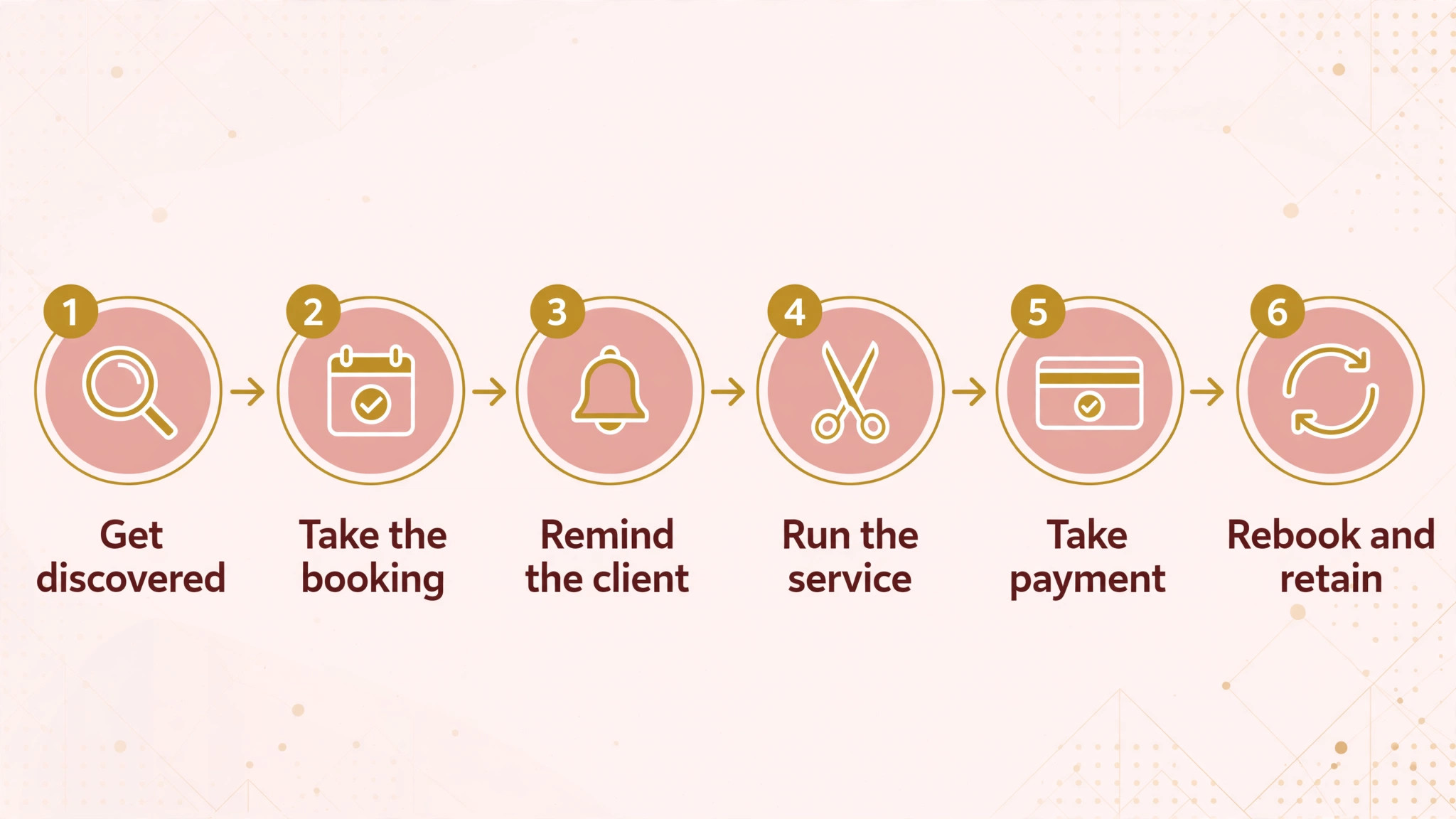
The order matters. Discovery first, booking second, service third, and rebooking last. A tool used out of order creates rework, so run the steps in sequence. The best ai tools for salons that fit your work are the ones that survive this order.
| Step | Job | Best tool | What good looks like |
|---|---|---|---|
| 1 | Get discovered | Fresha | Marketplace listing that puts the salon in front of new clients |
| 2 | Take the booking | GlossGenius | Online booking with deposits that protect the slot |
| 3 | Remind the client | Vagaro | Text reminders that cut no-shows before they happen |
| 4 | Run the service | Mangomint | Front desk view of the day, chairs, and stylist schedules |
| 5 | Take payment | Square Appointments | Fast checkout with tips and card on file |
| 6 | Rebook and retain | Booksy | Follow up messages that bring the client back on schedule |
Run the workflow on one week of real bookings before you commit to it. Take bookings, send reminders, run the day, take payments and chase rebookings for a single week, and count the no-shows. The workflow that cuts no-shows in half in week one will pay for itself every month after.
What a Salon Stack Costs at Real Volume
Prices below use annual billing where it is cheaper, and they assume the chair counts shown. Commissions and payment processing sit on top of every subscription, so budget for them separately. The best ai tools for salons below are priced at real volume, not at headline rates.
| User type | Volume | Tool stack | Monthly cost |
|---|---|---|---|
| Solo stylist | 1 chair | Square Appointments free | 0 dollars |
| Solo stylist, polished | 1 chair | GlossGenius Standard | About 24 dollars |
| Small salon | 3 chairs | Vagaro, 3 calendars | About 50 dollars |
| Growing salon | 5 chairs | GlossGenius Gold | About 48 dollars |
| Premium salon | 5 chairs | Mangomint | About 170 dollars |
Where does a salon actually lose money? Not on booking software, because a solo stylist can run on Square Appointments for free. It leaks out through empty chairs, through no-shows nobody chases and rebooking nobody does, so that is the one place worth paying for, and everything else can stay free.

Three Salon owners Setups That Actually Work
A single tool rarely covers the whole job, and the setups below are the pairs that readers actually run. Each one costs less than a single enterprise platform, and each one is easier to learn than a tool that tries to do everything.
Setup 1 fits solo stylist, starting out. GlossGenius does the heavy work, and Square Appointments covers the gap it leaves. One predictable bill plus a genuinely free option if you already use Square. Run this setup for a month before you add anything else, because most readers never need a third tool, and the money saved is better spent on the work itself.
Setup 2 fits new clients needed fast. Fresha does the heavy work, and Booksy covers the gap it leaves. Big marketplaces that send bookings, with commissions to budget for. Run this setup for a month before you add anything else, because most readers never need a third tool, and the money saved is better spent on the work itself.
Setup 3 fits three to seven chairs. Vagaro does the heavy work, and GlossGenius covers the gap it leaves. Broad features with a cost ceiling against predictable per user billing. Run this setup for a month before you add anything else, because most readers never need a third tool, and the money saved is better spent on the work itself.
The common thread across all three setups is the same. Buy the pair that matches the job you do most often, learn it properly, and add a third tool only when a real gap appears. A stack that grows with the work beats a stack bought all at once.
Mistakes to Avoid With Salon Software
The best ai tools for salons fail in the same few ways, and each mistake below costs time or money. Avoid them and the stack works.
Comparing subscriptions and ignoring commissions. A 20 dollar subscription with a 20 percent commission costs more than a 50 dollar subscription with none, once new clients arrive. Work out the total bill for your real new client numbers before you choose, and include payment processing in the same calculation.
Running a salon without deposits. A booking without a deposit is a promise, not a commitment. Take deposits on every new client booking, and make the cancellation policy clear at the time of booking. The salons with the fewest no-shows are the ones that charge for the slot.
Letting clients book by phone and text only. Phone bookings tie up the front desk, get written down wrong, and cannot be seen by the whole team. Move every booking online, so the diary is always current, every stylist sees it, and clients can book at midnight without calling.
Picking a tool for today chair count. A tool that is cheap for one chair and expensive for five will punish you for growing. Price every tool at the chair count you expect in a year, not the one you have today, and choose the one that stays affordable as you hire.

First Week Setup Checklist for Salon Owners
Use this checklist when you set up your stack, and keep a copy with your project notes. It turns the best ai tools for salons into a working setup in a week.
- Price your top three tools for one, three and five chairs.
- Set up online booking and test it as a client would.
- Turn on deposits for all new client bookings.
- Set up text reminders for 48 hours and 2 hours before each appointment.
- Import your client list with service history and notes.
- Set up payment processing and test a card payment end to end.
- Create a rebooking message that goes out after every appointment.
- Run one full week on the new tool before cancelling the old one.
Related Guides
Keep exploring with these guides on Stratilyze:
- Best CRM Software for Salons (10 Tools)
- Best AI Appointment Setters for Salons (15 Tools)
- Top 10 Accounting Software for Salons (10 Tools)
Frequently Asked Questions
Which salon software is best for a solo stylist?
GlossGenius is the best pick for a solo stylist, because Standard costs about 24 dollars a month billed yearly and includes booking, payments, marketing and deposits in one predictable bill. Square Appointments is the free alternative, and it makes sense if you already take payments through Square.
Is Fresha really free for salons?
Not anymore. Fresha ended its free plan in 2025, and Independent now costs about 20 dollars a month for a solo operator, plus a 20 percent commission on new marketplace clients. The marketplace is still large, but the total bill is higher than the old free plan suggested.
How do salons reduce no-shows?
Take deposits on new bookings, send text reminders 48 hours and 2 hours before the appointment, and keep a waitlist for cancelled slots. Tools like Vagaro, GlossGenius and Mangomint all handle deposits and reminders, and salons that use both typically cut no-shows by half or more.
What does salon software cost for a three chair salon?
From free on Square Appointments to about 150 dollars a month on Mangomint. A realistic mid range is about 48 to 70 dollars a month, with GlossGenius Gold at about 48 dollars and Vagaro at about 50 dollars for three calendars. Add payment processing on top of every figure.
Should a salon use a marketplace like Fresha or Booksy?
Yes, if you need new clients, and no, if your book is already full. Marketplaces send real bookings, but Fresha takes 20 percent of a new client first booking and Booksy Boost takes 30 percent of a first visit. Use them to fill empty chairs, then convert those clients to direct rebookings.
Can salon software handle payroll and commissions?
Yes, on the fuller platforms. Vagaro, Mangomint, Zenoti and Salon Iris all handle staff commissions, tips and payroll reporting, while the simpler booking tools leave it to a separate system. A salon with more than three staff should pick a tool that covers payroll, not just booking.
Our Call for Salons, and When the Runner-Up Wins
Our call is GlossGenius for most salons, because it gives a solo stylist or small team one predictable bill with booking, payments, marketing and deposits included, and the price stays flat as the team grows to nine. It is the cleanest single subscription in this list. That is what the best ai tools for salons are for, a stack that ships rather than a list that impresses.
The runner-up is Vagaro, and it wins when the job is breadth on a budget. If you need payroll, inventory, marketing automation and loyalty under one roof for about 30 dollars a month, Vagaro covers more ground than any other tool at its price. Start there when the salon outgrows a simple booking tool.