
It is 5 a.m. in a small bakery, and the ovens are already on. The baker pulls the first trays out, the counter staff arrive at six, and the first customers come through the door at seven for croissants that sell out by nine. The best bakery pos software is the till that keeps up with that morning without slowing it down, and this guide follows one bakery through the day to show which of the ten tools actually does it.
A bakery runs nothing like an ordinary retail shop. Croissants sell out by nine in the morning rush, a custom cake order carries a deposit and a pickup date three weeks away, and a wholesale account expects an invoice instead of a till receipt. One till has to carry the whole span, the quick counter sale, the custom order and the wholesale delivery, and keep the customer attached through all of it.
The bakery in this guide has one location and six staff, and it sells over the counter, online and wholesale to three cafes. Its morning is the ovens and the rush, its late morning is the wholesale orders, and its afternoon is the till count. The ten tools appear when the day needs them, and every figure is a United States list price as published in November 2026, with no introductory discount applied.
5 a.m.: The Ovens Are Already On
The day starts before the till is even switched on, and that is the first thing a bakery POS has to understand. The baker is shaping loaves while the counter staff set up, and the first job of the morning is not a sale, it is knowing what is baked, what is in the oven, and what will sell out first. A till that only knows sales cannot help with that, and a till that knows stock can tell the counter staff at 7 a.m. that the sourdough is nearly gone and the croissants will last until nine. That morning is the first test the best bakery pos software has to pass.
This is where the retail tools and the restaurant systems part company. Square, Lightspeed Retail, Shopify POS, Clover and Epos Now are built around the till, the counter sale, the return, the card payment. Toast, TouchBistro, Revel Systems and Kounta come from the restaurant side, so their home ground is the table, the kitchen display and the online order.
The recipe question is the one most bakeries forget to ask, and it is the one that costs money every week. Recipe costing is thinner on Square than on Lightspeed Retail, and a bakery that bakes from scratch should test the recipe tools before it buys, because the till that cannot cost a loaf cannot tell you whether the loaf is worth baking.
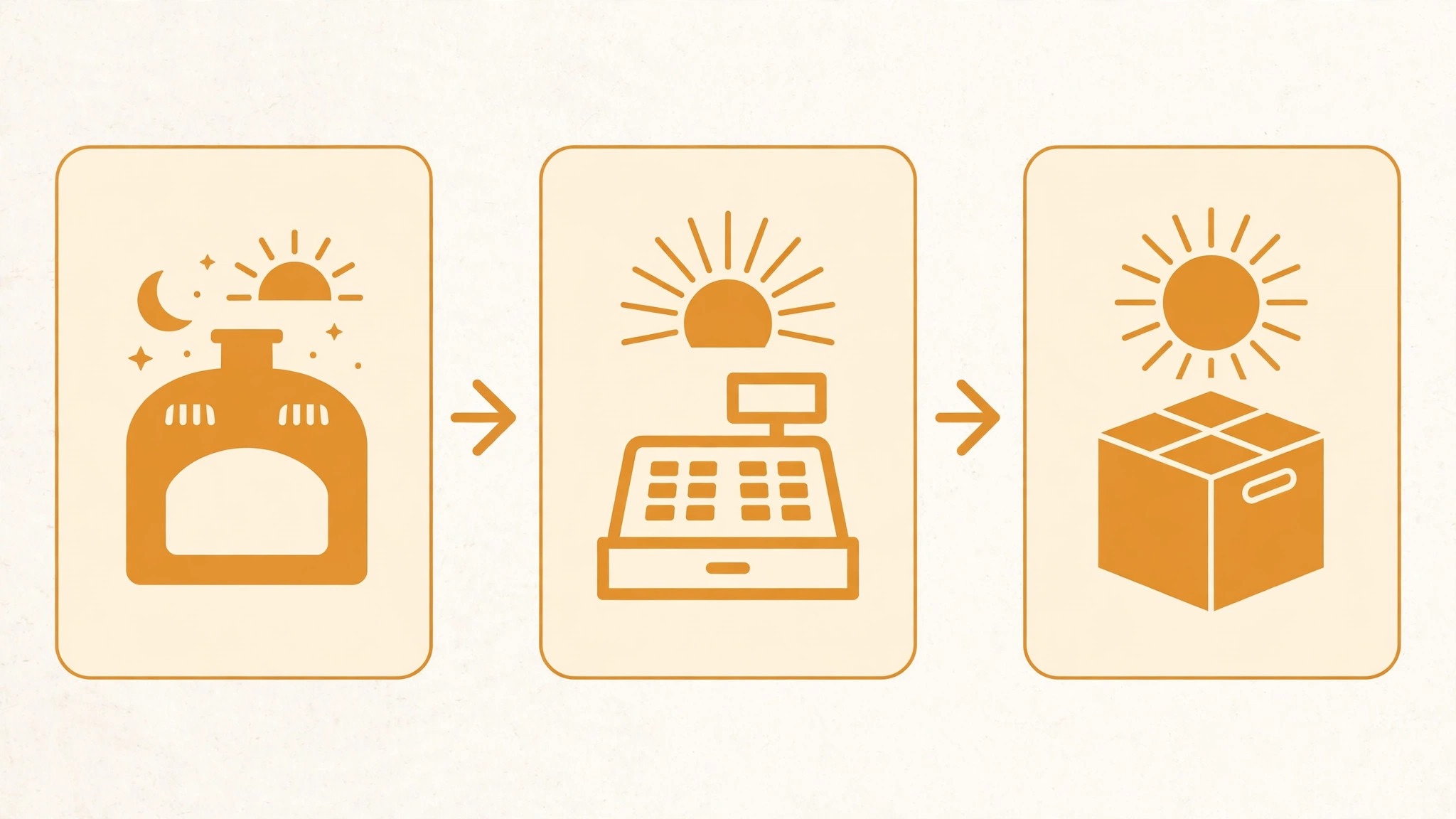
7 a.m.: The First Customers
The first customers come at seven, and they come fast. A croissant, a coffee, a loaf to take home, and the queue is five deep by 7.15. The till has to take a card, give change, and keep the queue moving, and a till that takes thirty seconds per sale will have a queue out the door by eight. Square is the fastest tool here for a counter sale, because the software costs nothing per location, the reader costs $59, and a new hire can run the checkout within an hour.
The card rate is the number that matters most at the counter, because the subscription is small and the processing bill is not. Square charges 2.6 percent plus 15 cents in person. Worked example, from the draft prices. On $15,000 a month taken by card, Square processing comes to about $400, which makes the processing bill the bigger number for a busy counter, not the subscription.
The morning rush also tests the online orders, because the customers who ordered last night want their pickup at eight, and the till has to show those orders alongside the counter sales. Toast offers commission free online ordering built into the till, Shopify POS joins the online store to the counter so a cake sold online comes out of the same stock count, and Square Online is free plus processing fees.
A bakery that takes most orders online should take Toast or Shopify POS rather than a counter only tool, because the online order that the till cannot see is the order that gets baked twice or not at all. That is the best bakery pos software test for a bakery that sells online.
Square vs Lightspeed Retail
Square and Lightspeed Retail answer the bakery question from opposite directions. Square puts payments first, the software is free, the hardware is simple, and a new hire can run the checkout within an hour. Lightspeed Retail puts stock first, purchase orders, stock spread across locations, and reporting deep enough for a specialty retailer.
Inventory depth is what splits the verdict. With a small menu and a single location, Square wins, because starting free and checking out simply matter more than stock control at that size. With several locations, a central kitchen and a wholesale account, Lightspeed wins, because inventory and purchase order tools stop being extras and become the work itself. Plenty of bakeries drift onto a middle path without planning it, free Square to begin with, then a second location, then a migration to Lightspeed carrying the whole menu and every custom order.
That move is the hidden price of starting free, so a bakery expecting a second location within a year should skip Square and begin on Lightspeed, even though the opening months cost $89 a month. Worked example, from the draft prices. Square software costs nothing against $89 a month on annual billing for Lightspeed Basic, which is $1,068 a year, and a bakery that migrates after a year pays that $1,068 plus the migration week. The best bakery pos software for a bakery that will stay small is Square, and the best for a bakery that will grow is Lightspeed, and the honest answer is to decide which bakery you are before you buy.
11 a.m.: The Wholesale Orders
By eleven the rush is over, and the wholesale orders come in. Three cafes want bread for tomorrow, one wants forty croissants, and one wants a standing order every weekday. The wholesale account does not want a till receipt, it wants an invoice, a delivery date, and a price that matches the agreement from last month. This is the moment most bakery tills fail, because they were built for the counter, not for the account.
Lightspeed Retail handles wholesale best here, since purchase orders, supplier tracking and invoicing run from the same screen as the counter sale. A bakery that supplies cafes and shops can invoice the wholesale account from the same system that sells a croissant at the counter. Square handles wholesale through invoicing rather than a built in wholesale flow, so a bakery with a few wholesale accounts can manage it, but a bakery with dozens of accounts should take Lightspeed Retail or Revel Systems.
The wholesale question is the one most bakeries forget to ask, and it is the one that forces a second system later. The standing order is the test, because a standing order that has to be retyped every morning will be typed wrong one morning, and the cafe that gets forty croissants instead of fourteen will not order again.

3 p.m.: The Till Count
The afternoon is quiet, and the till count is the job that closes the day. The owner counts the cash, checks the card totals against the till, and finds the morning’s numbers in one place. A till that cannot reconcile the day in ten minutes will eat an hour every evening, and an hour every evening is a whole working day every month, spent counting instead of baking.
Square makes the count simple, because the software is free, the sales are in one place, and the card totals match the reader. The till count is also where the custom cake orders show up, because a cake ordered three weeks ago with a deposit paid and a balance due has to be on the books, not in a notebook.
The custom order is the part of the bakery that most tills handle worst. Lightspeed Retail, Toast and Revel Systems all handle custom orders, with deposits, balances due and pickup dates tracked on the order. Square handles them through workarounds rather than a built in special order flow, so a bakery that takes custom orders daily should take a deeper tool.
The 10 Tools at a Glance
| Tool | Main job | Best for | Starting price |
|---|---|---|---|
| Square | Free POS for small bakeries | small bakeries starting free | Free |
| Toast | Restaurant POS with kitchen display | bakery cafes serving tables | From $69 a month |
| Lightspeed Retail | Inventory first retail POS | bakeries with deep inventory | $89 a month |
| Clover | Countertop hardware on one bill | bakeries wanting bundled hardware | $16 a month |
| Shopify POS | POS joined to an online store | bakeries selling online and in store | $29 a month |
| Epos Now | Retail and hospitality POS | bakeries wanting hardware and software together | Quote-based |
| TouchBistro | Restaurant POS with table service | bakery cafes with table service | Quote-based |
| Revel Systems | Cloud POS for food businesses | bakeries with several locations | Quote-based |
| Heartland | Retail and restaurant POS | bakeries with several locations | Quote-based |
| Kounta | Cloud POS for food businesses | bakeries wanting a cloud POS | Paid plan |
How to Choose the Best Bakery POS Software?
Start with the menu size and the locations, because those two numbers decide whether a retail tool or a restaurant system fits. A bakery with a small menu and one location can take Square or Shopify POS and pay little. A bakery with several locations and a central kitchen should take Lightspeed Retail or Toast, since inventory and kitchen display stop being optional at that size.
Count how many sales are custom orders, since a bakery that takes custom cake orders daily needs the special order tracking that only the deeper tools do well. Check whether the bakery sells wholesale, since a wholesale account needs invoicing rather than a till receipt. Ask whether online ordering matters, since a bakery that takes orders online needs commission free ordering built into the till. Work through those four questions and the shortlist shrinks to a pair before long, usually within minutes.
The 10 Tools in Detail
The ten tools below cover the retail till family and the restaurant system family, and each one is measured here as the best bakery pos software for a different kind of bakery. Each one is judged on the counter sale, custom orders, online ordering, inventory and wholesale, so a bakery can see which half of its business each tool serves. The first two get the longest look, because they are the two a bakery will actually choose between.
1. Square
Square gives a small bakery a till that costs nothing to run, a reader at $59, a terminal at $299 and a register at $899, with online selling and invoicing folded in. The software itself is free, and the paid plans sit at $49 and $149 per location. Starting free is the entire appeal, because a small bakery can accept cards from its first day without a monthly fee or a contract.
The trade is the depth, because recipe costing and special order handling are thinner here than on Lightspeed Retail, and a bakery that takes custom orders daily will feel it. Square suits a small bakery starting free, and the free software is genuinely free, not a trial.
Worked example, from the draft prices. A bakery that takes $15,000 a month by card pays about $400 a month in Square processing, which is $4,800 a year, against nothing a month in software on the free plan. The processing bill is the real cost of Square, and a bakery should price it before it prices the subscription, because the subscription is the smaller number.
2. Toast
Toast is a restaurant POS built for food service, with handheld ordering, kitchen display screens and commission free online ordering. Toast starts with a $0 starter kit and the Point of Sale plan from $69 a month. The kitchen display and online ordering are the best here, since an order flows from the table or the website to the kitchen screen without a ticket.
The trade is the fit, because Toast is built for a bakery cafe that serves tables and needs a kitchen display, and a small counter bakery will pay for table service tools it never uses. Toast suits a bakery cafe serving tables, and a small bakery should take Square for free and revisit Toast when the cafe side grows.
3. Lightspeed Retail
Lightspeed Retail is a stock-led till for specialty shops, built around purchase orders, stock spread across locations and reporting that stretches to thousands of SKUs. Basic starts at $89 a month on annual billing, Core at $149 and Plus at $289. No other tool here controls stock as tightly, because a bakery can follow purchase orders, transfers and suppliers from the same screen it sells from.
The trade is the price, because a small bakery pays $89 a month before it sells a loaf, and the inventory depth only pays it back when the bakery has several locations or a wholesale book. Lightspeed suits a bakery with deep inventory, and it is the best wholesale tool in this guide.
Here is the trade-off stated plainly. Lightspeed Retail costs $89 a month against Square’s free software, but you gain purchase orders, multi location stock and the wholesale flow that Square only handles through workarounds. If the bakery has several locations or a wholesale book, buy Lightspeed. If it has one counter and a small menu, buy Square and keep the $89.
4. Clover
Clover wraps the till and the software into a single package, countertop terminals, handheld devices, and an app marketplace covering loyalty and scheduling. Retail Basic opens at $16 a month for 36 months. One monthly bill is the draw for a bakery that wants everything from a single vendor, with the Compact terminal and the Starter software arriving as a pair.
The catch sits in the contract, subscriptions run 36 months with no cancellation, and a bakery that signs should read the term before the price. Clover suits a bakery wanting bundled hardware on one bill, and the 36 month term is the thing to check before signing.
5. Shopify POS
Shopify POS ties the bakery counter to the Shopify online store so tightly that inventory, customers and orders become a single list. Basic opens at $29 a month on annual billing, and POS Pro adds $89 per location. That single shared stock pool is the whole reason to buy it, a cake sold at the counter and a cake sold online come out of the same count.
The card rate is 2.6 percent plus 10 cents on Basic, with a 2 percent fee when using another processor. Shopify POS suits a bakery selling online and in store, and the shared stock count is the feature that stops the online order being baked twice.
6. Epos Now
Epos Now sells a combined till for retail and hospitality, covering sales, inventory, reporting and customer management, with the hardware included in the same deal. Pricing works on a quote, since hardware and software are sold together rather than separately. A bakery that wants its till, its printer and its software from one vendor, with one support number to call, is the customer this bundle is built for.
No published price means a bakery cannot weigh the cost against Square or Lightspeed Retail without requesting a quote, and the quote should cover the hardware, the software and the support together. Epos Now suits a bakery wanting hardware and software together, and the single support number is the reason to pick it.
7. TouchBistro
TouchBistro is a restaurant POS for cafes and bakeries with table service, with tableside ordering, menu management and reporting. TouchBistro sells on quote-based pricing. The tableside ordering suits a bakery cafe, since a server can take an order at the table and send it to the kitchen without walking back to the till.
TouchBistro does not publish a price, so a bakery cannot weigh the cost against Toast or Square without requesting a quote. It suits a bakery cafe with table service, and a counter-only bakery should not pay for tableside tools it will never use.
- Ask for a written quote that covers the till, the handhelds and the support.
- Check that the menu changes reach the kitchen screen the same day.
- Test the tableside ordering on a busy Saturday before committing.
8. Revel Systems
Revel Systems is a cloud POS for food businesses, with sales, inventory, kitchen display and multi location reporting. Revel Systems sells on quote-based pricing. The multi location reporting is the strength, since a bakery with several shops can see sales and stock across all of them from one screen.
Revel Systems does not publish a price, and the system suits a multi location business better than a single bakery. Revel Systems has no free trial, so a bakery should ask for a demo on its own menu before committing, because a demo loaded with sample products hides the custom order questions that settle the purchase.
Q. Would Revel suit a bakery with three shops and a central kitchen? A. Yes, because the multi location reporting and kitchen display were built for exactly that shape. Q. When should that bakery look elsewhere? A. When it has one shop and a small menu, because the quote-based price buys depth a single bakery will not use.
9. Heartland
Heartland covers retail and restaurant work in one system, sales, inventory, customer management and reporting aimed at businesses running several locations. Pricing comes by quote. Its depth across locations is the selling point, because stock, pricing and reporting stay in step at every site when run from a single back office.
With no published price, and a design that fits a chain better than a single bakery, Heartland asks for a conversation before a comparison. It suits a bakery with several locations, and a single bakery should take Square or Lightspeed Retail instead.
10. Kounta
Kounta, now part of Lightspeed, is a cloud POS for food businesses, with sales, inventory, online ordering and reporting. Kounta sells paid plans with pricing on request. The cloud setup suits a bakery that wants to run the till from a tablet, since the system needs no server in the shop.
Kounta pricing is not published, so a bakery cannot weigh the cost against Square or Lightspeed Retail without requesting a quote. Kounta has no free trial, so a bakery should ask for a demo on its own menu, and the tablet till is the reason to pick it over a counter terminal.
Best Pick by Job
| Job type | First pick | Second tool | Why this pair works |
|---|---|---|---|
| Small bakery starting free | Square | Shopify POS | Square charges nothing to begin, and Shopify POS brings the online store |
| Bakery with deep inventory | Lightspeed Retail | Heartland | Lightspeed handles purchase orders, and Heartland brings the multi store depth |
| Bakery cafe serving tables | Toast | TouchBistro | Toast covers kitchen display and online ordering, TouchBistro adds table service |
| Bakery selling online and in store | Shopify POS | Square | Shopify links the online store, while Square keeps the counter simple |
| Bakery needing custom cake orders | Lightspeed Retail | Square | Lightspeed tracks special orders, Square handles them through workarounds |
Two different families sit inside this list, and they solve different problems. The retail five, Square, Lightspeed Retail, Shopify POS, Clover and Epos Now, are built around the till, the counter sale, the return, the card payment. Toast, TouchBistro, Revel Systems and Kounta come from the restaurant side, so their home ground is the table, the kitchen display and the online order. That split is why the best bakery pos software is a family question first, and the counter or the kitchen decides it.
What I would do, if this were my bakery and my money, is start on Square for free and spend the first week on the menu, not on the hardware. Pull the full menu out with item, price, cost and recipe attached, strip out discontinued items and duplicate prices, and bring the custom orders in with customer, items, deposit paid, balance due and pickup date. A clean menu means the switch takes one to two weeks, and a messy one stretches it to a month, and the custom orders are where the hours go.
What Does Bakery POS Cost per Month?
Below, the best bakery pos software is priced at three sizes from published list prices dated November 2026. Restaurant systems appear as quote-based wherever no list price exists, and the card rates shown are the in person rates on the entry plans.
| Tool | 1 user a month | 3 users a month | 5 users a month | Card payment cost |
|---|---|---|---|---|
| Square | $0 | Plus plan $49 a month | Premium plan $149 a month | 2.6 percent plus 15 cents in person, reader $59 |
| Lightspeed Retail | Basic $89 a month, annual billing | Core $149 a month | Plus $289 a month | 2.6 percent plus 10 cents, extra registers $59 a month each |
| Shopify POS | Basic $29 a month, POS Pro $89 extra | Basic $29 a month, POS Pro $89 extra | $299 a month plan, POS Pro $89 extra | 2.6 percent plus 10 cents on Basic, 2 percent fee with another processor |
| Clover | Retail Basic $16 a month, 36 months | $29.95 a month | $84.95 a month | 2.6 percent plus 10 cents, hardware from $199 |
| Toast | $0 starter kit | $69 a month | $69 a month plus add-ons | Processing rates not published, ask for a written quote |
| Epos Now | Quote-based | Quote-based | Quote-based | Hardware plus software in one bundle, price on request |
Can a Bakery POS Handle Wholesale Orders?
Yes, Lightspeed Retail handles wholesale best here, since purchase orders, supplier tracking and invoicing run from the same screen as the counter sale. A bakery that supplies cafes and shops can invoice the wholesale account from the same system that sells a croissant at the counter.
Square handles wholesale through invoicing rather than a built in wholesale flow, so a bakery with a few wholesale accounts can manage it, but a bakery with dozens of accounts should take Lightspeed Retail or Revel Systems. The wholesale question is the one most bakeries forget to ask, and it is the one that forces a second system later. A bakery that takes one wholesale order a week can manage on Square, and a bakery that takes five a day cannot, because the invoicing, the delivery notes and the account balances need a system built for them.
Frequently Asked Questions
How much does Square really cost a bakery that takes $15,000 a month by card?
The software costs nothing, the reader costs $59, and the card processing comes to about $400 a month on $15,000 taken by card at 2.6 percent plus 15 cents. Square Plus at $49 a month adds inventory and customer management once the shop grows, and Premium at $149 a month adds more. The processing bill is the bigger number for a busy counter, not the subscription, so price the card rate first.
Do bakery POS systems handle custom cake orders?
Yes, Lightspeed Retail, Toast and Revel Systems all handle custom orders, with deposits, balances due and pickup dates tracked on the order. Square handles them through workarounds rather than a built in special order flow, so a bakery that takes custom orders daily should take a deeper tool. A bakery that takes one custom cake a week can manage on Square, while a bakery that takes five a day cannot.
Can a bakery take online orders?
Yes, Toast offers commission free online ordering built into the till, Shopify POS joins the online store to the counter, and Square Online is free plus processing fees. A bakery that takes most orders online should take Toast or Shopify POS rather than a counter only tool, because the online order that the till cannot see is the order that gets baked twice or not at all.
How long does it take to switch POS systems?
With a clean menu, most bakeries are done in one to two weeks, because the menu import and the custom orders are the bulk of the work. A bakery sitting on years of paper records should allow a month, and keep the old till running as a backup through the first week. The custom order list is the cheapest insurance in any switch, so map it before importing.
Is Toast worth it for a small bakery?
No, Toast is built for a bakery cafe that serves tables and needs a kitchen display, and its quote-based processing rates do not suit a small counter bakery. A small bakery should take Square for free, and revisit Toast when the cafe side grows. The processing quote is the part to watch, since Toast does not publish every rate and a small bakery should get it in writing.
What hardware does a bakery need?
A small bakery needs a reader at $59 on Square, and a busy counter needs a terminal at $299 or a register at $899. Lightspeed Retail charges $89 a month for software before any hardware, and each extra register costs $59 a month. Clover hardware starts from $199, and Epos Now bundles hardware and software in one deal, so get the hardware quote in writing before comparing.
What the Day Proved
The day proved that a bakery POS is not bought for its dashboard, and it is not bought for its feature list. It is bought for the ovens at 5 a.m., the queue at 7 a.m., the wholesale orders at 11 a.m., and the till count at 3 p.m. Square is the best bakery pos software pick for a small bakery, because the software costs nothing per location, the reader costs $59, and the card rate is 2.6 percent plus 15 cents. Lightspeed Retail is the pick for a bakery with deep inventory and several locations, and Toast is the pick for a bakery cafe that serves tables.
The numbers back that up. Square software costs nothing against $89 a month for Lightspeed Basic, a bakery that takes $15,000 a month by card pays about $400 a month in Square processing, and a bakery that takes five custom cakes a day needs a deeper tool than one that takes one a week. The croissants sold out by nine, the wholesale orders went out invoiced, and the till counted clean at 3.30, and that is what the day proved.