
A 12-truck company faces a year-one bill of $5,760 for telematics alone on the best fleet management software for trucking companies shortlist, and three times that once dashcams, hardware and a three-year contract join the maths. Samsara wins this roundup because its AI dashcams, predictive maintenance and real-time visibility cover the most jobs in one dashboard, and a trucking company that buys it stops paying for five separate tools. The bill below is the honest starting point, and the rest of this guide is about what the bill hides.
The Year-One Bill, Line by Line
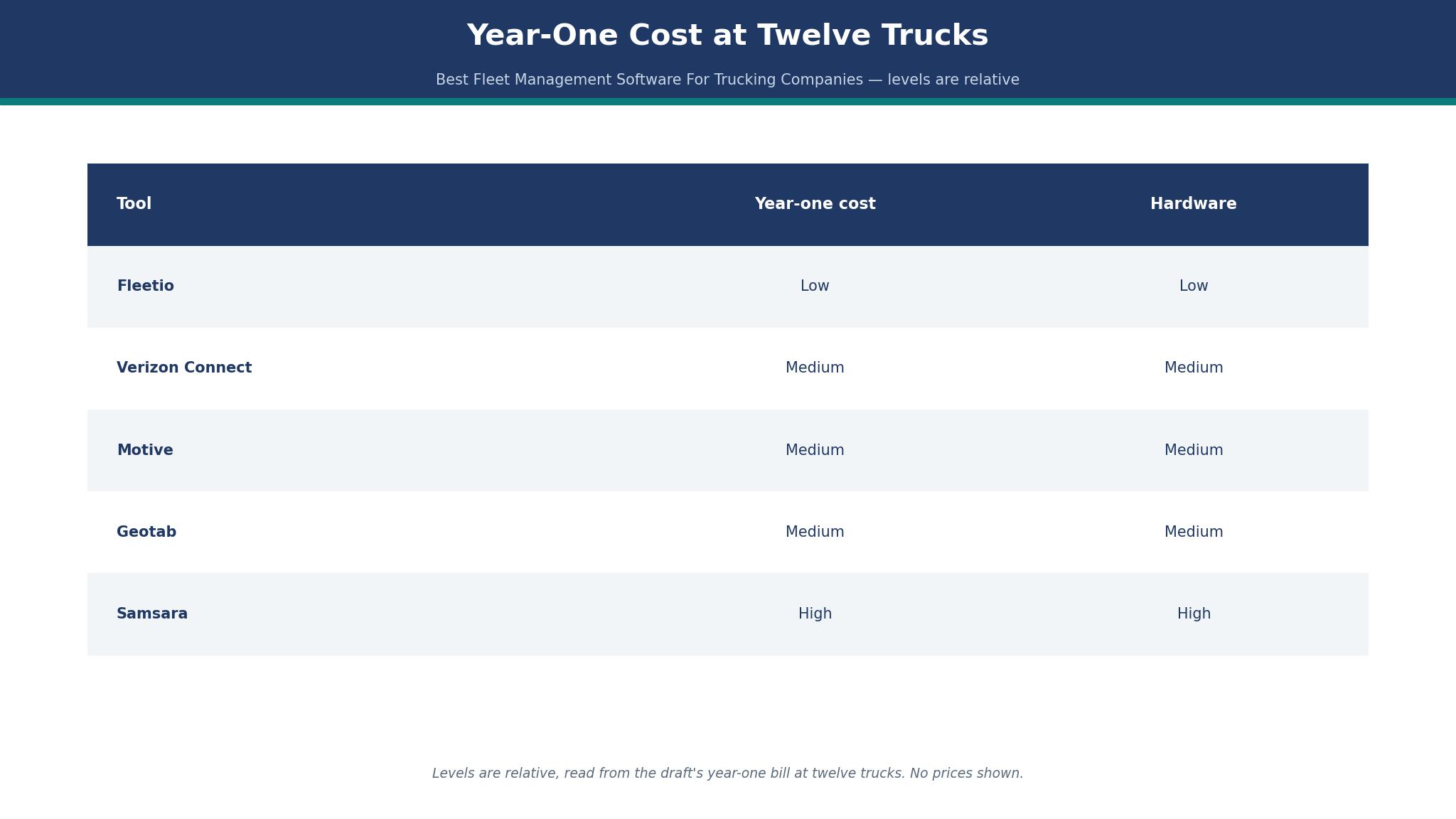
| Tool | Rate per vehicle a month, reported | 12 trucks, 12 months | Hardware, reported | Year-one total |
|---|---|---|---|---|
| Samsara | $27 to $50 | $3,888 to $7,200 | $99 to $548 per vehicle | $5,076 to $13,776 |
| Geotab | $25 to $45 | $3,600 to $6,480 | $80 to $120 per vehicle | $4,560 to $7,920 |
| Motive | $20 to $35 | $2,880 to $5,040 | About $150 per device | $4,680 to $6,840 |
| Verizon Connect | From $25 | From $3,600 | Quoted | From $3,600 plus hardware |
| Fleetio | From $4 to $5 | $576 to $720 | None, software only | $576 to $720 |
The table shows the five tools most buyers shortlist, and the spread is the story. The cheapest year one is Fleetio at $576, and the dearest is Samsara at up to $13,776, and both numbers are honest for different jobs. Fleetio manages maintenance. Samsara manages the whole fleet. A buyer who compares those two prices without comparing the jobs is comparing a hammer with a workshop.
Three costs hide outside the table. The first is the contract. Samsara typically asks for 36 months, and a 12-truck fleet at $40 a vehicle a month commits $17,280 over three years before hardware. The second is the dashcam. A dual-facing AI dashcam lifts the monthly rate to $40 to $60 a vehicle, which is where the top of the Samsara range comes from. The third is the install. A device that plugs into the diagnostic port takes minutes, and a wired dashcam takes an hour per truck, which is 12 hours of workshop time for this fleet.
What Does the Bill Hide?
The bill hides the contract first, and the contract is where the money is. A three-year prepaid contract means a 12-truck fleet pays $17,280 over three years at $40 a vehicle a month, and leaving early costs the rest of the term. A month-to-month plan costs more per month and nothing to leave, and for a fleet that might shrink, that freedom is worth the premium. Buyers in the best fleet management software for trucking companies market who sign a three-year deal without reading the exit clause learn its price when the fleet changes size.
The bill hides the hardware second. A gateway device costs $99 to $548 per vehicle, and a dashcam costs more again, so 12 trucks carry $1,188 to $6,576 of hardware before the first month’s subscription. Some vendors amortise the hardware into the monthly rate, and some charge it up front, and the buyer must ask which one applies before comparing two quotes. A quote that looks cheap with hardware up front is dearer than a quote that looks dear with hardware included.
The bill hides the data third. A telematics platform that charges per vehicle is simple. A platform that charges per vehicle, per driver seat and per data plan is not, and the extras can add 30 percent to the bill. Ask every vendor for the total monthly figure for 12 trucks and 14 drivers, in writing, before you sign.
The 15 Tools in Detail
Samsara leads on breadth, Geotab leads on data, and Motive leads on compliance, with twelve more behind them. The sections below cover all fifteen, with a year-one cost at twelve trucks and the limit that decides each tool in this best fleet management software for trucking companies list. The first three are the ones most fleets end up choosing between, so read them in full, and treat the rest as the shortlist for a narrower job.
1. Samsara
Samsara takes first place because it is the most complete fleet platform here, and its AI dashcams are the strongest in the list. It combines real-time GPS tracking, AI dashcams, electronic logging, maintenance and fuel data in one dashboard, and its video telematics and coaching tools are the reason large fleets choose it. A dispatcher who watches twelve trucks in Samsara sees location, speed, harsh braking and driver behaviour in one screen.
The price is the honest problem. Reported pricing runs $27 to $50 per vehicle per month plus hardware, and a standard 36-month contract is typical, with $99 to $548 in hardware per vehicle up front. A 12-truck fleet at $40 a vehicle a month pays $5,760 a year for software, plus about $2,400 in hardware at $200 per vehicle, for a year-one total near $8,160. At the top of the range, with dual-facing AI dashcams at $60 a vehicle, the same fleet pays $8,640 a year for software alone.
Samsara’s strength is the AI. Its dashcams spot distraction, following distance and harsh events with a precision other tools here do not match, and its predictive maintenance has prevented real breakdowns for fleets that use it. The video also exonerates drivers, which matters when a claim arrives and the footage proves the driver was not at fault. That footage is worth more than the subscription when it saves one claim.
The weakness is the contract. A three-year prepaid deal means a fleet commits $17,280 over three years at $40 a vehicle a month, and a fleet that shrinks pays for trucks it no longer runs.
Samsara is the best pick for a mid-to-large fleet that wants one platform for everything. It is the wrong pick for a fleet of five trucks that only needs GPS tracking, because the price and the contract are built for a larger operation.
2. Geotab
Geotab is the open platform, and its data depth is the best here. It sells through partners and resellers, it has a marketplace of over 200 add-ons, and its telematics data is the deepest in this list. A fleet that wants to build its own reports, or connect the fleet data to another system, will find Geotab the most flexible choice.
The price is reported at $25 to $45 per vehicle per month plus hardware, with $80 to $120 per device reported through resellers. A 12-truck fleet at $30 a vehicle a month pays $4,320 a year for software, plus about $1,200 in hardware, for a year-one total near $5,520. That is $2,640 less than Samsara at $40 a vehicle with $200 hardware, and the saving is real money for a small fleet.
Geotab’s strength is the open API and the marketplace. A fleet can add sustainability tracking, fuel cards, maintenance and safety tools from the marketplace, and the data flows into one place. Its weakness is the reseller model. Pricing and support quality vary by partner, so two fleets can pay different prices for the same tool, and the buyer must compare resellers as carefully as tools.
The worked example for a data-led fleet is short. A fleet that uses Geotab’s data to cut idling by one hour per truck per day saves, at a worked rate of $3.20 an hour in fuel, $800 per truck a year, or $9,600 for twelve trucks. That saving alone covers the software twice over.
3. Motive
Motive, formerly KeepTruckin, is the compliance-first tool, and it is the best pick for a trucking fleet that lives and dies by electronic logging. Its hours-of-service workflows, AI dashcam and fleet card sit in one platform, and its ELD compliance is the most trusted here for a fleet that crosses state lines every day.
The price is reported at $20 to $35 per vehicle per month plus hardware, with $100 to $200 per device and 36-month terms common. A 12-truck fleet at $25 a vehicle a month pays $3,600 a year for software, plus about $1,800 in hardware, for a year-one total near $5,400. That is the cheapest year one among the three full telematics platforms here, and the reason Motive is the value pick for small fleets.
Motive’s strength is the ELD and the driver app. Drivers log hours, inspect vehicles and message dispatch from one app, and the fleet card ties fuel spending to the truck that bought it. Its weakness is breadth. It does not match Samsara’s AI dashcam precision or Geotab’s data depth, and a fleet that wants the deepest analytics will outgrow it.
4. Verizon Connect
Verizon Connect is the enterprise telematics platform from a name every fleet manager knows, and it suits a large fleet that wants a vendor with scale. It covers GPS tracking, ELD, dispatch and maintenance, and its reporting is built for a fleet manager who answers to a board rather than to a dispatcher.
Pricing is reported from $25 per vehicle per month, with hardware quoted separately and early termination fees that buyers should read before signing. A 12-truck fleet at $25 a vehicle pays $3,600 a year for software, and the hardware and termination terms decide whether that figure is the whole bill.
5. Fleetio
Fleetio is the maintenance tool, and it is the cheapest honest tool in this list. It manages work orders, service history, inspections and fuel, and it does that job better than any full telematics platform here, because maintenance is all it does. A fleet that already has GPS tracking and needs maintenance done properly should buy Fleetio.
Pricing starts from $4 per vehicle per month, with some sources listing $5 to $10, so treat $4 as the published entry and $5 to $10 as the reported range for fuller plans. A 12-truck fleet at $5 a vehicle pays $720 a year, with no hardware, because Fleetio is software only. That is $7,440 less than Samsara in year one, and the saving is real, because Fleetio does not charge for GPS tracking the fleet already has.
Fleetio’s trade-off is scope. It does not track location, it does not run ELD, and it does not carry a dashcam. A fleet that buys Fleetio alone has no telematics, and a fleet that buys it alongside a GPS tool gets the best maintenance system here for the price of a coffee per truck per month.
6. Fleet Complete
Fleet Complete is the mid-market telematics platform, and it suits a fleet that wants tracking, dispatch and maintenance without an enterprise price. It covers GPS tracking, driver behaviour, maintenance and compliance in one dashboard, and its interface is simpler than Samsara or Geotab for a dispatcher who is new to telematics.
- Starting price: quote only; reported in the $25 to $40 a vehicle a month band.
- Best use: mid-size fleets that want one dashboard for tracking and maintenance.
- Weakness: it is less deep than Geotab on data and less sharp than Samsara on AI dashcams.
- Worked cost: a 12-truck fleet at a reported $30 a vehicle pays $4,320 a year, plus hardware.
- Verdict: a solid middle choice for a fleet that wants breadth without an enterprise contract.
Fleet Complete’s strength is the balance. It does most jobs well and none badly, and for a fleet that does not need the best dashcam or the deepest data, that balance is enough.
7. Teletrac Navman
Teletrac Navman is the long-running telematics brand, and it suits a fleet that values stability over novelty. It covers GPS tracking, ELD, driver safety and maintenance, and its reporting is built for a fleet manager who has used telematics for years and wants the numbers without surprises.
Q: What does Teletrac Navman cost? A: Quote only, with reported pricing in the $25 to $40 a vehicle a month band. A 12-truck fleet should ask for a written quote at its truck count before comparing it with Samsara or Geotab.
Q: Who should pick it? A: A fleet that wants a stable, proven platform and a vendor with a long history, rather than the newest AI features. Teletrac Navman is the steady choice.
Q: What does it give up? A: It gives up the AI dashcam precision of Samsara and the open marketplace of Geotab. A fleet that wants the newest features should look at those two first.
8. Azuga
Azuga is the budget GPS tracking tool, and it is the cheapest telematics entry here after Fleetio. It is owned by Bridgestone, and it covers GPS tracking, driver safety and basic maintenance for a fleet that needs to know where its trucks are and how its drivers behave. A small fleet that cannot justify Samsara’s price will find Azuga the most affordable honest option.
Pricing is reported from $15 to $25 per vehicle per month, with some sources listing $22.99 as the entry figure. A 12-truck fleet at $20 a vehicle pays $2,880 a year, which is $2,880 less than Samsara at $40 a vehicle. Azuga’s weakness is depth. It does not match Samsara on AI or Geotab on data, and a fleet that grows will outgrow it. Its strength is the price, and for a fleet of twelve trucks that price matters.
9. GPS Trackit
GPS Trackit is the straightforward tracking tool, and it suits a fleet that wants to know where its trucks are without paying for features it will not use. It covers GPS tracking, geofencing, alerts and basic reporting, and its interface is the simplest here after Fleetio.
Pricing starts from $25 per vehicle per month, reported, which puts a 12-truck fleet at $3,600 a year. GPS Trackit’s trade-off is scope. It is a tracking tool, not a fleet platform, and a fleet that needs ELD, maintenance and dashcams must buy those elsewhere.
10. Omnitracs
Omnitracs is the enterprise compliance platform, and it suits a large fleet that runs long-haul routes across the country. It covers ELD, dispatch, routing and driver workflow, and its history in long-haul trucking is longer than any tool here. A fleet of a hundred trucks running coast to coast will find it the most proven option.
Pricing is quote only, and enterprise deployments are reported in the same band as Samsara and Verizon Connect. Omnitracs’ weakness is the price and the complexity, which a 12-truck fleet does not need.
11. Linxup
Linxup is the small-fleet tracking tool, and it suits a business with a handful of trucks that wants GPS tracking without a sales process. It covers tracking, geofencing and alerts, and its setup is the fastest here, with devices that plug in and start reporting the same day.
Pricing is quote only, with reported entry figures near the Azuga band. A 12-truck fleet should ask for a written quote, because the price varies by device and by term. Linxup’s trade-off is depth, and a fleet that needs ELD or dashcams should look at Motive instead.
12. NexTraq
NexTraq is the mid-market tracking and safety tool, and it suits a fleet that wants driver safety scoring alongside GPS tracking. It covers tracking, speeding alerts, harsh braking and basic maintenance, and its safety reports help a fleet coach drivers without a dashcam.
Pricing is quote only, reported in the $20 to $35 a vehicle a month band. A 12-truck fleet at a reported $25 a vehicle pays $3,600 a year. NexTraq’s weakness is the dashcam, which it does not carry in the way Samsara does, and a fleet that wants video evidence should buy Samsara.
13. FleetWave
FleetWave is the asset and maintenance platform, and it suits a fleet that manages vehicles, trailers and equipment together. It covers asset tracking, maintenance scheduling, fuel and compliance, and its strength is the breadth of assets it can manage, not just trucks. A fleet with trailers, forklifts and generators as well as trucks will find it the most complete asset tool here.
Pricing is quote only, and the buyer should ask for a written quote at its asset count, not just its truck count. FleetWave’s trade-off is the telematics depth, which is thinner than Samsara or Geotab, and a fleet that needs real-time tracking should pair it with a GPS tool.
14. Quartix
Quartix is the simple tracking tool from the UK, and it suits a fleet that wants tracking and driver behaviour without complexity. It covers GPS tracking, speeding, harsh braking and idling reports, and its interface is the cleanest here for a manager who checks the fleet once a day.
Pricing is reported from about $15 a vehicle a month, which puts a 12-truck fleet at about $2,160 a year, the cheapest telematics year one in this list after Fleetio. Quartix’s weakness is the scope, which is tracking and behaviour only, and a fleet that needs ELD or maintenance must buy those elsewhere.
15. Rhino Fleet Tracking
Rhino Fleet Tracking is the no-contract tracking tool, and it suits a fleet that refuses a long contract. It covers GPS tracking, geofencing and alerts, with no long-term commitment, and a fleet can leave whenever it wants. That freedom is rare in this list, and for a fleet that might shrink, it is worth money.
Pricing is quote only, with reported entry figures in the budget band. A 12-truck fleet should ask for a written quote and compare the monthly figure with Azuga and Quartix, because the no-contract term is the feature that decides the purchase.
Samsara vs Geotab
The duel that decides most purchases is Samsara against Geotab, and the answer depends on whether the fleet wants an all-in-one platform or an open data platform. Samsara wins on the all-in-one job. Its AI dashcams, predictive maintenance and single dashboard cover the most jobs in one place, and a dispatcher who wants one screen will choose it. Geotab wins on the data job. Its open API, marketplace and telematics depth let a fleet build its own reports and connect its own systems, and a fleet with a data analyst will choose it.
On price, Geotab wins. A 12-truck fleet at $30 a vehicle on Geotab pays $4,320 a year for software, against $5,760 at $40 a vehicle on Samsara, a saving of $1,440 a year. On AI dashcams, Samsara wins without a contest, because its video telematics and coaching tools are the strongest here.
On contract, Geotab wins, because its reseller model offers more flexible terms than Samsara’s typical 36-month deal. The honest advice is to buy Samsara if the fleet wants one platform and the best dashcams, and buy Geotab if the fleet wants open data and a lower bill. That choice is the one most buyers in the best fleet management software for trucking companies market face, and it is the choice this section exists to make easy.
The Truck That Idled for Three Hours
One truck idled for three hours, and nobody reported it, because idling is invisible to a driver and obvious to the data. The truck sat at a delivery dock with the engine running, the driver waiting for a signature, and the fuel gauge dropping. Three hours at a worked rate of 0.8 gallons an hour is 2.4 gallons, and at $4 a gallon that is $9.60 for one truck on one day. Over 250 working days that is $2,400 for one truck, and $28,800 for twelve trucks, and the driver never reported it because the driver never saw it.
That is the failure this section is about, and it is the failure telematics exists to prevent. A GPS tracker sees the idle time, a good report shows it by truck and by day, and a manager who reads that report can coach the driver and save the fuel. A fleet without telematics pays $28,800 a year for idling it cannot see, and a fleet with telematics pays the software bill and keeps the fuel.
The practical rule follows from the failure. Read the idling report every Monday, rank the trucks, and talk to the top three drivers. A driver who idles for comfort in winter needs a different answer from a driver who idles at a dock, and the data shows which is which. The tools in this best fleet management software for trucking companies guide all report idling, and the fleet that reads the report saves more than the software costs.

How to Choose Fleet Management Software for Twelve Trucks?
Start with the truck count, not the tool. Twelve trucks need GPS tracking, ELD, maintenance and a dashcam, and the tool that covers all four in one place is worth more than four tools that cover one each. A fleet of five trucks needs less, and a fleet of fifty needs more, so the count decides the shortlist before any feature list is read.
Then price the three-year total, not the monthly rate. A 12-truck fleet at $40 a vehicle on Samsara pays $5,760 a year, and $17,280 over three years, plus hardware. A fleet at $25 a vehicle on Motive pays $3,600 a year, and $10,800 over three years, plus hardware. The difference is $6,480 over three years, and the question is whether Samsara’s dashcams and maintenance are worth that money.
Finally, ask for the exit clause in writing. A three-year contract with no exit is a different product from a three-year contract with a buyout, and a month-to-month plan is a different product again. A fleet that might shrink should pay the higher monthly rate for the freedom to leave, because the freedom is cheaper than paying for trucks that no longer run.
Best Pick by Job
| Job | Best pick | Year-one cost, 12 trucks |
|---|---|---|
| Mid-to-large fleet, one platform | Samsara | About $8,160 with hardware |
| Data-led fleet, open API | Geotab | About $5,520 with hardware |
| Compliance-first trucking fleet | Motive | About $5,400 with hardware |
| Maintenance only, software only | Fleetio | $720, no hardware |
| Small fleet, budget tracking | Azuga | About $2,880 |
| Small fleet, cheapest tracking | Quartix | About $2,160, reported |
| Fleet that refuses a long contract | Rhino Fleet Tracking | Quoted, no long term |
The table is the short version of the whole guide. The fleet size picks the row, and the section it points to is the part to read before signing. The picks in this best fleet management software for trucking companies guide are the same ones the detail sections recommend, so the table and the text agree.
What Does the Best Fleet Management Software for Trucking Companies List Miss About Fuel?
Most lists get one thing wrong about fuel, and it is the thing that costs fleets the most. They compare software prices, when fuel is the largest cost in the fleet. A 12-truck fleet driving 100,000 miles a year per truck at 6 miles per gallon burns 200,000 gallons, and at $4 a gallon that is $800,000 a year in fuel. A tool that cuts fuel use by 2 percent saves $16,000 a year, which is nearly three times the software cost.
The second mistake is treating idling as a small problem. Three hours of idling a day costs $2,400 per truck a year in the worked example above, and $28,800 for twelve trucks. A list that does not mention idling is not helping a fleet save money, because idling is where the money goes.
The third mistake is forgetting the driver. A tool that coaches drivers without shaming them saves more fuel than a tool that only reports, because a driver who trusts the coaching changes behaviour and a driver who does not ignores the report. Buy the tool whose coaching your drivers will accept, not the tool with the most features.
Frequently Asked Questions
Can I track fuel costs per truck without extra hardware?
Yes, with most tools here, because fuel data comes from fuel card integrations and from the vehicle’s own data, not from extra hardware. Samsara, Geotab and Motive all report fuel use per truck from those sources, and Fleetio tracks fuel from card imports. A fleet that wants fuel use by driver as well as by truck should check that the tool splits the data both ways before buying.
How much does fleet management software cost for 12 trucks in year one?
A 12-truck fleet pays $720 a year on Fleetio, about $2,160 on Quartix, about $2,880 on Azuga, about $5,400 on Motive, about $5,520 on Geotab, and about $8,160 on Samsara with hardware. The range is wide because the jobs are different, and any best fleet management software for trucking companies comparison that gives one price for every fleet is hiding the hardware and the contract.
Is Samsara worth the price for a small fleet?
For a fleet of twelve trucks that wants AI dashcams, predictive maintenance and one dashboard, yes. For a fleet of five trucks that only needs GPS tracking, no. Azuga or Quartix will track five trucks for a third of the price, and the saving is real money. Buy Samsara when the fleet is large enough to use what it offers.
Do I need a three-year contract?
No, but the monthly rate is higher without one. Samsara typically asks for 36 months, and Motive offers shorter terms. A fleet that might shrink should pay the higher monthly rate for the freedom to leave, because paying for trucks that no longer run costs more than the premium.
What is ELD, and do I need it?
ELD is an electronic logging device, and it records a driver’s hours of service automatically. A trucking company that crosses state lines needs it by law, and Motive, Samsara, Geotab and Verizon Connect all include it. A fleet that only runs locally should check its own rules before buying a tool for ELD alone.
How much fuel does idling really waste?
A truck idling for three hours burns about 2.4 gallons, which is $9.60 at $4 a gallon, and $2,400 a year over 250 working days. Twelve trucks idling the same way waste $28,800 a year. That is the worked example in this guide, and the fleet that reads its idling report every Monday saves most of it.
The Choice I Would Stand Behind
If I ran a 12-truck company, I would buy Samsara, and I would budget $8,160 for year one including hardware, and $5,760 a year after that for software. I would read the idling report every Monday, coach the top three drivers, and expect the fuel saving to cover the software bill in the first year.
I would keep Fleetio in mind for maintenance if the Samsara maintenance tools ever felt thin, and I would only look at Geotab if the fleet hired a data analyst who needed the open API. That choice is the one this guide recommends, because it matches the tool to the fleet rather than the fleet to the tool, and because the dashcam footage alone is worth the price the first time a claim arrives.