
Can a pricing tool really earn its fee on a single Airbnb listing? The top 10 ai pricing tools for airbnb hosts promise to set the right price every night, and the best of them do, because a flat rate of $19.99 a month is cheap against a single night sold $35 too low. PriceLabs is the tool I would buy first, and this interview with a host who runs four flats explains why, question by question.
Will It Undercut My Neighbours?
The host in this interview owns four flats in the same city, and her first question was the one every host asks first. She had heard that dynamic pricing tools chase every booking, and she pictured her flats listed at half price while her neighbours charged full rate. The answer is that a good tool does not undercut anyone. It sets a floor, and the host sets the floor.
PriceLabs lets the host set a minimum price, a maximum price, and a rule for every situation that matters. The minimum stops the tool from selling a Saturday night for less than the cleaning cost. The maximum stops it from pricing a holiday weekend so high that nobody books. The host in this interview set her minimum at $85, which is the price below which a night loses money after cleaning, and her maximum at $220, which is the price above which her flats sit empty. The tool works between those two numbers, and it never crosses them.
Beyond works differently. It charges a percentage of bookings, 1 percent on the Growth plan and 1.25 percent on the Pro plan, and it sets prices with less host input. That suits a host who wants the tool to do the work, and it worries a host who wants control. The host in this interview tried Beyond for a month and came back to PriceLabs, because she wanted to see the rule that set each price, and Beyond showed her the price without the rule.
The lesson is that undercutting is a setting, not a feature. A tool that lets the host set a floor cannot undercut the neighbours, because the host is the one who chose the floor. The top 10 ai pricing tools for airbnb hosts all offer that floor, and the host who sets it is protected. A tool that hides its logic can undercut, and the host will not know until the calendar is full of cheap bookings.
What Happens on a Slow Tuesday?
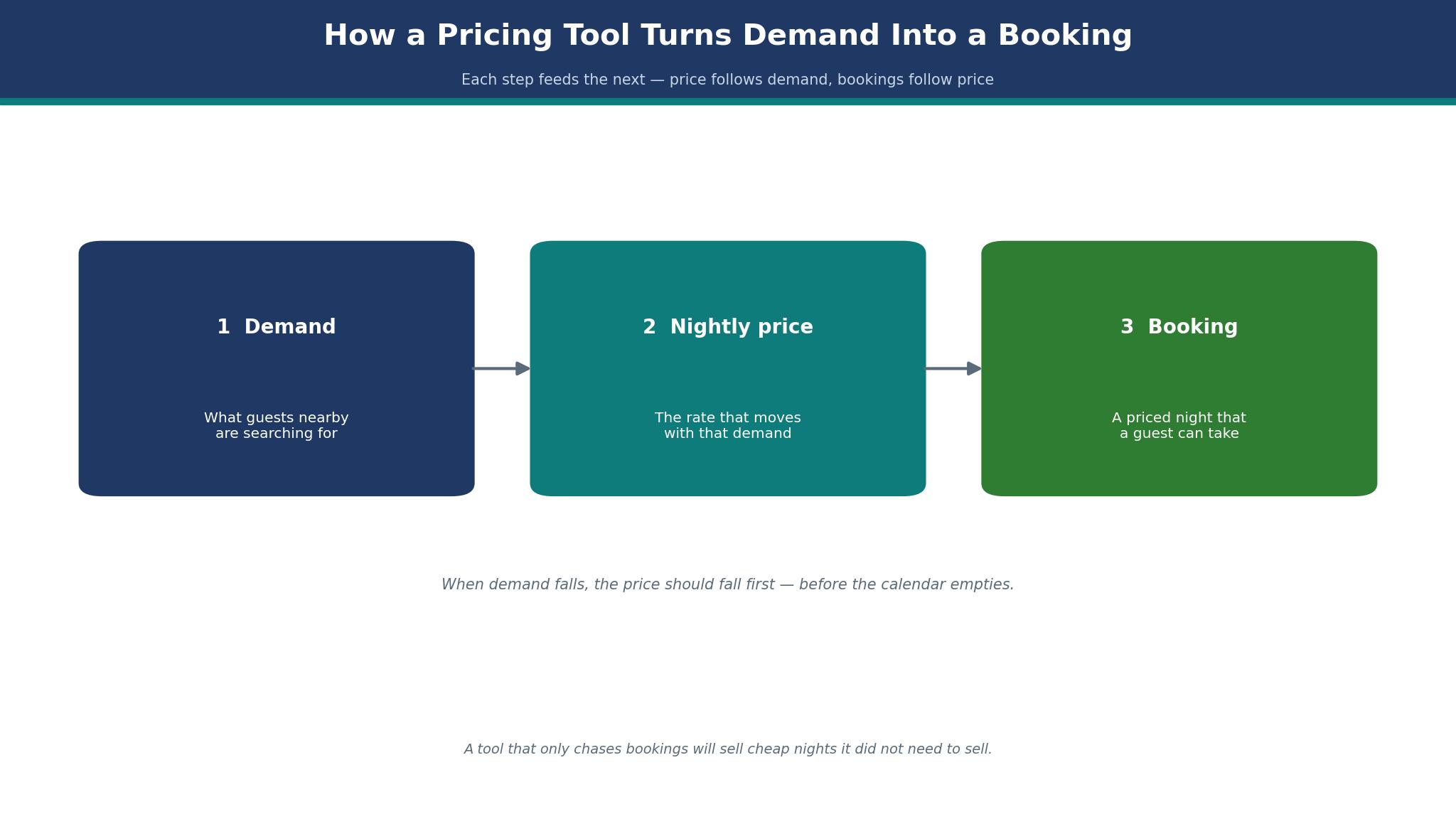
A slow Tuesday in February is the hardest night in the calendar. The flat is empty, the city is quiet, and the host has to decide whether a booking at $70 is better than an empty night at $0. The answer depends on the costs, and the tool is the thing that does the arithmetic.
PriceLabs looks at the demand for that Tuesday, the prices of similar flats nearby, and the host’s own booking history, and it sets a price that fills the night without giving it away. In the interview, the host’s February Tuesdays sold at $78 on PriceLabs, against a base price of $110, and the flat was occupied 22 nights out of 28 in the month.
Before the tool, the same flat sold at $110 on the nights it sold at all, and it sat empty 12 nights out of 28. The lower price earned more, because 22 nights at $78 is $1,716, and 16 nights at $110 is $1,760, and the difference is small, while the reviews from the extra guests were worth more than the $44. The top 10 ai pricing tools for airbnb hosts earn their fee on nights like that one, where the right price is lower than the host would have guessed.
Beyond handles a slow Tuesday by lowering the price further and taking its percentage from whatever is booked, which means the tool earns less when the host earns less. That alignment is the reason percentage pricing suits a slow market. Wheelhouse offers both models, a flat $19.99 a month or 1 percent of revenue, so the host can choose the model that fits the season. The flat fee wins in a busy month, and the percentage wins in a slow one, and a host who switches between them is not gaming the system. She is using it properly.
How to Choose the Top 10 AI Pricing Tools for Airbnb Hosts?
Start with the fee model, because it decides the bill before any feature does. PriceLabs charges $19.99 a month for the first listing in the United States, and $14.99 a month for each listing from the second to the fifth. Beyond charges 1 percent of bookings on Growth and 1.25 percent on Pro, with the first $5,000 in bookings free on Growth. Wheelhouse charges $19.99 a month flat, or 1 percent of revenue with a $2.99 monthly minimum. DPGO charges $18 a listing a month, or 0.5 percent of bookings. The arithmetic is simple at one revenue level and different at another, so work it out at your own revenue before choosing.
At $3,000 of bookings a month, PriceLabs costs $19.99, Beyond Growth costs $30, and Wheelhouse Flex costs $30. At $1,200 a month, PriceLabs still costs $19.99, while Beyond Growth costs $12 and Wheelhouse Flex costs $12. The flat fee wins once a listing books more than about $2,000 a month, and the percentage wins below that.
A host with four flats booking $3,000 each pays $79.95 a month on PriceLabs, which is $19.99 for the first listing plus $14.99 for each of the next three, or $959.40 a year. The same four flats on Beyond Growth at 1 percent pay $120 a month, or $1,440 a year. The difference is $480.60 a year, and it is the reason PriceLabs leads this guide.
Next, check the integrations. PriceLabs connects directly with Airbnb, Vrbo, and Booking.com, and with more than 160 property management systems. Beyond connects with the same three channels, and Wheelhouse connects with Airbnb and Vrbo. A host who lists on all three channels needs a tool that updates all three at once, because a price changed on Airbnb and not on Vrbo is a booking at the wrong price. Ask every vendor which channels it updates, and how fast the update travels.
Then look at the market data. PriceLabs sells market dashboards separately, which is a cost the host should know about before buying. AirDNA and Key Data are market data tools first and pricing tools second, and they suit a host who wants to know what the whole city is charging before setting a single price. A host who only wants the price set can skip them. A host who is choosing between two neighbourhoods for a fifth flat cannot.
Finally, try the free trial before paying. PriceLabs offers 30 days with no card needed. Wheelhouse offers a free tier. Beyond offers a free plan that shows insights without changing prices. A month of real data on your own listings is worth more than any review, because your flats, your city, and your season are the only ones that matter.
Best Pick by Job
The right tool changes with the number of listings and the host’s appetite for control. A host with one flat needs a low bill in a slow month. A host with ten flats needs volume pricing and deep rules. Each kind of host gets one named tool below, chosen from the fee arithmetic above and the detail section that follows.
| Job | Best pick | Why it wins for this job |
|---|---|---|
| One flat, wants maximum control | PriceLabs | Deepest rules, $19.99 a month, 30-day trial |
| One flat, wants hands-off pricing | Beyond | 1 percent of bookings, first $5,000 free |
| One flat, slow season, low revenue | Wheelhouse | 1 percent Flex at $12 on $1,200 of bookings |
| Four flats, growing portfolio | PriceLabs | $79.95 a month for four, $959.40 a year |
| Ten flats or more | PriceLabs | Volume rates fall to $5 a listing at 251 plus |
| A host choosing a new neighbourhood | AirDNA | Market data first, pricing second |
The pick that needs explaining is PriceLabs for a growing portfolio. The volume pricing is the reason, because the rate falls with every listing added, from $19.99 for the first to $14.99 for listings two to five, $12.99 for six to fifteen, and down to $5 at 251 or more. A host who plans to grow should buy the tool that gets cheaper as she grows, not the tool that takes a percentage of every extra booking.
The 8 Tools in Detail
The eight tools below are covered in ranking order, and the detail on each one states the fee, the trial, and the catch. The top 10 ai pricing tools for airbnb hosts are separated less by their algorithms than by their fee models, so each section starts with the money.
1. PriceLabs
PriceLabs is the default pick in this category, and the fee structure is the reason. The first listing in the United States costs $19.99 a month, listings two to five cost $14.99 each, listings six to fifteen cost $12.99 each, and the rate keeps falling to $5 a listing at 251 or more. Outside the United States, the United Kingdom, Canada, Europe, Australia, New Zealand, and Israel, the first listing costs $9.99. There is also an opt-in plan at 1 percent of revenue, for hosts who prefer a percentage, with a one-year lock-in.
The tool is the most customisable in this guide. The host can set rules for minimum stays, orphan nights, last-minute discounts, far-out premiums, and seasonal adjustments, and the rules are visible, so the host can see why a night is priced at $78 instead of $110. The market dashboards are sold separately, which is a cost to budget for, and the interface takes a weekend to learn properly. A host who wants the tool to do the work without input will find PriceLabs fiddly. A host who wants control will find it the only tool that gives enough of it.
The trial is 30 days with no card needed, which is the longest honest trial in this guide. A month of real data on your own listings shows whether the rules earn their fee, and the host in this interview kept the tool after the trial because the February calendar filled at prices she had set herself. That is the test that matters, and PriceLabs passes it.
A worked example shows the year-one cost. One listing at $19.99 a month costs $239.88 a year. Four listings cost $79.95 a month, or $959.40 a year. Ten listings cost $19.99 plus $14.99 for listings two to five plus $12.99 for listings six to ten, which is $144.90 a month, or $1,738.80 a year. At $3,000 of bookings a month per listing, the fee is less than 1 percent of revenue, and a single night recovered from underpricing pays for the month.
2. Beyond
Beyond is the hands-off pick, and its fee model is the simplest in this guide. The Growth plan charges 1 percent of bookings, the Pro plan charges 1.25 percent, and there is no flat per-listing option. The fee includes cleaning fees, excludes taxes and security deposits, and the first $5,000 in bookings is free on Growth. There is a free plan that shows insights without changing prices, which is a genuine way to test the tool before it touches a single booking.
The tool is polished and automated, and it suits a host who wants the price set without learning a rule system. The weakness is control. Beyond shows the price, and the host can override it, but the reasoning behind the price is less visible than on PriceLabs, and the host in this interview left for that reason. At $3,000 of bookings a month, Beyond Growth costs $30, against $19.99 on PriceLabs, so the hands-off convenience costs $120.12 a year per listing. At $1,200 a month, Beyond costs $12, and it is the cheaper tool, so the right choice depends on the revenue, not the brand.
3. Wheelhouse
Wheelhouse is the only tool in this guide that publishes both fee models side by side and lets the host choose. Pro Flex charges 1 percent of revenue with a $2.99 monthly minimum, and Pro Flat charges $19.99 a listing a month, falling to $16.99 at 10 to 49 listings. The host can switch between them, which means the tool fits a busy season and a slow season without a second subscription.
The interface is friendlier than PriceLabs, and the recommendations are strong, with a Navigator view that shows demand on a map. The weakness is depth. Wheelhouse does not offer the rule system that PriceLabs does, so a host who wants to set a different minimum stay for a holiday weekend will find the controls thinner. The free tier is real, with no card needed, and the Pro trial is the way to test whether the friendlier interface is worth the thinner rules.
A worked example shows when each model wins. At $1,200 of bookings a month, Pro Flex costs $12, and Pro Flat costs $19.99, so Flex wins by $7.99 a month. At $3,000 a month, both cost $30 and $19.99, so Flat wins by $10.01 a month. The crossover sits near $2,000 a month, and a host whose revenue crosses that line during the year should switch models with the season.
4. DPGO
DPGO is the quiet value pick, and its fee is the lowest flat rate in this guide. It charges $18 a listing a month, or 0.5 percent of bookings, or $1 per booked night, depending on the plan the host chooses. For a host with one listing booking $3,000 a month, the percentage plan costs $15, which undercuts PriceLabs by $4.99 a month and Beyond Growth by $15 a month. For a host with a slow listing, the $1 per booked night plan means the tool costs nothing on an empty night.
The weakness is scale and data. DPGO is smaller than PriceLabs and Beyond, its market data is thinner, and its integrations are fewer. A host with one or two listings will not notice. A host with ten listings across three channels will. Buy DPGO when the fee is the deciding factor and the portfolio is small. Buy PriceLabs when the portfolio grows past five listings and the rules start to matter.
5. AirDNA
AirDNA is a market data tool first and a pricing tool second, and that order matters. It shows what every listing in a city charges, how full they are, and what a new listing could earn, and its pricing features sit on top of that data. The subscription is quote-based for its full platform, with MarketMinder plans reported from about $25 a month for a single market, so the price is higher than a pure pricing tool and the value is different. A host choosing between two neighbourhoods for a fifth flat needs AirDNA before she needs PriceLabs, because the neighbourhood decision is worth thousands and the nightly price decision is worth tens.
6. Key Data
Key Data is the other market data tool in this guide, built for hosts and managers who want clean, comparable data across a whole market. It tracks occupancy, rates, and revenue for short-term rentals, and it feeds that data into pricing decisions. Pricing is quote-based, and the platform suits a manager with several listings who needs to report to an owner, rather than a host with one flat. The strength is the quality of the data and the clarity of the reports. The weakness is that it is not a pricing tool on its own, and a host who buys it still needs PriceLabs or Beyond to set the nightly price.
7. Mashvisor
Mashvisor is the investment pick, built for a host who is buying a property to let on Airbnb rather than pricing one she already owns. It analyses a property’s rental potential, estimates the return, and compares neighbourhoods, and its subscription is reported from $29.99 a month. The pricing features are thinner than PriceLabs, and the tool is not the right choice for nightly pricing alone. Buy Mashvisor before buying the flat, and buy PriceLabs after.
8. RoomPriceGenie
RoomPriceGenie closes this list as the small-hotel pick that also works for Airbnb hosts. It charges a share of booking revenue, with the exact rate set by quote, and it is built for small hotels and guesthouses that list on several channels. The tool is simpler than PriceLabs, the onboarding is personal, and the support is the kind where a person answers the phone. The weakness is the quote-based price, which means a host cannot budget without a conversation, and the thinner rule system, which means a host who wants deep control will outgrow it.
PriceLabs vs Beyond
The head-to-head is a contest between control and convenience, and the fee arithmetic decides it for most hosts. PriceLabs charges $19.99 a month for the first listing, with volume discounts that fall to $5 a listing at scale, and it gives the host a rule for every situation. Beyond charges 1 percent of bookings on Growth and 1.25 percent on Pro, with the first $5,000 free, and it sets the price with less host input.
At $3,000 of bookings a month, PriceLabs costs $19.99 and Beyond Growth costs $30, so PriceLabs wins by $10.01 a month, or $120.12 a year. At $1,200 a month, PriceLabs still costs $19.99 and Beyond costs $12, so Beyond wins by $7.99 a month.
At $6,000 a month, PriceLabs costs $19.99 and Beyond costs $60, so PriceLabs wins by $40.01 a month. The pattern is simple. The busier the listing, the more the flat fee wins, and the slower the listing, the more the percentage wins.
Control is the second deciding fact. PriceLabs shows the rule behind every price, and the host in this interview kept it for that reason. Beyond shows the price, and the host who wants to know why will find less to look at. A host who trusts the algorithm should buy Beyond. A host who wants to see the working should buy PriceLabs, and the host in this interview is in the second group.
The Night That Sold Too Cheap
The host in this interview remembers one night clearly, because it cost her $350. It was a Friday in October, a weekend when the city hosted a football match, and her flat sold for $85. The flat next door sold for $120, and the one across the street sold for $135. Her flat was the cheapest on the street, and it sold first, which felt like a win until she saw the neighbours’ prices.
The problem was not the tool. It was the floor she had set a year earlier, when $85 was a fair price for a quiet Friday, and the base price she had never updated. The tool worked inside the numbers she had given it, and the numbers were a year out of date. The top 10 ai pricing tools for airbnb hosts can only price inside the limits the host sets, and a limit set in January will still be there in October, quietly selling Fridays too cheap.
The fix took ten minutes. She raised her base price, set a rule that lifted the price when local events filled the calendar, and set a minimum stay of two nights for event weekends. The next event weekend sold at $128, and the flat earned $43 more per night for the same guests. The lesson is not that tools fail. It is that a tool needs its limits reviewed every season, because a city changes, a calendar changes, and a price set a year ago is a price for a city that no longer exists.

Can I Override It?
Yes, and the override is the feature that matters most, because a tool that cannot be overridden is a tool that owns the calendar. PriceLabs lets the host override any night, set a manual price, and block dates entirely, and the override is visible in the calendar so the host can see what she changed. Beyond allows overrides too, and Wheelhouse lets the host set a manual price for any night. The test is not whether the override exists, but whether it is easy to find on a phone at 10 p.m., when a guest asks for a late checkout and the host has to decide the price before morning.
The host in this interview overrides about five nights a month, usually for friends, for returning guests, and for the weekend when her sister visits. She does it on her phone, in under a minute, and the tool respects the override without resetting it the next day. A tool that resets a manual price overnight is not a pricing tool. It is a landlord, and the host should leave it. Ask every vendor how an override survives the next sync, and watch the answer, because the honest ones will show you, and the others will change the subject.
Frequently Asked Questions
What goes wrong when Airbnb pricing tools chase every booking?
The common failure is a calendar full of cheap bookings, because the tool filled every night at the lowest price that would sell, and the host earned less than she would have with fewer nights at higher prices. The fix is a floor price, a minimum stay, and a rule that lifts the price when demand rises. The top 10 ai pricing tools for airbnb hosts all offer those controls, and the host who sets them is protected. The host who leaves them at their defaults is the one who wakes up to a full calendar and a thin bank balance.
How much does an Airbnb pricing tool cost per month?
PriceLabs costs $19.99 a month for the first listing, $14.99 each for listings two to five, and less as the portfolio grows. Beyond costs 1 percent of bookings on Growth and 1.25 percent on Pro, with the first $5,000 free. Wheelhouse costs $19.99 flat or 1 percent of revenue. DPGO costs $18 a listing a month, or 0.5 percent of bookings. At $3,000 of bookings a month, the flat fee is cheaper. At $1,200 a month, the percentage is cheaper. The top 10 ai pricing tools for airbnb hosts differ most on that one line, so work it out at your own revenue.
Will a pricing tool work with Vrbo and Booking.com?
PriceLabs connects directly with Airbnb, Vrbo, and Booking.com, and with more than 160 property management systems. Beyond connects with the same three channels. Wheelhouse connects with Airbnb and Vrbo. A host who lists on all three channels needs a tool that updates all three at once, because a price changed on one channel and not the others is a booking at the wrong price. Check the integration list before buying, and test it on one listing first.
Can I set a minimum price so the tool never sells too cheap?
Yes, on every tool in this guide. The minimum price is the single most important setting, and it should cover the cleaning cost, the platform fee, and a margin, or the booking loses money. The host in this interview set her minimum at $85, which is the price below which a night loses money after cleaning. Set the minimum before the tool goes live, review it every season, and never let a tool run without one.
Does dynamic pricing hurt my reviews?
No, when it is done well, because guests who pay a fair price for a good flat leave good reviews, and the price is only part of the stay. Dynamic pricing hurts reviews when the price jumps after booking, or when a guest discovers the flat next door cost half as much for the same weekend. The fix is a stable price at booking, a clear listing, and a floor that keeps the price fair. The host in this interview saw her reviews improve after switching to PriceLabs, because the calendar filled with guests who had paid a fair price.
Should a host with one listing buy a pricing tool?
Yes, if the listing books more than about $2,000 a month, because the flat fee is cheaper than the revenue a single underpriced weekend costs. A listing that books $1,200 a month is better served by a percentage tool, where the fee falls with the revenue, or by a free tier that shows insights without changing prices. The test is simple. One night sold $35 too cheap pays for a month of PriceLabs, and most hosts sell at least one night too cheap every month.
The Verdict: My Pick for a Four-Flat Host
PriceLabs is my pick, and the fee arithmetic is the reason. Four listings cost $79.95 a month, or $959.40 a year, against $120 a month on Beyond Growth at $3,000 of bookings per listing, and the rules give the host the control she asked for in the first question of this interview. Beyond is the pick for a host who wants the tool to do the work, and Wheelhouse is the pick for a host whose revenue crosses the $2,000 line during the year. PriceLabs, Beyond and Wheelhouse carry the same names in the Best Pick table, each beside its fee arithmetic, so the ranking can be followed back to the numbers.
What I would do, if I owned the four flats in this interview, is buy PriceLabs on the 30-day trial, set a minimum of $85 and a maximum of $220, and review the limits every season, because a price set in January is a price for a city that no longer exists in October. I would keep the override close at hand, use it for friends and returning guests, and check the calendar every Friday. The tool earns its fee on the first weekend it prices correctly, and the host earns her evenings back, which is the real return on $19.99 a month.