

A bakery, a meal-prep kitchen and a farm shop all sell food online, and yet the right store for one of them is often the wrong store for the other two. This guide to the top 10 ecommerce platforms for food businesses starts with the seller, not the software, because the order type decides the platform. Read the buyer who looks like you, then read the tools that fit that buyer.
Three Food Sellers, Three Different Shops
Meet the three sellers this guide is written for. Rosa runs a bakery with six staff and a queue out the door on Saturday mornings. She wants pickup orders with time slots. Ben runs a meal-prep business from a rented kitchen, sending out 200 boxes a week on subscription. He needs recurring billing and a skip-a-week button more than he needs a pretty homepage. Tom runs a farm shop that ships meat and cheese boxes across the country in cold boxes. He needs weight-based shipping and delivery tracking, because a box that arrives warm is a refund and a lost customer.
Buy the wrong one and each of them regrets it differently. So this guide to the top 10 ecommerce platforms for food businesses gives each seller their own shortlist, and the full tool run later is grouped the same way.
| Tool | Starting price | Best for |
|---|---|---|
| Shopify | $29 a month | Most food businesses |
| WooCommerce | Free plugin | WordPress sites |
| BigCommerce | $29 a month | Larger catalogues |
| Squarespace | $16 a month | Small food brands |
| Wix | $29 a month | Simple food shops |
| Square Online | Free plan | Square POS users |
| Ecwid | Free plan | Small shops and markets |
| Shift4Shop | Free with Shift4 | Low-fee selling |
| Toast | From $69 a month | Restaurants and cafes |
| ChowNow | About $149 a month | Commission-free ordering |
The Bakery Going Online for the First Time
Rosa sells out of croissants by 10 a.m. most Saturdays, and her regulars have started asking if they can order ahead. Her first online store does not need to be clever. It needs pickup time slots, an order cutoff so the bakers know what to make, and a menu that she can change herself when the sourdough runs out. She has no one on staff who wants to manage a website, so the platform has to look after hosting, security and updates without her.
Her shortlist from the top 10 ecommerce platforms for food businesses is short on purpose. Shopify Basic at $29 a month on annual billing gives her the fastest checkout in this guide and an app for pickup slots. Square Online is free to start and pulls her menu straight from the register she already uses, so she never sells a cake online that has already sold in the shop. Squarespace at $16 a month gives her the prettiest shop of the three,
The deal-breaker for Rosa is the pickup slot. A platform without time slots means customers turn up at random hours and the queue comes back, just in a different form. If a platform cannot show her a pickup slot on the product page, it is out, however cheap it is. Her second deal-breaker is a monthly fee that starts before the orders do.
What would I do if I were Rosa? I would start on Square Online for a month, because it costs nothing and her menu is already in Square, and I would move to Shopify only when the orders outgrow the free plan. That way the bakery learns what its customers actually order online before it pays for a bigger store.
Shopify vs WooCommerce: Hosted Ease Against WordPress Control
Shopify and WooCommerce are the two most common picks in this guide, and they solve the same problem in opposite ways. Shopify runs the store, the hosting, the security and the updates for $29 a month on annual billing, so the owner never touches a server. WooCommerce costs nothing as a plugin, but the owner arranges hosting, installs WordPress, manages updates and fixes problems, which takes time and skill.
The cost comparison favours WooCommerce at the start and Shopify at scale. Hosting for a WooCommerce store runs roughly $25 to $350 a month depending on traffic, and extensions for subscriptions, bookings and better checkout add up until the total is close to the same $29 a month. Shopify charges 2.9% plus 30 cents on card transactions on the Basic plan, and WooCommerce owners pay the same 2.9% plus 30 cents through Stripe or PayPal in the US.
Here is the trade-off stated plainly. WooCommerce is cheaper in cash and richer in control, but you lose the weekend, because someone has to update plugins and fix the store when it breaks. If your time matters more than the saving, buy Shopify. If you already run WordPress and enjoy the control, WooCommerce is the honest pick.
The Meal-Prep Business With Weekly Subscriptions
Ben’s week runs on a rhythm. Orders close on Wednesday night, the kitchen cooks on Thursday, boxes go out on Friday, and on Monday the whole thing starts again. His platform has to bill 200 people every week, let a customer skip a week without phoning the kitchen, and pause a subscription when someone goes on holiday. A store that treats every order as a one-off sale will cost him hours of manual work every single week.
His shortlist from the top 10 ecommerce platforms for food businesses starts with WooCommerce, because subscriptions are cheaper and more flexible on WordPress, and the plugin has extensions built for exactly this weekly rhythm. Shopify is second, because the subscription apps work well but each one adds a monthly fee on top of the $29 a month plan. BigCommerce is third, for customer groups and bulk pricing.
The deal-breaker for Ben is the skip-a-week button. Without it, every holiday becomes a phone call, a refund or an angry customer with a box they did not want. His second deal-breaker is the per-order fee at volume. At 200 boxes a week, even a small percentage on top of the card fee adds up to real money by the end of the month. That is why BigCommerce earns a place here, since it charges no extra transaction fee on top of the payment processor rate.
Worked example, from the prices in this guide. Ben sells 200 boxes a week at $40 each, which is $32,000 a month. On Shopify Basic, card fees alone run 2.9% plus 30 cents per order, so 800 orders cost about $928 in percentage fees plus $240 in fixed fees, before the $29 plan and any subscription app. The saving comes from the apps and the plan, not the card rate, so price the apps, not just the plan.
Best Pick by Job
| Buyer | First pick | Second tool | Why this pair works |
|---|---|---|---|
| Bakery taking pickup orders | Shopify Basic | Square Online | Both handle pickup slots and local orders |
| Meal-prep subscription business | WooCommerce | Shopify Basic | Subscriptions are cheaper on WordPress |
| Farm shop shipping nationwide | BigCommerce | Shopify Basic | Both manage large catalogues and shipping |
| Restaurant taking online orders | Toast | ChowNow | Both are built for kitchens, not retail |
| Small food brand on a budget | Square Online | Ecwid | Both start free and sell fast |
| Market stall or pop-up seller | Square Online | Ecwid | Both work with a phone and a card reader |
If you are Rosa, start with Square Online and move to Shopify when the orders justify it. If you are Ben, start with WooCommerce and spend the saving on a better kitchen workflow. If you are Tom, start with BigCommerce and spend the first month getting the shipping rules right. The table above is the short version of the top 10 ecommerce platforms for food businesses. The detail run below is the long version, grouped by the same three buyers.
The Farm Shop Shipping Cold Food
Tom’s problem is not the website. It is the box. A meat and cheese box has to arrive cold, on the day promised, with the customer at home to put it in the fridge. His platform has to do weight-based shipping, show a delivery date before the customer pays, and send tracking that actually works. It also has to stop selling when the cold boxes run out, because an order he cannot ship cold is a refund waiting to happen.
His shortlist from the top 10 ecommerce platforms for food businesses puts BigCommerce first, because it handles large catalogues, complex pricing and multiple sales channels without extra apps, and its customer groups suit wholesale buyers who order in bulk. Shopify is second, because the shipping apps are strong and the checkout is fast, though each app adds a fee. WooCommerce is third, because the shipping rules can be set exactly how Tom wants them, if someone is willing to set them up.
The deal-breaker for Tom is delivery tracking tied to the order. A customer who cannot see where their cold box is will phone the farm, and Tom will spend his morning answering tracking questions instead of packing boxes. His second deal-breaker is stock that lies. A platform that lets a customer buy a box that is already sold is worse than no store at all for a business built on trust.
No platform solves cold shipping on its own. The ice packs, the insulated box and the courier all sit outside the software. Tom should price one shipment properly, box and ice and courier included, before he compares platform fees. A platform that saves $29 a month and loses one cold box a week is the expensive choice.

Which of the Top 10 Ecommerce Platforms for Food Businesses Gets an Order Online Fastest?
Square Online gets a food order online fastest, because a business that already uses Square POS can turn on an online store in an afternoon, with the menu, prices and inventory pulled straight from the register. The free plan charges no monthly fee, and the owner pays only 2.9% plus 30 cents per online transaction in the US. A bakery that already takes card payments through Square can be selling online the same day, without building a new site or moving a menu.
Shopify is the second fastest for a business starting from zero, because the store setup is guided and the checkout works out of the box. WooCommerce is the slowest start of the three, because the owner arranges hosting and installs WordPress before selling anything, though a business that already runs WordPress skips most of that work.
What Does a Food Store Cost to Run for a Month?
A small bakery selling $3,000 a month in pickup orders will pay about $116 a month on Shopify Basic, which is $29 for the plan plus card fees of 2.9% plus 30 cents per order. On Square Online the same bakery pays no monthly fee, so the month costs only the card fees, which is why the free start appeals to a first store. The question is whether the faster checkout is worth $29 a month to this bakery.
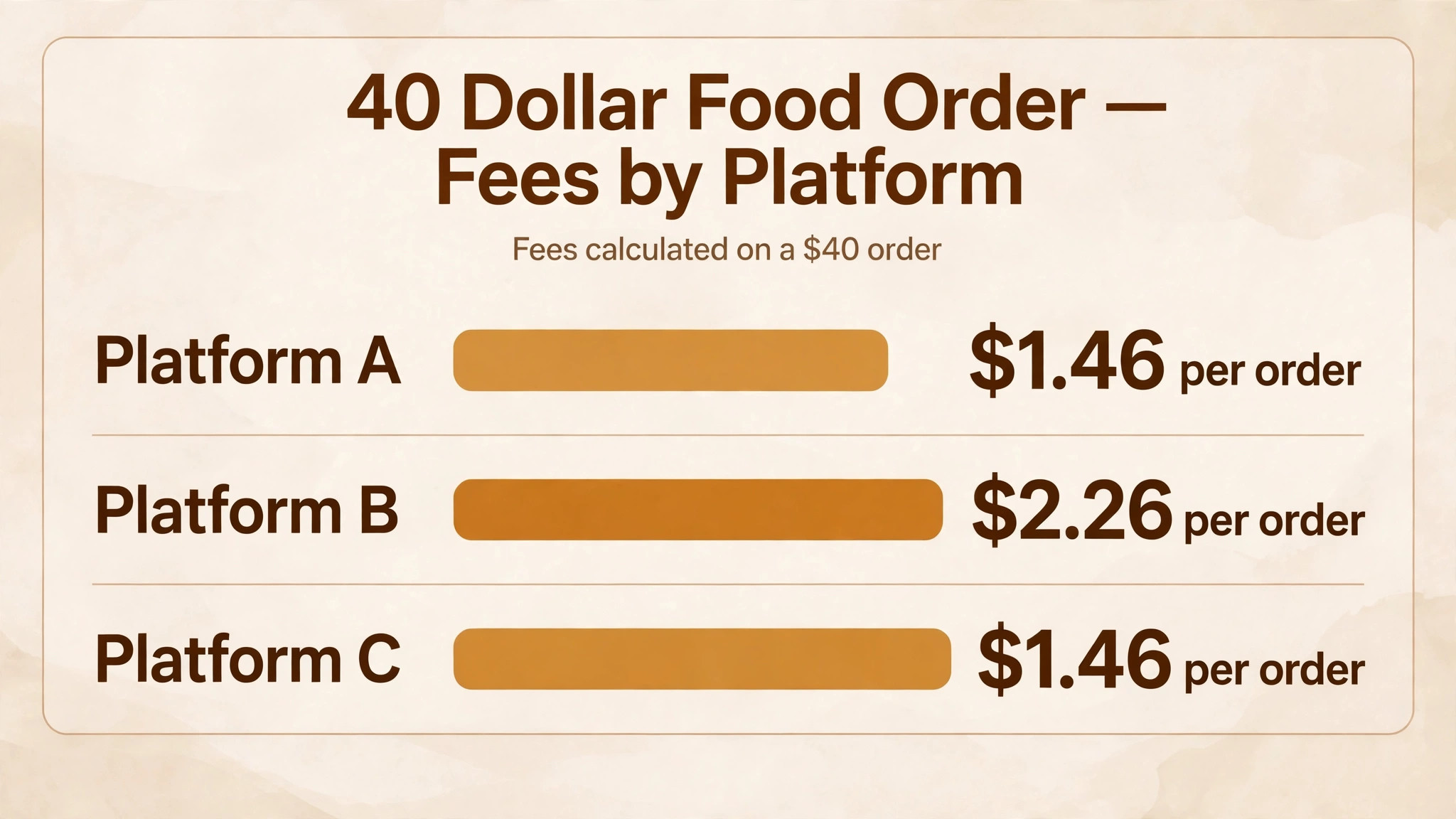
Worked example, from the prices in this guide. Take a $40 average order. On Shopify Basic the card fee is $1.16 plus 30 cents, which is $1.46 per order. On Squarespace Basic at $16 a month, the same order costs $1.46 in card fees plus a 2% transaction fee of 80 cents, which is $2.26 per order. At 100 orders a month, Squarespace Basic costs $80 more in fees than Shopify Basic, which wipes out the $13 saving on the plan. That is why the Core plan at $23 a month, with no transaction fee, is the honest Squarespace price at any real volume.
Can a Food Platform Handle Pickup, Delivery and Catering Orders?
Most of the platforms in this guide handle pickup and local delivery, but catering is where they split. Shopify handles pickup and delivery through apps, and catering orders usually need a separate app for deposits and event dates. Square Online has pickup times, local delivery and order notifications built in, which covers a cafe that also does office lunch orders. Wix has a restaurant menu app with online ordering and table reservations, which suits a small restaurant that takes bookings as well as orders.
The question to ask on any demo is about the cutoff. Can the platform stop taking orders for Saturday at a time you choose, and can it cap the number of orders per slot? A bakery that cannot cap Saturday pickup will promise more croissants than the ovens can make.
How to Choose the Best Ecommerce Platform for a Food Business
Start with the order type, not the price, when you compare the top 10 ecommerce platforms for food businesses. A bakery that sells pickup orders needs time slots, order cutoffs and a pickup confirmation message, while a butcher that ships nationwide needs weight-based shipping, cold-chain packaging options and delivery tracking. A meal-prep business that sells weekly subscriptions needs recurring billing and a skip-a-week button, while a restaurant needs table numbers, kitchen tickets and a delivery radius. The platform that fits the order type is the platform that will still fit in a year.
Next, count the real monthly cost, including the apps. Shopify Basic costs $29 a month on annual billing, or $39 month to month, and the pickup, delivery and subscription apps each add a fee. WooCommerce costs nothing as a plugin, but hosting runs roughly $25 to $350 a month and the extensions add up. Write the full list down before you choose, plan plus apps plus card fees, and compare that number, not the headline price.
Finally, test the checkout as a customer. Order something from your own store on your phone, in the car park, with one hand. The best platform for your food business is the one your customers can use without thinking about it.
The 10 Tools in Detail
The ten tools below, the full top 10 ecommerce platforms for food businesses, are grouped by the buyer they fit best, in the same order as the buyers above. Read your group first, then skim the rest.
For the bakery: Shopify, Square Online and Squarespace.
1. Shopify
Shopify is the hosted storefront most food businesses should start with, because it combines a fast checkout, a large app store and reliable uptime in one monthly fee. Basic costs $29 a month on annual billing, or $39 month to month, and includes unlimited products, a free SSL certificate, abandoned checkout recovery and discount codes. Online card transactions cost 2.9% plus 30 cents on the Basic plan, and the fee drops on higher tiers.
The food features come through apps, because Shopify does not ship pickup time slots, delivery zones or subscription billing in the base plan. The app store covers all three, with apps for slot booking, local delivery and recurring orders, though each app adds a monthly fee.
Worked example, from the prices in this guide. A bakery selling 100 orders a month at $40 each takes $4,000. Card fees run $1.46 per order, which is $146, plus the $29 plan, which is $175 a month before apps. Add one $15 pickup-slot app and the month is $190. That is the number to compare against the other platforms, not the $29 headline.
Shopify suits a bakery, butcher, grocer or meal-prep business that wants a store that just works and is willing to pay for apps.
One honest warning before you buy. The app bill grows quietly, one $10 app at a time, and a year later the store can cost twice the plan price. Audit the apps every three months and cancel the ones nobody uses.
2. WooCommerce
WooCommerce is the free WordPress plugin that turns a WordPress site into a full online store, and it is the best pick for a food business that already runs WordPress. The plugin itself costs nothing, and the store inherits the site’s domain, design, content and search ranking, so the owner does not start from zero. Hosting costs roughly $25 to $350 a month depending on traffic, and the owner pays the payment processor rate, which is 2.9% plus 30 cents with Stripe or PayPal in the US.
The strength is control. WooCommerce handles subscriptions, bookings, memberships and custom product types through extensions, and the owner can change any part of the store, from the checkout flow to the tax rules.
Worked example, from the prices in this guide. A meal-prep business on a $25 a month hosting plan with a $20 subscription extension pays $45 a month before card fees, against $29 plus subscription apps on Shopify. At 200 boxes a week the card fees are the same either way, so the saving is in the plan and the apps, not the card rate.
WooCommerce suits a food business that already runs WordPress and has someone to manage updates and backups. The free plugin is not a free store, but the total still beats Shopify for a business with the skills to run it.
The trade-off is the one from the comparison above. You save cash and gain control, but you lose the weekend when a plugin update breaks the checkout. If that sentence makes you nervous, Shopify is the better buy.
3. BigCommerce
BigCommerce is the hosted platform for a food business with a large catalogue, because it handles thousands of products, complex pricing and multiple sales channels without extra apps. Core costs $29 a month on annual billing, or $39 month to month, and includes unlimited products, unlimited staff accounts and no extra transaction fee on top of the payment processor rate. That last point matters, because a business selling $10,000 a month saves real money against a platform that charges its own percentage.
The food features are stronger than Shopify’s out of the box, with built-in product options, bulk pricing and customer groups that suit wholesale food buyers.
4. Squarespace
Squarespace is the website builder with a store attached, and it is the best pick for a small food brand that cares how the site looks. Basic costs $16 a month on annual billing and includes a store with a 2% transaction fee, while Core at $23 a month drops the fee to zero and adds advanced shipping, discounts and abandoned cart recovery. The templates are the best looking in this guide, and a food brand that sells on photos will look better here than anywhere else.
The food features are basic. Squarespace handles pickup, local delivery and gift cards, but it does not handle subscriptions or advanced delivery zones without workarounds, and the app ecosystem is thin compared with Shopify or WooCommerce. The $16 a month entry is the cheapest hosted start in this guide, though the 2% fee makes Core the honest price at any real volume.
5. Wix
Wix is the website builder that added a full store, and it is the best pick for a food business that wants a simple shop without learning a new system. Core costs $29 a month on annual billing and includes ecommerce, with no extra transaction fee beyond the payment processor rate. The editor is drag and drop, so the owner can move a photo, change a price and publish without touching code.
What Wix does well for food:
- Pickup, local delivery and online ordering are covered in the base store.
- Wix Restaurants adds online ordering, table reservations and a menu page, which makes it a real option for a small cafe.
- Gift cards and discount codes work without an extra app.
Wix suits a small food shop, a cafe or a market stall that wants a website and a store in one place. The restaurant app is the reason to pick it over Squarespace for a cafe.
6. Square Online
Square Online is the free online store for a business that already uses Square POS, and it is the fastest way for a small food business to start selling online. The free plan charges no monthly fee, and the owner pays 2.9% plus 30 cents per online transaction in the US. Plus at $29 a month removes Square branding, adds custom domains and lower processing rates, and is the tier a growing business should budget for.
The menu, prices and inventory sync between the shop floor and the website, so a bakery never sells a cake online that has already sold in the store, and pickup times, local delivery and order notifications are built in.
7. Ecwid
Ecwid is the store widget that adds a shop to any existing website, social page or marketplace listing. The free plan allows 5 products, Starter at $5 a month allows 100 products, and Venture at $29 a month allows 2,500 products with advanced features. The store drops into a WordPress site, a Wix site or a Facebook page, so the owner does not rebuild anything.
Is Ecwid enough for a food business? Yes, if the range is small and the website already exists. The food features are modest but real, with pickup, local delivery, product options and discount codes, and the mobile app lets the owner manage orders from a phone. It will always look like a widget, so a brand that sells on looks should buy Squarespace instead. The $5 a month Starter plan is the cheapest paid start in this guide, and the free plan is enough to test whether online orders are worth the effort.
8. Shift4Shop
Shift4Shop is the hosted platform that charges no monthly fee when the owner uses Shift4 payments, and it is the best pick for a food business that wants to keep fixed costs at zero. The free plan includes unlimited products, a free SSL certificate and built-in fraud protection, and the owner pays only the Shift4 processing rate, which is 2.9% plus 30 cents in the US. A paid plan exists for businesses that want to use a different payment processor, though the free plan is the reason most owners choose it.
The food features are solid, with product options, bulk pricing, discount codes and a built-in blog that helps a food brand rank on Google. The trade is the design, because the themes look dated next to Shopify, and a food brand that sells on photos will feel that gap every day.
9. Toast
Toast is the restaurant platform that combines a point of sale, online ordering and kitchen display in one system, and it is the best pick for a restaurant or cafe that takes orders at the table and online. The POS starts from $69 a month, and the Starter Kit is free, though the full online ordering and delivery features need a paid plan and a quote from Toast. The hardware is part of the system, with terminals, kitchen display screens and handhelds that all run the same software.
The strength is the kitchen. Orders from the website, the app and the dining room land on the same kitchen display, the menu syncs across every channel, and the reporting shows which dishes sell and which do not. It suits a restaurant, cafe or takeaway that needs one system for the dining room and the website, though the $69 a month starting price is only the floor, and a full setup with hardware and delivery will cost far more.
10. ChowNow
ChowNow is the online ordering service that lets a restaurant take orders without paying commission on every sale, and it is the best pick for a restaurant that is tired of marketplace fees. The price is reported at about $149 a month, and the owner should confirm the current rate with ChowNow before signing, because the company prices by location and volume. There is no per-order commission, so a restaurant that sells $10,000 a month online keeps the full amount minus the payment processor rate.
ChowNow builds a branded ordering page and app for the restaurant, handles the menu, the pickup times and the delivery, and the restaurant keeps the customer data, which marketplaces do not share. A restaurant that relies on a marketplace loses a third of every order to commission and never learns who its customers are, while a ChowNow restaurant owns the relationship.
Frequently Asked Questions
Which platform is best for a small bakery?
Square Online is the best start for a small bakery that already uses Square, because it is free and the menu syncs from the register. Shopify Basic at $29 a month is the better pick once pickup orders grow, because the checkout is faster and the pickup-slot apps are stronger.
Can I sell food online without a website?
Yes. Ecwid adds a shop to a Facebook page or an existing site, and Square Online gives a small food business a free store with no website to build. A market stall can take its first online orders through a link on social media, though a proper store becomes worth it once orders pass about 20 a week.
Do I need a food licence to sell online?
Most food businesses need the same licences and food hygiene registration online as they do in person, and the rules depend on the local council. Check with the local authority before taking the first order, because a platform will not check this for you.
What is the cheapest way to start selling food online?
Square Online and Ecwid both start free, and Square Online is the cheaper of the two at volume because the free plan has no product limit. Shift4Shop is also free with Shift4 payments.
How do I handle delivery for perishable food?
Use a platform with weight-based shipping and delivery date selection, such as BigCommerce or Shopify with a shipping app, and price the insulated box and ice packs into the delivery fee. Only ship on days the courier can deliver before noon, and stop selling when the cold boxes run out. A refund for a warm box costs more than the sale was worth.
Can a food platform handle subscriptions?
Yes. WooCommerce handles subscriptions through extensions and is the cheapest way to run a weekly meal-prep plan. Shopify handles them through apps that each add a monthly fee. Either way, check for a skip-a-week button before you buy, because that one feature decides whether subscriptions save time or create phone calls.
Pick Your Seller, Then Pick Your Platform
If you are Rosa, start free on Square Online and move to Shopify when Saturday pickup outgrows it. If you are Ben, build the weekly rhythm on WooCommerce and spend the saving on the kitchen, not on apps. If you are Tom, buy BigCommerce, get the shipping rules right in the first month, and price every cold box properly before you promise a delivery date. That is the whole guide to the top 10 ecommerce platforms for food businesses in three sentences. Pick your seller first, then pick your platform, and test the checkout on your phone before you tell your customers it is live.