
A pricing mistake went live on three product pages at once, and the top 10 product information management software search that followed was not about features at all. It was about one question. Which tool would have stopped the wrong price before a customer saw it? Akeneo wins this roundup because its data model, completeness checks and channel rules catch that error before it publishes.
The 8 Tools at a Glance
| Tool | Best for | Starting price | First-year signal |
|---|---|---|---|
| Akeneo | Mid-market brands with complex catalogues | Community Edition free; Growth from about €25,000 a year, reported | Best overall |
| Plytix | Small teams that want a published price | Free to 500 SKUs; Pro $499 a month for up to 50,000 SKUs | Best value |
| Salsify | Large brands syndicating to many retailers | Quote only; reported $50,000 to $150,000 a year and more | Best for retail syndication |
| inriver | Enterprise teams with heavy channel needs | Quote only | Best for large multi-channel catalogues |
| Pimcore | Teams that want open source plus more | Open source free; enterprise quote only | Best open platform |
| Catsy | Growing brands that sell on marketplaces | Quote only; reported from about $500 a month | Best for marketplace feeds |
| Sales Layer | Teams that want fast setup and clean feeds | From $399 a month, reported | Best for quick launch |
| Contentserv | Large manufacturers with deep product data | Quote only | Best for complex product data |
The table is the short version, and the detail sections below are the long one. The figures below were read from vendor pages and current comparison sources in late 2026, and a price two sources disagree on is labelled reported rather than settled. Most enterprise tools in this list publish no price, so the honest answer for them is a quote, not a number invented to fill a table. The ranking in this top 10 product information management software guide is built on what each tool prevents, not on what each tool promises.
The SKU That Had Four Names
One product, four names. The warehouse called it a blue kettle. The website called it a blue electric kettle. The marketplace listing called it a kettle, blue, 1.7 litre. The printed catalogue called it something else again. Four names, one SKU, and every team blamed the others when a customer ordered the wrong thing.
That is the failure a PIM exists to prevent, and it is the failure most buyers discover too late. A PIM gives every product one record, one name, one price and one set of facts, and every channel takes its copy from that record. When the price changes in the PIM, it changes everywhere at once. When the price changes in four places by hand, it changes in three of them, and the fourth is the one a customer sees.
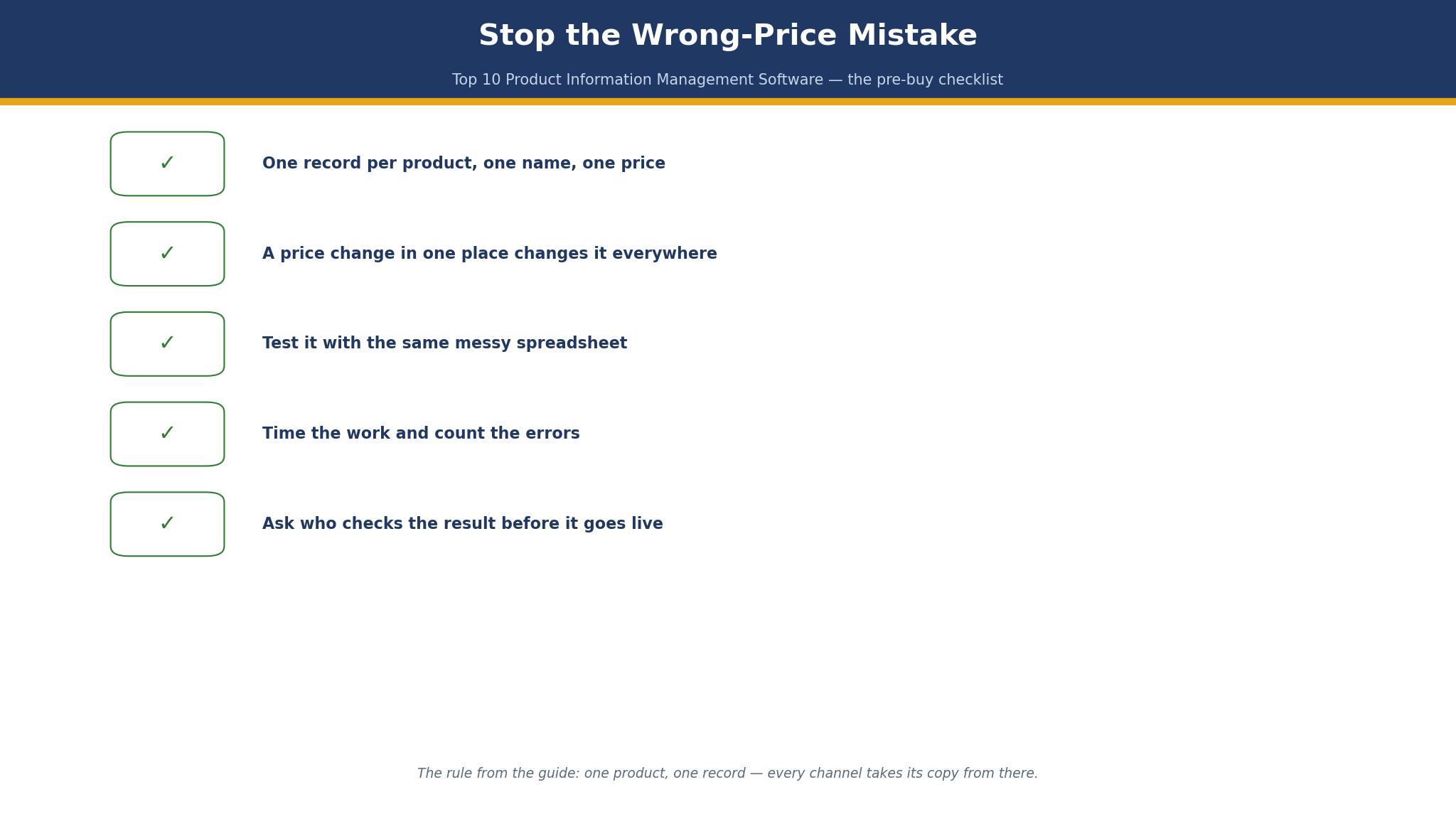
The test worth running before you buy is simple. Take twenty products, give each tool the same messy spreadsheet, and ask it to produce one clean record per product with a price, a description and a photo. Time the work, count the errors, and ask who checks the result. The tool that makes the check easy is the tool that prevents the next wrong price. The tool that makes the check hard is the tool that will let the next one through.
Akeneo vs Salsify
The head-to-head that matters most is the mid-market leader against the enterprise syndication leader. Akeneo wins on modelling and usability for a team that manages its own catalogue. Salsify wins on retailer syndication and digital shelf analytics for a brand that sells through hundreds of retailers. That split is the whole decision, and buyers in the top 10 product information management software market should make it before they look at any other feature.
On price, Akeneo is the cheaper of the two by a distance. Its Community Edition is free to download and self-host, and Growth is reported from about €25,000 a year, with Advanced and Premium quoted. Salsify publishes no price at all, and reported ranges run from $50,000 to $150,000 a year and more, with implementation on top. A brand that does not need Salsify’s retailer network should not pay Salsify’s price.
On syndication, Salsify wins. Its network reaches retailers that Akeneo reaches only through connectors and extra work, and its digital shelf tools show how products actually appear on a retailer site. On data modelling, Akeneo wins. Its product families, variants and reference entities handle a complex catalogue with less custom work, and its community is larger for a team that wants help without a support contract.
The 8 Tools in Detail
Akeneo leads on modelling, Plytix leads on value, and Salsify leads on syndication, and the rest fill narrower gaps. The sections below give each tool its due, with a year-one cost at a stated size and the limit that matters most in this top 10 product information management software list. Every verdict names the price evidence behind it, so you can check the figure yourself before asking for a quote, and the first three sections cover the catalogues most teams actually run.
1. Akeneo
Akeneo takes first place because it is the most complete PIM a mid-market team can actually run. Its data model handles product families, variants, hierarchies and reference entities without custom code, and its completeness tracking shows, product by product, what is missing before anything publishes. That completeness view is the feature that stops the wrong price, because a product with a missing price cannot go live by accident.
The price is the honest problem. Community Edition is free to download and self-host, and the setup budget for it runs about €15,000 to €40,000 through a partner, reported. Growth is reported from about €25,000 a year, and Advanced and Premium are quoted, with no dollar figure published. A team of five on Growth pays about €25,000 in year one for the licence, plus implementation, which puts the real year-one cost near €40,000 to €60,000 once setup is counted.
Akeneo’s strength is the ecosystem. Templates exist for most industries, connectors exist for most shops and marketplaces, and the community answers questions that would otherwise need a consultant. The weakness is the tier change. The old Growth and Enterprise names are gone, replaced by Growth, Advanced and Premium, and the pricing page lists Growth as starting at $0 a year behind a free trial, which tells a buyer nothing useful about the real cost.
The worked example matters here. A team of three spending 10 hours a week fixing product data by hand spends 520 hours a year on that work, which at $45 an hour is $23,400 a year in time. Akeneo Growth at a reported €25,000 a year costs about the same as the manual work it replaces, and it replaces it with cleaner data rather than more hours.
There is a second worked example worth doing, for the team that already has a shop. A catalogue of 10,000 SKUs with a 2 percent error rate carries 200 wrong records, and if each wrong record causes one lost sale a month at $40, the cost is $8,000 a month, or $96,000 a year. Akeneo’s completeness check does not fix every error, but it stops the missing-price and missing-image errors before they publish, which is where most of the lost sales sit.
2. Plytix
Plytix is the best value in this list, and the reason is simple. It publishes its prices, it starts free, and it charges no per-user fees. A small team can start today, import a catalogue, and see clean product records within a week, without a sales call or a quote.
The pricing is the clearest here. Standard costs $0 a month for up to 500 SKUs, and Pro costs $499 a month for up to 50,000 SKUs, with unlimited users on every plan. A second source lists Pro from €149 a month at 100 SKUs, so the price rises with SKU count and the two figures describe different catalogue sizes. Treat the $499 figure as the price at 50,000 SKUs and the €149 figure as reported at a smaller size. A year on Pro at 50,000 SKUs costs $5,988, which is a quarter of Akeneo Growth.
Plytix bundles PIM, digital asset management, feed management and an AI content studio in one platform, and every plan includes 500 AI credits a month, with more at $10 per 1,000. The trade-off is scale. Pro caps at 50,000 SKUs, and a catalogue larger than that needs Enterprise, which is quoted. Teams under that cap get the best deal in this list, and the unlimited users on every plan mean the price does not rise when the team grows.
3. Salsify
Salsify is the enterprise syndication leader, and for a large consumer brand that is the only job that matters. Its retailer network, digital shelf analytics and merchandising tools show a brand how its products actually appear on Amazon, Walmart and hundreds of other retailers, and that visibility is worth more than any PIM feature list.
The price is quote only, and reported ranges run from $50,000 to $150,000 a year and more, with implementation adding 50 to 200 percent on top of the first-year licence. A brand that budgets $75,000 for the licence should budget $110,000 to $225,000 for year one once implementation is counted. That is a serious number, and it is the reason Salsify belongs only on shortlists where retailer syndication is the main job.
Salsify’s strength is the network effect. Every retailer added makes the tool more valuable for the next brand, and the content tools help a team write product stories that sell rather than specifications that sit unread. Its weakness is the sales process. There is no price to check, no free tier to try, and no way to size the cost before a demo. A team that values a published price should look at Plytix first.
The digital shelf view deserves a paragraph of its own, because it is the feature that justifies the price for the right buyer. A brand can see how its product appears on a retailer site, whether the image is correct, whether the price matches, and whether the description is complete. A listing with a wrong image loses sales silently, and a brand without this view learns about it from a customer complaint, if it learns at all.
4. inriver
inriver is the enterprise PIM for teams with heavy channel needs and complex product data. It handles large catalogues, many locales and many channels, and its workflow tools suit a team where several people touch each product before it publishes. A manufacturer with 100,000 SKUs and ten channels is the customer inriver is built for.
Pricing is quote only, with no published figure to size against. Third-party ranges put enterprise deployments in the same band as Salsify, and implementation adds a similar share on top. A buyer should ask for a quote at the SKU count expected in two years, not today, because the price follows the catalogue size and the add-ons follow the channels.
inriver’s trade-off is speed. Implementation is measured in months, not weeks, and a team that needs a PIM live next month should not buy it. A team that can wait, and that needs the depth, gets a tool that handles complexity without breaking.
The workflow tools are the reason a large team stays with inriver once it is live. Several people touch each product before it publishes, and the workflow shows who has done what, what is still missing, and who must approve the next step. That visibility matters when a catalogue has 100,000 SKUs, because no single person can hold that catalogue in their head. Buyers in the top 10 product information management software market who run a large team should weigh that workflow as heavily as the price.
5. Pimcore
Pimcore is the open platform in this list, and that openness is its whole appeal. The open source edition is free, the data model is flexible, and the platform covers PIM, digital asset management, content management and commerce in one system. A team with developers gets a tool it can shape to its own catalogue, rather than a tool it must fit into.
The price is free for the software and real for the work. Hosting, implementation and maintenance are the buyer’s job, and a team without a developer should not take the free edition. The enterprise edition is quoted, and the total cost depends on how much of the platform the team uses. A worked example puts a small self-hosted setup at about $15,000 to $30,000 in year one for hosting and setup, which is cheaper than Akeneo Growth and dearer than Plytix Pro.
Pimcore’s weakness is the same as its strength. Flexibility means decisions, and a team that wants a guided setup will find too many choices. A team that knows its data model and has a developer will find it the most adaptable tool here.
The combined platform is worth weighing honestly. A team that uses Pimcore for PIM, digital asset management and content in one system avoids three separate subscriptions and three separate logins, and the data stays in one place. A team that only needs PIM pays for that breadth in setup time, and should ask whether the extra systems are a benefit or a distraction before choosing.
6. Catsy
Catsy is the marketplace feed specialist, and it earns its place for brands that sell on many marketplaces at once. It takes one product record and shapes it for each marketplace’s rules, so a listing that needs a different title, image size or attribute set on each channel gets it without manual rework.
- Starting price: quote only, reported from about $500 a month.
- Best use: brands selling on Amazon, Walmart, eBay and other marketplaces from one catalogue.
- Weakness: it is weaker as a general PIM than Akeneo or Pimcore, and buyers who need deep data modelling should look elsewhere.
- Worked cost: a year at a reported $500 a month is $6,000, plus setup, which is close to Plytix Pro for a narrower job.
- Verdict: buy it for marketplace feeds, not as the only PIM.
Catsy suits a team whose main pain is marketplace listings, not internal data quality. That is a real pain, and for that team Catsy is the right specialist.
7. Sales Layer
Sales Layer is the fast launch in this list. It promises a PIM live in weeks rather than months, and its interface is built for a team that wants clean product records without a long project. A growing brand that needs to publish to a shop and two marketplaces quickly will find it the easiest enterprise-shaped tool here.
Q: What does Sales Layer cost? A: From $399 a month, reported, which is $4,788 a year before setup. That sits between Plytix Pro and Akeneo Growth, and it is a fair price for a tool that launches fast.
Q: Who should pick it over Plytix? A: A team that needs more workflow and approval control than Plytix offers, and that is willing to pay about $1,200 a year less than Plytix Pro at 50,000 SKUs is not the comparison. The comparison is speed against price, and Sales Layer wins on speed.
Q: What does it give up? A: It gives up the open ecosystem of Akeneo and the free tier of Plytix. A team that wants a published price and a free start should try Plytix first, and a team that wants depth should try Akeneo.
8. Contentserv
Contentserv is the deep product data tool for large manufacturers. It handles complex product structures, many variants and many locales, and its marketing information management tools suit a company where product data feeds print catalogues, websites and sales tools at once. A manufacturer with deep bills of material is the customer Contentserv is built for.
Pricing is quote only, and enterprise deployments are reported in the same band as Salsify and inriver. Implementation is a project, not a setup, and a buyer should budget months rather than weeks. Contentserv’s trade-off is focus. It is excellent for complex manufactured products, and it is more than a retailer or a small brand needs. A team with a simple catalogue should not pay for depth it will never use.
The print catalogue is the detail that decides many Contentserv purchases, and it is easy to miss. A manufacturer that still prints a catalogue needs product data that flows into print, web and sales tools from one record, and Contentserv is built for exactly that flow. A team that never prints can ignore this strength, and a team that prints every season should weigh it heavily.
How to Choose Product Information Management Software Before the Catalogue Doubles?
Start with the catalogue, not the tool. Count the SKUs today, count them in two years, and count the channels each SKU must reach. A catalogue of 500 SKUs and two channels needs Plytix. A catalogue of 50,000 SKUs and ten channels needs Akeneo or inriver. A catalogue that sells through hundreds of retailers needs Salsify. The SKU count and the channel count decide the shortlist, and buyers in the top 10 product information management software market who skip this step buy the wrong tool twice.
Then price the implementation, not the licence. Implementation adds 50 to 200 percent on top of the first-year licence for the enterprise tools here, which means a $50,000 licence can cost $75,000 to $150,000 in year one. Ask every vendor for the implementation figure in writing, at your SKU count, before you sign. A vendor that will not give it is telling you something about the real cost.
Finally, run the twenty-product test. Give each tool the same messy spreadsheet, ask for one clean record per product, and count the errors. The tool that makes the check easy is the tool that prevents the next wrong price, and the tool that hides the check is the tool that will let one through.
One more check belongs on the list, and it is about the people. Work out who will run the catalogue when the person who picked the tool moves on. A PIM that only one person understands becomes a risk the day that person is away. Pick the tool a second person on your team can read, explain and fix, even when it is not the strongest option available.

What Does the Top 10 Product Information Management Software Market Get Wrong About Clean Data?
Most lists get one thing wrong about clean data, and it is the thing that matters most. They treat clean data as a feature, when it is a habit. A PIM does not clean a catalogue. A team cleans a catalogue, and the PIM makes the clean state easy to keep. A buyer who expects the tool to do the cleaning will be disappointed in every tool on this list.
The second mistake is treating the free tier as the whole tool. Akeneo Community Edition is free, Plytix Standard is free, and Pimcore is free, but each of them costs time, hosting or setup to run. The free tier is a way to test, not a way to run a business for free. Budget the time, and the free tier becomes a fair test.
The third mistake is buying for today. A catalogue doubles faster than a team expects, and a tool that caps at 50,000 SKUs becomes a migration project the year the catalogue passes that line. Buy for the catalogue in two years, and the tool you buy today is still the right tool then.
The fourth mistake is forgetting the images. A product record with a perfect price and a missing image still does not sell, and a PIM that cannot show which products lack images is hiding the gap. Check the completeness view for images, not just for prices and descriptions, before you sign, because the missing image is the error a customer sees first.
Best Pick by Job
| Job | Best pick | Year-one cost |
|---|---|---|
| Mid-market brand, complex catalogue | Akeneo Growth | About €25,000 licence, reported |
| Small team, published price, fast start | Plytix Pro | $5,988 at 50,000 SKUs |
| Large brand, hundreds of retailers | Salsify | $50,000 to $150,000, reported, plus implementation |
| Open source, developer-led team | Pimcore | About $15,000 to $30,000 hosting and setup |
| Marketplace feeds first | Catsy | About $6,000 a year, reported |
| Fast launch, workflow control | Sales Layer | $4,788 a year, reported |
The table is the short version of the whole guide. Match your catalogue to a row, then study the section it points to before signing. The picks in this top 10 product information management software guide are the same ones the detail sections recommend, so the table and the text agree.
Frequently Asked Questions
Akeneo or Salsify — which fits a small catalogue better?
Akeneo fits a small catalogue better, because its Community Edition is free and its Growth tier is reported from about €25,000 a year, while Salsify is built and priced for large brands syndicating to hundreds of retailers. A small catalogue does not need Salsify’s retailer network, and it should not pay Salsify’s price. Start with Akeneo or Plytix, and revisit Salsify when retailer syndication becomes the main job.
How much does PIM software cost a small team in year one?
A small team pays $0 on Plytix Standard to 500 SKUs, $5,988 on Plytix Pro at 50,000 SKUs, and about €40,000 to €60,000 on Akeneo Growth once implementation is counted. The range is wide because the jobs are different, and any top 10 product information management software comparison that gives one price for every team is hiding the implementation cost.
Can a PIM fix a catalogue that is already messy?
It can help, but it cannot fix it alone. A PIM gives the team one place to fix each product once, and completeness checks show what is still missing. The fixing itself is human work, and a team should budget weeks for it. A buyer who expects the tool to clean the data without that work will be disappointed.
How long does a PIM take to launch?
Plytix and Sales Layer launch in weeks. Akeneo Growth launches in weeks to a few months, depending on the catalogue. Salsify, inriver and Contentserv launch in months, because the catalogue is larger and the channels are more numerous. Ask for a launch date in writing, at your SKU count, before you sign.
Is open source PIM really free?
The software is free, and the running cost is not. Akeneo Community Edition and Pimcore need hosting, updates and backups, and a small setup costs about $15,000 to $30,000 in year one. A team without a developer should take a hosted plan instead, and count that cost in the comparison.
What happens to my data if I switch PIM tools later?
Export the product records, images and channel mappings before you switch, and test the import into the new tool with twenty products first. Most tools export to CSV, and most import from it, but the field mapping is the work. A switch is a project, not a button, and the team should budget a month for it. Keep the old tool running until the new one has published correctly for two weeks, and keep a copy of the old export as a backup.
Would I Buy Akeneo Again?
If I were choosing for a mid-market brand with 10,000 SKUs and five channels, I would buy Akeneo Growth, and I would budget €40,000 to €60,000 for year one including implementation. I would start with twenty products, prove the completeness check catches errors, and then import the rest in batches, checking each batch before the next one goes live. I would keep Plytix on the shortlist for a smaller catalogue, and I would only call Salsify when retailer syndication became the main job. That choice is the one this top 10 product information management software guide recommends, because it matches the tool to the catalogue rather than the catalogue to the tool.
One last habit matters more than the choice itself. Check the completeness score every Friday, fix the ten worst products first, and the catalogue stays clean without a big project.