

Most interview failures are not knowledge failures. Candidates know their work, yet under pressure they ramble, forget the result or answer the question they wish they had been asked. Rehearsal fixes that, but rehearsing alone in front of a mirror gives no pushback. When you use ChatGPT for interview preparation job seekers get a practice partner that asks follow ups, challenges vague answers and runs the same question until the answer lands cleanly.
This guide builds a six prompt workflow that covers research, likely questions, STAR stories, tricky questions, salary talk and a mock interview. It also covers the limits, since an AI practice partner cannot judge presence or read a room, and the checklist that turns a pile of rehearsed lines into a story bank you can draw on live.
What Changes When It Is Organised
Interviews reward structure more than brilliance. A candidate who answers in a clear shape, with a situation, an action and a result, sounds credible even when the story is ordinary. ChatGPT helps build that shape by redrafting rambling answers into tight ones, and by asking the follow up question that exposes the missing result.
The second gain is volume. A human mock interviewer gives you one session a week if you are lucky, while an AI partner can run ten rounds in an evening across different question types. Volume matters because fluency comes from repetition, and repetition without feedback just rehearses the same mistakes.
The third gain is research speed. Feeding in the job posting and the company page lets the tool generate questions tied to that exact role, instead of generic lists. Role specific practice beats generic practice, because interviewers ask about their problems, not about interviews in general.
How to Use Chatgpt For Interview Preparation Job Seekers
This section shows how to use ChatGPT for interview preparation job seekers in practice, starting from the setup decisions that matter most and ending with a routine you can repeat weekly.
Start with the job posting, not with a question list. Paste the posting and ask for the ten questions most likely for that role, with a note on what each question is really testing. That grounding keeps practice relevant, while starting from a generic list produces polished answers to questions nobody will ask.
Then set the rules for feedback before you practise. Ask for direct criticism, for follow up probes and for a score on clarity, not praise. Tools default to encouragement, so a candidate who never asks for criticism gets a pleasant session and an unchanged performance.
Success in the first month looks ordinary, which is a good sign. The system is built, the first entries are real, the weekly review happens on schedule, and the numbers start to tell a story. If the first month feels messy, that usually means the system is being used honestly, since a tidy system with no real entries helps nobody.
Picking the Right Tool for the Job
The main tool here is ChatGPT, and the table below compares it with two other routes to the same result. Start with the option that fits your current setup, run it for a month, and only add a second tool when a clear gap appears, because stacking tools before the routine is settled creates confusion that no software can fix.
| Option | What it does | Best for |
|---|---|---|
| ChatGPT | a conversational partner for drafting, drilling and mock interviews | a seeker who wants fast, role specific rehearsal |
| Interview Warmup style tools | structured practice with transcribed answers | a seeker who wants to hear their own pacing |
| A human mock interviewer | real judgment on presence and nuance | a seeker preparing for a final round |
ChatGPT
ChatGPT wins on speed and specificity. It adapts to your answers, rephrases questions and generates role specific drills in seconds. Its limit is judgment, since it cannot tell you how you came across in the room, so treat its praise with suspicion and its follow up questions as the real value.
Interview Warmup style tools
Structured practice tools win on playback, because hearing your own answer reveals filler words and rambling that text hides. Their limit is generic questions, so pair them with role specific prompts from a conversational tool for the best of both.
A human mock interviewer
A human interviewer wins on realism, especially for senior or final round roles where presence matters. The cost is scheduling and price, so use humans for the last rehearsal, after the AI rounds have fixed the structure and the stories.
Cost alone rarely decides well here, because the cheapest tool that nobody uses costs more than a pricier one that runs daily. Price the time of the person who maintains the setup alongside the subscription, since maintenance is the cost most budgets forget. A tool that needs a keeper should be compared honestly with one that runs itself, and the keeper cost belongs in the total.
The Setup Sequence
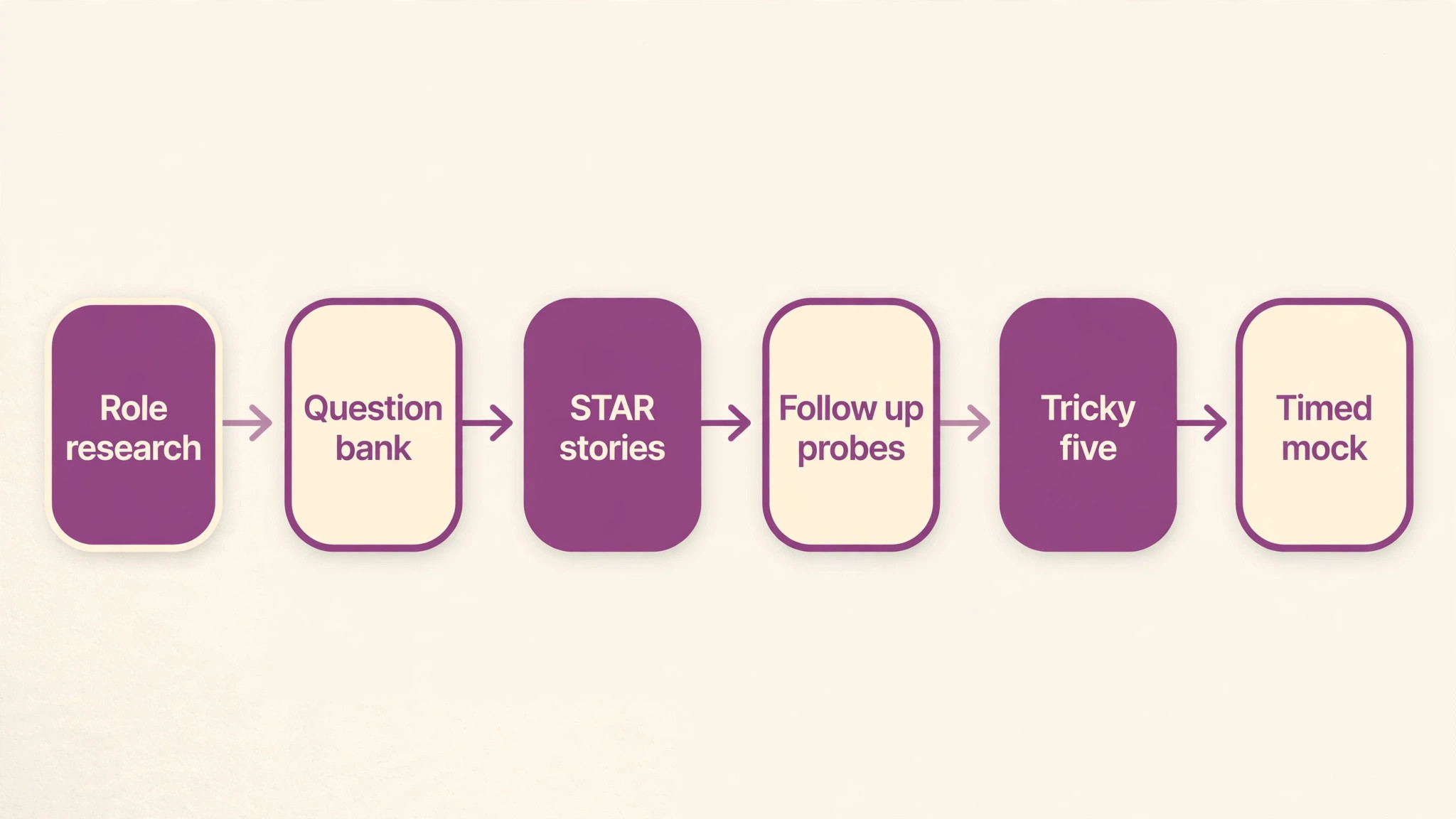
Use this workflow to use ChatGPT for interview preparation job seekers in order, because the order matters. Skipping ahead to extras before the basics are recorded creates work that has to be redone, while following the steps in order means each step builds on a finished earlier step. Tick each step off, and do not move on until the current step works with a real task.
- Feed the role before asking anything. Paste the job posting, the company description and the team page if one exists, then ask for the likely questions and what each one tests. Grounded prompts produce relevant practice, while ungrounded prompts produce generic lists that waste an evening.
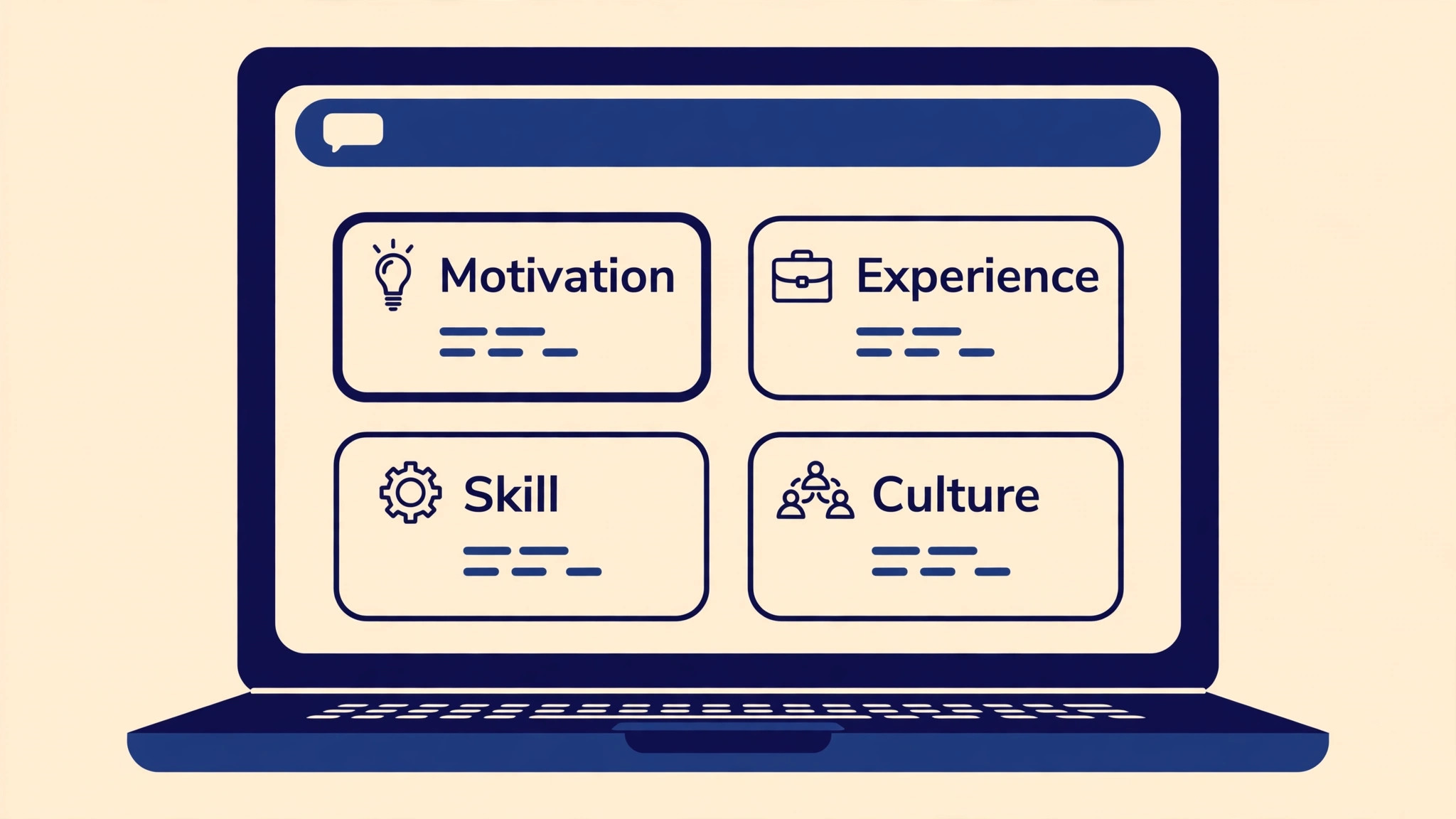
- Build the question bank for this role. Ask for ten questions split across motivation, experience, skill and culture, then add the five hardest questions for the role. Save the bank in a document, because a bank you can revisit beats a chat you must scroll to find.
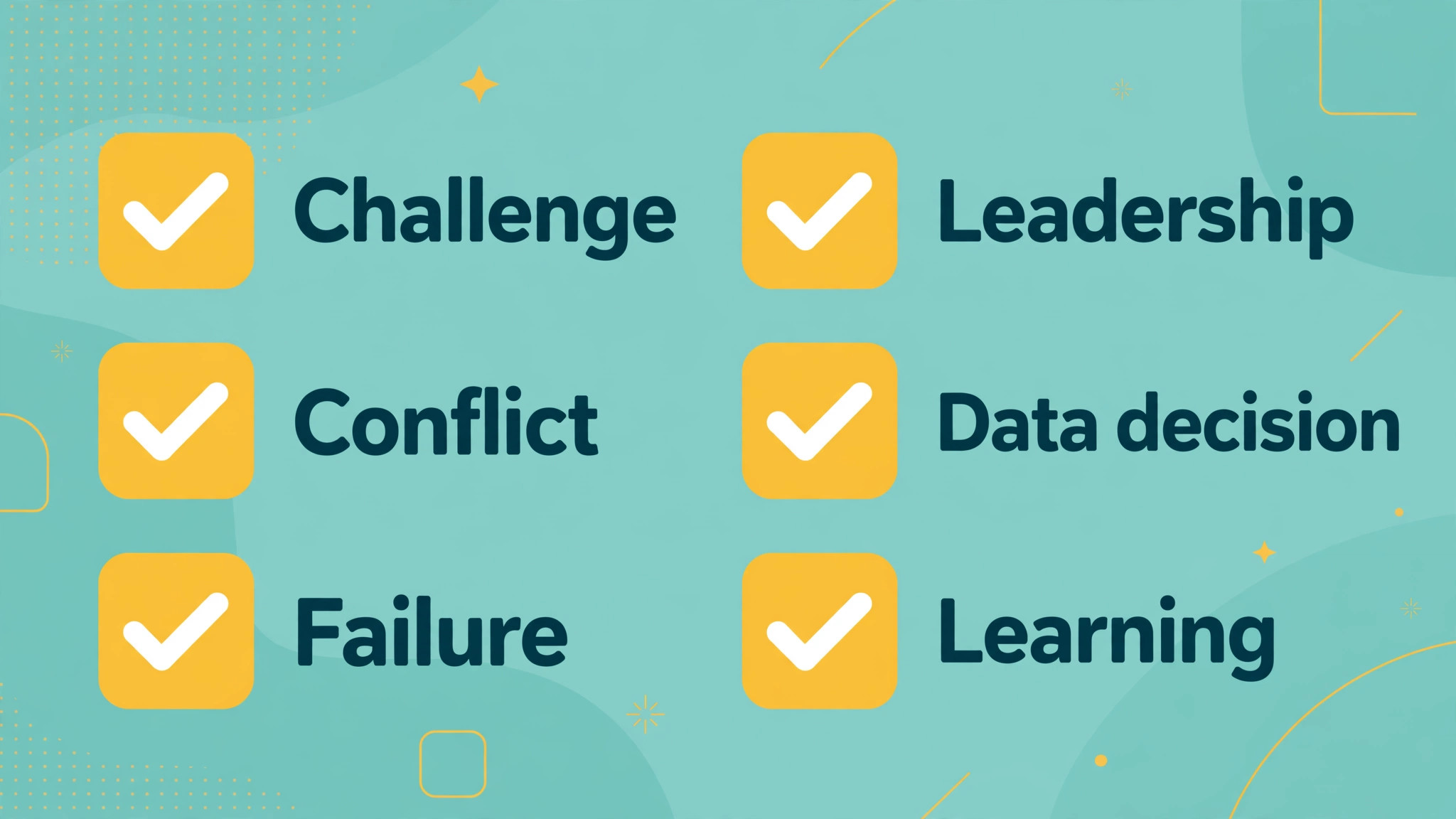
- Draft six STAR stories. Write one story each for a challenge, a conflict, a failure, a leadership moment, a data driven decision and a learning moment. Use the STAR shape of situation, task, action and result, and keep each story under two minutes spoken, since longer stories lose interviewers.
- Stress test each story with follow ups. Ask the tool to play a sceptical interviewer and probe each story for the missing number, the unclear decision and the vague result. Stories that survive three follow ups survive a real panel, while stories that collapse need a stronger result or a different example.
- Rehearse the tricky five. Practice the weakness question, the salary question, the gap in employment, the reason for leaving and the failure question. These five cause more damage than any technical question, because candidates improvise them, and improvised answers ramble.
- Run a timed mock interview. Ask for a 30 minute mock with one question at a time, no hints, and feedback only at the end. Answer out loud, not in writing, since speaking is the skill being tested. Record yourself if you can, because playback reveals pacing problems text cannot.
- Review, fix one thing, repeat. After each mock, pick the single weakest answer and rewrite it before the next round. Fixing one thing per round compounds fast, while trying to fix everything at once produces a new set of mistakes. Two focused rounds beat five unfocused ones.
An Example Week With the System
Take a concrete Monday as the starting point. The week begins with the current state visible in one place, so the first decision of the week is about priorities, not about finding information. That shift sounds small, but it changes the whole week, because decisions made from visible facts are faster and calmer than decisions made from searching inboxes and asking colleagues what is live. Speed and calm compound across a month of Mondays.
Wednesday usually brings the surprise, a late request, a changed deadline or a new item that does not fit the plan. A good system absorbs surprises by giving them a place, a status and a next action within minutes, instead of letting them float as a worry. The surprise still needs handling, but it no longer needs remembering, and that distinction frees attention for the handling itself, which is the work that actually matters.
Friday ends with a short honest audit. What moved, what stalled, what was dropped deliberately, and what the numbers say about the week. Deliberate drops deserve celebration, since a system that cannot say no to low value work will say yes to everything and finish nothing. That Friday audit, repeated weekly, is how a routine becomes a habit and a habit becomes a standard.
Your Template, Ready to Fill In
Use this template when you use ChatGPT for interview preparation job seekers without starting from a blank page each time. Copy it, fill it in with your own details, and keep the filled version where the people who use it can see it. A template that lives in a drawer helps nobody, while one that sits beside the work becomes the way the job actually gets done.
| Item | What to write down |
|---|---|
| Question bank | ten role specific questions plus the five tricky questions, saved in one document |
| STAR story bank | six stories in situation, task, action and result shape, each under two minutes spoken |
| Salary script | a range, a reason and a deflecting line for early salary pressure |
| Mock routine | 30 minute timed mock, feedback at the end, one fix per round |
| Pre interview checklist | stories reviewed, questions for them ready, logistics confirmed |
Fill the table in with real details from your own setup, not with guesses, because a plan filled with guesses gives confident answers that are wrong. If a detail is unknown, write unknown and find it before you act on that row, since a single guessed cost or time can undo an otherwise sound plan. Review the filled version every month for the first quarter, then every quarter after that, and update it when prices, people or suppliers change.
Keep the filled version where the work happens, whether that is a shared folder, a printed page or the tool itself, and name one person who owns updating it. Ownership matters because a template without an owner goes stale within a quarter, while one with a named keeper stays current through staff changes and price changes alike. When the owner changes, hand the template over explicitly, like any other responsibility.
- The question bank is built from the actual posting, not a generic list
- Six STAR stories exist, each with a clear result and a number where possible
- Each story survived three follow up probes
- The tricky five have rehearsed answers, not improvised ones
- A timed mock was answered out loud, not typed
- One fix per round was applied before the next mock
- Questions to ask the interviewer are prepared and specific to the role
- Salary range, reason and deflecting line are written down
When to Change the Template
Ask three questions before adding anything to the template. Does this field change a decision, does someone fill it in every week, and would the work suffer without it. If the answer to any question is no, leave the field out, since every field costs attention at entry time and at review time. Templates grow by addition and improve by subtraction, and the subtraction habit is the one most owners never develop.
When a field is removed, say why in a short note beside the template, so nobody re-adds it next month out of habit. Institutional memory lives in such notes, and a template with a short change history teaches new users faster than a template that simply appears. Good templates carry their reasoning with them, not just their fields.
Budget, Limits and Honest Trade-Offs
Before you commit money or time, write down the costs of the current way of working, because when you use ChatGPT for interview preparation job seekers you need a baseline to judge the new way against. Count the time spent, the errors made and the opportunities missed under the old way, then compare that total with the same total after one month of the new routine. If the new total is not lower, or the experience is not clearly better, change one thing and measure again rather than adding more tools.
ChatGPT offers a free tier that covers this workflow, since drafting questions and stories needs no advanced features. Paid tiers add higher limits and newer models, so check the vendor pricing page before paying, and start free, because the workflow matters more than the model.
The real cost is rehearsal time. Expect about three hours to build the bank and stories, plus 30 minutes per mock round. That is less than the time one failed final round costs in lost momentum, and the preparation carries across every interview in the search.
Watch for the cost that appears only after launch, such as extra seats as a team grows, premium features on higher tiers, or the time spent maintaining a setup that looked simple at first. Read the pricing page for the tier you will actually land on in six months, not the starter tier you land on today, because a tool that is cheap at small volume and expensive at larger volume can punish growth. Set a calendar reminder to review the bill every quarter, and compare it with the time saved, since a subscription that no longer saves time should be renegotiated or dropped.
Traps That Look Like Shortcuts
The mistakes below are common because each one feels reasonable at the time, and when you use ChatGPT for interview preparation job seekers it helps to name them before they happen. Read the list with anyone who will use the routine, agree which mistake your setup is most likely to make, and put one guard in place against it, because a named mistake is far easier to avoid than a vague warning to be careful.
- Memorising scripts word for word. Interviewers hear memorised answers instantly, so learn the shape and the result, not the script.
- Practising only in writing. Interviews are spoken, so answers that read well can sound stiff aloud.
- Accepting AI praise at face value. Ask for criticism explicitly, or every answer will be called strong.
- Using invented stories or numbers. A fabricated result collapses under one follow up, so keep stories true.
- Skipping questions for the interviewer. A candidate with no questions looks uninterested, however good the answers were.
Signs the System Is Paying Off
Pick a small set of numbers and track them monthly, because when you use ChatGPT for interview preparation job seekers you need evidence, not a feeling, about whether the change is paying. Choose numbers you can collect without extra admin, such as mock scores per round, average answer length, stories that survive probing and interviews that reach the next stage, and record them in one place on the same day each month. A trend over three months tells you far more than a single good or bad week.
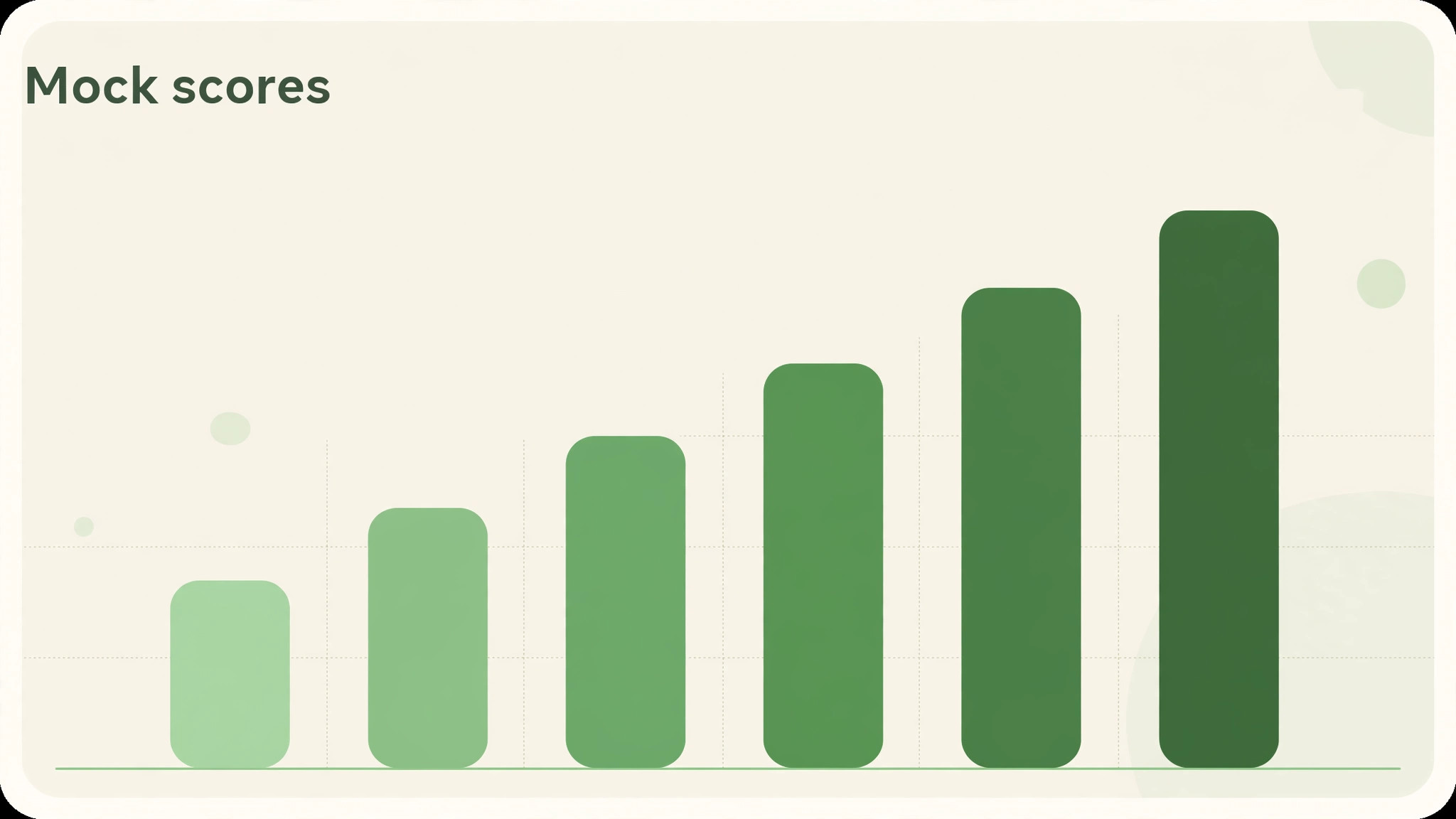
Track mock performance across rounds, because improvement you cannot see feels like no improvement. Note the weakest answer each round, the average answer length and how many stories survived probing. If answers shorten and stories survive more probes, the practice is working, even if it still feels uncomfortable.
Also track real outcomes. If first interviews go well but final rounds fail, the gap is likely depth or salary talk, not structure. Use that signal to shift practice toward the stage that fails, rather than repeating the whole workflow unchanged.
When a number moves the wrong way, change one element and watch the next period before changing anything else. Changing five things at once feels decisive, but it destroys the evidence, since nobody can tell which change helped. Single changes, measured honestly, are slower to announce and faster to learn from, which is the trade that matters over a year.
The Ninety Day Picture
After ninety days, a healthy setup shows up in small, boring ways, such as mock scores per round, average answer length, stories that survive probing and interviews that reach the next stage trending in the right direction without heroic effort, and fewer messages asking where things stand. Nobody celebrates a routine that simply works, which is why it is worth naming those signs when they appear, so the people involved recognise the payoff and keep funding the habit.
The warning sign is different, and it is worth watching for, which is when people start working around the setup instead of through it. Workarounds usually mean one step no longer fits reality, so ask what changed, fix that step, and prune anything the workaround replaced. A setup that adapts to one real change survives, while one that demands loyalty to an outdated step gets quietly abandoned.
Set the ninety day review now, with a named owner and a date in the calendar. Without a named owner and a date, reviews slip, and a slipped review means a system that slowly stops matching the reality it was built for. The review itself need not take long, since one hour with the numbers and the honest answers is enough to decide what to keep, what to change and what to stop.
Getting Through Month One
Week one is building. Feed the posting, build the question bank, draft six stories and stress test them. Do not book a mock until the stories exist, since mocking without stories just rehearses improvisation.
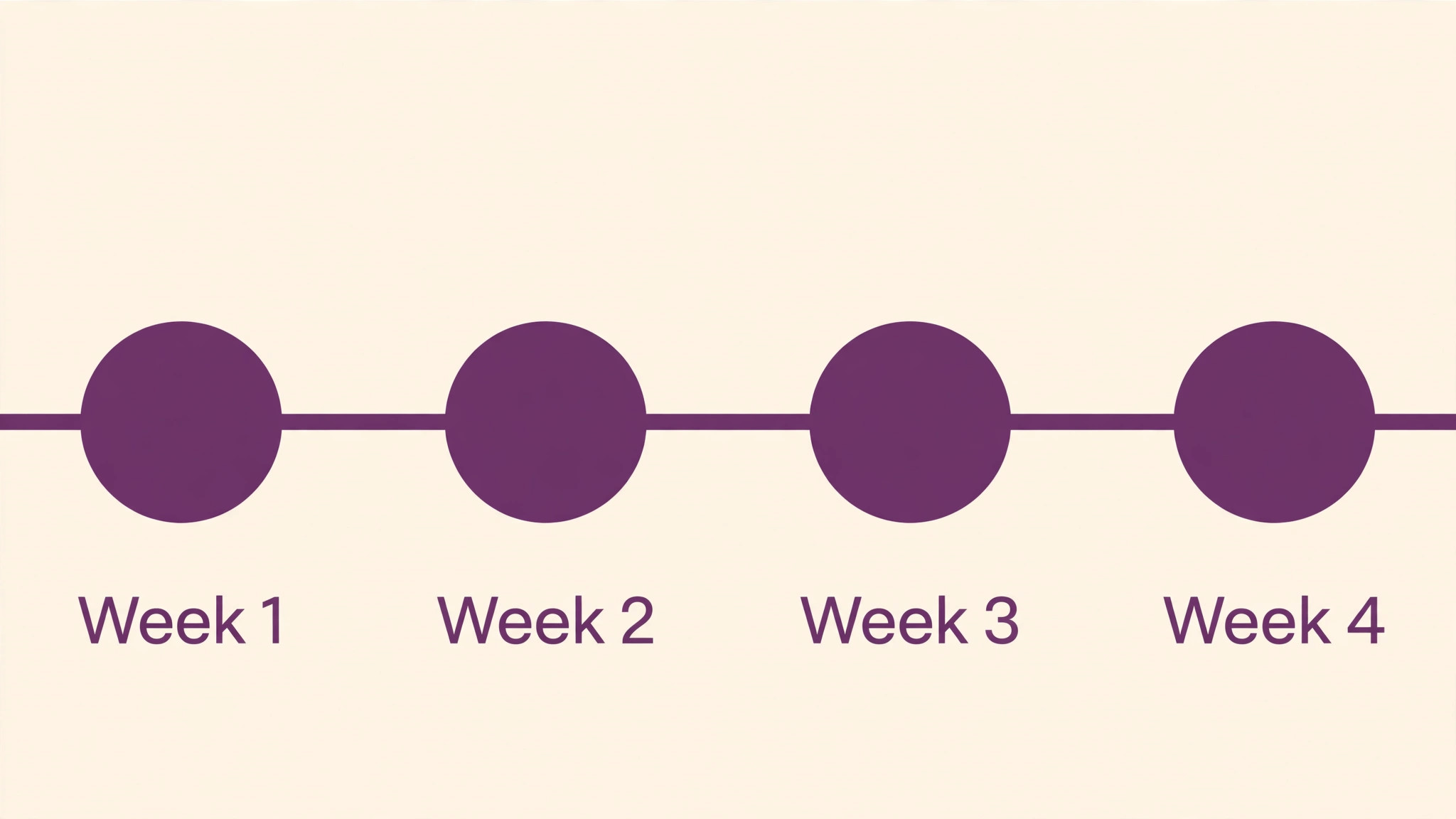
Weeks two to four are rounds. Run one timed mock per week, fix one thing per round and refresh the bank for each new role. By month end, the story bank should feel like a toolkit, not a script, and that is the state that performs best live.
If the first month feels messy, resist the urge to rebuild the system from scratch, since the fault usually sits in one step rather than in the whole approach. Return to the numbers you tracked, find the step where results diverged from the plan, and change that step alone. System swaps feel decisive, but they reset learning to zero, while a single step fix preserves everything that already worked.
Day by Day in Week One
On day one, build the template and import what is already live, without redesigning anything. The goal for day one is a working system with real entries, not a beautiful system with sample data, since real entries reveal the flaws that sample data hides. End the day by checking that every live item has a status and a next action.
On day two, use the system for new work as it arrives, and note every moment of friction. Friction notes are gold, because they point at the exact field, step or view that needs fixing, while general complaints about the system point nowhere. Keep the notes short, one line each, and review them at the end of the week.
On day three, fix the single biggest friction from the notes, and leave the rest alone. One fix per week is the pace that improves a system without destabilising it, and a system that changes daily never gets learned properly by anyone, including its owner. Stability for a week beats improvement every day.
On day four, share the system with anyone else who touches the work, and watch them use it without help. Watching a second person reveals instructions that only made sense to the author, and those instructions need rewriting before the system can survive a holiday or a handover. A system that only its author understands is not yet a system.
On day five, run the first weekly review, record the numbers, and decide one change for next week. The review closes week one with evidence instead of feelings, and that evidence becomes the baseline for month one. A week that ends with a review has already succeeded, whatever the numbers say, because the habit is the achievement.
Fixing the Common Stall Points
When reviews are the problem, shrink the review rather than skipping it. A five minute review that happens beats a thirty minute review that does not, so cut the review to the three most important checks and protect its slot on the calendar. Pairing the review with an existing habit, such as Friday coffee or Monday planning, also helps, since a review attached to a habit survives while a review floating free gets postponed.
When results stay flat after a month of honest use, check whether the system measures the right thing. A tracker that counts activity while the goal is outcome will show busy weeks and flat results, which feels like failure even when effort is real. Revisit the metrics, pick one outcome number that matters, and let that number drive the next change. If the outcome number still does not move after a further month, the approach itself, not the system, needs rethinking.
A stalled system usually fails at one of three points, which are entry, review or follow through, and diagnosing the right point saves a rebuild. If entries lag, the template is too heavy or entry takes too long. If reviews get skipped, the review is too long or it has no fixed slot. If actions do not follow, the numbers are not connected to decisions. Name the failing point plainly before changing anything, since a fix aimed at the wrong point adds complexity without restoring momentum.
More Reading on Stratilyze
More Reading on Stratilyze. For the systems around this one, read the best ai tools for job seekers guide, the how to use ai for job search guide, the best ai interview preparation tools guide. Read the guide that matches your next bottleneck first, because fixing the biggest bottleneck next gives a larger gain than polishing a part of the setup that already works well.
Frequently Asked Questions

Can ChatGPT predict my exact interview questions?
No, and treat any tool that claims to as suspect. It can predict likely question types from the posting and the role, which is valuable, but exact questions stay unknown. Prepare for types and stories, not for a leaked script, and you will handle surprises better.
Should I memorise the answers it writes?
No. Memorised answers sound flat and break when the question shifts slightly. Learn the structure of each story, the key result and the numbers, then speak naturally around them. Fluency beats recitation in every panel.
Is it cheating to practise with AI?
No. Practising with a tool is preparation, not deception, as long as the stories and results are your own. Inventing experience would be dishonest, while rehearsing true experience is what every good candidate does, with a coach or a tool.
How long should a STAR story take to tell?
Under two minutes spoken, with the result taking the final third. Longer stories lose the panel, while shorter ones often skip the action that proves your contribution. Time your stories aloud during practice, since written length misleads.
What if I have no good stories for a question?
Use a smaller true story rather than inventing a grand one. A modest project handled well, told with a clear result, beats a dramatic claim that collapses under follow up. Interviewers judge clarity and honesty more than scale.
How many mocks do I need before a real interview?
Two focused rounds is a good minimum, with one fix applied between them. More rounds help if each one targets a weakness, while endless unfocused rounds add fatigue without improvement. Quality of feedback matters more than round count.
What to Do Next
Interviews are won by candidates who sound structured, specific and calm, and those qualities come from rehearsal with feedback. When you use ChatGPT for interview preparation job seekers get that rehearsal on demand, grounded in the actual role and sharpened by follow up questions that expose weak stories before a panel does.
Build the bank, draft six true stories, run two timed mocks and fix one thing per round. Then walk in with stories you trust and questions of your own, and let the preparation do the talking. The tool cannot interview for you, but it can make sure you never meet a question type for the first time in the room.