
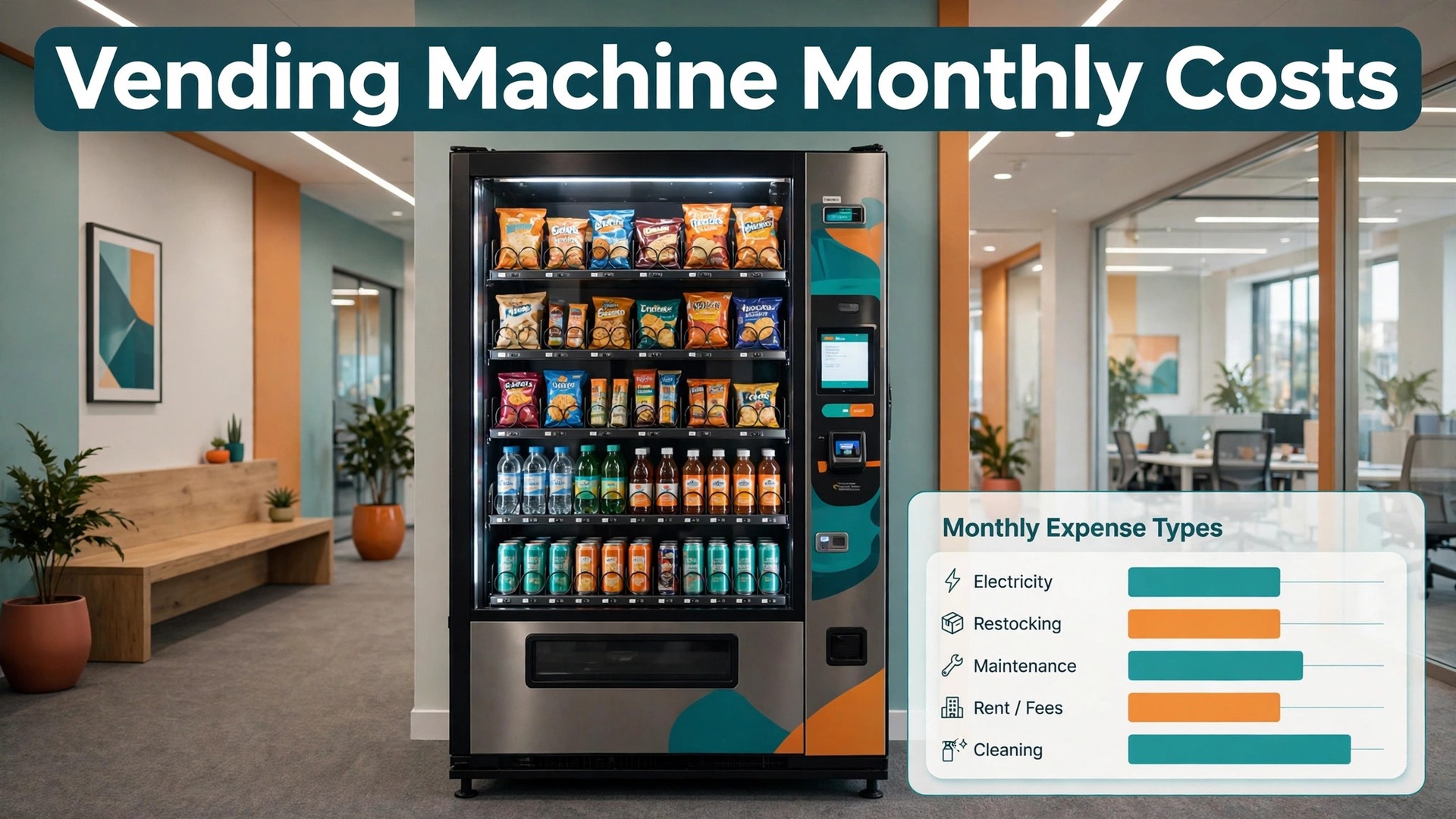
A vending machine that looks busy can still lose money, because the cash in the box is not profit. Stock, location commission, card fees, fuel, repairs and your own time come out before anything is left over. If you only track sales, you will keep restocking machines that quietly cost more than they earn. The cost of running a vending machine business monthly is therefore best understood as a set of small, recurring lines that add up across a route, not as one machine price or one rent figure.
This guide gives realistic monthly ranges for a single machine and for a small route, shows how location deals change the maths, and gives a margin table you can use to judge each location on its own numbers.
What the cost of running a vending machine business monthly Includes
Start with the four lines that appear every month whether sales are strong or weak. Stock is the largest variable cost, usually 40 percent to 50 percent of sales for snacks and drinks, which leaves a gross margin of 50 percent to 60 percent before other costs. Location commission or rent is the next line, commonly 10 percent to 25 percent of sales, or a flat fee of 50 dollars to 300 dollars a month for a smaller site. Card processing adds 3 percent to 5 percent of card sales, plus a monthly reader fee on many systems. Fuel, vehicle wear, cleaning and minor repairs form the fourth line, and they rise with route distance and machine age.
Add insurance, a phone plan for remote monitoring where used, and a small reserve for breakdowns, and you have the real monthly picture.
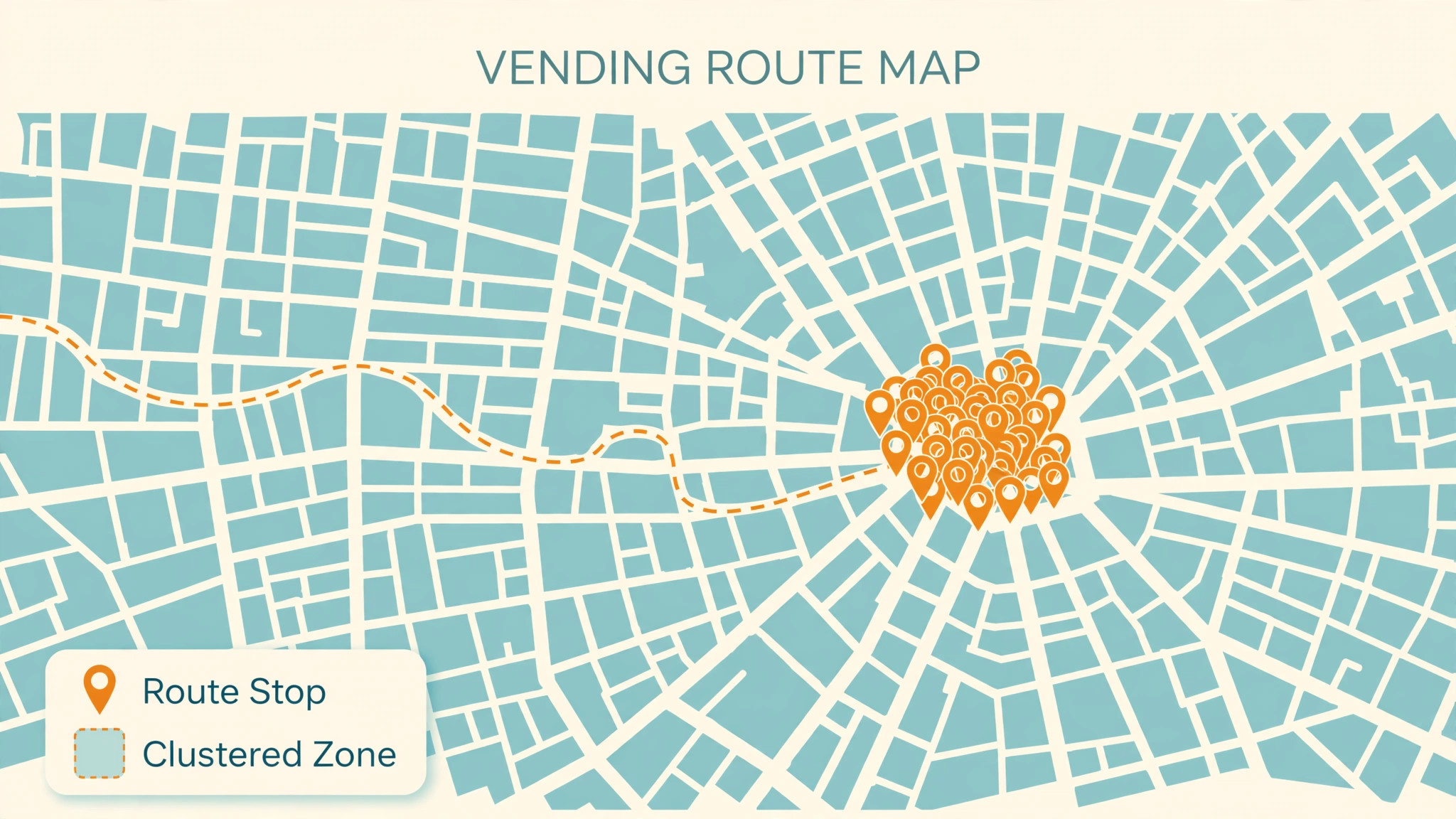
Published guides put a single machine operation at 100 dollars to 300 dollars a month in overhead, excluding stock, and a small route of five to ten machines at 500 dollars to 2,000 dollars a month. Those figures make sense only when machines are close together. A route spread across a wide area can double fuel and time costs while sales stay the same. Route density is therefore a cost control tool. Machines within a 20 mile radius can be serviced in one efficient run. Machines scattered across a county need more trips, more fuel and more hours, and each extra trip eats margin that no product price increase can easily replace.
The other key point is that monthly cost is not the same as monthly cash needed. Stock must be bought before it is sold, a card reader may be billed monthly, a location may require a minimum payment even in a slow month, and a compressor failure can cost several hundred dollars in one week. Keep a repair reserve separate from operating cash. A common working rule is to hold at least one month of stock and location costs in reserve for a small route, and more if any machine is old, refrigerated or located far from your base. That reserve turns a breakdown from a crisis into a repair job.
The Monthly Cost Table for One Machine and a Small Route
Use the table below for planning, and replace each range with your own quotes and sales records as soon as you have them. Figures are monthly unless stated otherwise, and stock is shown as a cost range because it moves directly with sales.
| Monthly cost item | One machine | Five machine route | Notes |
|---|---|---|---|
| Stock and drinks | 150 dollars to 400 dollars | 750 dollars to 2000 dollars | Rises with sales, watch waste and expiry |
| Location commission or rent | 50 dollars to 300 dollars | 250 dollars to 1500 dollars | Flat fee or share of sales |
| Card reader fees | 10 dollars to 30 dollars | 50 dollars to 150 dollars | Monthly fee plus percentage of card sales |
| Fuel and vehicle costs | 30 dollars to 120 dollars | 150 dollars to 600 dollars | Route density matters most |
| Cleaning and minor repairs | 20 dollars to 80 dollars | 100 dollars to 400 dollars | Older machines cost more |
| Insurance spread monthly | 25 dollars to 65 dollars | 40 dollars to 120 dollars | Liability and product cover |
| Phone and monitoring | 0 dollars to 15 dollars | 0 dollars to 50 dollars | Remote sales alerts save trips |
| Marketing and admin | 10 dollars to 50 dollars | 50 dollars to 200 dollars | Labels, records, tax and accounting |
| Total before your time | 295 dollars to 1060 dollars | 1390 dollars to 5120 dollars | Excludes loan payments and your labor |
Your time is the line most new operators forget. Restocking, cleaning, counting cash, handling card settlements, answering location calls and driving to a jammed machine all take hours. If you value that time at even a modest hourly rate, a low sales machine can show a loss even when cash flow looks positive. Track hours for the first two months, machine by machine. A machine that needs three hours a month for 100 dollars of net profit is a different business from a machine that needs one hour for the same profit, even though their sales look identical on a spreadsheet.
Loan payments also sit outside the table above, because they depend on how machines were bought. A new combo machine at 4,000 dollars to 8,000 dollars, financed over several years, adds a fixed monthly payment that must be covered before profit appears. A refurbished machine at 1,000 dollars to 3,000 dollars lowers that payment but may raise repair costs. Compare the total cost over the expected life of the machine, not just the monthly payment. A cheap machine that breaks often, rejects cards or spoils stock can cost more in lost sales and repair trips than a better machine with a higher payment.
Location Fees, Commission Deals and Free Placement
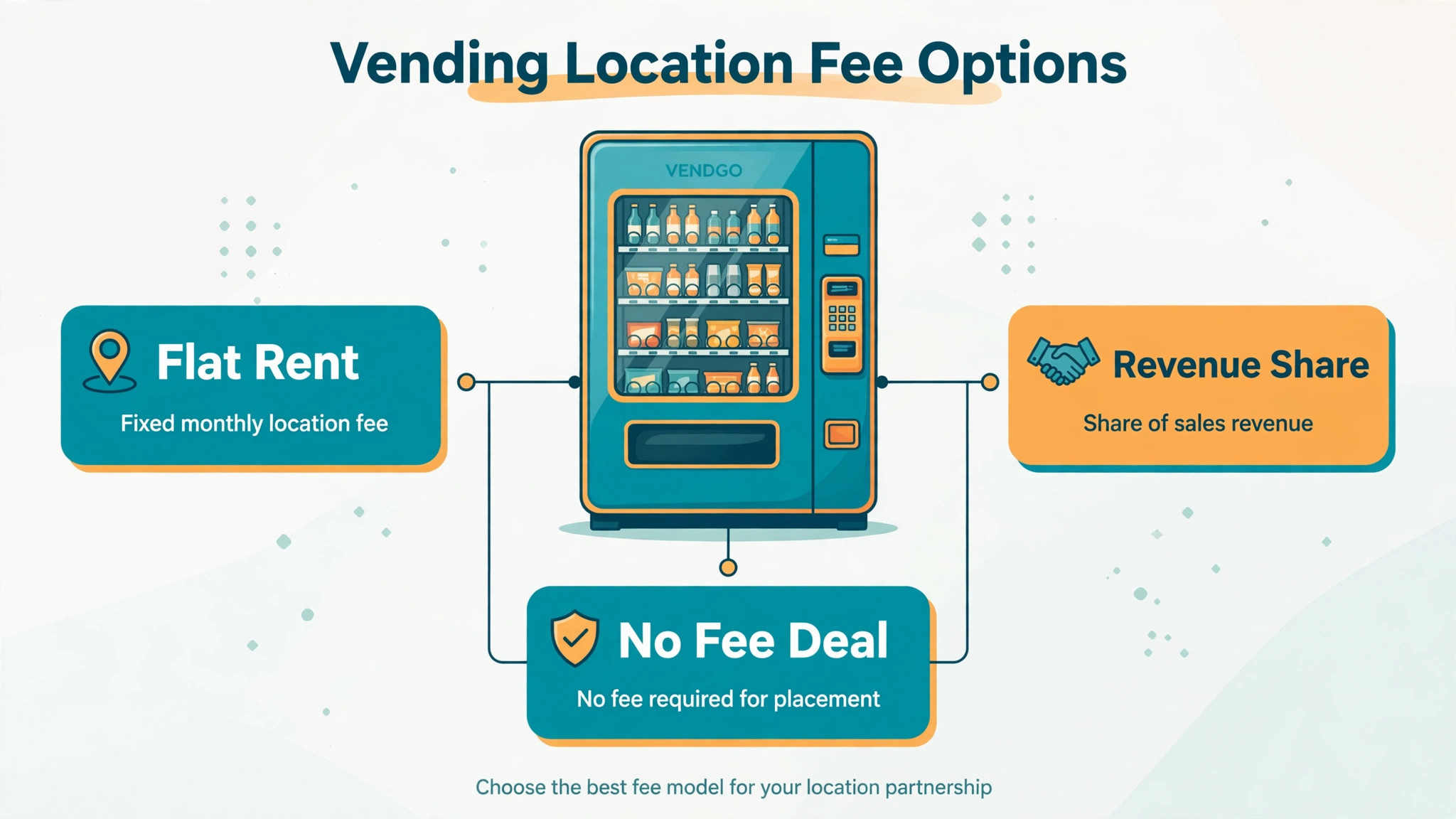
Location terms decide whether a machine survives. A commission deal pays the location a share of sales, commonly 10 percent to 25 percent, and works well when sales are uncertain, because the payment falls when sales fall. A flat rent deal pays a fixed monthly fee, often 50 dollars to 200 dollars for a modest site and higher for a premium site, and works well when sales are strong and predictable, because the location does not take a larger share as sales grow. A hybrid deal combines a small flat fee with a lower commission, which protects the location in slow months while letting the operator keep more upside in strong months.
A minimum guarantee deal, common in airports, transit hubs and large venues, pays the greater of a fixed fee or a commission share, and should only be signed when sales history supports the minimum.
Free placement is real, but it is not free in every sense. Some offices, gyms and apartment buildings offer space at no charge because a machine is a convenience for staff, members or residents. The operator still pays for stock, card fees, fuel and repairs, and still needs access, power and a contact who will report problems quickly. Free placement can be excellent for a first machine, because it removes the largest fixed cost while you learn sales patterns. It can also be fragile, because a change of building manager, a renovation or a competing machine can end the placement with little notice.
Get even a free placement in writing, with notice terms, access hours, power responsibility and who pays if the machine damages flooring or blocks a corridor.
Negotiate commission in tiers when you can. Offer a lower share up to a monthly sales level and a higher share above it. The location shares in growth, and you are protected during slow months or a seasonal dip. Ask for a trial period of three months with a review, rather than a long lock in, especially for an untested site. During the trial, track sales by week, note which products sell, and record service calls. At review, you will have evidence for a better deal, a product change or a move. A machine that stays in a weak location because moving feels like admitting failure is a machine that will keep costing money every month.
Also check practical costs before you sign. Is power included or charged separately. Is there a loading route that avoids stairs or a long carry. Can you service the machine outside peak hours without disturbing staff. Is the machine visible, well lit and near the natural flow of people, or tucked in a corridor where only a few people pass. A prime position inside a building can be worth a higher commission, because sales volume can more than cover the difference. A hidden machine at a low commission can still fail, because low sales leave little margin after stock and fuel.
Stock, Waste and the Products That Actually Sell
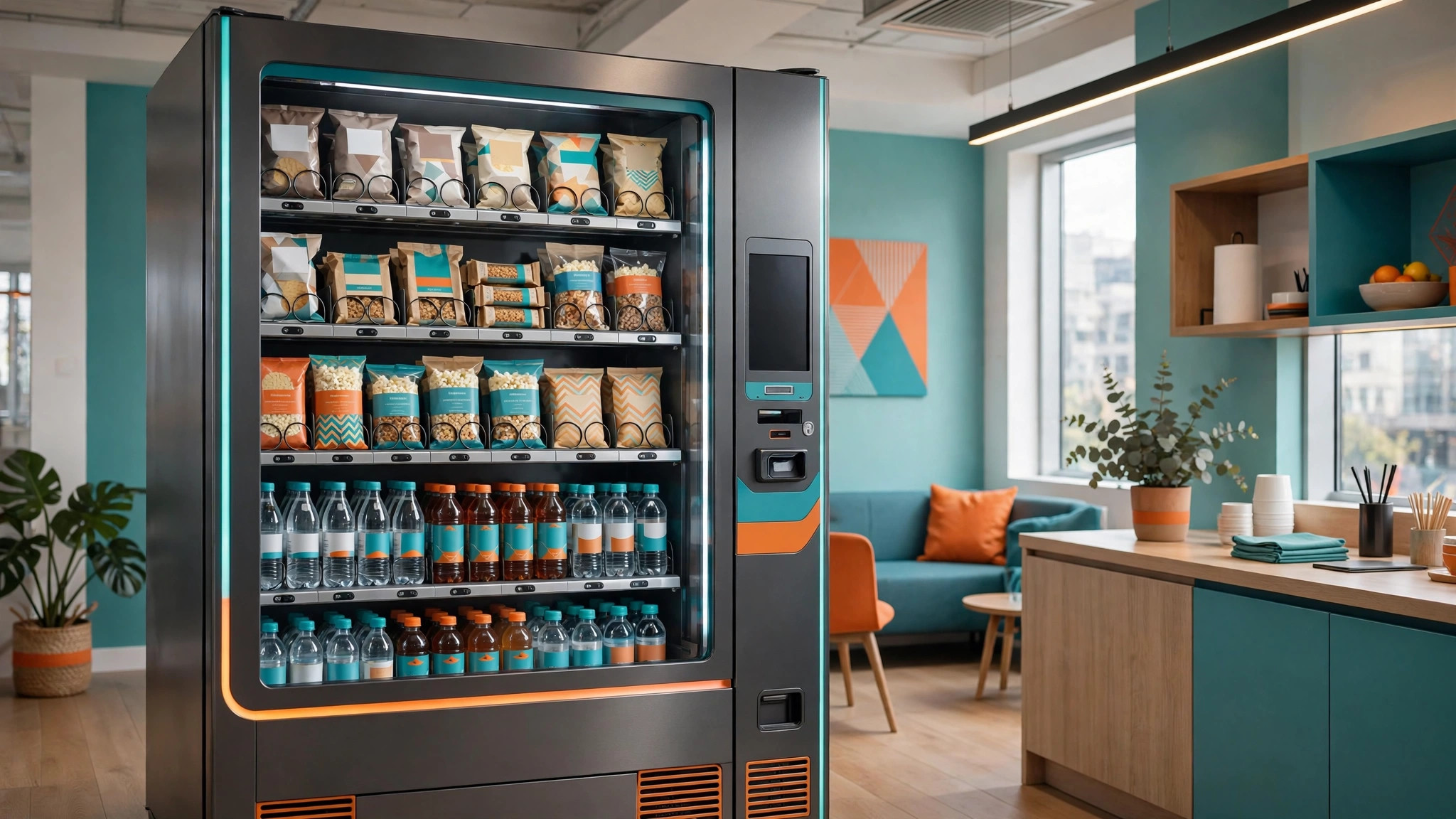
Stock cost is not just the wholesale price of what sells. It includes what expires, what is damaged, what is stolen, what is left in a slow machine for months, and the cash tied up in inventory sitting in your garage or van. Snacks such as chips and candy bars typically cost 40 cents to 80 cents wholesale and sell for 1.25 dollars to 2.00 dollars, giving a gross margin of about 60 percent before commission and fees. Sodas cost 40 cents to 60 cents and sell for 1.25 dollars to 1.75 dollars. Energy drinks cost more, at 1.00 dollar to 1.50 dollars, but sell for 2.50 dollars to 3.50 dollars.
Healthy snacks cost 80 cents to 1.20 dollars and sell for 2.00 dollars to 3.00 dollars, with a lower margin but sometimes higher demand in gyms and clinics. Use those ranges to set prices, not to guess profit, because commission and card fees come out after gross margin.
Track sales by product and by machine. Remote monitoring, where available, shows which slots are empty and which products sit untouched. Without monitoring, keep a simple log on each visit, noting what was sold, what was topped up and what was removed for expiry. Cut slow products quickly, even if you like them, and test one new product at a time. A machine with ten slow products and two strong sellers is wasting space, capital and cleaning time. A machine with a tight range of proven sellers, priced for its location, will turn stock faster and waste less.
Fresh food and refrigerated machines need extra care. Waste can quietly erase margin, because unsold sandwiches, salads or dairy products expire in days, not months. Only add fresh food where foot traffic is high, daily servicing is realistic, and temperature can be monitored. For most new operators, shelf stable snacks and drinks are the safer start. They tolerate a missed visit, survive a warm room better, and do not create food safety risks if a cooler fails for a few hours. If you do add fresh food later, price waste into the product, set a strict rotation routine, and check expiry dates on every visit without exception.
Pricing should reflect location, not just wholesale cost. A machine in a factory on night shift, a hospital waiting area or a college late at night can support slightly higher prices, because convenience matters and alternatives are limited. A machine in an office with a nearby shop needs competitive prices, or staff will walk elsewhere. Test prices in small steps, such as a 25 cent change on one product, and watch sales for two weeks before changing more. A price increase that cuts sales by a third can lower total profit, while a price cut that doubles sales of a low margin product can still leave you worse off after commission.
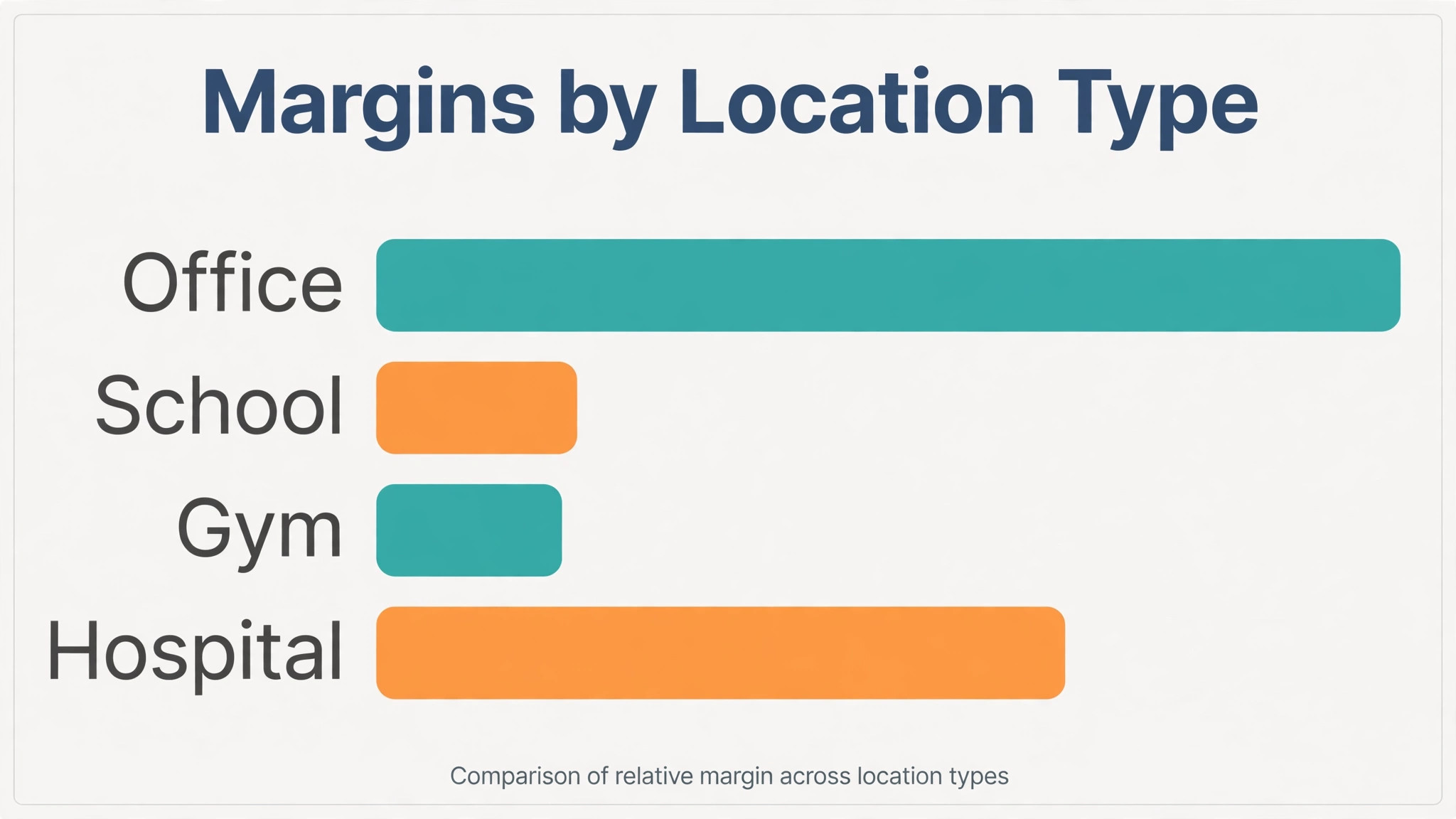
Route Margin by Location Type
The table below shows how the same machine can produce very different monthly results depending on sales, commission and service time. These are planning examples, not guarantees, and they exclude loan payments and operator labor so you can see the operating margin clearly.
| Location example | Monthly sales | Stock cost | Location payment | Card and other costs | Monthly operating margin |
|---|---|---|---|---|---|
| Small office, low traffic | 300 dollars | 135 dollars | 45 dollars | 60 dollars | 60 dollars |
| Gym, steady members | 600 dollars | 270 dollars | 90 dollars | 90 dollars | 150 dollars |
| Large office, strong traffic | 1000 dollars | 450 dollars | 150 dollars | 130 dollars | 270 dollars |
| Factory, shift workers | 1400 dollars | 630 dollars | 280 dollars | 170 dollars | 320 dollars |
| Hospital corridor, high traffic | 1800 dollars | 810 dollars | 360 dollars | 200 dollars | 430 dollars |
Read the table with care. The high traffic hospital example earns the most, but it may also need more frequent restocking, more cleaning, and a higher commission or rent. The small office example earns only 60 dollars before your time, which means one breakdown or one long drive can wipe out a month. That is why many operators set a minimum sales rule, such as 300 dollars a month per machine, and move machines that fall below it for two or three months in a row. Moving a machine costs time and transport, but keeping a weak machine costs money every month, and the opportunity cost is a better location that could have taken its place.
Route margin also improves when machines share a trip. Two machines in the same building, or in buildings a few minutes apart, can be serviced in one run with one fuel cost and one set of travel hours. A route of five machines in one business park is more profitable than five machines spread across a city, even if total sales are the same. When you are offered a new location, ask how far it is from your existing route, not just how many people work there. A site that adds an hour of driving needs higher sales to justify itself, and a site that fits an existing run can be profitable at lower sales.
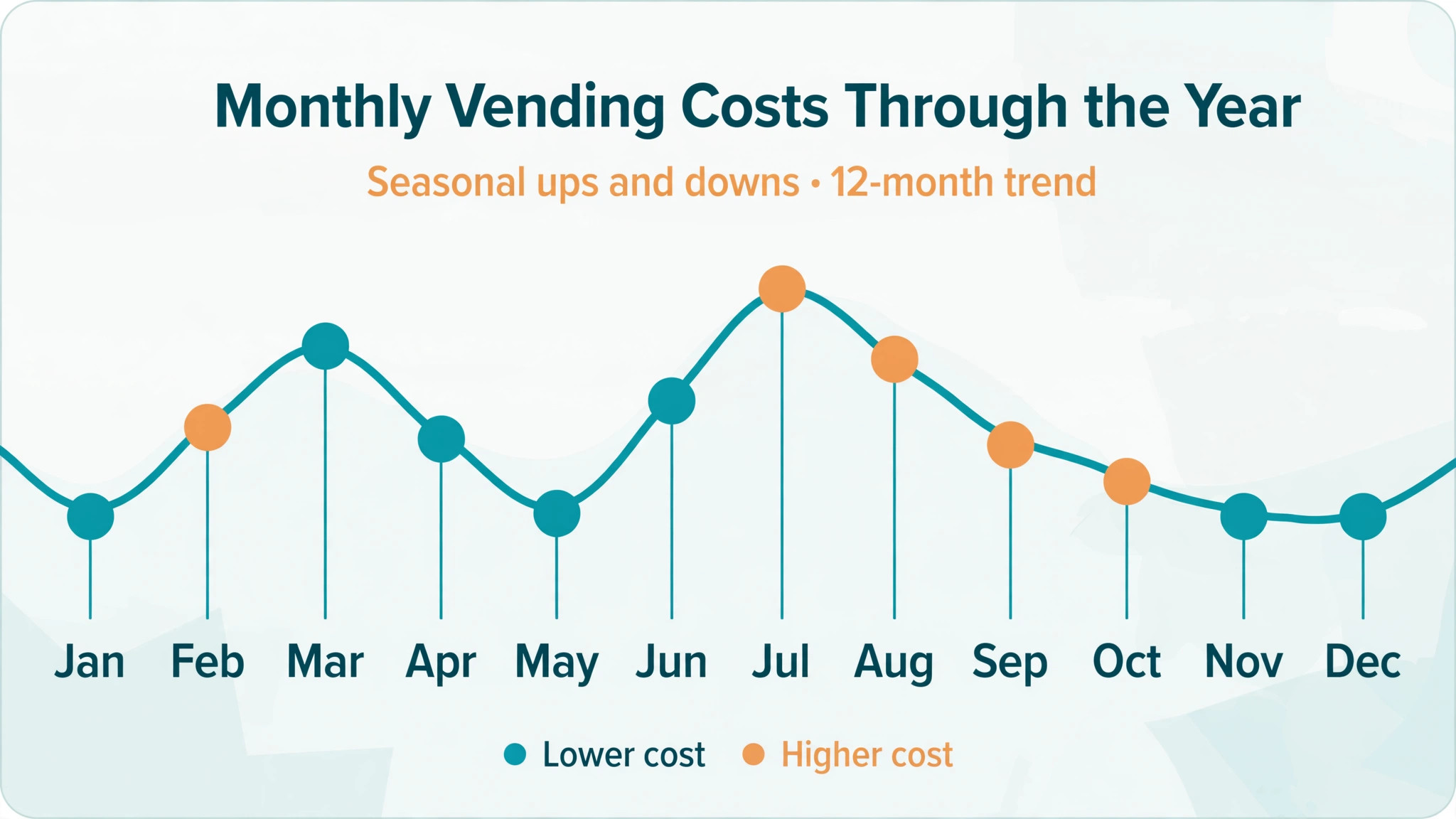
Seasonality matters too. Schools and colleges slow down in holidays, offices slow down when staff work from home, gyms peak in January and dip in summer, and factories may shut for maintenance weeks. Plan monthly costs with seasonality in mind. Hold a little extra cash before a known slow period, reduce stock orders for machines that will slow down, and use quiet weeks for deep cleaning, price reviews and location renegotiation. A route that looks profitable on an annual average can still run short of cash in a bad month, so monthly cash planning matters more than annual averages.
Running the Route Week by Week
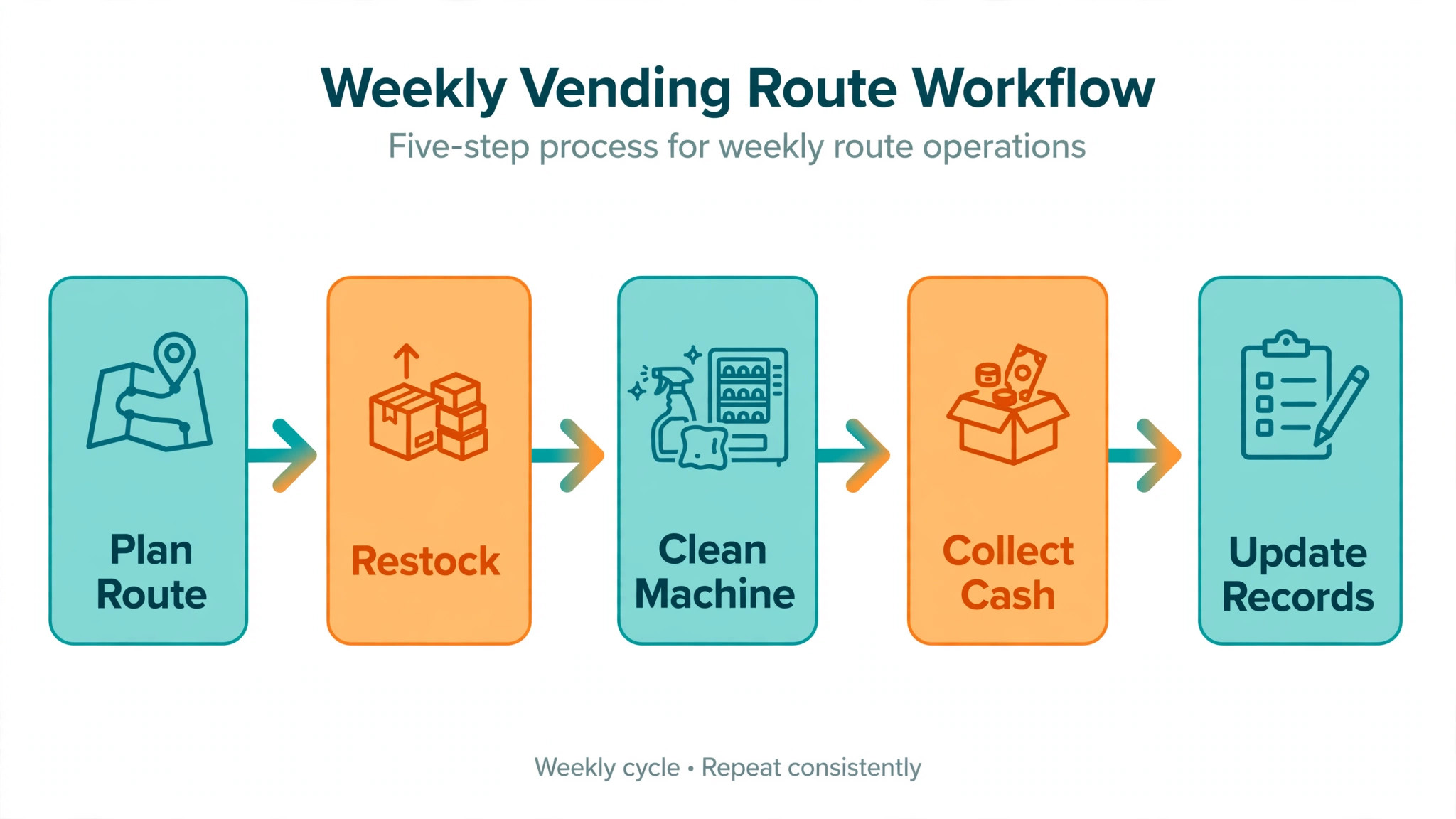
A good weekly routine keeps monthly costs down. Visit each machine on a set day, check stock, clean the front and payment area, test the card reader, clear any jam, and record sales and problems. A regular visit prevents small problems from becoming lost sales, because a jammed coil or a full coin box can stop a machine for days if no one notices. Keep a small kit in the vehicle with cleaning cloths, gloves, a basic tool set, spare labels and a few high demand products for emergency top ups. A second trip for a problem you could have fixed on the first visit doubles fuel and time costs for no extra sales.
Keep records simple but consistent. For each machine, record date, sales since last visit, stock added, cash collected, card settlement, commission due, and any repair or complaint. At month end, total those records by machine and by location. You will quickly see which machines earn their keep, which products waste money, and which locations need a price change, a product change or a move. Operators who rely on memory tend to keep weak machines too long and overstock slow products, because both problems feel smaller than they are until the monthly totals are added up.
Tax, licensing and insurance should be handled monthly, not left to year end. Set aside a share of sales for sales tax where applicable, keep receipts for stock, fuel and repairs, and check whether your city or state requires a vending license, a food handler permit or a sales tax permit for each location. Insurance costs vary, but general liability and product liability cover for a small route often falls in the range shown in the cost table. Review cover once a year, and tell your insurer if you add refrigerated machines, fresh food or machines in new types of locations, because those changes can affect risk and price.
When to Add, Move or Remove a Machine
Add a machine only when your existing route is profitable after counting your time, and when the new location fits the route geographically. A second machine in the same building, a second building on the same business park, or a site on the way to an existing machine is a better addition than a distant site with slightly higher foot traffic. Before adding, check power, access, security and the location agreement in writing. After adding, give the new machine three months to prove itself, with weekly sales tracking and a clear minimum sales rule agreed in advance, even if only with yourself.
Move a machine when sales stay below your minimum for two or three months despite product and price changes, when service time is high because of distance or frequent faults, or when the location changes in a way that reduces foot traffic. Moving is not failure. It is route management, and experienced operators move machines regularly. Remove or sell a machine when repair costs exceed its monthly margin for several months, when parts are hard to find, or when card and monitoring systems cannot be upgraded. An old machine that rejects cards in a card heavy location will lose sales every day, and no amount of cheap stock can fix that.
A small route can be a useful side income, and a larger route can become a full time business, but both need the same discipline. Published guides put a ten machine route at 30,000 dollars to 80,000 dollars a year in revenue, with 20 percent to 30 percent profit margins after costs. Those margins are achievable, but only when locations are chosen carefully, stock is tracked, routes are dense and weak machines are moved. The operators who struggle are usually not those with the worst machines. They are those who never add up monthly costs by machine, and therefore never learn which locations are subsidizing which.
A Monthly Checklist That Keeps Costs Visible
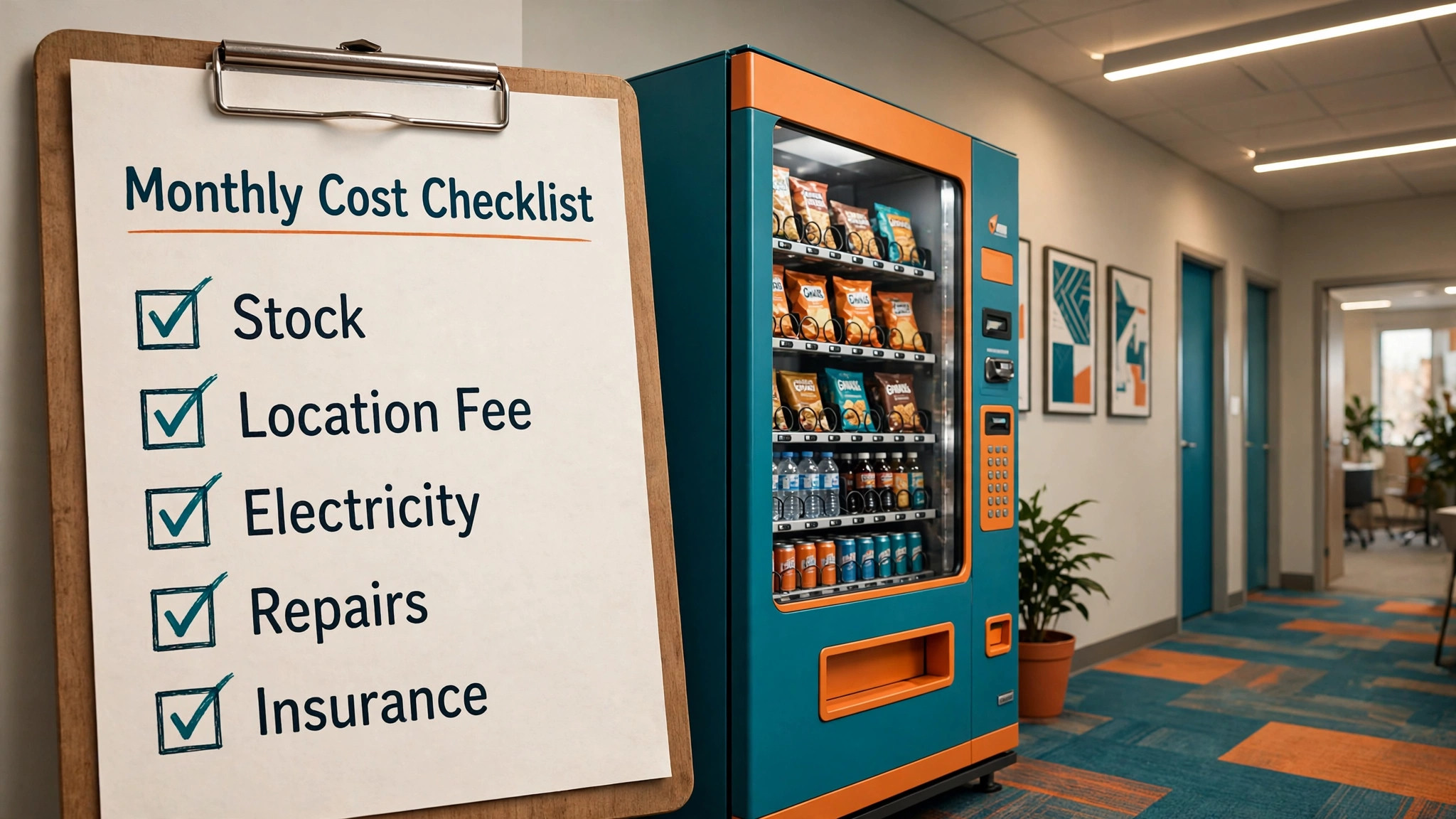
At the end of each month, run through the same short checklist for every machine. Record sales, stock cost, commission or rent, card fees, fuel and repair costs, and hours spent. Calculate operating margin per machine, and rank machines from strongest to weakest. Check expiry dates, clean the machine properly, and note any location change, such as a new manager, a renovation or a competing machine nearby. A monthly view of the cost of running a vending machine business monthly turns vague worries into clear decisions, because you can see which machine earned its place and which one did not.
Use the checklist to set next month stock orders, to decide whether a price change is needed, and to plan route days so no machine is visited twice for one problem. The cost of running a vending machine business monthly should fall as a share of sales when routes get denser and stock turns faster, and if it rises instead, the checklist will show whether fuel, waste, commission or repairs caused the change. Keep the checklist in one place, even if it is a simple spreadsheet, and review it before you agree to any new location, because a cost of running a vending machine business monthly that is already tight leaves no room for a weak new site.
Cash Handling, Security and Small Losses That Add Up
Cash handling deserves a routine of its own, because small losses are easy to miss and hard to recover. Count cash at the machine or in a secure place on the same day, record the amount by machine, and bank it promptly rather than carrying it for days. Keep coin and note mechanisms clean, because a dirty validator can reject good money and create complaints that cost more in lost sales than the cleaning ever would. Check for tampering, damaged locks and loose panels on every visit, and report any sign of forced entry to the location manager and to your insurer at once.
Security cameras in the location, good lighting around the machine and a lock that cannot be opened with a generic key all reduce risk, and they are cheaper than replacing stolen stock. Also watch for small, repeated losses that are not theft at all, such as products that fall behind a coil, drinks that are dented and unsellable, and snacks that are removed for expiry after sitting in a slow slot. Record those losses by product, because a product that is repeatedly wasted is a product that should be removed, repriced or moved to a faster machine.
A route that treats cash and stock with the same care as sales will keep its monthly margin honest, and that honesty makes every later decision about prices, locations and new machines much easier to trust.
More Reading on Stratilyze
Vending route costs sit beside the other mobile and low-overhead business budgets owners compare, so readers building a route usually check the neighbouring guides next. The guide to starting a vending machine business with AI covers the launch side of the same route, the guide to the monthly cost of running a food truck shows the closest mobile-business comparison, with the same route and stock math, and the guide to using Google Sheets for freelance invoicing explains the simple record keeping that keeps a cash route honest.
Frequently Asked Questions
How much does it cost to run one vending machine each month
Excluding stock, a single machine often costs 100 dollars to 300 dollars a month in location fees, card charges, fuel, cleaning and insurance, with stock adding 150 dollars to 400 dollars depending on sales. A cost of running a vending machine business monthly that ignores your time will look better than it really is, so track hours as well as cash.
What is a normal location commission for vending
Commission commonly ranges from 10 percent to 25 percent of sales, with flat fees of 50 dollars to 300 dollars a month for smaller sites. Premium sites may charge more or require a minimum guarantee, so compare the total location cost at your expected sales level, not just the headline percentage.
How many machines make a profitable route
Profit depends on sales per machine and route density more than machine count. A dense route of five machines can beat a scattered route of ten, because fuel and time costs are lower. Many operators aim for at least 300 dollars in monthly sales per machine before counting a location as viable.
How do card fees affect vending profit
Card fees typically add 3 percent to 5 percent of card sales, plus a monthly reader fee. Cards usually increase sales enough to justify the fee, especially in offices and colleges where fewer people carry cash, but the fee should still be included in every margin calculation. A cost of running a vending machine business monthly that leaves out card fees will overstate profit on card heavy machines.
When should I move a vending machine
Move a machine after two or three months of sales below your minimum despite product and price changes, or when repair and travel costs regularly exceed its margin. Give a new location a fair trial, track weekly sales, and move promptly when the evidence is clear rather than waiting for a recovery that never arrives.
Do I need a license to run vending machines
Requirements vary by city and state, and may include a business license, a sales tax permit, and a food handler permit for certain products. Check local rules before placing machines, keep records for tax, and confirm insurance cover for each location type you serve.
A Clearer Way to Judge Each Machine
Judge every machine on its own monthly numbers, not on total route sales. A route total can hide one strong machine subsidizing three weak ones, and that hiding is how costs creep up unnoticed. Set a minimum sales rule, track stock waste, keep routes dense, negotiate location terms with a trial period, and review the margin table every month. The cost of running a vending machine business monthly is manageable when each line is visible and each location earns its place. The cost of running a vending machine business monthly becomes a problem only when it is guessed, averaged across a route, or left until year end.
Start with one or two well placed machines, learn their real numbers, and grow only when the numbers, not enthusiasm, say the next machine will pay. That discipline is the difference between a route that quietly drains cash and a route that steadily builds income, and the cost of running a vending machine business monthly is the tool that shows which kind of route you actually own.