
A full time food truck with one or two staff typically costs 13,000 to 26,200 dollars a month to run before loan payments and owner pay, according to operator guides that publish full monthly breakdowns. That figure surprises new operators, because the truck itself is the cost they budget for, while food, labour and the daily cost of moving and parking the truck quietly become the larger bill. The cost of running a food truck monthly is therefore best read as a stack of recurring lines, not as one headline number, and the size of each line depends on how many days you trade, where you park, and what you serve.
This guide builds that stack line by line, using ranges published by operator guides, commissary listings and official permit pages, and it explains what pushes each line up or down. All figures are in United States dollars unless stated otherwise. Where sources disagree, the guide gives the wider range and says why, so you can budget for your city rather than trusting a single national average that may not match your streets.
What the cost of running a food truck monthly really includes
A food truck has two kinds of monthly cost, and confusing them is the fastest way to underprice a menu. Fixed costs stay roughly the same whether you serve 40 customers or 400 in a week. Commissary rent, insurance, permit renewals spread across the year, a truck loan or rental payment, phone and point of sale subscriptions all sit in this group. Variable costs rise with every sale. Ingredients, packaging, card fees, fuel for extra miles and the extra pair of hands on a busy Saturday all sit in this group.
The split matters because it changes what a slow week means. In a slow week, fixed costs do not fall, so each sale has to carry a larger share of them. In a busy week, variable costs climb, and a truck that looks profitable on a quiet Tuesday can lose money on a packed festival day if portion sizes drift, waste rises and a third staff member is added without a matching rise in average spend. Good operators track both groups separately, and they review them on the same day each month, before the next month of buying decisions is made.
The monthly cost table
The table below is the core of this guide. It shows a full time truck at three levels of operation, and it separates the lines a new operator most often forgets. Food cost is shown as a share of sales, because a fixed dollar figure for ingredients means nothing without the sales it supports. Card fees are shown at 2.5 to 3.5 percent of card sales, the range operator guides report, and the note under the table explains how to adjust that figure if most of your customers pay cash. That table is the clearest way to see the cost of running a food truck monthly at each level of operation.
| Monthly cost line | Part time truck, 2 to 3 days a week | Full time solo truck, 5 to 6 days a week | Full time truck with a small team |
|---|---|---|---|
| Food and ingredients | 2,500 to 4,000 dollars, about 28 to 35 percent of sales | 6,000 to 12,000 dollars, about 28 to 35 percent of sales | 8,000 to 15,000 dollars, about 28 to 35 percent of sales |
| Packaging and disposables | 300 to 600 dollars | 500 to 1,200 dollars | 800 to 1,800 dollars |
| Labour, including payroll taxes | 1,500 to 3,000 dollars | 4,000 to 8,000 dollars, or owner only at the low end | 6,000 to 12,000 dollars |
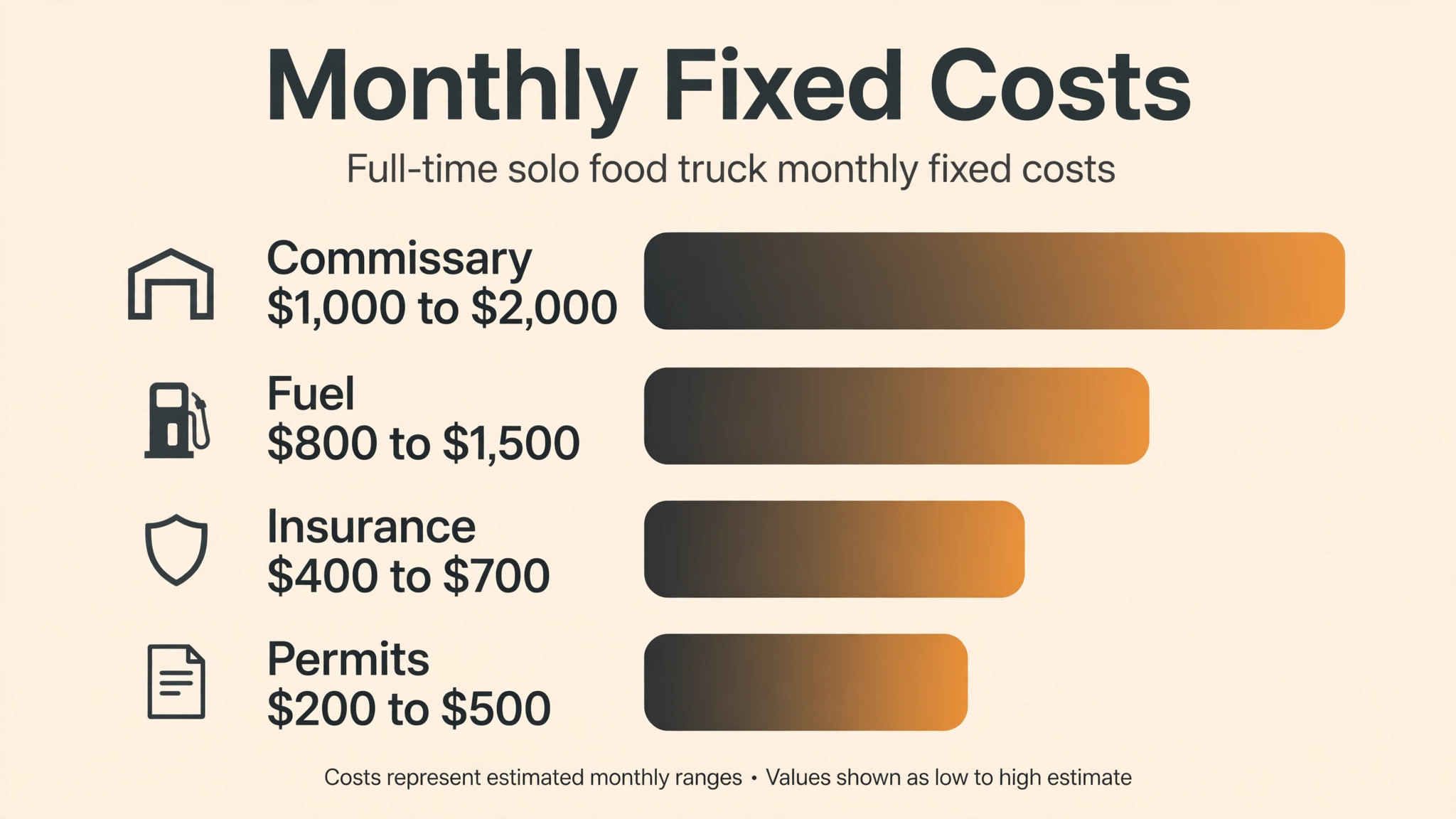
| Commissary rent and parking | 500 to 1,000 dollars | 1,000 to 2,000 dollars | 1,000 to 2,500 dollars |
| Fuel, truck and generator | 400 to 800 dollars | 800 to 1,500 dollars | 1,000 to 1,800 dollars |
| Maintenance and repairs reserve | 200 to 500 dollars | 400 to 1,000 dollars | 500 to 1,500 dollars |
| Insurance, spread monthly | 250 to 500 dollars | 400 to 700 dollars | 400 to 800 dollars |
| Permits and licences, spread monthly | 100 to 300 dollars | 200 to 500 dollars | 200 to 600 dollars |
| Card processing fees | 150 to 350 dollars | 400 to 900 dollars | 600 to 1,400 dollars |
| Phone, point of sale and software | 100 to 300 dollars | 100 to 300 dollars | 150 to 400 dollars |
| Marketing and pitch fees | 100 to 300 dollars | 200 to 500 dollars | 300 to 800 dollars |
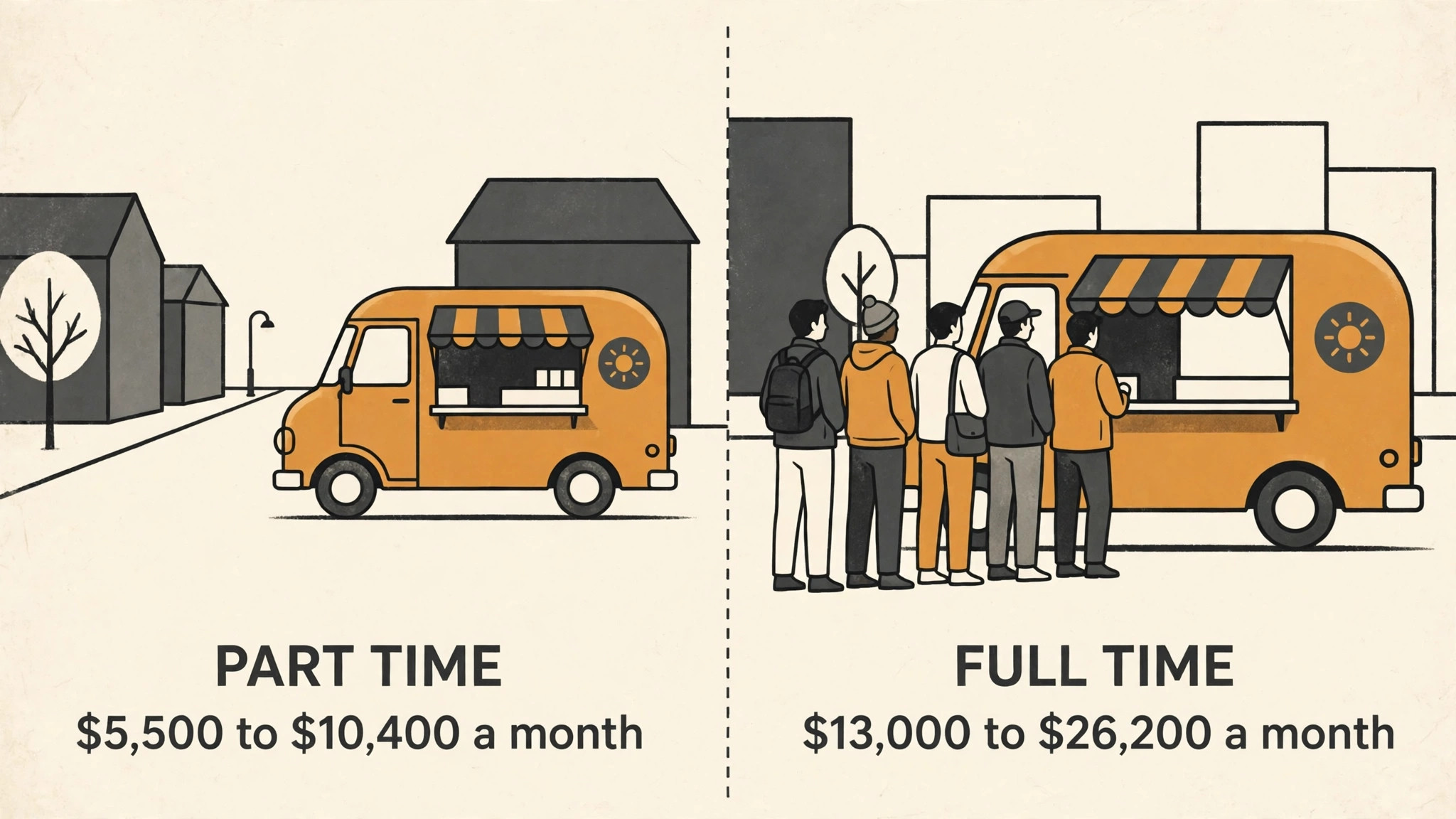
| Typical monthly total | 5,500 to 10,400 dollars | 13,000 to 26,200 dollars | 18,000 to 36,000 dollars |
Fuel and maintenance, the cost of moving
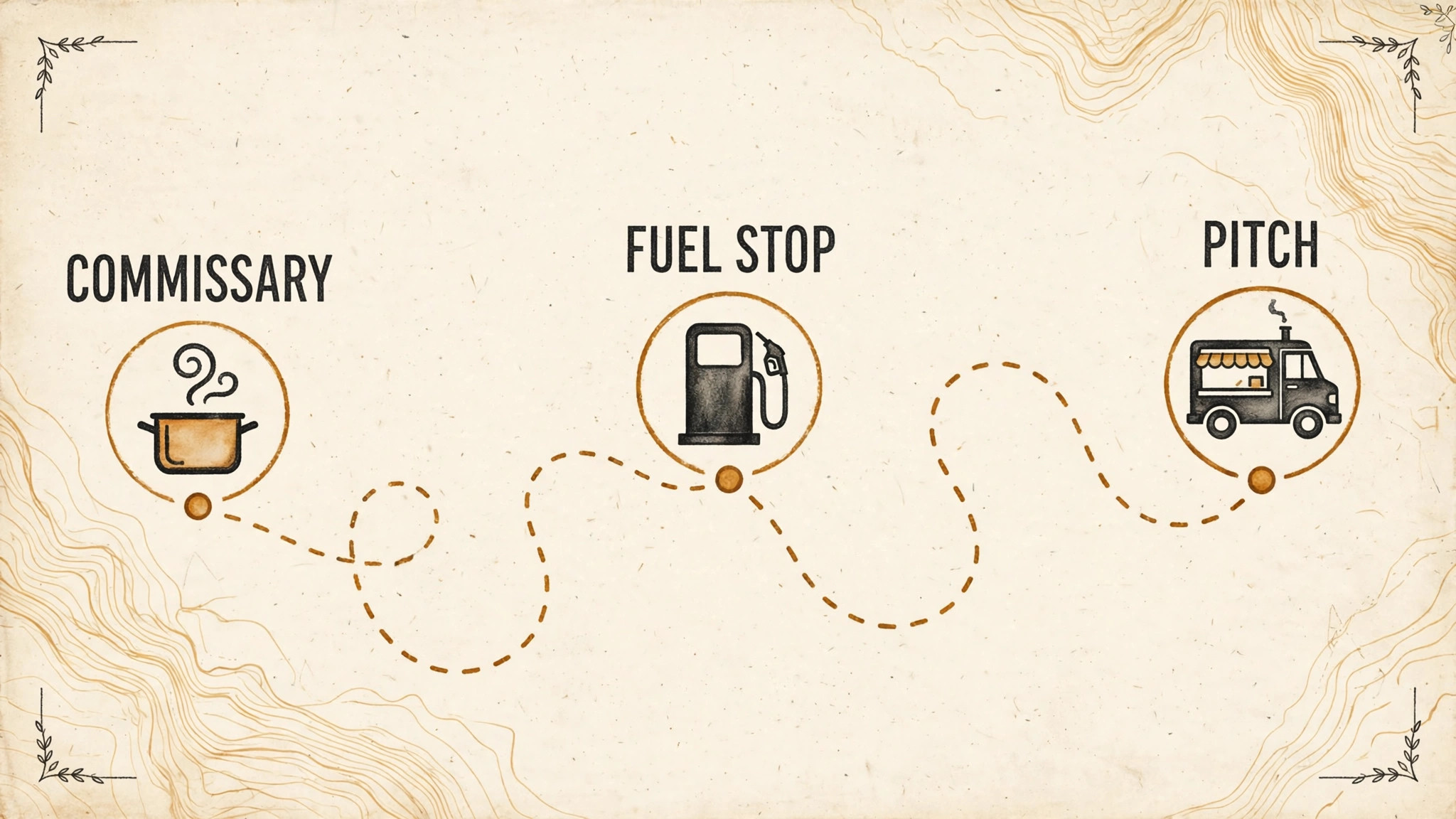
Fuel is two fuels, not one. The truck burns petrol or diesel to reach a pitch, and the generator or onboard cooking equipment burns fuel or propane to cook once you arrive. Operator guides put fuel and propane together at 200 to 800 dollars a month for lighter operations and 800 to 1,500 dollars a month for full time work, while other guides put fuel alone at 250 to 600 dollars a month and fuel plus utilities at 500 to 1,200 dollars a month. The spread is driven by three things, and each one is within your control to a degree.
Distance is the first driver. A truck that works one regular pitch five days a week, with a short run to and from the commissary, uses far less fuel than a truck that chases events across a county. A truck that reports 7 to 10 miles per gallon, a figure cited in operator guides, turns a 40 mile round trip into 4 to 6 gallons before the generator has run for a minute. Over 20 trading days, that single route choice can be worth several hundred dollars a month.
Cooking method is the second driver. A truck that grills and fries all day burns more propane than a truck that holds prepped food hot and assembles to order. A truck that runs refrigeration, lighting and a generator through a long summer service burns more again. Ask other operators with a similar menu what they spend on propane per week, because a generic national average will not reflect your equipment.
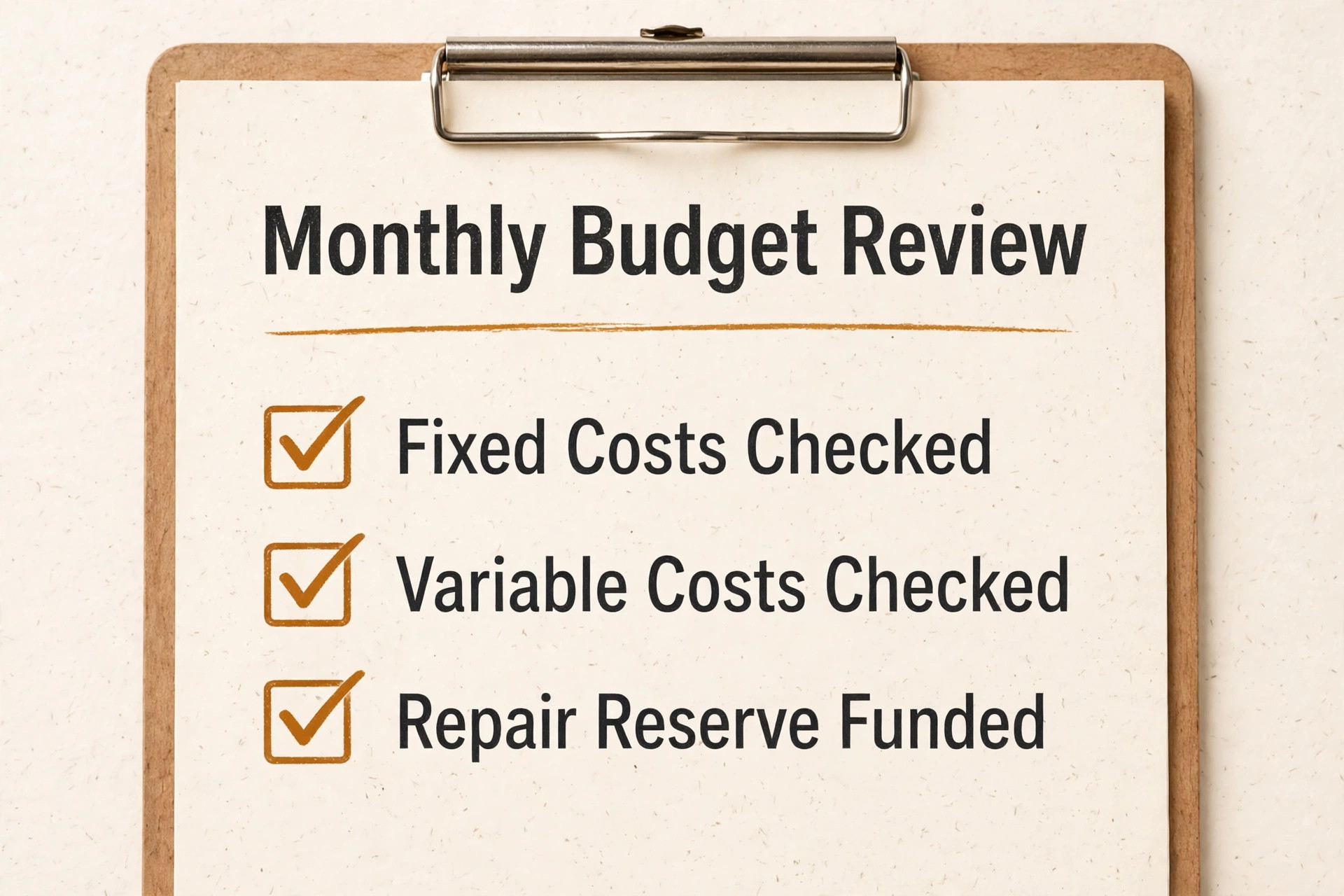
Maintenance follows the same logic. Routine servicing, oil, filters, tyres, brakes, refrigeration checks and fire suppression inspections are predictable, and guides put the monthly reserve at 200 to 500 dollars for lighter use and 400 to 1,000 dollars for full time use, with some guides extending the top end to 1,500 dollars for heavy equipment. What breaks a budget is not the oil change. It is the month when refrigeration fails during a heatwave, or a generator dies on a festival morning. Keep a separate repair reserve, not just a maintenance line, and fund it in good months.
A truck that earns well in summer and has no reserve in winter is a seasonal business pretending to be a year round one.
Commissary fees, the rent you cannot skip
Most health departments require a food truck to work from a licensed commissary, a commercial kitchen used for food preparation, cleaning, storage and overnight parking. A home kitchen is not a substitute, and operating without a commissary agreement can lead to fines, shutdowns or loss of a licence. That rule is why commissary rent is a fixed monthly cost for almost every legal truck, and why it should be settled before a truck is bought.
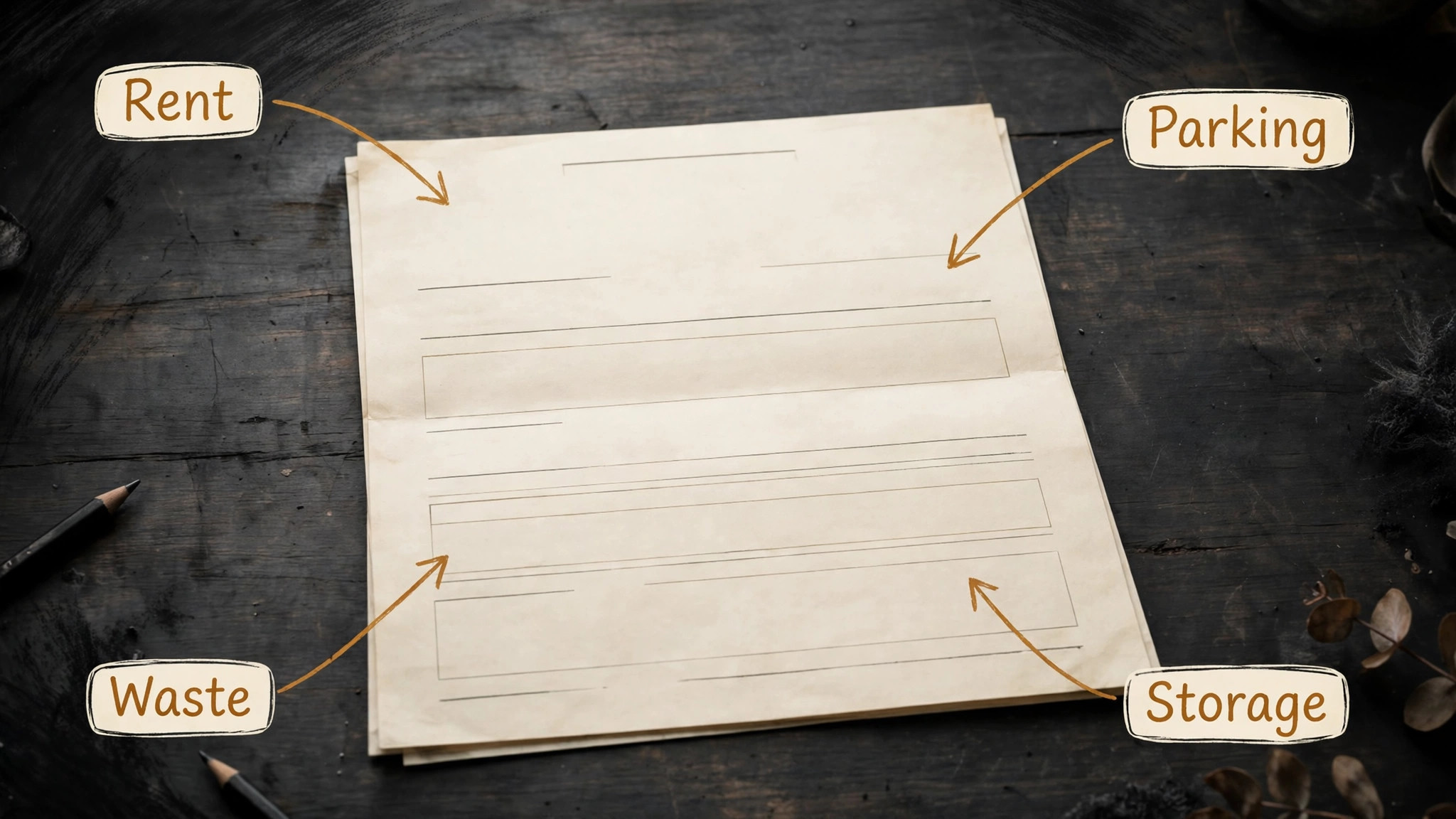
Published ranges cluster tightly, which makes this one of the more reliable lines to budget. Operator guides and commissary listings put standard monthly rent at 400 to 1,500 dollars a month, with major city averages at 600 to 900 dollars a month for a standard truck operation. Full service commissaries that include parking, waste disposal, water and storage are listed at 1,000 to 2,500 dollars a month, while shared kitchens rented by the hour are listed at 10 to 50 dollars an hour. Some commissaries also add a per vehicle parking fee of 150 to 400 dollars a month on top of kitchen time, so the headline rent is not always the full commissary bill.
What drives the price is location, hours and what is included. A commissary in Los Angeles or San Francisco sits at the top of the range, and California guides put commissary rent at 600 to 2,000 dollars a month, rising to 1,500 to 2,500 dollars a month in the most expensive cities. A commissary in a smaller city sits near the bottom. Hours matter just as much, since a truck that needs a dedicated bay for eight hours pays more than one that preps for two.
Before signing, confirm five points in writing. Confirm whether overnight parking is included, and whether the fee covers it or adds it separately. Confirm which hours your bay is actually available, because a kitchen that is free only when you need to be trading is useless. Confirm whether waste, grease disposal and water are included. Confirm whether the facility allows your cooking method, since some kitchens prohibit frying or smoke producing cooking. Confirm what happens to your agreement if the facility loses its health permit, because your own permit depends on it.
The cost of running a food truck monthly rises fastest when a commissary is chosen on price alone and then fails on access. A cheap kitchen 40 miles from your pitches adds fuel, adds driving time and adds the risk of a missed prep window. A slightly more expensive kitchen near your route can be the cheaper option once fuel and time are counted, and it is the option that keeps a truck trading on the days when prep runs late.
Permits and insurance, amortised monthly
Permits are the most variable line in the whole budget, and the variation is almost entirely about place. In smaller cities and suburban areas, operator guides put mobile food vendor permits at 200 to 600 dollars for the permit itself, with processing in days. In Los Angeles, New York and Chicago, the same guides put permits at 1,000 to 3,000 dollars, with waitlists that can stretch for months. First year permit and inspection costs across jurisdictions are reported at 1,000 to 10,000 dollars, depending on how many service zones a truck covers and how complex the local rules are.
New York City shows why a single national figure misleads. The city publishes a full term two year mobile food vending licence fee of 50 dollars, a food protection course fee of 53 dollars, and a full term two year permit fee of 200 dollars for a unit that prepares food on site, or 75 dollars for a unit that sells prepackaged food. Those official figures are small. The real cost in New York is access, because licences are capped, waiting lists exist, and operators report buying an existing licence on the secondary market for far more than the official fee.
A budget built only on official fees would miss that entirely, so always price both the fee and the wait.
To turn annual and two year fees into a monthly figure, spread each fee over its validity period and add the lines together. A health permit of 200 to 500 dollars a year becomes roughly 17 to 42 dollars a month. A fire safety permit of 100 to 500 dollars a year becomes roughly 8 to 42 dollars a month. A business licence, a mobile vendor licence and a parking permit each add their own small monthly share. Operator guides that do this spreading exercise land at 100 to 300 dollars a month for part time trucks and 200 to 500 dollars a month for full time trucks, and those ranges are the ones used in the table above.
They are not the fee itself. They are the fee divided by time, plus the smaller renewals that arrive through the year. Spread this way, the cost of running a food truck monthly for permits becomes a small, predictable line rather than a surprise bill.
Insurance is steadier, and it should be budgeted monthly even when it is paid annually. Operator guides put commercial auto and general liability insurance at 200 to 500 dollars a month, or roughly 2,000 to 6,000 dollars a year, with full time trucks at 400 to 700 dollars a month and California trucks at 400 to 700 dollars a month or 3,000 to 6,000 dollars a year. The drivers are vehicle value, equipment value, coverage limits, driving history and whether the policy covers events, catering and multiple locations.
A policy that covers only a single regular pitch will cost less than one that covers festivals across a state, but it will also leave a gap on the day you accept a festival booking outside its terms.
Staff costs, the line that decides your hours
Labour is the second largest cost after food for most trucks, and it is the line that decides how many days you can trade without burning out. Operator guides put part time help at 1,500 to 3,000 dollars a month, full time help at 4,000 to 8,000 dollars a month, and small teams at 3,000 to 5,000 dollars a month including payroll taxes and workers compensation for a lean team, rising to 6,000 to 12,000 dollars a month for a team serving higher volumes. Some guides extend the range to 15,000 dollars a month for larger operations with full teams, but that top end belongs to trucks running long hours at high volume, not to a new two person operation.
The cost of running a food truck monthly changes shape when the owner stops counting their own hours as free. A solo operator working 60 to 80 hours a week, a figure operator guides cite repeatedly, is paying for labour with time and health, not with wages. That model can look profitable on paper while the owner earns less per hour than a hired cook. A fairer test is to price owner hours at the same rate you would pay a replacement, then see whether the truck still makes money. If it does not, the business needs higher prices, higher volume or fewer trading days, not more unpaid hours.
Wages are only part of the staff bill. Payroll taxes, workers compensation, food handler certification, training time and the cost of covering sick days all sit on top of the hourly rate. A staff member paid 18 dollars an hour for 30 hours a week costs roughly 2,340 dollars a month in wages alone, before payroll taxes and workers compensation push the true cost higher. Two staff members on that pattern, plus a busy Saturday extra, can move a truck from the solo column of the table to the team column in a single month. That is normal at higher volumes, but it must be matched by sales, not by hope.
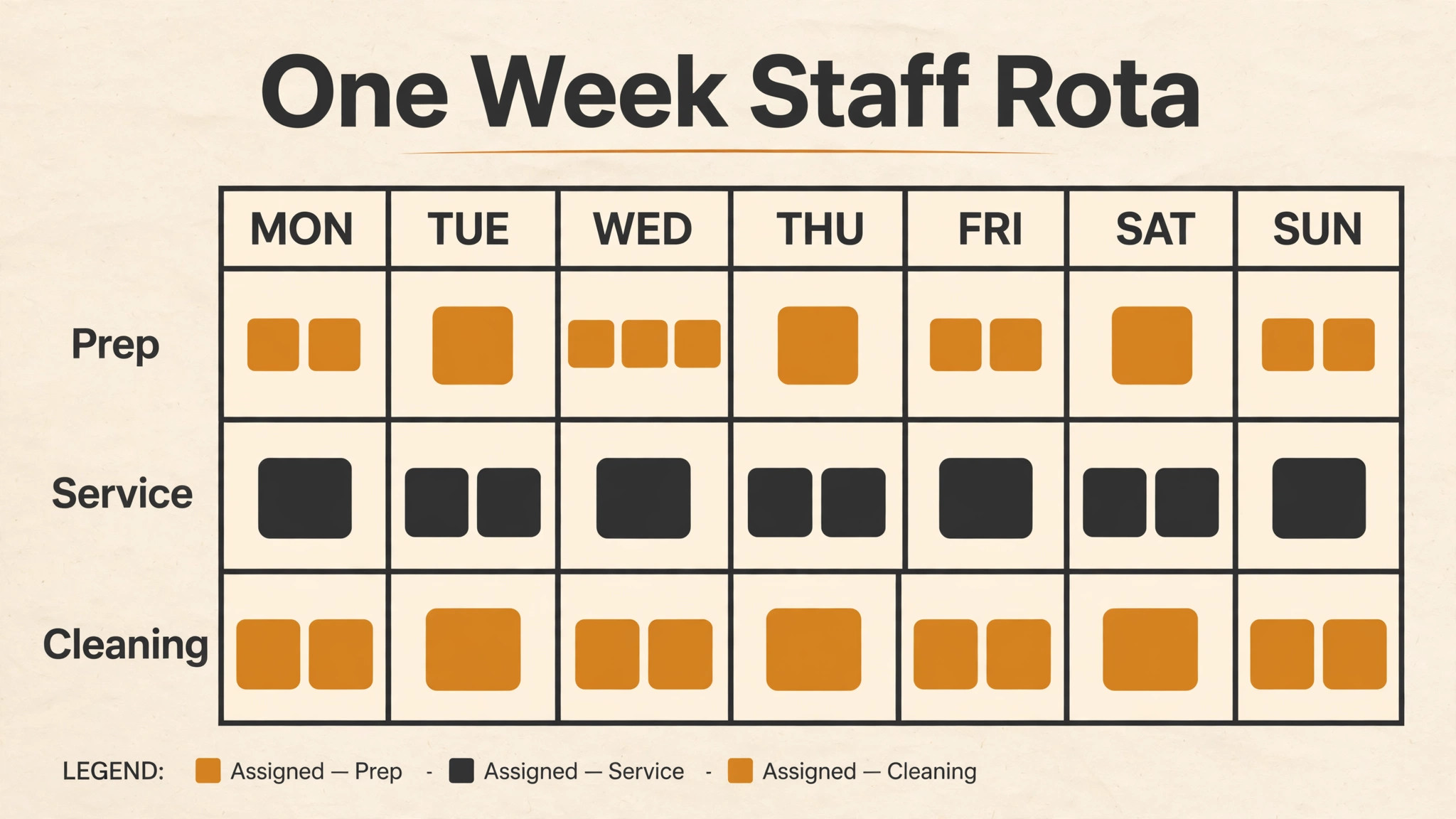
Staffing models that work in practice tend to follow a pattern. Start solo or with one part time helper, and add hours only when a specific shift repeatedly sells out or leaves a queue that costs sales. Cross train every hire on till, prep and cleaning, so a sick day does not close the truck. Write a simple rota that covers prep, service, cleaning and commissary time, not just service hours, because prep and cleaning are paid hours too. Keep a list of trained casual staff for events, rather than hiring a permanent team for a seasonal peak that lasts six weeks.
Food cost is usually expressed as a share of sales, not as a fixed monthly sum, because it moves with every plate sold. Operator guides agree on the target with unusual consistency. Food and ingredient costs should sit at 28 to 35 percent of sales for a general food truck, with successful operations targeting 28 to 30 percent. Coffee and beverage trucks run lower, at 15 to 20 percent. Dessert trucks run at 15 to 25 percent. Taco and Mexican trucks run at 25 to 30 percent. Barbecue and meat heavy trucks run higher, at 35 to 40 percent, and they need higher menu prices to carry that weight.
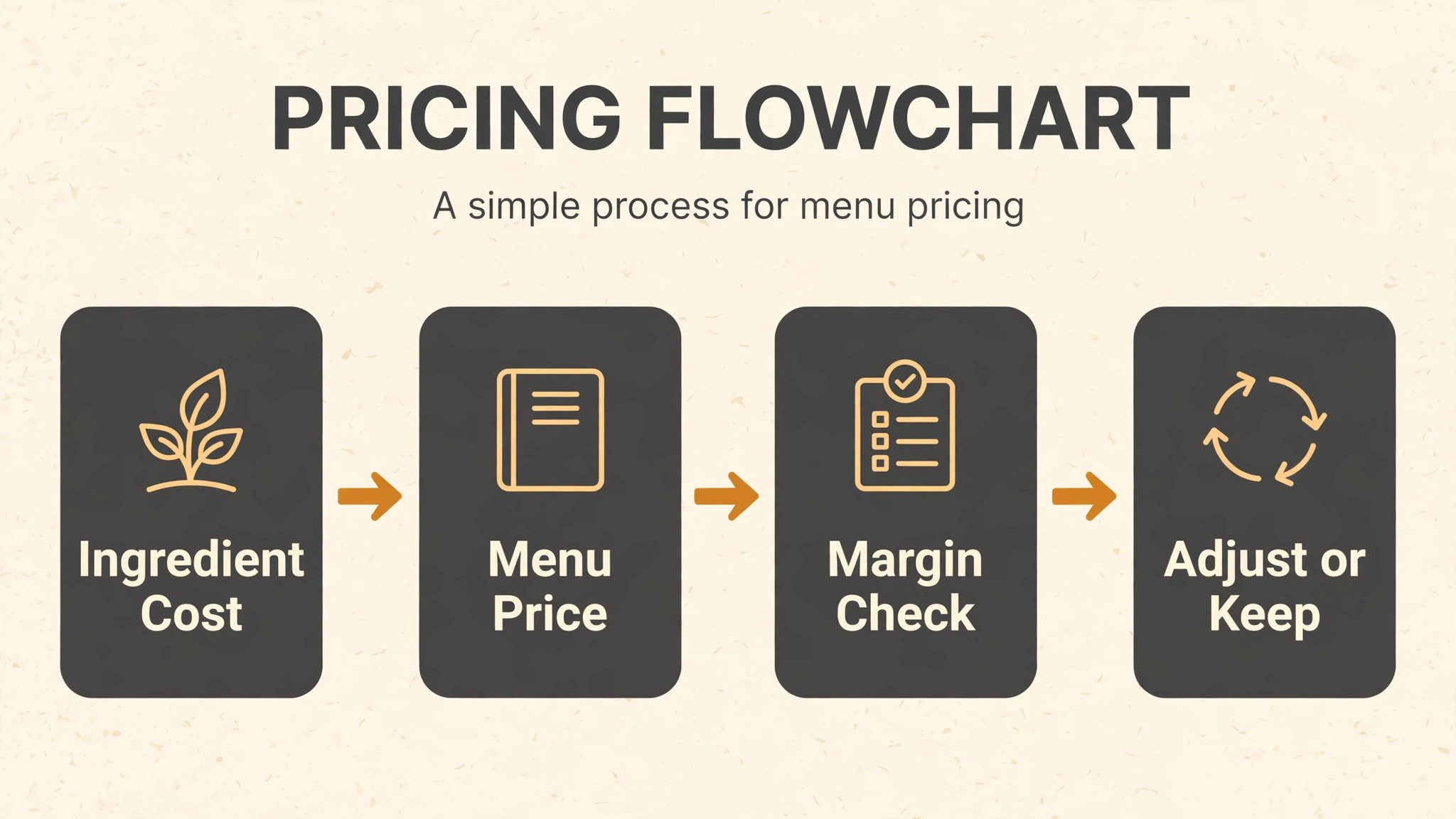
The calculation is simple, and it should be done per dish, not just per month. Divide the ingredient cost of one serving by its menu price, then multiply by 100. A burrito with 2.80 dollars of ingredients sold at 9.50 dollars has a food cost of about 29.5 percent, comfortably inside the healthy range. The same burrito sold at 7 dollars has a food cost of 40 percent, which eats margin even though the till looks busy. A monthly average can hide that problem, because a high margin drink sold alongside a low margin main can make the month look healthy while the main dish loses money on its own.
Four habits keep food cost inside its target range. First, build the menu around versatile ingredients that appear in several dishes, so a slow seller does not leave a fridge full of stock that spoils. Second, standardise portions with scoops, scales and pre portioned prep, because portion drift is the quietest form of food cost rise. Third, track waste daily, not monthly, and record what was thrown away and why, so a pattern such as overproduction on Sundays shows up in a week, not in a quarterly surprise. Fourth, reprice when supplier prices move, rather than absorbing three supplier rises and then making one large jump that shocks regular customers.
Each habit protects the cost of running a food truck monthly by keeping waste and portion drift under control.
Margin notes, what is left after the monthly bill
Margin is where this guide earns its keep, because a monthly cost table without margin notes tells you what you spend but not whether the business works. Start with gross margin, which is sales minus food and packaging costs. On a truck with a 30 percent food cost and packaging at roughly 5 percent of sales, gross margin is about 65 percent. That figure looks comfortable until labour, fuel, commissary, insurance, permits, maintenance, card fees and marketing are taken out.
Operator guides put net profit margin for food trucks at 6 to 9 percent in typical operations, rising to 6 to 15 percent in well run operations, with top performers reaching higher figures through tight control rather than higher prices alone.
Worked through on real numbers, the pattern becomes clear. Take a full time truck doing 25,000 dollars a month in sales, a figure used in operator breakdowns. Food at 28 to 35 percent is 7,000 to 8,750 dollars. Labour with one employee is 5,000 to 7,500 dollars. Commissary and overhead is 1,500 to 3,000 dollars. Insurance and permits are 300 to 500 dollars. Fuel is 400 to 1,000 dollars. Those lines leave roughly 4,750 to 10,800 dollars before loan payments and owner pay. This example shows why the cost of running a food truck monthly must be read beside sales, not alone.
Three margin levers matter more than any other. The first lever is average spend per customer. Adding a drink or a side raises sales without raising the fixed costs of the day, and drinks in particular carry a low food cost, which lifts overall margin. The second lever is waste. Every point of food cost saved by portion control goes straight to margin. The third lever is trading days. A truck that trades an extra day spreads fixed costs over more sales, provided the extra day actually brings customers.
Watch for margin traps that look like growth. A festival that charges a large pitch fee, requires extra staff and sells at a discount can produce high sales and low profit. A catering job that requires a long drive, extra prep and hired help can do the same. Price each event on its own lines, including pitch fee, extra labour, extra fuel and packaging, and decline the ones that do not clear your margin target, even when the headline sales figure looks exciting.
A monthly budget worksheet you can copy
Copy the worksheet below, fill in your own figures, and total the fixed and variable rows separately. That split shows what happens when sales rise, because variable costs will rise with them while fixed costs stay put.
| Line | Your monthly figure | Fixed or variable |
|---|---|---|
| Commissary rent and parking | Fixed | |
| Truck loan or rental payment | Fixed | |
| Insurance, spread monthly | Fixed | |
| Permits and licences, spread monthly | Fixed | |
| Phone, point of sale and software | Fixed | |
| Food and ingredients at expected sales | Variable | |
| Packaging and disposables | Variable | |
| Labour, including payroll taxes | Variable with hours | |
| Fuel, truck and generator | Variable with miles | |
| Maintenance and repairs reserve | Lumpy, budget monthly | |
| Card processing fees at expected sales | Variable | |
| Pitch fees and marketing | Mixed | |
| Total monthly cost |
Once the worksheet is filled in, work out three numbers from it. First, divide total monthly cost by expected trading days to get the daily sales needed to break even. Second, divide food plus packaging cost by expected sales to check your food cost share against the 28 to 35 percent target. Third, subtract total monthly cost and loan payment from expected sales to see what is left for owner pay and tax. If that third number is negative at realistic sales, change the model before you change the menu.
Mistakes that inflate the monthly bill
The second mistake is pricing from ingredient cost alone. A dish priced at three times its ingredient cost looks generous until labour, fuel, commissary, card fees and packaging are added, and then it is barely breaking even. Price from the full monthly worksheet, not from a single recipe card.
The third mistake is adding staff before sales justify them. An extra pair of hands speeds service, but it also adds wages, payroll taxes and training time. Add hours when queues cost sales, not when service merely feels busy for an hour at lunch.
The fourth mistake is chasing every event. A distant festival with a high pitch fee, a long drive and a discounted menu can produce a busy weekend and a loss. Price each event on its own lines, and keep a list of pitches that reliably clear your margin target.
The fifth mistake is treating the owner as free labour. A truck that only works because the owner works 80 hours a week without pay is not a profitable truck. It is a job with no days off, and it will break before the truck does.
For related reading, see how a food business starts in how to start a food truck business with AI, compare the wider restaurant toolkit in best AI tools for restaurants, plan catering style work in best AI tools for catering businesses, keep the books straight with best accounting software for small business, and compare a different mobile food model in cost of running a food delivery side business. For budgeting tools, best AI budgeting tools covers options that help track the monthly lines in this guide.
Frequently Asked Questions
How much does it cost to run a food truck each month?
A part time truck typically costs 5,500 to 10,400 dollars a month, and a full time truck typically costs 13,000 to 26,200 dollars a month, before loan payments and owner pay. The exact figure depends on trading days, city, menu and staffing, so use the worksheet in this guide with your own lines rather than adopting a national average.
What is the biggest monthly cost for a food truck?
Food is usually the largest single cost, at 28 to 35 percent of sales, followed closely by labour at roughly 20 to 35 percent depending on staffing. Together they take about half to two thirds of sales on a healthy truck, which is why menu pricing must cover both, not ingredients alone.
How much is commissary rent for a food truck?
Standard commissary rent is typically 400 to 1,500 dollars a month, with major city averages at 600 to 900 dollars a month. Full service commissaries that include parking, waste disposal, water and storage run 1,000 to 2,500 dollars a month, and some add a parking fee of 150 to 400 dollars a month on top of kitchen time.
Do food trucks need a commissary?
In most places, yes. Most health departments require a truck to work from a licensed commissary for preparation, cleaning, storage and overnight parking, and a home kitchen is not an approved substitute. Confirm the rule with your local health department before signing a lease or buying a truck, because operating without an agreement can lead to fines or shutdown.
What food cost percentage should a food truck target?
Target 28 to 35 percent of sales for a general food truck, with 28 to 30 percent as a healthy aim for most operations. Coffee and beverage trucks target lower, at 15 to 20 percent, while barbecue and meat heavy trucks run higher, at 35 to 40 percent, and need higher menu prices to carry that cost.
How much sales does a food truck need each day to break even?
Operator guides put break even sales at 400 to 600 dollars a day for most trucks, rising to 800 to 1,500 dollars a day for full time operators aiming at real profit. Work out your own figure by dividing your total monthly cost by trading days, because a truck with higher food or labour costs needs higher daily sales than a guide average assumes.
Run the Numbers Before You Roll Out
The cost of running a food truck monthly is not a mystery once it is broken into lines, and it is not a single number either. A part time truck can run for roughly 5,500 to 10,400 dollars a month. A full time truck needs roughly 13,000 to 26,200 dollars a month. A team truck needs more again, and it earns it only when sales, staffing and pitches move together. Food at 28 to 35 percent of sales and labour near a quarter to a third of sales decide whether those totals leave a profit, and commissary rent, fuel, insurance, permits and maintenance decide whether a slow month is survivable.
Build your worksheet this week, price your menu from the full monthly total rather than from ingredients alone, and fund a repair reserve before you need it. Choose pitches that clear your margin target, keep owner hours in the labour line, and review the numbers on the first day of each month. That routine turns a surprising monthly bill into a planned cost, and it leaves the money you save for the work that actually grows the truck, better food, faster service and regular customers who come back because the truck is there, week after week.