
For most service businesses that rarely handle cash, an online first account with a clean accounting feed is the right verdict. For cash heavy businesses, it is the wrong one, because cash deposit access and a lending relationship matter more than a low headline fee. That split is the whole decision in one paragraph, and this guide shows how to choose a business bank account small business owners can defend with numbers, from fee types and cash handling to integrations, branches, and the switching plan that avoids missed payments.
A business bank account is not a nicer version of a personal account. It separates business money from personal money, which protects your records at tax time, supports liability separation for formal entities, and gives customers and suppliers a professional payment trail. Mixing business and personal money in one account creates a reconciliation burden that grows every month, and it forces an accountant to untangle personal spending from business spending at year end. A separate account costs a small amount of setup effort and repays it for the entire life of the business.
The most expensive mistake is choosing on the headline alone. A welcome bonus, a waived first year fee, or a advertised rate can hide a transaction cap, a cash deposit charge, or a broken accounting feed that costs hours every month. The right comparison starts with how your business actually moves money, then matches an account shape to that pattern, then reads the full fee schedule for the account you shortlist.
Fees and terms change often, so treat any fee figure you see in a guide as a prompt to check the provider own current terms, not as a fact to rely on. This guide therefore compares fee types and what to check, rather than quoting figures that may already be out of date.
How to Choose a Business Bank Account Small Business Owners Should Start With
Start with three questions and answer them from your own records, not from a provider marketing page. How much cash do you deposit in a typical month, and how often. How many transactions do you make in a typical month, counting deposits, withdrawals, card settlements, and transfers together. What software must the account feed cleanly, and who else needs access, such as a bookkeeper or a payroll service. Those three answers eliminate most accounts immediately, which is the point. A shortlist of two or three accounts that fit your actual pattern beats a long list of accounts with attractive headlines.
Next, decide which account shape fits. A business checking account handles daily deposits and payments and is the core account for most small businesses. A business savings account holds reserves, such as tax money and a slow season buffer, separate from operating cash. A merchant or card settlement arrangement handles card payments and settlement timing, and it may sit with the bank or with a separate payment provider.
Many small businesses need checking plus savings, and only some need a separate merchant arrangement at the start. Adding accounts you do not need creates fees and admin for no benefit, while missing a savings account for tax money creates a cash crisis that feels like a banking problem but is really a separation problem.
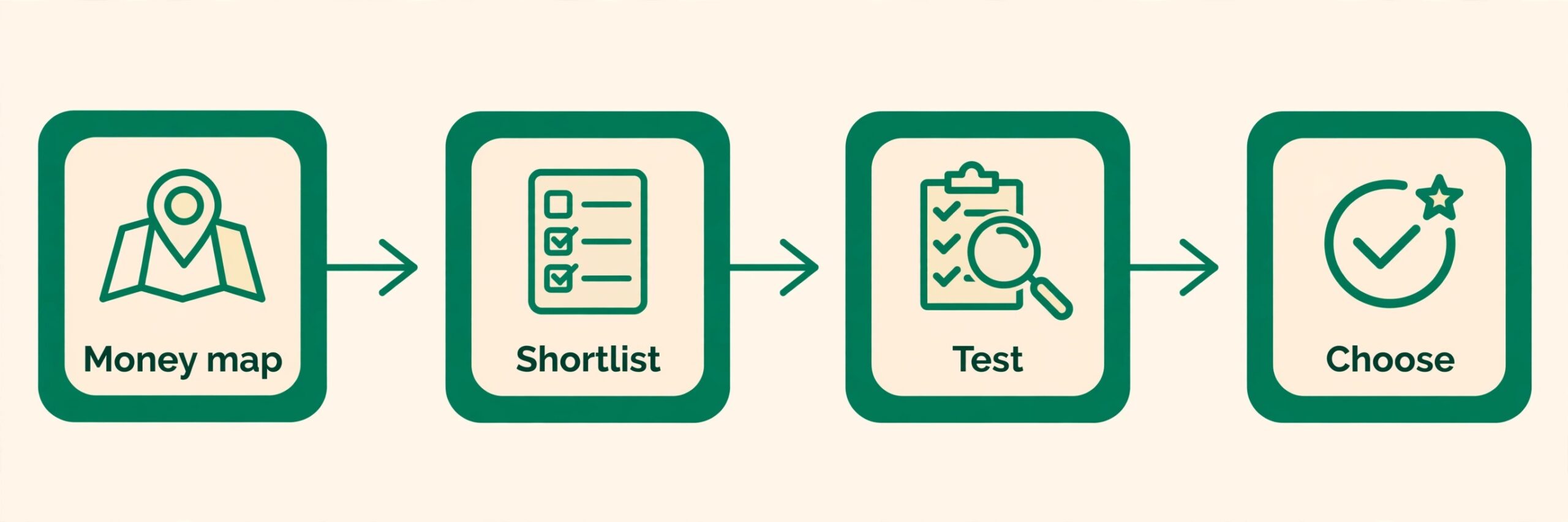
Finally, test the account before you commit fully. Open the account, connect the accounting feed, run a real invoice payment and a real supplier payment through it, and confirm the transactions appear correctly categorised. Check that statements download cleanly, that your bookkeeper can access what they need, and that support answers a test question in a useful way. A provider that fails those small tests before you depend on it will fail larger tests later. Keep the old account open during testing, so the new account has to earn the switch instead of inheriting it by default.
Separate Business Money From Personal Money First
Separation is the foundation, and it matters differently by entity type. It is also the first lesson in how to choose a business bank account small business owners will not regret. Sole proprietors face tax record problems when personal and business money mix, because every transaction must be classified by memory at year end. Limited liability companies and corporations face a stronger issue, because mixing funds can weaken the liability separation the entity exists to provide. Partnerships face a third issue, because multiple owners need clear records of who put money in and who took money out. In every case, a dedicated business account with its own card and its own statements turns a forensic exercise into a routine review.
Open a second savings account for tax money on the same day you open checking, and treat transfers to it as a fixed habit. The exact share to set aside depends on your tax situation, so confirm it with your accountant rather than copying a figure from a guide. Money moved to a tax account on receipt is money that will be there when the bill arrives. Money left in operating cash gets spent, and the tax bill then arrives as a shock.
Give your accountant or bookkeeper view only access where the provider offers it, and agree on what they will check each month. View access lets them reconcile without asking you to export statements, and it creates a second pair of eyes on unusual transactions. Set clear rules for who can move money, especially in partnerships, because unclear authority creates disputes that no fee saving can justify.
Map How Your Business Actually Moves Money
Before comparing providers, build a one month money map from your own records. Count incoming payments by method, such as card, bank transfer, check, and cash. Count outgoing payments by type, such as supplier payments, payroll, rent, and subscriptions. Note the largest single payment, the smallest frequent payment, and any seasonal spike, such as a holiday rush or a summer peak. That map is the specification for the account, and any provider that cannot handle your top three payment methods smoothly is eliminated, however attractive its headline looks.
Pay special attention to volume and timing, because the money map is the specification in how to choose a business bank account small business owners can defend with numbers. A consultant who invoices a handful of clients a month and is paid by transfer needs a very different account from a retailer processing hundreds of small card payments a day. Transaction caps, which many business checking accounts apply as a monthly allowance of free items, can become the largest banking cost for a high volume business if every item above the cap carries a charge.
Check how your provider counts items, because deposits, withdrawals, transfers, and card settlements may all count toward the same cap, or may be counted separately. Count your own volume honestly, including growth you expect in the next year, and choose a cap with headroom, not a cap you already exceed.
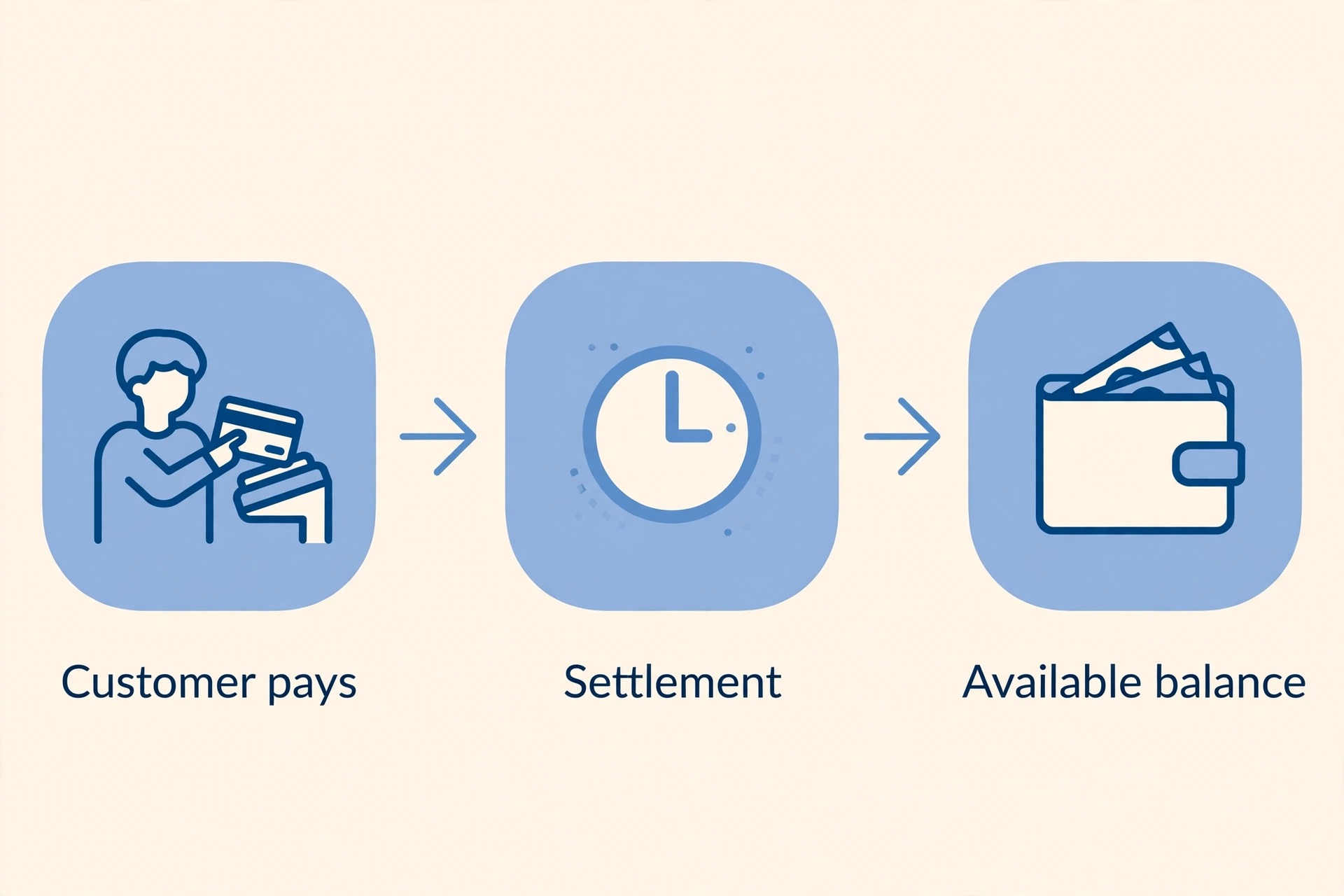
Cash flow timing matters as much as volume. Card settlement timing affects when sale money becomes available. Check clearing times affect when a customer check can be spent. Payroll funding deadlines affect when money must be in the account before wages go out. A business that pays staff weekly and receives card settlements slowly needs a buffer and a clear understanding of availability timing, or it will face shortfalls that look like a sales problem but are really a timing problem. Ask each shortlisted provider, in writing, how settlement and availability work for your main payment methods, and keep the answer with the account records.
The Fee Types That Quietly Cost the Most
Fee schedules reward careful reading, because the headline fee is rarely the fee that costs the most over a year. Fee reading is the unglamorous core of how to choose a business bank account small business owners can afford long term. Read the full schedule for each shortlisted account, and check current terms on the provider own site before opening anything, since terms change and guides go out of date. The fee types below are the ones to compare, with the question to ask about each one.
Monthly maintenance is the fee for keeping the account open, and many providers waive it when a condition is met, such as a minimum balance, a qualifying deposit relationship, or a level of activity. The right question is not whether a fee exists, but whether your business meets the waiver condition in a normal month, including slow months. A waiver that depends on a balance you only hold in peak season is not a waiver. It is a seasonal fee dressed as a benefit. Online first providers often charge no monthly fee at all, which suits businesses that value simplicity, but the absence of a monthly fee never justifies a poor fit on cash or integrations.
Transaction charges apply when monthly activity exceeds a free allowance, and they reward an honest volume count. Ask how items are counted, what counts as one item, and what the charge is per item above the allowance. Also ask about charges for specific actions you use often, such as wire transfers, stop payments, returned items, and overdrafts. A single returned payment or overdraft charge can exceed a month of maintenance fees, so the question is not only the price, but the controls available, such as low balance alerts and overdraft protection settings, that prevent the charge happening at all.
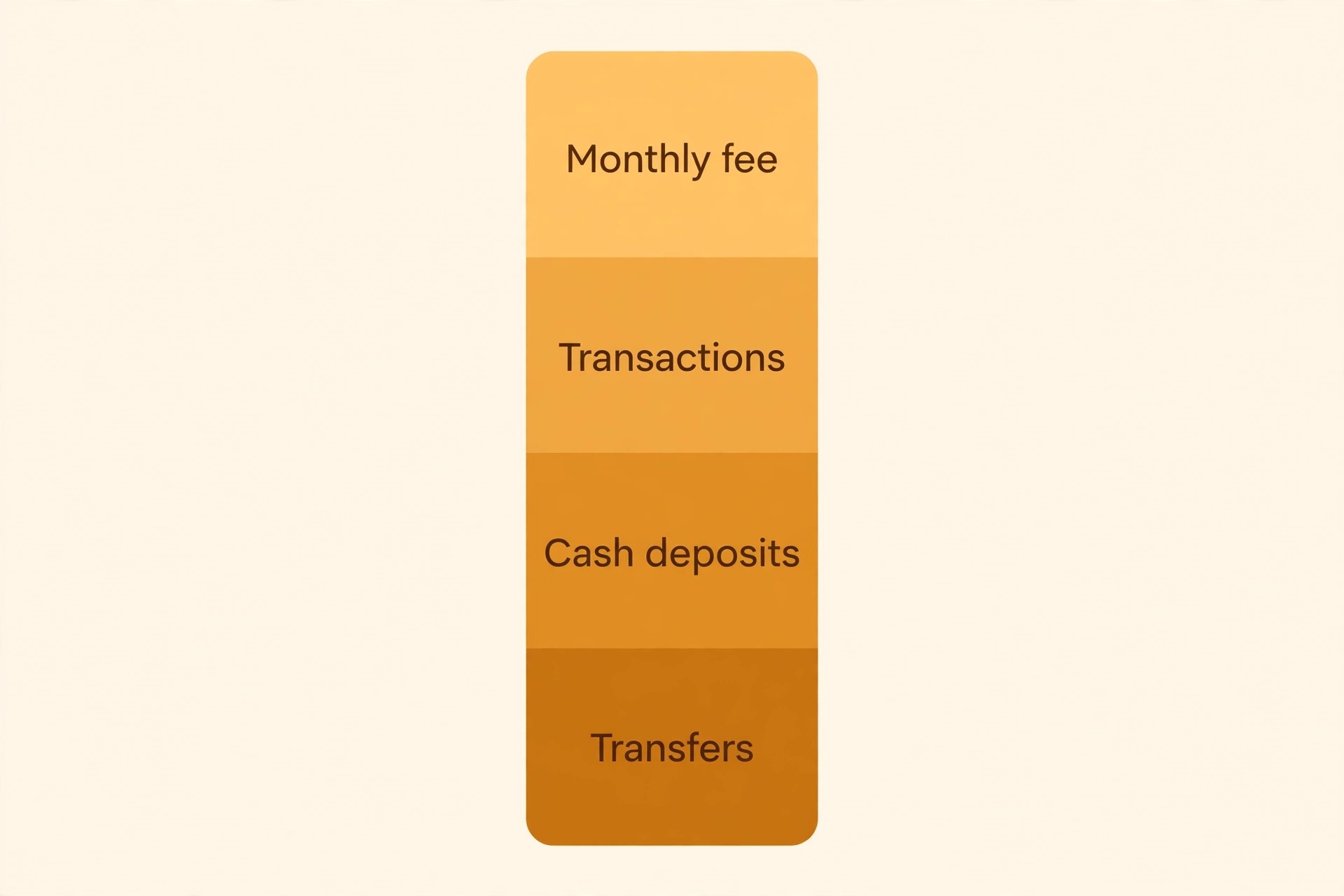
Cash handling charges matter most to cash businesses and least to digital ones, and they are covered in detail in the next section. Card and payment charges sit partly with the bank and partly with the payment provider, so compare the combined cost of receiving a card payment, not just the bank account fee in isolation. ATM charges matter when owners or staff withdraw cash away from the provider network, and foreign transaction charges matter for businesses that buy or sell across borders. List the fee types you will actually incur in a normal month, estimate them from your money map, and compare that total across providers, not the headline fee alone.
Cash Deposits. The Decider for Cash Heavy Businesses
Cash handling decides the account for restaurants, retailers, tradespeople, and any business where customers pay notes and coins. Cash access is the decider in how to choose a business bank account small business owners with tills and counters must get right. Branch based banks and credit unions usually include a monthly cash deposit allowance, with a charge per amount above it, and they provide a branch or night drop where cash can be deposited safely. Online only providers often cannot accept cash directly at all, or route cash through a retail network for a fee, which adds cost and delay to every deposit. If your business deposits cash weekly, that difference alone can outweigh every other feature.
Test cash handling against your real pattern, not against a generic assumption. How much cash do you deposit per week, and does it arrive in one large deposit or many small ones. How far is the nearest branch or deposit point, and what are its hours relative to your closing time. What happens to cash held overnight, and what insurance or safe storage does the business need in the meantime. A branch ten minutes away with evening hours fits a restaurant closing late. A deposit point an hour away does not, however low its fees look. Convenience in cash handling is not a luxury. It is a security and time cost paid on every deposit.
Consider a hybrid setup where cash volume is moderate. Some businesses run an online first account for daily operations and accounting, plus a local bank or credit union account for cash deposits and lending relationships, moving funds between them on a schedule. That setup adds one transfer to manage, but it can give the best of both shapes, low fee digital operations plus real cash access. The hybrid only works if the transfer schedule is actually followed and both accounts are reconciled monthly. A hybrid that is set up and then neglected becomes two half managed accounts, which is worse than one well managed account.
Decision Table by Business Type
This decision table is the overview proof for this guide, and the shortlist step in how to choose a business bank account small business owners can complete in an afternoon. It matches account shape to business pattern, so you can start from your type and then verify the details against current provider terms. Use it as a shortlist builder, not as a final recommendation, because individual providers differ within each shape.
| Business type | First priority | Account shape to shortlist | Watch out for |
|---|---|---|---|
| Freelancer or consultant, paid by transfer | Clean accounting feed, low monthly cost | Online first checking plus savings for tax | Transaction caps if invoice volume grows |
| Online shop, card payments dominant | Settlement timing, payment integration | Checking with strong card and shop integration | Combined card plus account cost, not headline alone |
| Restaurant or retailer, cash heavy | Cash deposit access and allowance | Branch or credit union checking plus savings | Cash charges above the allowance, deposit distance |
| Contractor, project payments and lending needs | Lending relationship, branch access | Local or community bank checking plus savings | Monthly fee waiver conditions in slow months |
| Growing team, payroll and multiple users | Payroll integration, user permissions | Checking with payroll feed and controlled access | Per user charges and authority rules |
| Seasonal business, uneven months | Reserve separation, fee waivers in slow months | Checking plus separate reserve savings | Waivers that fail in the slow season |
Read the table row for your type, then check the shortlisted shapes against your money map and the fee types above. A freelancer who starts taking cash at markets moves toward the retailer row. A retailer who moves mostly online moves toward the shop row. Business patterns change, and the account should be reviewed when the pattern changes, not only when a fee rises. A review once a year, timed with tax preparation, is enough for most small businesses, provided the monthly reconciliation stays current.
Integrations That Save Hours Every Month
An accounting feed is the integration that matters most, because it determines whether month end is an hour of review or a day of data entry. Feed quality is the daily test of how to choose a business bank account small business owners will live with every month. A clean two way feed sends transactions to your accounting software promptly and with enough detail to categorise them without guesswork. A broken feed sends duplicates, missing items, or vague descriptions that must be fixed by hand, and the time cost quickly exceeds any fee saving. Test the feed with real transactions during the trial period, and ask your bookkeeper to judge it, because they will live with it every month.
Invoicing, bill payment, and payroll funding are the next integrations to check. Some accounts include invoicing tools or connect directly to invoicing software, which shortens the path from work done to money received. Bill payment tools that schedule supplier payments and record them automatically reduce missed payments and duplicate payments. Payroll integration matters as soon as a business has staff, because payroll funding deadlines are unforgiving and a missed funding step delays wages. Check each integration against the software you already use, not against a generic list, because an integration with software you do not use is worth nothing.
Mobile tools deserve a practical test, not a feature list review. Deposit checks by phone where that is offered, approve payments, set alerts, freeze a card, and download a statement, all from the phone you actually carry. Also check support channels realistically. Digital only support suits owners comfortable with chat and email. Phone and branch support suits owners who want a person for complex transactions. Choose the support shape you will actually use under pressure, not the one that sounds modern.

Branches, Lending, and Support. When Relationships Matter
Branches still matter for specific needs, even as daily banking moves online. Cash deposits, certified payments, and complex transactions are all easier in person. A local banker who knows the business can also help when a payment is held or a fraud alert blocks a card. That help has real value, but only if the branch is reachable when you need it. Map branches against where you actually work and live.
Lending is where relationship banking earns its keep for many small businesses. A line of credit, equipment financing, a business credit card, or a government backed loan is easier to discuss where a banker can see deposit history and understand the business pattern. Local and community banks remain major originators of small business lending, and an existing deposit relationship often shortens the conversation, because the lender already holds the cash flow record. If you expect to need credit in the next two years, banking where you can borrow is a strategic choice, not a sentimental one. Ask shortlisted providers what lending they offer to businesses of your size, and what history they expect to see before an application.
Support quality shows up in failures, not in sign up. Test it before you depend on it. Call or message with a realistic question, such as a held payment, and judge the answer on accuracy and speed. Check published support hours against your working hours, because a business that works evenings needs support that covers those times, or at least a clear emergency route for blocked payments.
Opening Checklist and Documents
Opening a business account takes longer than opening a personal account, because the provider must verify the business and its owners. Prepare documents before applying, and check the provider own list, since requirements vary by entity type and jurisdiction. Commonly requested items include formation documents for companies and partnerships, a tax identification number, personal identification for owners and signers, a business address, and a description of the business activity. Sole proprietors may need a business registration or assumed name document where one applies. Having these ready prevents a stalled application that drags across weeks.
Expect questions about ownership and activity, and answer them plainly. Providers ask about owners, control persons, expected transaction volume, and source of funds as part of standard verification. Inconsistent answers slow the process more than any single missing document, so make sure all owners give the same business description and expected volume range. Agree on signers and authority before applying, because changing authority after opening usually needs fresh documents.
Fund the account with an opening deposit that meets the provider requirement, and confirm whether a minimum balance applies to fee waivers from the first month. Some accounts waive fees only after a balance is held for a full statement cycle, which means the first month may carry a fee even when the long term pattern qualifies for a waiver. Ask about that timing explicitly, and plan the opening deposit accordingly. Keep the old account open until the new account has processed a full cycle of incoming and outgoing payments successfully, so a problem in the new account does not become a cash crisis.
Switching Without Breaking Payments
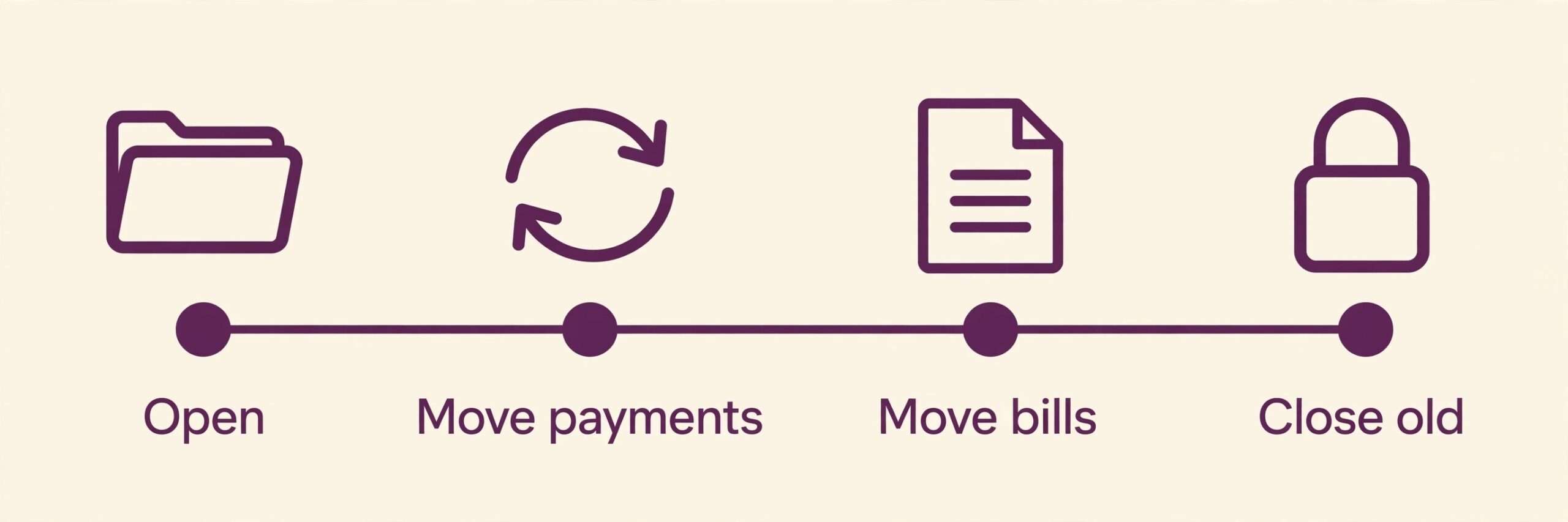
Switching accounts is a project, not a single form, and the plan matters more than the provider choice. A wave plan is the safe finish to how to choose a business bank account small business owners can switch to without missed payments. List every automatic payment in both directions before moving anything. Incoming items include customer transfers, card settlements, marketplace payouts, and recurring client payments. Outgoing items include payroll, rent, supplier payments, subscriptions, tax payments, and loan payments. Miss one item and the cost is a missed wage, a late supplier, or a failed tax payment, each of which damages trust far beyond any fee saving.
Move items in waves, not all at once. Start with a small number of low risk outgoing payments, confirm they clear from the new account, then move payroll and major suppliers, then move incoming payment details, and finally move subscriptions and smaller items. Keep both accounts funded during the overlap, and monitor both statements daily for the first month. Set a close date for the old account only after a full cycle has passed with no activity on it, and keep old statements for tax records after closing. A careful switch takes a few weeks and feels slow. A rushed switch takes a few weeks to repair and feels much worse.
Tell customers and suppliers about new payment details through a channel they already trust, and confirm receipt where the payment is large. A short message with the new account details, the effective date, and a contact for questions is enough. Warn regular payers to expect the change, because a payment details change is also a classic fraud pattern, and careful customers will rightly verify it.
Mistakes That Quietly Cost Small Businesses
The first mistake is chasing a welcome bonus while ignoring the fee schedule. A one time bonus is quickly spent, while a transaction cap or cash charge recurs every month for years. Compare the total cost over a year from your money map, not the first month benefit. A bonus that requires a balance or activity level you cannot sustain is not a benefit at all. It is a future fee with a marketing label.
The second mistake is choosing an online only account for a cash heavy business, or a branch account with a poor feed for a digital business. Both mistakes come from choosing on reputation instead of pattern. The money map prevents both, because it forces the decision to start from cash volume, transaction volume, and software needs, rather than from what other owners chose. Your pattern is the specification. Another business pattern is not.
The third mistake is keeping business and personal money mixed after opening the business account. An account that exists but is bypassed for convenience, such as paying suppliers from a personal card or receiving client payments personally, recreates the reconciliation problem the account was meant to solve. Route every business receipt and payment through the business account from day one, and reimburse personal spending properly where it happens by accident. Discipline in the first month sets the habit for the year.
The fourth mistake is never reviewing the account after opening it. Fees change, volume grows, cash patterns shift, and a provider that fitted two years ago may no longer fit. Review the account once a year against the current money map and the current fee schedule, and switch when the numbers justify it, using the wave plan above. Loyalty to a bank that no longer fits is not a virtue. It is an unexamined cost.
The Bank Account Verdict for a Small Business
The verdict from the opening still stands, with one addition. Choose the account that fits how your business moves money today, with headroom for how it will move next year, and verify the fee types, cash access, integrations, and lending options against current provider terms before opening. For digital service businesses, that usually means an online first account with a clean feed. For cash heavy businesses, it usually means a branch or credit union account with real cash access. For businesses in between, a hybrid setup can give both, provided both accounts are managed.
Start with the money map, shortlist two or three accounts, read their full fee schedules, test the feed and support with real transactions, and switch in waves while keeping the old account open. That process takes a few weeks and prevents years of quiet costs. A business bank account should be boring in the best sense, which is money arriving on time, records reconciling cleanly, and fees that match what you expected.
Frequently Asked Questions
Do I need a separate business bank account as a sole proprietor?
A separate account is strongly advisable even where it is not legally required, because it keeps business and personal money apart for tax records and for clear cash flow. Without separation, every transaction must be classified by memory at year end, and personal spending can be mistaken for business spending. A dedicated account with its own card and statements turns that annual exercise into a routine monthly review.
What fees should I compare when choosing a business account?
Compare fee types from your own money map, not just the headline monthly fee. Check monthly maintenance and its waiver conditions, transaction allowances and per item charges above them, cash deposit allowances and charges, wire and returned item charges, overdraft controls, and the combined cost of receiving card payments. Always check current terms on the provider own site before opening, because fee schedules change and guides go out of date quickly.
Can an online only bank work for a cash heavy business?
Usually not well, because many online only providers cannot accept cash directly, or route it through a retail network for a fee, which adds cost and delay to every deposit. A branch bank or credit union with a cash allowance and reachable deposit points usually fits cash heavy businesses better. A hybrid setup, with an online account for operations and a local account for cash, can work where cash volume is moderate and both accounts are managed.
How do I check whether a bank integrates with my accounting software?
Test the feed with real transactions during a trial period, and ask your bookkeeper to judge the result. A clean feed sends transactions promptly with enough detail to categorise them without guesswork. A poor feed sends duplicates or vague descriptions that must be fixed by hand. Also check invoicing, bill payment, and payroll connections against the software you already use, because an integration with software you do not use has no value.
What documents do I need to open a business bank account?
Requirements vary by provider, entity type, and jurisdiction, so check the provider own list before applying. Commonly requested items include formation documents for companies and partnerships, a tax identification number, personal identification for owners and signers, a business address, and a description of the business activity. Prepare these in advance and make sure all owners give consistent answers about the business and expected volume, because inconsistency slows verification.
How do I switch business bank accounts without missing payments?
List every automatic payment in both directions, then move items in waves, starting with low risk outgoing payments, then payroll and major suppliers, then incoming payment details, and finally subscriptions. Keep both accounts funded during the overlap, monitor both statements daily for the first month, and close the old account only after a full cycle with no activity. Tell customers and suppliers through a trusted channel and expect them to verify new details, which protects both sides.
More Reading on Stratilyze
– Best Accounting Software for Restaurants – Best Payment Software for Service Businesses – Best CRM Software for Consultants – How to Automate a Small Business with AI