

Hotels do not lose money in one dramatic moment. They lose it in small leaks that repeat every day: a phone call that goes unanswered at 11 pm, a room priced too low on a busy weekend, a guest message answered three hours late, a clean room sitting empty because housekeeping status never reached the front desk. The best AI tools for hotels in 2026 are worth buying only if they plug a specific leak. A tool that answers messages faster will not fix pricing. A pricing engine will not fix a slow turnover. This guide is organised around those leaks, not around features.
We tested the logic, not just the marketing, by asking one question for each tool: what job does it take off your team, what does it cost, and where does it break down? The 12 tools below cover booking and revenue, guest communication, daily operations and marketing. Prices are October 2026 USD figures. Where a vendor prices by room count, property size or modules and does not publish a headline rate, the guide says check checkout rather than guessing a number you cannot budget against.
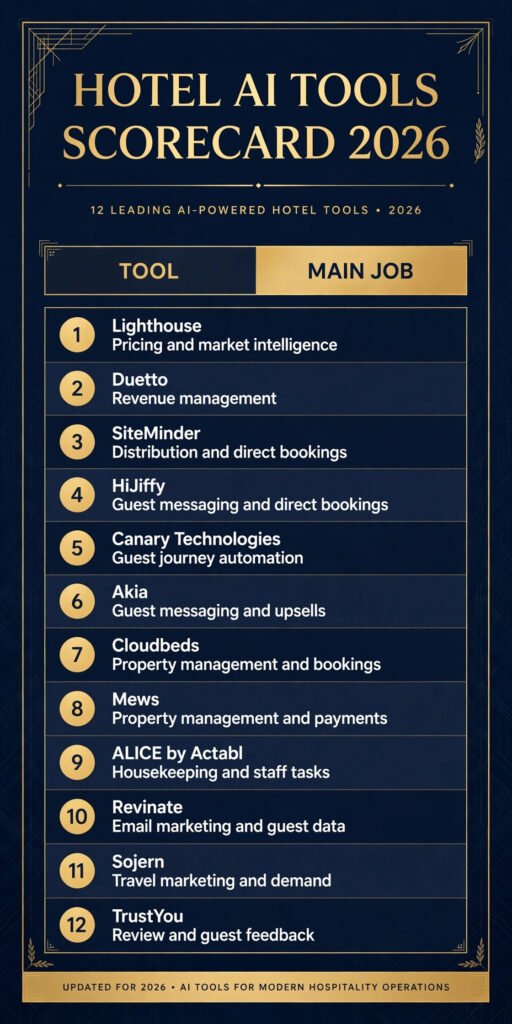
The 12 best AI tools for hotels at a glance
| Tool | Main job | Best for |
|---|---|---|
| Lighthouse | Pricing and market intelligence | Independent hotels that price by guesswork |
| Duetto | Revenue management | Larger hotels and groups with complex demand |
| SiteMinder | Distribution and direct bookings | Hotels that depend heavily on booking sites |
| HiJiffy | Guest messaging and direct bookings | Independent hotels drowning in messages |
| Canary Technologies | Guest journey automation | Hotels that want one guest system |
| Akia | Guest messaging and upsells | Hotels that want fast setup |
| Cloudbeds | Property management and bookings | Small and mid sized hotels |
| Mews | Property management and payments | Modern hotels and hostels |
| ALICE by Actabl | Housekeeping and staff tasks | Hotels where operations run on radios and paper |
| Revinate | Email marketing and guest data | Hotels that want repeat direct bookings |
| Sojern | Travel marketing and demand | Hotels that need new guests, not just better rates |
| TrustYou | Review and guest feedback | Hotels that live or die by review scores |
Start with the leak, not the tool
| Your biggest leak | Start with |
|---|---|
| Rooms priced too low on busy dates | Lighthouse, Duetto |
| Too many bookings through booking sites | SiteMinder, Revinate |
| Guest messages answered too slowly | HiJiffy, Canary Technologies, Akia |
| Rooms not ready when guests arrive | ALICE by Actabl, Cloudbeds, Mews |
| Few reviews, or bad ones left unanswered | TrustYou |
| Low occupancy in quiet weeks | Sojern, SiteMinder |
Booking and revenue: price the room right, sell it direct
1. Lighthouse
Lighthouse, formerly OTA Insight, turns competitor rates, demand signals and booking pace into pricing guidance an independent hotel can actually act on. Its rate shopping shows what comparable properties charge, its demand data flags events and busy periods, and its distribution tools help keep rates consistent across channels. For a 40 room hotel that still sets weekend rates by feel, this is the fastest way to stop leaving money on the table.
Pricing: check checkout. Lighthouse prices by property size and modules, so a small inn and a 200 room hotel will not pay the same figure.
Best for: independent hotels and small groups that want pricing intelligence without hiring a revenue manager.
Watch out for: it guides pricing, it does not run your whole operation. You still need a property system to act on the recommendations.
Try it at: https://www.mylighthouse.com
2. Duetto
Duetto is a full revenue management system built for hotels with enough demand variation to make manual pricing painful. It forecasts demand by segment, recommends rates by room type, and models cancellations and no shows. Large hotels use it to price business, leisure and group demand differently instead of applying one blanket rate to every guest.
Pricing: check checkout. Duetto is enterprise priced and quoted by property and scope.
Best for: larger hotels, resorts and groups where room type level pricing moves real revenue.
Watch out for: setup takes time and clean historical data. A hotel with messy past records will get weaker forecasts until the data improves.
Try it at: https://www.duettocloud.com
3. SiteMinder
SiteMinder connects a hotel to booking sites, metasearch and its own booking engine from one place. When a room sells on one channel, availability updates everywhere, which cuts overbookings and double bookings. Its booking engine also gives direct guests a clean path to book without paying a commission on every stay.
Pricing: check checkout. SiteMinder prices by plan and property size.
Best for: hotels that rely on online travel agencies and want more direct bookings without managing five separate tools.
Watch out for: distribution alone does not fill rooms. If demand is low, you still need marketing, which is where a tool like Sojern comes in.
Try it at: https://www.siteminder.com
Guest communication: answer fast, in every channel
4. HiJiffy
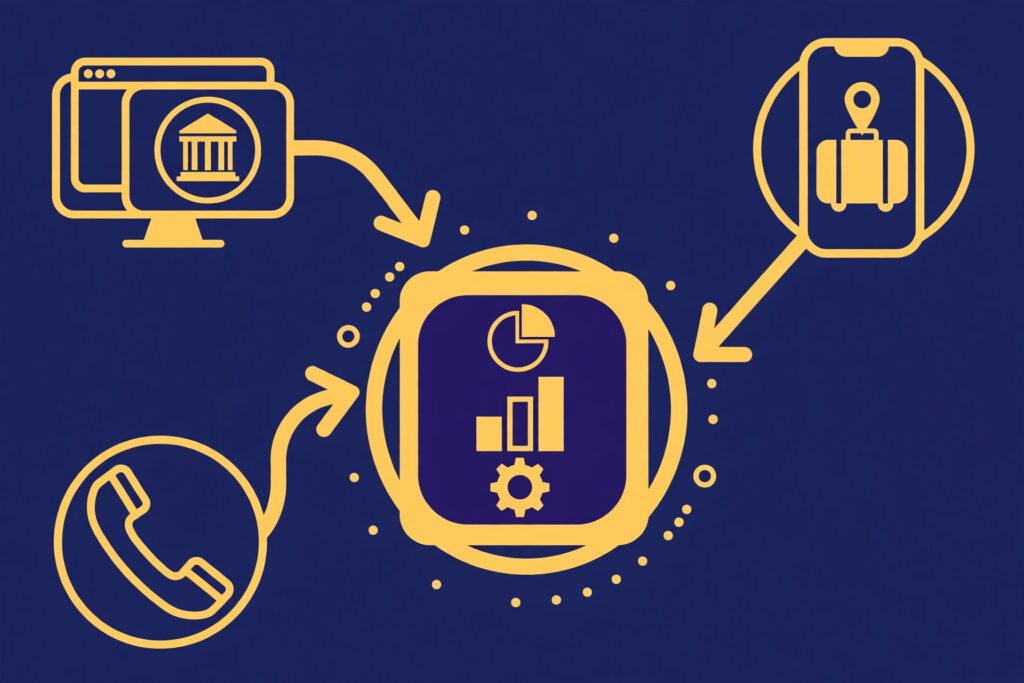
HiJiffy centralises guest messages from web chat, WhatsApp, email and booking sites into one inbox, then answers the repetitive questions automatically in more than 130 languages. Check in times, parking, breakfast hours and cancellation rules get answered at midnight without waking a night auditor. It also pushes direct booking offers inside the conversation, so a question about availability can turn into a booking.
Pricing: check checkout. HiJiffy prices by property and volume.
Best for: independent hotels, resorts and hostels that get the same questions across too many channels.
Watch out for: automation works best on routine questions. Complaints, special requests and upset guests still need a human reply, and the handover has to be obvious.
Try it at: https://www.hijiffy.com

5. Canary Technologies
Canary covers the whole guest journey in one system: messaging, AI voice, digital check in, upsells, payments and digital checkout. A guest can ask a question by text, buy a late checkout, and pay, without staff retyping details between systems. For hotels that currently run messaging in one tool, upsells in another and payments in a third, that single thread is the point.
Pricing: check checkout. Canary is quoted by property and modules.
Best for: hotels and groups that want one guest platform rather than a stack of point tools.
Watch out for: the value drops if you only use one module. If you only need messaging, a focused tool may cost less.
Try it at: https://www.canarytechnologies.com
6. Akia
Akia gives hotels an AI messaging layer with custom agents for different jobs, such as answering questions, sending upsell offers and parsing booking site emails. It also supports cashless tipping and guest requests, so staff get structured tasks instead of vague messages. Setup is faster than a full platform migration, which suits hotels that want results this month, not next quarter.
Pricing: check checkout. Akia prices by property and usage.
Best for: hotels that want guest messaging and upsells without replacing their property system.
Watch out for: upsell offers only work if the underlying inventory is accurate. An offer for a room upgrade you cannot deliver will create more complaints than revenue.
Try it at: https://www.akia.com
Daily operations: rooms ready, staff in sync
7. Cloudbeds
Cloudbeds combines a property management system, channel manager and booking engine in one platform aimed at small and mid sized hotels. Reservations, rates, availability and payments sit in the same place, and a mobile view lets managers check the day from anywhere. For a boutique hotel still running reservations in spreadsheets and a separate booking tool, Cloudbeds removes a whole layer of manual copying.
Pricing: check checkout. Cloudbeds prices by plan and room count.
Best for: boutique hotels, inns and small groups that want one core system.
Watch out for: it is a broad platform, not a specialist. Hotels that need deep revenue management or advanced guest messaging will still add a specialist tool on top.
Try it at: https://www.cloudbeds.com
8. Mews
Mews is a cloud property system built around automation and payments. It handles reservations, check in, payments and guest profiles, and connects to a wide marketplace of other hotel tools. Its design suits modern hotels and hostels that want guests to check in online and staff to spend less time at a desk retyping card details.
Pricing: check checkout. Mews prices by property and modules.
Best for: modern hotels, hostels and groups that value automation and a large integration marketplace.
Watch out for: migration from an old on premise system needs planning. Rate plans, guest history and payment setup all need checking before go live.
Try it at: https://www.mews.com
9. ALICE by Actabl
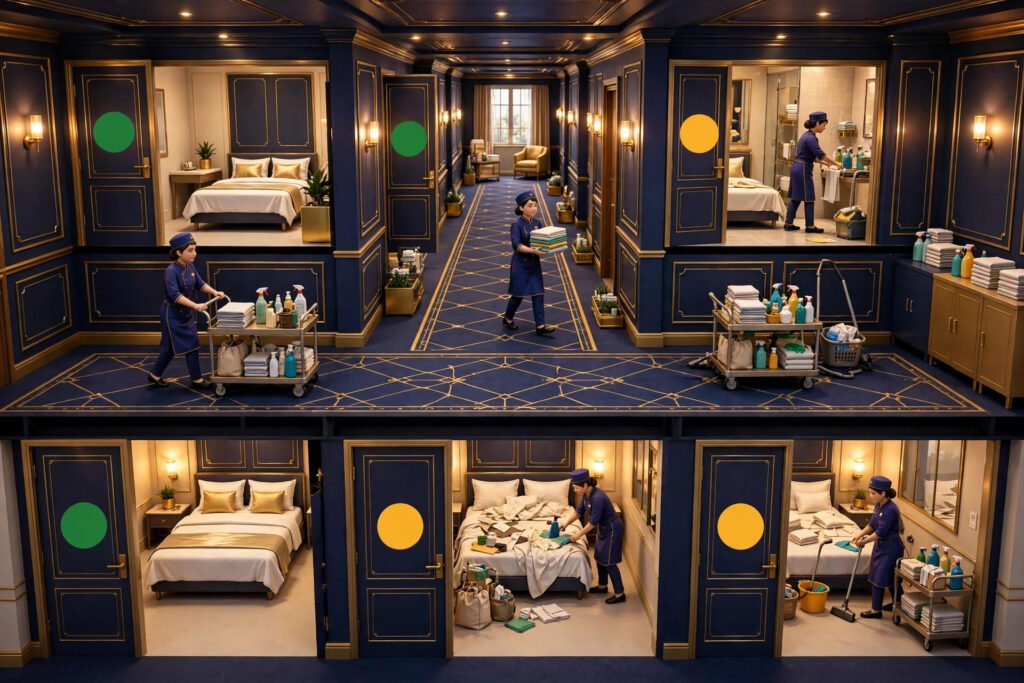
ALICE, from Actabl, organises housekeeping, maintenance and concierge work into tasks staff can see and update from a phone. When a room is cleaned, inspected or flagged for maintenance, the front desk sees it at once instead of waiting for a radio call or a paper list. That single change is what stops the classic problem of a ready room sitting empty while a guest waits in the lobby.
Pricing: check checkout. ALICE is quoted by property and modules.
Best for: hotels where housekeeping and maintenance coordination is the daily bottleneck.
Watch out for: it is an operations tool, not a guest facing one. It will not answer guest messages or set room rates.
Try it at: https://www.actabl.com
Marketing and reputation: fill rooms, protect the score
10. Revinate
Revinate turns guest data into email and messaging campaigns that bring guests back direct. It builds guest profiles from stays, segments them by behaviour, and helps hotels send targeted offers, pre arrival messages and upsell campaigns. A hotel that currently sends one generic newsletter to every past guest will see the difference in direct bookings and repeat stays.
Pricing: check checkout. Revinate prices by property and database size.
Best for: hotels with a real past guest list that want more direct and repeat bookings.
Watch out for: results depend on data quality. Duplicate profiles and missing emails weaken every campaign, so a data cleanup comes first.
Try it at: https://www.revinate.com
11. Sojern
Sojern uses travel intent data to find people actively planning trips, then runs advertising to them across search, social and display. Instead of advertising to everyone, a hotel advertises to travellers searching for its destination in its booking window. That matters most in quiet weeks, when the problem is demand itself rather than price or distribution.
Pricing: check checkout. Sojern campaigns are priced by scope and spend.
Best for: hotels and destinations that need new demand, especially in shoulder seasons.
Watch out for: advertising spend needs a clear test. Track direct bookings and cost per booking, not just clicks, or you will not know whether the campaign paid for itself.
Try it at: https://www.sojern.com
12. TrustYou
TrustYou collects reviews from across the web, analyses guest sentiment, and helps hotels reply faster and spot recurring problems. If ten reviews mention slow wifi or noisy rooms on one floor, the pattern shows up before a manager reads each review one by one. It also powers review widgets and guest surveys, so feedback keeps flowing after checkout.
Pricing: check checkout. TrustYou prices by property and modules.
Best for: hotels where review scores drive bookings and managers need to see patterns, not just individual complaints.
Watch out for: a review tool does not fix the underlying problem. If the same complaint repeats for months, the fix is operational, not a better reply template.
Try it at: https://www.trustyou.com

Pricing compared: what a hotel actually pays in 2026
| Tool | Free option | Paid model |
|---|---|---|
| Lighthouse | Demo | Check checkout |
| Duetto | Demo | Check checkout |
| SiteMinder | Trial | Check checkout |
| HiJiffy | Demo | Check checkout |
| Canary Technologies | Demo | Check checkout |
| Akia | Demo | Check checkout |
| Cloudbeds | Demo | Check checkout |
| Mews | Demo | Check checkout |
| ALICE by Actabl | Demo | Check checkout |
| Revinate | Demo | Check checkout |
| Sojern | Consultation | Check checkout |
| TrustYou | Demo | Check checkout |
The honest pattern here is that almost no serious hotel tool publishes a simple monthly price, because room count, modules and integrations change the quote. Budget by getting three quotes for the same room count and the same modules, and ask each vendor what is included in onboarding, support and integrations. A low headline quote that excludes your property system integration is not low.

Three starter stacks, by hotel type
A 30 room independent hotel does not need the same stack as a resort. For the independent hotel, start with Cloudbeds as the core system, Lighthouse for pricing guidance and HiJiffy for guest messages. That trio covers reservations, rates and replies, and each tool earns its place by fixing a daily leak. Add TrustYou once review volume grows enough to need pattern analysis.
A resort with restaurants, a spa and activities should start differently. Canary Technologies covers the guest journey, upsells and payments in one thread, Duetto handles the more complex pricing across room types and seasons, and ALICE by Actabl keeps housekeeping and maintenance in sync across a larger property. Marketing can wait until the operation runs cleanly, because a resort that upsells well but turns rooms over slowly will lose the repeat guest anyway.
A small hotel group should prioritise consistency. SiteMinder keeps distribution and availability consistent across properties, Revinate keeps guest data and repeat campaigns in one place, and Sojern fills quiet weeks with new demand. The group stack works only if every property uses the same rate plans and the same guest data rules. Without that discipline, a group buys the same tool three times and gets three different results.
How to Choose: match the tool to the week, not the demo
Start by writing down your last bad week. Which leak cost the most: empty rooms, low rates, unanswered messages, late turnovers or bad reviews? Buy for that leak first. A hotel with 85 percent occupancy and slow housekeeping should buy operations help before marketing. A hotel at 55 percent occupancy should buy demand and distribution help before a fancier guest app.
Next, check the integration before the feature list. Every tool above claims to connect to property systems, but the depth varies. Ask for a named integration with your exact property system, a test with your real rate plans, and a written answer on who fixes it when the connection breaks. A tool that cannot sync room status or rates reliably will create more manual work than it removes.
Then run a small test. Pilot messaging on one property or one room type, pilot pricing on shoulder dates, pilot housekeeping on one floor. Measure one number: response time, revenue per available room, turnover time or review score. If the number does not move in 30 days, the tool is not the right fit, however good the demo looked.
Finally, count total cost, not just the subscription. Include onboarding time, staff training, integration fees and the hours your team spends fixing sync errors. A tool that saves the front desk two hours a day but costs the revenue manager two hours a day has not saved anything.

Mistakes that quietly cost hotels money
The first mistake is buying a guest app before fixing the basics. A beautiful digital check in does not help if room rates are wrong, messages go unanswered or rooms are not ready. Fix pricing, messaging and turnover first, then add guest experience layers.
The second mistake is automating every message. Guests accept an instant answer for check in time or parking. They do not accept an automated reply to a complaint about a broken air conditioner at 2 am. Keep a clear human handover for complaints, refunds and special requests, and make sure staff actually see those messages.
The third mistake is trusting AI pricing without guardrails. Set minimum and maximum rates, review holiday and event dates by hand, and check what the system recommends before it goes live. An engine that drops rates during a local festival because it misread demand will cost more in one weekend than it saves in a month.
The fourth mistake is running tools that do not share data. If messaging, pricing and housekeeping each hold a different version of the truth, staff spend their day reconciling systems instead of serving guests. Pick tools that sync with your property system first, and add point tools only where the sync is proven.
The fifth mistake is measuring the wrong number. Clicks, message volume and app downloads do not pay salaries. Measure direct bookings, revenue per available room, response time, turnover time and review score. If those do not move, the tool is decoration.
Frequently asked questions
What is the best AI tool for a small independent hotel?
Start with the leak that costs most. For most small hotels that is either pricing or messaging, so Lighthouse for pricing guidance or HiJiffy for guest messages is a sensible first buy. Add a property system like Cloudbeds if reservations still run on spreadsheets.
Do these tools replace front desk staff?
No. They remove repetitive work, such as answering the same questions, updating room status and sending routine offers. Complaints, complex bookings and upset guests still need people, and hotels that cut staff at the same time as adding automation usually see review scores fall.
How much do AI hotel tools cost?
Almost all are quoted by room count, property size and modules, so there is no single monthly figure that fits every hotel. Get quotes for your exact room count and modules, and ask what onboarding, support and integrations cost on top of the subscription.
Will AI pricing hurt my rates?
Only without guardrails. Set minimum and maximum rates, review event dates by hand, and check recommendations before they go live. With those controls, pricing tools usually raise revenue by catching busy dates a human would miss.
Can AI messaging handle phone calls too?
Some tools, such as Canary, offer AI voice alongside messaging. Most messaging tools handle text channels first. If missed phone calls are your biggest leak, ask specifically about voice coverage, languages and handover to staff before buying.
Should a hotel buy one platform or several specialist tools?
A single platform suits hotels that want one system and one support team. Specialist tools suit hotels with one sharp problem, such as pricing or reviews. Either way, the deciding factor is integration depth with your property system, not the size of the feature list.
Conclusion: plug one leak, prove it, then move on
The best AI tools for hotels are not the ones with the longest feature lists. They are the ones that fix a leak you can measure: a higher rate on a busy weekend, a faster reply at midnight, a room ready when the guest arrives, a review score that climbs because the same complaint stops repeating. Pick the leak that cost most last month, pilot one tool against one number for 30 days, and only then buy the next one. Hotels that follow that order end up with a smaller, cheaper stack that actually works. Hotels that buy everything at once end up with a stack nobody fully uses.