

The best AI tools for financial advisors in 2026 are the ones that survive the review meeting. A portfolio report that looks sharp on a dashboard but confuses a client in the room is a liability, not a feature. A plan that takes three weeks to build is a bottleneck, no matter how pretty the output looks. And a note taking tool that saves an hour but creates a compliance headache has not saved anything at all.
That is the test this guide applies. Every tool below was judged on a simple question: does it make the next client conversation clearer, faster, or better documented? Tools that only add another dashboard were left out. Tools that replace a manual step an advisor actually repeats every week made the list.
Advisors buy differently from startups. A new tool has to fit custodial workflows, compliance review, and clients ranging from retirees who want paper to owners who want a portal.
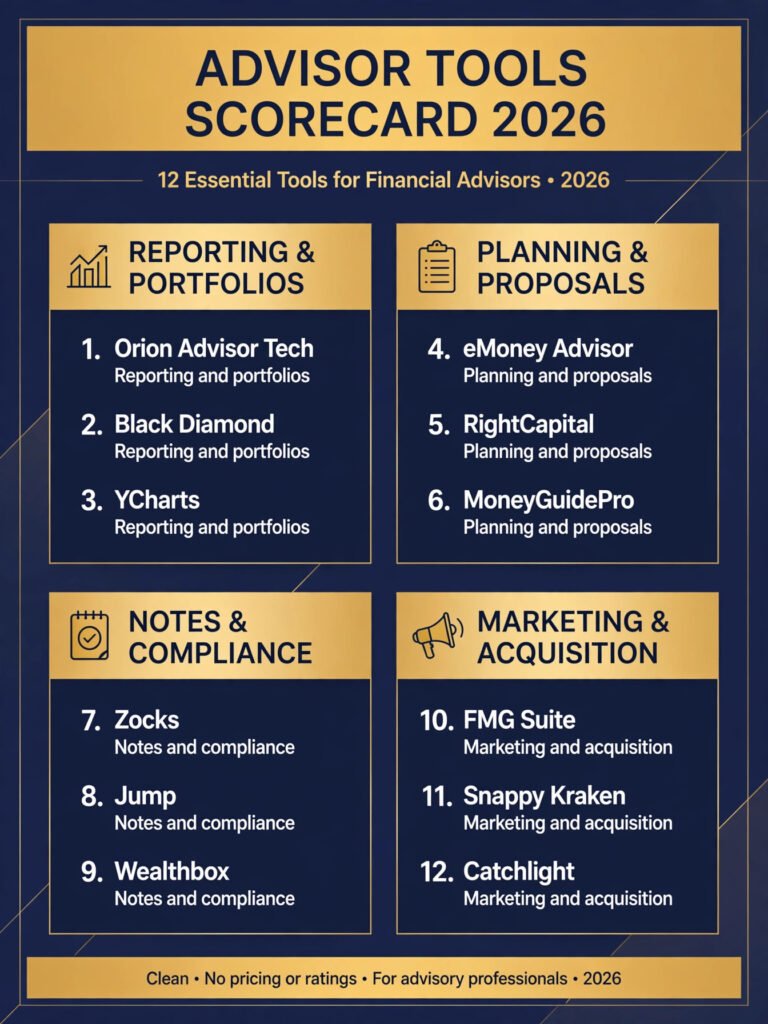
This guide covers 12 tools in four jobs, each with October 2026 pricing guidance, a best fit, and a watch out. Where a vendor does not publish a clear price, this guide says check checkout.
The 12 best AI tools for financial advisors at a glance
| Tool | Main job | Best for |
|---|---|---|
| Orion Advisor Tech | Reporting and portfolios | Firms that want one reporting and billing hub |
| Black Diamond | Reporting and portfolios | Firms that need deep portfolio reporting |
| YCharts | Reporting and portfolios | Visual client reports and comparisons |
| eMoney Advisor | Planning and proposals | Full financial plans with client portals |
| RightCapital | Planning and proposals | Fast plans for growing firms |
| MoneyGuidePro | Planning and proposals | Goal based plans at scale |
| Zocks | Notes and compliance | Meeting notes that feed the CRM |
| Jump | Notes and compliance | AI notes built for advisory firms |
| Wealthbox | Notes and compliance | Simple CRM that advisors actually use |
| FMG Suite | Marketing and acquisition | Compliant content and websites |
| Snappy Kraken | Marketing and acquisition | Campaigns that follow up automatically |
| Catchlight | Marketing and acquisition | Finding prospects who look like current clients |
Start with the job, not the demo
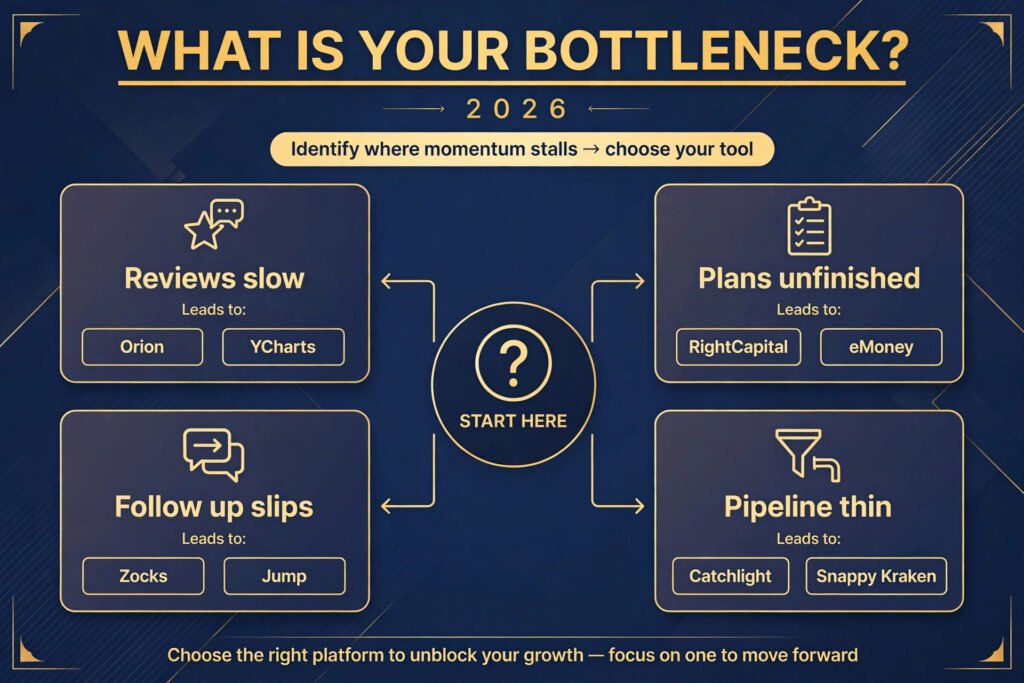
Start with the meeting that hurts most right now: slow reviews mean reporting, half finished plans mean planning, slipped follow up means notes, and a thin pipeline means marketing.
The table below maps each pain to a first pick and a second option.
| If this is the bottleneck | Start here | Also consider |
|---|---|---|
| Reviews take too long to prepare | Orion Advisor Tech | YCharts |
| Plans take weeks to finish | RightCapital | eMoney Advisor |
| Meeting follow up is inconsistent | Zocks | Jump |
| Client records live in too many places | Wealthbox | Black Diamond |
| Marketing happens in bursts, then stops | FMG Suite | Snappy Kraken |
| New client flow is too slow | Catchlight | Snappy Kraken |
Client reporting and portfolios
Reporting is where trust is won or lost. Clients remember whether the report answered their question and matched their statement.
1. Orion Advisor Tech
Orion is a full platform for advisors, covering portfolio accounting, reporting, billing, and trading in one system. Its reporting engine is the reason most firms adopt it. You can build branded quarterly reports, performance views, and billing statements from the same data, which cuts down on the reconciliation work that happens when reporting and billing live in separate tools.
The client portal lets clients see holdings, performance, and documents without calling for every update.
Pricing: check checkout. Orion prices by firm size and by the modules you use, so a single headline number would mislead. Ask for a quote based on assets under management, account count, and whether you need trading and billing included.
Best for: firms that want reporting, billing, and trading in one place and are ready to commit to a platform migration.
Watch out for: implementation takes real time. Moving custodial data, rebuilding report templates, and training staff is a project, not an afternoon. Budget for that, and do not plan the switch during tax season or year end reporting.
Try it at: https://orionadvisortech.com

2. Black Diamond
Black Diamond, from SS and C Advent, is a portfolio management and reporting platform used by many established advisory firms. Its strength is depth. Performance reporting, rebalancing, billing, and a client portal sit together, and the reporting options are detailed enough for firms with complex households, multiple custodians, and custom benchmarks.
It handles layered accounts and household views well, which suits firms serving high net worth clients.
Pricing: check checkout. Black Diamond is quote based, and pricing depends on assets, accounts, and modules. Expect an enterprise style sales process rather than a self serve signup.
Best for: established firms with complex reporting needs and clients who expect detailed household views.
Watch out for: it is a serious platform with a serious price and setup effort. Small solo practices may find the cost and the learning curve hard to justify until assets and account counts grow.
Try it at: https://www.advent.com
3. YCharts
YCharts is a research and reporting tool that advisors use to build visual comparisons, model portfolios, and client friendly charts. It is not a full portfolio accounting system. Its value is in the meeting room, where a clear chart often explains more than a page of numbers.
You can compare funds, ETFs, and portfolios side by side and build proposal pages a client can follow without a finance background.
Pricing: check checkout. YCharts offers advisor plans with different data and reporting limits, and pricing varies by seat and by feature tier.
Best for: advisors who want stronger visuals for reviews and proposals without replacing their core portfolio system.
Watch out for: YCharts will not replace billing, trading, or custodial reconciliation. If you buy it expecting a full platform, you will be disappointed. Buy it for research and presentation, and keep your existing system for accounting.
Try it at: https://ycharts.com
Planning and proposals
A plan that never reaches the client is not a plan. It is draft work. The tools in this section differ mainly in speed and depth. They differ mainly in speed and depth, from comprehensive modelling to fast plans to goal based plans at scale.
4. eMoney Advisor
eMoney is a comprehensive planning platform used by many large firms. It covers cash flow planning, goal tracking, estate and tax views, and a client portal where clients can link accounts and see their plan update as data changes. The depth is the point. For clients with business interests, rental property, stock options, or complex estate needs, eMoney can model scenarios that simpler tools cannot.
The client portal keeps clients engaged between reviews.
Pricing: check checkout. eMoney prices by advisor count and by plan tier, and larger firms negotiate custom terms. Solo advisors should ask specifically about entry level pricing before assuming it fits.
Best for: firms with complex planning cases and clients who want a living plan they can check between meetings.
Watch out for: depth comes with a learning curve. New advisors need training time, and data entry for a full plan is still work. The software speeds up modelling, but it does not remove the need for accurate client data.
Try it at: https://emoneyadvisor.com
5. RightCapital
RightCapital is a planning tool built for speed and for modern client experience. Plans can be built quickly, with visual outputs that clients understand at a glance: retirement readiness, cash flow, tax snapshots, and Roth conversion comparisons. The interface feels current, which matters when a client compares your plan presentation with every other polished app on their phone.
It also includes proposal and student loan planning features for younger clients.
Pricing: check checkout. RightCapital offers advisor plans with different client limits, and pricing varies by tier.
Best for: growing firms that need fast, client friendly plans and want a modern portal experience.
Watch out for: firms with very complex estate or business planning cases may still need a deeper tool for those clients. RightCapital covers most planning well, but it is not a replacement for specialist estate software in edge cases.
Try it at: https://www.rightcapital.com

6. MoneyGuidePro
MoneyGuidePro, from Envestnet, is a goal based planning tool used by thousands of advisors. Its approach is different from cash flow heavy tools. It starts with what the client wants to achieve, shows a probability of success for each goal, and lets advisors test changes in plain language: retire a year earlier, save a little more, spend a little less.
That framing works well in meetings, since clients understand a goal moving from amber to green when a contribution rises.
Pricing: check checkout. MoneyGuidePro is typically sold through enterprise and broker dealer channels, and pricing depends on firm arrangement.
Best for: firms that want goal based planning at scale, with a consistent meeting conversation across many clients.
Watch out for: the goal based framing can feel less detailed for clients who want line by line cash flow. If your clients ask for detailed annual projections, pair it with a deeper tool or be ready to explain the approach clearly.
Try it at: https://www.moneyguidepro.com
Notes, compliance, and the CRM
The least glamorous job on this list is also the one that protects the firm. When that step is skipped, follow up slips. The tools in this section close that gap in different ways: two capture the meeting itself, and one keeps the client record in order.
7. Zocks
Zocks is an AI meeting assistant built for financial advisors. It records meetings, produces summaries, and pushes notes and tasks into the CRM. The advisor specific design matters. Generic note tools produce a transcript. Zocks is designed to extract the items a compliance file actually needs: decisions, action items, and follow ups, mapped to the right client record.
For firms already using a CRM, notes landing there without manual copying is the main selling point.
Pricing: check checkout. Zocks offers advisor plans priced by seat, with tiers for firms and enterprises.
Best for: advisors who want meeting notes that go straight into the CRM with minimal manual handling.
Watch out for: get compliance approval before recording client meetings, and confirm consent and storage rules in your state and with your broker dealer or RIA compliance team. The technology is easy. The approval process is the part to plan for.
Try it at: https://www.zocks.com
8. Jump
Jump is another AI assistant built specifically for advisors, focused on meeting preparation, notes, and follow up. It can prepare a brief before a meeting from CRM data, capture the conversation, and draft follow up emails and tasks afterwards. That before, during, and after loop is what separates advisor tools from generic transcription apps.
Jump also emphasises compliance friendly workflows, with review controls for keeping notes inside approved systems.
Pricing: check checkout. Jump prices by advisor seat, with firm level plans for larger teams.
Best for: advisors who want the full meeting loop, from prep brief to follow up draft, in one advisor focused tool.
Watch out for: as with any recording tool, client consent and data handling must be settled first. Also check that Jump integrates with your specific CRM before committing, since the value drops sharply if notes have to be moved by hand.
Try it at: https://www.jumpapp.com
9. Wealthbox
Wealthbox is a CRM built for financial advisors, and its appeal is simplicity. Many advisor CRMs are powerful but heavy, and staff avoid them. Wealthbox is designed to be used every day: contacts, tasks, workflows, and client history in a clean interface that new staff can learn quickly.
It integrates with planning, portfolio, and note tools, so it can act as the hub for the client record.
Pricing: check checkout. Wealthbox offers plans by user, with different workflow and integration limits by tier.
Best for: firms that need a CRM staff will actually open, with advisor specific workflows and integrations.
Watch out for: Wealthbox is not a portfolio accounting system or a planning tool. It organises the client relationship. It does not replace Orion, Black Diamond, or a planning platform, and it should be bought alongside those tools, not instead of them.
Try it at: https://www.wealthbox.com

Marketing and client acquisition
Most advisors have a consistency problem. Content goes out for a month, then stops when client work peaks. The tools in this section are built to keep marketing running during busy periods, and to focus prospecting on people who resemble the clients you already serve well.
10. FMG Suite
FMG Suite provides compliant marketing content, websites, and email for financial advisors. Its library includes articles, videos, and social posts that are designed to pass compliance review, which is the main reason advisors choose it over a generic content tool. Generic content is easy to produce and hard to get approved. FMG content is built with approval in mind.
FMG also offers advisor websites and email campaigns, so a firm can keep a steady presence without a full marketing team.
Pricing: check checkout. FMG prices by package, with website, content, and email options sold in tiers.
Best for: advisors who want steady, compliant content and a professional website without building a marketing team.
Watch out for: library content will look similar across firms that use the same service. Personalise the introductions, add local detail, and write your own take on key topics. Otherwise your content will read like every other FMG site in your area. Advisors who publish regularly may also want dedicated writing support, and a guide to writing tools for freelancers can help with drafting habits even if the compliance rules differ; see best AI tools for freelance writers for drafting ideas to adapt under your own compliance review.
Try it at: https://fmgsuite.com

11. Snappy Kraken
Snappy Kraken is a marketing platform for advisors that automates campaigns, follow up, and lead nurturing. Instead of sending one email and hoping, you set up a sequence: a new prospect gets a series of relevant messages over weeks, a lapsed client gets a re engagement series, and a new client gets an onboarding series. The automation is the product.
It also includes content and landing pages, so campaigns do not stall while someone designs a page.
Pricing: check checkout. Snappy Kraken prices by package and by list size, with different campaign libraries by tier.
Best for: firms with an existing prospect list that needs systematic follow up, and firms that want campaigns to run without weekly manual effort.
Watch out for: automation without review can feel impersonal. Check the messages before they go out, adjust the tone for your client base, and make sure every campaign passes your compliance process. A sequence that runs itself still needs a human owner.
Try it at: https://snappykraken.com
12. Catchlight
Catchlight uses AI to help advisors find and prioritise prospects. It analyses data to identify people who resemble your best clients, and it scores prospects so outreach focuses on the most promising names first. For firms that buy lists or work from broad local data, that prioritisation can save a large amount of wasted outreach time.
Catchlight also provides enrichment on prospects, so a first conversation starts with relevant context.
Pricing: check checkout. Catchlight prices by firm and by data scope, so ask for a quote based on your market and prospect volume.
Best for: firms that want to focus prospecting on lookalike clients rather than working through unfiltered lists.
Watch out for: prospecting data quality varies by market, and AI scoring is a guide, not a guarantee. Test it on a small campaign first, measure response rates, and only expand if the scored prospects actually convert better than your current list.
Try it at: https://www.catchlight.ai
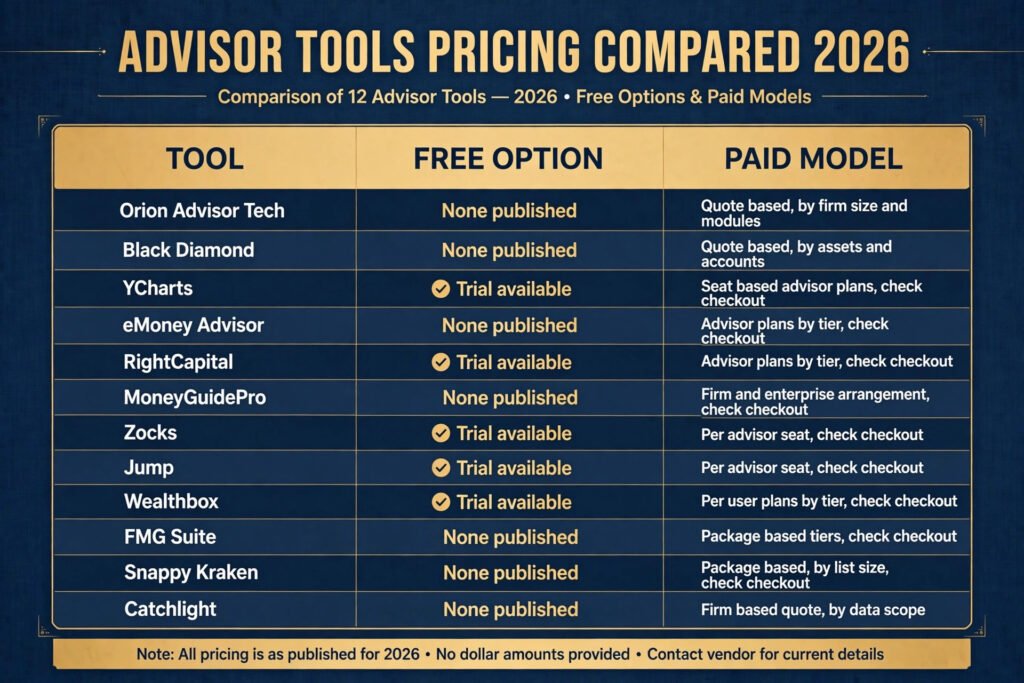
Pricing compared: what an advisor actually pays in 2026
| Tool | Free option | Paid model |
|---|---|---|
| Orion Advisor Tech | None published | Quote based, by firm size and modules |
| Black Diamond | None published | Quote based, by assets and accounts |
| YCharts | Trial available | Seat based advisor plans, check checkout |
| eMoney Advisor | None published | Advisor plans by tier, check checkout |
| RightCapital | Trial available | Advisor plans by tier, check checkout |
| MoneyGuidePro | None published | Firm and enterprise arrangement, check checkout |
| Zocks | Trial available | Per advisor seat, check checkout |
| Jump | Trial available | Per advisor seat, check checkout |
| Wealthbox | Trial available | Per user plans by tier, check checkout |
| FMG Suite | None published | Package based tiers, check checkout |
| Snappy Kraken | None published | Package based, by list size, check checkout |
| Catchlight | None published | Firm based quote, by data scope |
Add implementation and training time to the licence cost, and compare total cost for the job, not licence cost alone, since portals and CRM links are sometimes charged extra.
How to choose without buying twice
Advisor tech stacks overlap easily. A reporting platform may include a portal. A planning tool may include a CRM link. A note tool may include tasks that duplicate your CRM. Buying twice is the most common waste in this category, and it usually happens because each purchase was judged alone.
Use this sequence instead. Second, name the single bottleneck from the table near the start of this guide. Third, buy only the tool that removes that bottleneck, and use it for one full quarterly cycle before adding another tool. Fourth, check integrations before you pay: does the new tool send data to your CRM, your planning tool, and your portfolio system without manual export?
Ask compliance three questions before purchase: can we record client meetings, where is client data stored, and what review step is required before marketing goes out?
Finally, involve the daily user in the trial, since a tool the support team avoids will not hold accurate records.
Mistakes that quietly cost advisory firms
The first mistake is buying a platform for a problem you do not have yet. A solo advisor does not need enterprise reporting depth on day one. Buy for the next twelve months, not for a hypothetical firm five years from now.
The second mistake is skipping the compliance conversation. AI notes, marketing automation, and client portals all touch client data and regulatory duties. A tool that is easy to set up but hard to defend in an audit is not a shortcut. It is a risk that only becomes visible later.
The third mistake is judging a tool by its demo data. Trial with your own messy data, your own custodial feeds, and your own report templates. That trial tells you the truth.
The fourth mistake is underestimating training. Staff need time to learn a new CRM, a new planning interface, or a new reporting template. If training is squeezed into a busy week, adoption drops, and the firm ends up paying for a tool that only one person uses.
The fifth mistake is letting marketing run without a human check. Automated campaigns and library content save time, but they still carry your name. Read the content, check the compliance approval, and personalise the message for your clients. Automation should not replace judgement.
The sixth mistake is keeping too many tools that do the same job. If two tools both store client notes, one of them will go stale. Pick a system of record for each job, and retire the duplicate. A smaller stack that staff actually use beats a larger stack that nobody fully trusts.
Frequently asked questions
What is the best AI tool for financial advisors overall?
There is no single best tool, because advisors buy for different jobs. For fast client friendly plans, RightCapital is a strong first pick. For meeting notes that feed the CRM, Zocks and Jump lead. Start from your bottleneck, not from a general ranking.
Do advisors need compliance approval for AI meeting notes?
In most firms, yes. Recording client meetings, storing transcripts, and using AI summaries all touch compliance duties, and requirements vary by firm type, broker dealer, and state. Get approval before recording, confirm client consent rules, and check where data is stored and how long it is kept.
Can a small solo practice afford these tools?
Some, yes, and some, no. YCharts, RightCapital, Wealthbox, Zocks, and Jump are built with smaller firms in mind, and trials let you test fit before committing. Orion, Black Diamond, and eMoney are more likely to fit established firms with larger asset bases.
Will AI replace the advisor in planning and reviews?
No. AI speeds up data gathering, drafting, and reporting. It does not replace judgement about risk, family goals, tax trade offs, or the conversation that helps a client stay invested during a market fall. The firms that benefit most use AI to spend more time on those conversations, not less.
How long does it take to switch reporting platforms?
Longer than the sales call suggests. Moving custodial data, rebuilding report templates, testing billing, and training staff typically takes weeks to months, depending on firm size and account complexity. Keep the old system running until new reports are checked.
Should advisors use generic AI chatbots for client work?
Only with care, and never with identifiable client data in a tool that has not been approved for that use. For client facing work, use advisor specific tools that have been reviewed by your compliance process.
Conclusion: buy the meeting, not the dashboard
The best AI tools for financial advisors in 2026 share one trait: they make a specific meeting better. Orion and Black Diamond make the review meeting clearer. eMoney, RightCapital, and MoneyGuidePro make the planning meeting faster and easier to follow. Zocks, Jump, and Wealthbox make the follow up after the meeting reliable. FMG, Snappy Kraken, and Catchlight make the first meeting happen more often.
Start with the meeting that costs you the most time or the most clients. Trial one tool with real client work for a full quarter. Check compliance before you commit.
Done well, clients will notice because the next meeting runs on time and follow up arrives when promised.