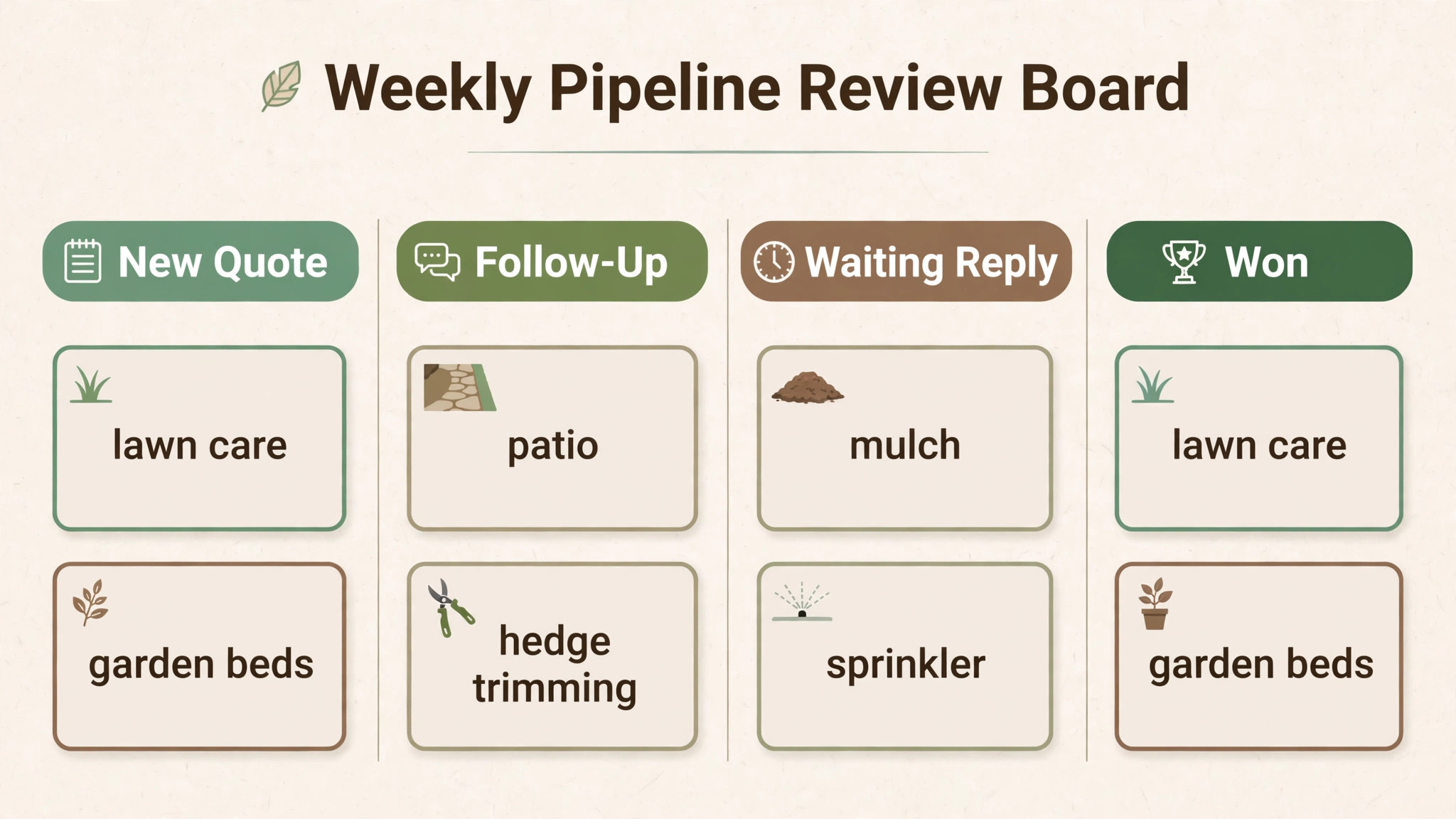
Most landscaping quotes are not lost on price. They are lost in silence. A homeowner asks three companies for a patio or a cleanup, reads the first clear quote, hears nothing from the second company for a week, and books the company that stayed in touch. If you want to use AI for landscaping company quote follow up, start from that silence, not from a new sales tool. The companies that close more work are the ones that confirm the quote arrived, answer the first question fast, and keep showing up with something useful until the homeowner decides.
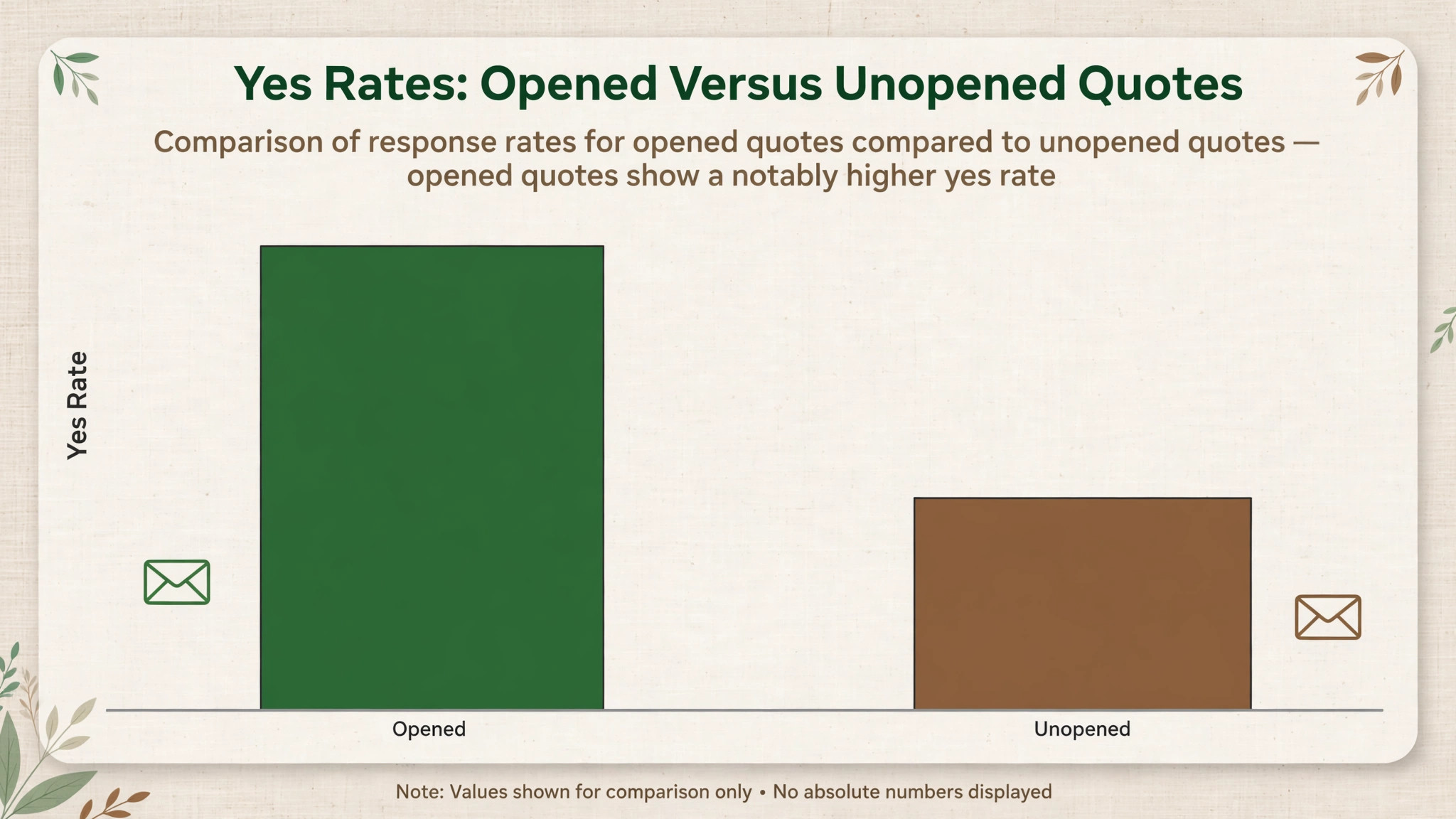
The numbers behind that claim come from one Connecticut landscaping and snow company that reviewed 209 residential estimates over six months. Homeowners who opened their estimate said yes 56 percent of the time, while homeowners who never opened it said yes only 16 percent of the time. Half of all yeses arrived within three days of the quote, and 90 percent arrived within 16 days. Bigger jobs were harder to close, with about one in three smaller jobs declined, nearly half of mid-size jobs declined, and almost three quarters of jobs over 15,000 dollars declined. Those patterns point to a simple rule. Get the quote opened, follow up inside the first three days, and keep going for about two weeks.
This guide turns that rule into a workflow you can run every week. You will see how to sort quotes by size and readiness, what to send on each day of the sequence, when a phone call must replace a message, and how AI drafting fits without sounding like a machine. At the end you get a copyable sequence template for a two week follow-up, plus the tracking habits that stop quotes from quietly dying in an inbox.
Why an unopened quote is not a pricing problem
Most companys still run this work by memory, inbox and a spreadsheet that one person understands. That works until the busy season, a staff holiday or a simple sick day breaks the chain, and then the homeowners who needed a reply hears nothing. The cost is invisible at first, because nobody complains about a message they never expected, yet the empty seat, the missed visit or the lost booking shows up in the numbers weeks later. Reading a guide like quote software for landscaping companies shows the same pattern in a neighbouring niche, where the system, not the effort, decides who gets served on time.
The reason to use AI for landscaping company quote follow up is not fashion. It is that the repetitive parts of this work, namely drafting, reminding, ranking and tracking, are exactly the parts a machine handles well, while the judgement parts, namely pricing, clinical or safety calls and personal conversations, must stay human. A workflow that respects that split will feel helpful to homeowners and to staff. A workflow that ignores it will feel cold, and homeowners will notice within a week.
Start with the record, not the tool. If the underlying list of homeowners, dates and promises is messy, automation will only send messy messages faster. Clean the list, write the rules, and then add one automation at a time, checking each one for a full cycle before adding the next. That discipline is what separates a company that uses AI well from one that merely owns AI tools, as any reader of lead follow-up for car dealerships will recognise from their own booking work.
Before the workflow, here is the decision shortcut for the whole guide. When you know which situation a homeowner is in, you know what to send, and use AI for landscaping company quote follow up becomes a set of small decisions rather than a large project. Keep this table near the weekly routine until the habit is automatic.
| Situation | Best first move | What to avoid |
|---|---|---|
| Homeowners is ready but has not replied | Short personal message with one clear next step | Another generic message with no detail |
| Homeowners is overdue or drifting | Personal contact that names the real reason to act | A discount offered before the reason is known |
| Homeowners just completed a visit or booking | Thank you plus the next date or step, booked now | Silence until the next cycle, when it is too late |
Every step that follows supports one row of that table. If a proposed automation does not help a row, leave it out, because extra messages cost attention, and attention is the scarcest resource a small business owns.
The tools a small crew can run from the truck
Three tools carry this workflow, and each one solves a different failure point. use AI for landscaping company quote follow up works best when each tool owns one job and the record stays in one place, so resist the urge to buy a new tool for every small gap. Fix the gap with a rule first, and buy only when the rule proves the need.
Jobber
Jobber fits landscaping companies because quoting, scheduling and customer messaging can share one job record. The follow-up win is visibility. When a quote, its sent date, its open state and its follow-up tasks live on the same record, nobody has to remember which homeowner is waiting. A quote that is visible gets followed up. A quote that lives in an inbox does not.
LMN
LMN is built for landscaping business operations, including estimating and job costing, which matters for follow-up because the follow-up message must match the real scope and price. When a homeowner asks whether the quote includes cleanup or edging, the answer should come from the estimate itself, not from a guess. A follow-up system that cannot see the estimate will eventually promise something the crew cannot deliver.
HubSpot CRM
HubSpot CRM suits a landscaping company that wants a clear pipeline for quotes, with stages, tasks and reminders that survive a busy week. Its value here is the task list. A quote that enters a follow-up sequence should generate dated tasks automatically, so a crew leader returning from a long day on site sees exactly who needs a call, not a vague feeling that someone is waiting.
General AI drafting assistant
A general AI assistant drafts follow-up messages from the real quote, the site notes and your approved tone, and nothing else. Give it the scope, the price, the season and the homeowner’s question, and let it draft three versions, short, warm and direct. A staff member picks one, edits it and sends it. The homeowner should never feel they are talking to a script, because a script cannot answer the question about the tree root near the fence.
How to use AI for landscaping company quote follow up without sounding pushy
The workflow below is written in the order work actually happens, not in the order tools are sold. Read it as a weekly routine, and note where a human must approve before anything reaches a homeowner. use AI for landscaping company quote follow up succeeds when the routine runs even in a busy week, so keep each step small enough to survive one.
Step 1. Send the quote where it will be opened
Send the quote by email and by text from a number the homeowner recognises, with one line that names the project and invites a reply. Watch whether it is opened. If a day passes with no open, resend by text rather than sending another email into the same unopened inbox. The study above shows the open is the turning point, so the first job of follow-up is delivery, not persuasion.
Step 2. Sort every quote the day it goes out
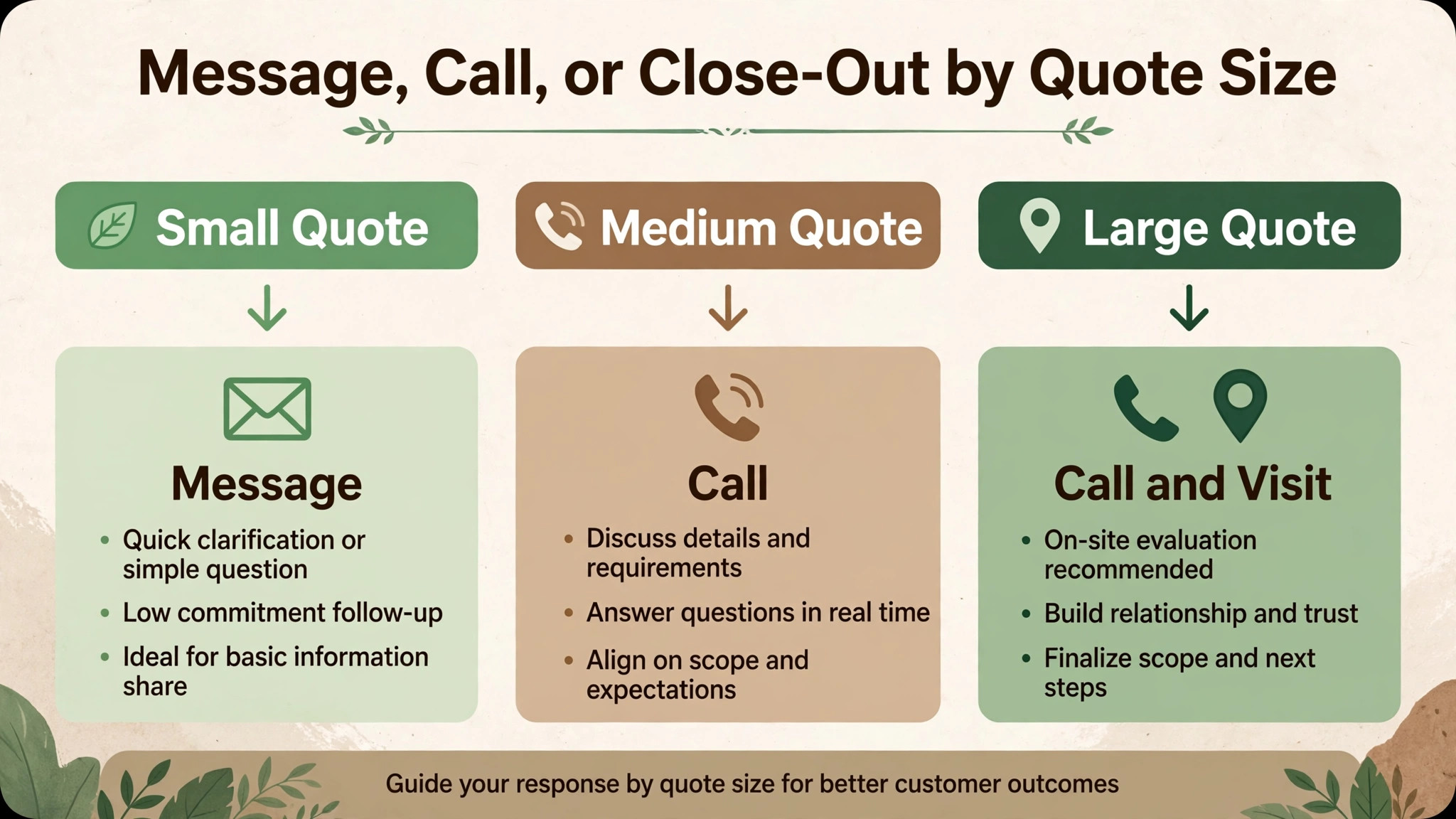
Put each quote into one of three groups, namely small jobs under 5,000 dollars, mid-size jobs, and large jobs over 15,000 dollars, and note whether the homeowner is a first-time customer or a returning one. Large first-time quotes need a call, not a message, because the study shows they are the hardest to close. Sorting takes ten minutes a day and decides everything that follows, because each group gets a different sequence.
Step 3. Confirm receipt on day zero
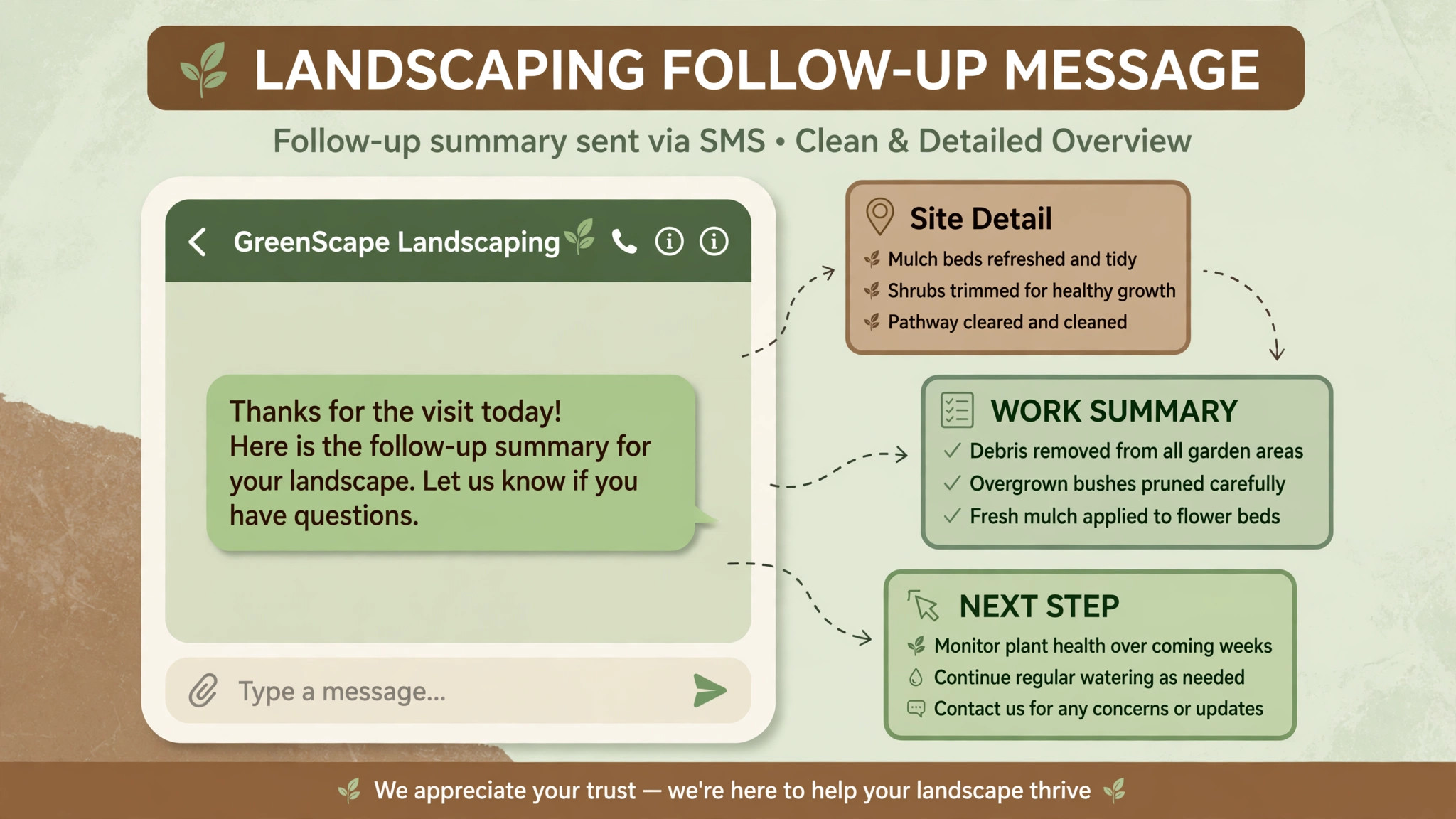
On the day the quote goes out, send a short confirmation that the quote arrived, names the project, states the price in the message or links clearly to it, and gives one clear next step. Invite questions and offer a short call. This message is not a sales pitch. It is proof that a human is paying attention, and it gives the homeowner a reply thread they can use later.
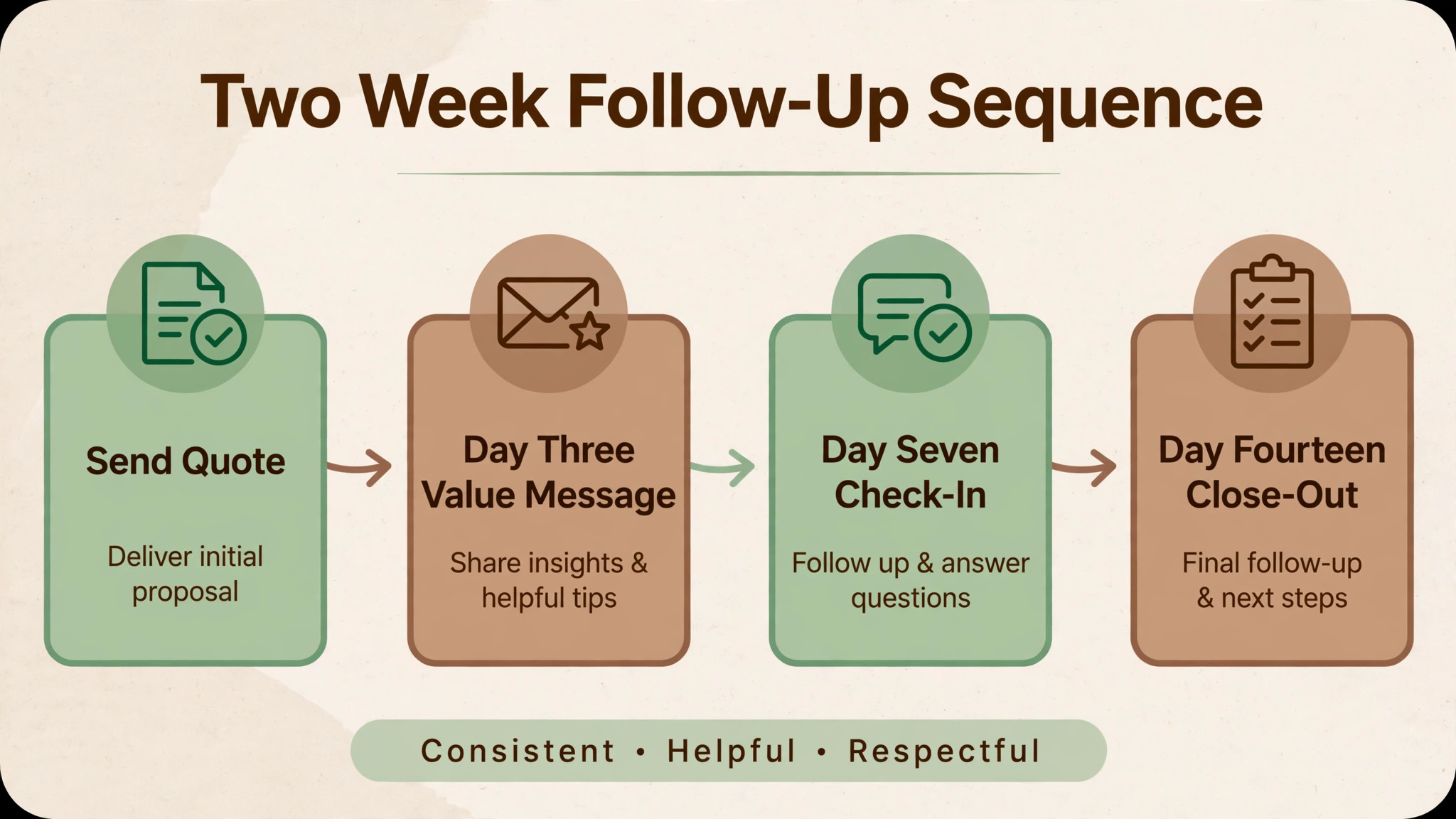
Step 4. Follow up on day three with value, not pressure
On day three, send a message that adds something useful, such as a photo of a similar finished project, a note on the best planting window, or an answer to a question raised during the walkthrough. AI can draft this message from your site notes, but the photo and the detail must be real. A homeowner who learns something from your follow-up will keep reading your messages. A homeowner who gets only reminders will stop.
Step 5. Call the big jobs and the warm opens
When a large quote is opened, or when any quote reaches day five without a reply, pick up the phone. Ask what other quotes included, what concerns remain, and whether phasing the work would help. On large jobs, offer to walk the property again. Many homeowners are too polite to email a concern about price or scope, and a short call surfaces the real objection in minutes.
Step 6. Send the day seven decision helper
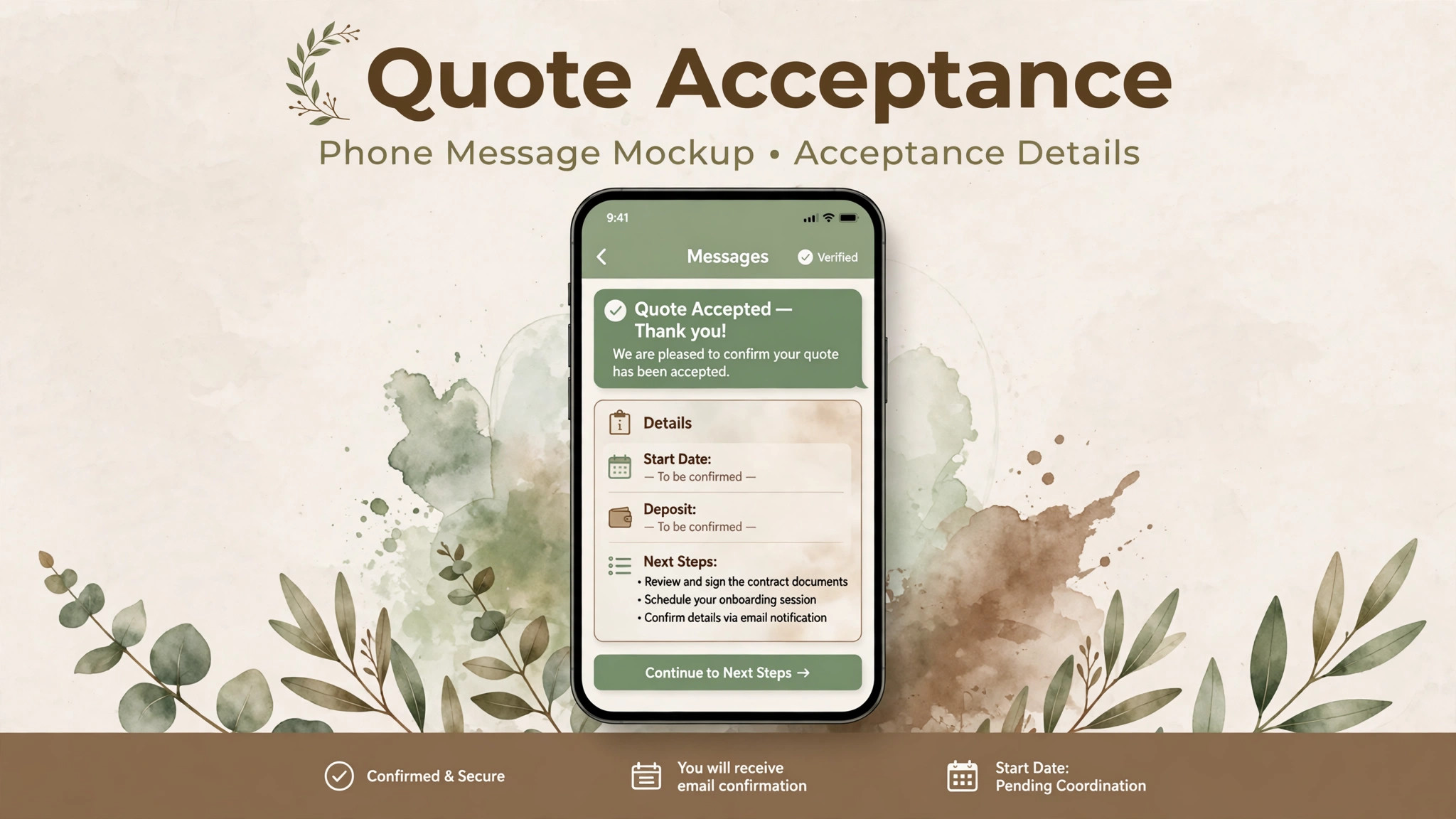
On day seven, send a message that makes deciding easier. Restate the scope in plain words, name the start window, explain the deposit, and offer two start dates. If the homeowner is comparing quotes, a short scope comparison helps more than a discount, because it shows what your price actually buys. AI can draft the comparison from the estimate, but staff must check every line against the real scope before sending.
Step 7. Close the loop on day fourteen
On day fourteen, send a closing message that respects the homeowner’s time. Say the quote stays open until a stated date, offer to hold a start slot with a deposit, and ask directly whether they have chosen another company or paused the project. A clear close-out beats a slow fade, because it produces a real answer, a booked job or a lost reason you can learn from. Record the reason for every loss.
Step 8. Move old quotes to win-back or out of the pipeline
After day fourteen, move the quote out of the active pipeline. A short win-back message a month later, tied to the season, can still recover some jobs, but the quote should no longer count as open work. The study shows only about one in ten yeses arrived after day sixteen, so a pipeline full of month-old quotes flatters the forecast and hides the real close rate. Review the pipeline every Friday and keep it honest.
The copyable quote-follow-up sequence template
Run this checklist in full the first time, then run it as a weekly habit. use AI for landscaping company quote follow up is only as strong as its weakest step, and a checklist is how a busy team keeps the weak step visible instead of forgotten.
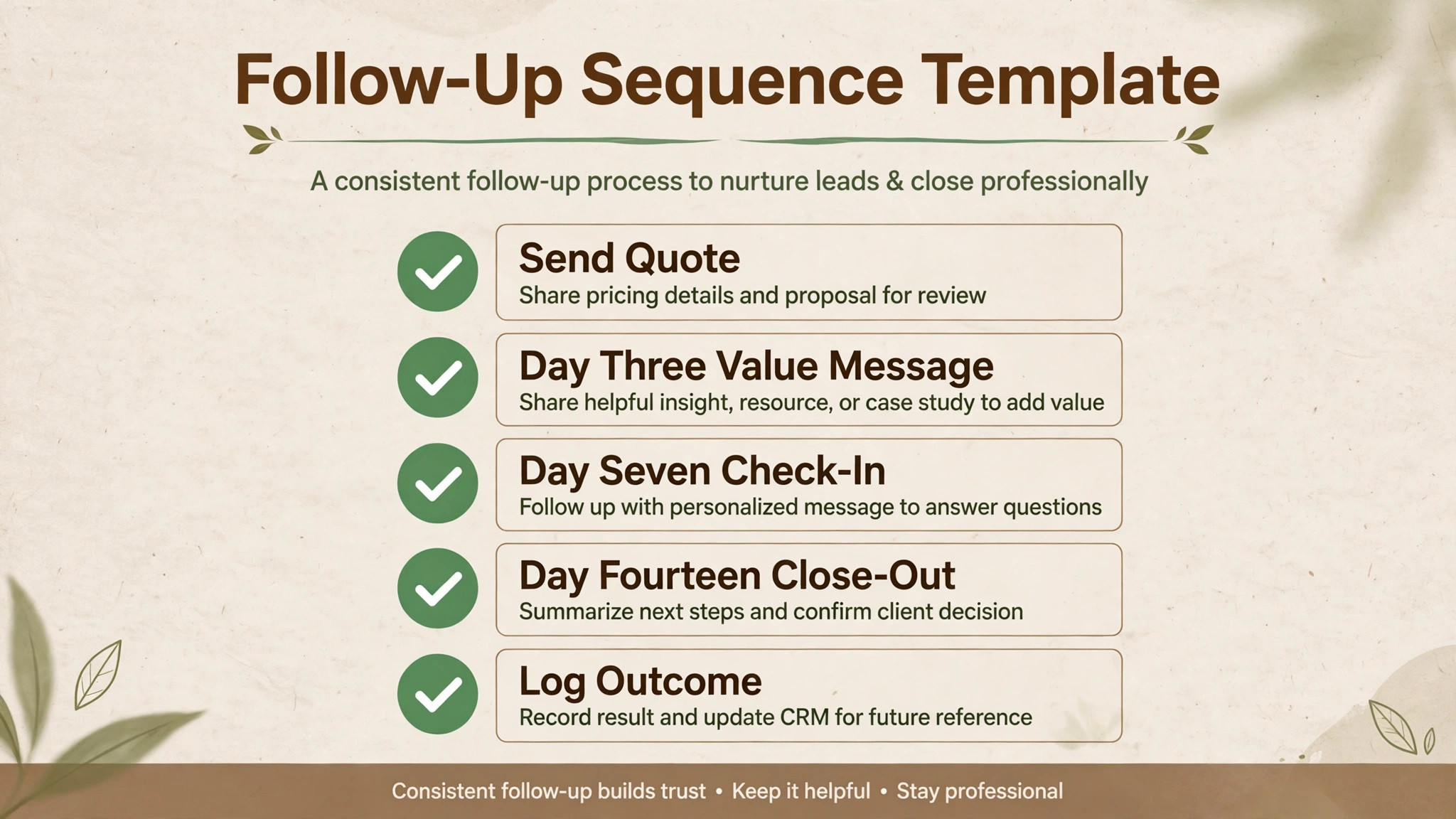
- QUOTE SENT BY TEXT AND EMAIL – Quote sent by text and email from a recognised number, with the project named and a reply invited.
- OPEN TRACKED – Open state checked within one day, with an unopened quote resent by text, not by another email.
- QUOTE SORTED – Quote sorted by size and by first-time or returning customer on the day it goes out.
- DAY ZERO CONFIRMATION – Day zero confirmation sent, naming the project and giving one clear next step.
- DAY THREE VALUE MESSAGE – Day three message sent with a real photo or a useful seasonal note from the site visit.
- BIG JOB CALL – Phone call made for large quotes and for any quote opened but unanswered by day five.
- DAY SEVEN DECISION HELPER – Day seven message sent with scope restated, start window named and deposit explained.
- DAY FOURTEEN CLOSE-OUT – Day fourteen close-out sent with a clear expiry date and a direct question about the decision.
- LOSS REASON RECORDED – Loss reason recorded for every lost quote, so pricing, scope and timing patterns become visible.
- PIPELINE REVIEWED – Active pipeline reviewed every Friday, with quotes older than fourteen days moved to win-back or closed.
Copy this list into your task system, assign one owner per item, and review it together each week. A checklist nobody owns is a poster, not a workflow, and the difference shows up in the first month.
What to say at each step of the sequence
The messages below are starting points, not scripts to copy blindly. Adapt each one with a real detail from the record, a real date and a real name, and keep the tone close to how your team actually speaks. A message that sounds like your team will be answered. A message that sounds like a system will be ignored.
The first message should confirm, not sell. Name the person, name the booking or visit, and give one clear next step with a reply route that works. Keep it under four short sentences, because a long message on a phone screen is a message that gets saved for later and then forgotten.
The second message should add value from the real record. Mention the last visit, the last class or the last conversation, and add one useful detail the recipient did not have, such as a date, a preparation note or a choice between two options. Value is what earns the next reply, and a message with no new information earns nothing.
The third message should make deciding easy. Restate the choice plainly, name the deadline honestly, and offer help with the decision rather than pressure to decide. If the recipient has a concern, this is the message that surfaces it, so end with a question that is easy to answer in one line.
The final message should close the loop with respect. Thank the person, state what happens next, and leave the door open with a real route back. A respectful close-out protects the relationship for the next cycle, and many lost bookings return months later to the business that closed gracefully.
What the 209 quote study means for a small crew
Measure four numbers weekly, namely response rate, conversion or completion rate, overdue rate and time from first contact to decision. use AI for landscaping company quote follow up should move at least two of those four within a month, or the workflow needs a timing change before it needs a tool change. Do not measure message volume, because sending more messages is easy and means nothing on its own.
Compare the new numbers with the same period before the workflow, not with another business, because seasons, prices and local competition differ too much for outside comparison to help. A guide such as estimating software for roofing contractors makes the same point for its own niche, where the honest baseline is your own past performance, measured the same way every week.
| Measure | What good looks like | What to change first |
|---|---|---|
| Response rate | Rising week on week | Message timing and first line |
| Overdue rate | Falling toward zero | The record step, not the message step |
| Decision time | Shorter, without more chasing | The clarity of the next step |
What one season of follow-ups teaches a crew
Seasonality changes every part of this sequence. In the spring rush, a quote that waits four days for a follow-up has often already lost to a faster competitor, because homeowners are booking the whole season in a few weeks. In winter, the same homeowner may need a slower sequence with a planning conversation rather than a booking push. AI can adjust the timing by season if you tell it the season and the booking window, but the rule stays the same. Match the urgency of your follow-up to the urgency of the homeowner’s season.
The site visit notes are the fuel for good follow-up, and most companies waste them. A note that says the homeowner worries about the oak roots, wants the patio ready for a graduation party, or hates the look of the current edging is worth more than any template. Feed those notes to your drafting assistant and require every follow-up to reference at least one real detail from the visit. Homeowners reply to messages that prove someone was listening. They ignore messages that could have been sent to any house on the street.
Losing well is a skill that pays for itself. Every lost quote should end with a short thank you, a question about what decided it, and a note in your system about whether price, timing, scope or a competitor won. After a month, those notes reveal patterns, such as a price gap on patios, a timing problem on spring cleanups, or a scope line that homeowners keep misunderstanding. AI can summarise those patterns across dozens of losses, but only if the loss reason was recorded honestly in the first place.
Finally, protect the crew from the pipeline. A follow-up sequence that books work faster than the crew can deliver creates a new problem, namely start dates that slip and homeowners who feel misled. Link the day seven message to a real start window, checked against the current schedule, and never promise a slot that is already full. A slightly slower booking pace with honest dates beats a fast pace with broken promises, because broken promises cost reviews, referrals and repeat work.
Getting follow-up running in the first two weeks
Week one starts with an audit, not a purchase. List every active homeowners, every open date and every promise that is currently tracked only in someone’s head or inbox, then move that list into one shared record with one owner. Write the rules for timing, channel and escalation on a single page, and get the whole team to agree them before any message goes out. An audit like this usually takes a day, and it prevents the most common failure, which is automating a messy list and then blaming the tool for messy results.
In the second half of week one, draft the templates and test them on real records. Pick five past cases that cover the normal range, from the easy win to the awkward exception, and draft every message for those cases by hand first. Then let the AI draft the same messages and compare the two sets side by side, keeping whatever is clearer and discarding whatever sounds generic. This comparison teaches the team what good input looks like, and it builds trust that the AI drafts will be checked rather than sent blind.
Week two is a pilot with a small group, not a launch to the whole list. Choose one segment, such as one class, one route, one month of renewals or one recall group, and run the full workflow for that segment only. Watch reply rates, watch complaints, and watch the time staff spend on review, because a workflow that saves an hour of drafting but costs two hours of fixing has not saved anything. Meet at the end of the pilot week and decide one change, not ten, so the effect of that change can actually be seen.
The most common pilot fixes are timing, channel and record gaps. A message sent at the wrong hour gets ignored, a message sent on the wrong channel never arrives, and a message built from a missing record field looks careless. Fix those three before you touch wording, because wording rarely causes a failed pilot. Also check the edge cases the pilot revealed, such as a duplicate record, a family with two contacts, or a customer who opted out on one channel but not another, and write a rule for each one.
Week three is the full rollout, and it should feel boring rather than exciting. Move the remaining segments onto the workflow one at a time, keep the weekly review meeting, and publish a one page monthly report showing response rate, overdue rate and decision time. Boring is the goal, because a workflow that only works when someone is excited about it will stop working in the first busy month. A workflow that runs quietly, with a named owner and a weekly review, will still be running next year.
Keep one rule above all others through the rollout. No message goes out without a named human approving it, no record stays in a private inbox, and no overdue item waits for the month-end meeting. Those three habits cost minutes a week, and they are what keep the workflow honest when the team is busy and the season is at its peak.
Frequently Asked Questions
How often should a landscaper follow up on a quote?
Four or five times over about two weeks works well, namely on the day the quote goes out, on day three, on day seven and on day fourteen, plus a call when a large quote is opened or when a quote sits unanswered. That rhythm covers the window in which most decisions happen, without turning follow-up into nagging.
Should follow-up be by text, email or phone?
Use text for speed, email for the full quote and scope, and phone for large jobs and real objections. Text gets opened, email carries detail, and a call answers the question a homeowner will not put in writing. A sequence that uses only one channel will miss homeowners who live in another.
What should the first follow-up message say?
It should confirm the quote arrived, name the project, invite questions and give one next step. Keep it short and specific to the property, mentioning something from the walkthrough so the homeowner knows it is not a mass message. AI can draft it, but the site detail must come from your notes.
When should you offer a discount to close a quote?
Rarely, and never as the first follow-up. First check whether the homeowner understood the scope, whether phasing helps, or whether a smaller first phase fits the budget. A discount offered too early teaches homeowners to wait, while a scope change keeps the price honest and the job profitable.
How do you handle a homeowner who chose a cheaper competitor?
Thank them, ask what the other quote included, and record the answer. Sometimes the cheaper quote excluded cleanup, disposal or a warranty, and a short factual comparison can still win the job. Even when it does not, the answer teaches you where your quotes need clearer scope lines.
How long should a quote stay open?
State an expiry date on the quote, usually fourteen to thirty days depending on the season and material prices. An open-ended quote invites delay and leaves you exposed to price changes. A stated date creates a natural reason for the day fourteen message and protects your schedule.
The verdict for landscaping companies
The verdict is plain. Get the quote opened, follow up inside three days, call the big jobs, and close the loop in two weeks. That sequence, run every week without exception, will close more work than any new lead source, because it works the pipeline you already paid to build. use AI for landscaping company quote follow up is a discipline before it is a technology, and the discipline is a clean record, a clear rule and a message approved by a human.
Start with the template in this guide and run it for thirty days. Track open rate, reply rate and close rate by quote size, and change one thing at a time, such as the day three message or the call rule. The companies that win in landscaping are rarely the cheapest. They are the ones that stay in touch until the homeowner decides. For a neighbouring view on keeping customers close, see dispatch software for plumbing companies and route scheduling for mobile pet groomers, which cover the same habit of noticing drift early and acting on it personally.