
The placement is signed, the candidate starts on Monday, and then silence. Nobody calls in week two or asks how the first Friday went. By week six the hiring manager mentions a small concern, by week eight the candidate is interviewing elsewhere, and by week ten the placement is gone. The agency did not lose that placement on start day. It lost it in the quiet weeks after, when a short check-in would have surfaced the problem while it was fixable. If you want to use AI for staffing agency placement follow up well, start from that gap. The work is not more selling. It is structured attention in the first 90 days, on time, to both sides.
How to use AI for staffing agency placement follow up without adding admin
A small agency cannot afford a full time placement care team, but it also cannot afford silent placements. The answer is a fixed cadence with AI doing the scheduling, drafting, and sorting, while recruiters handle the conversations that matter. The system in this guide runs on six touches in 90 days, two surveys, and one escalation rule. It works for temp placements, contract roles, and permanent hires, with the timing adjusted to the placement type. The difference between placement types is only the stakes at each touch. A temp placement needs a fast week one check. A permanent placement needs a deeper day 90 review. The cadence stays the same, and the questions change with the role.
The placement gap nobody owns
Most agencies track placements until the start date, then hand the relationship to chance. Recruiters move to the next requisition, managers assume no news is good news, and candidates assume small concerns are not worth raising. That assumption is where placements fail. Early turnover research makes the risk concrete. In a 2025 Enboarder survey of HR leaders, 20.5 percent reported that up to half of new hires leave within the first 90 days, and 60.8 percent said early turnover had increased in the past year. Those figures describe employers generally, not staffing placements, but the lesson transfers. The first 90 days are the highest risk window, and attention then is the cheapest retention tool an agency owns.
The gap also has an ownership problem. The hiring manager owns the job, the candidate owns their experience, and the agency owns the match, but nobody owns the check-in. When a concern surfaces, each side assumes another will raise it. A system built to use AI for staffing agency placement follow up fixes the ownership problem by naming the owner, the date, and the question in advance. The recruiter owns the cadence. The system owns the reminders. The candidate and the client each get a short, separate check-in, because what a candidate tells a recruiter often differs from what they tell a manager. That second channel is the real value of agency follow-up. It catches what internal check-ins miss.
The follow-up workflow, step by step
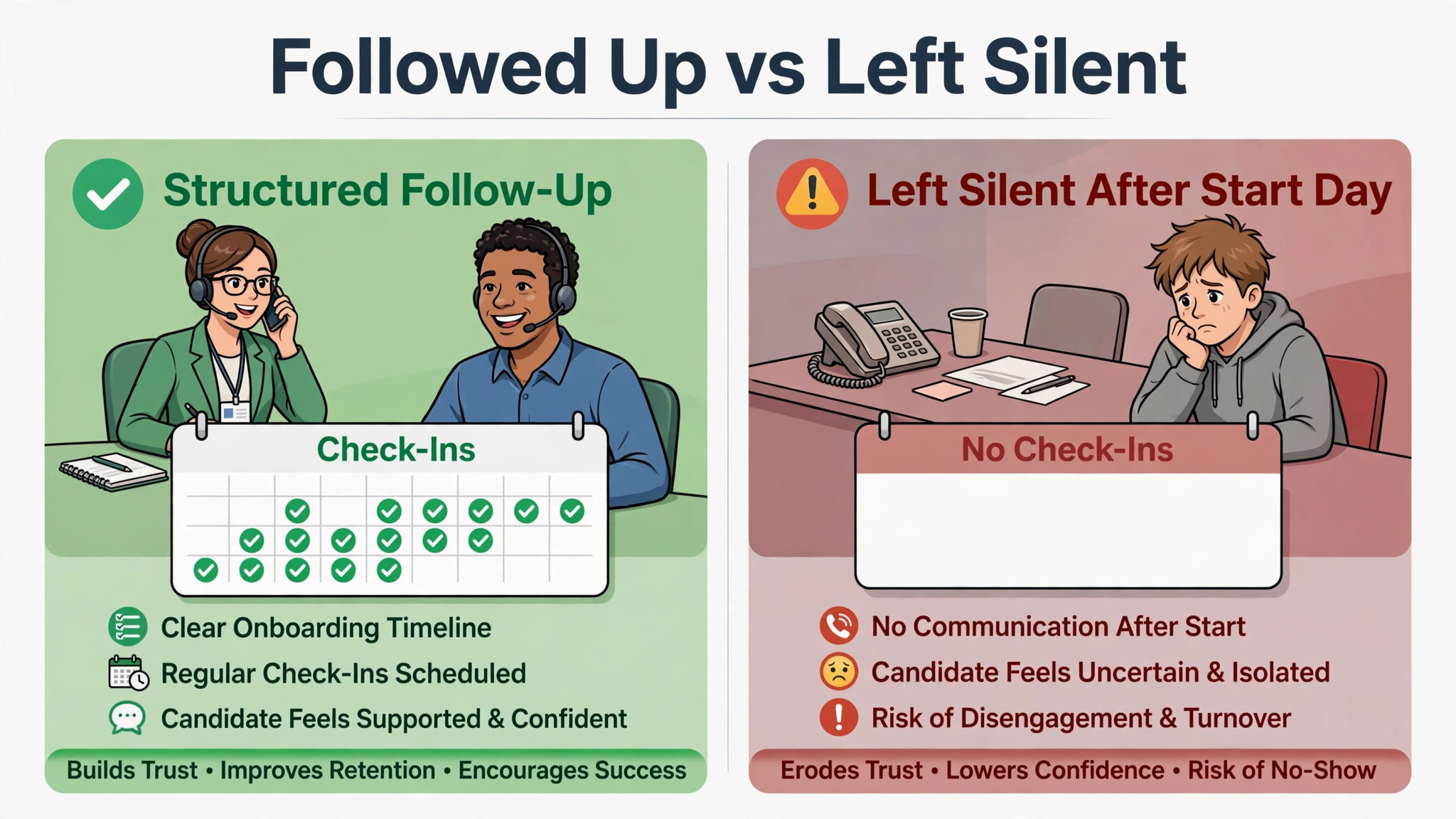
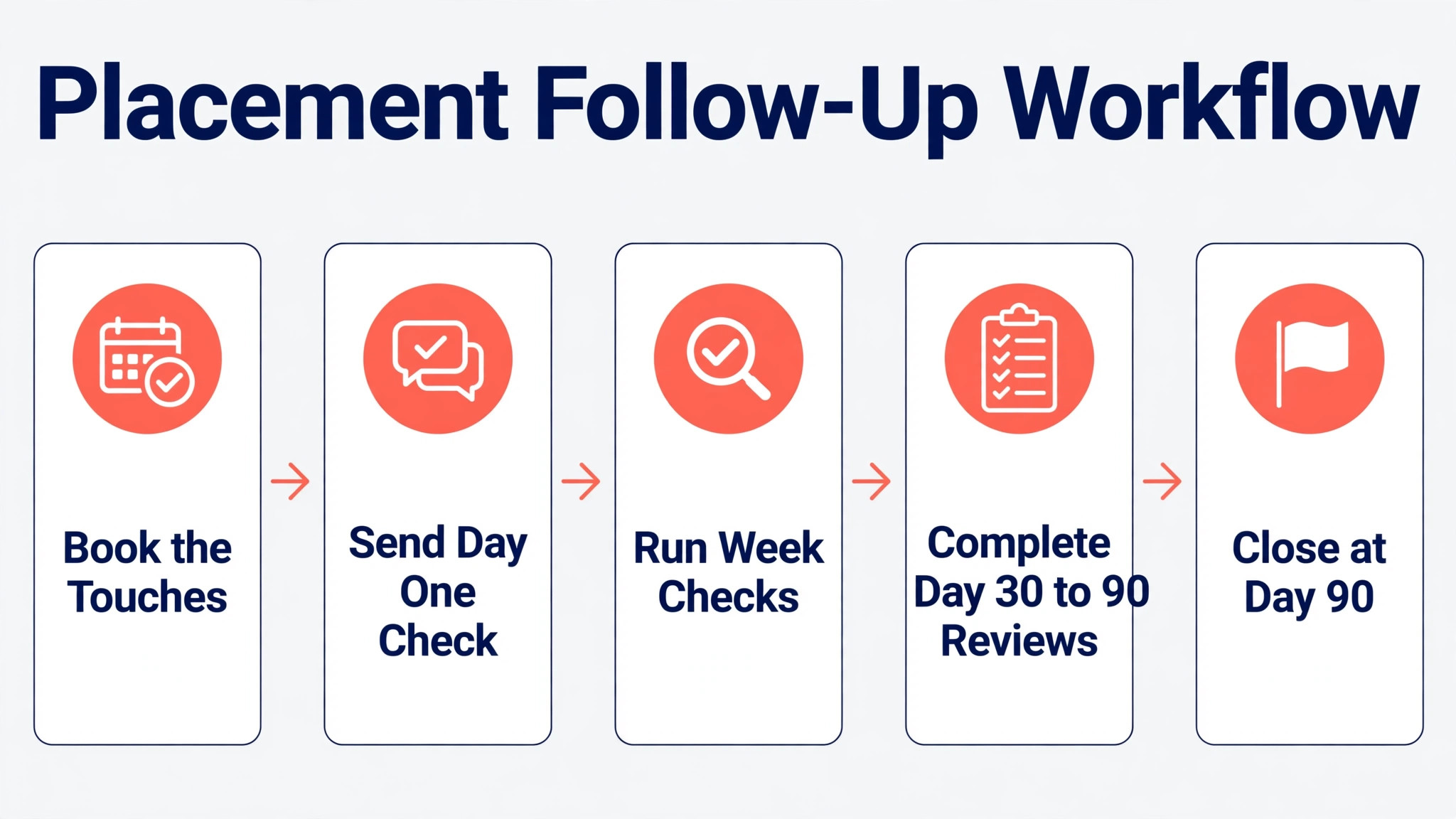
This workflow starts on placement day, not on start day. Every date is booked before the candidate walks in, so a busy week cannot quietly cancel a check-in. AI schedules the touches, drafts the messages, and sorts the replies into green, amber, and red. Recruiters read every amber and red reply personally and act within one business day. Green replies get a short thank you and a note on file. Nothing in this section requires new software to start. A spreadsheet of placement dates, a survey form, and a messaging tool your team already uses will run the first cycle.

Step 1. Book all five touches on placement day
On the day a placement is confirmed, book the full touch schedule. For permanent roles, use day one, week one, week three, day 30, day 60, and day 90. For contract roles under six months, use day one, week one, week three, day 30, and day 60. Enter the candidate, the client contact, and the hiring manager as separate recipients, because the candidate check-in and the client check-in ask different questions. AI can create these calendar entries and reminders from the placement record automatically. A touch not booked on placement day will not happen, because the next requisition always feels more urgent.
Step 2. Send a day one confirmation to both sides
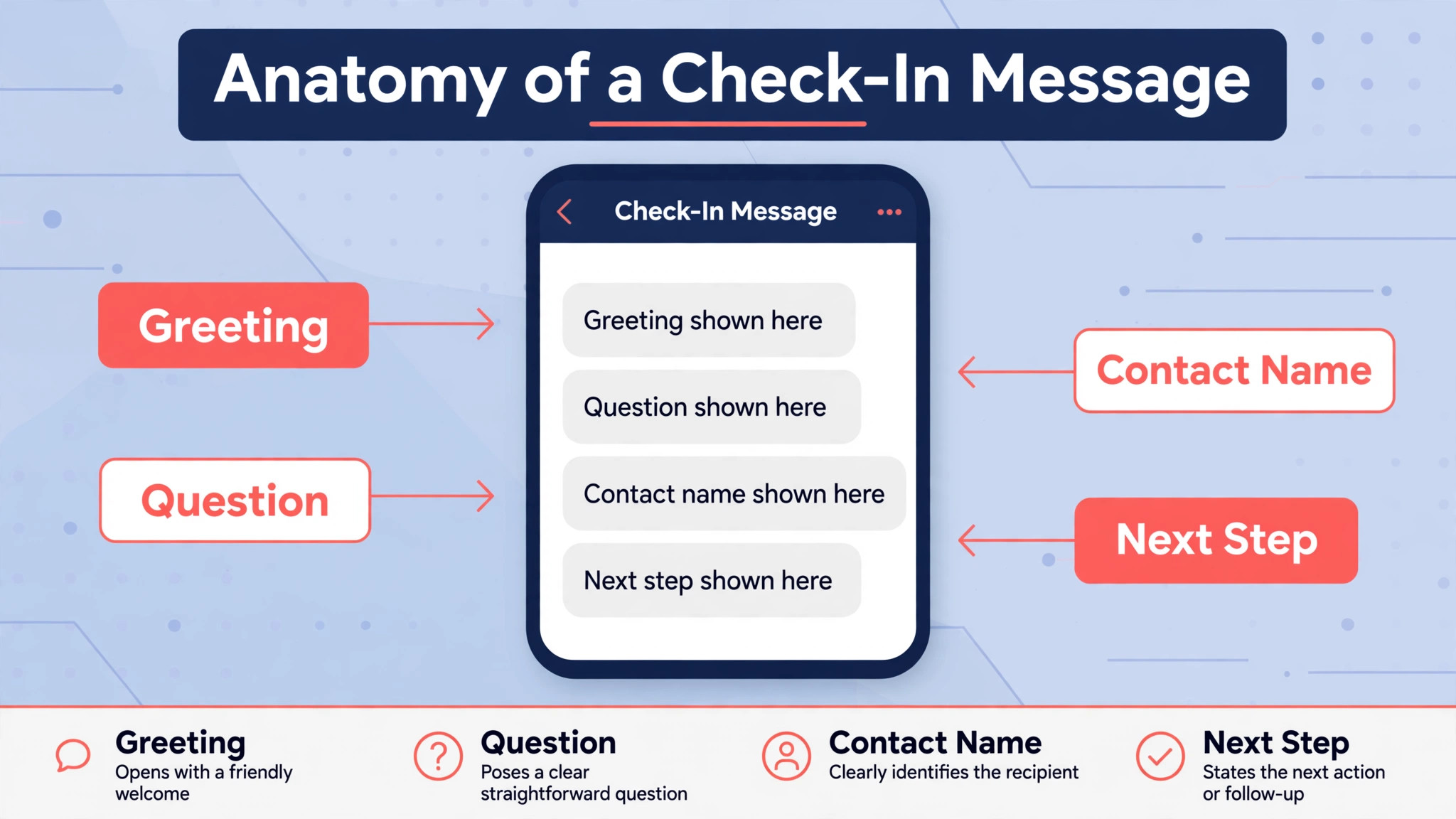
On the first day, send a short message to the candidate and a separate one to the client. The candidate message confirms a smooth start, names the recruiter as the contact for early questions, and asks one question only. Did anything surprise you today. The client message confirms the start, asks whether onboarding went as planned, and names the same recruiter contact. Keep both messages under 60 words. Day one messages are not surveys. They prove the agency is still present after the signature, and give both sides a named person to contact before a small issue grows. A candidate who knows who to call will call. A candidate who does not know will stay quiet and start looking.
Step 3. Run the week one check-in by phone
Week one end is the highest value touch in the workflow, and it should be a phone call, not a form. Call the candidate first. Ask about training, welcome, tools access, and one thing they wish they had known earlier. Then call the client contact and ask about attendance, attitude, early output, and gaps in skills or expectations. Compare both answers before recording anything. When the candidate says training is thin and the client says progress is slow, you found a fixable problem, not a bad match. AI can turn call notes into a file summary, but the call itself must be human. A week one form misses tone, hesitation, and the half sentence revealing the real issue.
Step 4. Send the week three pulse survey
By week three, novelty has worn off and friction appears. Send a short pulse survey to the candidate and a shorter one to the client. Five questions each is enough. The candidate survey covers role clarity, manager support, workload fit, team belonging, and likelihood to stay. The client survey covers output so far, communication, reliability, and any support the agency should provide. Use AI for staffing agency placement follow up to build the survey, send it at the right date, and sort replies into green, amber, and red. A recruiter reads every amber and red reply the same day and calls the respondent. A green reply gets a thank you and a file note.
The week three survey is the early warning system. Skipping it means the next signal arrives at day 30, when the problem is already a decision.
Step 5. Run the day 30, 60, and 90 reviews from one template
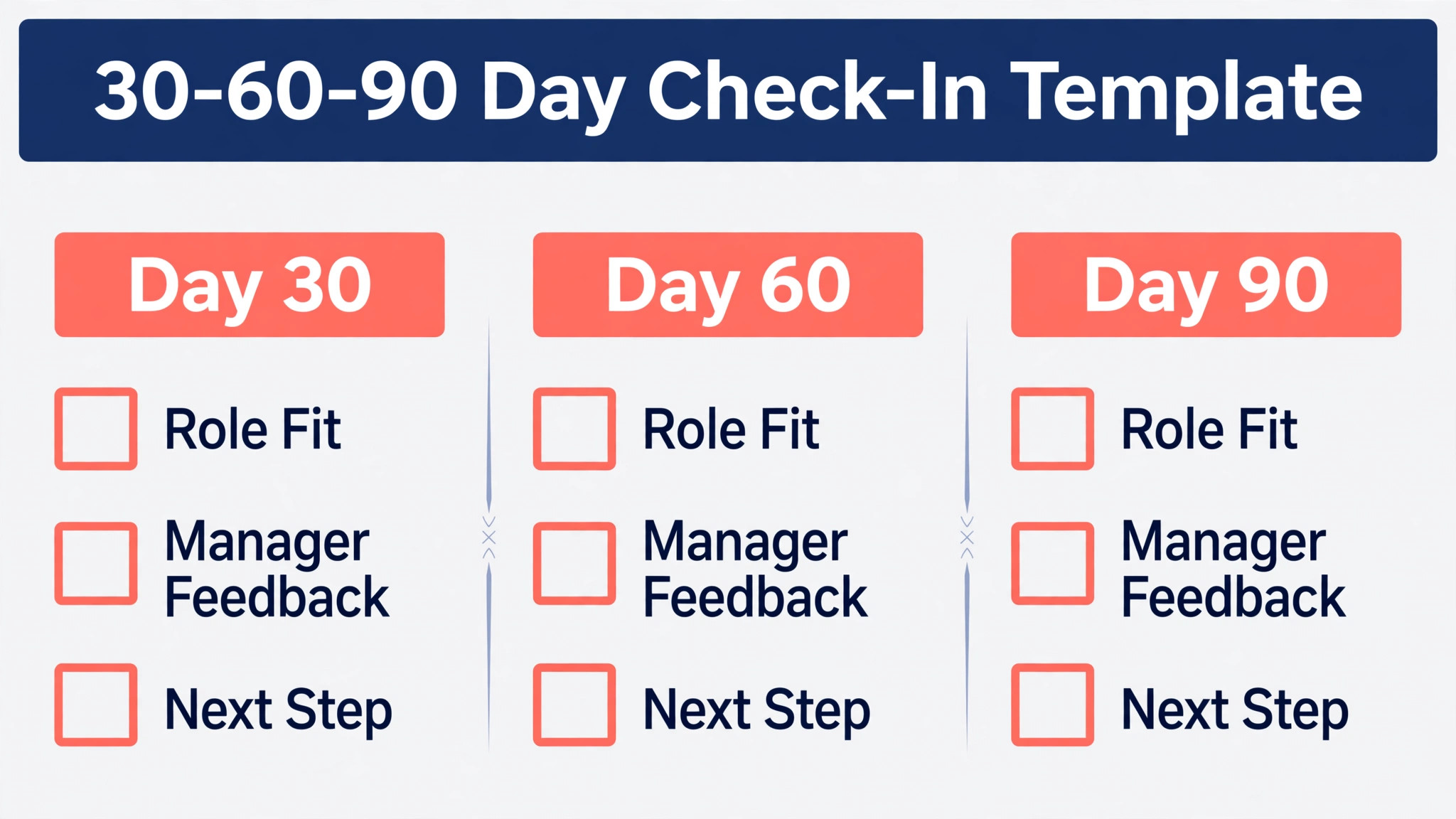
Day 30, 60, and 90 reviews use the template in the next section, with the emphasis shifting at each stage. Day 30 covers settling in, tools, relationships, and early gaps. Day 60 covers contribution, independence, and team fit. Day 90 covers future goals and whether the placement should convert, extend, or close with a testimonial. Use AI for staffing agency placement follow up at this stage to draft the review summary from survey replies and call notes, and to flag any answer that changed sharply since the last touch. A sharp change, such as belonging dropping from high to low between day 30 and day 60, is a signal to act, not a statistic to file.
Step 6. Escalate amber and red signals within one business day
Every signal needs a named response time. A red signal, such as a candidate saying they plan to leave or a client saying output is unacceptable, gets a same day call from the recruiter and a plan agreed within 48 hours. An amber signal, such as thin training or unclear expectations, gets a call within one business day and a fix agreed within the week. Record the signal, the action, and the outcome in the placement file.
AI can sort signals and draft the follow-up message, but it cannot make the call or agree the fix. Speed is the point. A red signal handled in three days often becomes a lost placement. The same signal handled in three hours often becomes a saved one, because the candidate feels heard before they decide to leave.
Step 7. Close the loop at day 90 and capture the proof
At day 90, close the placement properly. Send the client a short summary of the placement, check-in history, and outcome. Ask for a testimonial or a referral while the success is fresh. Send the candidate a thank you, a note about future roles, and an invitation to stay in touch.
Record the final outcome, the number of touches completed, and any lesson for the next similar placement. AI can draft both closing messages and can group lessons across placements into themes, such as onboarding gaps in one industry or training gaps for one role type. Those themes are gold for the agency, because they turn follow-up from a cost into a source of better matching. A placement closed well also produces the next placement, through referral and repeat business.
The 30-60-90 day check-in template
Copy this template for every placement and adjust the emphasis at each stage. Send the candidate version to the candidate and the client version to the client, separately, because honest answers need separate channels. Keep every question short, and keep the survey under five minutes. A long survey in week three gets ignored, and an ignored survey tells you nothing. The template below is the copyable core of this guide, and it is the reason this workflow survives busy weeks. When the template is fixed, the only work is sending it and reading the replies.
Day 30 candidate questions.
How clear is your role after the first month.
What training or access are you still missing.
How supported do you feel by your manager.
Who on the team have you connected with, and who have you not.
What is one thing we could fix this week.
How likely are you to stay in this role for the next 90 days.
Day 60 candidate questions.
How independent are you now in your core tasks.
What have you delivered that you are proud of.
Where do you still need support or training.
How well do you fit with the team and its way of working.
What would make the next 30 days better.
How likely are you to stay in this role for the next six months.
Day 90 candidate questions.
What are your goals for the next quarter in this role.
What strengths should we note for future roles.
What growth area should we support next.
Would you recommend this employer to a peer.
Would you work with our agency again.
What should we do differently for the next person in this role.
Day 30 client questions.
How is attendance and reliability so far.
How does early output compare with your expectation.
What gap in skills or expectations should we address.
What support should the agency provide now.
Would you place with us again on this evidence.
Day 60 client questions.
How independent is the placed worker now.
What has the worker delivered that matters most.
What concern, if any, is growing rather than shrinking.
Should the role change in scope or support.
How likely are you to extend or convert this placement.
Day 90 client questions.
How would you rate the placement overall.
What did our follow-up do well, and what did it miss.
Would you give a testimonial or referral.
What role should we discuss next.
The template works because it asks the same core questions at every stage, so change over time is visible. A candidate who rates belonging high at day 30 and low at day 60 is telling you something, even if no single answer looks alarming. Compare each placement against its own history, not against other placements. A quiet candidate in a quiet team may be perfectly happy, while a chatty candidate in a loud team may be struggling. The pattern matters more than any single score, and the pattern only appears when the same questions are asked on schedule.
Tools that run this workflow
The best tool is the one that already holds your placement records, because follow-up dates, contacts, and history must live in one place. Agencies that use AI for staffing agency placement follow up well start from a familiar system with clean data, which beats a new system with messy records. Review your options in a dedicated guide to CRM software for staffing agencies before you change systems, because switching in the middle of a placement cycle creates exactly the missed touches this workflow is designed to prevent. Agencies that already screen candidates with AI should also read a guide to staffing agency candidate screening to see how the front end of the pipeline connects to the follow-up stage.
Bullhorn placement records
Bullhorn is a widely used staffing platform that combines applicant tracking with CRM records, and it suits agencies that need placement history, client contacts, and candidate records in one system. Its strength for follow-up is the single placement record. When the placement, the client contact, and the candidate history live together, booking five touches and tracking their completion becomes a report rather than a memory test. Use AI to draft check-in messages from that record and to summarize call notes, but keep the escalation decision with the recruiter. A red signal needs a human call, not an automated reply.
HubSpot follow-up sequences
HubSpot is a general CRM platform with sequences, reminders, and email tracking, and it suits smaller agencies that want follow-up automation without a specialist system. Its strength is the sequence. A recruiter can build all six touches as a dated sequence, with reminders to call rather than only emails to send. Use AI to draft the sequence messages in the agency tone, then edit them by hand. The risk with a general CRM is that placement data and sales data mix, so keep a clear placement pipeline separate from the sales pipeline. Clean separation keeps follow-up dates visible and prevents a placement touch from being lost among sales tasks.
Zoho Recruit candidate tracking
Zoho Recruit is a recruitment platform with candidate tracking, client records, and workflow automation, and it suits agencies that want hiring and placement records in one place at a lower cost than specialist platforms. Its strength for follow-up is the workflow rule. A placement status change can trigger the check-in sequence automatically, so the day one and week one touches are booked without a recruiter remembering to book them. Use AI to draft the survey questions and to group survey replies into themes across placements. Keep the human check on every amber and red reply. Automation books the touch. Only a recruiter can save the placement.
What to ask at each check-in
The table below is the quick reference for the whole workflow. Use it to train new recruiters, because it shows what changes at each stage and what stays the same. The candidate questions move from settling in, to contribution, to future. The client questions move from early output, to independence, to the decision about extension or conversion. Both sides get asked about likelihood to continue, because that single question, asked early and honestly, predicts more than any other.
| Check-in | Candidate focus | Client focus | Action if amber or red |
|---|---|---|---|
| Day one | Start went smoothly, one surprise | Onboarding went as planned | Same day call, fix the surprise |
| Week one | Training, welcome, tools access | Attendance, early output, gaps | Call within one business day |
| Week three | Role clarity, support, belonging | Output, communication, reliability | Call same day, agree a fix |
| Day 30 | Settling in, missing training | Output versus expectation | Fix agreed within the week |
| Day 60 | Independence, contribution, fit | Independence, growing concerns | Plan agreed within 48 hours |
| Day 90 | Future goals, testimonial | Overall rating, next role | Close, capture proof, ask referral |
The table also sets the escalation rule in plain sight. A recruiter who sees an amber reply should not need to ask what to do. The table says it. Call, agree a fix, record the outcome. That clarity is what makes the workflow survive staff changes. A new recruiter can run the cadence from the table and the template alone, without learning the system from scratch. Keep both documents in one place, review them quarterly, and update the questions when a repeated theme shows the current set is missing something.
Warning signs and escalation
Some warning signs look small and cost placements. A candidate who stops replying to check-ins is a warning sign, not a busy week. A client who stops answering the day 30 survey is a warning sign, not a satisfied customer. A candidate who mentions a second interview, even casually, is a red signal. A client who mentions restructuring, even vaguely, is a red signal for contract roles. Train recruiters to treat silence as data. When a touch goes unanswered, the follow-up is a phone call, not another email. Two unanswered touches trigger a manager review of the placement. Three unanswered touches trigger a direct conversation with the client about risk, because a placement that cannot be contacted cannot be saved.
Escalation also needs a boundary. The agency can fix training gaps, clarify expectations, and mediate misunderstandings. It cannot fix a toxic manager, a role that was misdescribed, or a pay gap the client will not close. When the problem is outside the agency’s power to fix, say so plainly to both sides, and help the candidate plan an exit that protects their reputation and the agency’s relationship with the client. A graceful exit, handled honestly, often produces a future placement with the same client. A placement that collapses without warning produces neither. When you use AI for staffing agency placement follow up, the escalation rule is the part that must never be automated away. Sorting can be automatic. Judgment cannot.

How to measure placement survival
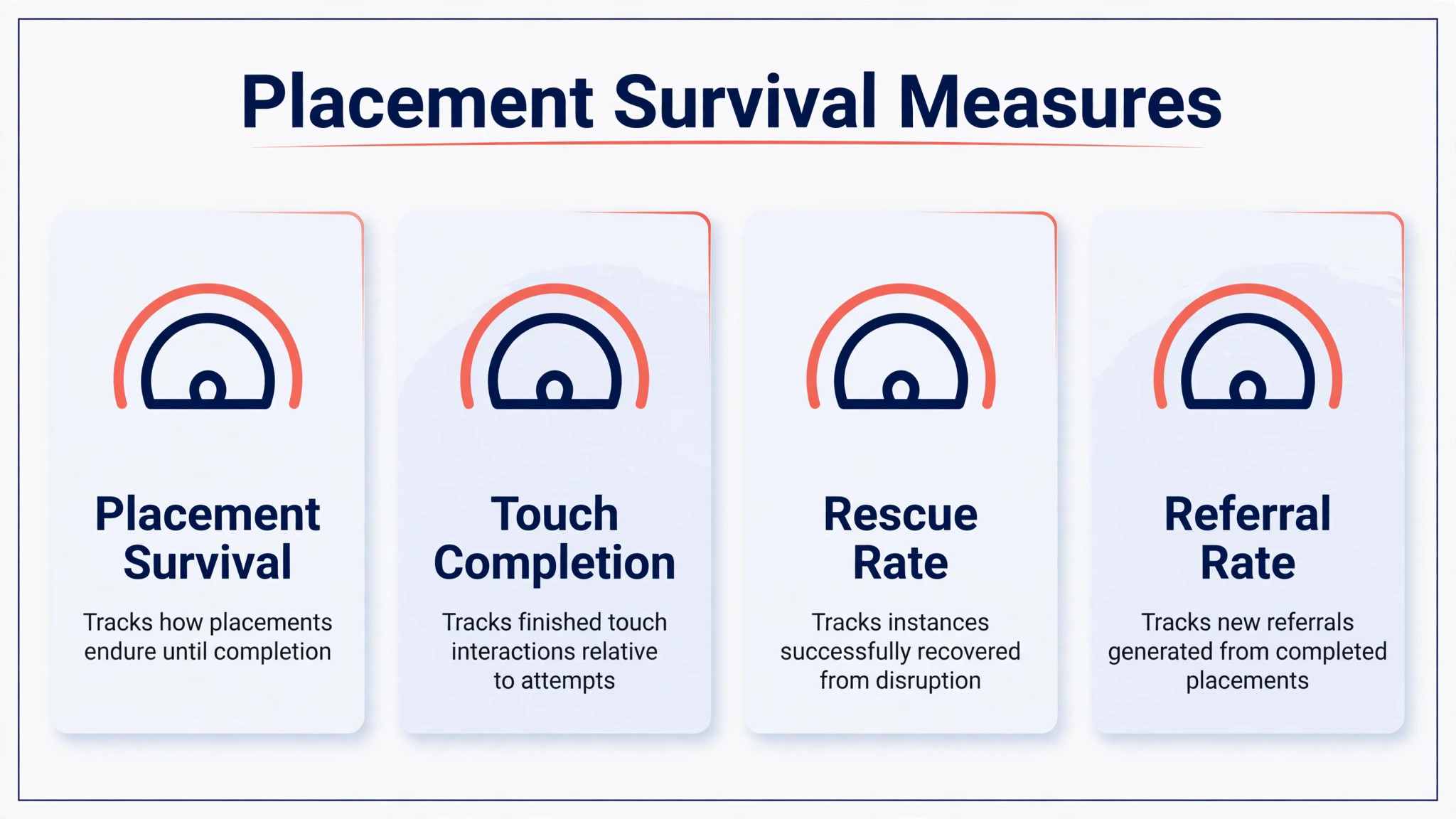
Measure four numbers monthly and judge the system on all four together. Placement survival at day 90 is the share still active at day 90. Touch completion is the share of booked check-ins completed on time. Rescue rate is the share of amber and red signals that ended with the placement continuing. Referral rate is the share of day 90 closures that produced a testimonial or referral. A system that lifts touch completion but not survival is busy without being useful. A system that lifts survival and referral rate is working, because it saves placements and produces new business from the ones it saved. Report these numbers on one monthly page, not in a dashboard nobody reads.
Compare survival by placement type, industry, and client, not as one overall figure. A survival problem concentrated in one industry points to a matching or onboarding issue there. A survival problem concentrated with one client points to an issue the agency should raise directly. Use AI for staffing agency placement follow up to group survival data by these dimensions and surface the concentration, but keep the conversation with the client human. Also track the week three survey response rate separately. If response rates fall, the early warning system is failing, even if survival looks fine. Survival is a lagging number. Response rate is a leading one, and leading numbers are what let you act before placements are lost.
Mistakes that cost placements
The most common mistake is checking in only with the client. A client-only cadence misses the candidate side entirely, and the candidate side is where most early exits are decided. Always check both sides, separately, at every stage.
The second mistake is sending a long survey at week one. Week one needs a phone call, not a form, because tone and hesitation carry the information. The third mistake is letting AI send without a human read. AI drafts can misstate a role title, invent a detail, or use a tone that does not fit the relationship. Every message needs a recruiter eye before it goes out, especially in the first cycle. The fourth mistake is recording signals without acting on them. A file full of amber flags with no recorded action is worse than no file, because it proves the agency knew and did nothing.
The fifth mistake is treating follow-up as a sales exercise. A check-in that pushes the next requisition before asking how the placement is going will be read as self interest, and the candidate will stop answering honestly. Ask about the placement first, listen, act, and only then, at day 90, ask about the next role.
The sixth mistake is stopping at day 30. Many agencies run a good first month and then disappear, but the day 60 and day 90 touches are where extension, conversion, and referral decisions are made. A system that stops at day 30 saves the easy placements and loses the valuable ones. Run the full 90 days, every time, even when the placement looks safe. Safe placements are the ones that produce testimonials, and testimonials produce the next client.
Frequently Asked Questions
How often should a staffing agency check in after placement?
Check in on day one, at the end of week one, at week three, and on day 30, day 60, and day 90. That cadence gives six touches, with the week one touch by phone and the week three touch by short survey. For short contract roles, compress the later touches to day 30 and day 60, but never skip week one or week three. Those two touches catch the problems that decide most early exits.
Each touch should be short, with one clear question for day one and five questions for surveys. A cadence that is booked on placement day, with dates in the calendar before the candidate starts, is far more likely to happen than a cadence left to memory. Book first, then work the list.
What should agencies ask candidates at the 30 day check-in?
Ask about role clarity, missing training or access, manager support, team connections, one fixable problem, and likelihood to stay for the next 90 days. Those six questions cover the factors that decide early retention, and they are short enough to answer in five minutes.
The most important question is the last one, because a candidate who rates likelihood to stay as low is telling you to act now. Follow any low rating with a phone call within one business day, not another survey. The day 30 review is also the moment to compare answers with week one and week three, because a sharp change in any factor is a stronger signal than any single score. Record the comparison, not only the latest answers.
Should agencies check in with the client or the candidate first?
Check both, separately, at every stage, and call the candidate first at week one. The candidate call comes first because candidates raise concerns with recruiters that they will not raise with managers, such as thin training or unclear expectations. The client call follows, and comparing the two answers reveals the real problem. A client only cadence misses the candidate side, where most early exits are decided. A candidate only cadence misses the client side, where extension and conversion decisions are made. Separate channels matter. A joint check-in produces polite answers from both sides and honest answers from neither. Keep the channels separate, compare the answers, and act on the gap between them.
Can AI run placement follow-up without recruiters?
AI can schedule touches, draft messages, build surveys, sort replies into green, amber, and red, and summarize call notes. It cannot make the week one phone call, judge a hesitant answer, mediate a misunderstanding, or agree a fix with a client. Those judgments are the work that saves placements, and they need a recruiter. The right division is clear. AI owns timing, drafting, and sorting. Recruiters own conversations, escalation, and decisions. Agencies that automate the conversation lose the second channel advantage entirely, because candidates quickly learn that replies go to a system, not a person. Keep a human on every amber and red reply, and keep the week one touch as a phone call, not a form.
What is a good placement survival rate at day 90?
There is no single benchmark that fits every agency, because survival varies by industry, role type, and contract length. Judge your agency against its own history first.
Track survival at day 90 by placement type and by client, and look for improvement over two quarters of running the full cadence. A survival problem concentrated with one client or in one industry points to a specific fix, such as better onboarding in that industry or a direct conversation with that client. Comparing your rate with other agencies is less useful than comparing your current quarter with your previous one, because your mix of roles and clients is unique. Report survival alongside touch completion and rescue rate, so you know whether the system ran and whether it worked.
Which CRM tools work best for placement follow-up?
The best tool is the one that already holds your placement records, because follow-up dates, contacts, and history must live in one place. Bullhorn suits agencies that need staffing specific tracking, HubSpot suits smaller agencies that want general CRM sequences, and Zoho Recruit suits agencies that want hiring and placement records together at a lower cost.
Choose the tool your recruiters already use well rather than switching to chase a feature. For broader context, compare recruitment focused options in a guide to CRM software for recruitment agencies, and read how follow-up works in a related sales setting in a guide to car dealership lead follow up. New agencies should also read a practical first employee onboarding guide to understand what the client side of onboarding looks like.
Final verdict
Here is the decision. Book the touches on placement day, call in week one, survey in week three, review at day 30, 60, and 90, escalate amber and red signals within one business day, and close every placement with proof and a referral ask. That is the whole system.
Use AI for staffing agency placement follow up to make it affordable for a small agency, handling scheduling, drafting, and sorting. Recruiters make it work by handling the calls, the judgment, and the fixes. Start with your next five placements, run the template exactly as written, and compare their day 90 survival with your last five placements. If survival rises, keep the system and extend it. If it does not, check touch completion first, because a system that was never run cannot be judged. The placements you save in the first 90 days are the cheapest revenue your agency will ever earn.