
Start with the verdict. If you run a tanning salon and too many members drift away at renewal time, use AI for tanning salon membership renewals as a timed reminder and rescue system, not as a discount machine. The salons that keep members do not send more messages. They send the right message at the right moment, they remind members of value they already paid for, and they make renewal a one tap decision. AI handles the timing, the list sorting, and the first draft. Your staff handles the judgment, the offer, and the final send. That division of work is what makes this system both fast and human.
How to use AI for tanning salon membership renewals without sounding pushy
A tanning membership only renews when the member still sees value in it. That value is built during the month, not in the week before billing. The workflow in this guide therefore starts long before the renewal date. It tracks visits, spots quiet members early, and sends short messages that reference real behavior, such as a missed week or an unused upgrade. When you use AI for tanning salon membership renewals in this way, the renewal message feels like a continuation of a relationship, not a surprise bill. Members stay because they were looked after, not because they were chased.
The verdict in plain terms
For most tanning salons, the best starting point is three timed touches and one rescue offer. Send a value reminder 10 days before renewal, a short renewal notice three days before billing, and a same day confirmation when payment succeeds. Add one rescue message for members who cancel or whose payment fails. Run that system for two full renewal cycles before you judge it. If your renewal rate rises and your cancellation reasons stay visible in your records, keep the system and add a loyalty perk. If nothing changes, fix the offer or the timing before you blame the tool.
| Member situation | Best first move | What to avoid |
|---|---|---|
| Active member, renewal in 10 days | Value reminder with visit count and next month plan | A discount offered before the member asked for one |
| Quiet member, no visit in three weeks | Friendly check in plus a reason to return this week | A billing reminder that ignores the silence |
| Payment failed at renewal | Same day payment update link plus a short grace note | Repeated billing attempts with no message |
| Member asked to cancel | One save attempt, then a clean exit and a return offer later | A stream of messages after the member said no |
The table above is the decision shortcut for the whole workflow. Every step that follows supports one of those four moves. Keep it near your front desk routine until the habit is automatic. Staff should be able to answer one question for any member. Is this member active, quiet, failed, or leaving. The answer decides the message, and the message decides whether the member stays.

Why members cancel and what actually saves them
Members rarely cancel for one single reason. The common pattern is a slow fade. Visits drop from twice a week to once, then to none. The member stops thinking about the salon, the renewal charge arrives as a surprise, and cancelling feels easier than re-engaging. Price matters, but it is rarely the whole story. A member who visits regularly and feels known by name will often renew at the same price without a second thought. A member who has not visited in a month will question the same price, because the value has faded from memory. Renewal work is therefore mostly memory work. Remind members what they used, what they liked, and what comes next.
AI helps most with the noticing part. No person can watch every visit pattern across hundreds of members, but a system can flag the member who visited weekly and then stopped. It can also draft a message mentioning the last visit, the usual bed level, or the lotion the member buys. Staff then check the draft for accuracy and tone before sending. That check matters. A message with a wrong detail, such as a wrong package name, damages trust faster than no message at all. The goal is a system that notices early, drafts honestly, and never sends a guess dressed up as a fact. When you use AI for tanning salon membership renewals, that noticing is the whole advantage.
The renewal workflow, step by step
This workflow runs on a weekly rhythm plus three fixed renewal touches. The weekly rhythm takes under an hour once the setup is done. The renewal touches are automatic in timing but human in approval. Nothing in this section requires a new software purchase to start. You can run the first cycle with your current booking system, a spreadsheet of renewal dates, and a messaging tool your staff already uses.

Step 1. Pull the renewal list every Monday
Start each week with one list. Pull every member renewing in the next 21 days, every member whose payment failed in the past seven days, and every member with no visit in the past 21 days. Sort the list into the four groups from the decision table, active, quiet, failed, or leaving. Use AI for tanning salon membership renewals to sort this list, then review it yourself before any message is written. A list with wrong dates or duplicate names will poison every later step, so fix data errors at this stage, not at the send stage.
Step 2. Check visit history before you write anything
For each member on the list, confirm three facts. When was the last visit, which package does the member hold, and is there an open issue such as a broken bed complaint or an unresolved payment question. AI can surface these facts in a short summary per member, which saves staff from digging through records one by one. Do not let the summary invent facts. If the record is blank, the message must not claim a visit that did not happen. A member with an open complaint gets a personal call first, not a renewal message. Sending a billing reminder to an unhappy member is the fastest way to turn a fixable problem into a cancellation.
Step 3. Draft three renewal messages with AI, then edit by hand
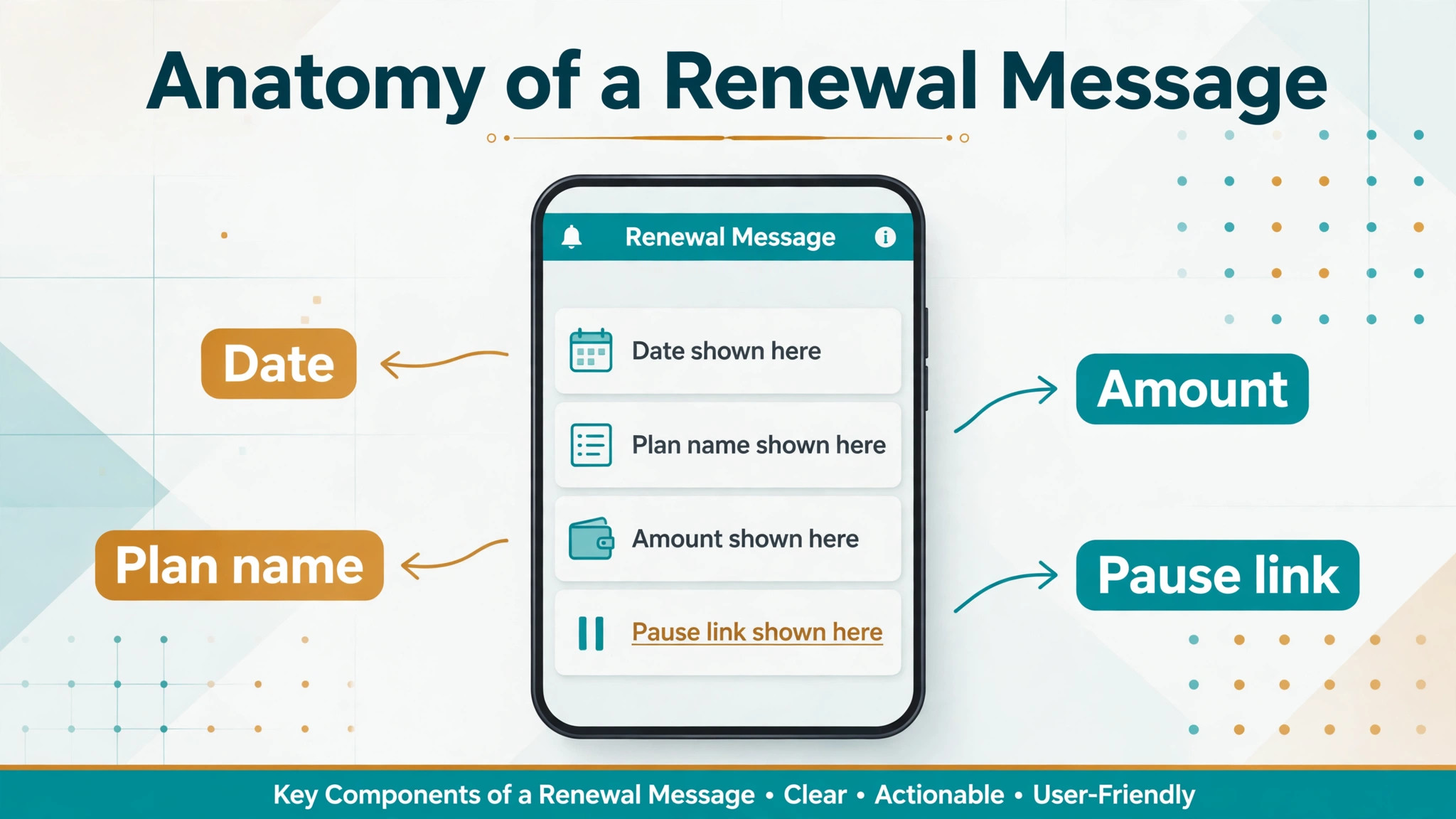
Write three short templates and reuse them. The first is the value reminder, sent 10 days before renewal, which mentions recent visits and the plan for next month. The second is the renewal notice, sent three days before billing, which states the date, the amount, and how to change or pause the plan. The third is the payment confirmation, sent when renewal succeeds, which thanks the member and states the next renewal date. AI can draft all three in your salon tone if you give it examples of messages you already send. Then edit by hand, fix any guessed detail, and read the result aloud. If it sounds like a generic coupon, rewrite the first line.
Step 4. Send through the channel members already answer
Most tanning salon members answer texts faster than email, but the right channel is the one your members already use for booking reminders. Check your own reply rates before you choose. If texts get replies and emails get ignored, send renewals by text and keep email for receipts and longer explanations. Send at a time members can act, such as late morning or early evening, not at midnight when an automated job happens to run. One message per touch is enough. A member who receives the same reminder by text, email, and app notification on the same day feels chased, not cared for. Pick one channel per touch and stick to it.
Step 5. Handle failed payments on the same day
A failed payment is a rescue opportunity, not a lost member. When a renewal payment fails, send a short message the same day with a payment update link and a clear grace period, such as access continuing for a set number of days while the member updates the card. AI can draft the message and can suggest a retry time, but staff should approve the grace terms. Do not retry the same card silently several times in one day. That pattern looks like a billing error and can trigger a bank block or a chargeback. One clear message, one easy link, and one follow up three days later is the right cadence for most salons.
Step 6. Make one save attempt, then respect the no
When a member asks to cancel, make exactly one save attempt. Offer a pause instead of a cancel, a lower tier for a month, or a reason to stay, such as an upcoming event or a package balance the member would lose. AI can suggest which save offer fits the member, based on visit history and package type, and can draft the wording. Staff should make the offer in person or by phone, because a cancellation conversation deserves a human voice. If the member still says no, cancel cleanly, confirm in writing, and stop renewal messages at once. A graceful exit leaves the door open for a return. A stream of messages after a no slams it shut.
Step 7. Record the result and learn from every cycle
After each renewal cycle, record four numbers for every group. How many renewed, how many paused, how many cancelled, and how many needed a payment rescue. Also record the stated reason for every cancellation. AI can group those reasons into themes, such as price, low usage, moved away, or poor experience, and can show which theme is growing. Review those themes monthly with your team. If low usage is the top reason, the fix is earlier engagement, not a bigger discount. If price is the top reason, the fix may be a lower tier or a pause option. When you use AI for tanning salon membership renewals well, that record turns a messaging routine into a retention strategy.
What to send at 30, 10, and 3 days
The timing of renewal messages matters as much as the wording. Thirty days before renewal is the moment for a value message, not a billing message. Remind the member what the month delivered, such as the number of visits or the upgrade they enjoyed, and suggest one thing to try in the coming month. This message should contain no price and no urgency. Its job is to make the member feel the membership was worth it before any billing talk begins. Members who receive only billing reminders learn to associate your salon with charges. Members who receive value reminders associate it with results.
Ten days before renewal is the moment for the practical notice. Salon software such as Mangomint sends a membership renewal email 10 days before renewal as a standard automated message, and that timing is a sound model to copy even if you use different software. State the renewal date, the plan name, and the amount, plus how to pause or change the plan. Keep it short enough to read on a phone screen without scrolling. Three days before billing, send the final short notice, one line of reminder plus the same change link. After billing, send the confirmation with the next renewal date. Four touches across 30 days is enough. More touches add annoyance without adding renewals.

Tools that run this workflow
You do not need a new platform to run the renewal workflow well. The best tool is the one that already holds your membership records, your visit history, and your payment status. A familiar system with clean data beats a new system with messy records. Salons that use AI for tanning salon membership renewals often borrow ideas from retention work in nearby beauty businesses, such as the approach in a guide to nail salon client retention offers. Review your options in a dedicated guide to booking software for tanning salons before you change systems, because switching software mid cycle creates exactly the data errors this workflow is designed to prevent.
Mangomint membership messages
Mangomint is a salon and spa platform with automated membership messages, including a message 10 days before renewal, a message when renewal succeeds, and a message when a membership is cancelled. That built in cadence matches the workflow in this guide closely, which makes it a natural fit for salons that already use it. Use AI to draft the message wording inside that cadence, but keep the timing the platform already provides. The value of Mangomint here is not a clever feature. It is a tested timing pattern that staff do not have to remember or rebuild each month.
Mindbody renewals and payments
Mindbody is a widely used booking and payments platform for salons, spas, and fitness businesses, and it holds the membership, visit, and payment records this workflow depends on. Its strength for renewals is the single record. When membership status, visit history, and payment status live in one place, the Monday list pull becomes a report rather than a research project. Use AI to summarize that record into short per member briefs for staff, and to draft the renewal and rescue messages. Keep payment retries and grace terms under human control, because a billing decision should never be fully automatic.
Boulevard booking and client records
Boulevard is a salon booking platform built around client records, appointments, and payments, and its client timeline view helps staff check visit history before writing a renewal message. That check is step two of this workflow, and it is the step most often skipped when staff are busy. A timeline that shows the last visit, the usual service, and any notes from past visits lets staff personalize a message in under a minute. Use AI to turn that timeline into a draft sentence, such as a reference to the member’s usual visit pattern, then verify the sentence against the record before sending. Accuracy first, speed second.
Vagaro reminders and packages
Vagaro is a salon booking platform with reminders, packages, and membership style selling, and it suits smaller salons that want booking, reminders, and payments in one place. Its reminder system can carry the 10 day and three day renewal touches, while its package records help staff see which members hold unused sessions or upgrades. For a small salon, that combination is often enough. AI adds the drafting and the list sorting. The platform adds the timing and the record. Together they give a two person team the same renewal discipline as a much larger salon, without a larger payroll.
The membership renewal checklist
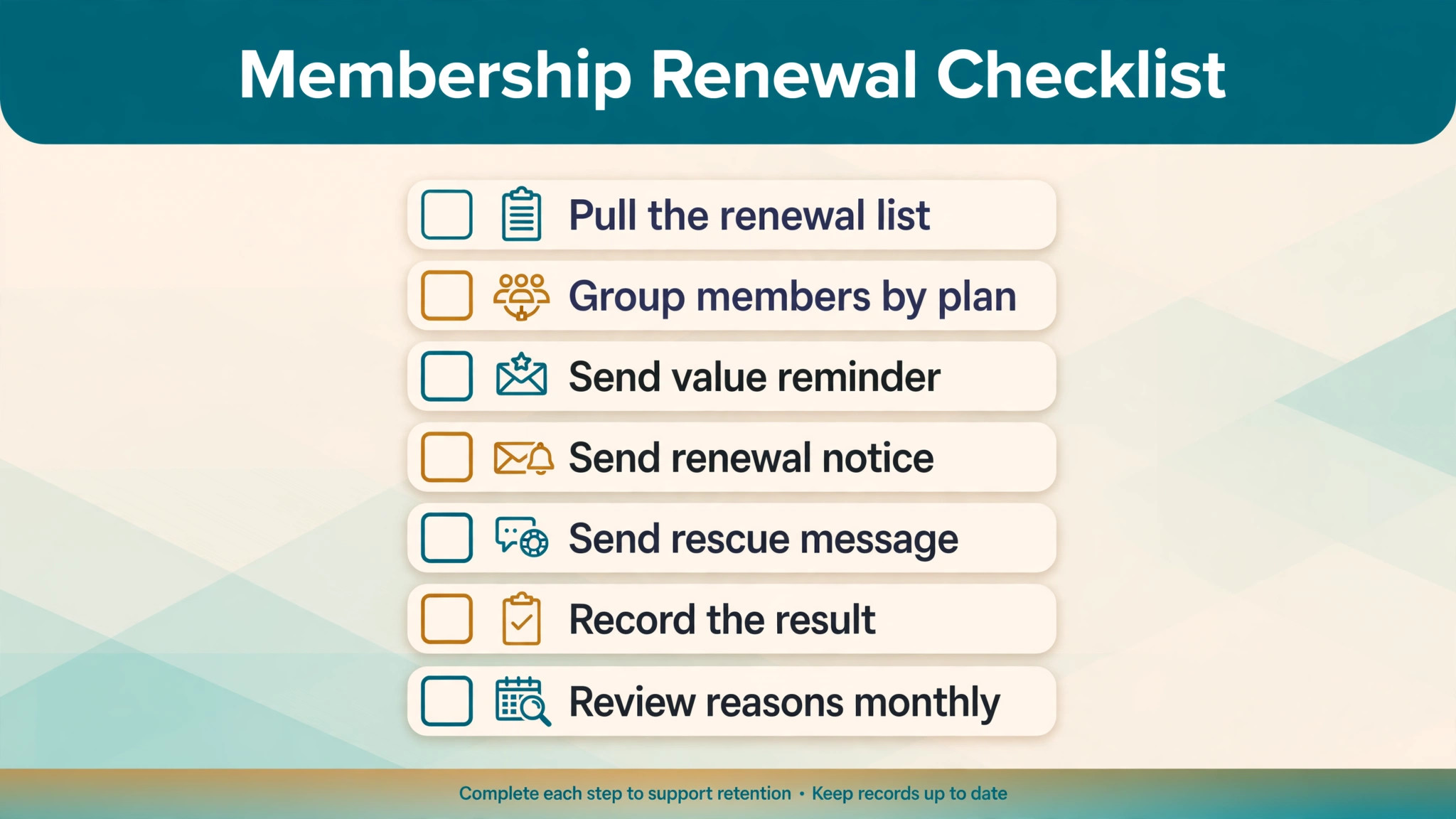
Use this checklist every week, and run it in full during the week before your largest renewal batch. It is the copyable core of this guide. Print it, keep it at the front desk, and initial each line as it is done. A checklist that lives only in a manager’s head will be skipped in a busy week. A checklist on paper gets done even when the manager is away.
Pull the 21 day renewal list plus failed payments plus quiet members.
Sort the list into active, quiet, failed, or leaving groups.
Verify last visit, package, and open issues for every member on the list.
Draft the value reminder, renewal notice, and confirmation with AI.
Edit every draft by hand and remove any guessed detail.
Send the 10 day value reminder through the channel members answer.
Send the three day renewal notice with date, amount, and change link.
Send the same day confirmation when renewal payment succeeds.
Send a same day payment update link when a payment fails.
Make one save attempt for cancellations, then cancel cleanly on a no.
Record renewals, pauses, cancellations, and rescue outcomes per group.
Group cancellation reasons into themes and review them monthly.
Fix data errors found during the list pull before the next cycle.
The checklist works because it forces the unglamorous steps, list accuracy and result recording, to happen alongside the visible steps, message sending. Most renewal systems fail on the unglamorous steps. Messages get sent to the wrong members, results never get recorded, and the same mistakes repeat every month. A completed checklist is proof the system ran. An incomplete one tells you exactly where it broke, which is the information you need to fix it before the next cycle.
Timing and message rules that protect trust
Messages that use AI for tanning salon membership renewals fail when they feel like billing traps. Three rules prevent that feeling. First, never let a member learn about a renewal from a bank statement. The 10 day and three day notices exist so the charge is expected, not discovered. Second, always include a way to pause or change the plan in the notice itself. A member who must call and argue to pause will cancel instead. A member who can pause in one tap often returns. Third, keep every message short. A renewal notice is not a newsletter. Date, plan, amount, change link, and one warm line is the whole message. Anything longer gets skimmed, and the date gets missed.
Tone rules matter as much as timing rules. Write like a person who knows the member, not like a billing department. Use the member’s name, reference one real fact, and avoid pressure language such as warnings about losing access. Urgency has a place in a final notice, but it should be factual, such as stating the renewal date, not threatening. Set a stop rule. A member who replies stop, who cancels, or who asks not to be messaged must leave the renewal sequence at once. AI can enforce a stop rule if your messaging tool supports it, but staff must check that unsubscribes took effect. A stop request that is ignored is a trust breach that no later offer repairs.

How to measure renewal rate and revenue
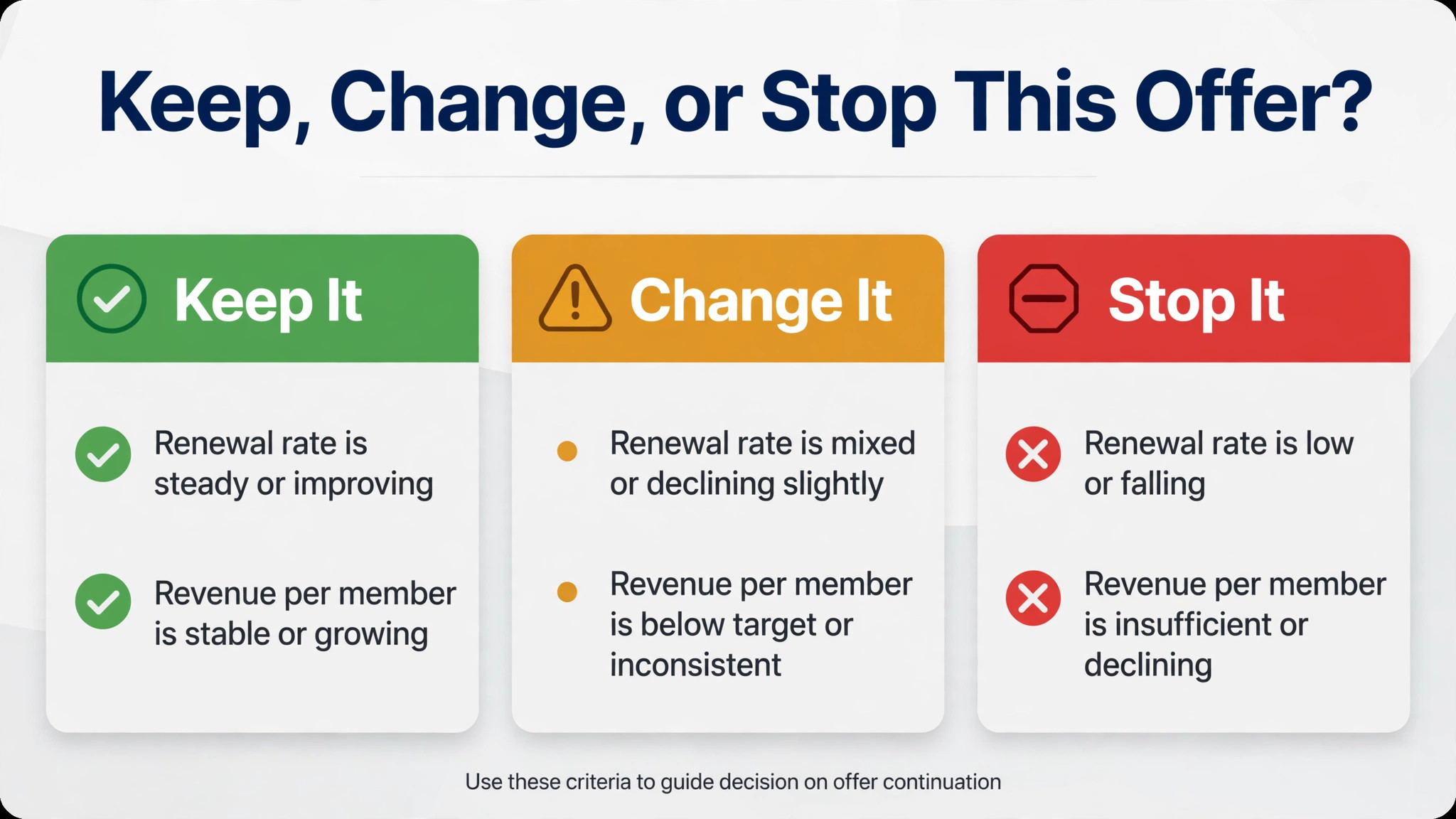
Measure four numbers monthly, and judge any plan to use AI for tanning salon membership renewals on all four together. Renewal rate is the share of members due who actually renew. Rescue rate is the share of failed payments recovered within seven days. Save rate is the share of cancellation requests turned into pauses or lower tiers. Revenue per member is total membership revenue divided by active members. A system that lifts renewal rate but cuts revenue per member, because it relied on deep discounts, is not a win. A system that holds price, lifts rescue rate, and keeps save rate steady is a genuine improvement. Report these numbers on one monthly page, not in a dashboard nobody reads.
Compare each cycle with the same cycle last year, not only with last month, because tanning demand is seasonal. A summer renewal rate will look different from a winter one, and a month to month comparison can mislead you into changing a system that was actually working. Also track the quiet member segment separately. If quiet members start visiting again after the check in message, the early engagement part of the system is working, even before renewal numbers move. That early signal is worth watching, because it tells you the workflow is catching members before they decide to leave, which is the cheapest moment to save them.
Mistakes that cost renewals
The most common mistake is discounting first. A discount offered to a member who would have renewed anyway costs margin and teaches members to wait for the next discount. Offer value first, a pause option second, and a price change only when the member raises price or when usage data shows the current tier genuinely does not fit. The second mistake is messaging everyone the same way. A loyal weekly visitor and a member who has not visited in six weeks need different messages, and sending both the same renewal notice wastes the one chance to re-engage the quiet member. Segment before you send, every time.
The third mistake is letting AI send without a human check. AI drafts can guess a package name, invent a visit, or use a tone that does not fit your salon. Every message needs a staff eye before it goes out, especially in the first two cycles. The fourth mistake is ignoring the exit interview. A member who cancels without giving a reason is data lost. Ask one short question at cancellation, record the answer, and review the themes monthly. The fifth mistake is treating renewal as a billing event instead of a relationship event. Billing is the last step of renewal. The relationship work beforehand decides the outcome, and no billing day message can replace it.
Frequently Asked Questions
How early should a tanning salon remind members about renewal?
Send a value reminder 30 days before renewal and a practical notice 10 days before, with a final short notice three days before billing. The 30 day message should contain no price and no urgency, only a reminder of what the membership delivered. The 10 day message states the date, plan, and amount, plus how to pause or change. The three day message is a one line reminder with the same change link. This cadence gives members time to decide without feeling rushed, and it means no member first learns about a renewal from a bank statement. Salons using automated membership messages already follow a similar pattern, with a renewal notice 10 days ahead as standard practice.
Can AI write renewal messages without sounding impersonal?
AI can draft the structure and wording, but the personal feel comes from real facts and human editing. Feed AI the member’s last visit date, package name, and usual pattern, and set a short word limit. Then edit by hand, fix any guessed detail, cut extra praise, and add one sentence only your salon could write. Read the result aloud. If it sounds like a generic billing notice, rewrite the first line. The combination of AI drafting and human editing keeps messages fast and personal at the same time, and it is the approach recommended throughout this guide. Never send an AI draft without a staff check, especially in the first two cycles.
What should a salon do when a renewal payment fails?
Send a short message the same day with a payment update link and a clear grace period, such as continued access for a set number of days. Do not retry the same card silently several times in one day, because that pattern can trigger a bank block or a chargeback. Send one follow up three days later if the payment is still unresolved. Staff should approve the grace terms, and the message should state plainly what happens if the card is not updated. A failed payment handled this way often becomes a saved member, because the member experiences help rather than a shutoff. Track rescue rate monthly to see whether the process is working.
Should tanning salons offer a discount to save a cancelling member?
Offer a discount only after value and flexibility have been tried. First offer a pause, a lower tier, or a reason tied to real usage, such as an unused upgrade or an upcoming season. A discount offered first trains members to threaten cancellation for a price cut, and costs margin on members who would have stayed. If the member raises price directly, or usage data shows the current tier does not fit, a lower tier or time limited adjustment is reasonable. Record which save offers work, by member group, so future attempts use evidence rather than habit. A save that keeps a member at a sustainable price beats a save that keeps them at a loss.
How do salons handle members who never visit but keep paying?
Quiet paying members need a check in, not a billing reminder. After 21 days without a visit, send a friendly message that asks how they are and offers one easy reason to return this week, such as a lotion sample waiting at the desk. Do not mention billing in that message. If the member stays quiet for a second month, offer a pause rather than letting the membership drift toward a surprise cancellation. Some quiet members prefer to keep paying for the option value, and that choice should be respected. Others are quietly unhappy, and a pause offer surfaces the problem while the relationship can still be saved. Track the quiet segment separately in your monthly numbers.
Which booking tools work best for tanning salon renewals?
The best tool is the one that already holds your membership, visit, and payment records. Mangomint, Mindbody, Boulevard, and Vagaro all hold the core data this workflow needs, which is renewal date, package, visit history, and payment status. Choose the tool your staff already uses well, rather than switching to chase a feature. A familiar tool with clean data beats a new tool with messy records. For context, compare salon booking options in a guide to scheduling software for salons, and read how other salons keep clients coming back in a guide to AI tools for nail salons. A small salon setting up its first system should also read a practical small salon booking system setup guide before choosing.
Final verdict
The verdict from the opening still stands, with one addition. Renewal is won in the weeks before billing, not on billing day. A weekly list, three timed touches, a same day payment rescue, one honest save attempt, and a monthly review of reasons will keep more members than any discount campaign. AI removes the sorting and drafting burden. It does not remove the need for accurate records, a human check, and a message that respects the member. Start with one renewal cycle, run the checklist in full, and let the renewal rate tell you what to improve next. That discipline, repeated every month, is what turns a tanning salon membership base from a leaky bucket into a steady business.