

The best AI tools for crypto traders in 2026 are not the ones that promise the highest returns. They are the ones that help you make fewer unforced errors: entering a trade with a plan, sizing it correctly, tracking what you actually own, and knowing when the market story has changed. Crypto moves fast, trades around the clock, and punishes sloppy process more than most markets. A good tool does not remove that risk. It makes your process visible, repeatable, and easier to audit after the fact.
That distinction matters because most crypto tool marketing sells the opposite. Screenshots of green portfolios, claims of automated profits, and backtests that only show the good years are everywhere. This guide ignores all of that. Every tool below was judged on a practical test: does it help a real trader decide, execute, track, or review better than doing the same job by hand? If the answer was unclear, the tool did not make the list.
One warning before the details. No tool in this guide guarantees profit, and several of them can lose money faster if used carelessly. Automated bots trade while you sleep, which is a feature when your rules are sound and a liability when they are not. Signal tools report what other traders are doing, which is useful context and terrible instruction. Treat every tool here as an assistant to your own judgement, never as a replacement for it. If you cannot explain why you entered a trade in one sentence, no tool will fix that.
The 13 best AI tools for crypto traders at a glance
| Tool | Main job | Best for |
|---|---|---|
| 3Commas | Trading bots | Automated strategies across exchanges |
| Cryptohopper | Trading bots | Strategy building without code |
| Pionex | Trading bots | Built in bots with low fees |
| LunarCrush | Market signals | Social and sentiment data |
| Santiment | Market signals | On-chain plus social signals |
| TradingView | Market signals | Charts, alerts, and screening |
| CoinTracker | Portfolio tracking | Tax ready portfolio tracking |
| Koinly | Portfolio tracking | Multi exchange tax reports |
| Delta | Portfolio tracking | Simple portfolio overview |
| Glassnode | On-chain analysis | Bitcoin and network data |
| Nansen | On-chain analysis | Smart money wallet tracking |
| Arkham | On-chain analysis | Entity and wallet intelligence |
| CryptoQuant | On-chain analysis | Exchange flows and whale alerts |

Start here: pick by your job, not by hype
| Your job right now | Start with | Why |
|---|---|---|
| Automate a rules based strategy | 3Commas or Pionex | Both execute without you watching the screen |
| Understand market mood before trading | LunarCrush or Santiment | Both measure what the crowd is doing |
| Clean up a messy portfolio and tax year | CoinTracker or Koinly | Both reconcile exchanges and wallets |
| Check whether holders are selling | Glassnode or Nansen | Both show real holder behaviour |
| Check whether coins are flowing onto exchanges | CryptoQuant | Exchange flow data shows supply pressure early |
| Keep it simple and stay informed | Delta and TradingView | One tracks, one charts, neither overpromises |
Trading bots: let rules trade, not emotions
1. 3Commas
3Commas is a bot platform that connects to major exchanges through API keys and runs strategies you define: grid bots, dollar cost averaging bots, and signal based bots. Its strength is flexibility. You can run several bots at once, set stop losses and take profits, and watch every trade from one dashboard instead of logging into five exchanges.
Pricing: free tier with limited bots, paid plans by bot count and features. Check checkout for current plan details.
Best for: traders who already have a strategy and want it executed consistently, including overnight.
Watch out for: grid bots lose money in strong one direction trends, because they keep buying into a falling market or selling into a rising one. Set a clear invalidation point before you start any bot, and never give a bot withdrawal permission on your exchange API keys.
Try it at: https://3commas.io
2. Cryptohopper
Cryptohopper is a cloud based bot builder with a visual strategy designer, a marketplace of signals and strategies, and backtesting. You do not need to write code to build a bot, and you can paper trade a strategy before putting real money behind it. That paper trading step is the single most valuable feature here, and skipping it is the most common mistake new bot users make.
Pricing: free trial, paid plans by number of positions and features. Check checkout for current plan details.
Best for: traders who want to test ideas quickly without building infrastructure.
Watch out for: marketplace strategies are ranked by past performance, which tells you little about future results. Treat any strategy you did not test yourself as unproven, and cap the capital on any new bot until it has survived at least a few weeks of live conditions.
Try it at: https://www.cryptohopper.com
3. Pionex
Pionex is an exchange with trading bots built in, including grid bots, dollar cost averaging bots, and rebalancing bots. Because the bots live inside the exchange, there is no separate bot subscription and no API key setup. Fees are the exchange trading fees, which keeps the total cost simple to understand.
Pricing: no separate bot subscription. Trading fees apply per trade. Check checkout for the current fee schedule.
Best for: traders who want bots without managing a second platform or a second bill.
Watch out for: because Pionex is itself an exchange, your funds sit on that exchange while bots run. That concentrates custody risk in one place. Keep only trading capital there, and move longer term holdings to a wallet you control.
Try it at: https://www.pionex.com
Market signals: read the crowd, then decide for yourself
4. LunarCrush
LunarCrush tracks social activity across crypto: mentions, engagement, influencer activity, and sentiment scores for thousands of coins. Its value is not prediction. Its value is context. When a coin you hold suddenly spikes in social mentions, you can check whether the spike came from real discussion or from a coordinated push, and that changes how you react.
Pricing: free tier with limited data, paid plans by data depth. Check checkout for current plan details.
Best for: traders who want an early warning that attention is shifting, before price confirms it.
Watch out for: social spikes often peak at price tops, when everyone is already excited. A high social score is a reason to check your exit plan, not a reason to chase. Bots and paid promotion can inflate mentions, so cross check any spike against trading volume.
Try it at: https://lunarcrush.com
5. Santiment
Santiment combines on-chain data with social data: holder behaviour, exchange flows, development activity, and social volume in one platform. That combination is what sets it apart. A price move backed by rising development activity and steady holders means something different from the same move driven only by social hype, and Santiment lets you tell the two apart.
Pricing: free tier with limited metrics, paid plans by data access. Check checkout for current plan details.
Best for: traders who want signals grounded in holder behaviour, not just chatter.
Watch out for: the metric library is large, and it is easy to find a chart that supports whatever you already believe. Pick two or three metrics before you trade, write down what each one would need to show to change your mind, and ignore the rest during a position.
Try it at: https://santiment.net
6. TradingView
TradingView is the charting platform most crypto traders already use: clean charts, hundreds of indicators, custom screeners, and price alerts that work across exchanges. Its AI contribution is practical rather than flashy: pattern recognition, alert automation, and community scripts that save hours of manual chart work. If you trade from charts at all, this is the baseline tool everything else is compared against.
Pricing: free tier with limited indicators and alerts, paid plans by features. Check checkout for current plan details.
Best for: any trader who makes decisions from price action and wants reliable alerts.
Watch out for: indicator overload is real. Ten indicators on one chart do not produce ten times the insight. They produce conflicting signals and hesitation. Build one setup, backtest it on past data, and trade it consistently before adding anything new.
Try it at: https://www.tradingview.com

Portfolio tracking: know what you own, and what you owe
7. CoinTracker
CoinTracker connects to exchanges and wallets, reconciles your trades, and produces tax reports for major jurisdictions. Its strength is breadth of integrations and a relatively painless import process. For traders with activity across several exchanges, the alternative is a spreadsheet that grows more unreliable every month, and CoinTracker replaces that with a single reconciled view.
Pricing: free tier for limited transactions, paid plans by transaction count. Check checkout for current plan details.
Best for: traders who need tax reporting and hold assets across multiple platforms.
Watch out for: imported data is only as good as the exchange records behind it. Missing transfers between your own wallets are the most common source of wrong tax figures. Reconcile wallet to wallet transfers manually at least once a quarter, and do not file a report you have not sanity checked against your own records.
Try it at: https://www.cointracker.io
8. Koinly
Koinly is a portfolio tracker and tax calculator with wide exchange and wallet support and reports for many countries. It handles staking rewards, airdrops, and DeFi activity better than most general trackers, which matters because those are exactly the transactions that create tax surprises. Its dashboard also gives a clear profit and loss view per asset, which helps with review even outside tax season.
Pricing: free portfolio tracking, paid plans for tax reports by transaction count. Check checkout for current plan details.
Best for: traders with DeFi, staking, or NFT activity alongside exchange trades.
Watch out for: DeFi transaction classification is still imperfect across the industry. A misclassified liquidity pool transaction can change your reported gain. Review flagged transactions yourself rather than accepting every auto classification, especially for complex DeFi positions.
Try it at: https://koinly.io
9. Delta
Delta is a portfolio tracker focused on clarity: connect exchanges and wallets, see your holdings, performance, and allocation in one clean app. It does not try to be a tax engine or a trading bot. That restraint is its appeal. For traders who mainly want to answer one question, what do I own and how is it doing, Delta answers it without a wall of features.
Pricing: free tier with core tracking, paid plan for advanced features. Check checkout for current plan details.
Best for: traders who want a daily portfolio check without tax or trading complexity.
Watch out for: Delta is a viewer, not a decision tool. It will not warn you that a position has grown too large or that your allocation has drifted. Pair it with a written rebalancing rule, for example reviewing allocation monthly, so the app informs a decision instead of replacing one.
Try it at: https://delta.app
On-chain analysis: follow real money, not opinions
10. Glassnode
Glassnode publishes on-chain metrics for Bitcoin and major networks: holder cohorts, exchange balances, realised price levels, and network activity. These metrics show what holders are actually doing, which is harder to fake than social sentiment. Long term holder accumulation during a price fall, for example, tells a different story from the same fall driven by exchange inflows.
Pricing: free tier with basic metrics, paid plans by metric depth. Check checkout for current plan details.
Best for: traders who want a structural view of Bitcoin cycles and holder behaviour.
Watch out for: on-chain data describes the past and the present, not the future. A metric can stay at an extreme for months while price moves against you. Use Glassnode to judge risk and timing context, not as a buy or sell trigger on its own.
Try it at: https://glassnode.com

11. Nansen
Nansen labels wallets and tracks smart money: funds, large traders, and early participants whose moves often precede wider market moves. Its dashboards show token flows, wallet activity, and NFT trends in a form that is readable without writing your own blockchain queries. For traders who follow specific funds or whales, Nansen turns raw chain data into a watchlist.
Pricing: no free tier for full features, paid plans by data access. Check checkout for current plan details.
Best for: traders who base part of their process on tracking known participants.
Watch out for: following smart money is not the same as copying it. You do not know a wallet’s full position, its time horizon, or whether a transfer is a sale, a custody move, or collateral. Use Nansen flows as a prompt to research, never as an automatic trade signal.
Try it at: https://www.nansen.ai
12. Arkham
Arkham is a blockchain intelligence platform that identifies entities behind wallets and visualises fund flows between them. Where Nansen focuses on dashboards, Arkham focuses on investigation: tracing a specific wallet, mapping its counterparties, and setting alerts when an entity moves. That makes it powerful for traders who research a token’s major holders before buying.
Pricing: free tier with limited queries, paid plans by usage. Check checkout for current plan details.
Best for: traders who research holder concentration and entity moves before entering a position.
Watch out for: entity labels are best effort, and a mislabelled wallet can mislead badly. Confirm any important finding against a second source, and remember that knowing who holds a token does not tell you what they will do next.
Try it at: https://platform.arkhamintelligence.com
13. CryptoQuant
CryptoQuant is an on-chain and market data platform best known for exchange flow data: how much Bitcoin and other assets move onto and off exchanges, plus miner flows, stablecoin supply, and derivatives indicators such as funding rates and open interest. Where Glassnode explains holder cohorts and Nansen follows named wallets, CryptoQuant answers a narrower question with unusual clarity: is supply moving toward exchanges, where it can be sold, or away from them, where it is more likely held? That flow data is widely cited precisely because it is hard to fake and easy to misread in isolation, so it works best as one check alongside price structure.
Pricing: free tier with limited data and history, paid plans by data access and history depth. Check checkout for current plan details.
Best for: traders who want exchange flow, miner behaviour, and derivatives context in one place, especially Bitcoin focused traders.
Watch out for: exchange inflows do not always mean selling. Transfers can be custody moves, internal exchange reshuffling, or collateral shifts, and a single large inflow has produced many false alarms. Confirm a flow signal against volume and price action before acting on it, and favour sustained multi day trends over one day spikes.
Try it at: https://cryptoquant.com
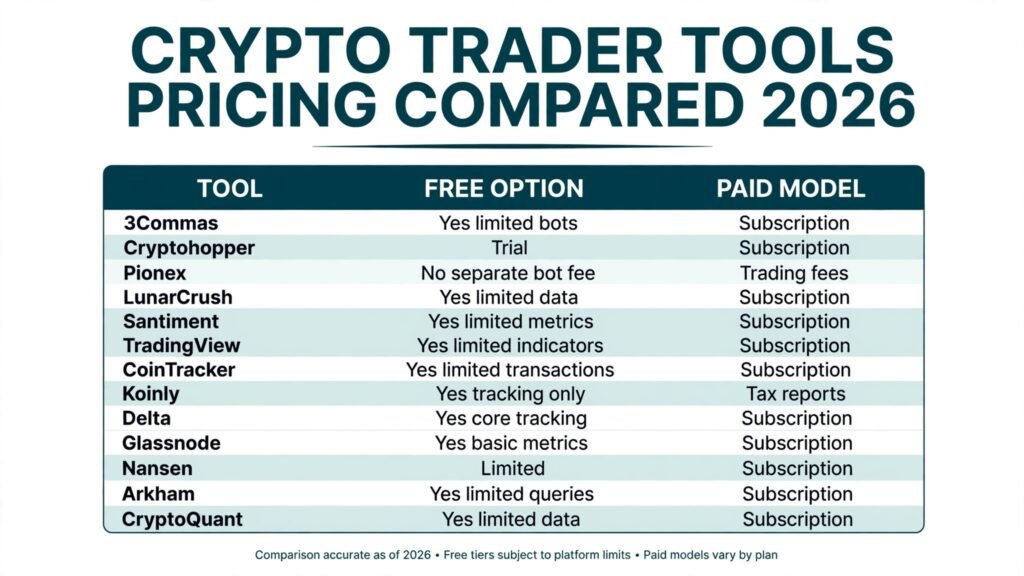
Pricing compared
| Tool | Free option | Paid model |
|---|---|---|
| 3Commas | Yes, limited bots | Subscription by bots and features, check checkout |
| Cryptohopper | Trial | Subscription by positions and features, check checkout |
| Pionex | No separate bot fee | Trading fees per trade, check checkout |
| LunarCrush | Yes, limited data | Subscription by data depth, check checkout |
| Santiment | Yes, limited metrics | Subscription by data access, check checkout |
| TradingView | Yes, limited indicators | Subscription by features, check checkout |
| CoinTracker | Yes, limited transactions | Subscription by transaction count, check checkout |
| Koinly | Yes, tracking only | Tax reports by transaction count, check checkout |
| Delta | Yes, core tracking | Subscription for advanced features, check checkout |
| Glassnode | Yes, basic metrics | Subscription by metric depth, check checkout |
| Nansen | Limited | Subscription by data access, check checkout |
| Arkham | Yes, limited queries | Subscription by usage, check checkout |
| CryptoQuant | Yes, limited data | Subscription by data access, check checkout |
Two pricing lessons matter more than any single plan. First, subscription costs stack fast. Three tools at modest monthly prices can exceed the profit of a small account in a flat year, so count total tool spend against account size before adding anything. Second, the cheapest tool that answers your actual question beats an expensive platform you open once a month. Start free, prove the tool changes a decision, then pay.
How to choose: a four question test
Choosing starts with an honest answer to four questions, in this order.
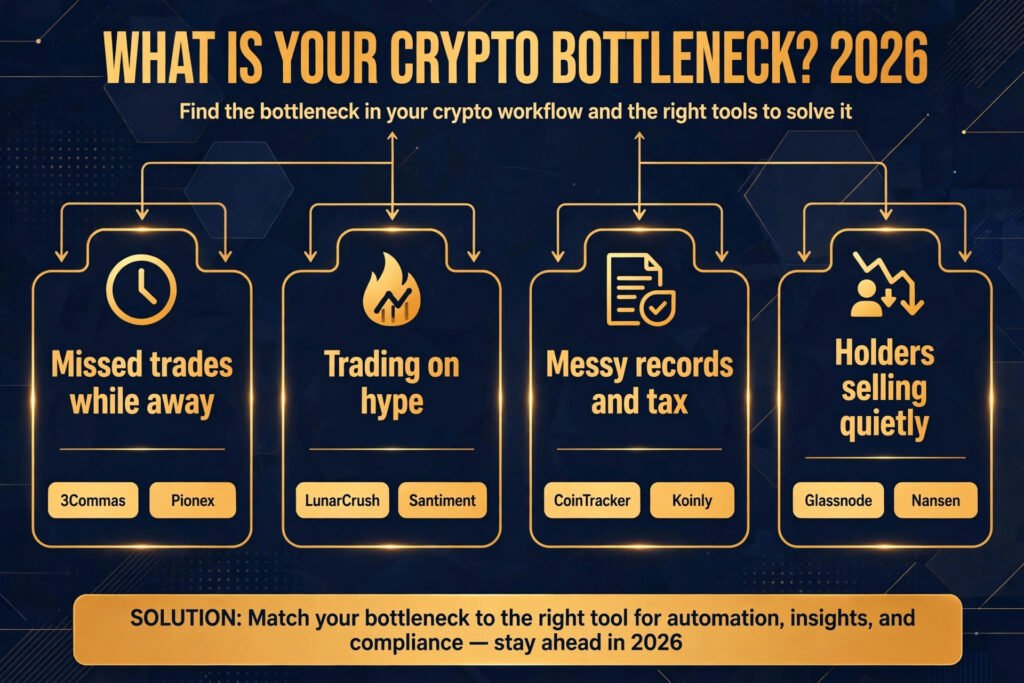
First, what is your bottleneck? If you miss trades because you sleep, you need automation, so start with bots. If you enter trades you later regret, you need better pre trade checks, so start with signals or on-chain data. If tax season is chaos, you need tracking first, whatever else you buy later. Buying a signal tool when your real problem is messy records will not fix anything.
Second, what is your time horizon? Bots and signals suit active traders who check positions daily. Portfolio trackers and on-chain metrics suit longer term holders who review weekly or monthly. A day trader does not need Glassnode holder cohorts, and a long term holder does not need a grid bot running every hour.
Third, what can you verify? Before paying for any tool, run its free tier for two weeks and record one decision it changed. If you cannot name one, cancel it. This test kills most impulse subscriptions, and it is the cheapest discipline in this guide.
Fourth, what is your total cost? Add subscription fees, trading fees, and the time you spend managing the tool. A bot that needs daily tuning is not passive income. It is a part time job with a subscription fee, and you should judge it that way.
Mistakes to avoid
The most expensive mistake is automating a strategy you have never traded by hand. If you cannot explain the rules, the exit, and the worst case loss without looking at a screen, a bot will execute your confusion at machine speed. Trade any strategy manually first, even on paper, until its losing streaks no longer surprise you.
The second mistake is trusting one signal. Social spikes, on-chain flows, and chart patterns each fail regularly on their own. Traders who survive combine at least two independent checks, for example price structure plus holder behaviour, and size positions smaller when the checks disagree.
The third mistake is ignoring custody. Tools that connect to exchanges through API keys should never have withdrawal permission. Tools that ask for seed phrases are scams, without exception. No legitimate tracker or bot needs your seed phrase, and any request for it ends the conversation.
The fourth mistake is chasing every new tool. Crypto tooling changes fast, and switching platforms every month destroys the one thing that matters most: a consistent record of your own decisions. Pick a small stack, keep it for a quarter, and review it against results before changing anything.
The fifth mistake is treating tax as a year end problem. Every trade, swap, and staking reward can create a taxable event, and reconstructing a year of DeFi activity in December is painful and error prone. Connect a tracker early, reconcile quarterly, and keep exchange records even after you stop using a platform.
The sixth mistake is sizing positions from excitement. A tool that shows a coin trending does not tell you how much to buy. Decide position size from account risk first, for example a fixed small percentage per trade, and let signals influence timing and selection only.
Frequently asked questions
Do AI crypto trading bots actually make money?
Sometimes, for traders with tested rules and disciplined risk limits. Bots do not create an edge. They execute one consistently, including its losing periods. Untested bots, especially grid bots in trending markets, lose money reliably. Paper trade first, cap capital, and judge a bot over months, not days.
Are crypto signal tools worth paying for?
They are worth paying for if they change a decision you can name. Social data helps you gauge crowd mood, and on-chain data helps you judge holder behaviour. Neither predicts price on its own. Use free tiers first, and pay only for metrics you check weekly and act on.
Which tool should a beginner start with?
Start with TradingView for charts and alerts, plus Delta or CoinTracker for portfolio tracking. That pair covers decisions and records without automation risk. Add a bot only after you have traded a strategy manually and can state its rules and exit clearly.
Is it safe to connect a bot to my exchange?
It is reasonably safe if you follow three rules: use API keys with trading permission only, never withdrawal permission; use a unique key per tool; and revoke keys immediately if a tool is compromised or abandoned. Never share seed phrases or passwords with any tool.
Do I need on-chain tools for Bitcoin only trading?
Not necessarily. Glassnode is strongest for Bitcoin, and its holder metrics suit longer term Bitcoin traders. If you trade mostly smaller tokens, wallet tracking tools like Nansen or Arkham are more relevant, because holder concentration matters more in thin markets.
Can one tool replace the rest of this list?
No. Bots execute, signals inform, trackers record, and on-chain tools explain holder behaviour. They answer different questions. A good stack is small: one charting tool, one tracker, and one or two tools matched to your bottleneck, reviewed quarterly.
Conclusion
The best AI tools for crypto traders in 2026 reward process, not prediction. Start with your bottleneck, not with the loudest marketing. If you miss trades, automate carefully with 3Commas or Pionex. If you chase hype, add LunarCrush or Santiment as a reality check. If your records are a mess, fix them first with CoinTracker or Koinly. If you want to understand holders, Glassnode or Nansen will show you more than any influencer thread.
Keep the stack small, keep withdrawal permissions off, paper trade before you automate, and review every tool against one question: did it change a decision for the better? Tools that pass that test earn their fee. Tools that do not should be cancelled, however impressive their dashboards look. In a market that never sleeps, the trader with the clearest process, not the most tools, is the one who lasts.