
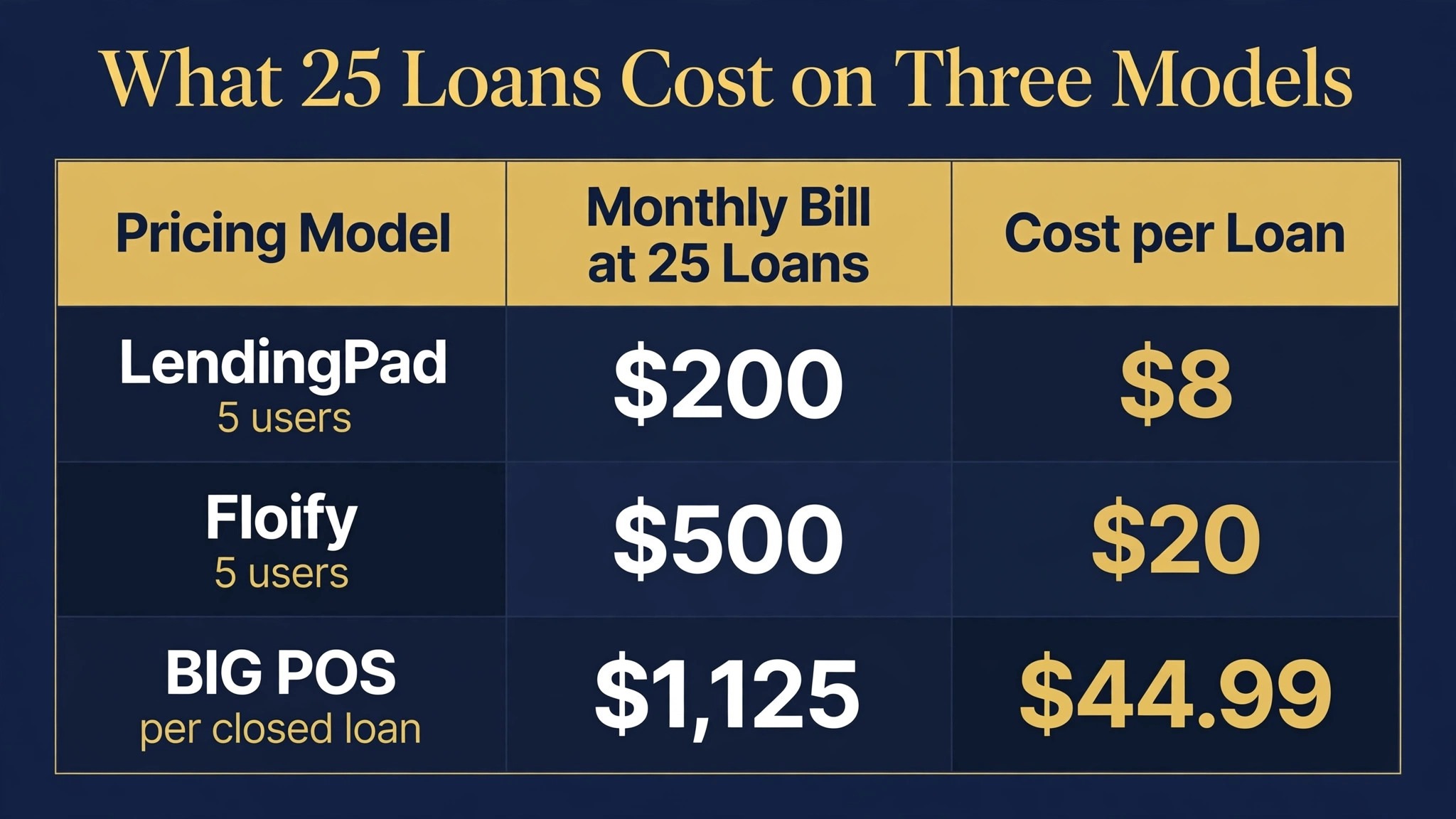
A small broker closing twenty-five loans a month and shopping for the best mortgage pos software for lenders will pay anywhere from $200 to $1,125 a month for the same twenty-five files, and the difference is not the features. It is the pricing model. One tool charges per user, one charges per loan, and one charges an enterprise contract, and the pages below price every tool on the same twenty-five loans so the comparison is honest.
What Does Fallout Cost a Small Broker?
Fallout is the word lenders use for applications that die before closing, and it is the quietest cost in this whole guide. A borrower starts an application, gets asked for one document too many, hears nothing for a week, and quietly applies with the lender down the street. The broker never sees a lost loan. The broker sees a pipeline that was full last month and empty this month, and blames the market.
A good POS attacks fallout in two places. First, the application itself. A guided application that a borrower can finish on a phone in one sitting loses fewer people than a form that asks for everything up front and saves nothing halfway. Second, the silence after the application. A borrower who gets milestone updates, a clear document checklist and a message when the file moves does not go looking for another lender, because the borrower knows where the loan stands.
The cost of fallout is measured in loans, not in software fees. A broker closing twenty-five loans a month who loses even one application a month to a slow or silent process loses twelve loans a year, and each one is a loan the broker already spent time and advertising money to win. The POS that costs $500 a month and saves one loan a month pays for itself many times over, while the POS that costs $200 a month and loses one loan a month is the dearest tool in the guide.
The second place a POS earns its keep is the document chase. A loan officer who spends the day phoning borrowers for pay stubs and bank statements is not closing loans, and every day a file waits for a document is a day the borrower can change their mind. Floify and Maxwell both automate the chasing, with follow-ups that go out on their own and a checklist the borrower can see, so the officer only touches the files that are actually stuck.
So judge every tool below by the fallout question, not the subscription question. Does the borrower finish the application, does the borrower know what happens next, and does the loan officer see the stall before the borrower walks away? Floify answers yes to all three with its guided application and milestone updates, and that is the real reason a small broker pays $500 a month for it instead of $200 for a cheaper tool that leaves the borrower guessing.
One Loan, in Numbers
Take one loan and follow it from the first click to the closing table. The borrower applies online at nine in the evening, uploads a pay stub from a phone, and gets a status update without calling the loan officer. The loan officer checks the file in the morning, asks for one missing document through the portal, and the borrower uploads it before lunch. That is the loan a good POS delivers, and it is the loan the numbers below are priced against.
Here is that loan priced three ways, because the pricing model decides the bill before any feature is discussed. On Floify, a five-user broker pays a reported under $100 per user a month, which is about $500 a month, so one loan out of twenty-five costs about $20 in POS fees. On LendingPad, the same five users pay a reported $40 per user a month, which is $200 a month, so one loan costs about $8. On BIG POS, the broker pays $44.99 per closed loan with no monthly fee and no seat cost, so one loan costs $44.99, and a slow month costs nothing at all.
A mortgage point of sale is the borrower-facing front door of the loan. It is the application, the document upload, the disclosures and the status updates, all in one borrower portal. A good POS cuts the days to close, because the borrower uploads the pay stub at nine in the evening instead of faxing it on Monday. That choice is the heart of the decision, and the rest of this guide prices it honestly.
| Tool | Main job | Best for | Starting price |
|---|---|---|---|
| Floify | Digital mortgage POS | Most brokers | 99 dollars per user a month |
| LendingPad | LOS with POS | Low cost origination | 40 dollars per user a month |
| Blend | Digital origination platform | Banks and credit unions | Quote only |
| Encompass Consumer Connect | Encompass borrower POS | Encompass shops | 300 dollars a month |
| SimpleNexus | Mobile mortgage POS | Mobile experience | Quote only |
| Maxwell | Mortgage POS and automation | Mid market lenders | 99 dollars a month |
| Arive | Broker POS and LOS | Modern brokers | 49 dollars 99 cents per user a month |
| BIG POS | Encompass POS, per loan | Per loan pricing | 44 dollars 99 cents per closed loan |
Most lenders overpay in one of two ways. They buy an enterprise platform for a broker shop that closes ten loans a month, or they buy a cheap POS that does not connect to their loan origination system, which means every file is retyped. This guide prices the same twenty-five loans a month on every tool, so the comparison is honest, and the best mortgage pos software for lenders is the one whose pricing model matches the loan volume.
Floify vs LendingPad: POS Only Against Full Origination
Floify and LendingPad are the two names a small broker hears first, and the choice is POS only against full origination. Floify gives the broker a polished borrower front door at a reported under $100 per user a month, while LendingPad gives the broker a POS beside a full loan origination system at $40 per user a month. A broker that already has a LOS should pick Floify, and a broker that needs both should pick LendingPad.
On the borrower experience Floify is ahead, with the guided application and the automated document requests that cut the days to close. On the total bill LendingPad is ahead, because one subscription covers the POS and the LOS, while Floify needs a LOS beside it. At twenty-five loans a month the gap is $300 a month, because five users on Floify cost about $500 and five users on LendingPad cost $200, and that gap is the price of the polished front door.
The best mortgage pos software for lenders is the one that matches the stack, and for a broker starting from scratch that is LendingPad. For a broker who already runs a LOS and wants the cleanest borrower experience money can buy at this size, it is Floify. The wrong pick is an enterprise platform, because the minimum commitment alone costs more than the broker closes. The other wrong pick is the tool that looks cheap and does not connect to the LOS, because every file the officer retypes by hand is a file that can carry a typo into the closing documents, and a typo in a disclosure is a delay the broker pays for in days, not dollars.
The 8 Tools in Detail
The eight profiles below are priced per file, because the best mortgage pos software for lenders is bought by the loan, not by the feature list. Each one starts with what the plan costs at a real loan volume, then what it does to the borrower experience, then where it stops being the right buy.
1. Floify
Floify is a digital mortgage POS with borrower applications, document collection, disclosures and status updates in one portal. Its strength is the borrower experience, with a guided application and automated document requests that cut the days to close. Pricing is reported from under $100 per user a month, with tiers scaled by volume and features.
The milestone updates are a real win, because the borrower sees the loan status without calling the loan officer. A borrower who can see the file moving does not call to ask where it is, and a loan officer who does not spend the day answering status calls spends the day closing loans. That is the fallout defence from the earlier section, built into the product.
Here is the worked example. A five-user broker pays about $500 a month, which is $20 per loan at twenty-five loans a month and $50 per loan at ten loans a month. The per-loan cost falls as the volume rises, because the subscription stays flat while the loans grow, and that is the shape of per-user pricing.
The limit is that it is a POS first, so a lender that needs a full LOS must connect it to one. Floify connects to the major loan origination systems, and the connection is the product, so test it with a real file before paying.
What I would do, if this were my brokerage, is buy Floify the month the broker starts losing borrowers to a slower application, and not before. A broker closing a handful of loans a month for repeat clients who prefer the phone does not need it yet, and a broker closing twenty-five loans a month cannot afford to be without it.
2. LendingPad
LendingPad is a cloud loan origination system with a borrower POS, covering application, processing, underwriting and closing. Its strength is the price, with a reported $40 per user a month entry that includes the POS and the LOS. The platform includes automated compliance tracking, QM management and integrations with the major vendors.
Here is the worked example. Five users cost $200 a month, which is $8 per loan at twenty-five loans a month and $20 per loan at ten loans a month. That is the cheapest honest price for a full system in this guide, and the gap against Floify is $300 a month at the same five seats.
The per-user pricing is simple, which makes the monthly bill easy to forecast as the team grows. The trade is the borrower portal, which is simpler than Blend and less polished than Floify, and the smaller brand presence. A broker that needs a POS beside a full origination system at the lowest honest price should pick LendingPad, and accept that the portal is plain.
3. Blend
Blend is a digital origination platform for banks, credit unions and mortgage providers, with a modern borrower application and workflow automation. Its strength is the scale, with intelligent origination, automated follow-ups and analytics that fit high-volume lenders. Pricing is quote only, with reported institutional deployments around $75,000 a year and per-loan fees on top.
Here is the worked example, and it is the one that settles the question for a small broker. $75,000 a year is $6,250 a month before any per-loan fees, which is more than twelve times the Floify bill for five users. A broker closing twenty-five loans a month would pay about $250 per loan on the subscription alone, before the per-loan fees are counted.
The autopilot analytics help a lender see which applications stall and why, which is hard to get from a simple POS. The trade is the price and the implementation, which needs weeks and a proper rollout plan. Blend fits a bank or credit union with real volume, and a small broker should not consider it until the volume demands it.
4. Encompass Consumer Connect
Consumer Connect is the borrower POS from ICE Mortgage Technology, built to feed applications directly into Encompass. Its strength is the native link, with applications, documents and disclosures flowing into Encompass without retyping. Pricing is reported from about $300 a month as an add-on, or about $10 to $20 per completed digital application.
Here is the worked example. At twenty-five completed applications a month, the per-application price of $10 to $20 works out to $250 to $500 a month, which sits beside the $300 monthly figure, so the two prices agree with each other. The single source of truth is the real value, because the loan file lives in Encompass from the first click, and the trade is that it only makes sense for Encompass shops.
5. SimpleNexus
SimpleNexus is a mobile-first mortgage POS from nCino, with a borrower app, loan officer tools and relationship management. Its strength is the mobile experience, with a borrower app that handles the application, documents and messages. Pricing is quote only, with reported ranges from $2,000 to $5,000 a month for mid-size lenders.
The loan officer app is a real advantage, because the officer can work the file from the field, and the borrower app is the best mobile experience in this guide. The trade is the price and the enterprise positioning, which puts it out of reach for a small broker. At $2,000 a month, a broker closing twenty-five loans pays $80 per loan on the subscription alone, before anything else is counted.
6. Maxwell
Maxwell is a mortgage POS and automation platform with borrower applications, document collection and workflow automation. Its strength is the automation, with follow-ups and document chasing that cut the loan officer workload. Pricing is reported from about $99 to $199 a month, with tiers scaled by volume and features.
The borrower satisfaction scores are strong, which matters when the lender competes on experience. At $99 a month, a broker closing twenty-five loans pays about $4 per loan, which is the cheapest per-loan figure of any subscription tool in this guide. The trade is the smaller brand and the thinner LOS list compared with Floify and Blend, so confirm the integration before signing.
7. Arive
Arive is a modern broker platform with a POS and a LOS, built for brokers who want a clean, fast system. Its strength is the published pricing, with Broker Core originator seats at $49.99 per user a month on annual billing.
- Five users cost $249.95 a month, which is $10 per loan at twenty-five loans a month.
- The platform includes the borrower application, processing and integrations with the common vendors.
- The interface is the cleanest in this guide, which helps a small broker team learn it fast.
- The trade is the newer brand, with a smaller community and fewer third-party integrations than the older tools.
- Pick Arive when the broker wants modern software with a clear price and no quote call.
8. BIG POS
BIG POS is a white label mortgage POS built by lenders on Encompass, with borrower, loan officer and partner portals. Its strength is the pricing, with $44.99 per closed loan, no minimums, no seat fees and no long-term contract. The platform includes a mobile app, rules-driven workflows and document management, with Encompass as the single source of truth.
Is per-loan pricing really cheaper?
It depends on the month. At ten loans a month the bill is $449.90, at twenty-five it is $1,124.75, and at fifty it is $2,249.50. A slow month costs nothing, and a busy month costs the most, which is the fairest shape in this guide for a broker with uneven volume.
What is the catch?
It only fits Encompass shops, and the $10,000 deposit at signing is a real commitment. A broker who closes eleven loans a month pays about the same as five users on Floify, because $44.99 times eleven is $494.89, so eleven loans is the break-even point between the two models.
Best Pick by Job
The pick changes with the size of the broker, so this table is organised by loan volume, not by feature count. Find your volume, then read the row.
| Broker size | First pick | Second tool | Why this pair works |
|---|---|---|---|
| Small broker, under 25 loans | Floify | LendingPad | Floify is the POS, LendingPad adds the origination system |
| Mid-size lender, 25 to 100 loans | Blend | Maxwell | Blend is the enterprise POS, Maxwell fits the mid market |
| Encompass shop | BIG POS | Encompass Consumer Connect | BIG POS is 44 dollars 99 cents per closed loan, Consumer Connect is the native add-on |
| Bank or credit union | Blend | SimpleNexus | Blend fits the digital front door, SimpleNexus fits the mobile experience |
A broker closing 25 loans a month on Floify pays a reported under $100 per user a month, which is about $500 a month for five users. The same broker on BIG POS pays $44.99 per closed loan, which is $1,125 a month for 25 loans, but with no monthly fee and no seat cost.
A broker closing 25 loans a month on LendingPad pays $200 a month for five users, which is the cheapest full system in this guide at that volume. An Encompass shop faces a different choice, because the native Consumer Connect add-on at about $300 a month keeps the file in Encompass from the first click, while BIG POS at $44.99 per closed loan costs $1,125 a month at the same volume but asks for no monthly commitment and no seat fees.
How to Choose the Best Mortgage POS Software for Lenders
Start with the loan volume and the LOS, then check the borrower experience, then check the pricing model. A lender that closes 20 loans a month needs a different tool than one that closes 200, and a POS that does not connect to the LOS will cost more in retyping than it saves in fees. The best mortgage pos software for lenders is the one that fits the LOS the lender already runs.
- Confirm the POS connects to your LOS, because a missing integration means manual retyping.
- Check the pricing model, per loan, per user or enterprise contract, against your real volume.
- Test the borrower application on a phone, because most borrowers apply from a phone.
- Confirm the disclosure and compliance workflow is built in, not an add-on.
- Ask how long the implementation takes, since an enterprise POS can need months.
Then test the borrower flow the way a borrower would, which is on a phone, at night, with one hand. Complete a test application, upload a document, and check that the status updates arrive. A mobile flow that works will win the borrower, while one that fails will send them to the lender down the street. Finally, ask for the full first-year total in writing, including the implementation, because an enterprise POS can charge $50,000 to $200,000 for implementation on top of the subscription, and that line can double the first-year cost.
What Does a Mortgage POS Cost at 25 Loans a Month?
The pricing model decides the bill, so the table below prices the same 25 loans a month on three models. A per-loan tool costs more at volume, while a per-user tool costs more at low volume, which is why the same lender can pay half on one tool and double on another.
| Volume | Cheapest option | Monthly bill | What changes at this size |
|---|---|---|---|
| 25 loans a month | BIG POS | 1,125 dollars a month | 44 dollars 99 cents per closed loan, no seats |
| 25 loans a month | Floify, 5 users | 500 dollars a month | Per user pricing, about 100 dollars each |
| 25 loans a month | LendingPad, 5 users | 200 dollars a month | 40 dollars per user, POS and LOS together |
The best mortgage pos software for lenders at twenty-five loans a month is the one that matches the stack the broker already runs, because the $925 gap between LendingPad at $200 and BIG POS at $1,125 is not a feature gap, it is a model gap. Add the implementation and the per-loan fees before signing, because an enterprise POS can charge a $50,000 to $200,000 implementation on top of the subscription, and a broker that forgets that line can double the first-year cost.
What Happens When Loan Volume Doubles?
Start by checking the POS, because a doubled volume will expose every manual step in the application flow. A lender whose POS automates the document chasing will handle twice the files, while one whose loan officers chase paper by hand will drown in the second month.
Next, check the pricing model, because a per-loan tool that was cheap at 25 loans will be expensive at 50. A lender that closes 50 loans a month on BIG POS pays $2,250 a month, while the same lender on Floify pays about $500 for five users, and on LendingPad pays $200. The per-loan bill doubles with the volume, while the per-user bill stays flat, and that is the whole of the model question.
Then check the people, because a doubled volume will break a one-person process first. A broker with a single loan officer who knows the POS is a broker with a single point of failure, and the month that officer takes a holiday is the month the pipeline stalls. Train a second officer on the portal before the volume arrives, with a real file each, so the first live borrower is never the first test.
Then check the LOS integration, because a doubled volume will break a weak integration first. A POS that feeds the LOS cleanly will scale, while one that needs manual retyping will create errors at exactly the moment the team is busiest. After that, check the disclosure workflow, because twice the files means twice the disclosure deadlines, and train a second loan officer on the POS before the volume arrives, because a single trained officer is a bottleneck.

Frequently Asked Questions
How long does it take to implement a mortgage POS?
A small broker can be live on Floify or LendingPad in two to four weeks. An enterprise POS like Blend or SimpleNexus can need six to twelve weeks, with a proper rollout plan and training, and an enterprise implementation can add $50,000 to $200,000 on top of the subscription.
What is the best mortgage POS for a small broker?
Floify is the pick for most small brokers, with published pricing reported from under $100 per user a month and the cleanest borrower experience in this guide. LendingPad is the pick when the broker wants a POS beside a full origination system at $40 per user a month, and Arive is the pick for a modern POS at $49.99 per user a month.
What is the cheapest mortgage POS?
LendingPad is the cheapest full system at a reported $40 per user a month, which is $200 a month for five users. BIG POS charges $44.99 per closed loan with no monthly fee, which is cheapest at low volume, and Maxwell at $99 a month is the cheapest per-loan subscription figure in this guide at about $4 per loan.
Does Blend publish pricing?
No. Blend does not publish list pricing, with reported institutional deployments around $75,000 a year. Lenders should treat any specific number as an estimate and get a quote, and a small broker should not consider Blend until the volume demands it.
What is the difference between a POS and a LOS?
A POS is the borrower-facing front door, with the application, documents and status updates. A LOS is the back-office system that processes, underwrites and closes the loan. Most lenders need both, and some tools sell them together, which is why LendingPad and Arive bundle the two.
How much does Floify cost per month?
Floify pricing is reported from under $100 per user a month, with tiers scaled by volume and features. A five-user broker pays about $500 a month before any add-ons, which is $20 per loan at twenty-five loans a month and $50 per loan at ten loans a month.
The Ledger: Spend, Save, Risk
Here is the whole guide as a ledger at twenty-five loans a month, so the decision fits on one page. Find your row, check the monthly figure, and buy the tool that matches the broker you actually run.
| Broker | What you pay a month | What you get | The risk |
|---|---|---|---|
| Small broker, POS only | 500 dollars, Floify, 5 users | The cleanest borrower experience, 20 dollars a loan | Needs a LOS beside it |
| Small broker, POS plus LOS | 200 dollars, LendingPad, 5 users | A full system for 8 dollars a loan | A plainer borrower portal |
| Encompass shop, uneven volume | 1,125 dollars, BIG POS | Pay only when a loan closes, no seats | 2,250 dollars a month at 50 loans |
| Mid-market, automation first | 99 to 199 dollars, Maxwell | Document chasing that cuts officer workload | A thinner LOS list |
| Bank or credit union | Quote-based, Blend, about 75,000 dollars a year reported | Scale, analytics and a digital front door | Implementation of 50,000 to 200,000 dollars |
Buy Floify when the broker needs a polished digital front door with a published price, and buy LendingPad when the broker needs a POS beside a full origination system at $40 per user a month. Buy BIG POS when the lender runs Encompass and wants to pay only when a loan closes. Whatever the pick, confirm the LOS integration first, test the borrower flow on a phone, and price the model at the real loan volume, because the best mortgage pos software for lenders is the one that matches the volume the broker actually closes.