
AI agents for recruiting have split into two very different species in 2026, and confusing them is the most expensive mistake in HR tech buying right now. The first species converses with applicants: screening them by text or voice, answering their questions at 2 AM, and booking interviews onto real calendars. The second species hunts for candidates who haven’t applied: searching hundreds of millions of profiles from a plain-English description and running outreach on its own.
We evaluated the four platforms that define these categories — Paradox, Humanly, Juicebox, and HireVue — against the jobs recruiting teams actually hand to agents: high-volume screening, interview scheduling, passive-candidate sourcing, and structured assessment. For each, we dug into what October 2026 pricing really looks like (including the vendors who don’t publish it), what the agent does well in practice, and where a human recruiter still has to stay in the loop.
Quick Answer
| Platform | Category | Pricing (Oct 2026) | Best for |
|---|---|---|---|
| Paradox (Olivia) | Screening + scheduling agent | Not published; third-party listings start ~$1,000/mo, typical mid-size contracts reported $30K–$95K/yr | High-volume hourly/frontline hiring at enterprise scale |
| Humanly | Screening + scheduling agent | Not published; quote-based, mid-market positioning | Mid-size companies wanting conversational screening without enterprise overhead |
| Juicebox | Sourcing agent | Starter $99/seat/mo (annual); Agents add-on $199/agent/mo | Recruiters sourcing passive candidates with natural-language search |
| HireVue | Assessment + interviewing platform | Not published; listings start ~$35K/yr, average contract ~$50K/yr | Enterprises running structured video interviews and assessments at scale |
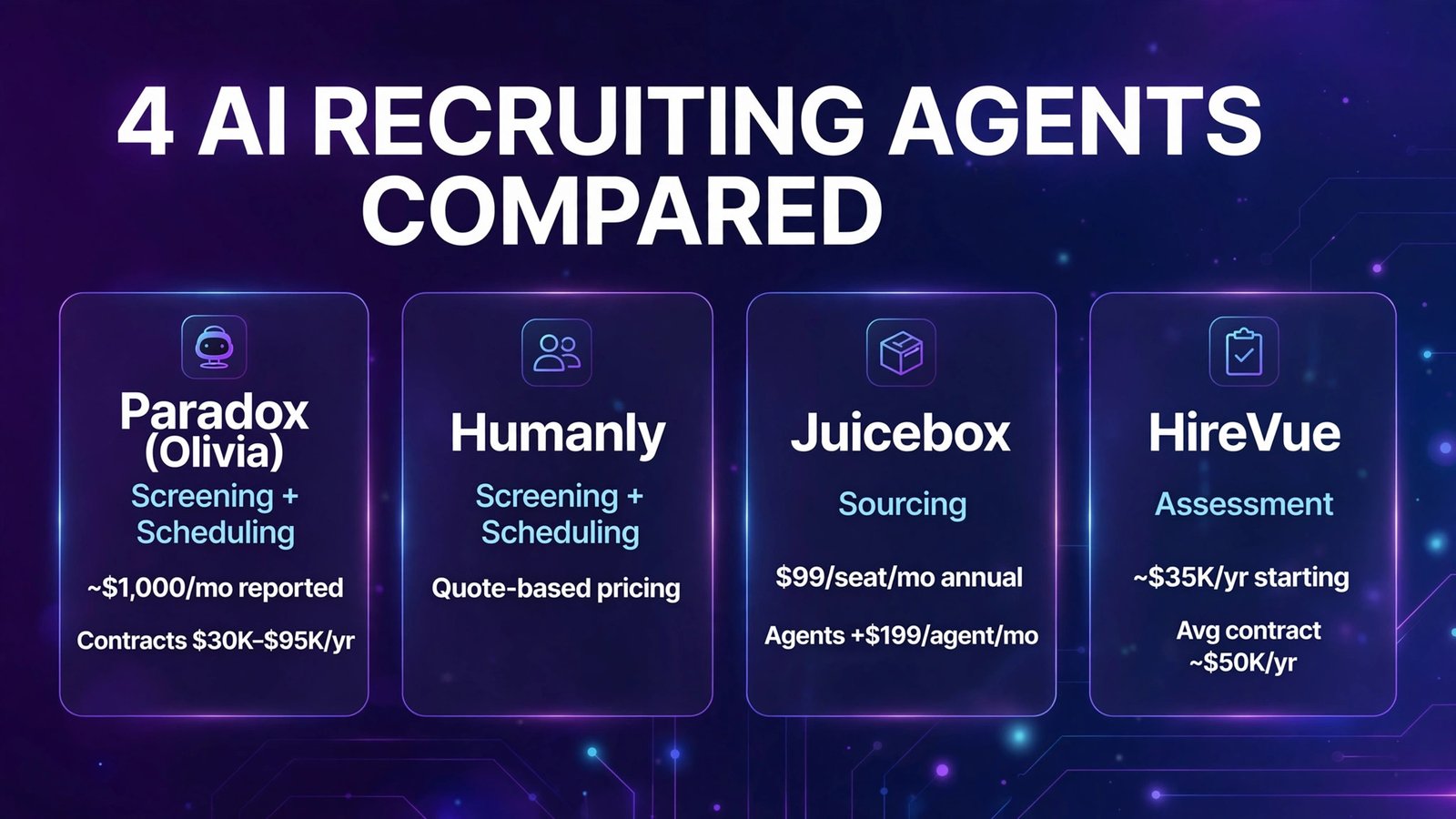
Bottom line: Hiring hundreds of hourly workers a year? Paradox is the proven machine — now owned by Workday — and Humanly is its mid-market alternative. Your bottleneck is finding people, not processing applicants? Juicebox is the only true sourcing agent here. Your bottleneck is fair, structured assessment of thousands of applicants? HireVue. Most recruiting teams eventually need two of these categories, not one — buy for your actual bottleneck first.
What Recruiting Agents Actually Do (Three Different Jobs)
Before the tools, get the taxonomy right, because vendors blur it deliberately:
- Screening & scheduling agents (Paradox, Humanly): engage applicants the moment they apply — ask knockout and screening questions conversationally, answer FAQ, and book interviews. The value is speed: application-to-interview in minutes instead of days, which is decisive for hourly roles where the best candidates take another job within 48 hours.
- Sourcing agents (Juicebox): work the other side of the funnel — search external profile databases, rank matches, find contact details, and run outreach sequences autonomously. The value is pipeline for roles that get few or no quality applicants.
- Assessment platforms with AI (HireVue): structured video interviews, game-based and skills assessments, and AI-assisted scoring to shortlist consistently at volume. The value is a defensible, validated process — and it’s the category under the most regulatory scrutiny.
1. Paradox (Olivia) — The High-Volume Screening Machine
What it is: Paradox’s assistant, Olivia, is a conversational agent that handles the front end of hiring by text and chat: candidates apply by texting a keyword or tapping a link, Olivia answers their questions, asks screening questions, and books (and rebooks) interviews directly onto hiring-manager calendars — 24/7, in 100+ languages. It extends into offers, onboarding paperwork, and virtual hiring events. In a major 2025–2026 development, Workday acquired Paradox (agreement August 2025, closed October 1, 2025, reported ~$1 billion) — Olivia now sits inside Workday’s talent acquisition suite as its candidate experience agent, while continuing to integrate with other ATS platforms.

2026 pricing (not published — reported ranges): Paradox sells by custom quote, with no free trial. Its Capterra listing shows a starting price of ~$1,000/month, and G2 buyer data cited by pricing trackers puts typical mid-size contracts in the $30,000–$95,000/year range, with setup/integration adding more in year one. Treat these as planning ranges from third parties — Paradox does not confirm them, and your quote will move with hiring volume, locations, and modules.
Hands-on notes: Olivia’s scheduling is the best in this category, full stop — multi-person, multi-location interview coordination that used to eat a coordinator’s week happens in seconds, and rescheduling (the silent killer of hourly hiring funnels) is handled conversationally instead of by phone tag. Its public customer results are striking: large frontline employers in retail, QSR, and logistics report application-to-interview collapsing from days to minutes, and Paradox reports tens of millions of interviews handled per year. Two cautions from our research: implementation averages around two months (this is an enterprise rollout, not a weekend setup), and a June 2025 security incident that exposed applicant data means security diligence questions belong in your first vendor call, not your last.
Pros:
- Best-in-class interview scheduling and rescheduling automation
- Text-first, mobile-first, 100+ languages — matches how hourly candidates actually apply
- Proven at the largest frontline employers (retail, hospitality, healthcare, logistics)
- Now backed by Workday, with deep ATS integrations (Workday, SAP SuccessFactors, iCIMS, UKG, Greenhouse and more)
Cons:
- No published pricing, no trial; enterprise sales cycle and ~2-month implementation
- Overkill below roughly 500 hires/year — the economics need volume
- Workday ownership raises long-term questions for teams standardized on other ATS platforms
Verdict: If you hire hourly/frontline workers at scale, Paradox is the default choice — budget five figures, plan a real implementation, and expect the scheduling automation alone to justify it.
2. Humanly — Conversational Screening for the Mid-Market
What it is: Humanly is a conversational AI recruiting platform aimed squarely at the mid-market: an AI agent that engages candidates on your careers site and messaging channels, runs structured screening conversations (chat, voice, and video formats), schedules interviews, and ranks candidates from conversation transcripts with scorecards your recruiters review. It layers automated reference checking and screening analytics on top — and can also run as its own lightweight ATS if you don’t have one.
2026 pricing (not published — model described): Humanly does not publish a price list; pricing is quote-based and configured per client. Its model has historically been subscription-based on hiring volume/role streams, and the company has signaled a move toward pay-per-candidate and pay-per-hire components. A 2026 industry guide cited ~$1,000/month per role stream, but Humanly does not confirm pricing publicly — get a written quote scoped to your roles and volume, and negotiate a pilot period into it.
Hands-on notes: What stands out in evaluation is the recruiter side of the product: every AI screening conversation produces a transcript, structured answers, and a ranked shortlist, so recruiters start from evidence rather than a black-box score. The chat/voice/video AI interviewer is configurable per role (questions, knockout criteria, scoring), and the demo interview on its site is worth running as a candidate to feel the experience your applicants will get. Humanly typically gets an AI interviewer live within about a week of kickoff — materially faster than enterprise rollouts. The weaker spots: it’s less proven at Paradox-scale volume, its newer products (AI notetaker, talent CRM) have thin public track records, and candidates can’t self-reschedule in all flows.
Pros:
- Screening, scheduling, AI interviews, and reference checks in one mid-market product
- Transcript-backed rankings — recruiters see why, not just a score
- Fast implementation (~1 week to a live AI interviewer per the vendor)
- Works on top of major ATS platforms (Workday, Greenhouse, iCIMS, UKG, Taleo and others) or standalone
Cons:
- No published pricing and no stated free trial — the sales call is mandatory
- Less proven at very high (enterprise) volumes than Paradox
- Security certifications aren’t prominently documented — ask for the paperwork during diligence
Verdict: The right shape for mid-size employers (roughly 100–2,000 hires/year) who want Paradox-style screening without an enterprise contract and implementation project.
3. Juicebox — The Sourcing Agent (PeopleGPT)
What it is: Juicebox (also branded Juicebox/PeopleGPT) flips the funnel: instead of processing applicants, its agents go find candidates. You describe who you want in plain English — “VP of Marketing with B2B SaaS experience at a Series B company who has led a rebrand” — and PeopleGPT searches 800M+ profiles across 30+ sources, returns ranked, enriched profiles with contact details, and (with the Agents add-on) runs autonomous multi-step sourcing and outreach campaigns: find, evaluate, draft personalized outreach, sequence follow-ups, and manage the pipeline.

2026 pricing (verified): Free plan: one seat, limited searches. Starter: $99/seat/month billed annually ($119 monthly) — unlimited searches, 500 contact credits/month. Growth: $179/seat/month billed annually ($199 monthly) — 1,500 contact credits/month, up to 5 seats. Juicebox Agents add-on: $199 per agent/month on top of any paid plan. Business: custom, annual only.
Hands-on notes: The natural-language search is the real deal — our test queries returned sensibly ranked lists without a single Boolean string, and the “find similar profiles” feature (give it two great candidates, get fifty more like them) is the fastest way we’ve found to expand a thin pipeline. Contact-data quality was good on US tech profiles and thinner in some international and non-tech segments, so sample your actual market before buying seats for the whole team. The Agents add-on is powerful but doubles the effective price quickly — one seat on Growth with one agent is $378/month — and autonomous outreach deserves a human review loop for the first campaigns, both for quality and for candidate-experience reasons (see the compliance section below).
Pros:
- Natural-language search over 800M+ profiles genuinely replaces Boolean drudgery
- Only platform here that creates pipeline instead of processing it
- Published pricing and a free plan — the lowest-friction evaluation in this roundup
- Find-similar and autonomous agents compress a sourcer’s week into hours
Cons:
- Agents add-on ($199/agent/mo) stacks fast on top of seat pricing
- Contact-data depth varies by segment and geography — test your market first
- ATS sync and some team features are gated to the custom Business tier
Verdict: If your recruiters’ bottleneck is “we can’t find enough qualified people to talk to,” Juicebox is the pick — and the only one of the four that solves that problem at all.
4. HireVue — Structured Assessment at Enterprise Scale
What it is: HireVue is the enterprise interviewing and assessment platform: on-demand and live video interviews built from 1,000+ job-specific guides, game-based and coding assessments, automated scheduling, and AI-assisted scoring that shortlists candidates against validated competency models. It reports 70M+ interviews hosted and is used by large employers for graduate, hourly, and professional intakes where thousands of applicants need a consistent, structured first evaluation.
2026 pricing (not published — reported ranges): HireVue publishes no pricing and offers no free trial. Third-party listings (G2/Capterra) show Essentials starting at ~$35,000/year (positioned for organizations of 2,500–7,500 employees), and procurement data from Vendr puts the average contract at ~$49,855/year, with large enterprise deals reported above $145,000. Implementation adds a reported $15,000–$40,000 in year one, and modules like game-based assessments and advanced analytics can be separate line items — insist on an itemized quote.
Hands-on notes: HireVue’s strength is rigor: structured questions tied to job competencies, consistent scoring rubrics, and — critically for the enterprise tier — adverse-impact testing and validation documentation, the paperwork your legal team will ask for when (not if) the AI’s decisions are questioned. One important historical note for buyers doing diligence: HireVue discontinued facial-analysis scoring years ago (2021) following criticism; current AI evaluates interview content and assessments, not faces — but expect candidates and journalists to ask, and have the answer ready. The candidate experience is the trade-off: one-way video interviews are efficient for employers and divisive for applicants, with completion rates suffering when candidates perceive the process as impersonal. For senior or scarce-skill roles, use HireVue for the structured screen if you must — and get a human in front of finalists fast.
Pros:
- Deepest validation and adverse-impact testing documentation in the category — built for regulated, scrutinized hiring
- Structured, consistent evaluation across thousands of applicants
- Interview guides, assessments (including coding and game-based), and scheduling in one platform
- FedRAMP-authorized offerings for government and regulated industries
Cons:
- Enterprise pricing (~$35K+/yr floor) and multi-year contract expectations
- One-way video format draws candidate skepticism and can dent completion rates
- Implementation fees add materially to year-one cost
Verdict: For large, high-scrutiny hiring programs where defensibility matters as much as efficiency, HireVue remains the reference platform. Everyone below enterprise scale will find it oversized.
Per-Role Use Cases: Which Agent for Which Hire?
The platforms overlap less than their marketing suggests. Match the agent to the role type:

| Role type | Funnel problem | Best agent | What it automates |
|---|---|---|---|
| Hourly/frontline (retail, warehouse, QSR, care) | Applicants ghost before interviews; schedulers drown | Paradox (enterprise) / Humanly (mid-market) | Text-to-apply screening, instant scheduling, reminders, rescheduling |
| Customer support & sales reps | Volume + consistent first screen | Humanly / HireVue | Structured screening conversations or async video + scoring |
| Scarce technical & specialist roles | No applicants; must source passive candidates | Juicebox | Natural-language sourcing, enrichment, outreach sequences |
| Graduate/campus intakes | Thousands of similar applicants, fairness scrutiny | HireVue | Structured interviews + validated assessments at scale |
| Executive roles | Judgment, confidentiality, relationships | None of these as primary | Agents help with research/scheduling only — humans run this process |
Pricing Table (What We Could Verify, October 2026)
| Platform | Published pricing? | Entry point | Model |
|---|---|---|---|
| Paradox | No | ~$1,000/mo (third-party listing); typical contracts reported $30K–$95K/yr | Custom annual contract by volume/modules |
| Humanly | No | Quote-based; industry guide cited ~$1,000/mo per role stream (unconfirmed) | Configured subscription; moving toward per-candidate/per-hire elements |
| Juicebox | Yes | Free plan; Starter $99/seat/mo annual | Per-seat + contact credits; Agents +$199/agent/mo |
| HireVue | No | ~$35K/yr (third-party listing); average contract ~$50K/yr | Custom annual/multi-year contract + implementation |
The honest pattern: the screening/assessment platforms sell like enterprise software (quotes, contracts, implementations); the sourcing agent sells like SaaS (published tiers, free plan). Judge each against its own category’s norms — and always ask the enterprise vendors for an itemized year-one total, including implementation.
Full Comparison Table
| Paradox | Humanly | Juicebox | HireVue | |
|---|---|---|---|---|
| Agent job | Screening + scheduling | Screening + scheduling | Sourcing | Assessment |
| Engagement style | Text/chat conversations | Chat, voice, video | Natural-language search + outreach | Structured video + assessments |
| Published pricing | No (quotes only) | No (quotes only) | Yes | No (quotes only) |
| Entry point | ~$1,000/mo (reported) | Quote-based | Free plan; $99/seat/mo annual | ~$35K/yr (reported) |
| Free tier/trial | Neither | Neither stated | Free plan | Neither |
| Candidate channel | SMS/text-first | Web chat, voice, video | Email + LinkedIn outreach | On-demand video |
| Languages | 100+ | Multi-language | Global profiles | 40+ (Enterprise) |
| Adverse-impact testing | Ask vendor | Ask vendor | N/A (sourcing) | Enterprise tier |
| Best at | Hourly hiring at scale | Mid-market screening | Passive-candidate pipeline | Defensible assessment |
How to Choose
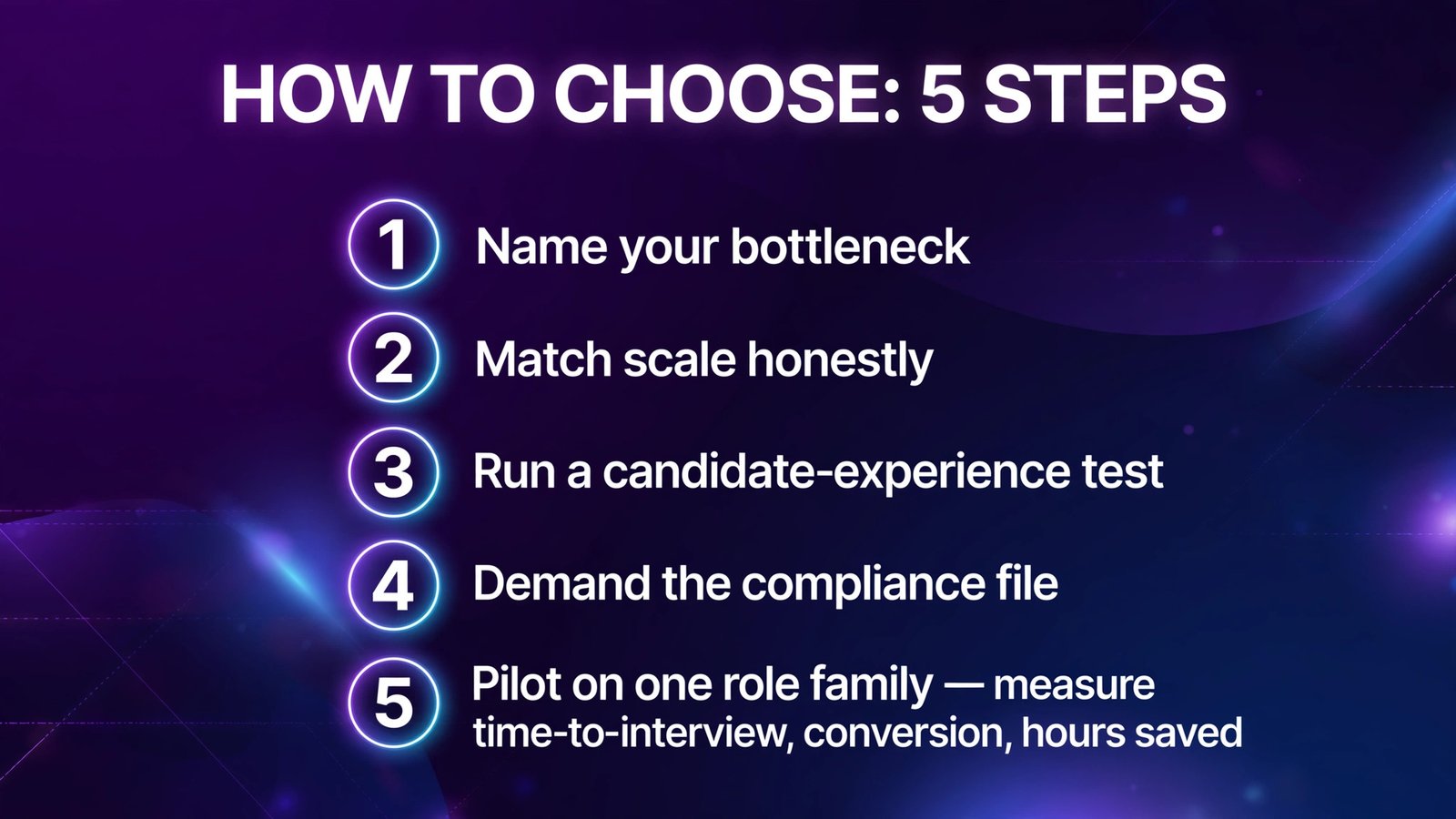
- Name your bottleneck in one sentence. “Applicants wait days for interviews” → screening/scheduling (Paradox/Humanly). “We have no pipeline” → sourcing (Juicebox). “Our screening is inconsistent and legally exposed” → assessment (HireVue). Buying for the wrong bottleneck is the #1 failure mode.
- Match scale honestly. Under ~200 hires/year, enterprise platforms won’t pay back; Humanly or Juicebox (by bottleneck) will. Above ~2,000 hires/year in frontline roles, Paradox’s economics and proof points dominate.
- Run a candidate-experience test. Have two employees apply for a real role through the agent before you sign. Slow, robotic, or creepy at any step will show up in your completion rates later.
- Demand the compliance file during evaluation. Validation studies, adverse-impact testing methodology, data-retention controls, and the accommodation process (see FAQ) — vendors who have it ready are vendors who’ve survived enterprise diligence.
- Pilot on one role family, measure three numbers. Time-to-interview, screening-to-interview conversion, and recruiter hours saved — for 60–90 days, against your pre-agent baseline. Expand only if all three move.
Frequently Asked Questions
Are AI recruiting agents biased? How is that controlled?
They can be — an agent trained or configured carelessly can reproduce and scale human bias faster than any human could. The controls that matter: screening criteria tied to documented job requirements (not “culture fit” vibes), validation studies showing scores predict job performance, adverse-impact testing (checking selection rates across demographic groups, e.g., the four-fifths rule) run regularly rather than once at launch, and human review of rejections at the margin. HireVue builds adverse-impact testing into its enterprise offering; with Paradox, Humanly, or Juicebox, ask what testing they perform on your configuration and cadence — and don’t accept “our AI is unbiased” as an answer from anyone.

Is using AI agents in hiring legal? What about the EU AI Act and US rules?
Yes, with obligations that are growing. The EU AI Act classifies most recruitment AI as high-risk, phasing in requirements for risk management, human oversight, transparency, and documentation. In the US, NYC Local Law 144 requires annual independent bias audits and candidate notice for automated employment decision tools used on NYC residents; Illinois and other states require notice/consent for AI-analyzed video interviews, and Colorado’s AI Act adds duties for high-risk AI in employment. The EEOC has also made clear that Title VII and the ADA apply to algorithmic screening exactly as they apply to human screening. This is a fast-moving area — involve employment counsel before deploying, especially across states or into the EU.
Do candidates actually like AI screening agents?
The evidence is split by format. Text-based screening and instant scheduling (Paradox, Humanly) generally improve candidate satisfaction versus the alternative — silence — because candidates get instant responses and an interview booked in minutes. One-way AI video interviews (HireVue-style) are more divisive: efficient, but some candidates find them impersonal, and completion rates can drop. Practical rules: tell candidates an AI is involved and why, keep it fast, always offer a human path, and never make AI the only thing standing between a strong candidate and a conversation.
How much do AI agents for recruiting cost overall?
Published pricing exists only for Juicebox here ($99/seat/month annual to start, plus $199/agent/month for autonomous agents). The others are quote-based: Paradox is reported from ~$1,000/month with typical mid-size contracts of $30K–$95K/year; HireVue listings start around $35K/year with average contracts near $50K/year; Humanly is configured per client. Add implementation (reported $15K–$40K for HireVue-class rollouts) to any enterprise year-one budget, and treat all third-party figures as planning ranges until you have a written quote.
Can these agents replace recruiters?
No — they replace the parts of recruiting that were never really recruiting: scheduling phone tag, repetitive screening questions, data entry, chase-up reminders, and first-pass sourcing. What they don’t replace is judgment: assessing motivation, selling the role to a skeptical finalist, advising a hiring manager whose spec is unrealistic, and owning fairness in the final decision. Teams that deploy agents well redeploy recruiter hours into exactly that work; teams that deploy them as a headcount-cut usually discover the quality and compliance costs later.
What should I ask vendors about data privacy and candidate data?
Five questions: (1) Is candidate data used to train models shared across customers? (Get the answer in the contract.) (2) What are retention and deletion controls — can candidates request deletion, and does it actually propagate? (3) Where is data processed/stored (EU residency matters for GDPR)? (4) What security certifications do you hold (SOC 2 Type II minimum), and have there been incidents affecting applicant data? (5) How do you handle accommodation requests — e.g., a candidate who cannot do a video or text screen due to a disability must get an equivalent alternative process. The quality of the answers is itself a vendor signal.
Conclusion
AI agents for recruiting work best when you buy them by job, not by hype: Paradox (now Workday’s) for high-volume screening and scheduling at enterprise scale, Humanly for the same job at mid-market scale, Juicebox when the problem is finding candidates at all, and HireVue when consistent, validated, defensible assessment matters most. The through-line of every successful deployment we’ve seen: the agent owns the repetitive 80%, humans own judgment and fairness, and the compliance conversation happens before the contract — not after the first regulator, candidate, or journalist asks about it.
Next step: write down your single biggest funnel bottleneck in one sentence, then run the matching pilot: Paradox or Humanly on one high-volume role family, or a Juicebox free plan against your hardest-to-fill open role. Measure time-to-interview or pipeline created for 60 days — the numbers will make the buying decision for you.