

An agency that bills 40 clients a month loses roughly 12 hours to manual bookkeeping for every 100 invoices it sends, and the best ai accounting tools for agencies cut that work to under three hours by sorting transactions, chasing overdue payments and drafting the month-end close without a human touching every line. The gap between the cheapest and the most expensive tool in this guide is more than 450 dollars a month, yet the right choice is rarely the cheapest one.
QuickBooks Online leads this guide because it pairs strong automation with the widest accountant network, so an agency can hand a client file to almost any outside bookkeeper and expect them to know the system already. Xero follows closely for agencies with international clients, since its multi-currency handling and unlimited users remove two common ceilings at once. The remaining eight tools cover narrower ground, from free invoicing to a fully staffed finance team, and each one solves a specific agency problem better than the generalists do.
Every tool below was live in November 2026, and the prices quoted are the vendor list prices found on their own pricing pages, so confirm the current number before paying. A ten-person creative agency with retainer clients needs different accounting than a media buying agency that passes large ad budgets through its books.
Where Agency Books Go Wrong First
Agency accounting breaks in a different place than ordinary small business accounting. The first crack appears in client profitability, because an agency that tracks revenue by client but not by project will look profitable while two or three accounts quietly drain the margin. Time gets logged against the wrong client, software seats get shared across accounts, and subcontractor costs land in a general bucket instead of the project that caused them.
A second crack is the month-end close. An agency that closes its books 20 days after month end is making staffing and pricing decisions on stale numbers, and the delay usually comes from uncategorised transactions piling up in a review queue. AI categorisation cuts that pile down, yet the tools differ sharply in how much they get right on the first pass, because every correction is time the automation was supposed to save.
The last crack is reporting that nobody reads. A profit and loss statement that arrives as a dense table gets ignored, while a short report that shows margin by client, outstanding invoices by age and cash runway gets acted on. The best ai accounting tools for agencies in this guide were scored on whether their reports answer the questions an agency owner actually asks on a Monday morning.
What Agency Pricing Really Costs
The sticker price of accounting software rarely matches what an agency pays in year one. A 38 dollar plan looks cheap until the agency adds three users, a payroll add-on and a payment processing fee on every client card payment, and the monthly bill doubles without any new feature being used. Agencies should price a tool by the full stack, not by the headline plan, and the detail sections below call out the add-ons that matter.
Per-user pricing punishes agencies that need many seats. A tool that charges per user looks fair for a five-person agency and expensive for a 25-person one, especially when half the seats belong to project managers who only approve expenses. Unlimited-user tools remove that penalty, which is why Xero and Zoho Books score well for larger agencies. Before choosing, count the people who need access, not just the people who do the books.
Service-based tools charge by revenue band or by expense volume, and the price jumps when the agency grows. Bench starts at 199 dollars a month for agencies under 250,000 dollars of annual revenue, while Zeni starts near 494 dollars a month and expects a larger operation. Those prices buy human bookkeeping, so the comparison is not software against software, it is software against hiring a part-time bookkeeper.
Free plans deserve a hard look too. Wave and Zoho Books both offer free tiers that cover invoicing and basic bookkeeping, and for a new agency with five clients they can be enough.
The 10 Tools at a Glance
| Tool | Main job | Best for | Starting price |
|---|---|---|---|
| QuickBooks Online | Full accounting with wide accountant support | Agencies that want the standard choice | 38 dollars a month |
| Xero | Multi-currency accounting with unlimited users | Agencies with international clients | 27 dollars a month |
| FreshBooks | Invoicing and time tracking for services | Agencies that bill by the hour | 23 dollars a month |
| Zoho Books | Low-cost full accounting | Budget-conscious agencies | 20 dollars a month |
| Wave | Free invoicing and bookkeeping | New agencies with few clients | Free |
| Puzzle | AI-first ledger for startups | Agencies that want heavy automation | 30 dollars a month |
| Digits | AI bookkeeping software | Agencies that run their own books | 65 dollars a month |
| Pilot | AI bookkeeping with human review | Agencies that want a monthly close | 99 dollars a month |
| Bench | Staffed bookkeeping service | Agencies that want books done for them | 199 dollars a month |
| Zeni | AI bookkeeping plus a finance team | Larger agencies with investor reporting | 494 dollars a month |
Best Pick by Job
| Job type | First pick | Second tool | Why this pair works |
|---|---|---|---|
| Standard agency books | QuickBooks Online | Xero | QuickBooks Online has the widest accountant support and Xero covers international clients |
| Hourly billing | FreshBooks | Zoho Books | FreshBooks tracks time to invoice and Zoho Books adds full accounting at a low price |
| Tight budget | Wave | Zoho Books | Wave costs nothing to start and Zoho Books adds depth when the agency grows |
| Hands-off books | Bench | Pilot | Bench supplies a bookkeeper and Pilot adds AI speed at a lower price |
| International clients | Xero | QuickBooks Online | Xero handles multi-currency and QuickBooks Online covers the rest of the stack |
Budget follows the same logic. An agency with 500,000 dollars of annual revenue can justify a 199 dollar bookkeeping service, because the cost is a small share of revenue and the time saved goes back to billable work. An agency with 80,000 dollars of revenue cannot, and should start free or near-free, then upgrade when client count forces the issue. The best ai accounting tools for agencies are the ones that fit the agency’s current size without blocking the next stage of growth.
How to Judge the best ai accounting tools for agencies
Start with the categorisation test, because that is where AI accounting either saves time or creates it. Import three months of real transactions, let the tool categorise them, and count how many suggestions you correct. A tool that gets 90 percent right on the first pass will save hours every month, while one that gets 70 percent right will feel like a second job.
Next, test client profitability reporting. Build a report that shows revenue, direct costs and margin for your five largest clients, and see how many clicks it takes. If the tool cannot split costs by client without manual work, it will not help an agency find its unprofitable accounts. Look for project tracking, time allocation and expense tagging, because those three features decide whether the report is real or approximate.
Then check the invoicing workflow end to end. Create a retainer invoice, a milestone invoice and an hourly invoice, send all three, and watch how the tool handles late payment reminders. The best ai accounting tools for agencies send reminders automatically, accept card payments without a separate setup, and show which invoices are overdue at a glance.
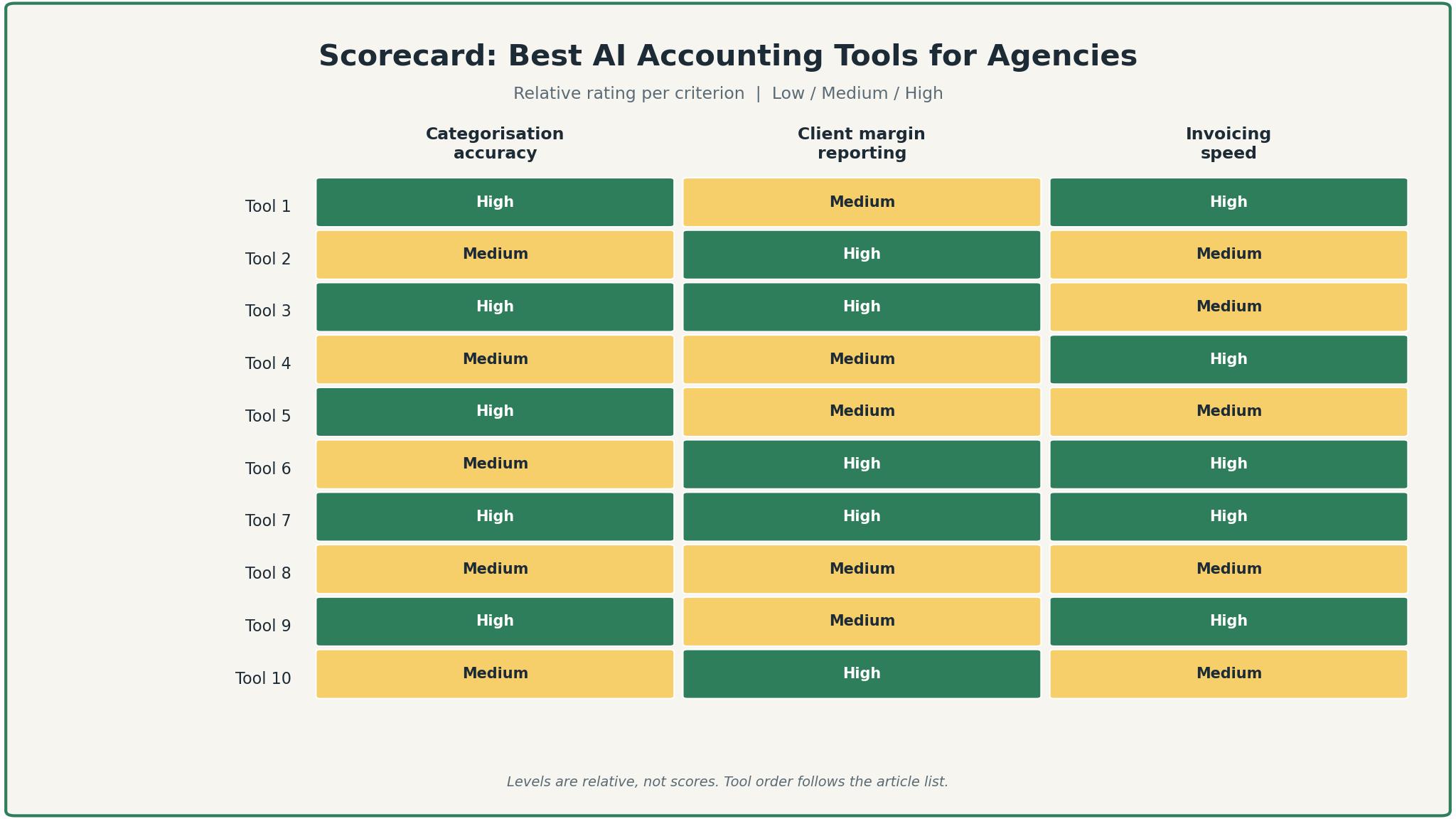
The 10 Tools in Detail
Accountant coverage sets the order below, so the tool most outside bookkeepers already know leads the list.
1. QuickBooks Online
QuickBooks Online is the default accounting system for American agencies, and that position is its biggest strength. Almost every freelance bookkeeper and small accounting firm already uses it, so an agency can hire help without training anyone on a new system.
The drawback is the price curve. Simple Start costs 38 dollars a month for one user, and an agency that needs five users, payroll and inventory tracking lands on Plus at 140 dollars a month or higher. Add-ons stack up quickly, and the interface carries years of accumulated menus that can confuse a new user.
QuickBooks Online suits agencies that want the safe choice and expect to work with outside accountants. It fits a ten-person agency with retainer and project billing, a media buyer passing ad spend through, and any firm whose accountant already works in the system. The integration list is the widest in this guide, which matters when the agency also runs a CRM and a project tool.
Put it through a live trial with your own bank feed and your messiest client, because a clean demo hides the rough edges. Connect the account, import 90 days of transactions, and watch how many the AI categorises correctly without help. Then build a client margin report and send a test invoice to yourself, checking how long each step takes.
2. Xero
Xero wins on structure. Unlimited users on every plan means the whole agency can have access without a per-seat bill, and multi-currency support is built in rather than bolted on. Its project tracking links time and costs to a client, which is the foundation of agency margin reporting.
The drawback is the invoice and bill limits on the entry plan. Early costs 27 dollars a month and allows only 20 invoices and 5 bills a month, which a busy agency will pass in the first week. Most agencies need Growing at 55 dollars a month, so the real entry price is higher than the headline. Payroll runs through a partner integration rather than natively, which adds a second login for American agencies.
Xero suits agencies with international clients, distributed teams and anyone who hates per-user pricing. It fits a remote agency billing in three currencies, a design studio with contractors in two countries, and a firm that wants every project manager to see project costs without paying for a seat each.
Run a two-week comparison against your current system using real invoices in two currencies. Send five invoices in dollars and three in euros, pay a contractor in pounds, and reconcile the bank feed daily. Note how many times you need support or a workaround, and whether the multi-currency balances match your spreadsheet.
3. FreshBooks
FreshBooks is built around the service business invoice, and it shows in every screen. Time tracking links directly to invoices, expenses attach to a client with one tap, and the client portal lets customers see their invoices, pay online and approve estimates without an email chain.
The drawback is accounting depth. FreshBooks is not a full double-entry ledger in the way QuickBooks Online and Xero are, and agencies that need inventory, complex tax handling or detailed balance sheet work will outgrow it. Bank reconciliation exists but is lighter, and the Lite plan covers only five billable clients, so a growing agency moves to Plus at 43 dollars a month or Premium at 70 dollars a month fairly soon.
FreshBooks suits small agencies that bill by the hour and value speed over depth. It fits a three-person studio, a freelance collective that shares one billing system, and a consultancy that sends most of its invoices from time entries.
Test it by billing a real week of work from time entries alone. Log hours for three clients, convert the entries to invoices, and send them through the client portal. Then check how long the bank reconciliation takes and whether the expense reports show margin by client. If the invoicing feels fast and the reports answer the margin question, the depth trade-off is worth it.
4. Zoho Books
Zoho Books delivers the most accounting per dollar in this guide. The Standard plan costs 20 dollars a month for three users, and it includes invoicing, bank reconciliation, expense tracking, project billing and automated workflows that other tools reserve for higher tiers.
The drawback is the ecosystem lock-in. Zoho Books works best alongside other Zoho products, and agencies that run a different CRM or project tool will find the integrations thinner than QuickBooks Online or Xero offer. Payroll is limited to select American states, so many agencies need a separate payroll tool.
Zoho Books suits budget-conscious agencies that want full accounting without a big monthly bill. It fits a five-person agency that needs project billing and multi-user access, a firm already using Zoho CRM, and any agency that wants automation rules without paying a premium tier price.
Set up one automated workflow and one project report during the trial, then judge the tool on those two things. Create a rule that routes expenses over 200 dollars to a manager for approval, and build a project profitability report for your largest client. If both work without a support call and the report reads clearly, Zoho Books will carry the agency further than its price suggests.
5. Wave
Wave is the only genuinely free accounting tool in this guide, and its free tier is not a trial. Unlimited invoicing, unlimited expense tracking and basic bookkeeping cost nothing, which makes it the right first step for a brand-new agency.
The drawback is the ceiling. Wave Pro at 19 dollars a month adds receipt capture and removes some limits, but the tool has no project profitability reporting worth the name, no multi-currency depth and no payroll of its own.
Wave suits agencies in their first year, solo operators and side projects that need proper invoices without a monthly bill. It fits a freelancer moving into agency work, a two-person studio testing a niche, and any firm that wants to keep costs at zero while it finds its first retainer clients.
Use it for a full billing cycle before deciding whether to stay or move on. Send every invoice for one month through Wave, reconcile the bank feed weekly, and try to produce a margin report by client at month end. If the invoicing feels complete and the missing margin report does not hurt yet, stay. If the report gap forces a spreadsheet, start planning the move to a paid tool.
6. Puzzle
Puzzle is an AI-first ledger built for startups, and it treats automation as the product rather than a feature. It categorises transactions, drafts journal entries and flags anomalies as they happen, and its real-time dashboard shows cash, burn and runway without waiting for a month-end close.
The drawback is maturity. Puzzle is newer and smaller than the established tools, so its integration list is shorter and its accountant network is thin. An agency that needs a specific payroll integration or a niche tax report may find it missing, and the 30 dollar a month starting price buys the software only, with no human bookkeeper in the loop.
Puzzle suits tech-forward agencies that already run modern tools and want automation first. It fits a startup-focused agency, a firm whose clients are venture-backed companies, and an owner who checks the dashboard daily and likes real-time numbers.
Feed it a month of your real transactions and compare its categorisation with your current books. Import the bank feed, let the AI sort everything, and count the errors against the ledger you already trust. Then open the cash runway view and check whether the number matches your own forecast. If the AI is accurate and the runway view is honest, Puzzle can replace a heavier system.
7. Digits
Digits runs AI agents across the ledger, and its pitch is simple, the books largely manage themselves. Essentials costs 65 dollars a month and covers categorisation, reconciliation and quality review by software, with higher tiers adding dimensional accounting and multi-entity support.
The drawback is the absence of a human in the loop. Digits is software, not a service, so when the AI misreads a transaction or a report looks wrong, the agency fixes it. The site does not confirm a QuickBooks Online or Xero sync, which matters for agencies that need to share data with an outside accountant.
Digits suits agencies that want to run their own books with heavy automation and no bookkeeper. It fits an owner-operator agency, a firm with a financially confident founder, and a team that already reconciles weekly and wants the software to do the repetitive part.
Trial it with your most complex month, not your simplest one. Pick a month with refunds, contractor payments and a client credit, and let Digits process the whole set. Check every categorisation against your real ledger, then open the reporting view and see whether it answers the margin-by-client question. If the complex month comes out clean, the software will handle the ordinary ones.
8. Pilot
Pilot splits the difference between software and service. Essentials costs 99 dollars a month and runs on AI alone, closing the books monthly without a human, while Core and Custom add a dedicated bookkeeper on top of the same engine.
The drawback is the tier boundary. Essentials covers up to 100,000 dollars a month in expenses on a cash basis, and the human tier pricing is not fully public, so an agency cannot budget the upgrade precisely from the website.
Pilot suits agencies that want a monthly close they can trust without hiring a bookkeeper. It fits a growing agency whose books have outgrown DIY software, a firm preparing for investor or lender reporting, and an owner who wants the close done by the tenth of the month without chasing it.
Ask for the close on a trial month and read the output like a sceptic. Give Pilot one month of bank feeds, invoices and expense records, then check the resulting profit and loss statement line by line against your own records. Note any transaction it could not place and how it flagged the gap. If the close is clean and the gaps are clearly marked, the service earns its fee.
9. Bench
Bench is a bookkeeping service, not software, and that distinction is the point. A dedicated bookkeeper keeps the ledger, reconciles the accounts and delivers monthly financials. Bookkeeping Light costs 199 dollars a month for businesses under 250,000 dollars of annual revenue, and the standard tier costs 399 dollars a month.
The drawback is the history. Bench shut down without warning in December 2024 and was acquired days later, relaunching in January 2025. Reviews through 2026 still mention slower closes and slower support than before the shutdown, and that scar is worth knowing before signing.
Bench suits agencies that want the books done by a person and are willing to pay for it. It fits an owner who hates bookkeeping, a firm with no finance staff, and an agency that needs monthly financials it can hand to a lender without extra work.
Before signing, ask for a sample monthly report and a catch-up quote for any backlog. Read the sample for clarity, check whether client-level reporting is included or extra, and confirm the close date you will actually get. Then compare the monthly fee with the cost of the hours you currently spend on books. If the report is clear and the fee is below your time cost, Bench is the right kind of expensive.
10. Zeni
Zeni combines AI bookkeeping with a dedicated finance team, and it is the most complete service in this guide. The Starter plan starts at 494 dollars a month on annual billing, and the team handles daily bookkeeping, bill pay, invoicing and investor-ready reporting.
The drawback is the price and the requirements. Zeni is priced like a service, not a subscription, and it requires QuickBooks Online Plus as the underlying ledger, which adds to the bill.
Zeni suits larger agencies and funded firms that need investor-grade financials. It fits an agency preparing a fundraise, a firm with multiple entities or locations, and an owner who wants a finance team without hiring one.
Book a demo and ask to see a real client dashboard, not a slide deck. Check how bill pay works, how the team handles a disputed invoice, and what the monthly reporting pack contains. Then confirm the total cost, including the QuickBooks Online Plus requirement, and compare it with hiring a part-time controller. If the demo is concrete and the total is below a hire, Zeni fits.
Mistakes That Cost Agencies Money
The most expensive mistake is choosing a tool for the agency you wish you had instead of the one you run. A three-person studio does not need a 494 dollar finance team, and a 30-person agency does not need a free invoicing app that cannot report margin by client. Size the tool to the next twelve months of clients, not to a five-year dream, and plan the upgrade path in advance. The best ai accounting tools for agencies are judged here on fit for the agency’s current size, not on the longest feature list.
A second mistake is ignoring the add-on bill. Payment processing fees, payroll add-ons, extra user seats and receipt capture tools each add a line to the monthly total, and together they can double the headline price. Ask for the full-stack quote before committing, and include the transaction fees on the payment volume the agency actually processes. The cheapest headline plan is often the most expensive stack.
How to Make the Final Call
Start by listing the agency’s non-negotiables, because the list is shorter than most owners expect. Multi-currency, project margin reporting, contractor payments and per-user pricing are the four that eliminate most tools quickly. Write them down, score each tool against them, and drop any tool that fails a non-negotiable, no matter how attractive its other features look.
Next, run a paid trial on the top two choices with real data. A free trial with demo data proves nothing, while two weeks with the real bank feed, real invoices and real clients shows the truth. Measure three things, categorisation accuracy, time to produce a client margin report, and time to send and reconcile ten invoices.
Then check the human factor. Call support during the trial, ask a hard question about a transaction edge case, and judge the answer. An agency that cannot reach a knowledgeable person when the books look wrong will pay for that gap later, usually at tax time. The best ai accounting tools for agencies pair strong software with reachable support, and the trial is the time to test that claim.

Frequently Asked Questions
Which accounting tool is best for a small agency?
QuickBooks Online is the safest answer for a small agency among the best ai accounting tools for agencies, because it combines strong automation with the widest accountant network and the deepest integration list. Xero is the better pick when the agency bills in more than one currency or wants unlimited users without a per-seat bill. A new agency with under five clients can start free on Wave and move to a paid tool once the client list grows past ten.
How much should an agency pay for accounting software?
A small agency should expect to pay between 20 and 70 dollars a month for software alone, or between 99 and 199 dollars a month when a human bookkeeper is included. The total depends on user count, add-ons and payment processing fees, so budget the full stack rather than the headline plan. An agency that spends more than 2 percent of revenue on accounting should check whether the tool is doing work a cheaper one could do.
Can AI accounting software replace a bookkeeper?
AI software can replace the data entry and categorisation part of bookkeeping, but it cannot replace judgment on unusual transactions, tax decisions or client disputes. Most agencies land in the middle, using AI software for the daily work and a human bookkeeper for the monthly close and the year-end review. Services like Bench, Pilot and Zeni exist for agencies that want the human part handled too.
Does Xero or QuickBooks Online handle multi-currency better?
Xero handles multi-currency better at a lower price, because it is included on every plan and works with unlimited users. QuickBooks Online supports multi-currency from the Essentials tier upward, but the per-user pricing and higher tiers make it more expensive for a team that bills internationally. An agency with more than a quarter of revenue in a second currency should test Xero first.
What is the cheapest way for a new agency to start?
Wave costs nothing and covers invoicing, expense tracking and basic bookkeeping, which is enough for a new agency with a handful of clients. Zoho Books is the next step, with a free plan under 50,000 dollars of revenue and a 20 dollar a month Standard plan that adds project billing and three users. The key is choosing a tool that exports cleanly, so the move to a paid system later does not mean re-entering a year of history.
How often should an agency review its accounting tool?
An agency should review its accounting tool every six months, or whenever client count grows by half. The review should re-run three measures, categorisation accuracy, time to produce a client margin report, and time to send and reconcile ten invoices. If any measure has worsened since the last review, the tool is no longer keeping up with the agency, and a switch should be planned before the next busy season.
The Verdict on Agency Accounting
QuickBooks Online takes the top spot because it is the tool an agency is least likely to regret. The automation is strong, the accountant network is unmatched, and the integration list covers almost every CRM and project tool an agency might use.
Xero is the pick for agencies with international clients, and FreshBooks is the pick for small agencies that bill by the hour. Wave is the right start for a new agency, and Bench is the right answer when the owner wants the books done by a person rather than by software. The best ai accounting tools for agencies are not the ones with the longest feature list, they are the ones that fit the agency’s billing model, its client count and its tolerance for doing the books itself.
Choose by the billing model first, the client count second and the price third. Run a real trial, measure the three things that matter, and set a review date.