
PushPress is the strongest choice among the best ai loyalty tools for gyms, because its free Core plan covers memberships, bookings, and payments without a contract, its Pro plan at 159 dollars a month adds the retention tools a single-location gym actually uses, and its pricing is published plainly instead of hidden behind a sales call. Gym owners do not need the biggest platform or the most features. They need members who keep coming back after month three, a rewards system the front desk can run without a manual, and a monthly bill that does not double once the add-ons land.
That need shapes every pick below. A gym loyalty programme is not a coffee shop stamp card. It has to survive missed weeks, frozen memberships, class no-shows, and members who train at 6 a.m. and never speak to staff. The tools that rank highest here tie rewards to attendance and referrals and automate the nudges that bring lapsed members back.
Price matters more than it does for a software buyer, because a gym pays for the software, the card processing, and usually a branded app on top. This guide states the real starting price for each tool, what the processing costs, and where the add-ons hide. Every price was checked against live pricing pages in November 2026.
What Keeps Members Coming Back After Month Three
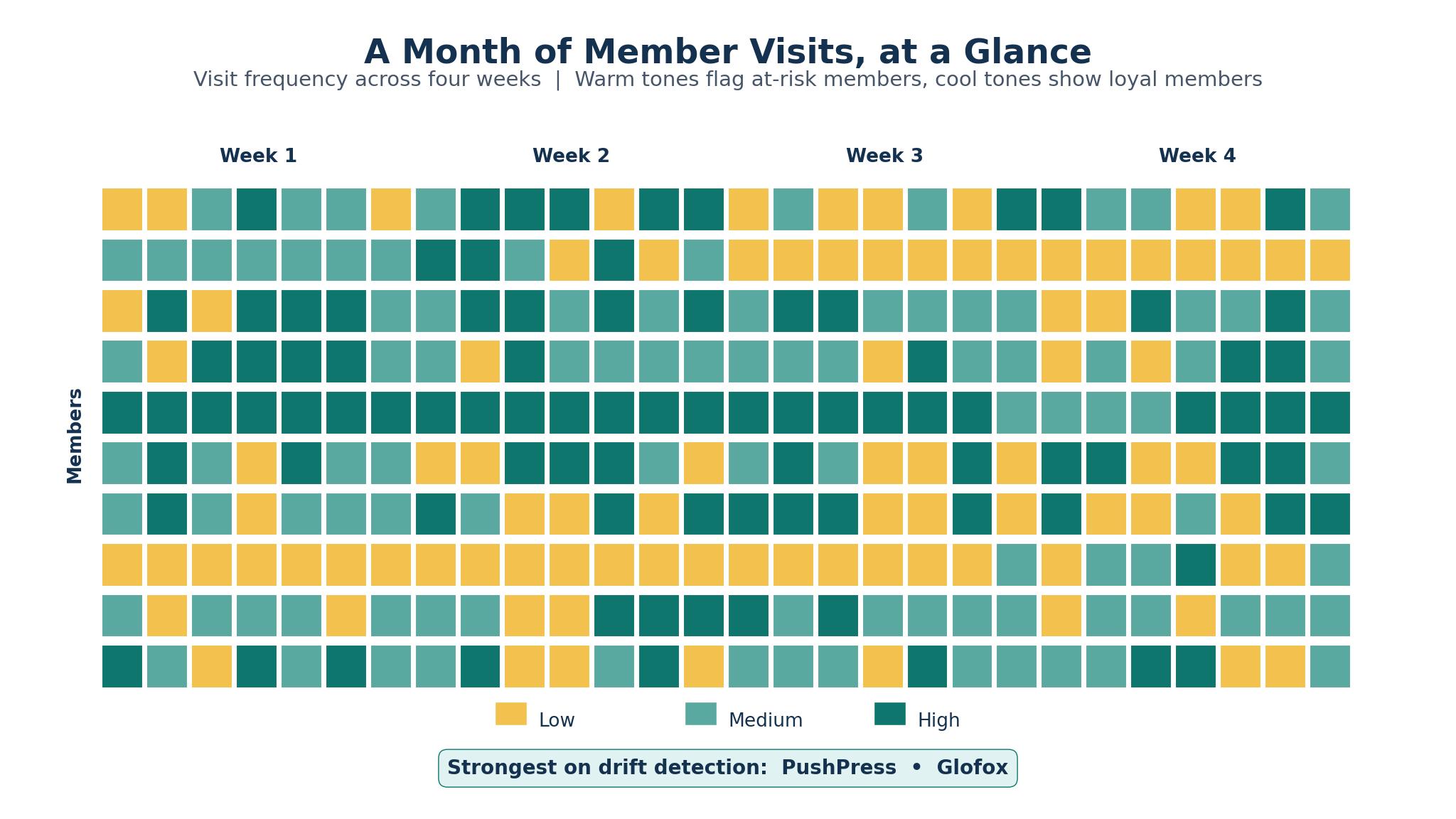
The first month is easy. A new member is motivated, the classes are novel, and the habit has not been tested yet. Month three is where gyms lose people, and the tools that help are the ones that notice the drift early. Mindbody and Glofox both track attendance patterns and flag members whose visits are dropping, while PushPress Grow adds CRM follow-up that reminds staff to check in. The best ai loyalty tools for gyms do not wait for a cancellation. They act on the second missed week.
Rewards must match what members actually value. A free smoothie means little to a member who trains before work, while a free guest pass or a class upgrade means a lot. Perkville lets gyms build point systems around visits, referrals, and milestones, and Smile.io and Stamped both support tiered rewards that recognise long-term members differently from new joiners. The reward that works is the one the member would have paid for, not the one that was cheapest to give away.
Referrals are the cheapest acquisition a gym has, and a loyalty tool should make them easy. A member who brings a friend is worth more than any ad, and the tools that track referrals cleanly are the ones that get used. TeamUp and Gymdesk both handle referral tracking without extra modules, while Mindbody ties referrals into its marketplace.
Points, Perks and Referrals That Gyms Can Actually Run
A loyalty programme fails when the front desk cannot run it. If staff need a manual to award points, or members need an app tutorial to redeem a reward, the programme will die quietly within a month. Among the best ai loyalty tools for gyms, PushPress and TeamUp both keep the loyalty workflow inside the booking and check-in flow the staff already use, so awarding points takes no extra steps. Glofox puts rewards inside its member app, which works when members actually open the app.
Points should be simple enough to explain in one sentence. One point per visit, a bonus for a referral, and a reward at fifty points is a system anyone can follow. Smile.io and Stamped both support that simplicity, while Perkville allows more complex rules for gyms that want them.
Perks must be easy to deliver. A free class, a guest pass, or a month at a lower rate are all perks the front desk can grant in seconds. Zen Planner and Wodify both let staff grant perks from the same screen they use for check-in, which is why they rank well on this point.
The True Cost: Software, Processing and the Branded App
The subscription is only the first line of the bill. A gym pays the monthly software fee, then card processing of roughly 2.6 to 3.5 percent on everything collected, then usually a branded app fee on top. Among the best ai loyalty tools for gyms, PushPress Pro at 159 dollars a month charges 2.89 percent plus 30 cents per transaction, while its free Core plan charges 4.99 percent plus 30 cents, so the free plan costs more per payment. TeamUp starts at 119 dollars a month for up to 100 clients, with processing on top, and its branded app adds 99 dollars a month.
Quote-only platforms are the hardest to budget. Mindbody publishes a 79 dollar a month entry point per location, but owners report paying 99 to 499 dollars a month once the plan they need is included, before the branded app and processing. Glofox advertises plans from 99 dollars a month, with operators reporting 110 to 400 dollars.
The branded app is the most common surprise. PushPress charges 97 dollars a month for its branded app, TeamUp charges 99 dollars a month, and Mindbody includes the app only on higher tiers. A gym that wants members to book, check in, and redeem rewards from its own app should budget 100 dollars a month for it, or accept the vendor app instead.
The 10 Tools at a Glance
| Tool | Main job | Best for | Starting price |
|---|---|---|---|
| PushPress | Gym software with loyalty and CRM | Single-location gyms on a budget | Free; Pro from $159 per month |
| Mindbody | Gym and studio platform with marketplace | Discovery and multi-location | From $79 per location per month |
| Glofox | Member experience and retention | Branded app and retention | From $99 per month |
| TeamUp | Class booking with every feature included | Class-based studios | From $119 per month |
| Zen Planner | Gym software for CrossFit and functional fitness | CrossFit boxes | From $117 per month |
| Gymdesk | Gym software for martial arts and multi-discipline | Martial arts and multi-discipline gyms | From $75 per month |
| Wodify | Gym software with leaderboards and WODs | CrossFit boxes that run competitions | From $79 per month |
| Perkville | Points and rewards for fitness businesses | A dedicated loyalty programme | Custom quote |
| Smile.io | Points, referrals and VIP tiers | Simple points and referrals | Free; paid from $49 per month |
| Stamped | Loyalty, reviews and referrals | Loyalty plus review collection | From $29 per month |
Best Pick by Job
| Job type | First pick | Second tool | Why this pair works |
|---|---|---|---|
| Single-location gym on a budget | PushPress | TeamUp | PushPress starts free, and TeamUp includes every feature at one price |
| Multi-location and discovery | Mindbody | Glofox | Mindbody brings the marketplace, and Glofox brings the branded experience |
| CrossFit box | Zen Planner | Wodify | Zen Planner covers billing and classes, and Wodify adds leaderboards |
| A dedicated loyalty programme | Perkville | Smile.io | Perkville builds the points system, and Smile.io adds referrals cheaply |
| Loyalty plus reviews | Stamped | Perkville | Stamped collects reviews, and Perkville runs the deeper rewards |
How to Pick the Best AI Loyalty Tools for Gyms Without Overbuying
A two-week trial on your own member data beats a month of reading reviews, because a loyalty tool is judged by what it does with your members, not by its feature list. Pick two tools from the glance table and run them side by side on the same question, which is which members are drifting. Import your member list, check the attendance flags, and see which tool finds the at-risk members faster. The winner is the tool that shows you the members you were about to lose.
Start with the drift test. Take your last three months of attendance and ask each tool to list the members whose visits fell by half. A tool that surfaces that list in one click is doing the job, while a tool that needs a custom report is adding work. PushPress Grow and Glofox both handle this well, and Mindbody flags the pattern in its retention reports. If the tool cannot show you the drift, it cannot run a loyalty programme.
Then test the reward. Create one simple reward, such as a free guest pass after ten visits, and walk it through from earning to redemption as a member would. Time how long it takes, and count the steps. If a member needs more than three taps or a staff member needs a manual, the programme will not survive contact with a busy gym floor.
Finish by pricing the full stack. Add the subscription, the processing on your monthly volume, and the branded app if you want one, then compare the total across the two tools. A tool that looks cheap at 79 dollars a month but costs 400 dollars with processing and the app is not cheap. The best ai loyalty tools for gyms are the ones whose total bill you can predict, so treat a quote you cannot get in writing as a warning sign.
The 10 Tools in Detail
1. PushPress
PushPress is the value pick for independent gyms. Core is genuinely free, with memberships, bookings, and payments included, while Pro costs 159 dollars a month and Max costs 229 dollars a month, both with lower processing rates than the free plan. The platform covers check-in, billing, and class scheduling, and the Grow CRM add-on handles follow-up and retention.
The free plan charges more per payment, at 4.99 percent plus 30 cents, against 2.89 percent on Pro. A gym doing real volume will pay more in processing on the free plan than the Pro subscription costs, so the free tier is a trial, not a permanent home.
It suits single-location gyms and CrossFit boxes weighing the best ai loyalty tools for gyms that want modern software without a contract.
Test it by running your real member list through the free plan for two weeks, then pricing the same volume on Pro. If the processing saving covers most of the Pro fee, upgrade. If the free plan handles your volume, stay free and revisit when the gym grows.
2. Mindbody
Mindbody is the industry default, and its marketplace is the reason. Being listed where millions of consumers search for classes is a genuine acquisition channel that no competitor matches, and the scheduling depth, with waitlists, instructor management, and multi-location support, is proven at scale. Starter costs 79 dollars a month per location, with Accelerate and Ultimate quoted on a sales call.
Total cost is the problem. Owners report paying 99 to 499 dollars a month per location before the branded app and processing, and Mindbody takes 20 percent of a new marketplace client’s first purchase, capped at 30 dollars, on top of standard processing.
It suits established studios and multi-location businesses that benefit from discovery. If your gym sits in a city where members find classes through the Mindbody app, the marketplace alone justifies the fee. It also suits wellness businesses that mix classes, appointments, and retail in one system.
Test it by asking for the full stack in writing, including the plan, the processing, and the app, then comparing the total with PushPress Pro. If the marketplace brings you five new members a month, the fee pays for itself. If it brings none, the default is not earning its keep.
3. Glofox
Glofox sells the member experience. Its branded app, class booking, and retention tools are built around the member, and the platform is designed for boutique studios and growing multi-site brands. Entry starts at 99 dollars a month, with Essential, Boost, Elite, and Enterprise tiers quoted through sales.
The quote is the obstacle. Glofox publishes one number and quotes the rest, and operators report paying 110 to 400 dollars a month depending on the plan. The platform is also stronger on experience than on raw gym management, so a gym that needs deep billing or complex membership rules may find it lighter than Mindbody or PushPress.
It suits boutique studios and brands where the member app matters. If your members book, check in, and redeem rewards from their phones, and the app carries your brand, Glofox delivers the most polished experience in this list. It also suits growing brands that need the same app across two or more locations.
Test it by asking three members to book a class and redeem a reward in the app, then watching how long it takes. If they finish in under a minute without asking staff, the experience is real. If they need help, the app is not doing its job.
4. TeamUp
TeamUp promises no upsell. Every customer gets the full feature set, and the only thing that changes the price is the active client count, starting at 119 dollars a month for up to 100 clients and 189 dollars a month for 101 to 200. The platform covers class booking, memberships, payments, and referrals, and the 14-day free trial is long enough to test it on real classes.
The price rises with your member count, so a growing gym pays more at every band. The branded app also costs 99 dollars a month extra, and the platform is built for class-based studios, so a gym that runs open access rather than classes will find less of the feature set relevant.
It suits class-based studios that want simple, predictable software. If your gym runs a timetable of classes and you want every feature included at one price, TeamUp is the cleanest deal here.
Test it by running a full week of classes through the trial, including a referral and a reward, and checking whether staff needed any help. If the week runs without a support call, the simplicity is real.
5. Zen Planner
Zen Planner is built for CrossFit boxes and functional fitness gyms. It covers memberships, class scheduling, billing, and workout tracking, with a branded member app available as an add-on at 39 dollars a month. Pricing starts at 117 dollars a month, and the Studio tier runs to 289 dollars a month for larger gyms. The platform understands WODs, leaderboards, and affiliate billing in a way general gym software does not.
The price climbs with the tier, and the branded app adds 39 dollars a month. A gym that does not run CrossFit-style programming will pay for features built for a different kind of gym.
It suits CrossFit boxes and functional fitness gyms that need workout tracking alongside billing. If your members care about their WOD history and their leaderboard position, Zen Planner keeps that data where the billing already lives. It also suits affiliates that need the workout and the payment in one system.
Test it by tracking a week of WODs and checking whether members can see their history in the app. If the history is there and the billing is clean, the platform is doing both jobs. If either is missing, a specialist tool may serve you better.
6. Gymdesk
Gymdesk is built for martial arts and multi-discipline gyms. It covers memberships, belt tracking, class scheduling, and payments, with pricing from 75 to 200 dollars a month depending on member count. The platform understands the structure of a martial arts school, with ranks, stripes, and family memberships, which general gym software handles poorly. There is no setup fee.
Scope is limited. Gymdesk is a specialist, so a general gym will find less of the feature set relevant, and the loyalty tools are lighter than Perkville or Smile.io.
It suits martial arts schools, BJJ academies, and multi-discipline gyms. If your gym tracks belts, runs family plans, and teaches several disciplines under one roof, Gymdesk fits the structure without workarounds. It also suits small schools that want a clear price tied to member count.
Test it by setting up your belt ranks and a family plan in the trial, then checking whether the billing and the tracking work together. If the ranks, the payments, and the attendance all line up, the specialist fit is real.
7. Wodify
Wodify is the CrossFit specialist with leaderboards, WOD tracking, and competition tools built in. It starts at 79 dollars a month plus a per-member charge, and it covers class scheduling, billing, and performance tracking in one system. The leaderboard is the feature members talk about, and it drives the competitive culture that keeps CrossFit members engaged.
Per-member pricing is the catch. The 79 dollar base plus a per-member charge means the bill grows with every new member, which punishes growth in a way flat pricing does not. The platform is also built for CrossFit, so a general gym will find much of the feature set irrelevant.
It suits CrossFit boxes that run competitions and care about leaderboards. If your members check the leaderboard after every WOD and your gym runs in-house competitions, Wodify turns that culture into retention.
Test it by running a week of WODs and checking the leaderboard after each class. If members engage with it and the billing stays clean, the culture tool is working. If the leaderboard sits unused, the per-member charge is not earning its keep.
8. Perkville
Perkville is a dedicated loyalty platform for fitness businesses. It builds point systems around visits, referrals, and milestones, with rewards that gyms define themselves, and it integrates with the gym software the business already uses. Pricing is by custom quote, which reflects the integration work, and the platform is built for gyms that want loyalty as a system, not as an add-on.
Getting a quote is the hurdle. A custom price means a sales conversation, and the total cost depends on the integration and the member count, so budgeting is harder than with a published price. Perkville is also a loyalty layer, not a gym management system, so it needs another platform underneath it.
It suits gyms that already have management software and want a serious loyalty programme on top. If your gym runs Mindbody or Glofox and the built-in rewards are too thin, Perkville adds the depth without replacing the system.
Test it by asking for a written quote that includes the integration and the monthly fee, then comparing the total with Smile.io. If the depth justifies the price, Perkville earns its place. If the quote is vague, the programme will be too.
9. Smile.io
Smile.io is the simple loyalty pick. It offers points, referrals, and VIP tiers with a clean interface and a free plan, while paid plans start at 49 dollars a month. The platform is built for small businesses that want a loyalty programme running in days, not weeks, and its referral tools are the strongest at this price. The free plan covers the basics, which makes it easy to test.
Smile.io is a general loyalty tool, not a gym specialist. It does not track attendance or class bookings natively, so it needs an integration or manual point awards to connect with gym activity. A gym that wants points awarded automatically on check-in will find the setup takes more work than a native tool.
It suits small gyms that want points and referrals without a complex setup. If your gym is independent, your members are already engaged, and you want to reward visits and referrals simply, Smile.io gets the programme running fast.
Test it by setting up a points rule and a referral reward in the free plan, then asking a member to earn and redeem a point. If the path is clear and the reward arrives, the simplicity is real.
10. Stamped
Stamped combines loyalty, reviews, and referrals in one platform, starting at 29 dollars a month. It lets gyms award points for visits and purchases, collect reviews from happy members, and run referral rewards, all from the same dashboard. The review collection is the feature that sets it apart, since a gym with strong reviews wins new members without extra marketing.
Like Smile.io, Stamped is a general platform, not a gym specialist. It needs an integration to award points automatically on attendance, and the gym-specific features are thinner than Perkville. A gym that wants deep loyalty logic will find the tool lighter than a dedicated platform.
It suits gyms that want loyalty and reviews together. If your gym needs more Google reviews and a simple rewards programme, Stamped covers both for the lowest entry price in this list.
Test it by sending a review request to five happy members and checking how many respond, then awarding points for a visit and watching the redemption path. If the reviews arrive and the points redeem cleanly, the combined tool is doing two jobs for one fee.
A 30-Day Loyalty Launch for a Single-Location Gym
A loyalty launch does not need a quarter. It needs thirty days, one simple reward, and a front desk that knows the script. Start week one by picking the reward, which should be something members already want, such as a free guest pass after ten visits. Tell the staff first, so they can explain it in one sentence, and put a sign at the front desk that states the rule plainly.
Week two is the soft launch. Award points on every check-in, and let members see their balance in the app or at the desk. Do not announce it widely yet, because the first week will reveal the friction, and you want to fix the redemption path before the whole gym is watching. If a member earns a reward in week two, make the redemption a small celebration, because other members will notice.
Weeks three and four are the full launch. Announce the programme in the class, in the app, and at the desk, and ask your happiest members to bring a friend for a free class. Track the numbers weekly: how many members earned points, how many redeemed, and how many referrals arrived.

Signs Your Loyalty Programme Is Working, and When to Change It
The first sign is redemption. A programme where members earn points but never redeem them is a programme with the wrong reward, and the fix is to ask members what they would actually want. The second sign is referrals, since a member who brings a friend is telling you the gym is worth recommending. The third sign is the drift rate, which is the share of members whose visits fall by half. If that rate drops after the launch, the programme is keeping people.
Change the reward when the data tells you to, not when you get bored. A reward that worked for six months may stop working when the member base changes, and a new reward should be tested on a small group before it replaces the old one. Keep the points rule stable while you change the rewards, because members who cannot follow the rule will stop trying. Among the best ai loyalty tools for gyms, the ones with the clearest reporting make this decision easiest, since they show redemption and drift in the same view.
Stop the programme if it costs more than it saves. Add the software, the rewards, and the staff time, then compare that total with the revenue from retained members and referrals. If the maths does not work after three months, the programme is not the problem.
Frequently Asked Questions
How much does a gym loyalty programme cost to run?
The software runs from free to about 400 dollars a month, plus card processing of roughly 2.6 to 3.5 percent and a branded app at about 100 dollars a month if you want one. PushPress starts free and Pro costs 159 dollars a month, while Mindbody starts at 79 dollars a month per location and rises with the plan.
Do gym members actually use loyalty programmes?
Yes, when the reward is simple and the redemption is easy. Members use programmes that offer something they already want, such as a guest pass or a class upgrade, and they abandon programmes where the points are hard to understand or the reward is hard to claim. Keep the rule to one sentence, and make the redemption take less than a minute.
What is the best loyalty reward for a gym?
A free guest pass after ten visits is the strongest starting reward, because it brings a new person into the gym and costs little to deliver. A free class upgrade and a month at a lower rate also work well. The reward that fails is usually a branded item nobody asked for, or a discount on something members do not buy.
Can a small gym afford a loyalty tool?
Yes. PushPress Core is free, Smile.io has a free plan, and Stamped starts at 29 dollars a month. A small gym should start with a free or cheap tool, run one simple reward, and upgrade only when the redemption data shows the programme is working. The expensive platforms are built for multi-location brands, not for a single room.
How do I stop members cancelling?
Notice the drift early. The tools in this guide flag members whose visits fall by half, and the right move is a personal check-in, not a discount. Ask how they are doing, offer a class that fits their schedule, and remind them what they liked about the gym. A discount offered after the decision is made rarely changes it.
Should loyalty points expire?
Yes, but gently. Points that never expire pile up and lose meaning, while points that vanish without warning frustrate members. Set a twelve-month expiry, warn members a month before their points lapse, and offer a small reward to use them. The expiry keeps the programme moving, and the warning keeps the trust.
The Verdict for Gym Owners
PushPress is the pick for most gym owners comparing the best ai loyalty tools for gyms, because the free plan covers a real gym, the Pro plan adds the retention tools that matter, and the pricing is published plainly. Mindbody is the pick when discovery drives your growth, and Glofox is the pick when the member app is the product. Start with one simple reward, watch the redemption rate, and let the data decide whether the programme grows. The tool that keeps your members coming back after month three is the tool that earns its fee.