

Gumroad takes 10 percent of every sale you make, and that single number is the whole reason the best gumroad alternatives exist. A creator selling 1,000 dollars a month hands Gumroad 100 dollars, while the same month costs 29 dollars on Sellfy Starter. This guide runs the ten tools below through a fee fight, duel by duel, so you can see exactly what each one keeps at 500, 1,000 and 5,000 dollars a month in sales.
Here is how the bracket works. Ten tools enter, and they meet in pairs where the money question is sharpest. A flat fee tool faces a percentage tool, a free start faces another free start, and a course bundle faces an all in one business platform. Each duel ends with a winner and a number, and a tool that loses one duel can still be the right buy for a different kind of seller.
Before the first duel, one fact sets the whole fight. Gumroad charges a flat 10 percent on every direct sale and 30 percent on sales through its Discover marketplace, with no monthly fee at all. That shape is generous at the start and punishing at scale, because the fee never falls as volume grows. A creator selling 2,000 dollars a month hands Gumroad 200 dollars, while the same month costs 29 dollars on Sellfy Starter or 49 dollars on Payhip Plus.
Duel 1: Sellfy vs Lemon Squeezy, Flat Fee Against a Percentage
Sellfy Starter costs 29 dollars a month with no per sale fee, while Lemon Squeezy costs 5 percent plus 50 cents on every sale. At 500 dollars a month in sales, Sellfy costs 29 dollars and Lemon Squeezy costs about 35 dollars on roughly 20 orders. At 1,000 dollars a month, Sellfy still costs 29 dollars and Lemon Squeezy costs about 70 dollars. At 5,000 dollars a month, Sellfy Premium costs 119 dollars billed yearly and Lemon Squeezy costs about 350 dollars.
The tax handling runs the other way, and it is the only reason this duel is close. Lemon Squeezy acts as the merchant of record, which means it collects and remits sales tax and VAT for you, while Sellfy leaves tax filing with the seller. A creator selling into Europe and the United States will feel that difference every quarter.
Surcharges are the quiet part of the Lemon Squeezy bill. Buyers outside the United States add 1.5 percent, PayPal payments add 1.5 percent, and subscription renewals add 0.5 percent. An international buyer paying by PayPal costs about 8 percent plus 50 cents, not 5 percent, so run the numbers on your own order mix. Stripe bought Lemon Squeezy in July 2024, and signups remain open, but the company has said support is slower since the move toward Stripe Managed Payments.
Sellfy wins this duel on money, and it is not close above 300 dollars a month in sales. That split is the cleanest way to read the best gumroad alternatives when the choice narrows to two. Lemon Squeezy still wins for one seller. If your buyers live in a dozen countries and the thought of filing VAT returns makes you want to stop selling, take Lemon Squeezy and pay the percentage gladly.
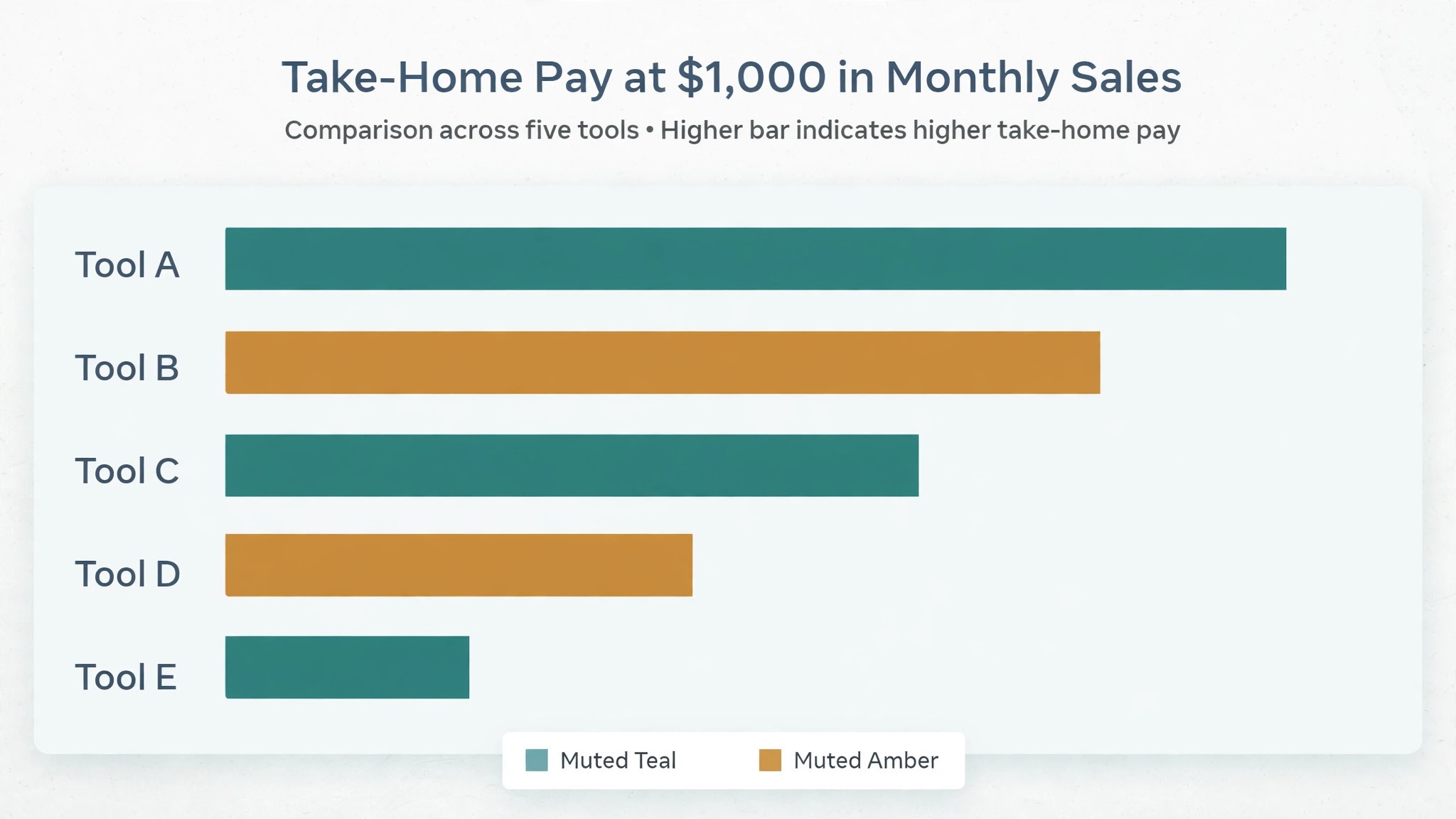
At $1,000 a Month in Sales, What Does Each Tool Keep?
At 1,000 dollars a month in sales, the gap between the cheapest and the dearest tool in this guide is about 86 dollars a month, which is more than 1,000 dollars over a year. The table below shows the monthly bill for each tool at that volume, before card processing, because every tool here adds Stripe or PayPal processing of about 2.9 percent plus 30 cents on top.
| Tool | Monthly bill at $1,000 sales | What you keep |
|---|---|---|
| Sellfy Starter | $29 | $971 |
| Lemon Squeezy | About $70 | About $930 |
| Payhip Free | $50 | $950 |
| Podia Mover | $89 | $911 |
| Teachable Starter | $104 | $896 |
| Thinkific Basic | $36 | $964 |
| Kajabi Kickstarter | $69 | $931 |
| SamCart Launch | $79 | $921 |
| ThriveCart | $495 once, $0 monthly | $1,000 after month one |
| SendOwl Standard | $18 | $982 |
SendOwl looks like the winner of this table, and the number is honest, but it wins a different contest. SendOwl is a delivery tool, not a storefront, so the 18 dollars buys checkout and secure download links on a website you already own. Sellfy at 29 dollars buys the store, the product pages and the checkout. When you line up the best gumroad alternatives by what they include, the cheapest row is rarely the cheapest buy.
Duel 2: The Free-Start Fight
Payhip Free and Lemon Squeezy both cost nothing a month, and that is why they meet in this duel. Payhip Free charges 5 percent per sale, Lemon Squeezy charges 5 percent plus 50 cents per sale, and both include far more than a starter tier does. The question is which free start costs less once real orders arrive, and the answer depends on the size of the average order.
Take a single 25 dollar ebook, the classic first product. Payhip Free takes 1 dollar 25 cents, and Lemon Squeezy takes 1 dollar 75 cents. Now take a 10 dollar template. Payhip takes 50 cents, and Lemon Squeezy takes 1 dollar, so the per sale charge doubles the fee on a small order. A seller with low priced products pays noticeably more on Lemon Squeezy.
At 100 dollars a month in sales, Payhip Free costs 5 dollars and Lemon Squeezy costs about 7 dollars. At 500 dollars a month, Payhip costs 25 dollars and Lemon Squeezy costs about 35 dollars. Payhip wins the money fight at every volume, and it also wins on payout speed, because Payhip pays out to your own Stripe or PayPal account right after each sale.
Lemon Squeezy wins the duel on one thing, and it is the same thing as before. Payhip handles EU VAT and United States sales tax for sellers, but Lemon Squeezy is a full merchant of record, so the tax filing sits with the company rather than with you. Payhip wins this duel for a creator starting out. Lemon Squeezy is the free start to pick when the audience is worldwide and the tax paperwork is what you dread most.
Best Pick by Job
| Monthly sales | First pick | Second tool | Why this pair works |
|---|---|---|---|
| Under $300 a month | Payhip Free | Lemon Squeezy | Both cost nothing until you sell |
| $300 to $1,000 a month | Sellfy Starter | Payhip Plus | Flat fees beat a 10 percent cut |
| $1,000 to $3,000 a month | Sellfy Business | Payhip Plus | Sellfy caps rise, Payhip stays cheap |
| Over $3,000 a month | Payhip Pro | Sellfy Premium | Both remove the per sale fee |
| Courses and memberships | Podia Mover | Thinkific Basic | Podia covers more product types |
The table is built on last month sales, and among the best gumroad alternatives that is the number to trust over any feature list. A creator who sold 150 dollars last month pays 15 dollars on Gumroad, 7 dollars 50 cents on Payhip Free and 29 dollars on Sellfy, so the free tools win. A creator who sold 1,000 dollars pays 100 dollars on Gumroad and 29 dollars on Sellfy, so the flat fee wins. A creator who sold 5,000 dollars pays 500 dollars on Gumroad and 99 dollars on Payhip Pro.
One row in the table deserves a second look. Courses and memberships point to Podia Mover, not to the cheapest tool, because a course seller is buying a classroom and a checkout. Podia covers courses, memberships, coaching and email in one bill, while Sellfy covers downloads, subscriptions and print on demand.
Duel 3: The Storefront Fight, Who Wins at $1,000 a Month?
Podia Mover costs 39 dollars a month, or 33 dollars billed yearly, with a 5 percent platform fee on every sale. Kajabi Kickstarter costs 69 dollars a month, or 55 dollars billed yearly, with no per sale fee, and it covers one product. Both promise to be the whole business in one bill, and both are telling the truth, but they are built for different sizes of business.
At 500 dollars a month in sales, Podia costs 64 dollars and Kajabi costs 69 dollars, so Podia wins by a small margin. At 1,000 dollars a month, Podia costs 89 dollars and Kajabi still costs 69 dollars, so Kajabi wins by 20 dollars. At 2,000 dollars a month, Podia costs 139 dollars and Kajabi still costs 69 dollars. The duel flips at about 600 dollars a month in sales.
Kajabi wins this duel on price at volume, and it wins on replacement value too. A creator who pays 39 dollars for a course tool, 30 dollars for email, 29 dollars for a funnel tool and 16 dollars for a website pays 114 dollars a month across four bills, so Kajabi Basic at 149 dollars a month is not far above the stack it replaces. Podia wins for a creator under 600 dollars a month in sales, because Mover is cheaper there and still covers courses, memberships, coaching and email.
The trade-off is the product limit. Kajabi Kickstarter covers one product, so a creator with three products needs Basic at 149 dollars a month, or 143 dollars billed yearly, with three products and 10,000 contacts. Podia has no such single product wall on Mover, so a creator with several small products should take Podia, and a creator with one flagship course and a growing email list should take Kajabi.
How to Choose the Best Gumroad Alternatives for Your Sales
Start with last month sales, not with the feature list. The fee math in the duels above is the whole decision for most creators, and it is settled by one number you already know. Under 300 dollars a month, stay fee first. Over 300 dollars a month, move to a flat fee. Over 3,000 dollars a month, move to a plan with no per sale fee at all.
Next, count the product types, because the tool has to hold everything you sell. A seller with one PDF needs a checkout link and delivery, which Lemon Squeezy and SendOwl do well. A seller with a course, a membership and a download needs one store that covers all three, which Podia and Kajabi do, while Sellfy covers downloads, subscriptions and print on demand.
Then check who handles tax, because this is the cost that never shows up in the pricing table. Gumroad and Lemon Squeezy act as the merchant of record, which means they collect and remit sales tax and VAT for you. Sellfy and Payhip do not, so the seller stays responsible for tax filing. A creator selling into Europe should weigh that difference before choosing a flat fee tool.
Finally, check the payout path, because cash timing matters when sales are your income. Payhip pays out to your own Stripe or PayPal account right after each sale, so the money is yours at once, and Sellfy settles the same way. Gumroad pays weekly on Fridays to a United States bank account, and international creators go through PayPal, with a 100 dollar minimum payout until identity verification is complete.
What Happens to Your Gumroad Links When You Move?
Moving off Gumroad is a weekend job, not a rebuild, but it has one step people skip and then regret. Export the customer list and the product files from Gumroad first, before you cancel anything, because the export is the only copy of who bought what. Import them into the new store, and email buyers with the new links before you close the old pages.
The links are the part that bites. Every Gumroad link you ever shared, in a video description, a newsletter, a social post, lives on the internet and keeps getting clicked. Those links will not follow you to the new store on their own. Keep the Gumroad product pages live with a note pointing buyers to the new store, and leave that redirect in place for at least six months.
The Discover marketplace is the one thing you cannot take with you. Gumroad takes 30 percent on sales through Discover, and in return it puts products in front of buyers who were not looking for you. None of the best gumroad alternatives in this guide has a marketplace like it, so keep the Gumroad page live for discovery and move the direct sales to the cheaper tool.

The 10 Tools in Detail
The ten tools below cover fee first checkouts, flat fee storefronts, course platforms and cart tools. Each one is judged on the real monthly cost at a real sales volume, so this roundup of the best gumroad alternatives stays honest about what a creator keeps.
1. Sellfy
Sellfy is a hosted creator storefront that covers digital downloads, subscriptions, physical goods and print on demand in one subscription. Starter costs 29 dollars a month, or 22 dollars billed yearly, Business costs 79 dollars a month, or 59 dollars billed yearly, and Premium costs 159 dollars a month, or 119 dollars billed yearly. Every plan charges a 0 percent transaction fee.
The sales cap is the number to watch. Starter covers up to 10,000 dollars of sales a year, Business up to 50,000 dollars and Premium up to 200,000 dollars. A store that passes its cap without upgrading can face a 2 percent overage fee on the amount above it, so the cap matters more than the fee.
Work it out in monthly terms, because 10,000 dollars a year is only about 833 dollars a month. A store doing 1,000 dollars a month outgrows Starter in the first year, and at 2,000 dollars a month the store sits on Business at 79 dollars a month. The bill is still far below Gumroad, which would take 200 dollars on the same month.
The print on demand catalogue is the second income line. A seller can offer shirts and mugs without holding stock, and Stripe or PayPal take their standard processing cut of about 2.9 percent plus 30 cents on top of the subscription.
There is no free plan, only a 14 day trial with no card, and that is the honest weakness. The trial is long enough to build the store and make the first sale, so check your trailing twelve month sales against the 10,000 dollar cap before you commit.
2. Lemon Squeezy
Lemon Squeezy is a merchant of record checkout for software licences, subscriptions and digital products. It charges 5 percent plus 50 cents per sale with no monthly fee, and that single fee covers card processing, currency conversion and tax handling. Surcharges stack on top, with 1.5 percent for buyers outside the United States and 1.5 percent for PayPal payments.
The surcharge math is worth running on your own orders. An international buyer paying by PayPal costs about 8 percent plus 50 cents, not 5 percent, so a seller whose audience is half European and half American pays closer to 6.5 percent on average.
Stripe bought Lemon Squeezy in July 2024, and the direction since then has been toward Stripe Managed Payments, which became generally available in April 2026. Signups remain open, but the company has said support is slower and updates are fewer.
It suits sellers who want tax handled and no monthly bill. The 5 percent fee beats Gumroad’s 10 percent at every volume, and the merchant of record cover is the feature that subscription tools do not offer.
Open the account, sell one product, and read the surcharge list before you price a catalogue.
3. Payhip
Payhip is a London based store builder for digital downloads, online courses, memberships, coaching and physical products. The Free Forever plan costs 0 dollars a month plus a 5 percent transaction fee, Plus costs 29 dollars a month plus 2 percent, and Pro costs 99 dollars a month with no Payhip fee at all. Every plan includes every feature.
The break even points are clean, and they are the reason Payhip is easy to recommend. Free costs less than Plus below about 967 dollars a month in sales, and Plus costs less than Pro below about 3,300 dollars a month. A creator can start free and move up when the monthly bill proves it, without ever changing tools.
Payouts land in your own Stripe or PayPal account right after each sale, and Payhip handles EU VAT and United States sales tax for sellers. Most free plans in this market hide features behind the paywall, and Payhip hides nothing, which means the free plan is a real business tool rather than a demo.
The weakness is the one the numbers already show. At 5,000 dollars a month in sales, Free costs 250 dollars, which is half of what Gumroad would take and still far more than Pro at 99 dollars. A seller who stays on Free out of habit pays for the habit every month.
Start free, sell the first product, and upgrade to Plus when monthly sales pass 967 dollars.
4. Podia
Podia is an all in one platform for courses, digital downloads, memberships and coaching, with email marketing built in. Mover costs 39 dollars a month, or 33 dollars billed yearly, with a 5 percent platform transaction fee on every sale. Shaker costs 89 dollars a month, or 75 dollars billed yearly, with a 0 percent fee and affiliate marketing included. Both plans include a 30 day free trial with no card.
The 5 percent fee on Mover is the number that decides the pick. A creator selling 1,000 dollars a month pays 89 dollars a month on Mover, which is dearer than Sellfy at 29 dollars and Payhip Plus at 49 dollars. The value is the bundle, because Podia replaces a course platform, a membership tool and an email tool.
It suits creators who sell several product types under one brand. The storefront is clean, the course builder is simple, and the email tool means the list lives where the products live. Try the 30 day trial with a real product, and price the bundle against Sellfy plus a separate email tool.
5. Teachable
Teachable is a course platform built for first time course sellers, with coaching and downloads alongside courses. The Starter plan costs 29 dollars a month billed yearly, or 39 dollars month to month, and carries a 7.5 percent transaction fee on every sale. Builder costs 69 dollars a month billed yearly and drops the fee to zero, with up to five products and 1,000 students. Teachable retired its free plan in June 2025.
The 7.5 percent fee is the trap in the headline price. A creator selling 4,000 dollars a month of courses on Starter pays 300 dollars in transaction fees plus 39 dollars base, which is 339 dollars a month, against Thinkific Basic at 36 dollars with no fee. Start on Starter only if monthly sales are under 500 dollars.
6. Thinkific
Thinkific is a structured course platform for creators who build proper learning products, with communities, completion certificates and group coaching on higher tiers. Basic costs 36 dollars a month billed yearly, or 49 dollars month to month, Start costs 74 dollars a month billed yearly, and Grow costs 149 dollars. Thinkific charges a 0 percent platform transaction fee when you use its built in payment processor.
The catch is the Stripe surcharge. A surcharge applies if you connect your own Stripe account, at 5 percent on Basic, 2 percent on Start and 1 percent on Grow. A creator who insists on their own Stripe account should budget 5 percent on Basic, because the headline zero fee only holds on Thinkific Payments.
The free plan now offers one course with unlimited students, and a 14 day trial covers the paid tiers. The course player is stronger than Teachable’s for structured learning, with better lesson navigation and student progress tracking.
7. Kajabi
Kajabi is the all in one course business platform, covering courses, communities, email, funnels and a website in one bill. Kickstarter costs 69 dollars a month, or 55 dollars billed yearly, and covers one product. Basic costs 149 dollars a month, or 143 dollars billed yearly, with three products and 10,000 contacts. Growth costs 199 dollars a month billed yearly, and Pro costs 399 dollars. There is no free plan, only a trial.
The entry price is the highest in this guide, and the value is replacement. A creator who pays 39 dollars for a course tool, 30 dollars for email, 29 dollars for a funnel tool and 16 dollars for a website pays 114 dollars a month across four bills, so Kajabi Basic at 143 dollars billed yearly is not far above the stack it replaces. A creator who needs a course should not buy Kajabi, because Thinkific Basic at 36 dollars does that job for a quarter of the cost.
8. SamCart
SamCart is a checkout and cart platform for sellers who optimise the buy step itself. Launch costs 79 dollars a month, Grow costs 159 dollars and Scale costs 319 dollars, all reported from the vendor pricing page.
- The draw is the checkout, with one click upsells, order bumps, subscriptions and abandoned cart recovery built around the payment page.
- SamCart is not a storefront, and that is the boundary to understand, because it sits on top of a website or a sales page and turns the checkout into the product.
- It suits sellers with proven products who want to lift conversion at checkout, and a seller who does not use the upsells should take a cheaper storefront instead.
Test the checkout on one product first, and measure the upsell take rate before you commit to a monthly plan.
9. ThriveCart
ThriveCart is a cart platform sold as a one time payment, which makes it the odd one out in a market of monthly bills. The lifetime licence costs 495 dollars one time, with no monthly fee after that. The platform covers checkout pages, upsells, subscriptions, affiliates and coupons, and it connects to Stripe and PayPal for processing.
The math favours patience. At 1,000 dollars a month in sales, Gumroad costs 1,200 dollars a year and Sellfy costs 348 dollars a year, while ThriveCart costs 495 dollars once. ThriveCart passes Sellfy on total cost in about seventeen months.
Does a one time payment mean no more bills ever? Not quite. Card processing still applies on every sale, and the licence is only a bargain if the tool stays supported for years. Buy it only after a trial run on a real product, and confirm in writing what the lifetime licence covers before you pay 495 dollars.
10. SendOwl
SendOwl is a light digital delivery and checkout tool for sellers who want a simple buy link without a full store. Standard costs 18 dollars a month, with higher tiers for larger catalogues. The tool handles secure download links, licence keys, subscriptions and abandoned cart emails, and it embeds on an existing website rather than replacing it.
SendOwl trades breadth for focus, so it handles one job cleanly and leaves the rest to other tools. A seller who wants a storefront, a blog and email in one place will need other tools alongside it. Try it on one product, and check that the licence key and drip delivery cover what you sell.
Frequently Asked Questions
Can I move my products and customers off Gumroad?
Yes, on most tools in this guide, but the move needs a plan. Export the customer list and the product files from Gumroad, import them into the new store, and email buyers with the new links before you close the old pages. Payhip and Sellfy both support imports, and Podia offers migration help. Test the new checkout with one real purchase before you redirect the old links.
Which Gumroad alternative has no monthly fee?
Payhip Free and Lemon Squeezy both cost nothing per month. Payhip Free charges 5 percent per sale with every feature included, and Lemon Squeezy charges 5 percent plus 50 cents per sale with tax handling included. Gumroad itself has no monthly fee either, but at 10 percent it costs twice what either alternative charges on the same sale.
What is the cheapest way to sell a $25 ebook?
Among the best gumroad alternatives, Payhip Free is cheapest for a single 25 dollar ebook, at 1 dollar 25 cents per sale with no monthly fee. Lemon Squeezy costs 1 dollar 75 cents on the same sale, which is 5 percent plus 50 cents. Sellfy costs 29 dollars a month regardless of sales, so it only wins once monthly sales pass 290 dollars.
Does Sellfy really charge no transaction fee?
Yes. Sellfy charges a 0 percent transaction fee on every plan, and the only per sale cost is Stripe or PayPal processing at about 2.9 percent plus 30 cents. The limit is the annual sales cap, at 10,000 dollars a year on Starter, 50,000 dollars on Business and 200,000 dollars on Premium. A store that passes its cap can face a 2 percent overage fee.
How much does Gumroad actually take at $1,000 a month in sales?
Gumroad takes 100 dollars, which is 10 percent of 1,000 dollars, and it takes 300 dollars on sales through Discover, which is 30 percent. Sellfy Starter costs 29 dollars on the same month, Payhip Free costs 50 dollars, and Lemon Squeezy costs about 70 dollars. The fee never falls as volume grows.
Is ThriveCart really a one time payment?
ThriveCart sells a lifetime licence for 495 dollars one time, with no monthly fee after that. Card processing applies on every sale through Stripe or PayPal. Confirm in writing what the licence covers, including future updates, before you pay, because a one time price only saves money if the tool stays supported for years.
The Champion, and Who Should Still Pick the Loser
Sellfy takes the bracket. At 29 dollars a month with no per sale fee, it keeps more of every sale than any full storefront in this guide once monthly sales pass 290 dollars, and it covers downloads, subscriptions and print on demand in one subscription. A creator doing 1,000 dollars a month keeps 971 dollars before card processing, against 900 dollars on Gumroad.
Lemon Squeezy is the runner-up, and it is still the right pick for one kind of seller. If your buyers live in a dozen countries and the thought of filing VAT returns makes you want to stop selling, the 5 percent fee buys you out of that work. Payhip Free is the pick for a creator starting from zero, because it costs nothing until a sale lands.
If I were starting today, here is what I would do. I would open Payhip Free this week, sell the first product, and watch the monthly total for three months. The month sales pass 300 dollars, I would move to Sellfy Starter, because the flat 29 dollars beats every percentage in the guide from that point on. Pick the tool that matches last month sales among the best gumroad alternatives.