

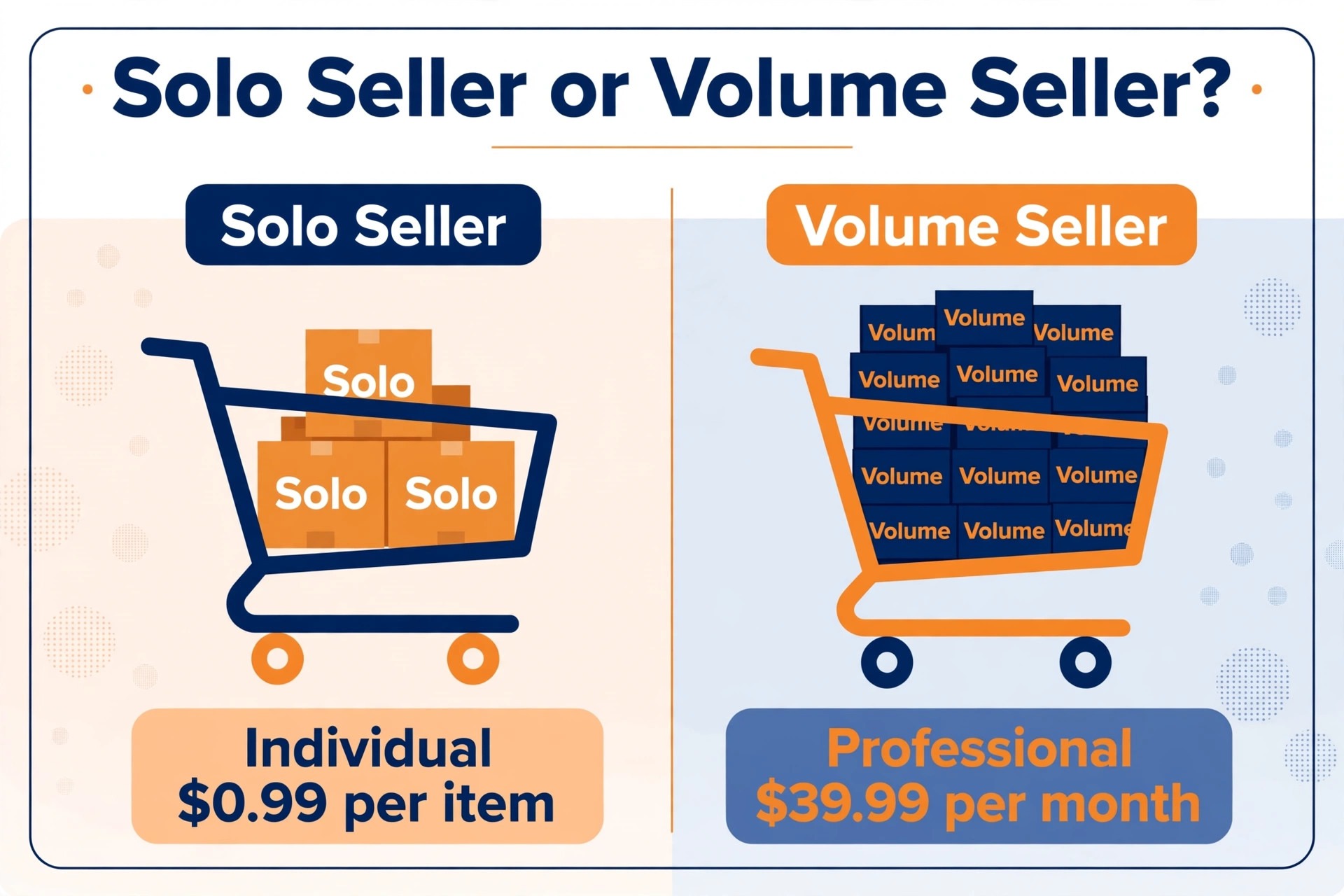
About forty items a month is the line where the Professional plan starts to beat the Individual plan, because 39.99 dollars a month replaces 0.99 dollars per item sold at almost exactly that volume. That stat led opening frames the cost of Amazon seller fees small business in the clearest possible way. Below that line, pay per item and keep fixed costs low. Above it, pay the monthly plan and let volume work for you.
Amazon fees stack in layers, and each layer depends on a different choice. The selling plan depends on volume, the referral fee depends on category and price, and FBA fees depend on size, weight, storage time, and season. A seller who budgets only the referral fee will understate the real cost, especially in the holiday peak, when fulfilment fees rise and storage rates jump.
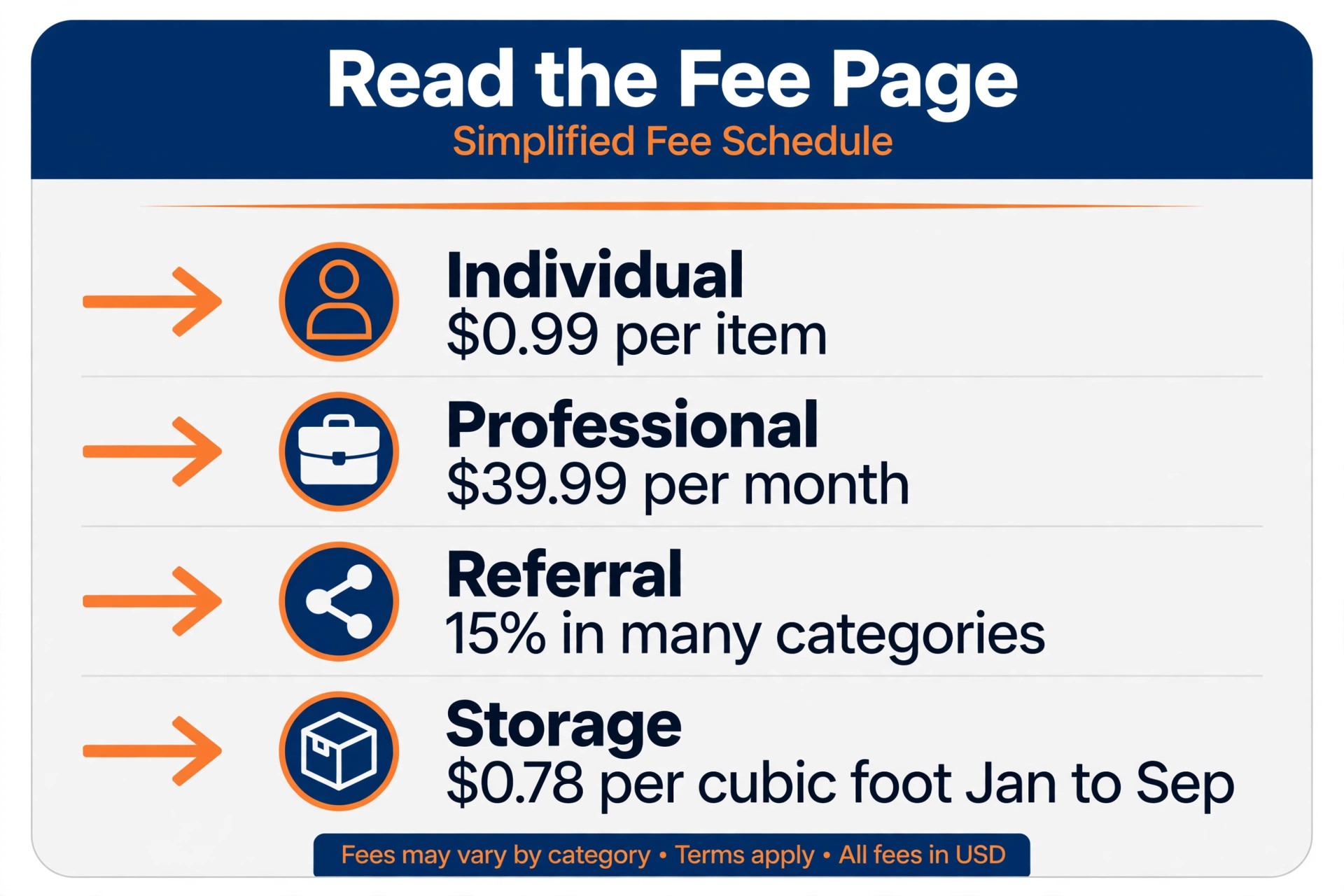
Fees in this guide use published United States rates at writing time, with Individual at 0.99 dollars per item, Professional at 39.99 dollars a month, referral at 15 percent in many categories with a 0.30 dollar minimum, and storage at 0.78 dollars per cubic foot from January to September and 2.40 dollars from October to December. Rates change at least once a year, so check Seller Central and the current fee schedule before you price a product.
What the cost of Amazon seller fees small business Really Includes
Every seller pays a selling plan charge plus a referral fee, whether orders are fulfilled by Amazon or by the seller. Individual sellers pay 0.99 dollars per item sold with no monthly fee, while Professional sellers pay 39.99 dollars a month with no per item plan charge. Both plans pay referral fees on every sale, calculated on the total sale price including shipping or gift wrap the buyer pays, with category rates and minimums set in the fee schedule.
Referral fees sit at 15 percent in most categories, including Home and Kitchen, Toys and Games, and Sports and Outdoors in published breakdowns, with a 0.30 dollar minimum per item in many cases. Other categories differ, and some use price tiers, such as a lower rate on the part of the price above a threshold. Check the category rate for your exact product, because a single category error can move the margin by several percent on every sale.
FBA adds fulfilment fees per unit shipped, monthly storage fees per cubic foot, a 3.5 percent fuel and logistics surcharge on fulfilment fees from April 2026, and further charges for aged inventory, low inventory levels, inbound placement, and returns processing in some cases. FBA has no separate subscription fee, but most FBA sellers use the Professional plan, which is why the plan and fulfilment costs are usually budgeted together.
Amazon Selling Plans and Referral Fees Side by Side
The table below separates the charges every seller pays from the charges only FBA sellers pay, because mixing them is the most common budgeting error. Use the selling plan plus referral total as the base, then add FBA only if Amazon will store and ship the product.
| Charge | Rate | When it applies |
|---|---|---|
| Individual plan | 0.99 dollars per item sold | Every item, no monthly fee |
| Professional plan | 39.99 dollars per month | Active listings, no per item plan charge |
| Referral fee | 15 percent in many categories, 0.30 dollars minimum | Every sale, category rate applies |
| FBA fulfilment | Per unit by size, weight and price | Every unit Amazon ships |
| FBA storage standard size | 0.78 dollars per cubic foot Jan to Sep, 2.40 dollars Oct to Dec | Monthly, on average volume stored |
| Fuel and logistics surcharge | 3.5 percent of fulfilment fees | FBA fulfilment from April 2026 |
The crossover between plans is simple arithmetic. At 40 items a month, Individual plan charges total 39.60 dollars, just under the 39.99 dollar Professional fee, and at 41 items they pass it. A seller near that line should choose Professional for its extra tools, such as bulk listing and reporting, even if the fee saving alone is small. A seller well below the line should stay on Individual until volume proves itself.
Category choice matters as much as plan choice. Electronics, beauty, and media categories carry different referral rates and, for some media items, a closing fee, so a seller with products across categories should budget each category separately. A single blended referral rate across a mixed catalogue will overstate margin on high fee categories and understate it on low fee ones.
Use this table as the starting point for judging the cost of Amazon seller fees small business against the work the team actually does each week, rather than against a rival headline price alone.
Worked Fees on One Hundred, One Thousand and Ten Thousand Dollar Months
The totals below assume a 25 dollar average item, a 15 percent referral fee, no FBA fulfilment or storage, and United States rates, so the plan comparison stays clear. They show the cost of Amazon seller fees small business at three monthly revenue levels, before product cost, shipping to Amazon, and FBA charges.
| Month revenue | Items at 25 dollars | Individual plan plus referral | Professional plan plus referral | Cheaper plan |
|---|---|---|---|---|
| 100 dollars | 4 items | 18.96 dollars | 54.99 dollars | Individual |
| 1,000 dollars | 40 items | 189.60 dollars | 189.99 dollars | Near tie |
| 10,000 dollars | 400 items | 1,896 dollars | 1,539.99 dollars | Professional |
At 100 dollars a month, Individual is far cheaper, because the Professional monthly fee alone is more than half the revenue. At 1,000 dollars a month the two plans land within forty cents of each other, which is the crossover in action. At 10,000 dollars a month Professional saves about 356 dollars against Individual, because the fixed monthly fee replaces 396 dollars of per item charges. Volume, not revenue alone, drives the choice, since a high priced catalogue crosses the line at lower revenue.
FBA changes the totals again, and it should be added as a separate line, not folded into the referral rate. As an illustration only, a fulfilment fee of 4 dollars per unit would add 16 dollars on a 100 dollar month, 160 dollars on a 1,000 dollar month, and 1,600 dollars on a 10,000 dollar month, before storage, the 3.5 percent surcharge, and any peak season uplift. Use the Amazon Revenue Calculator for your exact size and weight tier, since a small parcel and a large parcel can differ by several dollars per unit.
Fees That Catch New Sellers by Surprise
Holiday peak fulfilment fees catch sellers who price in summer and sell in winter. Published breakdowns put peak fulfilment fees from October 15 to January 14 at about 0.32 dollars more per unit on average than non peak rates, with the 3.5 percent surcharge on top. A seller who never updates prices for the peak season gives away margin on the busiest weeks of the year, so review prices before October each year.
Storage fees jump in the final quarter too, from 0.78 dollars to 2.40 dollars per cubic foot for standard size items in published United States rates. Slow stock that was cheap to store in spring becomes expensive in autumn, and aged inventory surcharges add further cost after 181 days. Send only stock that will sell within the season, and clear slow lines before October rather than paying to store them through the peak.
Inbound placement, low inventory level, and returns processing fees are smaller lines that still surprise new FBA sellers. Sending inventory to a single location, running stock too low, or selling a product with a high return rate each triggers its own charge. Read the FBA fee schedule for your product type before the first shipment, and build a small allowance for these lines into the product margin, rather than discovering them on a settlement report.

How Amazon Fees Change Through the Selling Year
Paying yearly usually lowers the monthly equivalent, but it also locks money into a tool before you know whether the team will stay with it. A small business should treat the annual saving as a reward for a tool that already proved itself, not as a reason to commit on day one. Start monthly, run a real month of work through it, and only switch to yearly billing when the renewal date would otherwise catch you by surprise.
Monthly billing costs more per month, yet it keeps the exit cheap. If the team size changes, the workload drops, or a better fit appears, a monthly plan lets you step down without waiting out a contract year. That flexibility has real value for a business with seasonal work or uncertain hiring plans. Compare the yearly saving against the cost of being stuck, not against zero.
That choice between monthly and annual billing is a core part of the cost of Amazon seller fees small business, because the same team can pay a very different total for the same service depending on the cycle chosen.
Which Amazon Plan Fits Which Sales Volume
Start from the constraint that will hurt first. For some teams it is the number of profiles, for others it is approvals, reporting, or automation. Find that constraint in the trial by doing real work, not by reading the feature list. If the trial never hits the limit, the lower tier is probably enough for now. Upgrade when a limit actually blocks work, and keep a note of the date and the task that forced the move.
| Seller shape | Sensible first plan | Reason |
|---|---|---|
| Testing seller, under 40 items a month | Individual | No monthly fee while demand is unproven |
| Steady seller, over 40 items a month | Professional | Fixed fee beats per item charges, plus bulk tools |
| FBA seller at any serious volume | Professional | FBA workflow pairs with bulk listing and reporting |
| Seasonal seller | Review each season | Peak fulfilment and storage change the margin |
Start from the constraint that will hurt first. For some teams it is the number of profiles, for others it is approvals, reporting, or automation. Find that constraint in the trial by doing real work, not by reading the feature list. If the trial never hits the limit, the lower tier is probably enough for now. Upgrade when a limit actually blocks work, and keep a note of the date and the task that forced the move.
Matching the tier to the team shape is the simplest way to control the cost of Amazon seller fees small business without losing a feature the team actually uses every week.
Budget Mistakes That Inflate Amazon Costs
The most common budget mistake is buying for the business you hope to become rather than the business you run today. A higher tier bought for a future team still bills every month while that team is only a plan on paper. Buy for current volume, keep the upgrade path open, and let growth trigger the higher bill. Growth should pay for the tool, not the other way round.
Another costly mistake is counting only the headline price and ignoring the extras that appear later. Add ons, extra profiles, usage charges, and a second tool bought to cover a gap can double the first quote. Add every likely extra to the first month estimate, even if the vendor page lists it as optional. A budget built on the full stack is rarely surprised.
Avoiding these mistakes is the fastest way to lower the cost of Amazon seller fees small business without changing tools or cutting a feature the team needs.
How to Keep Amazon Fees Under Control
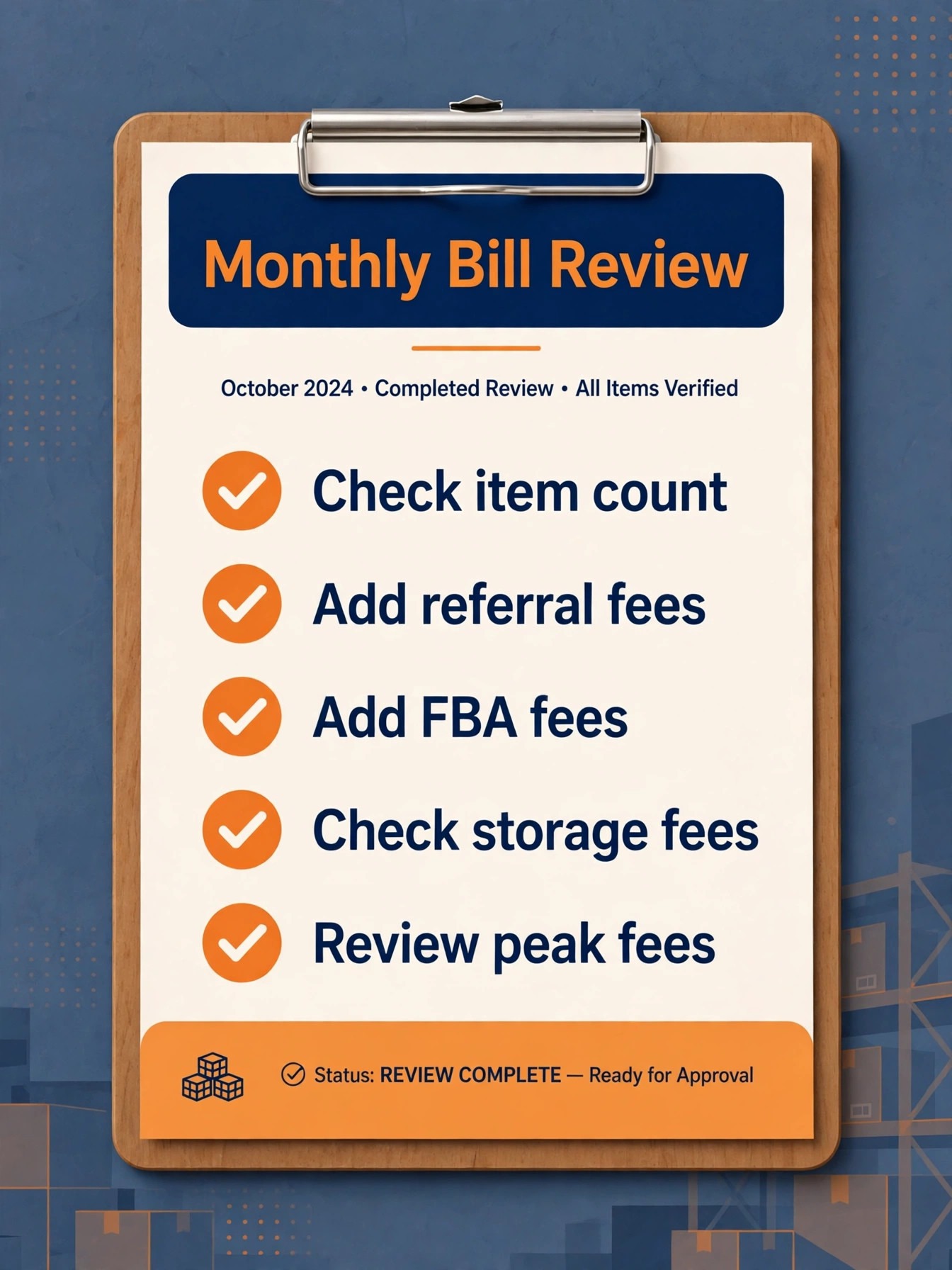
A simple monthly review keeps a subscription bill honest. Once a month, check who logged in, which limits were hit, and what the tool delivered that could not have been done with a cheaper option. Remove seats for people who left, close channels that no longer post, and downgrade a tier that is only half used. Fifteen minutes of review can save more than any discount code.
Write the renewal date and the cancellation steps in the same place you track other bills. Many small businesses lose money not on the price itself but on renewals that nobody noticed. A shared calendar entry with the price, the billing cycle, and the vendor support link turns renewal from a surprise into a decision. Review the bill before it renews, not after it lands.
A monthly review like this keeps the cost of Amazon seller fees small business tied to real use, and it catches seats, channels, or profiles that no longer earn their price.
Review the bill against actual use at the end of the first month, and write down which features were used daily, which were used once, and which were never opened. That short note becomes the evidence for the renewal decision, and it stops the team from paying for a tier chosen on a demo rather than on real work.
Ask the vendor what happens to your data if you downgrade or cancel, and test an export before you rely on the tool for anything important. A clean export turns a subscription into a reversible choice, while a blocked export turns a monthly bill into a trap. This check takes minutes in a trial and can save weeks later.
Keep one owner for each paid tool, even in a tiny team. That person tracks the renewal date, the seat count, and the monthly usage, and they approve any upgrade. Shared ownership usually means nobody owns the bill, and bills without an owner tend to grow quietly.
Negotiate from usage, not from hope. A vendor is more likely to help on price when you can show steady use, a clear seat count, and a renewal date you are willing to walk away from. A polite note before renewal, with the competing price in hand, often beats a complaint after the invoice arrives.
Separate the cost of the tool from the cost of the work around it. Setup time, training, and the weekly habit of checking a new inbox all carry a price in hours. A tool that saves ten hours a month at a higher price can still be cheaper than a free tool that nobody uses properly.
Watch for seasonal swings before choosing a billing cycle. A business with a busy summer and a quiet winter may prefer monthly billing through the slow months, even if annual billing looks cheaper on paper. The right cycle follows the revenue pattern, not just the discount.
Document the reason for the chosen tier in one sentence and keep it with the bill. When a new team member asks why the business pays for a higher tier, that sentence answers the question without a fresh debate. It also makes the downgrade decision easier when the reason no longer applies.
Test the support response during the trial, not after a problem hits a live customer. Send a real question, time the reply, and judge whether the help matches the price. Support quality is part of the monthly cost, because slow help turns into lost customers and extra staff time.
Compare the tool price against the price of doing the same work by hand, including the hours spent on manual posting, inbox triage, or fee arithmetic. A tool that looks expensive on a price page can still be cheap against ten hours of staff time a month, while a cheap tool that nobody uses is expensive at any price. Time, not headline price, is the real budget line.
Run a trial with a clear pass mark written down before the trial starts, such as a reply time, a posting count, or a report built in under an hour. A trial without a pass mark tends to drift into a paid plan by default, because nobody wants to admit the test was inconclusive. A written pass mark makes the renewal decision a fact check, not a feeling.
Check what happens when a team member leaves, since seats, channels, and logins often stay active after the person has gone. A quarterly seat audit that removes departed users and reassigns their work prevents the slow creep that inflates many small business bills. Treat every login as a cost, even on a plan that charges per channel rather than per user.
Keep the billing email in a shared inbox that more than one owner can see, so renewal notices and price change emails do not sit unread in a departed employee mailbox. Many price rises are announced by email weeks before they take effect, and a business that misses the notice loses the chance to downgrade or switch before the new rate starts.
Ask whether a lower tier plus a small second tool beats a higher tier of one tool, since the best combination is not always a single vendor. A cheap scheduler plus a separate reporting sheet can beat a premium all in one plan for a team that only needs one premium feature. Price the combination honestly, including the extra login and the extra weekly habit it creates.

When FBA Still Pays and When Fulfilled by Merchant Wins
Upgrade when a specific limit blocks real work three times in one month, not when a feature looks interesting. A blocked approval, a profile cap, or a missing report that forces manual work is a clear trigger. Write the trigger down, price the next tier for the actual team size, and check whether a cheaper workaround covers the same task. If no workaround exists, the upgrade is justified.
Stay on the current tier when the pain is occasional and the workaround takes minutes. Many teams upgrade for one busy week and then pay the higher price through quiet months. A better test is to ask whether the limit will still bite in ninety days at normal volume. If the answer is no, wait. The higher tier will still be there when volume genuinely grows.
How Amazon Fees Compare With Close Alternatives
Price alone rarely decides a tool, because the cheapest option can cost more in time if it misses a core task. The table below puts the headline price beside the job each alternative does best, so the comparison stays practical. Check the vendor page for current prices before deciding, since all of these vendors change packaging from time to time.
| Channel | Fee shape | Best for |
|---|---|---|
| Amazon Individual | Per item plus referral | Testing demand with Amazon shoppers |
| Amazon Professional plus FBA | Monthly plan plus referral plus fulfilment | Sellers who want Prime reach |
| Shopify plus payment processing | Monthly plan plus processing per sale | Sellers with their own traffic |
| Etsy | Per sale stack near 11 percent before ads | Handmade and vintage sellers |
Test the finalists on the same real tasks for one week each, and score them on time saved, errors caught, and reports delivered, rather than on feature count alone. A tool that wins on identical work is the tool that will still win in month six, when the novelty has worn off and only the daily habit remains.
Frequently Asked Questions About Cost of Amazon Seller Fees for a Small Business
Should a new seller choose Individual or Professional?
Choose Individual while sales stay under about 40 items a month, because 0.99 dollars per item is cheaper than 39.99 dollars a month at that volume, and there is no monthly bill in a quiet month. A new seller testing demand should keep fixed costs low until the product proves it can sell repeatedly.
Choose Professional once sales pass about 40 items a month, or when bulk listing, reporting, and API access matter for the workflow. At 40 items the two plans cost almost the same, so the extra Professional tools tip the decision. Review the item count monthly, not once a year, since volume can cross the line quietly. That trial measurement gives a realistic estimate for the cost of Amazon seller fees small business before any annual commitment.
What is the Amazon referral fee in most categories?
Referral fees sit at 15 percent in many categories, including Home and Kitchen, Toys and Games, and Sports and Outdoors in published breakdowns, with a 0.30 dollar minimum per item in many cases. The fee applies to the total sale price, including shipping or gift wrap the buyer pays, so a product with paid shipping carries a referral fee on the shipping amount too.
Other categories differ, and some use tiered rates by price, so check the fee schedule for your exact category before pricing. A seller with products in several categories should build a separate margin sheet per category, because a blended rate will mislead pricing on at least one product line.
How much does FBA add per unit?
FBA fulfilment fees depend on size tier, weight, and price, and they reset each January with a holiday peak uplift from October to January. Published breakdowns note an average rise of about 0.08 dollars per unit in January 2026, a 3.5 percent fuel and logistics surcharge from April 2026, and a peak uplift averaging about 0.32 dollars per unit. Exact rates must come from the Amazon rate card for your product dimensions.
Storage adds a further monthly charge per cubic foot, at 0.78 dollars from January to September and 2.40 dollars from October to December for standard size items in published United States rates. A low priced, bulky product can therefore carry a high FBA cost relative to its price, while a small, higher priced product carries a lighter load. Use the Revenue Calculator before committing stock.
Does FBA suit a small business with low priced products?
FBA suits low priced products only when volume is high and the product is small and light, because fulfilment and storage charges take a larger share of a low price. Low Price FBA rates help items under 10 dollars in recent fee changes, but the seller should still work the full per unit cost, including referral, fulfilment, storage share, and surcharge, before listing.
A low priced, bulky product is often better fulfilled by the merchant, or sold in a bundle that lifts the average order value. Bundling two or three low priced items into one shipment spreads the fulfilment fee across a higher total, which can turn a losing product into a viable one without changing the product itself.
How do peak season fees affect a small seller?
Peak fulfilment fees from October 15 to January 14 add about 0.32 dollars per unit on average, with the surcharge on top, and storage rates more than triple for standard size items in the final quarter. A seller who prices for non peak costs and sells heavily in December will see margin shrink on the busiest weeks, which is the opposite of the intended seasonal gain.
Review prices in September, clear slow stock before October, and send only stock that will sell during the peak. A small price rise for the peak season, explained by higher fulfilment and storage costs, is fairer than absorbing the uplift silently. Track the settlement report weekly during the peak so surprises surface early.
Should I use FBA or fulfil orders myself?
Use FBA when Prime reach, fast shipping, and Amazon customer service win sales that merchant fulfilment would lose, and when the per unit fulfilment cost still leaves a healthy margin after referral and storage. FBA also removes packing, shipping, and returns handling from the seller day, which has real value for a solo owner.
Fulfil by merchant when the product is bulky, slow moving, or low priced relative to its size, or when the seller already has a packing workflow that costs less than FBA per unit. Many sellers mix the two, using FBA for fast moving small products and merchant fulfilment for slow or bulky lines. Review the mix each season as dimensions and volume change.
A Sensible Budget for Amazon Seller Fees for a Small Business
For most small sellers, the sensible Amazon path is Individual while testing, Professional once item count passes forty a month, and FBA only for products whose size, price, and velocity leave a clear margin after fulfilment, storage, and surcharge. Price each category separately, review prices before the October peak, and use the Revenue Calculator for every new product before sending stock. That sequence is a practical way to manage the cost of Amazon seller fees small business as the business grows, without paying for a tier before it is needed.
Amazon earns its fees when its shoppers and Prime reach bring sales a small seller could not win alone, and it stops earning them when fulfilment and storage charges eat the margin on slow, bulky, or very low priced lines. Count your items, work the plan plus referral plus FBA stack on every product, and let the net remainder choose the plan and the fulfilment method. A margin built that way holds up in peak season as well as in quiet months.
More Reading on Stratilyze
These related guides cover the work around the price, from choosing a tool to running the weekly routine that makes it pay.
- How to choose a first product to sell on Amazon without guessing, with demand, fee, and competition checks in one pass.
- A small seller guide to Amazon listings that answer shopper questions before they reach the review section.
- When to bundle products on Amazon to lift average order value and spread fulfilment cost across a higher total.
- How to read an Amazon settlement report each month so fee surprises surface while they can still be fixed.