
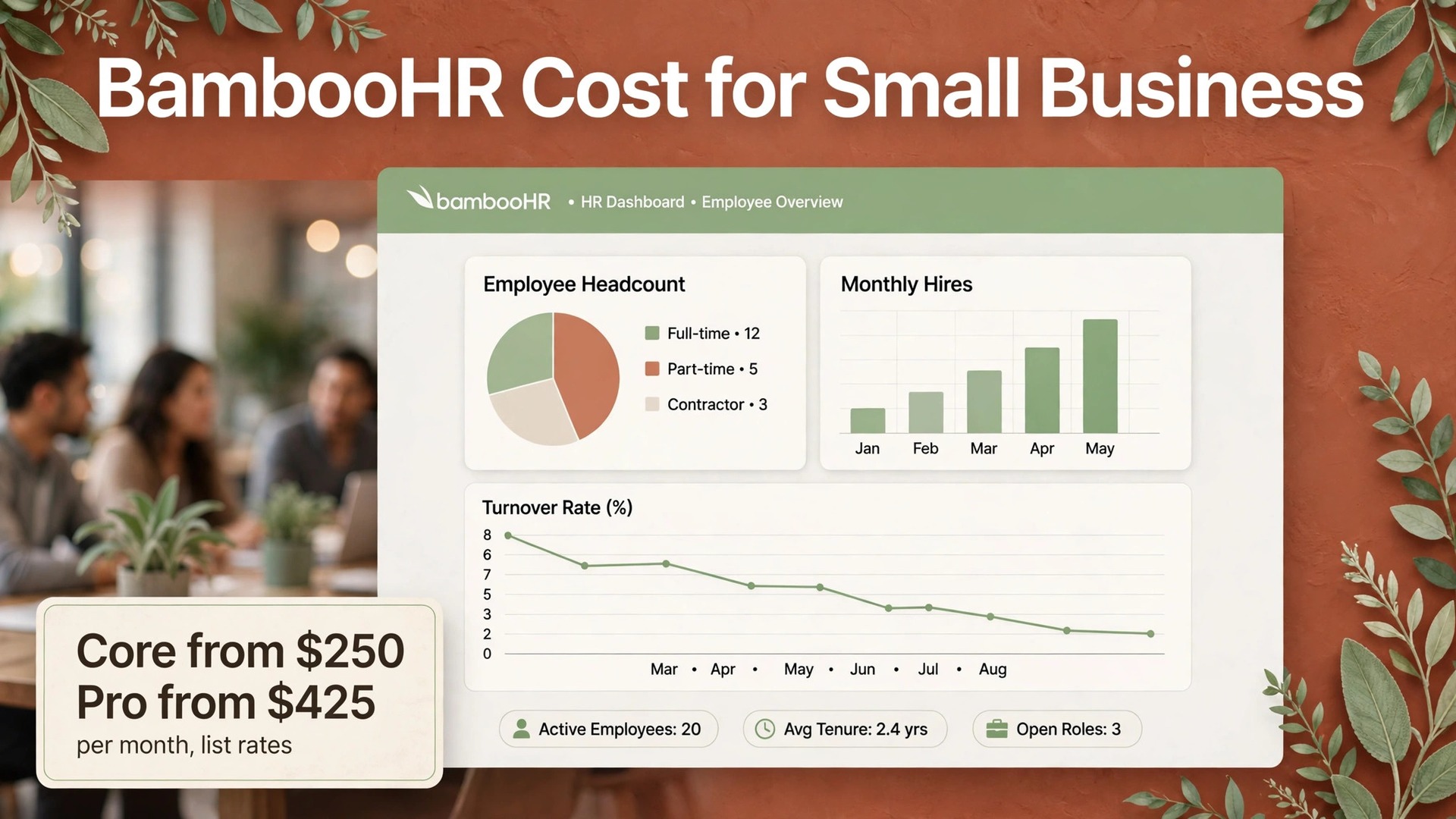
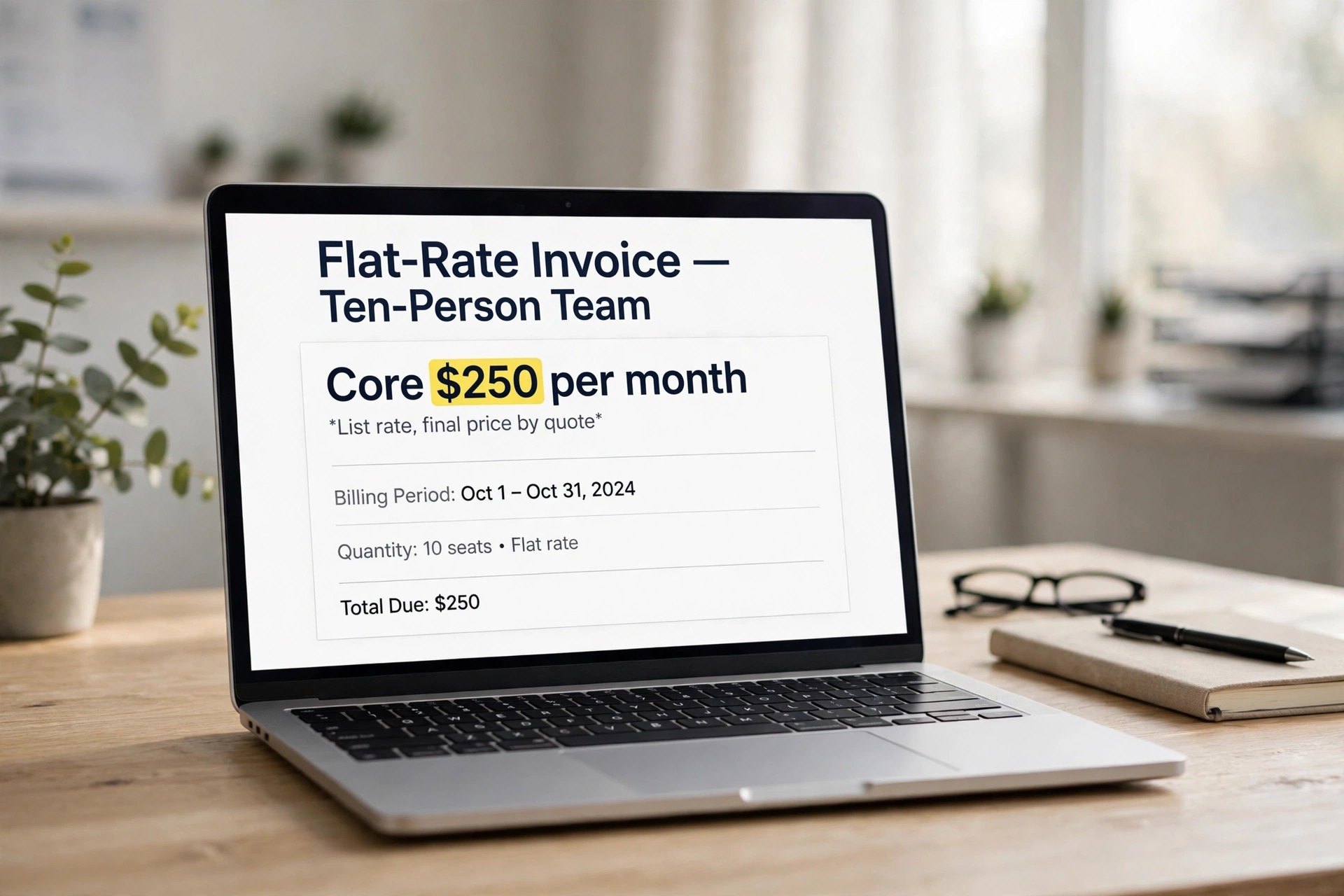
A ten person company on BambooHR Core does not pay $100 a month. It pays at least $250, because BambooHR charges small teams a flat monthly rate instead of a per employee rate, and that single fact changes the whole budgeting conversation. The cost of BambooHR for small business monthly is therefore not a simple multiplication for small teams, it is a floor that only becomes a per employee rate once headcount passes twenty five.
That floor is the most misunderstood part of BambooHR pricing, and it catches buyers who multiply a per employee rate by a small headcount and budget a figure the vendor will never charge. A ten person team budgeting $100 for Core will be invoiced $250, and a ten person team budgeting $170 for Pro will be invoiced $425. Both gaps are large enough to break a careful budget, and both are avoidable once the flat rate is understood.
This guide explains the two pricing models, compares Core and Pro, runs worked monthly totals for 10, 25, and 50 person teams, and flags the add ons that sit outside the plan price. Prices here are starting points drawn from published pricing guides at writing time, so check the vendor page before you buy, because BambooHR routes every purchase through a quote and published rates carry discount notes that change the final figure.
Core, Pro, and the Two Pricing Models
BambooHR sells three plans, Core, Pro, and Elite, but a small business will realistically compare Core and Pro, with Elite as a later step for larger teams. Core covers employee records, standard and custom reports, workflows and approvals, hiring with five open job postings, email and offer letter templates, new hire packets, onboarding checklists, e signatures, time off management, and an AI assistant that answers questions about HR data.
Pro adds everything in Core plus performance management, employee community and recognition tools, 25 open job postings, compliance training courses, and an AI assistant that also reads company policies and documents. Those additions suit a business where performance reviews, engagement, and policy questions have become daily work rather than occasional tasks, which usually happens as headcount passes twenty five and informal management stops scaling.
Elite adds compensation planning with benchmark data, custom dashboards, HR benchmarks, 50 open job postings, and premium services, at a published rate of $25 per employee a month for larger teams. A small business should treat Elite as a future step, not a starting point, because its value lies in strategic compensation and benchmarking work that a team under fifty rarely performs.
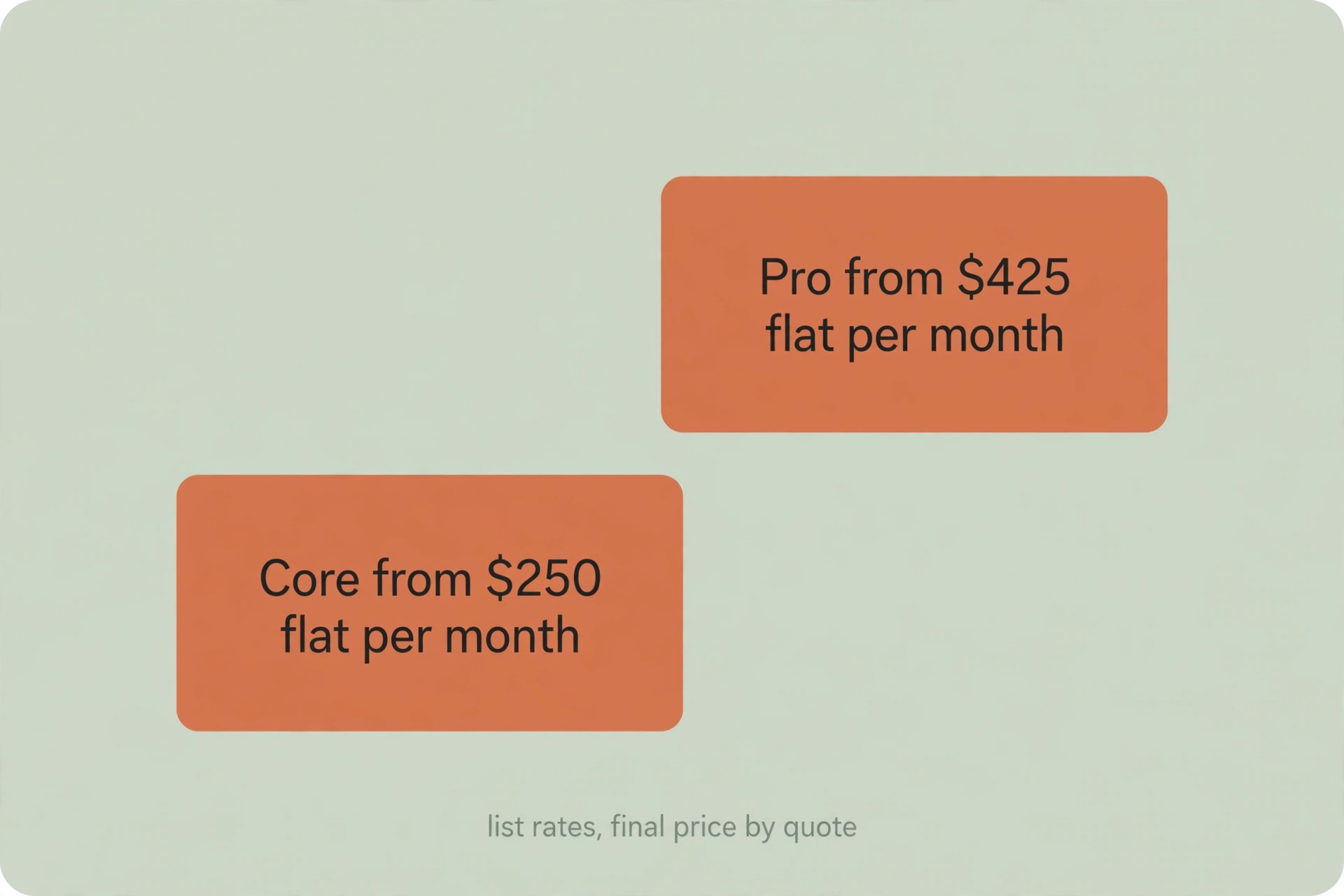
The pricing model splits by headcount, and the split is the key to the whole guide. Companies with more than 25 employees pay per employee per month, at published rates of $10 for Core and $17 for Pro, with some vendor FAQ pages quoting starting rates of $10.25 and $17.50. Companies with 25 or fewer employees pay a flat monthly rate starting at $250 for Core and $425 for Pro in published guides. Volume discounts apply automatically at larger headcounts, and nonprofit discounts of 15 percent are noted in some guides, but both require a quote to confirm.
| Plan | Above 25 employees | 25 or fewer employees | Job postings |
|---|---|---|---|
| Core | $10 per employee a month | From $250 a month flat | 5 open jobs |
| Pro | $17 per employee a month | From $425 a month flat | 25 open jobs |
| Elite | $25 per employee a month | Flat rate by quote | 50 open jobs |
Treat the published rates as list prices, not quotes, because BambooHR asks every buyer to request a quote for their exact team size. The quote should sit at or below list for the core plan, and it will add a separate line for any add on chosen, so compare quotes line by line rather than trusting a single monthly figure.
How the cost of BambooHR for small business monthly works out at 10, 25, and 50 employees
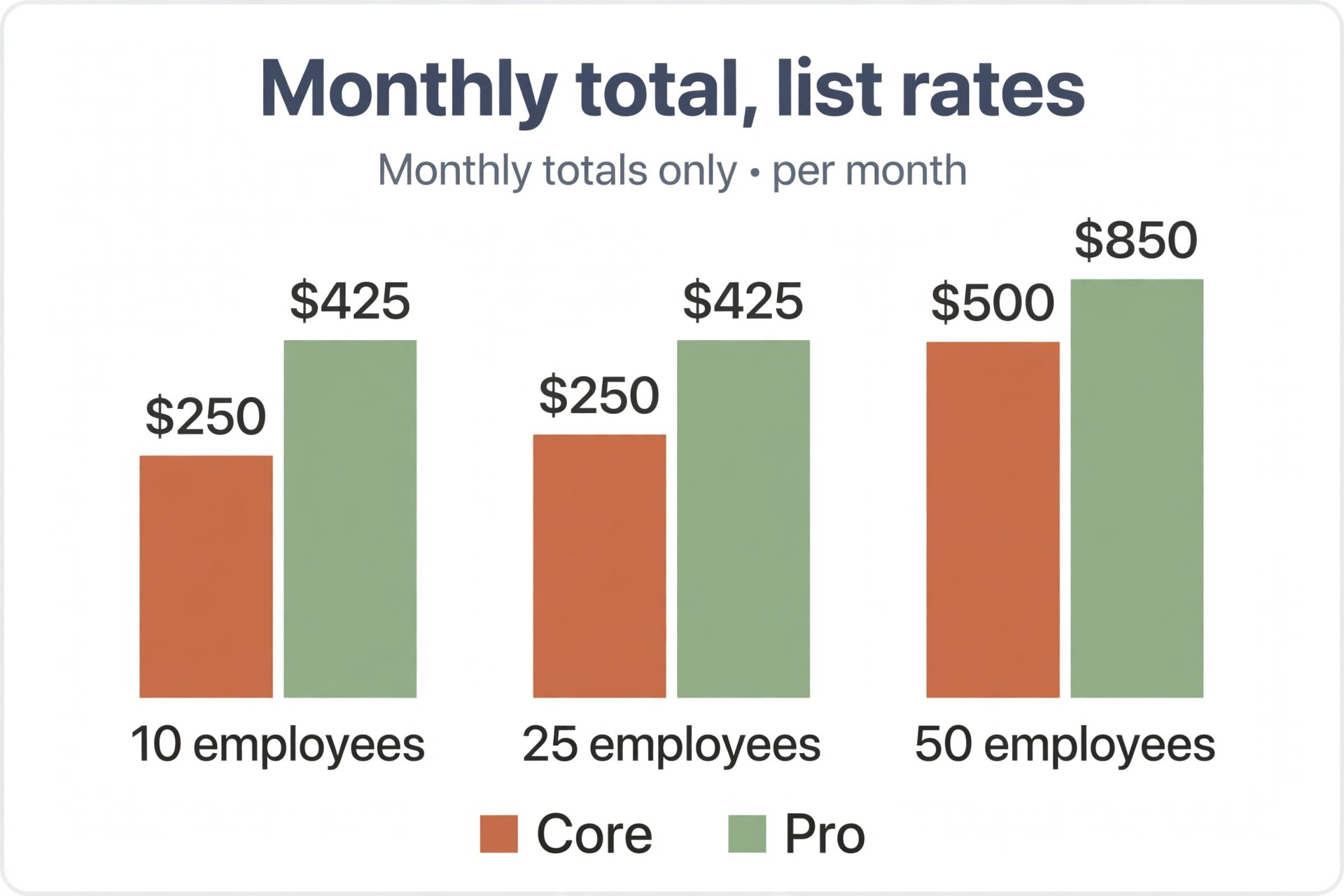
The worked totals below use the published list rates, with the flat rate applied at 25 or fewer employees and the per employee rate applied above that line. They exclude add ons, taxes, and discounts, which a quote will adjust, so treat them as a budgeting starting point and confirm the exact figure on the vendor page before committing.
A 10 person team pays $250 a month on Core and $425 on Pro, because the flat rate applies and headcount does not reduce it. That works out at $25 per person on Core and $42.50 per person on Pro, which is far above the published per employee rates and is the highest effective rate any BambooHR customer pays. Over a year, the 10 person totals are $3,000 on Core and $5,100 on Pro, before add ons and discounts.
A 25 person team pays $250 a month on Core and $425 on Pro, which is exactly where the flat rate meets the per employee rate. At 25 people, $250 divided by $10 is 25, and $425 divided by $17 is 25, so the flat rate and the per employee rate agree perfectly. Yearly totals are again $3,000 and $5,100, which means a business growing from 10 to 25 people pays no extra BambooHR subscription at all, a rare and welcome pattern in software pricing.
A 50 person team pays $500 a month on Core and $850 on Pro, because the per employee rate now applies cleanly. Yearly totals reach $6,000 and $10,200, before volume discounts that should reduce them somewhat at this size. The gap between Core and Pro at fifty people is $350 a month, or $4,200 a year, so the Pro decision must rest on performance management, engagement, and policy tools the team uses weekly.
| Team size | Core a month | Pro a month | Core a year | Pro a year | Core effective per person |
|---|---|---|---|---|---|
| 10 employees | $250 flat | $425 flat | $3,000 | $5,100 | $25.00 |
| 25 employees | $250 flat | $425 flat | $3,000 | $5,100 | $10.00 |
| 50 employees | $500 | $850 | $6,000 | $10,200 | $10.00 |
The pattern to remember is that BambooHR gets cheaper per person as a small team grows toward 25, then scales linearly above 25. A very small team pays a premium per head for a system built for larger teams, while a team approaching 25 gets the best value in the whole range, because the flat rate buys a full HR system for a growing headcount at no extra subscription cost.
Core Against Pro, the Decision That Matters Most
Core is the HR system of record, and for most small businesses it is enough. Employee records, reporting, hiring, onboarding, and time off cover the daily HR job, and a business that runs those processes cleanly on Core has no reason to pay for Pro. The question is not whether Pro features sound useful in a demo, but whether performance reviews, engagement work, and policy questions already consume real management time every week.
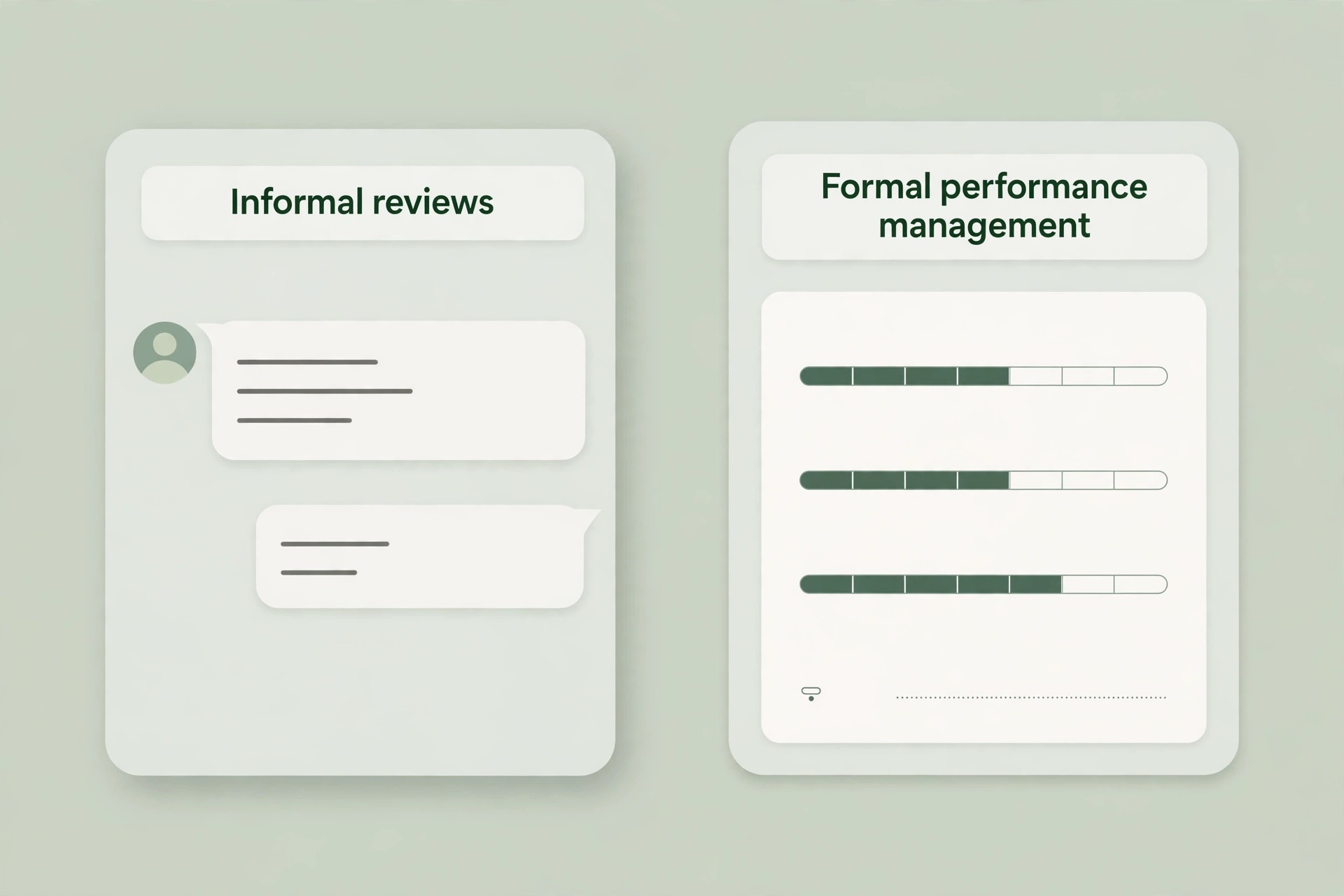
Performance management is the Pro feature with the clearest trigger. A business that runs formal reviews twice a year, tracks goals across a team, and needs review history visible alongside records will benefit from Pro, because doing reviews in spreadsheets alongside a Core system creates duplicate data and version confusion. A business that reviews informally over coffee, with no written cycle, gains nothing from a performance module it will open twice a year.
Employee community and recognition tools suit a business where engagement has become a management priority, such as a team spread across locations, a business with retention worries, or a team growing fast enough that culture needs deliberate attention. A ten person team in one office, where everyone talks daily, rarely needs a community platform to stay connected, and paying for one adds a tool nobody opens.
Compliance training courses on Pro matter for businesses in regulated work or with safety, harassment prevention, or industry training duties. Fifteen courses in some listings cover common requirements, and tracking completion inside the HR system beats chasing certificates by email. A business with no mandated training gains nothing from the course library, and should not let it drive the plan choice.
Job posting limits are a practical Pro trigger that many buyers overlook. Core allows five open jobs, which suits a business hiring one or two roles at a time, while Pro allows 25, which suits a business hiring across many roles at once. A business in a hiring wave that hits the five job cap will feel it immediately, because the sixth role cannot be posted until another closes, and that bottleneck alone can justify Pro for a hiring quarter.
The Flat Rate Trap for Very Small Teams
The flat rate is fair for a 25 person team and punishing for a five person team, and that asymmetry deserves honest discussion. A five person team on Core pays $250 a month, which is $50 per person, or five times the published per employee rate, for a system whose depth it barely uses. That team should compare BambooHR seriously against simpler HR tools or even well organised spreadsheets, because the premium per head is real money for a tiny business.
A ten person team faces a milder version of the same trap at $25 per person on Core, which is still two and a half times the per employee rate. That premium can still be justified if the team hires actively, manages time off carefully, and uses reporting weekly, because the system replaces several manual processes at once. It cannot be justified if the team only stores records and runs payroll elsewhere, because a record store alone does not need a $250 monthly system.
The growth path softens the trap, because every hire up to 25 reduces the effective per person rate without raising the subscription. A business planning to grow from ten to twenty people within a year should view the flat rate as a temporary premium that falls with each hire, and should budget the flat rate as fixed rather than scaling it with headcount in forecasts. A business with no growth plan should view the flat rate as permanent and judge it accordingly.
Nonprofit and volume discounts can soften the flat rate somewhat, with 15 percent nonprofit discounts noted in published guides, but the discount still requires a quote and may not apply to the flat rate in the same way as to per employee rates. Ask explicitly whether any discount applies to the flat rate for the team’s size, and get the answer in the quote, because a discount that only applies above 25 employees does nothing for a ten person team.
Add Ons Priced Separately From the Plan
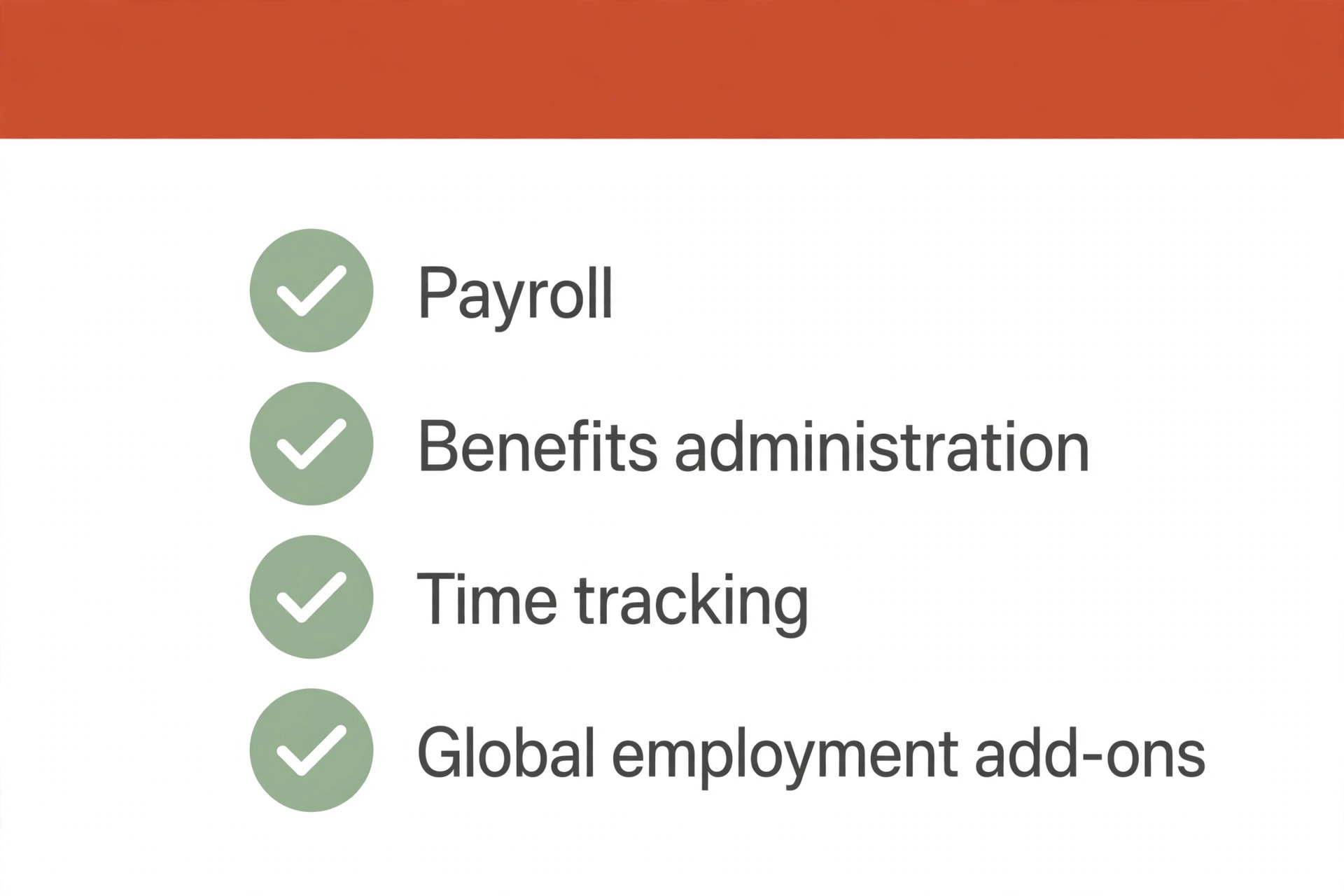
Payroll, benefits administration, time tracking, and global employment are add ons priced separately, and BambooHR publishes no figure for any of them in the guides consulted for this guide. That silence matters, because a business that assumes payroll is included will face a second price line it never budgeted, and the add on line can be substantial depending on headcount and complexity.
Payroll as an add on suits a business that wants HR records and payroll in one system, because employee data flows into pay runs without re entry, and changes to records update payroll automatically. A business already happy with a separate payroll provider should not add BambooHR payroll by default, because two payroll systems is worse than one, and the integration benefit only exists when BambooHR becomes the payroll system of record.
Benefits administration as an add on suits a business offering health insurance, retirement, and other benefits through BambooHR, because enrolment, eligibility, and deductions then live alongside records. A business with simple benefits, or benefits handled by a broker portal, gains little from moving administration into BambooHR, and should price the add on against the broker service it already uses.
Time tracking as an add on suits hourly teams that need hours flowing into payroll and time off balances, while global employment suits businesses hiring outside their home country. Both are specialist needs, and both should be quoted separately before any plan decision, because an add on quote can change the ranking between Core and Pro, or between BambooHR and a rival that bundles the feature.
A payroll promotion noted in late 2026 guides offers payroll subscription fees at zero through December 2026 for eligible customers buying qualifying payroll on a twelve month agreement, with implementation and some other fees excluded. Promotions of that kind are worth asking about, but they should not set the budget, because a promotion that ends leaves the full add on rate behind, and the honest comparison is always list against list.
Getting a Quote Without Overpaying
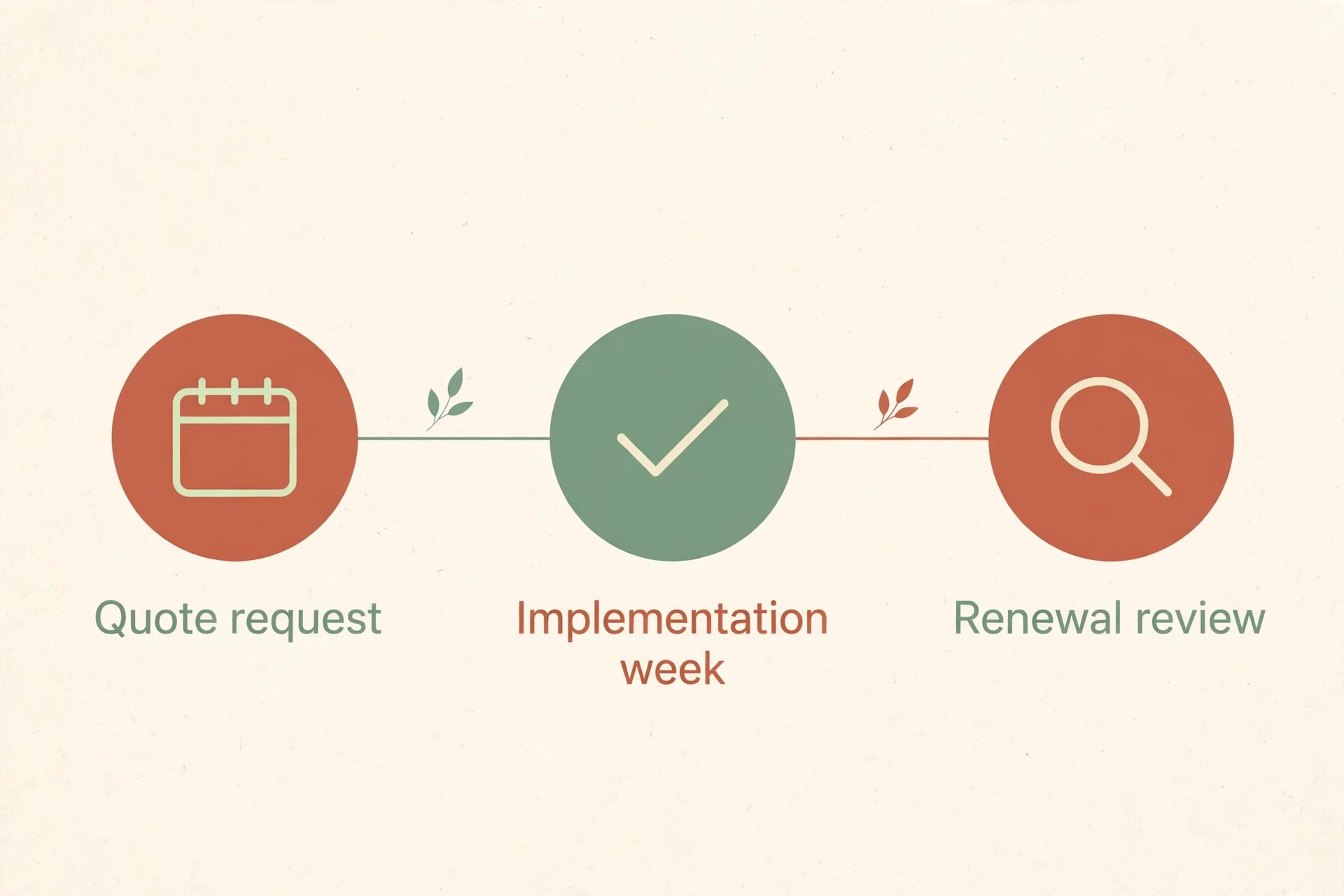
Every BambooHR purchase runs through a quote, which means the buyer has more negotiating room than with a self serve checkout, and also more room to be confused. The quote should list the plan, the headcount basis, the flat or per employee rate, each add on separately, any discount and its duration, and the renewal terms. A quote that shows only a single monthly figure hides the structure, and the buyer should ask for the breakdown before signing.
Volume discounts apply automatically at larger headcounts in published guides, which means a 50 person quote should sit below the $500 and $850 list figures used in this guide, though the exact discount is not published. A buyer should ask what volume tier the team falls in, what happens to the rate as headcount grows past the next tier, and whether the discount is locked for the term or reviewed at renewal.
Contract length is a negotiation lever worth using. BambooHR terms can be month to month in some listings, which suits a team still proving the fit, while a longer commitment may buy a lower rate for a settled team. A new team should favour flexibility for the first term, prove the system with real HR work for a quarter, and then negotiate a longer term from a position of known value rather than hope.
Implementation time is a cost beside the quote that buyers underestimate. Migrating records, setting up workflows, configuring time off policies, and training managers takes staff hours, and a team that rushes implementation will carry bad data into the new system for years. Budget a proper implementation week, clean records before migration, and train managers on the workflows they will actually use, because a system adopted messily costs more in lost trust than in subscription fees.
BambooHR Against Rippling, Gusto, and Zoho People
Rippling bundles HR with IT and payroll in a single platform, and its pricing is typically quote based, which makes direct comparison harder but the breadth comparison clear. A business that wants one system for records, payroll, laptops, and app access may find Rippling compelling, while a business that only needs HR records will find BambooHR clearer and often cheaper, because Rippling charges for breadth the business may never use.
Gusto is primarily a payroll platform with HR features, while BambooHR is primarily an HR platform with payroll as an add on, and that orientation decides the fit. A business whose main pain is payroll should start with Gusto, while a business whose main pain is records, hiring, onboarding, and time off should start with BambooHR. A business with both pains should compare the combined cost of BambooHR plus its payroll add on against Gusto plus its HR features, because the combined figure is the honest comparison.
Zoho People suits businesses already inside the Zoho ecosystem, because HR then sits alongside CRM, finance, and collaboration tools staff already know. A Zoho business gains from that integration, while a business with no Zoho presence gains nothing from it and should compare BambooHR on HR merits alone. The lesson is that the best HR tool is often the one that fits the systems already in place, not the one with the lowest headline rate.
The cost of BambooHR for small business monthly compares best at 25 to 50 employees, where the flat rate has matured into a fair per employee rate and the system depth matches management needs. Below 15 employees, the flat rate premium means simpler rivals deserve a serious look, and a buyer who skips that comparison risks paying a large team price for a small team system.

Mistakes That Waste Money on BambooHR
The first mistake is budgeting the per employee rate for a team under 25, which understates Core by $150 a month at ten people and Pro by $255. Always apply the flat rate below 25, and check the vendor page for the current flat figures, because a budget built on multiplication alone will fail at the first invoice.
The second mistake is buying Pro for features the team will open twice a year. Performance management, engagement tools, and training libraries only earn their price when they support weekly or monthly work, and a team that reviews informally and trains rarely should stay on Core and revisit Pro when management work genuinely grows.
The third mistake is assuming payroll and benefits are included in the plan price. They are add ons quoted separately, and a buyer who discovers that at implementation faces a second negotiation under time pressure, which is the worst moment to negotiate. Get add on quotes alongside the plan quote, before any decision, so the full monthly figure is known up front.
The fourth mistake is migrating dirty records into a clean system. Duplicate employee entries, outdated job titles, and incorrect time off balances carried into BambooHR will haunt every report the system produces, and managers will blame the software for data the business supplied. Clean records before migration, assign a data owner, and validate a sample of records after import, because data quality decides whether the system earns trust or loses it.
Keeping the BambooHR Bill Aligned With Headcount
Headcount forecasting is the core discipline for BambooHR budgeting, because the bill behaves differently below and above 25. A business growing from 15 to 25 pays no extra subscription, which should be celebrated in forecasts, while a business growing from 25 to 50 sees the bill scale linearly, which should be budgeted per hire. The cost of BambooHR for small business monthly stays predictable when forecasts use the flat rate below 25 and the per employee rate above it, rather than a single rate for all sizes.
Quote reviews at renewal are the second discipline, because volume discounts, nonprofit status, and add on needs all change with growth. A team that passed 50 employees since the last quote may qualify for a better volume tier, while a team that dropped an add on should see it removed from the renewal quote. The cost of BambooHR for small business monthly rewards buyers who ask for a fresh quote breakdown at renewal, rather than accepting a rolled over figure.
Add on reviews are the third discipline, because payroll, benefits, and time tracking needs evolve with the business. An add on bought for a hiring wave may no longer be needed when hiring slows, while a new need, such as global employment for a first overseas hire, may require a new add on quote. The cost of BambooHR for small business monthly includes those add ons silently unless someone lists them, and a quarterly add on list turns silent costs into visible choices.
Finally, keep a one page record of the plan, the headcount basis, the add ons, and the renewal date, and review it with the budget owner each quarter. That page turns the cost of BambooHR for small business monthly from a vague line on a card statement into a managed number, and managed numbers stay lower than unmanaged ones, because every line on the page has a reason or gets removed.
A Worked Month for Two Different Small Businesses
Take a ten person creative agency with steady headcount, simple hiring, and no hourly staff. On Core, the monthly subscription is $250 flat, or $3,000 a year, before add ons. Pro would cost $425 a month for performance and engagement tools the agency rarely uses, so the $175 monthly saving stays in the budget, and the agency revisits Pro only when formal reviews or multi role hiring arrive.
Now take a fifty person professional services firm with regular hiring, formal performance reviews, and policy questions from managers weekly. On Pro, the monthly subscription is $850, or $10,200 a year before volume discounts and add ons, against $500 on Core. The $350 monthly step buys performance management, engagement tools, 25 job postings, and policy aware AI help that managers use daily, which makes Pro a working tool rather than a luxury. If volume discounts reduce the Pro figure at quote time, the case strengthens further, but it already stands on daily use alone.
The lesson is that the right plan follows headcount position against the 25 person line, plus management work that is measurable before purchase, meaning review frequency, hiring volume, and policy question volume. Both examples show why the cost of BambooHR for small business monthly rewards measuring those numbers before requesting a quote. Write those numbers down, price each plan against them, and the choice usually becomes obvious. If two plans both fit, choose the cheaper one and revisit in a quarter, because upgrading HR software is far easier than recovering a year of overpayment.
Frequently Asked Questions About BambooHR Pricing
How much does BambooHR Core cost for a ten person team?
A ten person team pays the flat rate starting at $250 a month for Core in published guides, not $100, because teams of 25 or fewer pay a flat rate rather than a per employee rate. That works out at $25 per person, and the yearly total is $3,000 before add ons, taxes, and discounts. Confirm the current flat figure on the vendor page.
What is the difference between Core and Pro in plain terms?
Core covers records, reporting, hiring with five open jobs, onboarding, and time off. Pro adds performance management, employee community and recognition, 25 open jobs, compliance training, and an AI assistant that reads company policies. The step from Core to Pro is $7 per employee a month above 25 people, or $175 a month on the flat rate below 25.
Does BambooHR include payroll in the plan price?
No. Payroll, benefits administration, time tracking, and global employment are add ons priced separately, and BambooHR publishes no figure for them in the guides consulted here. Request add on quotes alongside the plan quote, so the full monthly figure is known before any decision.
When does a small business need Elite instead of Pro?
Elite suits larger teams doing strategic compensation planning, benchmarking, and custom dashboard work, at $25 per employee a month above 25 people. A small business should consider Elite only when compensation and benchmarking work becomes regular, because Core and Pro cover daily HR work for teams under fifty.
Can a business negotiate the BambooHR quote?
Yes, because every purchase runs through a quote, and volume discounts apply automatically at larger headcounts while nonprofit discounts are noted in some guides. Ask for a line by line breakdown, confirm whether discounts apply to the flat rate or only to per employee rates, and compare the renewal terms before signing.
Is BambooHR worth it for a very small team?
It depends on growth plans and HR workload. A five or ten person team pays a high effective rate per person under the flat rate, so simpler tools deserve a serious comparison. A team planning growth toward 25, hiring actively, and using reporting and onboarding weekly can justify the flat rate, because each hire up to 25 lowers the effective rate without raising the subscription.
More Reading on Stratilyze
– Cost of Slack for a Small Business Monthly – Cost of Zoom for a Small Business Monthly – Hiring Your First Employee Without Payroll Headaches, plain text title, link not verified at writing time – Small Business HR Tools That Grow With Headcount, plain text title, link not verified at writing time