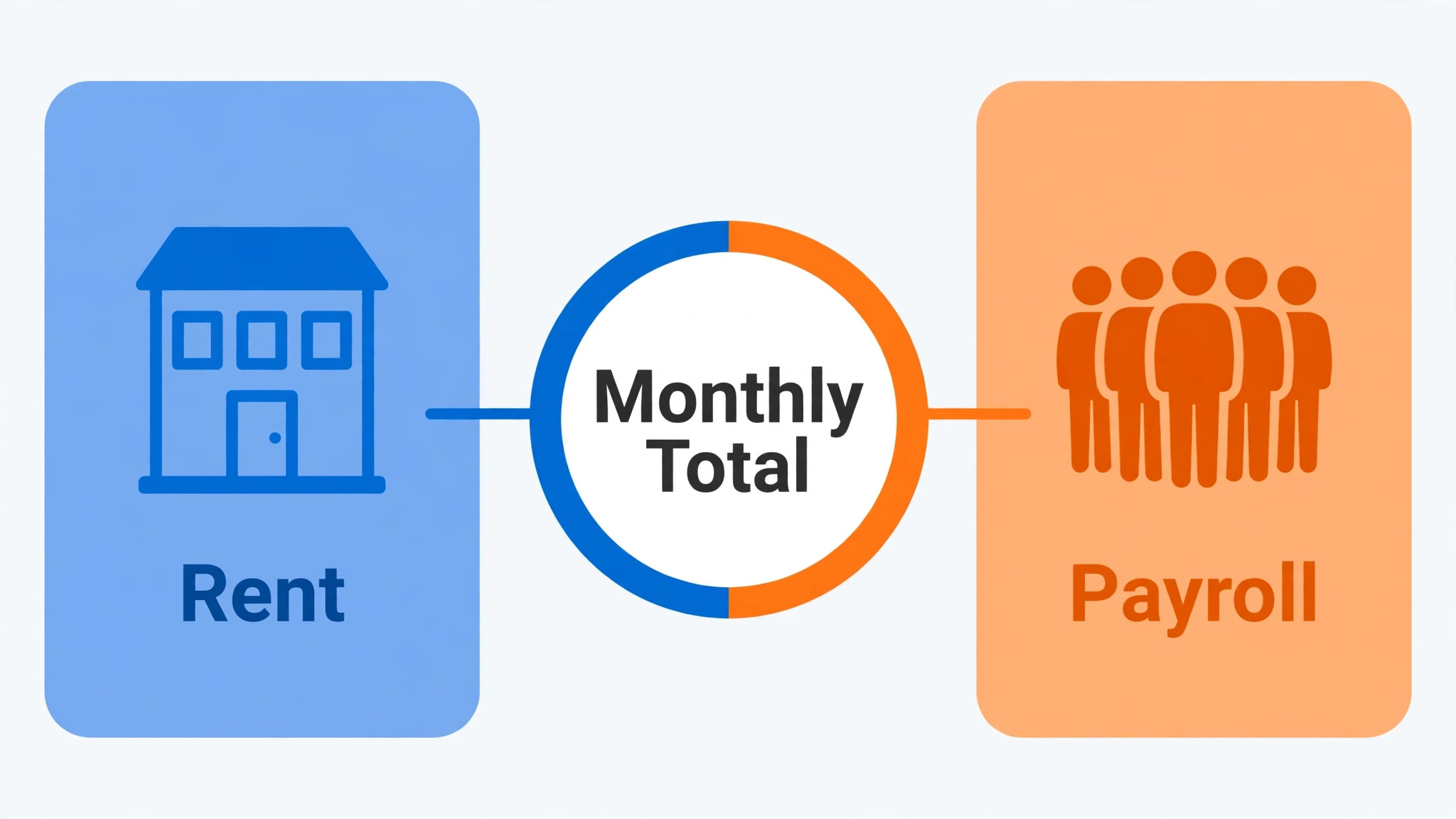
Verdict first. Most new gyms fail on rent and payroll, not on equipment, and the cost of running a gym monthly should shape every line of the budget before a single machine is ordered. A boutique studio and a big box gym are barely the same business, and their monthly bills prove it, because square footage, staffing, and the model chosen before signing the lease decide the cost far more than the brand of treadmill. The two biggest lines on every budget are rent and payroll, together accounting for roughly 70 to 80 percent of total monthly expenses, and every other line, from insurance to cleaning, follows from those two decisions.
This guide breaks down the cost of running a gym monthly by size and model, with a first month budget that shows where the money actually goes.
Rent and Payroll, the Two Lines That Decide Everything
Rent is the first commitment and the hardest to undo, which is why it deserves more thought than any other line. Published 2026 guides put small gym rent at $2,000 to $5,000 a month, mid sized gym rent at $5,000 to $10,000, and large facility rent at $10,000 to $20,000 or more, with boutique studios in premium locations at $2,000 to $8,000 and big box sites at $8,000 to $25,000. Location moves those figures more than size does. A 3,000 square foot space in a suburban strip mall and the same space on a busy urban high street can differ by a factor of three, and the dearer space only earns its rent if foot traffic converts into members.
Before signing, negotiate the terms that matter as much as the rate, meaning a rent free build out period, a tenant improvement allowance, and a break clause or expansion option. A three month rent free period on a $6,000 lease is worth $18,000, which is more than most equipment negotiations will ever save you.
Payroll is the second giant, and it is the line that grows fastest as a gym matures. Small gyms often run on $0 to $5,000 a month of payroll because the owner teaches, cleans, and answers the phone. Mid sized gyms run $5,000 to $15,000, and large gyms run $15,000 to $40,000 or more. Instructor pay runs $25 to $50 an hour for qualified trainers, with experienced and specialty coaches at the top of that range, while front desk staff run $15 to $20 an hour. Personal trainers employed full time earn roughly $37,000 to $69,000 a year, and gym managers around $40,000.
Payroll often ends up a third or more of monthly costs, and the owner operated phase is how most gyms survive year one. Plan the hiring sequence deliberately. Add front desk cover before adding a second trainer, because missed calls and unanswered messages lose members faster than a thin class schedule does, and add cleaning help before either, because a dirty gym loses members silently, without complaints, through non renewal.
The cost of running a gym monthly by gym size
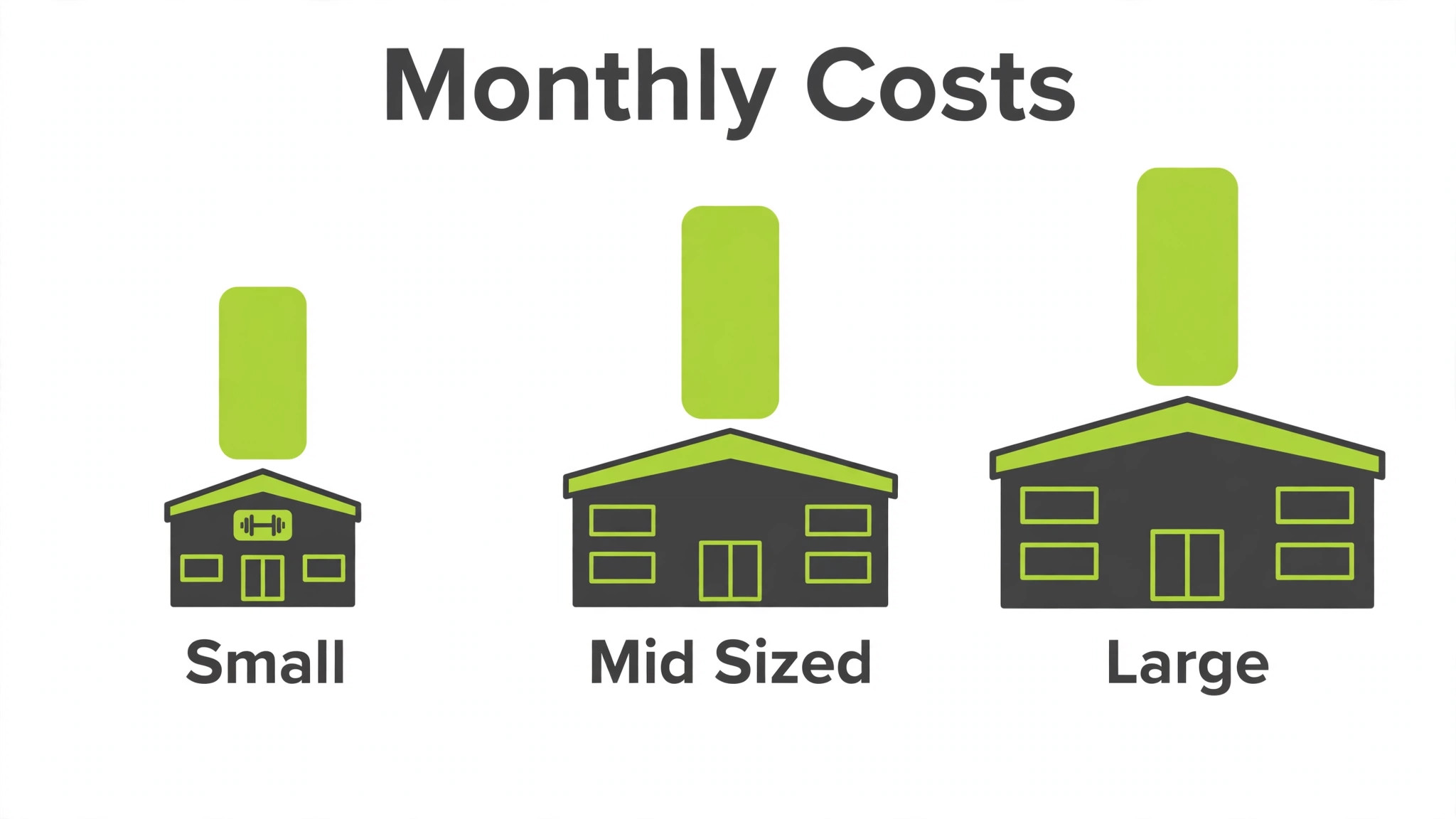
The cost of running a gym monthly is best read as a table, because the categories stay the same while the numbers scale. The table below uses published 2026 guides that converge closely on the same ranges, which gives confidence in the shape even though any single gym will differ with its city and model.
| Monthly category | Small gym | Mid sized gym | Large gym |
|---|---|---|---|
| Rent | $2,000 to $5,000 | $5,000 to $10,000 | $10,000 to $20,000 and above |
| Payroll | $0 to $5,000 | $5,000 to $15,000 | $15,000 to $40,000 and above |
| Utilities | $500 to $1,000 | $1,000 to $2,000 | $2,000 to $4,000 |
| Insurance | $200 to $400 | $300 to $500 | $500 to $1,000 |
| Marketing | $500 to $1,500 | $1,500 to $3,000 | $3,000 to $5,000 and above |
| Software and technology | $100 to $250 | $200 to $400 | $300 to $500 |
| Maintenance and supplies | $200 to $500 | $500 to $1,000 | $1,000 to $2,000 |
| Total monthly | $3,500 to $13,650 | $13,500 to $31,900 | $31,800 to $72,500 and above |
The totals hide an important truth, which is that the meter runs every month whether you have 10 members or 300. A gym with fixed monthly costs of $30,000 charging an average of $89 a month per member needs roughly 337 paying members just to break even, and below that number it loses money while above it additional members are almost pure profit, because the marginal cost of an inactive member is close to zero. That is why the first year of a gym is a race to a member count, not a race to perfect programming.
Published timelines put break-even at 8 to 12 months for a well run gym, with months 1 to 3 at 30 to 50 percent of target membership, months 4 to 6 at 60 to 80 percent, and profitability arriving in months 12 to 18. A gym that opens without a pre sales campaign and a working capital reserve is betting that race on hope, and hope is not a funding strategy.
Fixed costs versus per member costs
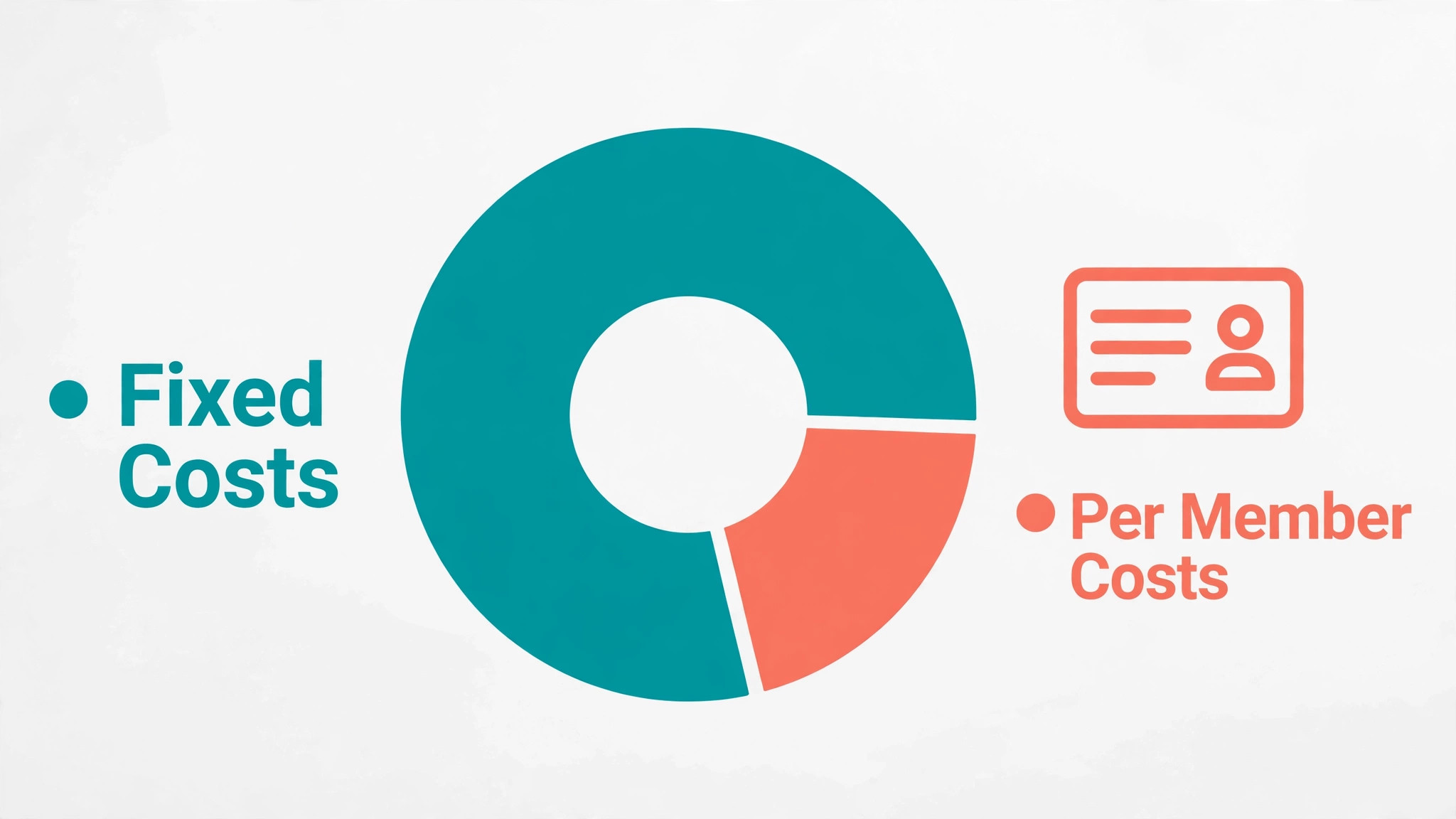
Splitting costs into fixed and per member lines changes how you make decisions. Fixed costs, meaning rent, insurance, base payroll, software, and loan payments, do not move when one more member joins. Per member costs, meaning extra cleaning, consumables, towel service, and wear on equipment, move slowly with usage, and published guides put variable costs per member at a few hundred dollars a month in total for a whole gym, not per head, because most of the cost base is fixed. That structure has two consequences.
First, pricing power matters more than cost cutting once the doors are open, because adding $10 to a monthly membership across 300 members is $3,000 a month of almost pure margin, while cutting $3,000 of fixed cost usually means cutting something members notice. Second, churn is the enemy that matters most. Industry annual churn runs 30 to 40 percent, which means a gym with 500 members losing 5 percent a month must acquire roughly 300 new members a year just to stand still. Retention spending, such as coach check ins, community events, and progress tracking, is therefore not a luxury line. It is cheaper than the acquisition spending it replaces, since marketing typically consumes 5 to 12 percent of revenue.
Boutique Studio Versus Big Box, a Cost Comparison
The boutique versus big box choice is the most consequential cost decision a gym owner makes, because it sets rent, payroll, and pricing all at once. Boutique studios run small footprints in premium locations, with specialised instructors, higher per member prices, and lower total overhead. Published comparisons put boutique monthly costs at $10,000 to $25,000, against $20,000 to $60,000 for traditional gyms. Boutique payroll runs $8,000 to $20,000 for specialised instructors, while big box payroll runs $12,000 to $40,000 for trainers, reception, and cleaning. Boutique utilities run $800 to $2,000 against $2,000 to $5,000 for a large facility with heavy heating, ventilation, and machine loads. Boutique insurance runs $300 to $700 against $500 to $1,200.
The boutique model wins on cost control and loses on volume ceiling, since a studio with 150 members at $150 a month grosses $22,500, while a big box gym with 800 members at $50 grosses $40,000, but needs far more of it to cover its base.

Pricing strategy follows the model. Budget gyms charge $10 to $25 a month, mid range gyms $30 to $70, and premium gyms $80 to $200 or more, with most gyms landing at $50 to $70. A boutique studio must hold a premium price, because its member count cannot carry a budget price. A big box gym must hold volume, because its fixed base cannot be carried by a small member count at any price. The failure mode for boutiques is discounting to fill classes, which destroys the premium positioning that justifies the price.
The failure mode for big box gyms is competing on price with budget chains, which is a race to the lowest cost base that an independent gym will lose. Choose the model whose economics you can actually defend in your city, not the model you personally prefer to train in, because those are often different gyms.
Equipment, buy it, lease it, or buy it used
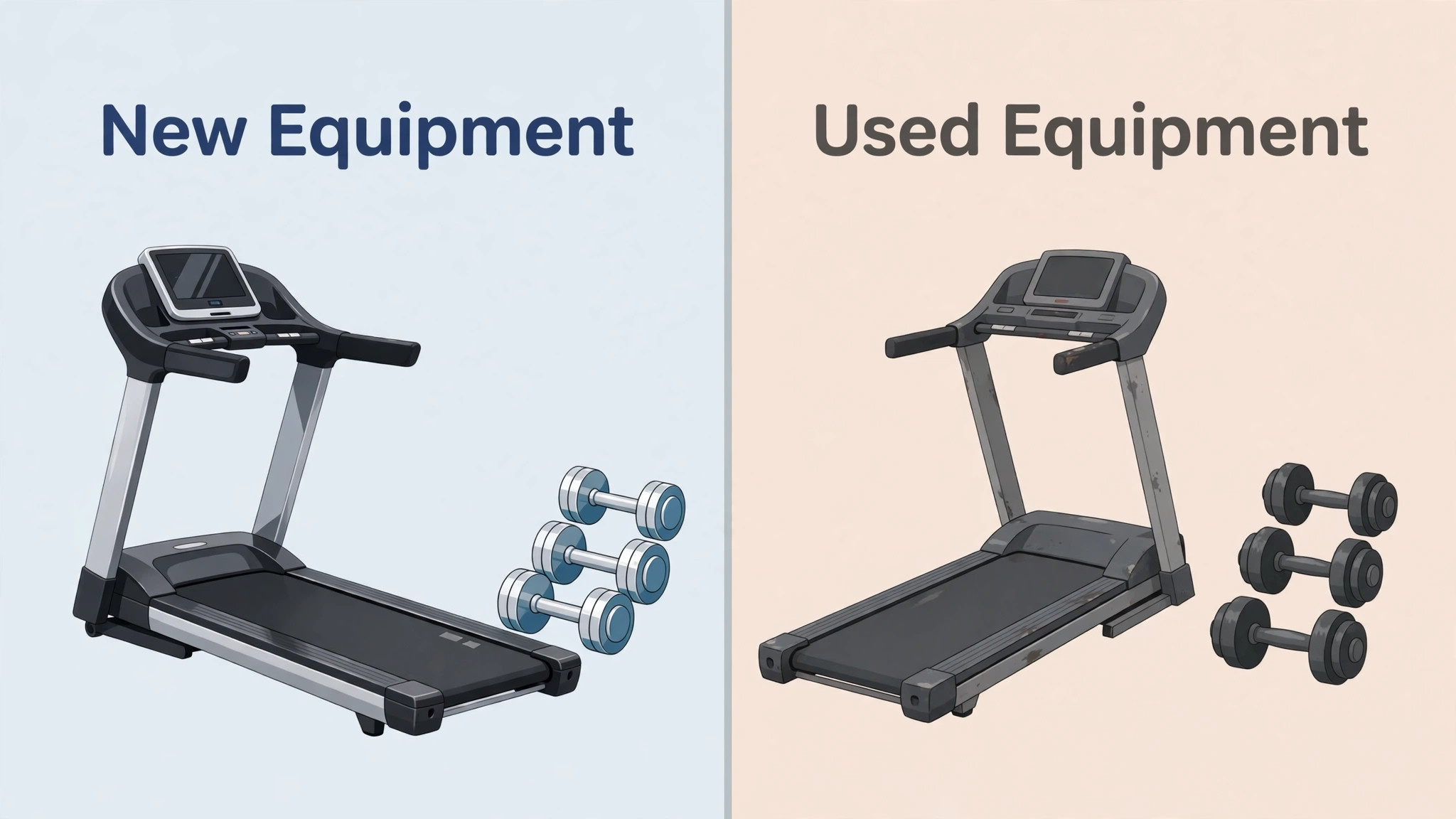
Equipment is the largest startup cost for most gyms and a smaller but persistent monthly cost thereafter. Buying a full commercial setup runs $50,000 to $150,000 for a large gym, $40,000 to $70,000 for a mid sized one, and $10,000 to $25,000 for a small studio. Strength equipment bought outright runs $15,000 to $50,000, cardio $20,000 to $75,000, specialty items $10,000 to $40,000, and accessories $2,000 to $10,000. Leasing converts that capital cost into a monthly line, with strength leases at $1,000 to $3,000 a month and cardio leases at $1,500 to $4,000 a month, and published guides put equipment lease or replacement at $1,000 to $2,500 a month for a standard facility.
Used commercial equipment typically sells for 40 to 60 percent of retail, which is the single biggest saving available to a new gym, and it is a saving worth taking for strength equipment, which wears slowly, while being more cautious with cardio machines, where motor and console wear matters.
Monthly equipment costs do not end at the lease or loan payment. Maintenance runs $200 to $2,000 a month depending on size, and published guides put equipment depreciation at 15 to 25 percent a year, which means a $100,000 equipment base loses $15,000 to $25,000 of value annually. Budget a maintenance reserve from month one, and track cost per machine, because one chronically broken treadmill can cost more in member complaints and repair visits than its replacement would. The cost of running a gym monthly includes this quiet depreciation whether you budget for it or not, and gyms that ignore it discover the bill all at once when a whole cardio row needs replacing in the same year.
Utilities, insurance, software, and the smaller lines
Utilities scale with machines and showers, not just square footage. Small gyms run $500 to $1,000 a month, mid sized $1,000 to $2,000, and large facilities $2,000 to $4,000, with some guides putting large gym utilities as high as $5,000 to $10,000 where heating and cooling loads are heavy. Energy efficient lighting, timers on heating and ventilation, and low flow showers are unglamorous investments that pay back in months, because utility costs arrive every month for the life of the lease.
Insurance runs $200 to $1,000 a month depending on size, with annual liability premiums of $1,000 to $4,000 for a typical gym and $2,000 to $6,000 for larger or higher risk operations, and it should cover liability, property, and professional risk for trainers. Get quotes from brokers who know fitness, because a generic commercial policy often excludes the exact risks a gym faces, such as member injury during supervised training.
Gymdesk and the software line
Gym management software is a small line that punches above its weight, because it controls billing, and billing failures are membership losses. Published guides put gym management software at $75 to $200 a month, with point of sale hardware adding $500 to $2,000 one time, and other guides put software at $100 to $500 a month depending on size. The software should handle memberships, billing, class bookings, access control, and reporting without manual workarounds, and it should integrate with your payment processor so failed payments are retried and flagged automatically.
A gym losing 3 percent of members a month to billing friction is losing more than the software costs to fix it, and that comparison is the right way to judge a software quote. Do not buy the cheapest software that cannot handle your model, and do not buy an enterprise platform for a 100 member studio. Buy the one whose billing and booking flow matches how your members actually join and attend.
Fixed Costs, Per Member Costs, and a First Month Budget
The table below is the overview proof for this guide, combining the fixed monthly base with the costs that move per member, and then a first month budget for a mid sized gym opening its doors. Use it as a template, replacing each range with a quote from your city, because rent and payroll vary more by location than any other line.
| Cost line | Type | Mid sized gym monthly range |
|---|---|---|
| Rent | Fixed | $5,000 to $10,000 |
| Core payroll | Fixed | $5,000 to $15,000 |
| Insurance | Fixed | $300 to $500 |
| Software and technology | Fixed | $200 to $400 |
| Equipment lease or loan | Fixed | $1,000 to $2,500 |
| Utilities | Mostly fixed | $1,000 to $2,000 |
| Marketing | Variable with growth | $1,500 to $3,000 |
| Maintenance and cleaning | Per member driven | $500 to $1,000 |
| Consumables and supplies | Per member driven | $200 to $500 |
| Fixed monthly subtotal | Fixed | $11,500 to $28,400 |
| Variable monthly subtotal | Per member driven | $2,200 to $4,500 |
A first month budget for that mid sized gym adds one time opening costs to the first month of running costs. Pre opening rent and deposit often run $10,000 to $25,000, initial marketing and a grand opening campaign $3,000 to $15,000, and working capital of three to six months of operating costs is the reserve that published guides recommend holding. A mid sized gym with a $20,000 monthly burn needs $60,000 to $120,000 of reserve to survive a slow first two quarters, and that reserve is the difference between a gym that reaches its 8 to 12 month break-even and one that closes in month five. The most common first year mistake is not overspending on equipment.

It is opening with a full cost base and a partial member base, and no reserve to bridge the gap. The cost of running a gym monthly in month one is the same as in month twelve. The revenue is not, and the budget must respect that gap.
Where Gyms Waste Money, and Where Cutting Hurts
Every gym cost line has a version that is waste and a version that is investment, and telling them apart is the skill that separates gyms that survive from gyms that slowly bleed. The cost of running a gym monthly is full of lines that look like savings and act like losses, and the most expensive of them is cutting the things members actually notice while keeping the things they never see.
Marketing is the first place owners cut, and usually the worst. When membership stalls, the instinct is to cut the $1,500 to $3,000 marketing line, but that line is the only one that fills the classes that pay every other line. Published guides put ongoing marketing at 7 to 10 percent of monthly revenue, and member acquisition at 5 to 12 percent, which means a gym grossing $25,000 a month should be spending roughly $1,250 to $3,000 on marketing as a matter of routine, not as an emergency measure.
Cutting marketing to save $2,000 while losing 20 members at $60 a month costs $1,200 in recurring revenue every month thereafter, and the members lost to a quiet gym rarely return when marketing restarts. The smarter cut is marketing waste, meaning broad campaigns that reach everyone and convert no one, replaced by referral programmes, local partnerships, and Google Business Profile work that cost little and convert locally. A gym that knows its cost per acquired member can cut with confidence. A gym that does not is cutting blind.
Cleaning is the second line owners cut, and the second worst. A dirty changing room, a smelling studio, or a broken shower does not generate complaints. It generates non renewals, which look like a marketing problem but are really a cleaning problem. Cleaning and facility maintenance run $300 to $2,000 a month depending on size, and that range is small beside rent and payroll, which makes it a terrible place to save $300. The members who leave over cleanliness rarely tell you why, so the cost of the cut is invisible in feedback and visible only in churn data months later.
If a cost line must be cut, cut it from somewhere members do not experience daily, such as renegotiating a software contract, consolidating suppliers, or reducing energy waste, rather than from the floor they train on.
Staffing mistakes that inflate the payroll line
Payroll waste usually comes from hiring in the wrong order or on the wrong terms, not from paying too much per hour. The most common mistake is hiring full time staff before membership justifies it. A full time front desk hire at $15 to $20 an hour costs $2,400 to $3,200 a month before employer costs, and if the gym has 80 members, that hire alone consumes a large share of revenue. Part time cover, split shifts, and owner cover during quiet hours are the bridge until membership reaches the level where full time pay is a fraction of revenue rather than a large share of it. The second mistake is paying trainers a flat salary when class attendance varies.
A base plus per class or per head arrangement aligns trainer pay with the revenue their classes generate, and it protects the gym in slow months without cutting trainer income in good ones. The third mistake is ignoring the cost of turnover. Recruiting, onboarding, and rebuilding a class following after a trainer leaves costs far more than a retention raise, and the cheapest payroll line is often the one that keeps a good trainer for three years rather than replacing one every eight months.
Contractor versus employee status is another payroll trap with real cost consequences. Many gyms engage trainers as contractors, which avoids employer taxes and benefits, but misclassification can create back taxes, penalties, and legal exposure if the trainer works set hours, uses gym equipment exclusively, and is directed like an employee. The saving from contractor treatment is real, roughly 20 to 30 percent on labour cost, but it is only a saving if the classification is defensible. Get the classification reviewed before building a business on it, because a reclassification order arrives as a lump sum bill for every past month, not as a gentle correction.
Revenue lines that change the monthly math
Cost control alone rarely saves a gym, because the fixed base is so large that revenue quality matters more. Personal training is the highest margin revenue line most gyms have. A trainer working one on one at $80 a session, capped at 25 sessions a week to avoid burnout, tops out near $100,000 a year over 50 working weeks, and semi private training at four clients paying $40 each brings $160 an hour, double the one on one rate while each client pays less. Trainers typically take 30 to 50 percent commission, leaving the gym a strong margin on hours that use existing floor space.
Small group training, nutrition coaching, and youth programmes use the same facility during underused hours, which is the cheapest capacity a gym owns, because the rent is already paid. A gym that fills its 10am and 2pm dead hours with programmes does not just add revenue. It adds revenue at almost no extra fixed cost, which is the most profitable revenue in the business.
Retail, merchandise, and supplements are often overestimated as revenue lines and underestimated as cost lines. Stock ties up cash, expires or goes out of fashion, and needs display space and staff time to sell. A small, well chosen retail range beside reception can add a few hundred dollars a month of margin, but a large supplement wall in a struggling gym is capital that should have been marketing or reserve. The test for any new revenue line is simple. Does it use capacity you already pay for, and does it serve members you already have. If yes, it probably improves the monthly math.
If it needs new space, new staff, or new customers to work, it is a new business, and it should be judged as one rather than smuggled into the gym budget.
More Reading on Stratilyze
Gym costs sit beside the other monthly fitness and booking costs owners compare, so readers planning a gym usually check the neighbouring fitness guides next. The guide to setting up a small gym class booking system covers the booking tool that shapes the member experience, the guide to the best AI tools for gyms shows the software side of running the same business, and the guide to AI tools for gym member onboarding explains the signup flow that turns a first visit into a paying member.
Frequently Asked Questions
How much does it cost to run a gym per month?
A small gym costs $3,500 to $13,500 a month, a mid sized gym $13,500 to $32,000, and a large facility $32,000 or more. The cost of running a gym monthly depends mostly on rent and payroll, which together account for roughly 70 to 80 percent of the total, so any estimate that does not start with those two lines is not an estimate worth trusting.
How many members does a gym need to break even?
It depends on price and fixed costs. A gym with $30,000 of fixed monthly costs charging $89 a month per member needs roughly 337 paying members to break even. A budget gym at $25 a month needs far more members, and a boutique studio at $150 a month needs far fewer. Calculate your own break-even by dividing fixed monthly costs by average revenue per member, and then add a margin for churn.
Is it cheaper to lease gym equipment or buy it?
Leasing costs $1,000 to $3,000 a month for strength and $1,500 to $4,000 for cardio, and it preserves capital while bundling maintenance on some contracts. Buying costs $50,000 to $150,000 for a large setup but is cheaper over five years if the equipment lasts. Used equipment at 40 to 60 percent of retail is the best value for strength gear, while cardio machines deserve more caution because motors and consoles wear.
Heating, ventilation, and electrical upgrades are the most commonly overlooked cost, running $15,000 to $50,000 for a commercial gym, because heavy cardio loads and 50 or more people training at once demand more than a standard retail fit out provides. Get a mechanical and electrical assessment before signing a lease, not after, because the upgrade cost can exceed the rent negotiation you thought you won.
How long does it take for a gym to become profitable?
A well run gym typically reaches break-even in 8 to 12 months and becomes profitable in 12 to 18 months. Months 1 to 3 usually reach 30 to 50 percent of target membership, and months 4 to 6 reach 60 to 80 percent. A pre sales campaign, a working capital reserve of three to six months, and a retention plan are the three things that most reliably shorten that timeline.
Should I open a boutique studio or a big box gym?
Open a boutique studio if you can hold a premium price and a specialised offer, since boutique monthly costs of $10,000 to $25,000 are manageable with 100 to 200 members at premium rates. Open a big box gym only if your market can deliver the volume its $20,000 to $60,000 monthly base demands. The wrong model in the right city still fails, because the cost base and the pricing strategy must match.
The Verdict on Monthly Gym Costs
The cost of running a gym monthly rewards owners who respect the fixed base and fear churn more than they fear competitors. Lock a rent you can carry at half your target membership, hire in the order that protects retention, hold three to six months of operating reserve, and price for the model you actually run rather than the model you wish you ran. A gym is a fixed cost business with a variable revenue line, and the owners who win are the ones who build the member count before they build the cost base, not after.
Review the fixed base every quarter, because a lease, a contract, or a staffing pattern that made sense at opening rarely stays optimal as membership grows.