
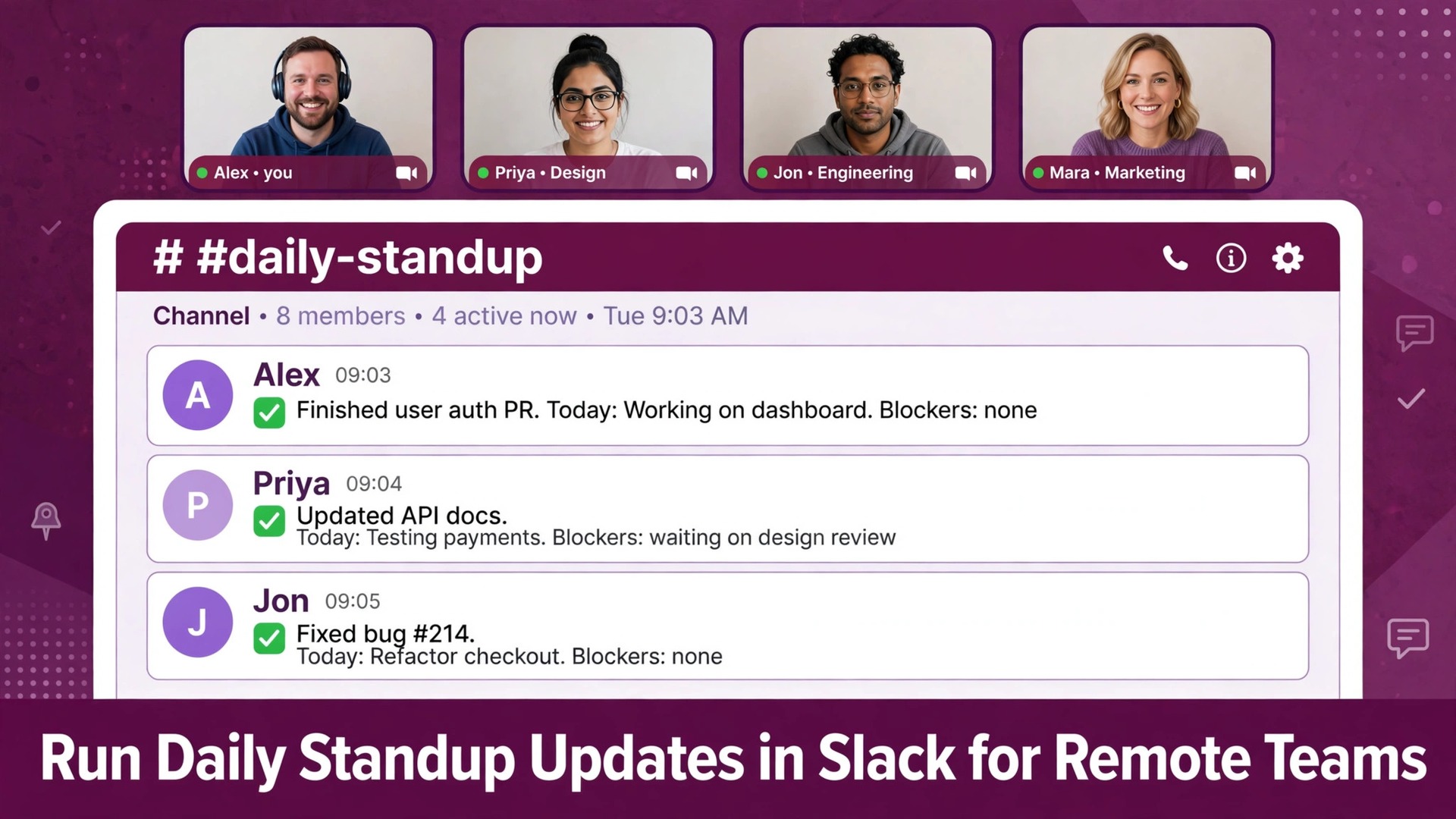
A live daily standup and an async Slack standup solve the same problem in opposite ways, and for remote teams, the difference decides whether the ritual helps or harms. The live standup forces everyone onto a call at one hour, which punishes time zones, interrupts deep work, and turns a fifteen minute check-in into thirty minutes of waiting for people to join and settle. The async Slack standup asks each person to post three answers when their workday starts, and the team reads a complete picture in minutes, on their own schedule, which is why remote teams use Slack for daily standup updates remote teams.
When you use Slack for daily standup updates remote teams get alignment without the meeting, and that trade is worth making carefully, because a badly run async standup is just as useless as a badly run meeting, only quieter.
Slack is a team messaging platform built around channels, threads, and integrations, and its Workflow Builder lets teams automate routine processes without code. For standups, that combination is ideal, because the channel is where the team already works, the thread is where discussion happens, and the workflow is what prompts people, collects answers, and posts summaries on schedule. A standup bot app can add scheduling, reminders, and digests on top of that, but the core system works with Slack alone, and this guide starts there, so teams can adopt async standups without buying another tool before they know whether the habit fits.
This guide builds an async standup system that remote teams actually sustain. You will decide whether async fits your team, design a message format that people can write in two minutes, set up prompts and summaries that run themselves, handle blockers so they get fixed instead of merely reported, and review the ritual regularly so it does not decay into noise. By the end, your team will have a standup that respects time zones, protects focus, and surfaces problems early, which is what a standup was always supposed to do.
Live Meetings Versus Async Slack Standups
The case against live standups for remote teams is not that meetings are evil. It is that a daily meeting at a fixed hour imposes a cost that grows with every time zone added. A 9 a.m. standup in one city is an evening call in another and a very early call in a third, and team members in the worst slots either join exhausted or skip and miss the alignment the meeting was supposed to provide. Even in a single time zone, a daily meeting breaks the first deep work block of the day, and research on attention consistently shows that interrupted focus is expensive to rebuild.
A team that meets daily pays that cost daily, whether or not the meeting produced anything worth interrupting for.
Async standups remove the scheduling cost, but they introduce a different risk, which is that updates become performative. People write vague answers to satisfy the ritual, nobody reads them, and blockers hide in paragraph three of a long post. The fix is structure, not more meetings. A fixed message format, a short length limit, a dedicated channel, and a daily summary that highlights blockers make async updates scannable, and scannable updates get read. A team that reads updates catches blockers early. A team that does not read them might as well not write them, and the ritual becomes theater. Design for reading, not just for writing, and the async format wins.
| Standup factor | Live daily meeting | Async Slack standup |
|---|---|---|
| Time zone fairness | Punishes distant zones daily | Everyone posts at their own morning |
| Focus protection | Breaks the first work block | No interruption, read when ready |
| Participation | Quiet members stay quiet | Everyone writes, everyone is heard |
| Record keeping | Relies on memory or notes | Searchable channel history |
| Blocker visibility | Depends on who speaks up | Blockers highlighted in summaries |
| Main risk | Meeting bloat and fatigue | Updates ignored or written vaguely |
The table shows why async fits remote teams, but it also shows the condition, which is that updates must be read and blockers must be acted on. When you use Slack for daily standup updates remote teams succeed when a lead reads the summary daily, follows up on blockers the same day, and calls a live meeting only when a problem genuinely needs synchronous discussion. Async is the default. Live is the exception, used deliberately, and that inversion is what protects both alignment and focus.
Designing a Standup Message People Will Actually Write
A standup message should take two minutes to write and thirty seconds to read. The classic three questions achieve that, and they have survived because they work. What did you do yesterday. What will you do today. What is blocking you. Keep those three questions, and resist adding more, because every additional question reduces completion. If your team needs a fourth question, such as a mood check or a shout-out, add it as an optional line, not as a required field, so the core update stays fast even on busy days. A standup that takes ten minutes to write will be skipped on the days when it matters most, which are the busy days when blockers pile up.
Format the message for scanning, not for prose. Use a short header line with the person’s name and date, then three labeled lines, one per question, each kept to one or two sentences. Use bullet points for multiple items, and keep the whole update under about one hundred words. Long updates bury blockers, and buried blockers are the failure mode of async standups. If an update needs more detail, put the detail in a thread reply, so the channel summary stays scannable and the detail remains available to anyone who needs it. Teach this format by example, with the team lead posting well-formatted updates first, because teams copy what leaders do, not what handbooks say.
Timing rules matter as much as format. Set a posting window, such as by the time each person starts work, rather than a single global deadline, because a global deadline reintroduces the time zone problem that async was supposed to solve. A workflow or bot can prompt each person at their local morning hour, and post a summary once the window closes, so the team gets one digest to read instead of a stream of individual posts throughout the day. Decide what happens to late or missing updates, such as a private nudge rather than a public shaming, because public pressure produces rushed, vague updates, while a private nudge produces real ones. The goal is honest information, not compliance theater.
Workflow Builder Prompts and Summaries
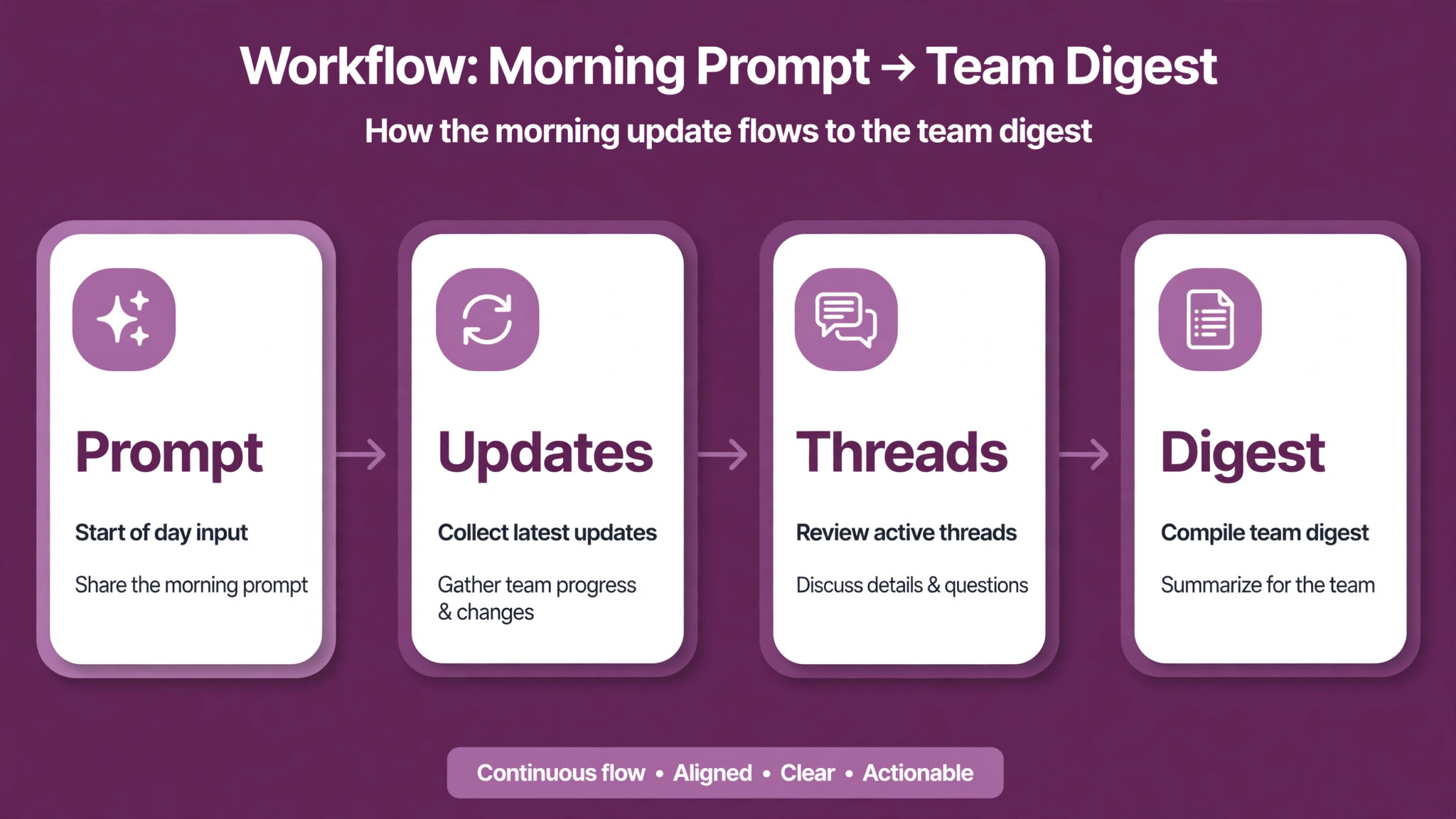
Slack’s Workflow Builder lets you build a standup workflow without code, starting from a scheduled trigger or a link, collecting responses through a form, and posting them to a channel. A simple workflow sends a morning prompt, collects the three answers, and posts each update to the standup channel, while a more complete version also logs responses to a spreadsheet for later review. Build the simple version first, test it with the team for a week, and add logging or summaries only when the team asks for them. Automation should serve the habit, not precede it, because a complex workflow built before the habit exists will be blamed when the habit fails, even if the real cause was unclear expectations.
The Standup Message Template
This template is the overview-proof element for this guide. Copy it into your standup channel’s pinned message, and ask every team member to follow it, so updates stay consistent and scannable from day one. When you use Slack for daily standup updates remote teams benefit most from a template that is short enough to use daily and structured enough to surface blockers, and this one is designed to do both.
| Template line | What to write | Example style |
|---|---|---|
| Yesterday | One or two completed items, with outcomes | Finished the checkout test plan and shared results |
| Today | One or two planned items, with a clear focus | Building the payment error handling and writing tests |
| Blockers | Anything stopping progress, with what help is needed | Waiting on API access, need the credentials from the platform team |
| Optional note | A shout-out, a risk, or a mood flag, only if useful | Thanks to the design team for the fast mockup turnaround |
Keep the template visible and stable. Changing the format monthly confuses the habit, and a habit that keeps changing is a habit that dies. If the team wants a change, discuss it in a retrospective, agree it, and update the pinned template once, with a note explaining why. Stability is a feature of rituals, not a flaw, because people automate their behavior around a stable format, and automation is what makes a two-minute update genuinely take two minutes. New team members should learn the template on their first day, by reading the pinned message and seeing a week of examples in the channel history.
Setting Up Channels, Threads, and Summaries
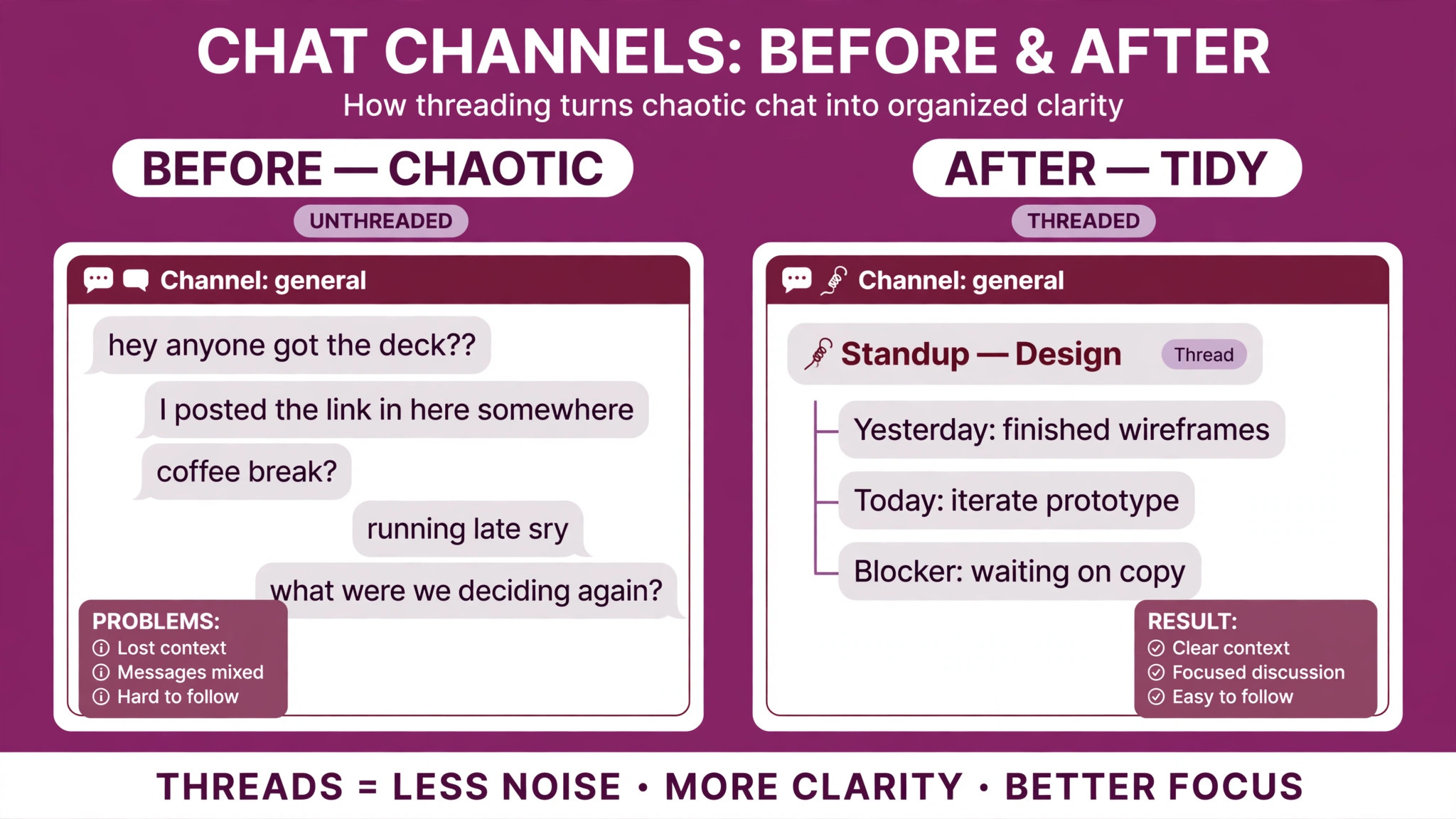
Create a dedicated channel for standups, separate from general team chat, so updates do not drown in other conversation and the channel history becomes a searchable record of what the team did. Name it clearly, pin the template, and set the expectation that standup posts go there and discussion of a post goes in its thread, not as new channel messages. Threads keep the channel summary readable, because a discussion about one person’s blocker does not push everyone else’s updates out of view. Teach thread replies explicitly, because many teams know threads exist but default to channel messages out of habit, and the channel degrades within a week.
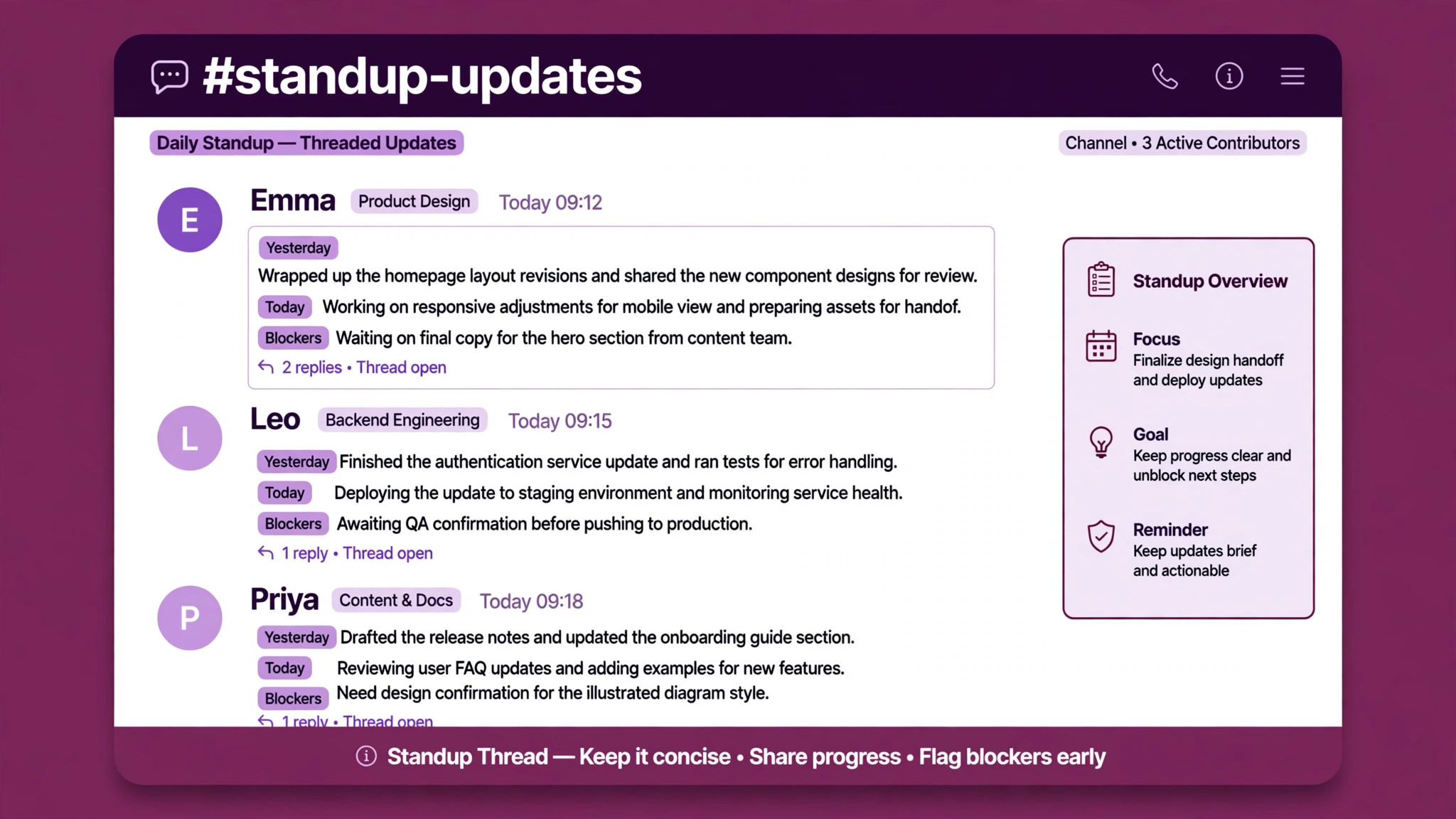
Summaries are what make async standups readable at scale. A daily digest that lists each person’s update, with blockers pulled out at the top, lets a lead scan the whole team in minutes. A bot app or a workflow can generate that digest automatically, or a rotating team member can post it manually for small teams. Either way, the digest should appear at a consistent time, in the same channel, so the team knows when and where to read it. Without a digest, each person must read every individual post, and as the team grows, that reading burden kills the habit. With a digest, a team of twenty can stay aligned in the time it takes to read one message.

Archive and search complete the system. Because standup updates live in a channel, they are searchable by person, date, and keyword, which means a lead can answer questions like what someone was working on three weeks ago, or when a blocker first appeared, without asking. That history is valuable during retrospectives, performance reviews, and incident reviews, because it shows what the team actually did, not what anyone remembers. Protect that value by keeping the standup channel focused, and by moving off-topic discussion to threads or other channels, so the history stays clean and searchable rather than cluttered with unrelated chat.
The Blocker Follow-Up Checklist
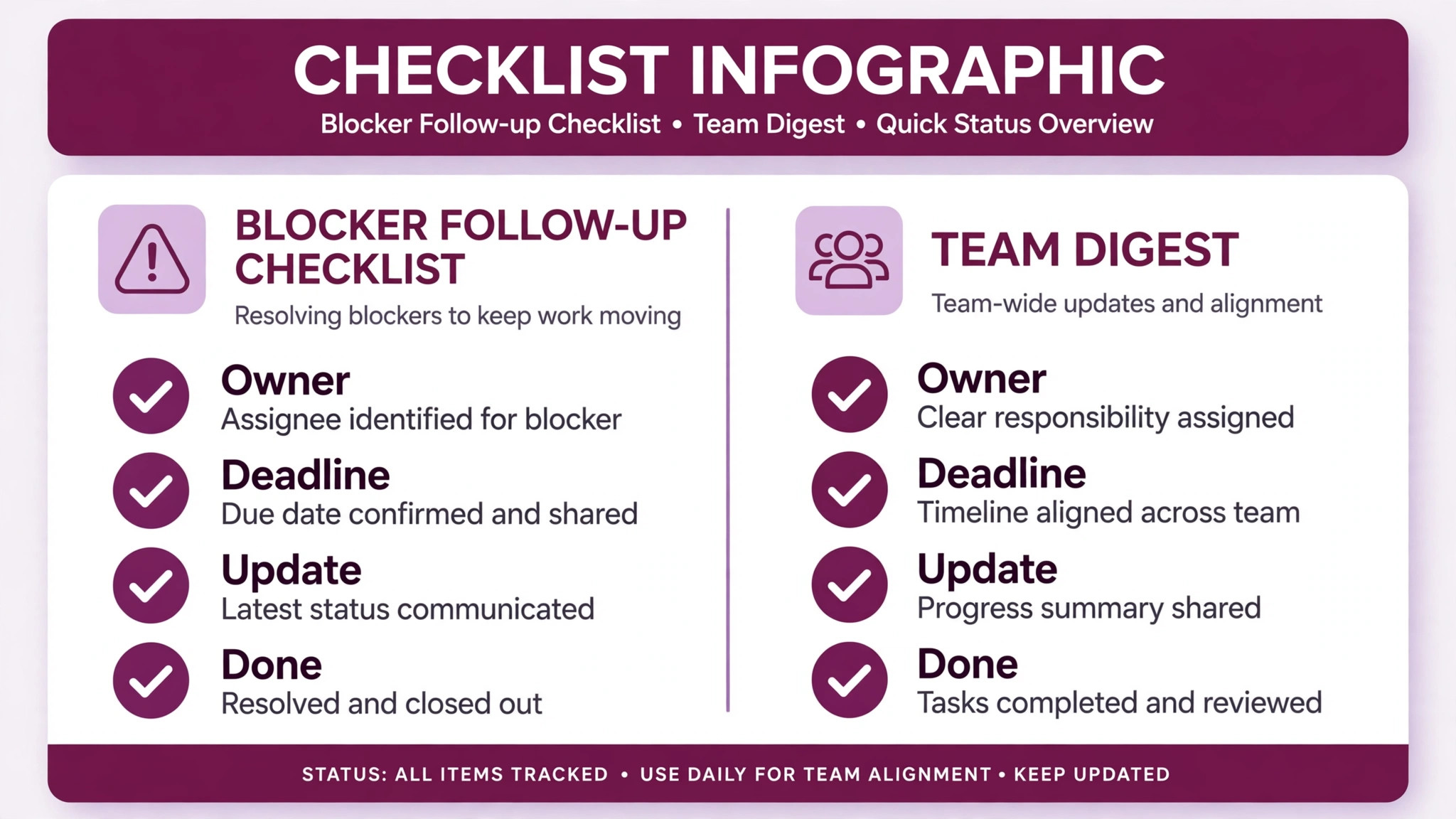
A standup that reports blockers without fixing them is worse than no standup, because it teaches the team that reporting changes nothing, and people stop reporting honestly. Use this checklist daily, led by the team lead or a rotating facilitator, to turn reported blockers into resolved ones. When you use Slack for daily standup updates remote teams must treat blocker follow-up as the core job of the ritual, because alignment without action is just information.
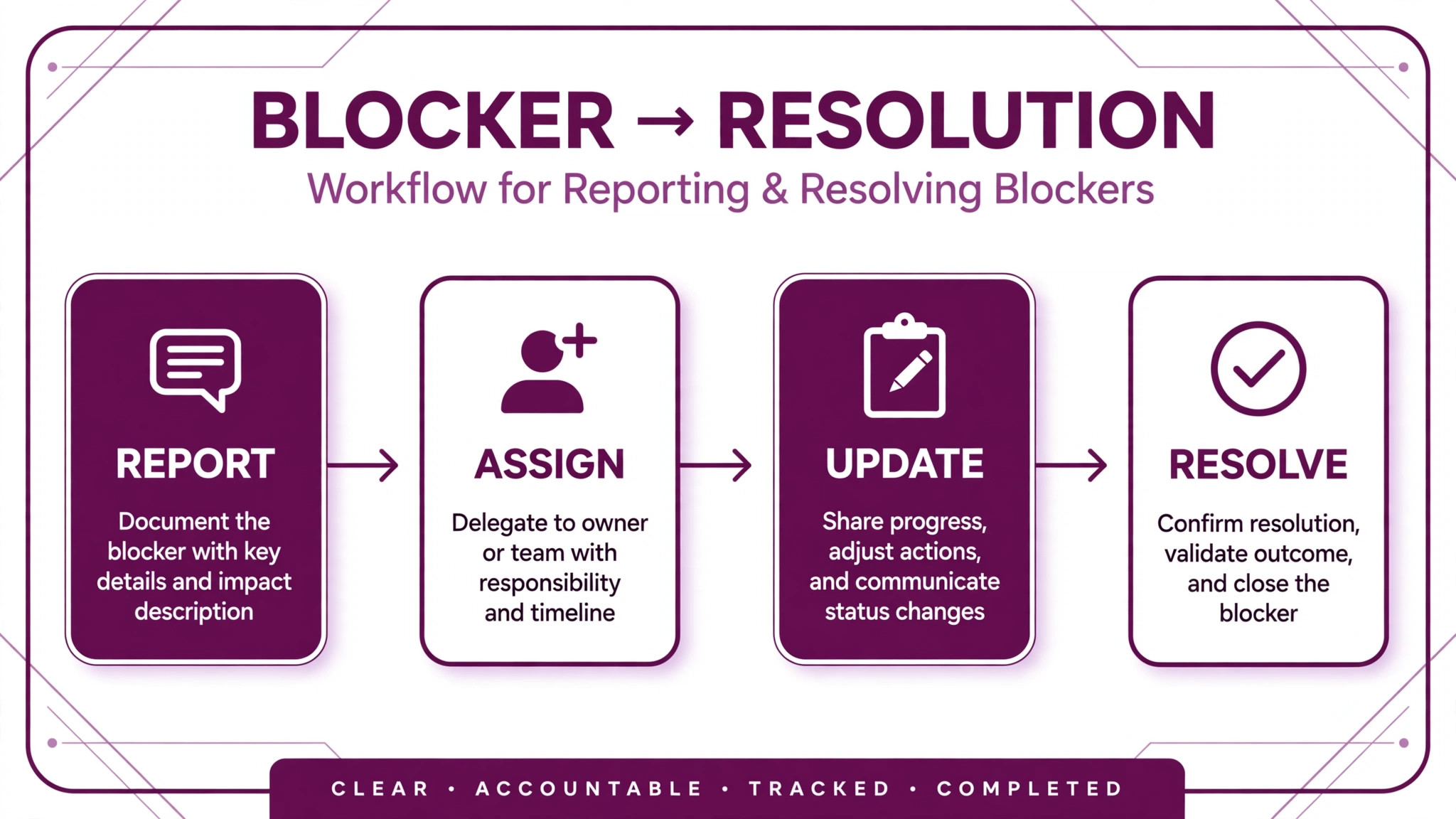
- Read the daily digest and list every blocker reported, with the person blocked and the help needed.
- Contact each blocked person the same day, in a thread or direct message, to confirm the blocker and agree a next step.
- Assign an owner to each blocker who is not the blocked person, since blockers usually need someone else’s action.
- Set a deadline for each blocker, even if it is just a check-in time, so nothing drifts without a next look.
- Escalate blockers that survive two days, by raising them in a team channel or a live call, rather than letting them repeat in standups.
- Update the standup thread when a blocker is resolved, so the team sees progress and the history stays accurate.
- Review repeated blockers weekly, and fix the systemic cause, such as missing access, unclear ownership, or a broken process.
- Thank people who report blockers early, publicly, so the team learns that reporting is rewarded, not punished.
- Track blocker age in a simple log, so patterns, such as one team always blocking another, become visible.
- Close the loop in the next standup, by noting which blockers were resolved and which are still open.
Blocker culture deserves a final word. Teams that punish blockers, by treating them as failures, get silence, and silence hides problems until they become crises. Teams that reward blockers, by responding fast and thanking the reporter, get early warnings, and early warnings are cheap to fix. The standup is a reporting tool, not a performance review, and leaders who use it to judge output will destroy the honesty it depends on. Judge the system by how fast blockers get fixed, not by how impressive updates sound, and the team will keep telling you the truth.
How to Use Slack for Daily Standup Updates Remote Teams Across Many Time Zones
Time zones are where async standups prove their worth, and also where they fail if designed carelessly. When you use Slack for daily standup updates remote teams spanning many zones should abandon the idea of a single standup moment entirely, and replace it with a rolling window. Each person posts at their local morning, the digest compiles as posts arrive, and the team reads the digest at their own morning, seeing yesterday’s work from colleagues whose day already ended and today’s plans from colleagues whose day just began.
That rolling picture is actually richer than a live meeting, because it spans more of the team’s working hours, but it requires everyone to understand that the digest is a snapshot, not a live status, and that a teammate’s plan may have changed since they posted it.
Handoff discipline makes rolling standups work across zones. When a person in an early zone finishes their day, their standup update for the next day should note anything a later-zone colleague needs to pick up, such as a review waiting, a deployment scheduled, or a customer reply promised. That note turns the standup into a handoff document, and handoffs are what let a team work around the clock without dropping work between zones. Teach the team to write handoff notes explicitly, especially on Fridays in early zones, when a later-zone colleague may work a full day after the early-zone author has left. A standup without handoff notes leaves later zones guessing, and guessing produces duplicate work and missed follow-ups.
Overlap hours deserve deliberate use. Most multi-zone teams share a small overlap window, often one or two hours, and that window should be protected for the conversations that genuinely need live interaction, such as unblocking a complex problem or making a decision with many stakeholders. Do not spend overlap hours on status sharing, because the standup already handled status, and spending precious overlap on reciting updates wastes the scarcest resource a distributed team has. When you use Slack for daily standup updates remote teams free their overlap for decisions and collaboration, and that reallocation is often the largest productivity gain from going async, larger even than the meeting time saved.
Cultural fairness matters as much as scheduling fairness. A standup system that always asks one zone to post first, or that always schedules the digest around one headquarters time zone, signals whose time matters most, and that signal erodes trust over time. Rotate digest times where possible, rotate facilitation across zones, and ensure that blockers from every zone get the same same-day follow-up, not just blockers from the headquarters zone. When you use Slack for daily standup updates remote teams build inclusion by design, through rotating roles and equal response times, and that inclusion shows up in who speaks, who reports blockers, and who stays on the team.
A standup that works for every zone is a standup that keeps a distributed team together.
Finally, measure time zone health explicitly in your quarterly review. Ask each zone whether the posting window fits their day, whether the digest arrives at a useful time, and whether blockers get followed up promptly regardless of zone. If one zone consistently reports worse experiences, fix the system for that zone, even if it means a different digest time or a second summary. Fairness in async systems is not automatic. It is designed, measured, and maintained, and the quarterly review is where that maintenance happens.
Mistakes That Kill Async Standups
The most common mistake is letting updates grow long and vague, which happens when the template is unclear or unenforced. Enforce brevity kindly, by modeling short updates and by asking for clarification in threads when an update is unclear, rather than by criticizing length publicly. The second mistake is never reading or acting on updates, which teaches the team that standups are theater. A lead who reads the digest daily and follows up on blockers the same day sustains the ritual. A lead who does not kills it within weeks, regardless of tooling.
The third mistake is adding too many questions or too much automation too early, which turns a two-minute habit into a form-filling exercise. Start simple, prove the habit, and add features only when the team asks. The fourth mistake is using standup updates as surveillance, by tracking who posts late or judging productivity from update wording. That misuse destroys trust, and trust is the precondition for honest blockers. The fifth mistake is never reviewing the ritual itself, so a standup that stopped working keeps running out of inertia. Review the standup quarterly, ask the team what helps and what wastes time, and change it based on their answers. A ritual that adapts survives.
A ritual that does not becomes a chore, and chores get skipped.
Reviewing and Improving Your Standup Ritual
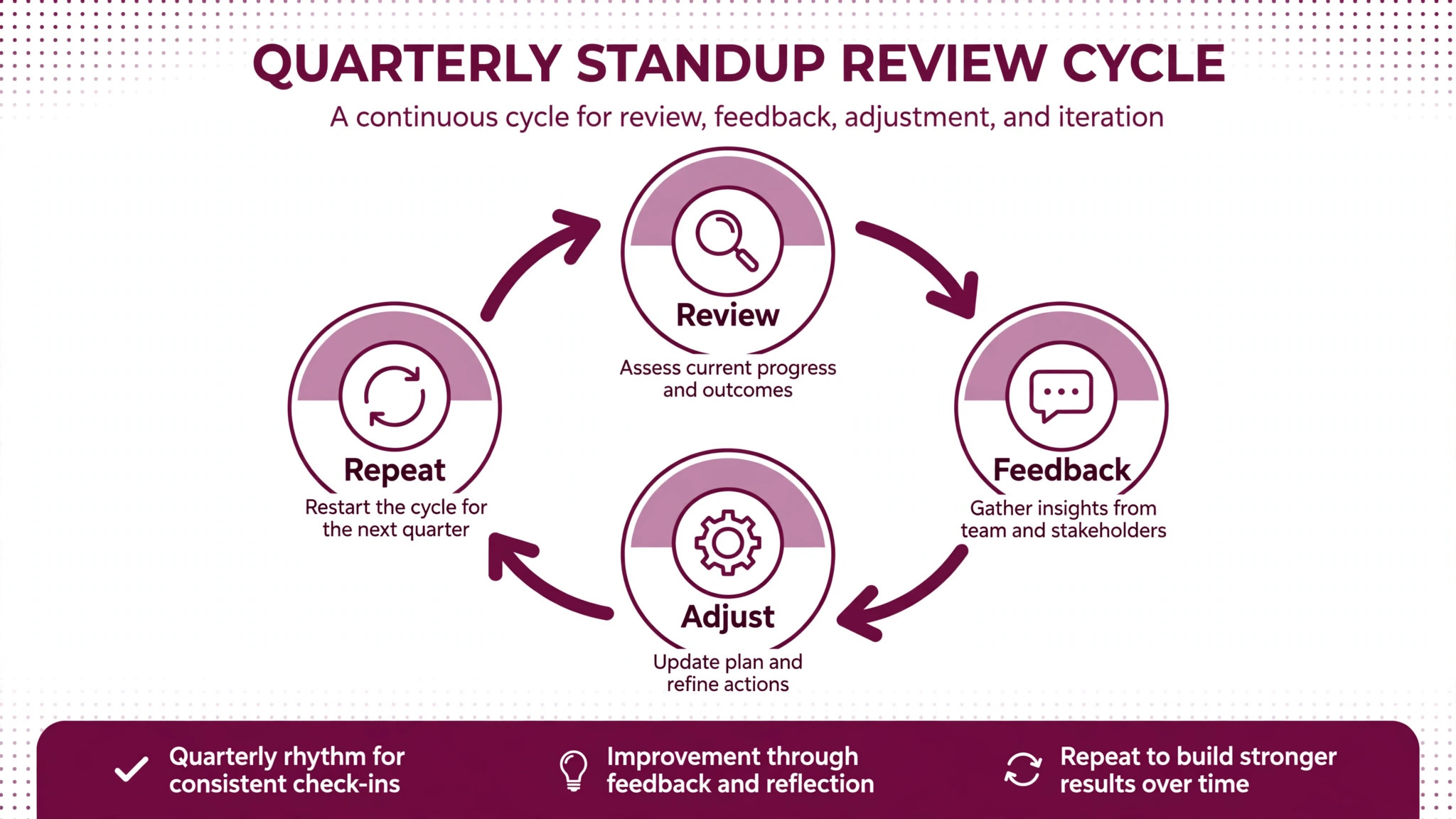
A standup ritual needs a retrospective, just like any other team process, because what works for a team of five may fail for a team of fifteen, and what works in one quarter may fail in the next. When you use Slack for daily standup updates remote teams should review the ritual every quarter with three questions. Are updates short, honest, and read. Are blockers fixed fast. And does the team feel more aligned or just more monitored. Survey the team anonymously if needed, because honest answers about a ritual require safety, and a survey that only leaders answer will praise a ritual that everyone else resents.
Act on what the review finds. If updates are too long, tighten the template and model brevity. If blockers linger, assign a dedicated facilitator for a month and track blocker age visibly. If the team feels monitored, stop any practice that resembles surveillance, and say so explicitly, because trust lost through surveillance takes longer to rebuild than any process improvement saves. If the team has outgrown async standups, because the work became highly interdependent and needs daily live coordination, say so and switch deliberately, rather than letting the async ritual decay while everyone quietly wishes for a meeting. The right standup format is the one the team uses honestly, and honesty is the metric that matters most.
Small experiments beat big redesigns. A one-week trial of a new digest time, a new template line, or a rotating facilitator produces real evidence about what helps, while a sweeping redesign produces debate without data. Treat each experiment as a test with a clear question, such as whether a Friday wins line increases morale or merely lengthens updates, and judge it by answers from the team rather than by enthusiasm from the person who proposed it. Small experiments beat big redesigns when they are measured honestly, because honest measurement turns opinions into decisions the whole team can accept.
Try a one-week change, such as adding a Friday wins line, or moving the digest time, or rotating the facilitator, and measure whether updates improve. Keep changes that help, discard changes that do not, and record decisions in the channel’s pinned message, so new members inherit the current format rather than the original one. A standup ritual that evolves in small steps stays alive for years, while a ritual frozen at launch slowly becomes irrelevant. Evolution is maintenance, and maintenance is what separates a lasting habit from a launch-week enthusiasm that fades.
More Reading on Stratilyze
Readers building remote team habits may also enjoy running classroom collaboration in Microsoft Teams for teachers, recording async video updates in Loom for remote teams, and running project status meetings in Microsoft Teams. Each one covers a different part of async collaboration, from daily check-ins to long-form updates that teammates read on their own schedule.
Frequently Asked Questions
How long should a Slack standup update be?
Aim for under one hundred words, covering yesterday, today, and blockers in one or two sentences each. Short updates get read, and read updates surface blockers. If an update needs more detail, put it in a thread reply, so the channel summary stays scannable while detail remains available to anyone who needs it.
Should standups be async or live for remote teams?
Async suits most remote teams, especially across time zones, because it removes scheduling costs and protects focus. Live standups suit work that is highly interdependent and needs daily synchronous coordination, or moments when a blocker needs real-time discussion. Use async as the default, and call a live meeting deliberately when a problem genuinely needs it, rather than by routine.
What time should team members post their standup?
Each person should post by the time their own workday starts, rather than by a single global deadline, because a global deadline reintroduces the time zone problem. A workflow or bot can prompt each person at their local morning hour, and a digest can post once the window closes, giving the team one summary to read at a consistent time.
Do I need a standup bot app, or is Slack alone enough?
Slack alone is enough to start, using a dedicated channel, a pinned template, and Workflow Builder prompts. A bot app adds scheduling, reminders, digests, and tracking, which help as teams grow or span many time zones. Start simple, prove the habit, and add a bot only when the team asks for a feature that Slack alone does not provide conveniently.
How do I handle team members who never post updates?
Start with a private nudge, not public pressure, and ask whether the format, timing, or workload is the problem. Often, non-posting signals a format that feels useless or a workload that leaves no time for rituals. Fix the cause, model the habit from leadership, and only treat persistent non-posting as a performance conversation after the system itself has been checked and improved.
Should standup updates be used to judge performance?
No, standups are for alignment and blocker removal, not for performance judgment. Using updates to judge output destroys the honesty the ritual depends on, because people will write impressive updates instead of true ones. Judge the system by how fast blockers get fixed and how aligned the team feels, not by how impressive individual updates sound.
Alignment Without Another Meeting
Remote teams do not need more meetings. They need a reliable way to know what everyone is doing, what is stuck, and what help is needed, and to learn that in minutes rather than in a call. When you use Slack for daily standup updates remote teams get exactly that, provided they keep updates short, read the digest daily, and follow up on blockers the same day. Set up the channel this week, pin the template, and run the ritual for two weeks before judging it. If blockers get fixed faster and mornings feel calmer, the standup is working, and your team just won back hours of focus every week without losing alignment.