
Maya had written the first chapter of her novel three times. Each version started strong, with a thief, a locked city gate and a storm coming in off the sea, and each version stalled at exactly the same place: chapter two, page four, where the thief had to decide what she actually wanted. Maya knew the feeling well. It is the feeling every fiction writer knows, and it is the feeling AI story generators promise to fix.
They do fix part of it. A good story generator will hand you ten versions of chapter two before your coffee cools, and one of them will usually contain the sentence that unsticks you. What they do not do is write your novel for you, at least not a novel worth reading. The tools that help most are the ones built around how fiction actually gets written: characters who stay in character, plots that remember what happened three chapters ago, and drafts you can revise without losing the thread. This guide covers 13 tools that do that job, grouped by the kind of story you want to tell, with honest pricing and the limits that matter.
One warning before the list. A story written entirely by a machine is not protected by copyright in the United States, and Amazon requires you to declare AI-generated content when you publish through Kindle Direct Publishing. The tools worth paying for are the ones that keep your fingerprints on the page: you outline, you revise, you decide. Treat every tool below as a writing partner, not a ghostwriter, and you stay on the right side of both rules.
The 13 story generators at a glance
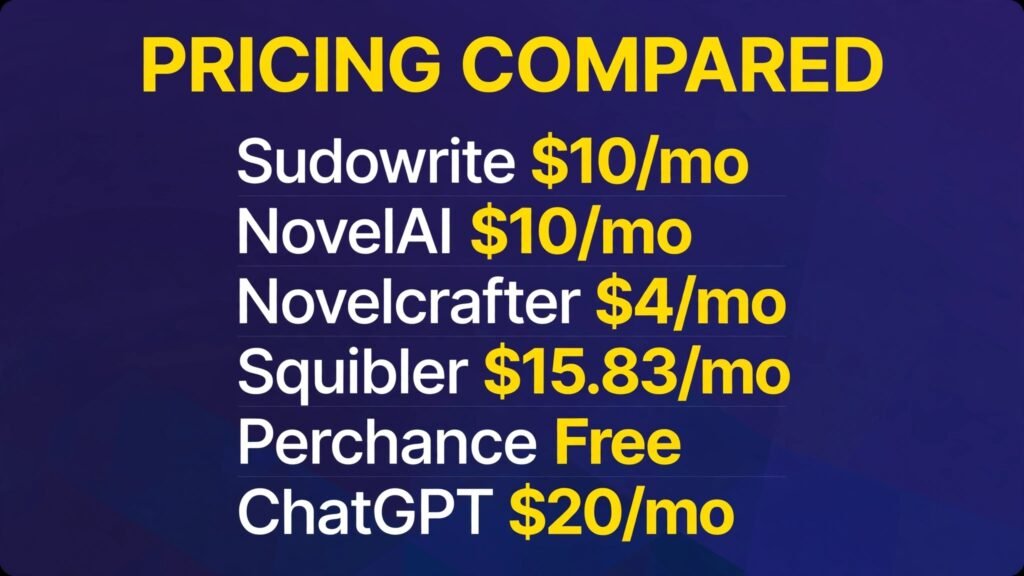
| Tool | Free tier | Paid from | Best for |
|---|---|---|---|
| Sudowrite | Trial, no card | $10/mo annual | Finishing a novel |
| NovelAI | Free Paper tier | $10/mo | Genre fiction, privacy |
| Novelcrafter | 21-day trial | $4/mo (AI from $8 + API) | Series and worldbuilding |
| Squibler | Free, 1,000 credits/mo | $29.99/mo ($15.83 annual) | Beginners, full manuscripts |
| AI Dungeon | Yes | Check checkout | Interactive adventures |
| Perchance | Yes, unlimited | Free | Free stories, no account |
| Plot Factory | Free basic plan | $7.50/mo reported | Collaborative novels |
| Talefy | Yes | $1.99/mo reported | Branching game stories |
| BedtimeStory.ai | Check checkout | Check checkout | Children’s bedtime stories |
| Campfire | Free core | Module pricing | Worldbuilding first |
| DreamGen | Yes | $7.83/mo reported | Interactive roleplay fiction |
| ChatGPT | Yes | $20/mo Plus | Brainstorming and dialogue |
| Claude | Yes | $20/mo Pro | Prose quality and editing |

Prices are US list prices found in October 2026 roundups. They change often, so check the vendor page before you pay. Where sources disagreed, this guide says so instead of picking one number and hoping.
If you want to finish a novel
Sudowrite: the fiction writer’s default
Sudowrite is the tool most working novelists name first, and the reason is its workflow. It is built for fiction from the ground up: a Story Bible holds your characters, plot threads and world details, and the AI consults it as it writes, so chapter twelve remembers what chapter two promised. Its Muse model is tuned for fiction, and its scene tools cover the actual jobs of drafting: continue a scene, rewrite a passage, describe a setting with sensory detail, and brainstorm what happens next when you are stuck.
The catch is the credit system. Every generation spends credits, and heavy drafting days burn through them faster than the plan name suggests. Check the credit allowance on the plan you buy, not just the monthly price, and remember that the cheapest tier is aimed at hobbyists, not at someone drafting a full novel in a month.
Pricing: Free trial on every plan, no credit card required. Hobby and Student from $10 a month billed annually, Professional around $29 a month, with higher tiers up to $59 a month reported. Sources disagree on the monthly-billed figures, so confirm the checkout page.
Best for: Novelists who draft fast and want fiction-specific tooling.
Watch out for: Credit limits, and a learning curve on the full feature set.
Try it at: sudowrite.com

NovelAI: genre fiction with privacy built in
NovelAI is the pick for writers whose fiction mainstream assistants refuse to touch: dark fantasy, horror, erotica, and anything with content filters in the way. It runs its own models, including Kayra, with a memory and Lorebook system that keeps world rules consistent across long stories. Every story stored on its servers is encrypted, and only you can read it, which matters when the manuscript is personal.
The tradeoff is prose quality. Its models cannot match Claude or GPT-class output on pure literary prose, and the interface feels dated next to Sudowrite. But for genre writers who need fewer restrictions and a lore system that actually works, it is the most honest specialist on this list.
Pricing: Free Paper tier with 50 generations. Paid tiers at $10, $15 and $25 a month.
Best for: Genre fiction, dark and adult themes, privacy-conscious writers.
Watch out for: Dated interface, and prose that needs more editing than Sudowrite or Claude.
Try it at: novelai.net
Novelcrafter: the series writer’s workshop
Novelcrafter is less a generator and more a workshop for writers building big worlds across multiple books. Its Codex is an intelligent wiki where character details, locations, magic systems and lore live with custom fields, tags and cross-references, and the AI pulls from it automatically as it writes. If you have ever lost track of a minor character’s eye colour in book two, this is the tool that prevents it.
The pricing model is the thing to understand before subscribing. The subscription itself does not include AI: you bring your own API key from OpenAI, Anthropic or another provider, and generation is billed per token on top. That makes the entry price misleading for heavy users, but it also means you choose the model, and you can switch models without switching tools.
Pricing: $4, $8, $14 and $20 a month, with two months free on annual billing. The $4 tier has no AI. Every AI tier is bring-your-own-key, so API costs come on top. 21-day free trial on all features.
Best for: Plotters, series writers, and worldbuilders with complex lore.
Watch out for: Two bills instead of one, and setup time to learn the Codex and prompts.
Try it at: novelcrafter.com
Squibler: the gentle on-ramp to a full book
Squibler is the tool to hand someone who has never used an AI writer before. It pairs a visual plotting board and scene cards with an AI that drafts from a concept, genre and handful of story elements, producing a 200 to 300 page manuscript organised into chapters and scenes. It also handles screenplays, with dedicated templates and automatic formatting, which few story tools attempt at all.
Its standout detail is the free tier: free forever, with 1,000 AI credits a month, so you can genuinely test AI book writing before paying. Some reviews quote different free-tier numbers, so confirm your balance in the app. The Plus plan is a jump from free, and the Pro plan jumps again, but as a first AI writing tool, the free tier is hard to beat.
Pricing: Free tier with 1,000 credits a month. Plus $29.99 a month, or $15.83 a month billed annually. Pro $49.17 a month billed annually.
Best for: Beginners, and writers who want a full first draft to revise.
Watch out for: Less powerful than the specialists for long novels, and a rigid outlining system to learn.
Try it at: squibler.io
If you want the story to talk back
AI Dungeon: the original interactive adventure
AI Dungeon is where interactive AI fiction started. You type what your character does, the story responds, and the plot bends around your choices instead of following a script. It supports character profiles and branching narratives, and it exports to JSON and ZIP, which makes it useful for game writers prototyping a narrative, not just for play.
It is a game first and a writing tool second. If your goal is a publishable novel, Sudowrite or Novelcrafter will serve you better. If your goal is to find out what happens when the thief opens the gate instead of picking the lock, nothing else on this list is as fun, and fun is a legitimate reason to write.
Pricing: Free tier available. Paid plans exist for heavier use; check the current checkout page for tiers.
Best for: Interactive adventures, game narrative prototyping, and play.
Watch out for: Output is improvisational, not structured for publication.
Try it at: aidungeon.com
Talefy: branching stories for games and readers
Talefy builds choice-based narratives: stories where the reader picks a path and the plot branches. That makes it a natural fit for game writers, interactive fiction authors, and anyone writing for platforms where the audience decides. It supports character profiles and branching structure as first-class features, not afterthoughts.
The free tier lets you test the format, and reported paid pricing starts very low, which makes it a cheap experiment. The tradeoff is depth: branching stories multiply fast, and keeping every branch consistent is work no tool fully automates yet.
Pricing: Free tier available. Paid from $1.99 a month reported; confirm on the checkout page.
Best for: Choice-based narratives, game writing, and interactive fiction.
Watch out for: Branch management gets complex as stories grow.
Try it at: talefy.ai

DreamGen: interactive fiction with room to roam
DreamGen sits in the same interactive corner as AI Dungeon, with character-driven roleplay fiction and a free tier for trying it out. Its context handling covers around 5,000 words in reported specs, which is enough for a session but not for a novel, so judge it on what it is: a playground for characters and scenes, not a manuscript tool.
Pricing: Free tier available. Paid from $7.83 a month reported; confirm on the checkout page.
Best for: Interactive roleplay fiction and character exploration.
Watch out for: Limited context for long-form work.
Try it at: dreamgen.com
Perchance: free stories with no account at all
Perchance is the best free option on this list, full stop. It generates unlimited stories with no account and no sign-up, and it has a long history as a community tool for random generators and story prompts. If you want to test whether AI stories are even your thing, start here, because it costs nothing, not even an email address.
The tradeoff is everything else. There is no manuscript workspace, no story bible, no revision tooling, and no support. It is a generator, not a writing desk. Use it to play, to prompt, and to warm up, then move a promising idea into a real tool when it deserves one.
Pricing: Free, unlimited, no account required.
Best for: Free experimentation, prompts, and casual stories.
Watch out for: No workspace, no continuity tools, no support.
Try it at: perchance.org
If the story is for someone specific
BedtimeStory.ai: stories for children
BedtimeStory.ai does one job: short, personalised bedtime stories for children. You set the characters, the setting and the lesson, and it produces a story you can read tonight. Parents use it for the same reason teachers use story prompts: a child who stars in the story listens harder.
Keep expectations honest. These are short, simple stories, not literature, and you should read every one before reading it aloud, because AI text sometimes wanders into odd details. Pricing varies by plan, so check the checkout page before subscribing, and treat the free output as the test.
Pricing: Plans vary; check the current checkout page.
Best for: Parents, grandparents, and teachers who want personalised children’s stories.
Watch out for: Short, simple output that needs a human read-through first.
Try it at: bedtimestory.ai

Plot Factory: novels written together
Plot Factory is built for collaborative novelists: multiple writers, shared outlines, and audio export for listening back to drafts. Its free basic plan makes it a low-risk way to test whether a writing group actually benefits from a shared tool, and its generation sits on top of solid planning features rather than replacing them.
Reported paid pricing spans $7.50 to $50 a month depending on tier, which is a wide range, so match the tier to your group size before paying. Generation quality is mid-tier compared with Sudowrite, so judge it as a collaboration tool with AI help, not as the strongest prose engine here.
Pricing: Free basic plan. Paid tiers reported from $7.50 to $50 a month.
Best for: Writing groups, collaborative novels, and audio draft review.
Watch out for: Generation quality trails the fiction specialists.
Try it at: plotfactory.com
Campfire: worldbuilding before writing
Campfire inverts the usual order. Most tools start with prose; Campfire starts with the world. Its free core covers characters, locations, timelines and magic systems, and paid modules add more, so you can build a complete world bible before writing a single scene. Writers who plan deeply love it; writers who discover the story by drafting often find it slows them down.
Generation itself is basic compared with Sudowrite or NovelAI. Think of Campfire as the planning desk and pair it with a prose tool for drafting, rather than expecting one tool to do both jobs brilliantly.
Pricing: Free core. Paid modules priced individually; check the current module list.
Best for: Worldbuilders, series planners, and lore-heavy fiction.
Watch out for: Generation is basic, and module costs add up.
Try it at: campfirewriting.com
If you want a general assistant instead
ChatGPT: the brainstorming partner
ChatGPT is not a story tool, and that is exactly why many writers keep it open next to one. It is superb at brainstorming: ten plot twists, five ways the thief could escape, dialogue variants for a scene that feels flat. It also handles screenplay formatting questions and story structure advice well, because it has read more craft books than any human alive.
Its weakness is continuity. A long novel in a chat window forgets, drifts, and needs constant reminding, which is why the specialist tools exist. Use ChatGPT for ideas and dialogue, then write the manuscript somewhere built for manuscripts. For the wider writing workflow, our best-ai-writing-tools-for-bloggers guide covers how general assistants fit around specialist tools.
Pricing: Free tier. Plus at $20 a month.
Best for: Brainstorming, plot ideas, dialogue variants, and craft questions.
Watch out for: No story bible, weak long-form continuity.
Try it at: chatgpt.com
Claude: the prose editor in the room
Claude is the general assistant most working novelists actually use for prose, because its output reads cleaner and needs less fixing. It is strongest at editing: paste a scene and ask what is weak, and it finds real problems instead of praising everything. It also handles long documents well, which makes it a good revision partner for a full chapter.
Like ChatGPT, it has no fiction workspace, no lore tracking, and no scene tools. The winning combination for many writers is Claude for prose quality plus Sudowrite or Novelcrafter for structure, and the two together cost less than most writers spend on coffee in a month.
Pricing: Free tier. Pro at $20 a month.
Best for: Prose quality, editing passes, and revision feedback.
Watch out for: No story bible or fiction-specific workflow.
Try it at: claude.ai
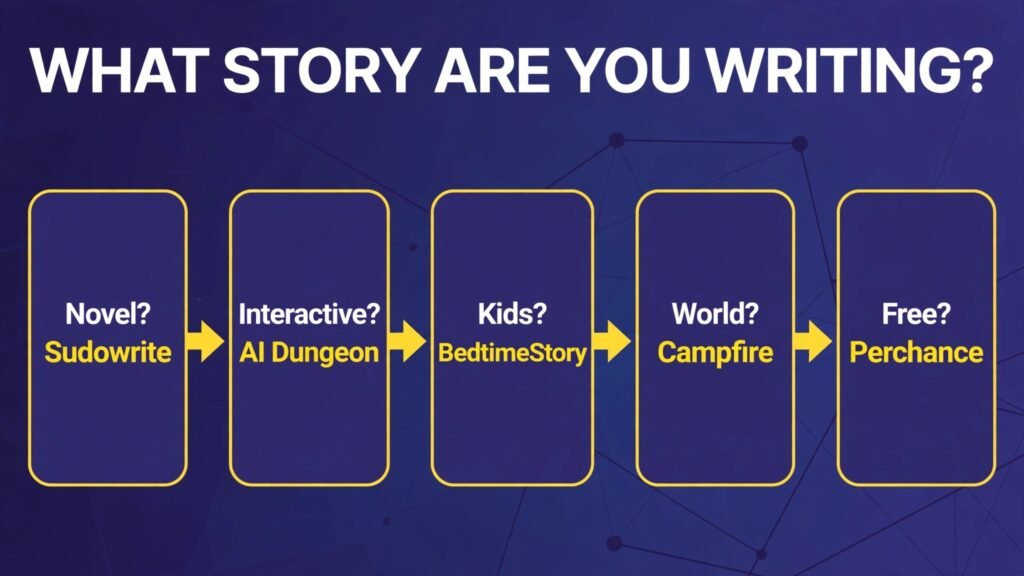
How to choose: match the tool to the story
The fastest way to pick is to start from the story, not the ranking.
- Finishing a novel: Sudowrite first, Novelcrafter if you plan series and lore.
- Genre fiction with fewer filters: NovelAI, for the Lorebook and privacy.
- First book, gentle start: Squibler, with its free tier and full-draft workflow.
- Interactive and game stories: AI Dungeon for play, Talefy for branching structure.
- A story for a child tonight: BedtimeStory.ai, with a human read-through first.
- A world before the prose: Campfire for planning, paired with a prose tool for drafting.
- Ideas and editing only: ChatGPT for brainstorming, Claude for revision passes.
- Zero budget: Perchance for free play, Squibler’s free tier for a real manuscript.
One more practical point. Most writers do not need two paid fiction tools. Pick one workspace for the manuscript and use a general assistant for brainstorming and editing. The exception is series writers: pairing Novelcrafter’s Codex with Claude’s prose editing is a combination many working authors keep, because neither does the other’s job well.
Before you publish: Prices in this guide are October 2026 roundup figures, and they move. Sudowrite’s monthly-billed tiers, Squibler’s free-tier numbers, and the BYOK arithmetic on Novelcrafter all differ across sources, so open the vendor pricing page and confirm the figure on the checkout screen before subscribing. And before you publish anything, read the copyright note at the top of this guide again: your revisions are what make the work yours.
Frequently Asked Questions
What is the best AI story generator overall?
Sudowrite, for most fiction writers. It is the strongest all-round fiction workspace, with a Story Bible, scene tools, and a model tuned for fiction. If your priority is prose quality alone, Claude is the better editor, and if your priority is worldbuilding across a series, Novelcrafter is the better planner.
Is there a completely free AI story generator?
Yes. Perchance generates unlimited stories with no account at all. Squibler’s free tier, with 1,000 credits a month, is the best free route to an actual manuscript, and NovelAI’s free Paper tier gives you 50 generations to test its style.
Can AI write a whole novel for me?
It can produce a full draft, and Squibler is built to do exactly that. The honest question is whether that draft is publishable, and the answer is usually no without heavy revision. Readers, editors and the copyright rules all reward the same thing: your judgment on every page. Use the tool to get unstuck and to draft fast, then revise like it matters, because it does.
Do I own the stories an AI generator writes?
Under current standard terms, the output usually belongs to you as the user, and Squibler states this explicitly. But ownership is not the same as copyright protection: in the United States, a story written entirely by a machine is not protected, while a story you substantially wrote and revised is on firmer ground. Keep your outlines, drafts and revision history as evidence of your authorship.
Do I have to disclose AI use when publishing?
On Amazon Kindle Direct Publishing, yes, you must declare AI-generated content. Other platforms have their own rules, and they are changing, so check the platform you publish on before uploading. Disclosure is not a punishment; it is a label, and readers increasingly expect it.
Which story generator is best for children’s stories?
BedtimeStory.ai, because it is built for short personalised stories for children. Read every story before reading it aloud, and keep the personal details you feed it minimal, since children’s data deserves extra care.
Which tool is best for screenplays?
Squibler, among the tools here, because it has dedicated screenplay templates and automatic formatting. Novelcrafter does not handle screenplays, and the general assistants can advise on format but will not manage a script workspace for you. For the wider creator workflow, our best-ai-tools-for-youtubers guide covers video and script tools around it.
Should I cancel my general AI subscription for a fiction tool?
Not necessarily. Most working writers keep one general assistant for brainstorming and editing and one fiction workspace for the manuscript. If you only write occasionally, a general assistant plus Perchance or Squibler’s free tier may be all you need. Pay for a fiction tool when you are drafting regularly and the free limits actually bite.
Conclusion
So here is the challenge, not a summary. Tonight, open Perchance or Squibler’s free tier, and write the first scene of the story you keep postponing. Give the thief a name, give her a reason to open the gate, and let the tool hand you three versions of what happens next. Pick the one that surprises you, rewrite it in your own voice, and keep going tomorrow.
That is how these tools earn their place. Not by writing the novel for you, but by getting you past chapter two, page four, where every good story either dies or begins. The best AI story generator is the one that gets you to chapter three, and then gets out of your way.
If you want the wider picture, our best-free-ai-writing-tools guide covers free writing help beyond fiction, and our how-to-write-a-blog-post-with-ai guide covers the non-fiction side of AI writing. For marketing copy around a finished book, the jasper-vs-copyai-vs-writesonic comparison covers the tools built for that job.