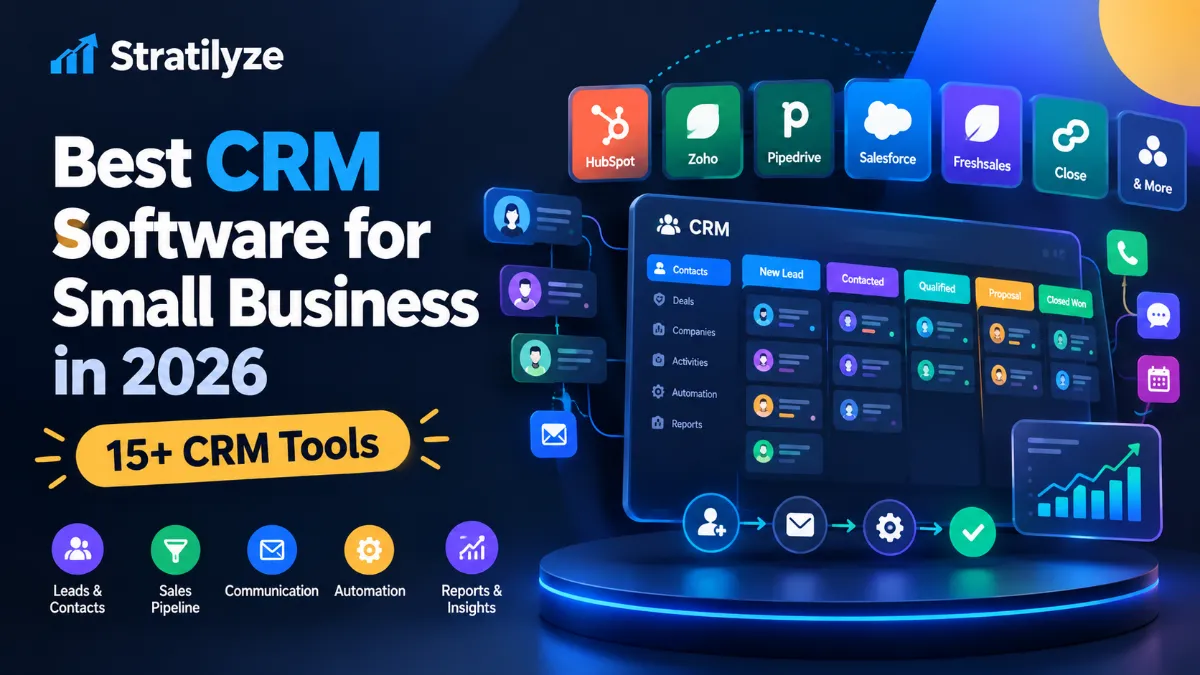
Choosing the right CRM can make a big difference for a small business. A good CRM keeps customer details, leads, sales opportunities, follow-ups and communication in one place, so your team does not have to rely on scattered spreadsheets, inboxes and notes.
The challenge is that there are now dozens of CRM platforms aimed at small businesses. Some focus on sales pipelines, while others combine CRM with marketing automation, customer service, email, calling or broader business management.
This guide compares 16 of the best CRM software for small business in 2026, including HubSpot, Zoho CRM, Pipedrive, Freshsales, Salesforce, Close, Bigin, Insightly, Copper and more.
The goal is not simply to list popular CRM tools. Instead, this guide looks at who each CRM is best for, what it does well, where it may not fit, pricing considerations and which type of small business should consider it.
Quick Picks
If you want to narrow the list quickly, these are some of the strongest options to consider:
| CRM | Best For | Free Option | Starting Paid Price* |
|---|---|---|---|
| HubSpot CRM | Best overall for many small businesses | Yes | From $7/seat/month for current Starter offer |
| Zoho CRM | Value and customization | Yes | From $14/user/month |
| Pipedrive | Sales pipeline management | Trial | From $14/user/month annually |
| Freshsales | Affordable sales CRM with AI | Yes, up to 3 users | From $9/user/month annually |
| Salesforce | Growing businesses needing a broad CRM | Free option/trial availability | From $25/user/month |
| Bigin | Very small businesses and startups | Yes | From $7/user/month annually |
| Close | Sales teams using calls and email | Trial | From $9/user/month annually |
| Less Annoying CRM | Simple small-business CRM | 30-day trial | $15/user/month |
| Insightly | CRM plus project management | Trial | From $29/user/month annually |
| Copper | Google Workspace users | Trial | From $23/user/month annually |
| Nimble | Relationship-focused selling | Trial | From $24.90/user/month annually |
| EngageBay | CRM plus marketing automation | Yes | From $11.04/user/month |
| Streak | CRM inside Gmail | Limited/free tools | From $49/user/month |
| Keap | Marketing and sales automation | Trial | From $299/month |
| Zoho Bigin | Lightweight pipeline management | Yes | From $7/user/month annually |
| HubSpot Sales CRM | Sales and customer management | Yes | Depends on features |
*Pricing and plan availability can change. Prices shown here are current examples from official pricing pages checked for this guide. Some providers offer different prices depending on billing cycle, region, contacts, seats or promotional offers.
What Is CRM Software for Small Business?
CRM stands for Customer Relationship Management.
CRM software helps a business organize information about prospects and customers and track what happens throughout the sales process.
Instead of keeping customer information in separate spreadsheets, email inboxes and notebooks, a CRM can bring information together in a central system.
Typical CRM features include:
- Contact management
- Lead management
- Sales pipelines
- Deal tracking
- Follow-up reminders
- Email integration
- Task management
- Sales reporting
- Customer communication history
- Workflow automation
- Lead scoring
- Marketing integration
- Mobile apps
- Team collaboration
For a small business, the biggest advantage is often organization.
A CRM can help answer simple but important questions such as:
- Who are our current leads?
- Which prospects need a follow-up?
- What deals are likely to close?
- Which salesperson owns each opportunity?
- When did we last contact a customer?
- Which customers have not purchased recently?
The Best CRM Software for Small Business in 2026
1. HubSpot CRM – Best Overall for Many Small Businesses
HubSpot CRM is one of the strongest starting points for a small business because it combines CRM functionality with marketing, sales and customer service tools.
HubSpot currently offers free foundational tools, with the free tier available for up to two users. Its current Customer Platform Starter offer starts at $7 per seat per month, although the standard displayed price is higher and promotional terms can apply.
Why consider HubSpot?
- Contact and company management
- Deal pipelines
- Sales tools
- Marketing features
- Customer service tools
- Reporting
- Integrations
- AI-powered features
- Free entry-level tools
Best for
HubSpot is particularly attractive to small businesses that want to start with a CRM and potentially add marketing, sales and customer service functionality later.
Potential downside
The platform becomes more complex as you move into advanced products and paid tiers. Businesses should check exactly which features and limits are included before upgrading.
Best for: Small businesses wanting an all-in-one CRM ecosystem.
2. Zoho CRM – Best Value and Flexibility
Zoho CRM is a strong choice for businesses that want a capable CRM without immediately moving into expensive enterprise software.
Zoho’s current pricing calculator lists Standard at $14/user/month, Professional at $23, Enterprise at $40 and Ultimate at $52.
Key features
- Lead management
- Contact management
- Sales pipelines
- Workflow automation
- Reports
- Analytics
- Customization
- AI capabilities
- Integrations
- Mobile access
Best for
Zoho CRM works particularly well for small businesses that want more customization as they grow.
Its wider ecosystem is another advantage. Businesses already using other Zoho products may find it easier to build a connected software stack.
Best for: Small businesses looking for value and customization.
3. Pipedrive – Best for Sales Pipeline Management
Pipedrive CRM takes a sales-first approach.
Its interface is built around visual pipelines, helping sales teams see where deals are in the process and what actions need to happen next.
Pipedrive’s current Lite plan is $14 per seat per month when billed annually. Growth is $39, Premium is $59 and Ultimate is $79 per seat per month under annual billing.
What stands out
- Visual sales pipelines
- Lead management
- Deal tracking
- Follow-up management
- Email integration
- Sales reporting
- Automation
- Meeting scheduling
- AI features
- More than 500 integrations
Pipedrive specifically positions its platform for small businesses that need to keep customer details, activities and deals connected.
Best for
If your main goal is to improve the sales process rather than manage every area of your business from one platform, Pipedrive is worth considering.
Best for: Sales-focused small businesses and sales teams.
4. Freshsales – Best Affordable Sales CRM
Freshsales is Freshworks’ sales-focused CRM.
Freshsales currently offers a free plan for up to three users. Its Growth plan is $9/user/month when billed annually, followed by Pro at $39 and Enterprise at $59.
Features include
- Contact management
- Account management
- Sales pipelines
- Phone
- Chat
- Custom fields
- Reports
- Sales dashboards
- AI features
- Workflow tools
Freshsales can be appealing to small businesses that want sales communication and CRM features without immediately paying for a high-end platform.
Best for: Startups and small sales teams looking for an affordable CRM.
5. Salesforce – Best for Growing Businesses
Salesforce Small Business CRM is one of the most established CRM platforms available.
Salesforce can be much more powerful than what a very small business initially needs, but that breadth becomes useful when a company needs deeper customization, automation, reporting and integrations.
The current Salesforce Small Business pricing page lists Starter Suite at $25/user/month and Pro Suite at $100/user/month, with the latter billed annually.
Salesforce can provide
- Lead management
- Opportunity management
- Sales forecasting
- Reports and dashboards
- Marketing tools
- Customer service
- Automation
- Custom fields
- Custom apps and objects
- AppExchange integrations
- AI capabilities
Best for
Salesforce makes more sense when your business expects its CRM requirements to become more sophisticated.
Best for: Growing small businesses that need a highly expandable CRM platform.
6. Bigin by Zoho – Best Lightweight CRM
Bigin CRM is designed as a simpler CRM option within the Zoho ecosystem.
The current pricing page lists a free plan, Express at $7/user/month annually, Premier at $12 and Bigin 360 at $18.
Bigin focuses heavily on pipelines, contacts, activities and straightforward sales workflows.
Why small businesses may like it
- Simple interface
- Pipeline management
- Contact management
- Activity tracking
- Automation
- Built-in phone features
- Dashboards
- Zoho ecosystem integration
Best for
Bigin is especially interesting for freelancers, small sales teams and businesses that find full CRM platforms unnecessarily complicated.
Best for: Small teams that want a simpler CRM than traditional enterprise platforms.
7. Close – Best CRM for Sales Communication
Close CRM is built around sales communication.
It combines CRM functionality with calling, email, SMS, sales workflows and AI features.
Current annual pricing starts at $9/user/month for Solo and $35/user/month for Essentials. Growth is $99 and Scale is $139/user/month when billed annually.
Key strengths
- Calling
- SMS
- Lead management
- Sales pipelines
- Workflows
- Reporting
- AI sales features
- Mobile access
This makes Close especially interesting for businesses where sales representatives spend much of their day contacting prospects.
Best for: Outbound sales teams and businesses heavily dependent on calls and email.
8. Insightly – Best CRM With Project Management
Insightly CRM combines CRM functionality with project management.
Its current CRM pricing lists Plus at $29/user/month, Professional at $49 and Enterprise at $99 when billed annually.
Useful features
- Lead management
- Contact management
- Project management
- Reports
- Dashboards
- Workflow automation
- Lead assignment
- AI Copilot
- Customization
Best for
This can work well for businesses that do not want customer management and project delivery to live in completely separate systems.
Best for: Service businesses, agencies and teams managing customer projects.
9. Copper CRM – Best for Google Workspace Users
Copper CRM is designed around Google Workspace users.
The platform focuses on CRM, pipelines and customer relationships while fitting naturally into Google-based workflows.
Current annual pricing starts at $23/user/month for Basic, $59 for Professional and $99 for Business.
Highlights
- Contact management
- Sales pipelines
- Task automation
- Project management
- Contact enrichment
- Workflow automation
- Reporting
- Integrations
- Bulk email on higher plans
Best for
If your business already relies heavily on Gmail, Google Calendar and other Google Workspace tools, Copper deserves consideration.
Best for: Google Workspace-focused businesses.
10. Less Annoying CRM – Best Simple CRM
Less Annoying CRM takes a deliberately simple approach to CRM pricing.
The company currently charges $15 per user per month, with no tiers or long-term contracts. It also provides a 30-day free trial.
What you get
- Unlimited contacts
- Unlimited pipelines
- Task management
- Email logging
- Mobile access
- User permissions
- Customer support
- 25GB file storage per user
Best for
Not every small business needs dozens of dashboards and automation features.
If your main requirements are contact organization, pipeline tracking and follow-ups, Less Annoying CRM can be a refreshing alternative.
Best for: Small businesses that value simplicity.
11. Nimble – Best for Relationship-Based Selling
Nimble CRM focuses heavily on relationship management and contact enrichment.
Its current pricing is $24.90 per seat per month when billed annually or $29.90 monthly.
Key features
- Contact management
- Email integration
- Microsoft 365 integration
- Google Workspace integration
- Contact enrichment
- AI-powered email tools
- Sales prospecting
- Relationship tracking
Best for
Nimble can be useful for consultants, agencies, freelancers and relationship-driven sales teams.
Best for: Relationship-based selling and professional services.
12. EngageBay – Best Budget All-in-One CRM
EngageBay CRM combines CRM with marketing and sales tools.
Its current CRM & Sales Bay plans include a free option, while paid plans start around $11 per user per month depending on billing and the displayed pricing option.
Features include
- Contact management
- Deals
- Tasks
- Email tracking
- Appointment scheduling
- Live chat
- Lead scoring
- Email marketing
- Automation
- Landing pages
- Calling
- Reports
The free plan currently supports up to 15 users but has feature and contact limitations.
Best for
EngageBay can make sense when a small business wants CRM, marketing and automation without purchasing several separate applications.
Best for: Budget-conscious businesses wanting an all-in-one platform.
13. Streak – Best CRM Inside Gmail
Streak CRM takes a different approach by putting CRM functionality directly inside Gmail.
This can be useful for businesses where most customer communication already happens through email.
Current paid pricing starts at $49/user/month monthly or $59/user/month annually for Pro, with higher tiers available.
Features include
- Shared pipelines
- Email tracking
- Mail merge
- Contact management
- AI features
- Reports
- Automations
- Gmail-based workflows
Best for
Streak is worth considering if your team wants CRM functionality without moving away from Gmail.
Best for: Gmail-heavy businesses and small teams managing customers through email.
14. Keap – Best for Marketing Automation
Keap CRM goes beyond traditional contact management and focuses heavily on automation.
The current platform starts at $299/month when billed at the displayed annual amount, and implementation services are part of Keap’s onboarding approach.
Key features
- CRM
- Lead scoring
- Sales pipelines
- Email marketing
- Landing pages
- Forms
- Appointment scheduling
- Automated follow-ups
- SMS marketing
- Invoicing
- Payments
- Sales automation
Best for
Keap is more suitable for businesses that have enough sales and marketing activity to benefit from advanced automation.
It may be excessive for a freelancer who simply needs contact management.
Best for: Established small businesses that rely heavily on marketing and sales automation.
15. Zoho CRM – Best for Businesses That Want a Larger Business Software Ecosystem
Zoho CRM deserves another look from a different angle because the CRM is part of a much wider business software ecosystem.
Businesses can connect CRM processes with other tools for:
- Accounting
- Marketing
- Analytics
- Customer support
- Forms
- Projects
- Automation
That can reduce the need to connect a large number of unrelated vendors.
The current Zoho CRM pricing structure ranges from Standard through Ultimate, with the official calculator showing $14, $23, $40 and $52 per user per month respectively.
Best for: Small businesses planning to build a broader business software stack.
16. Pipedrive – Best for Businesses That Put Sales First
Pipedrive also deserves a place on the shortlist for businesses where the CRM’s main job is to make sales activity more organized.
Its current plans include pipeline management, reporting, integrations, email synchronization, automation and AI capabilities depending on the plan.
One of its biggest advantages is that the platform is designed around the sales process rather than trying to become every type of business software.
Best for: Businesses with a straightforward sales process and a sales-driven team.
CRM Software Comparison by Business Need
There is no single CRM that is best for every small business.
Your priorities matter more than the number of features a platform offers.
| Business Need | Recommended CRM |
|---|---|
| Best overall starting point | HubSpot |
| Best value | Zoho CRM |
| Best sales pipeline | Pipedrive |
| Best affordable sales CRM | Freshsales |
| Best for growth and customization | Salesforce |
| Best simple CRM | Less Annoying CRM |
| Best Gmail CRM | Streak |
| Best Google Workspace CRM | Copper |
| Best relationship management | Nimble |
| Best sales calling CRM | Close |
| Best CRM + projects | Insightly |
| Best lightweight Zoho CRM | Bigin |
| Best budget all-in-one | EngageBay |
| Best marketing automation | Keap |
Best Free CRM Software for Small Business
If your business is just starting, paying for CRM software immediately may not be necessary.
Several platforms offer free plans or free entry points.
HubSpot
HubSpot’s free tools provide a strong starting point for small businesses that want CRM functionality without an immediate subscription. The current free tier is available for up to two users.
Freshsales
Freshsales currently offers a free plan for up to three users.
EngageBay
EngageBay currently offers a free plan with CRM functionality and a larger user allowance, although contacts and features are limited.
Bigin
Bigin has a free plan designed around a simple pipeline and basic CRM functionality.
Zoho CRM
Zoho also has a free option, making it another platform worth checking before paying for a CRM.
The important point is that free CRM does not automatically mean unlimited CRM. Always check contact limits, user limits, automation limits, integrations and reporting features before migrating your customer database.
CRM Software for Different Types of Small Businesses
CRM for Freelancers
A freelancer usually does not need an enterprise CRM.
Look for:
- Contact management
- Simple pipelines
- Follow-up reminders
- Email integration
- Calendar
- Notes
Good options: Less Annoying CRM, Bigin, HubSpot and Nimble.
CRM for Small Sales Teams
Sales teams typically need stronger pipeline management and activity tracking.
Look for:
- Lead assignment
- Deal stages
- Sales activities
- Email tracking
- Forecasting
- Automation
- Reporting
Good options: Pipedrive, Freshsales, Close and HubSpot.
CRM for Agencies
Agencies often need to manage both sales opportunities and existing clients.
Useful features include:
- Client records
- Sales pipelines
- Project management
- Tasks
- Communication history
- Reporting
Good options: HubSpot, Insightly, Zoho CRM and Copper.
You may also want to combine your CRM with dedicated project management software. Our guide to Best Project Management Software can help if project delivery is an important part of your workflow.
CRM for Ecommerce Businesses
An ecommerce company may need more than a traditional sales CRM.
Consider whether your CRM supports:
- Customer segmentation
- Marketing automation
- Email campaigns
- Purchase history
- Customer support
- Ecommerce integrations
- Lead and customer analytics
Good options: HubSpot, Zoho CRM, Salesforce and Keap, depending on business size and complexity.
What Features Should a Small Business CRM Have?
You do not need every CRM feature available.
Start with the features that solve your actual business problems.
1. Contact Management
This is the foundation of a CRM.
You should be able to store customer information such as:
- Name
- Phone
- Company
- Job title
- Notes
- Communication history
- Custom fields
2. Sales Pipeline
A pipeline lets you see where prospects are in the sales process.
For example:
New Lead → Contacted → Qualified → Proposal → Negotiation → Won
A good pipeline should make it easy to move deals between stages.
3. Follow-Up Management
A CRM becomes much more useful when it helps you remember what needs to happen next.
Look for:
- Tasks
- Reminders
- Scheduled emails
- Follow-up notifications
- Activity tracking
4. Email Integration
If your sales team spends most of its day in email, CRM email integration can save a lot of manual work.
Some CRMs can automatically associate emails with contacts or deals.
5. Automation
Automation becomes increasingly useful as your customer base grows.
For example:
New lead submitted → Create contact → Assign salesperson → Send confirmation → Create follow-up task
This can reduce repetitive administrative work.
6. Reporting
A CRM should help you understand your sales process.
Useful reports can include:
- Open deals
- Won deals
- Lost deals
- Sales activity
- Revenue forecasts
- Conversion rates
- Pipeline value
7. Integrations
Your CRM should work with the other software you already use.
Common integrations include:
- Gmail
- Outlook
- Google Calendar
- Microsoft 365
- Slack
- Accounting software
- Marketing platforms
- Scheduling apps
- Zapier
- Ecommerce platforms
If your business already uses several tools, integration quality can be more important than having the longest feature list.
For example, if your CRM needs to work alongside scheduling and communication tools, you may also want to compare our guides to Best Scheduling Apps and Best Team Communication Software.
How Much Does CRM Software Cost?
CRM pricing varies significantly.
Some small businesses can operate on a free plan, while more advanced CRM systems can cost hundreds or thousands of dollars per month.
Current examples show the range clearly:
- HubSpot has free tools and paid options starting from its current promotional Starter offer.
- Freshsales has a free plan and paid plans starting at $9/user/month annually.
- Pipedrive starts at $14/user/month annually.
- Zoho CRM Standard currently starts at $14/user/month.
- Less Annoying CRM costs $15/user/month.
- Salesforce Starter Suite starts at $25/user/month.
- Keap starts at $299/month under its current displayed pricing.
But subscription price is not the only cost.
Also consider:
- Number of users
- Contact limits
- Marketing contacts
- Automation usage
- AI credits
- Phone or SMS usage
- Integrations
- Data migration
- Implementation
- Training
- Premium support
A $10 CRM can become more expensive than expected if important features require several add-ons.
How to Choose the Best CRM for Your Small Business
Instead of choosing the CRM with the longest feature list, start with your workflow.
Step 1 – Define the problem
Ask what is currently going wrong.
Are you losing track of leads?
Missing follow-ups?
Keeping customer data in spreadsheets?
Unable to see your sales pipeline?
Sending repetitive emails manually?
Your answer should influence your CRM choice.
Step 2 – Count your users
A CRM for one person is very different from a CRM for 15 salespeople.
Calculate your actual number of users before comparing prices.
Step 3 – Map your sales process
Write down your current process.
For example:
Lead → Qualification → Meeting → Proposal → Negotiation → Customer
Then check whether the CRM can reproduce this workflow without unnecessary complexity.
Step 4 – Check integrations
Make a list of the software you already use.
If your company uses Google Workspace, accounting software, scheduling tools and marketing software, check whether your preferred CRM integrates with them.
Step 5 – Test before buying
Most serious CRM providers offer trials or free plans.
Use the trial with a realistic workflow instead of simply clicking through the dashboard.
Try:
- Importing contacts
- Creating a pipeline
- Adding a deal
- Scheduling a follow-up
- Connecting email
- Creating a report
- Testing automation
- Checking the mobile experience
Step 6 – Calculate the total cost
Do not look only at the advertised starting price.
Calculate:
Users × monthly price + add-ons + usage fees + required services
This gives you a more realistic estimate.
CRM vs Spreadsheet for Small Business
A spreadsheet can work surprisingly well for a very small business.
If you have a handful of customers and a simple sales process, you may not need a full CRM yet.
However, spreadsheets become harder to manage when you need:
- Multiple salespeople
- Follow-up reminders
- Communication history
- Automated workflows
- Lead assignment
- Deal pipelines
- Sales reports
- Customer segmentation
A CRM becomes more valuable as the number of customer interactions increases.
If you are still deciding whether your business needs a spreadsheet or a dedicated platform, our guide to Best Spreadsheet Software for Small Business may also be useful.
CRM and Accounting Software Should Work Together
Your CRM manages relationships and sales activity, while accounting software handles financial records.
You may eventually want both.
For example:
CRM: Lead → Opportunity → Customer
Accounting: Invoice → Payment → Revenue
Connecting these systems can reduce duplicate data entry.
If you’re building a broader small-business software stack, see our guide to Best Accounting Software for Small Business.
CRM Software Mistakes Small Businesses Should Avoid
Choosing a CRM because it has the most features
More features do not automatically mean better software.
A complicated CRM that your team refuses to use is worse than a simple CRM everyone understands.
Ignoring the user experience
If entering a new lead takes too many steps, your database may become outdated quickly.
Buying too early
A solo business with 50 contacts may not need an expensive enterprise CRM.
Start with the problem you actually need to solve.
Ignoring migration
Before changing CRMs, understand how you will move:
- Contacts
- Companies
- Deals
- Notes
- Activities
- Custom fields
- Historical communication
Not checking pricing limits
Some platforms limit contacts, automation, reports, AI usage or integrations based on the plan.
Always check the current pricing page before purchasing.
Which CRM Should You Choose?
There is no universal winner.
For many small businesses, HubSpot is an excellent starting point because of its free CRM tools and broader customer platform.
If price and customization are major priorities, Zoho CRM is one of the strongest alternatives.
For sales teams that want a focused pipeline experience, Pipedrive is a natural choice.
If you want an affordable sales CRM with a free entry point, Freshsales is worth looking at.
If your business is likely to become more complex, Salesforce offers significantly more room for customization and expansion.
For a very small team that wants simplicity, Bigin or Less Annoying CRM may be a better fit than a large enterprise platform.
And if your business lives inside Gmail or Google Workspace, Streak or Copper can make more sense than moving your workflow into a completely separate environment.
The best CRM is ultimately the one your team will actually use consistently.
A smaller CRM with clean data, regular follow-ups and a clear sales process will usually be more useful than an expensive platform filled with features nobody uses.
Frequently Asked Questions
What is the best CRM software for small business in 2026?
HubSpot is one of the strongest overall starting points for many small businesses. Zoho CRM, Pipedrive, Freshsales and Salesforce are also strong options depending on budget, sales process and growth plans.
What is the best free CRM for small business?
HubSpot, Freshsales, Bigin, Zoho CRM and EngageBay all provide free CRM options or free entry-level plans, although their limits differ.
Is HubSpot really free?
Yes. HubSpot currently offers free foundational tools, with its free option available for up to two users. Paid features and additional products have separate pricing.
Is Zoho CRM good for a small business?
Yes. Zoho CRM is particularly attractive for businesses that want customization, automation and a wider business software ecosystem without immediately choosing a high-cost enterprise CRM.
Is Pipedrive good for small businesses?
Pipedrive is particularly useful for businesses where sales pipeline management is the main CRM requirement. Its plans focus heavily on leads, deals, follow-ups, automation and sales activity.
How much does CRM software cost?
CRM software can cost anywhere from free to hundreds of dollars per month depending on users, features, contacts, automation and additional services. Small businesses can often start with free or low-cost plans and upgrade as requirements grow.
Should a small business use a CRM or Excel?
Excel or Google Sheets can be enough for a very small customer list and simple workflow. A CRM becomes more useful when you need pipelines, reminders, communication history, automation, multiple users and sales reporting.
Can CRM software replace accounting software?
Usually no. CRM software and accounting software serve different purposes. CRM handles customer relationships and sales activity, while accounting software manages financial records, invoices and payments.
Do small businesses really need CRM software?
Not every small business needs a CRM immediately. But once customer information, sales opportunities and follow-ups become difficult to manage manually, a CRM can save time and improve organization.
What is the easiest CRM for a small business?
Less Annoying CRM, Bigin and HubSpot can be good starting points for businesses that want relatively straightforward CRM workflows. The easiest option depends on how complex your sales process is.
Final Verdict
The best CRM software for small business in 2026 depends on what you need the CRM to accomplish.
HubSpot is a strong overall choice for businesses wanting a broad platform with a free starting point.
Zoho CRM is excellent for flexibility and value.
Pipedrive is a strong sales pipeline choice.
Freshsales offers an attractive combination of affordability and sales features.
Salesforce makes more sense for businesses expecting more complex CRM requirements.
Bigin and Less Annoying CRM are worth considering if simplicity matters more than having every advanced feature.
The smartest approach is to avoid choosing based only on popularity or feature count. Define your sales process, calculate the real cost, test a few options and choose the CRM that fits the way your business actually works.
A CRM should make customer management simpler, not more complicated.
If you’re building a complete small-business software stack, these guides may also help: