AI image generators have changed dramatically in 2026. What used to require detailed prompts, design software and multiple editing steps can now often be done with a short description and a few revisions.
But choosing the best AI image generator is not as simple as picking the tool that produces the most impressive demo image.
Different tools are better at different things. Some are excellent for photorealistic images, while others are better for text inside images, product visuals, illustrations, branding, editing existing photos or creating consistent characters.
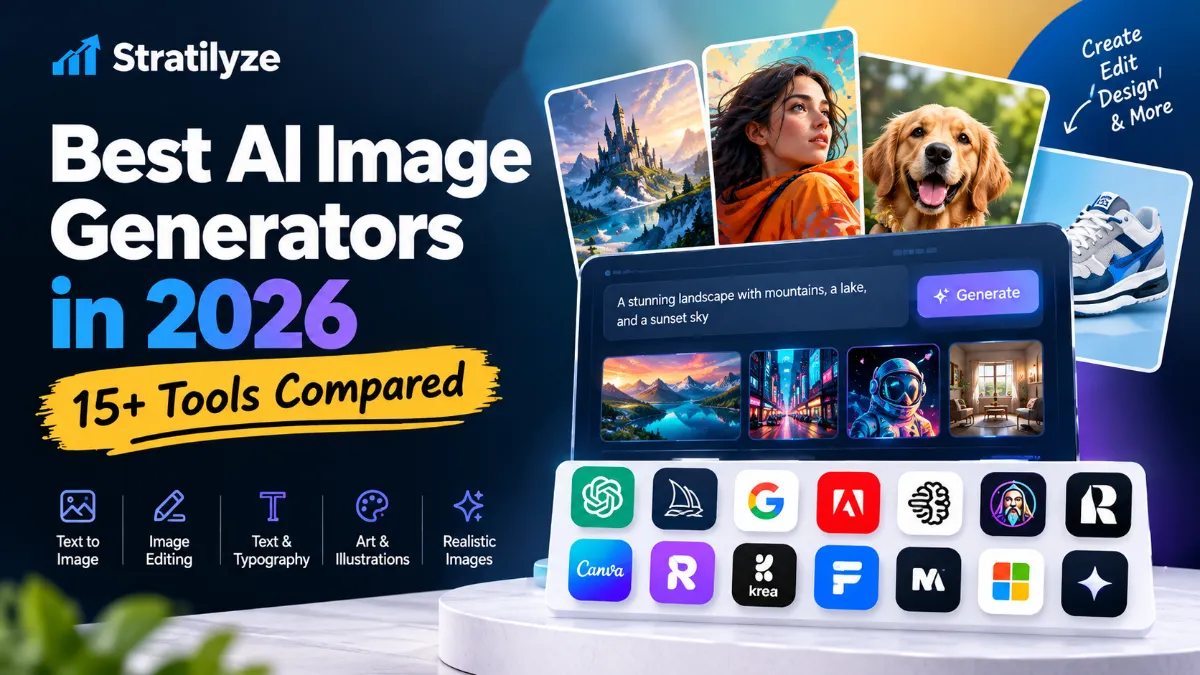
This guide compares 16 of the best AI image generators in 2026, including ChatGPT Images, Midjourney, Google Gemini, Adobe Firefly, Ideogram, Leonardo AI, Recraft, Krea, Freepik, Canva, Runway, FLUX.2 and more.
The goal is to help you choose the right tool for your actual workflow rather than simply ranking tools by popularity.
Quick Comparison of the Best AI Image Generators
| AI Image Generator | Best For | Free Option | Main Strength |
|---|---|---|---|
| ChatGPT Images | Overall image creation and editing | Yes | Prompt following and editing |
| Midjourney | Artistic and cinematic images | No permanent free plan | Visual quality and style |
| Google Gemini | Images with editing and text | Yes, with limits | Editing, references and text |
| Adobe Firefly | Commercial creative workflows | Yes | Adobe ecosystem |
| Ideogram | Text and typography | Yes | Text rendering |
| Leonardo AI | Creators and game assets | Yes | Models, presets and customization |
| Recraft | Design, vectors and branding | Yes | Vector and design workflows |
| Krea | Real-time generation and upscaling | Yes | Fast creative iteration |
| Freepik AI | Multiple AI models in one platform | Yes/limited | Large creative toolkit |
| Canva AI | Social media and marketing designs | Yes | AI + design editor |
| Runway | Creative image and video workflows | Limited | Image and video creation |
| Stable Image | Developers and advanced control | API credits | Generation, editing and control |
| Microsoft Designer | Beginners and quick graphics | Yes | Simple AI-powered design |
| NightCafe | Experimenting with many models | Yes | Large model library |
| FLUX.2 | Photorealism and production assets | Playground/API options | Control and consistency |
| Imagen in Gemini | High-quality generated imagery | Through Gemini | Detail and realism |
Note: AI image pricing, model names, usage limits and availability change frequently. The pricing examples below reflect official pages checked for this guide and should be verified again before purchasing.
What Is an AI Image Generator?
An AI image generator is software that uses artificial intelligence to create or modify images from instructions.
You might type:
“A modern home office overlooking the New York skyline at sunset, realistic photography, warm natural lighting.”
The AI interprets the description and generates an image based on the prompt.
Modern image generators can do much more than simple text-to-image generation. Depending on the platform, you may be able to:
- Generate images from text
- Edit existing images
- Remove objects
- Replace backgrounds
- Combine reference images
- Maintain character consistency
- Create product photography
- Generate illustrations
- Create logos and graphics
- Generate posters
- Add readable text
- Upscale images
- Create variations
- Expand an image beyond its original frame
- Generate images in different aspect ratios
This means the best AI image generator depends heavily on what you are trying to create.
The Best AI Image Generators in 2026
1. ChatGPT Images – Best Overall AI Image Generator
ChatGPT Images is one of the most versatile options for people who want to create and refine images through natural language.
OpenAI’s current ChatGPT Images system can generate new images, edit existing images, add text, change details and work from uploaded references. OpenAI’s September 2026 release notes also describe improvements in image detail, editing precision and generation speed with ChatGPT Images 2.5.
You can simply describe what you want and then continue refining it conversationally.
For example:
“Create a modern SaaS dashboard illustration for a technology blog.”
Then:
“Make the dashboard wider, move the laptop to the right and leave more empty space on the left for a headline.”
That conversational editing workflow is one of its biggest advantages.
Best features
- Text-to-image generation
- Image editing
- Reference images
- Natural-language revisions
- Text inside images
- Transparent backgrounds
- Different compositions and sizes
- Fast iteration
Best for
- Bloggers
- Marketers
- Content creators
- Social media graphics
- Illustrations
- Product concepts
- Blog thumbnails
- General-purpose image creation
Potential downside
People who want highly specialized artistic control may prefer a dedicated platform such as Midjourney or FLUX.
Best for: Most users who want one flexible AI image tool.
2. Midjourney – Best for Artistic and Cinematic Images
Midjourney remains one of the most recognizable names in AI image generation.
It is particularly strong when the goal is a visually striking image rather than a simple business illustration.
Midjourney’s current plans are Basic at $10/month, Standard at $30, Pro at $60 and Mega at $120. Annual billing provides a 20% discount. Standard, Pro and Mega include unlimited image generations in Relax Mode, while Stealth Mode is available on Pro and Mega.
Why Midjourney stands out
Midjourney is particularly attractive for:
- Concept art
- Cinematic scenes
- Fantasy artwork
- Character concepts
- Editorial imagery
- Fashion visuals
- Architecture
- Creative advertising
- Artistic photography
Its visual style can be a major advantage when you want something that feels deliberately designed rather than generic.
Best for
Artists, designers, creative professionals and users who prioritize visual style.
Potential downside
Midjourney is not necessarily the easiest choice if your primary requirement is business graphics with precise layouts and editable text.
Best for: High-impact artistic and cinematic imagery.
3. Google Gemini – Best for AI Image Editing and Context
Google Gemini has become a serious image-generation option through Google’s Nano Banana image models.
Google’s current Gemini image-generation tools support generation and editing, including character consistency, local edits, multiple reference images and improved text rendering. Gemini’s current Nano Banana 2 can generate images at high resolution, while paid Google AI plans provide access to Nano Banana Pro for more advanced generation and editing.
One particularly useful feature is the ability to combine reference images.
For example, you could provide:
- A product photo
- A background reference
- A style reference
and ask Gemini to combine them into a new composition.
Best features
- Image generation
- Image editing
- Reference images
- Character consistency
- Text rendering
- Local edits
- Image combinations
- High-resolution output
Best for
- Product concepts
- Social media graphics
- Image editing
- Marketing visuals
- Infographics
- Creative experimentation
Best for: Users who want strong generation plus conversational image editing.
4. Adobe Firefly – Best for Creative Professionals
Adobe Firefly is designed to fit into a broader professional creative workflow.
Instead of being only an image generator, Firefly provides tools for generating and editing images, video and audio.
Adobe currently offers a free Firefly plan with limited daily generations. Firefly Standard is listed at $9.99/month with 2,000 generative credits, while Firefly Pro is $19.99/month with 4,000 credits. Adobe also offers higher tiers for heavier creative workloads.
Why Firefly is different
Its biggest advantage is its connection to Adobe’s creative ecosystem.
This can be useful if your workflow already involves:
- Photoshop
- Illustrator
- Adobe Express
- Creative Cloud
- Professional marketing assets
Best for
- Designers
- Marketing teams
- Creative agencies
- Brand content
- Image editing
- Commercial creative workflows
Potential downside
If you simply want to generate occasional AI artwork, Firefly’s broader ecosystem may be more than you need.
Best for: Professional creative workflows and Adobe users.
5. Ideogram – Best AI Image Generator for Text
If your images need readable text, Ideogram deserves serious attention.
This is one of the areas where Ideogram has built a strong reputation. Its current Ideogram 4.0 platform emphasizes typography, design and commercial image generation.
Current personal plans include a free tier, Plus at $20/month or $15/month when billed annually, and Pro at $60/month or $42/month annually. The Plus plan includes 1,000 priority credits per month, while Pro includes 3,500.
Where Ideogram works especially well
- Posters
- Logos
- Advertisements
- Social media graphics
- Typography
- Product mockups
- Marketing designs
- Headlines inside images
Best for
If you frequently need an image containing:
“50% OFF”
or
“Best AI Tools in 2026”
or a logo-like design, Ideogram is worth testing.
Best for: Images where accurate text is important.
6. Leonardo AI – Best for Creators and Custom Workflows
Leonardo AI is designed for creators who want more control over image generation, models and creative workflows.
Its current free plan provides 150 fast tokens per day. Paid individual plans currently start at $12/month for Essential, followed by Premium at $30 and Ultimate at $60/month. Higher plans add more tokens, private generations, personal AI models and other capabilities.
Features
- Image generation
- Image editing
- Personal AI models
- Presets
- Collections
- Multiple generation options
- Video generation
- Creative workflows
Best for
- Game assets
- Character design
- Concept art
- Creators
- Marketing visuals
- Content production
Potential downside
The number of options can be slightly overwhelming for someone who only wants a simple text-to-image tool.
Best for: Creators who want more control than a basic image generator provides.
7. Recraft – Best for Design and Vector Graphics
Recraft is particularly interesting for designers because it focuses on more than raster image generation.
Its current platform includes raster and vector generation, image editing, background removal, vectorization, inpainting and style creation. Recraft’s V4.1 models are designed for everyday creative workflows, while its API also supports vector outputs.
Useful capabilities
- Vector graphics
- Illustrations
- Brand visuals
- Typography
- Image editing
- Background replacement
- Vectorization
- Style creation
- Upscaling
Best for
- Logos
- Icons
- Illustrations
- Marketing designs
- Brand assets
- UI concepts
Best for: Designers who need AI-generated graphics rather than only photorealistic pictures.
8. Krea – Best for Real-Time Creative Workflows
Krea takes a slightly different approach to AI image creation.
Its platform focuses on fast creative iteration, image generation, editing, upscaling and broader creative workflows.
Krea currently offers a free plan with 100 compute units per day and access to Krea 2. Its Basic plan is $9/month, Pro is $35/month and Max is $105/month. Paid plans add commercial licensing, broader model access, upscaling and workflow capabilities.
Best features
- Real-time generation
- Image generation
- Image editing
- Upscaling
- LoRA fine-tuning
- Creative workflows
- Multiple models
Best for
- Rapid experimentation
- Creators
- Designers
- Image enhancement
- Concept development
Best for: Creators who want to experiment quickly rather than generate one image and stop.
9. Freepik AI – Best for an All-in-One Creative Platform
Freepik has evolved beyond a traditional stock-asset platform.
Its current AI offering brings multiple image, video and audio models together with stock assets, editing tools, upscaling and other creative features.
Current Freepik plans include Premium at $14.50/month when billed annually, Premium+ at $33.75/month annually and higher professional tiers. The platform currently includes access to multiple AI image models and a large stock library.
Why Freepik is useful
Instead of choosing one AI model, you can access multiple models within a broader creative environment.
This is particularly useful for marketers who need:
- Images
- Stock photography
- Graphics
- AI generation
- Editing
- Upscaling
- Design assets
Best for
Content creators, marketers, designers and agencies that need many creative resources in one place.
Canva is not purely an AI image generator, and that is actually part of its strength.
You can generate an image and immediately place it into a larger design containing:
- Headlines
- Logos
- Buttons
- Charts
- Photos
- Icons
- Brand colors
- Social media layouts
Canva currently offers a Free plan, while Pro is listed at $180/year for one person and Business at $250/year per person in the US. The paid plans include substantially larger AI allowances and broader design features.
Best for
- Blog graphics
- Social media posts
- Presentations
- Ads
- YouTube thumbnails
- Marketing materials
- Posters
Potential downside
If you only care about generating standalone artistic images, specialized image generators can offer more focused control.
Best for: People who want to generate an image and turn it into a finished design immediately.
11. Runway – Best for Image and Video Creation
Runway is strongly associated with AI video, but its current platform also includes image generation.
Its Gen-4 Image model supports text and image inputs, multiple aspect ratios and 720p or 1080p output. The current documentation lists the cost at 5 credits for a 720p image and 8 credits for a 1080p image.
Why use Runway for images?
Runway makes more sense if you expect your workflow to move from:
Image → Animation → Video
rather than stopping at a static image.
Best for
- Creative campaigns
- Concept art
- Storyboards
- Advertising
- Video production
- Image-to-video workflows
Best for: Creators who want AI image generation alongside video tools.
12. Stable Image – Best for Developers and Advanced Workflows
Stability AI’s Stable Image platform provides APIs and services for generating, editing, upscaling and controlling images.
Current Stable Image services include:
- Stable Image Ultra
- Stable Image Core
- Stable Diffusion 3.5
- Image upscaling
- Inpainting
- Background removal
- Search and replace
- Control tools
Stability AI currently uses a credit-based API system, with one credit priced at $0.01. Stable Image Ultra costs 8 credits per generation, Stable Image Core costs 3 credits, and Stable Diffusion 3.5 models have different credit requirements.
Best for
- Developers
- Custom applications
- Automated workflows
- High-volume generation
- Image editing systems
- Technical users
Best for: Businesses and developers who want to integrate image generation into their own applications.
13. Microsoft Designer – Best for Beginners
Microsoft Designer is designed to make AI-assisted visual creation accessible to non-designers.
It can generate images from text and then let you continue editing them inside the design environment.
Microsoft says Designer can create custom images, social posts, invitations, stickers and other visual designs, while its AI tools can also remove backgrounds, erase objects and enhance images.
Best for
- Beginners
- Social media graphics
- Invitations
- Simple marketing graphics
- Quick image editing
- Microsoft users
One important consideration is licensing. Microsoft currently describes the consumer Designer experience as licensed for personal, non-commercial use with a Microsoft account, so businesses should check the current terms before using it commercially.
Best for: Beginners who want simple AI-powered visual design.
14. NightCafe – Best for Experimenting With Multiple Models
NightCafe is useful for people who want to experiment with a large selection of image-generation models rather than committing to a single model.
Its current model library includes options such as GPT Image 2, Muse Image, MAI Image 2.6, Nano Banana 2, Flux and Stable Diffusion models. NightCafe’s September 2026 model guide also describes free and paid model options, with different credit requirements depending on the model and resolution.
Best for
- AI art experimentation
- Trying multiple models
- Community-based creation
- Artistic styles
- Learning AI image generation
Potential downside
The number of models can make the platform feel more complicated than a simple one-model generator.
Best for: Users who enjoy experimenting with different AI models.
15. FLUX.2 – Best for Professional Image Generation and Control
FLUX.2 from Black Forest Labs is less of a traditional consumer design app and more of a powerful image model family available through APIs, Playground and other integrations.
The current FLUX.2 family includes variants such as:
- FLUX.2 [max]
- FLUX.2 [pro]
- FLUX.2 [flex]
- FLUX.2 [klein]
The models support image generation and editing, multi-reference inputs, photorealistic output and improved text rendering. Some versions support up to 10 reference images and output up to 4 megapixels.
The [flex] model is specifically positioned for typography and small details, while [klein] focuses on fast, high-volume generation.
FLUX.2 currently uses pay-as-you-go API pricing rather than requiring a traditional subscription. Pricing varies by model and megapixel usage.
Best for
- Product photography
- Advertising
- E-commerce
- Professional creative production
- Consistent characters
- Reference-based generation
- Developers
Best for: Professional users who need strong control and production-oriented image generation.
16. Imagen – Best for Photorealistic Detail
Google’s Imagen family is another important name in the AI image-generation landscape.
Google DeepMind describes Imagen 4 as a text-to-image model focused on creativity, photorealism, fine details, diverse styles and improved text rendering. Imagen 4 can generate images at up to 2K resolution.
For everyday users, Imagen’s capabilities are increasingly exposed through Google’s Gemini products rather than requiring users to interact with the underlying model directly.
Best for
- Photorealistic images
- Detailed scenes
- Product concepts
- Illustrations
- Marketing imagery
- High-detail visual concepts
Best for: Users looking for Google’s image-generation technology through Gemini and related products.
Best AI Image Generator by Use Case
There is no reason to use the same AI image generator for every project.
Here is a more practical way to choose.
| Use Case | Best Choices |
|---|---|
| Overall image generation | ChatGPT Images |
| Artistic images | Midjourney |
| Photorealistic images | Gemini / Imagen / FLUX.2 |
| Text inside images | Ideogram / FLUX.2 |
| AI image editing | ChatGPT Images / Gemini |
| Commercial creative workflow | Adobe Firefly |
| Logos and vector graphics | Recraft |
| Social media graphics | Canva |
| Fast experimentation | Krea |
| Game and concept art | Leonardo AI |
| Multiple AI models | Freepik / NightCafe |
| Image + video workflow | Runway |
| Developer API | Stable Image / FLUX.2 |
| Beginner-friendly design | Microsoft Designer |
| Reference-based generation | FLUX.2 / Gemini |
| Marketing graphics | Canva / Firefly / Ideogram |
Which AI Image Generator Is Best for Blog Thumbnails?
For bloggers and publishers, the best choice is not necessarily the tool that creates the most artistic image.
You usually need:
- Correct headline text
- 16:9 composition
- Strong visual hierarchy
- Space for branding
- Consistent colors
- Readable typography
- Relevant imagery
- Easy editing
For this use case, ChatGPT Images, Ideogram, Canva, Adobe Firefly and Gemini are particularly worth considering.
A practical workflow is:
Generate concept → create image → add or refine text → resize to 16:9 → compress → upload to WordPress
If you’re building an AI-focused website, you can also combine your image workflow with our guide to Best Free AI Tools in 2026 for additional tools.
Which AI Image Generator Is Best for Text?
If readable text is your priority, start with:
1. Ideogram
Strong choice for typography-heavy designs and posters.
2. FLUX.2 Flex
Designed specifically with typography and detailed text work in mind.
3. Gemini
Google’s current Nano Banana models have improved text rendering and can work with multiple references.
4. ChatGPT Images
Useful when you want to create and then revise text or layout conversationally.
For a design containing several words, however, it is still worth checking every generated image carefully. AI-generated text can occasionally contain spelling or layout errors.
Which AI Image Generator Is Best for Photorealism?
Photorealism is a more complicated category because different models excel at different types of realism.
For general photorealistic generation, consider:
- FLUX.2
- Gemini
- Imagen
- Midjourney
- Adobe Firefly
- Leonardo AI
FLUX.2 currently emphasizes photorealistic output, precise colors, spatial reasoning and multi-reference control.
Google’s Imagen 4 also focuses on photorealism, fine detail and improved clarity.
The best choice depends on whether you need artistic realism, commercial product imagery, realistic people or consistent characters.
Which AI Image Generator Is Best for Free Use?
If you don’t want to pay immediately, several tools provide free access or free credits.
Some options include:
- ChatGPT Images
- Gemini
- Adobe Firefly
- Ideogram
- Leonardo AI
- Krea
- Canva
- Microsoft Designer
- NightCafe
- Freepik with limited access
However, free does not always mean unlimited.
A free plan may limit:
- Daily generations
- Image resolution
- Priority generation
- Commercial licensing
- Editing features
- Private generations
- Model access
- Number of credits
For a broader list of free AI tools, see our Best Free AI Tools in 2026 guide.
AI Image Generator vs AI Design Tool
These terms are often used interchangeably, but they are not exactly the same.
An AI image generator primarily creates images.
Examples:
- Midjourney
- FLUX.2
- Ideogram
- Leonardo AI
An AI design platform combines image generation with layout and editing.
Examples:
- Canva
- Adobe Firefly
- Microsoft Designer
- Freepik
For a professional marketing workflow, an AI design platform can sometimes be more useful because you do not have to move the generated image into another application.
What Should You Look for in an AI Image Generator?
Before choosing a platform, consider these factors.
1. Image Quality
Look beyond a single impressive demo.
Ask whether the tool consistently produces good results across different prompts.
2. Prompt Following
A powerful generator should understand details such as:
- Number of objects
- Position
- Lighting
- Camera angle
- Style
- Colors
- Background
- Aspect ratio
3. Text Rendering
If you create advertisements, posters or thumbnails, text accuracy matters.
Ideogram and newer models from several providers have made significant improvements here.
4. Editing
Generation is only half the workflow.
Being able to say:
“Remove the person in the background.”
or
“Change the blue shirt to green.”
can save significant time.
5. Reference Images
Reference-based generation is increasingly important for:
- Products
- Characters
- Brand assets
- Consistent campaigns
- E-commerce
FLUX.2, Gemini and several other platforms now support multiple reference images.
6. Commercial Rights
Never assume that every generated image can automatically be used for every commercial purpose.
Check the provider’s current licensing and terms before using AI-generated images for:
- Products
- Advertising
- Client work
- Merchandise
- Paid campaigns
- Logos
- Commercial websites
This is particularly important because the image-generation service, underlying model and subscription plan may have different terms.
Are AI-Generated Images Copyrighted?
This is not a simple yes-or-no question.
Copyright protection can depend on:
- How much human creative input was involved
- The jurisdiction
- Whether the work contains human-created elements
- The platform’s terms
- How the image is used
Therefore, businesses should not assume that paying for an AI image generator automatically gives them every possible intellectual-property right.
For commercial work, review the provider’s current terms and licensing information before relying on generated images as business assets.
Can AI Image Generators Replace Graphic Designers?
Not completely.
AI image generators are excellent at speeding up certain parts of creative work, but professional design involves much more than generating a picture.
A designer may still need to handle:
- Brand identity
- Layout
- Typography
- Color systems
- Art direction
- User experience
- Consistency
- Client requirements
- Final production
- Accessibility
- Print specifications
AI is better viewed as a creative production tool than a complete replacement for design expertise.
How to Write Better AI Image Prompts
You do not always need extremely long prompts.
A useful structure is:
Subject + environment + composition + style + lighting + camera + output requirements
For example:
A modern SaaS dashboard displayed on a laptop in a bright minimalist office, clean professional technology photography, blue and white color palette, three-quarter camera angle, soft natural lighting, realistic materials, wide 16:9 composition with empty space on the left.
This gives the model information about:
- What to create
- Where it is
- How it should look
- How it should be composed
Then refine the result instead of trying to write the perfect prompt in one attempt.
A Better Workflow for Consistent AI Images
If you create content regularly, consistency becomes more important than generating one impressive image.
Try this workflow:
Step 1 – Define the visual style
Choose a consistent direction such as:
- Modern SaaS
- Editorial
- Photorealistic
- Minimal
- 3D
- Cinematic
Step 2 – Create a reusable prompt structure
Keep your preferred:
- Colors
- Lighting
- Composition
- Aspect ratio
- Visual tone
consistent.
Step 3 – Use reference images
When available, provide previous designs or brand references.
Step 4 – Generate variations
Instead of accepting the first result, create several alternatives.
Step 5 – Edit the strongest version
Use image editing to correct:
- Objects
- Text
- Background
- Colors
- Composition
Step 6 – Finish in a design tool
For professional content, you may still want Canva, Photoshop, Illustrator or another design application for final typography and layout.
How Much Do AI Image Generators Cost?
There is no standard pricing model.
You will encounter:
Free plans
Usually limited by:
- Daily credits
- Queue priority
- Resolution
- Features
Subscription plans
Common for consumer-focused tools such as Midjourney, Leonardo, Ideogram and Krea.
Credit systems
Platforms such as Stability AI and many multi-model services charge based on usage.
Pay-as-you-go APIs
FLUX.2 provides usage-based pricing where costs depend on model and image resolution.
Why pricing can be difficult to compare
One platform may charge:
$20/month
while another charges:
$0.03 per image
Those prices are not directly comparable.
If you generate 50 images per month, a subscription may make more sense.
If you generate 5,000 images through an application, an API-based system may be more economical.
Which AI Image Generator Should You Choose?
Here is the simplest decision guide.
Choose ChatGPT Images if:
You want a flexible general-purpose generator with conversational editing.
Choose Midjourney if:
Your priority is artistic and cinematic visual quality.
Choose Gemini if:
You want strong editing, reference images and Google’s latest image-generation capabilities.
Choose Adobe Firefly if:
You work heavily with Adobe products or professional creative workflows.
Choose Ideogram if:
Your images need accurate text and typography.
Choose Leonardo AI if:
You want more creator-focused controls and customization.
Choose Recraft if:
You create logos, vectors, illustrations or branded graphics.
Choose Krea if:
You want fast experimentation and real-time creative workflows.
Choose Freepik if:
You want multiple AI models plus stock assets and creative tools.
Choose Canva if:
You need to turn generated images into finished social or marketing designs.
Choose Runway if:
You want to move between AI images and AI video.
Choose Stable Image if:
You need image-generation APIs and developer control.
Choose Microsoft Designer if:
You want a simple beginner-friendly design experience.
Choose NightCafe if:
You enjoy experimenting with many different models.
Choose FLUX.2 if:
You need high-quality generation, reference control and professional production workflows.
Final Verdict
The best AI image generator in 2026 depends on what you want to create.
There is no single tool that wins every category.
For most people, ChatGPT Images is one of the strongest all-around choices because it combines generation, editing and natural-language iteration.
Midjourney remains a compelling choice for artistic and cinematic imagery.
Gemini is particularly interesting for image editing, reference images and Google’s latest image-generation technology.
Adobe Firefly is a strong choice for professional creative workflows.
Ideogram stands out when text inside images matters.
Leonardo AI is well suited to creators who want more control, while Recraft is especially interesting for vector and design work.
Canva makes the most sense when the generated image needs to become part of a finished marketing asset.
For advanced production workflows, FLUX.2 offers strong control, multi-reference generation and high-resolution output, while Stable Image is more attractive for developers building image-generation systems.
The biggest mistake is choosing an AI image generator simply because someone calls it “the best.”
Instead, choose based on your workflow:
Need art? Use Midjourney.
Need text? Try Ideogram.
Need editing? Try ChatGPT Images or Gemini.
Need professional Adobe workflows? Use Firefly.
Need design? Try Recraft or Canva.
Need production control? Look at FLUX.2.
Need APIs? Consider Stable Image or FLUX.2.
The AI image-generation market will continue changing quickly, so the best strategy is to learn which tool is best for each type of visual problem, rather than becoming dependent on one generator.
Frequently Asked Questions
What is the best AI image generator in 2026?
ChatGPT Images is one of the strongest all-around choices, while Midjourney, Gemini, Adobe Firefly, Ideogram and FLUX.2 can be better for specific workflows.
What is the best free AI image generator?
There is no single winner. ChatGPT Images, Gemini, Firefly, Ideogram, Leonardo AI, Krea, Canva and Microsoft Designer all provide free access with different limitations.
Which AI image generator is best for realistic images?
FLUX.2, Gemini/Imagen, Midjourney, Leonardo AI and Firefly are all worth considering for realistic imagery. Results vary depending on the subject and prompt.
Which AI image generator is best for text?
Ideogram is one of the strongest choices for typography-heavy images. FLUX.2 Flex and newer Gemini models are also worth considering for text-heavy visuals.
Can I use AI-generated images commercially?
Potentially, but you should check the current terms and licensing of the specific platform and plan you use. Commercial rights can vary between providers and models.
Is Midjourney free?
Midjourney currently operates through paid subscription plans. Its Basic plan is $10/month, with higher tiers available.
Is Adobe Firefly free?
Adobe Firefly has a free plan with limited daily generations. Paid plans provide additional generative credits and features.
Is Leonardo AI free?
Leonardo AI currently offers a free plan with 150 fast tokens per day. Paid plans provide more tokens, private generations and additional capabilities.
Can AI image generators edit existing photos?
Yes. Many modern AI image generators support editing, including ChatGPT Images, Gemini, Firefly, Krea, Recraft, Leonardo AI and FLUX.2.
Can AI image generators create images with consistent characters?
Yes. Character consistency has become a major feature across several platforms. Gemini, Ideogram, Leonardo AI and FLUX.2 offer different approaches to maintaining characters or subjects across generations.
If you’re exploring AI tools for content creation and productivity, you may also want to read: