
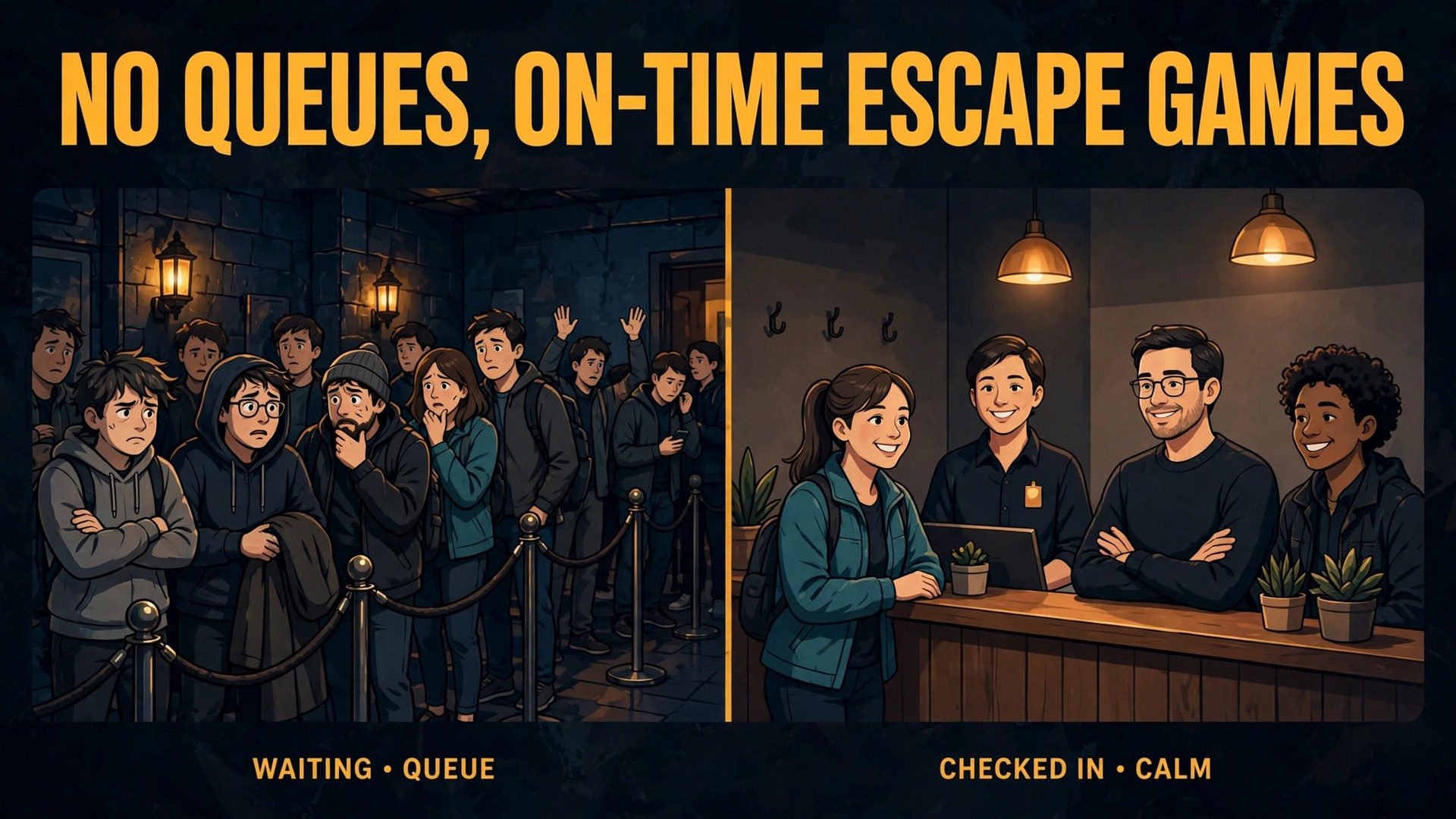
Compare two Friday evenings at the same escape room. In the first, the phone rings during a briefing, a group of eight arrives with three waivers unsigned, and the game master spends the first ten minutes chasing signatures while the next group waits in the lobby. In the second, every waiver is signed before arrival, the group size matched the room, and a reminder the day before already recovered the one booking that would otherwise have gone quiet. Operators who use AI for escape room booking management build that second evening on purpose.
The rooms are identical, and the evenings are not, because the second evening was managed by a workflow instead of by memory, by moving routine work before arrival instead of letting it collide with the game.
That difference is the whole case for AI in this business. Escape rooms sell time slots, and a slot that starts late, starts short handed, or starts empty costs revenue that cannot be recovered later in the evening. AI earns its place by handling the routine work around the slot, which is routing groups, chasing waivers, reminding players, recovering no shows, and asking for reviews, while humans run the game itself.
This guide builds that workflow step by step, with honest limits. AI can draft, sort, remind, and chase, but it cannot judge whether a room is ready, whether a group is suitable for a horror theme, or whether a complaint deserves a free game. Those calls stay with people, and the workflow below keeps them there.
How to Use AI for Escape Room Booking Management Without Losing the Game Day Feel
Start from the slot, not from the software. An escape room slot has a small set of facts that decide whether the game runs well, which are the room, the start time, the group size against the room minimum and maximum, the waiver state for every player, the payment state, and the game master assigned. If any fact is missing at start time, the game starts badly, no matter how good the room design is. Build the workflow around completing those facts before the group arrives.
The second rule is that AI works before the game, while humans work during it. Messages, routing, waivers, and reminders all happen before the door closes, and the game master should be free from screens once the briefing starts. A workflow that pings the game master mid game has failed, even if the messages are clever, because the game is the product and anything that distracts from it hurts the review that follows.
The third rule is to automate the most repeated job first and measure it for a month. For most rooms, that job is waiver chasing or reminder sending, because both happen for every booking and both fail quietly when done by hand. A room that automates five jobs at once cannot tell which one broke when Saturday numbers dip, while a room that automates one job at a time knows exactly what changed.
What AI Should Handle and What the Game Master Must Own
The table below draws the line that protects both the game and the business. Anything in the right hand column stays with a named human, even when an AI draft makes the job faster.
| Job | AI can handle | Human must decide |
|---|---|---|
| Group routing | Match group size to room capacity | Whether an oversized group splits |
| Waiver chasing | Reminders and per player links | Whether an unsigned player may play |
| Reminders | Timing, wording, arrival instructions | Last minute room changes |
| No show recovery | Rebooking offers and waitlist messages | Refund and reschedule exceptions |
| Review requests | Timing and draft text | Reply to a serious complaint |
| Upselling | Suggest a second room after a game | Whether a tired group should be sold more |
| Staff rostering drafts | Flag gaps against bookings | Final game master assignments |
| Room readiness | Checklist delivery and tracking | Whether a room is ready to run |
Room readiness deserves emphasis, because it is the job most often assumed to be automated when it is not. A system can track that a room was reset on schedule, but only a game master walking the room can confirm that a prop works, a lock resets, and a clue is in place. AI can deliver the checklist and record the sign off, and it cannot walk the room. A business that confuses those two will run a broken game with a perfect checklist.
Age and theme suitability is the second boundary. AI can ask for ages and flag a booking that looks unsuitable for a theme, but a human should make the call and the conversation, especially for birthday groups and corporate groups where the organiser may not know every player’s comfort level. A template message that turns a group away will read as rejection, while a short human conversation can reroute the group to a better room and keep the booking.
Step Workflow From Booking to Review
Work through these steps in order for each booking. The workflow is deliberately front loaded, because work done before arrival is invisible to players, while work done after arrival is visible as waiting.
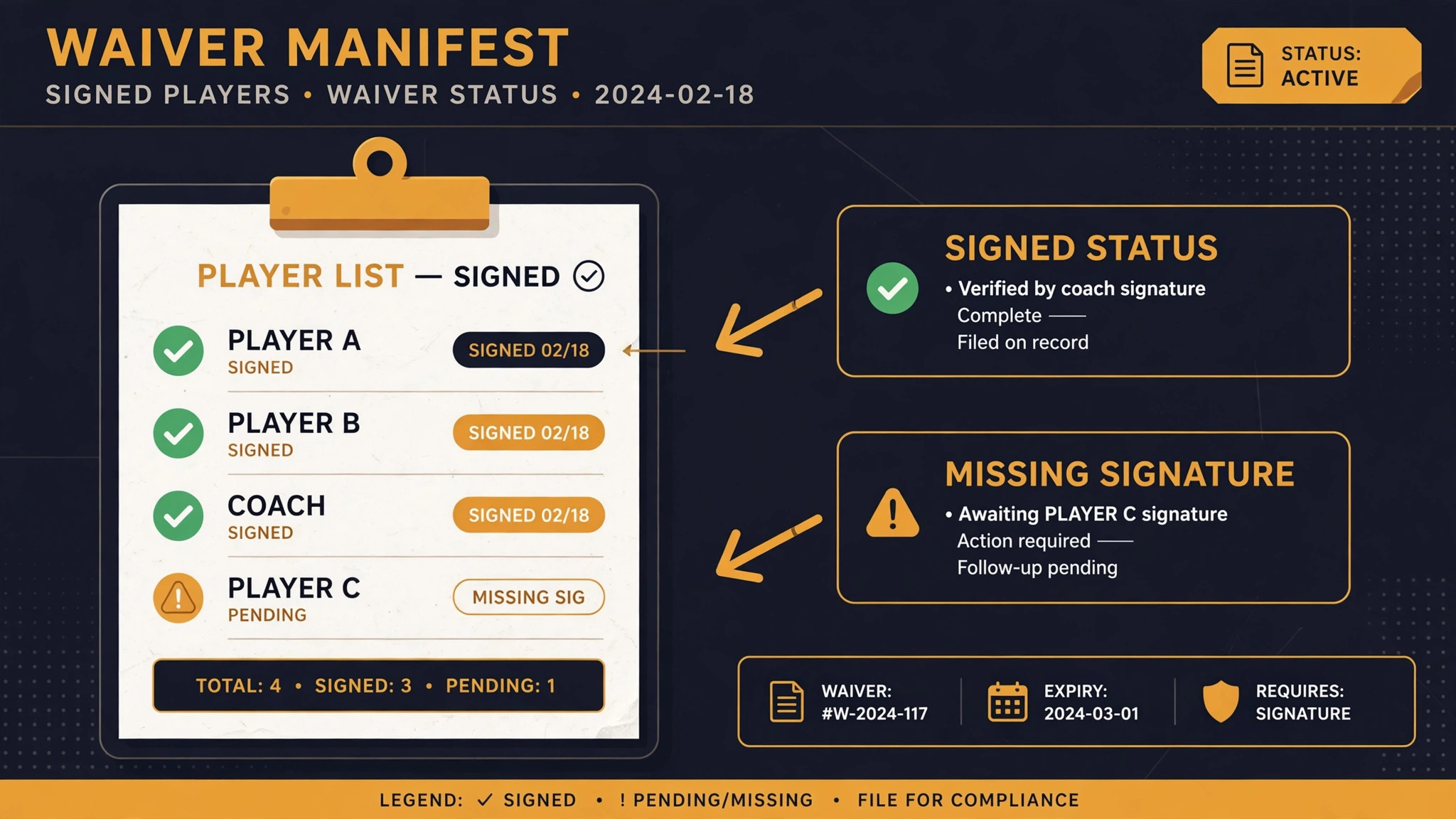
- Capture the booking on one calendar that holds rooms, slots, and game masters together, so two parties can never land on the same room at the same time. A room is an exclusive slot, and the calendar must treat it that way.
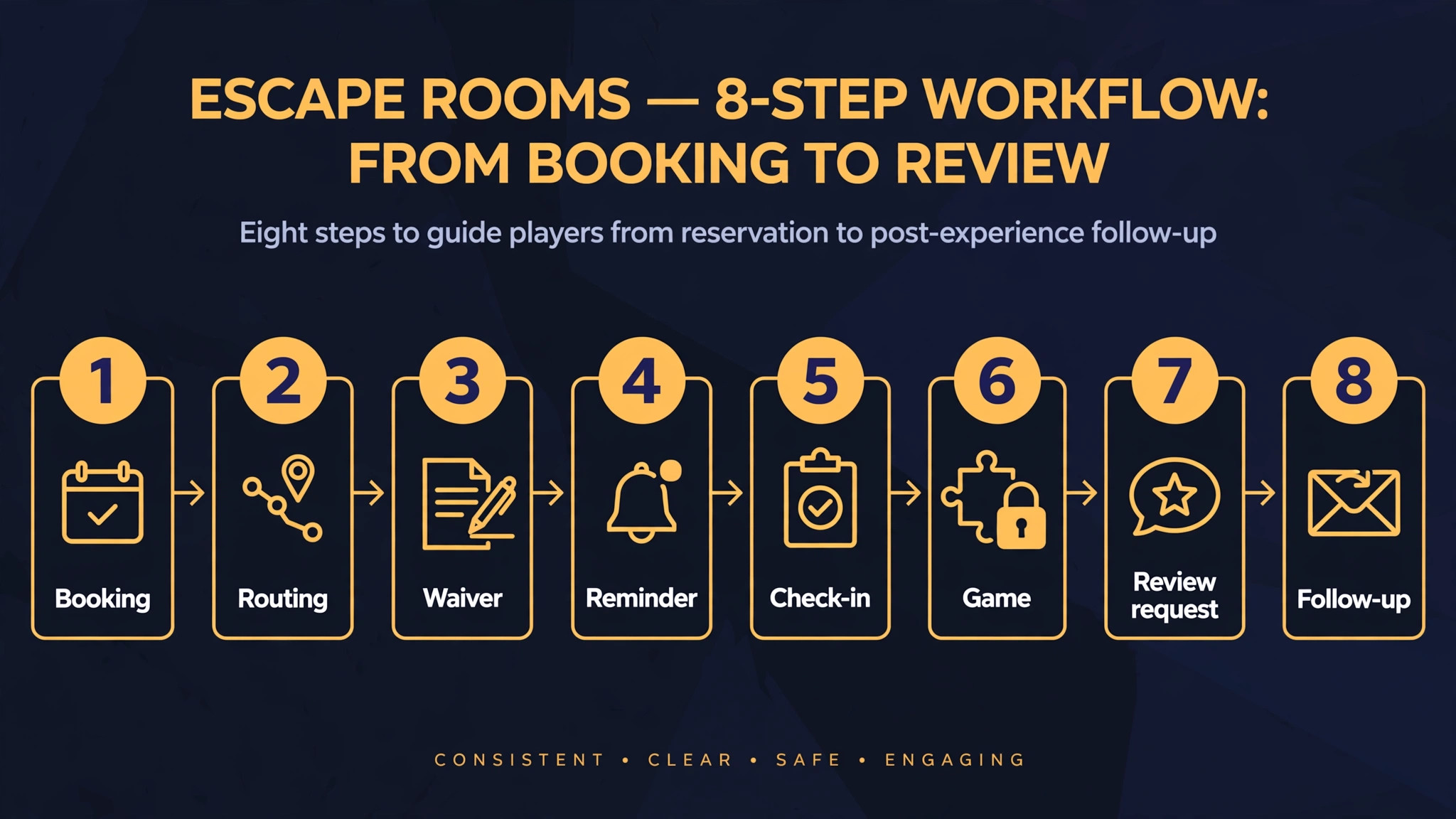
- Route the group at booking time, matching party size to room minimum and maximum, and offering a split across two rooms where one room cannot hold the group. Route private games and public games differently, because a public game that mixes strangers needs a different confirmation from a private game for friends.
- Send a group claim link to the organiser at once, so every player can claim a spot and sign a waiver from their own phone before the game. A single organiser signing for eight people is not a substitute for eight signatures, and the manifest should show the gap plainly.
- Chase waivers on a fixed schedule, with a reminder the day before and a final reminder on the morning of the game, and show the organiser a live count of signed versus outstanding players. Stop chasing by message and call the organiser when half the group remains unsigned the day before.
- Send arrival reminders with the start time, the arrival time, parking or entry notes, and the minimum group rule, so a group that arrives short knows before it travels. A reminder that only states the time wastes the one message most likely to be read.
- Check the group in with one tap at arrival, confirming waivers, headcount, and payment in a single view, then start the briefing on time. A check in that requires three screens will delay the game it was meant to protect.
- Run the game without workflow interruptions, record the result and any incident plainly, and reset the room against a checklist before the next slot. The reset buffer belongs in the schedule itself, so a sixty minute game starting every ninety minutes leaves real reset time.
- Send a review request at a sensible hour after the game, offer a second room where the group clearly enjoyed the first, and record corporate and birthday groups for a return offer. A review asked for the next morning reads as a request, while a review asked for at midnight reads as noise.
Group Size Routing That Fills Rooms Properly
Group routing is where revenue hides, because a room that enforces its minimum online fills differently from a room that negotiates its minimum by phone. When a booking page shows each slot with its minimum group and seats left, small groups can see whether they can join a public game or must book privately, and large groups can see whether they need two rooms. That clarity fills slots that a vague page leaves empty.
Operators who use AI for escape room booking management should let AI suggest the routing and let a human approve the awkward cases. A group of nine for a room that holds eight is an awkward case, because the answer depends on the room, the theme, and the group’s flexibility. AI can offer the split across two rooms or a different slot, and a human can judge whether a ninth player standing in would spoil the game. A system that simply rejects the ninth player loses a booking that a short conversation would have saved.
Corporate groups need a routing pattern of their own. One organiser books several rooms for twenty or more people, and each employee should be able to pick a room, sign a waiver, and confirm independently from one shared link. The dashboard should then show who is in which room and who still needs to sign, without the organiser chasing signatures by email. AI sorting makes that dashboard possible, but the organiser still needs a human contact when a department changes its numbers the day before.
Pricing by group size should be visible at routing time, not discovered at checkout. Flexible pricing for different group sizes works only when the group understands it before committing, because a surprise price at payment is the most common reason a booking is abandoned. Show the price for the actual group size as soon as the size is chosen, and let AI recalculate it instantly when the size changes.
Waiver Follow Up That Ends Clipboard Chasing
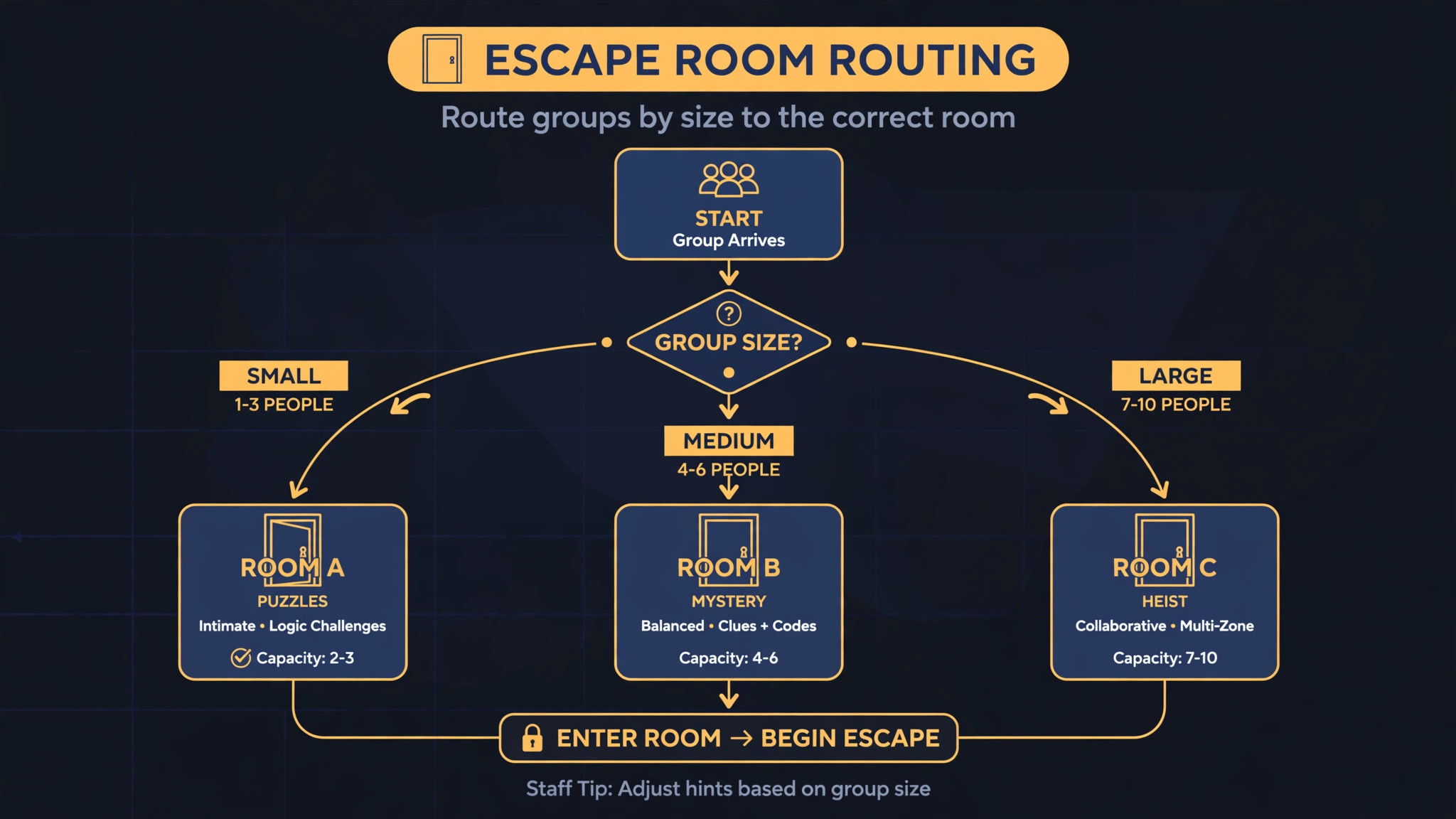
Waivers are the job players notice most when they go wrong, because a waiver queue at arrival delays the game for everyone. The fix is to move signatures home, where each player signs on their own phone before travelling. For groups, the organiser shares one link, and every player signs independently, so the manifest at arrival shows every waiver signed or names the missing players plainly.
Operators who use AI for escape room booking management should automate the chasing, not the judgement. AI can send the first link, the day before reminder, and the morning reminder, and it can tell the organiser exactly how many players remain unsigned. The judgement, which is whether an unsigned player may still play, belongs to the venue, and the answer should follow a written policy rather than a game master’s mood on a busy night. Write that policy before the season, including identification rules for younger players, and train every game master on it.
Minors and school groups need extra care in waiver wording and in data handling. Collect only what the waiver genuinely needs, store signed documents against the guest profile or booking as the system allows, and check retention rules for your area before keeping data longer than necessary. AI can file the documents, but a human should confirm that the filing matches the policy, because a filing mistake discovered during a dispute is worse than a slow filing done right.
A useful test for any waiver workflow is the eight player arrival test. When eight players walk in, the game master should be able to see the manifest, confirm every signature, and start the briefing without a clipboard, a pen, or a search through emails. If the test fails, the workflow needs fixing before the next weekend, because every weekend that fails it teaches players that arrival means waiting.
No Show Recovery and Review Requests That Bring Groups Back
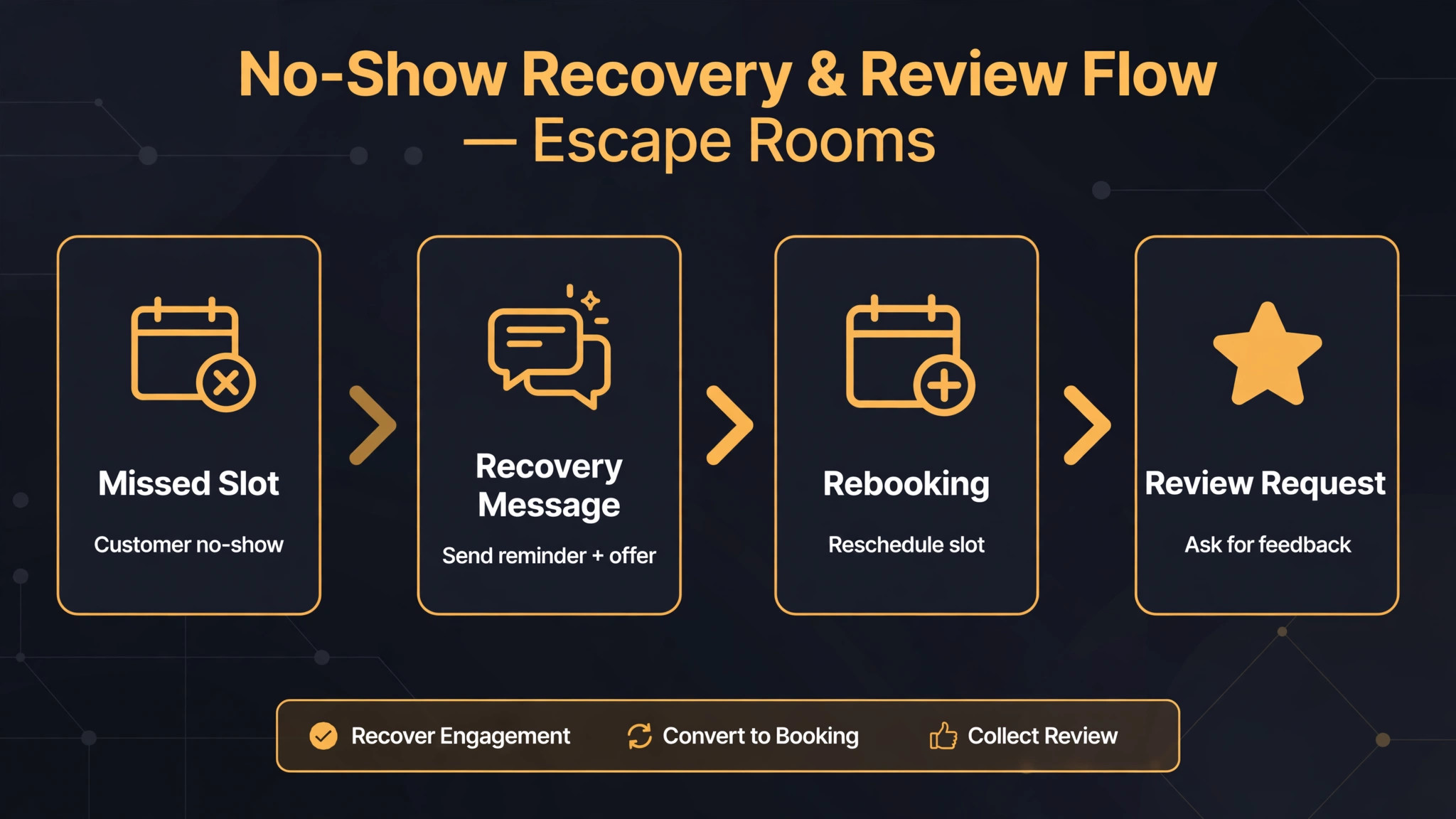
No shows hurt escape rooms more than most businesses, because an empty slot at eight on a Friday cannot be resold at eight on a Friday. Prevention comes first, through deposits or prepayment at booking, plus reminders that state the start time and the arrival time clearly. A booking that required a deposit and received two reminders still sometimes goes quiet, and that is where recovery begins.
Recovery should start fast and stay polite. When a group misses its slot, send a rebooking offer within the hour, with two alternative slots and a simple way to claim one, rather than a message that only notes the absence. AI can draft and send that offer, and it can watch a waitlist for the next matching slot, but a human should handle any reply that disputes the charge or asks for an exception. A fast, polite offer retains a group that a slow or scolding message would lose.
Operators who use AI for escape room booking management often find that review requests are the second half of recovery, because a group that returns is worth more than a group that only plays once. Ask for a review after the game, not during it, and ask once, with a link that works on a phone. A group that played well will review when asked well, and a group that played badly needs a human reply before any review request, because asking an unhappy group for a public review without first addressing the complaint invites the review you least want.
Second room selling follows the same rule. A group that finished buzzing is a good candidate for a second room offer, and AI can time that offer for the day after the game, when the memory is fresh but the evening is over. A group that struggled, arrived late, or complained should receive a human follow up first, not an upsell. Selling to a frustrated group reads as indifference, while a human check in reads as care, and care is what brings groups back.
Booking Tools That Support This Workflow
Bookeo
Bookeo is a widely used escape room booking platform, with online bookings, scheduling, payments, deposits, waiver management, reminders, and staff rostering in one system. It supports group games, private games, and player choice games, and its reminders include email and text options, with text reminders using purchased credits on some plans. Confirm pricing and credit costs at checkout, and test the waiver flow with a full group before relying on it for a weekend rush.
Escape Navigator is a booking platform and customer system for escape rooms, covering website widgets, payments, room and staff calendars, digital waivers, game hosting tools, guest return automation, and analytics. Its AI sales features respond to inquiries quickly and take deposits, which suits rooms that lose bookings overnight when nobody answers. Confirm pricing at checkout, and check that its guest return automation matches your review and rebooking rules before switching it on.
Koalendar
Koalendar is a scheduling platform with escape room features, including a booking page per room theme, real time availability, automated confirmations and reminders, custom intake forms, and group booking handling with private or public sessions. It connects to other tools through automation connectors, which suits a room that already runs payments or messaging elsewhere. Confirm pricing at checkout, and test group size limits and pricing rules on a real booking before launch.
Wakesys
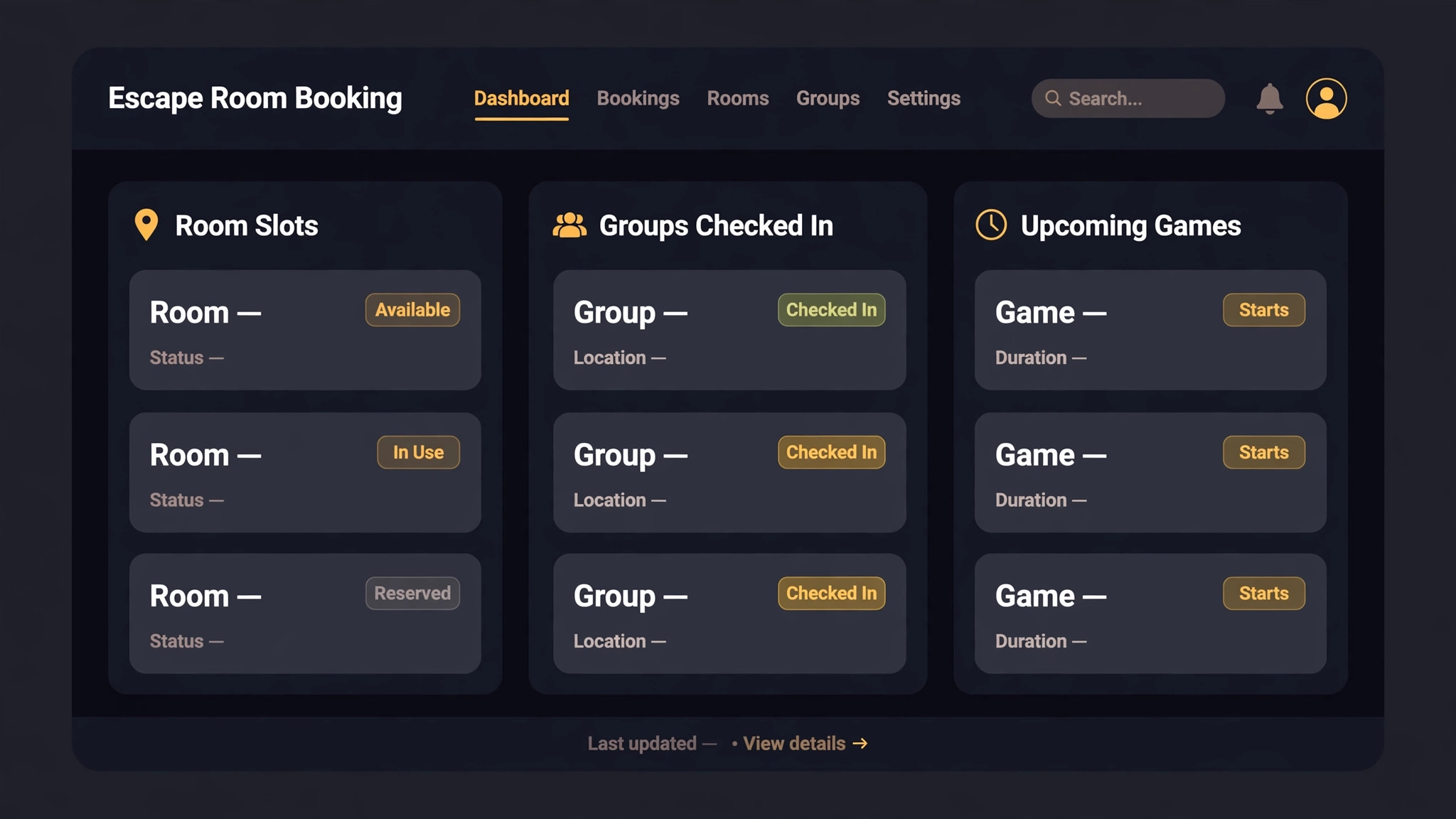
Wakesys is a booking system built around the exclusive slot idea, where one booking takes a room, every player signs before arrival, and the clock starts on time. Its game master dashboard shows rooms, slots, bookings, and waiver status at a glance, and group claim links let corporate groups self organise without the venue chasing individual signups. Confirm pricing at checkout, and run the eight player arrival test on its dashboard before a busy weekend.
Appointible
Appointible serves experience businesses that sell time slots, including escape rooms, with per room calendars, group bookings, reminders, and intake fields on the booking form. It suits a single location room or a mixed venue that also sells other timed experiences, because each room or departure is its own bookable resource. Confirm pricing at checkout, and check how waiver links are handled in confirmations, since some setups paste a waiver link into the confirmation rather than tracking signatures natively.
Weekend Rush Checklist
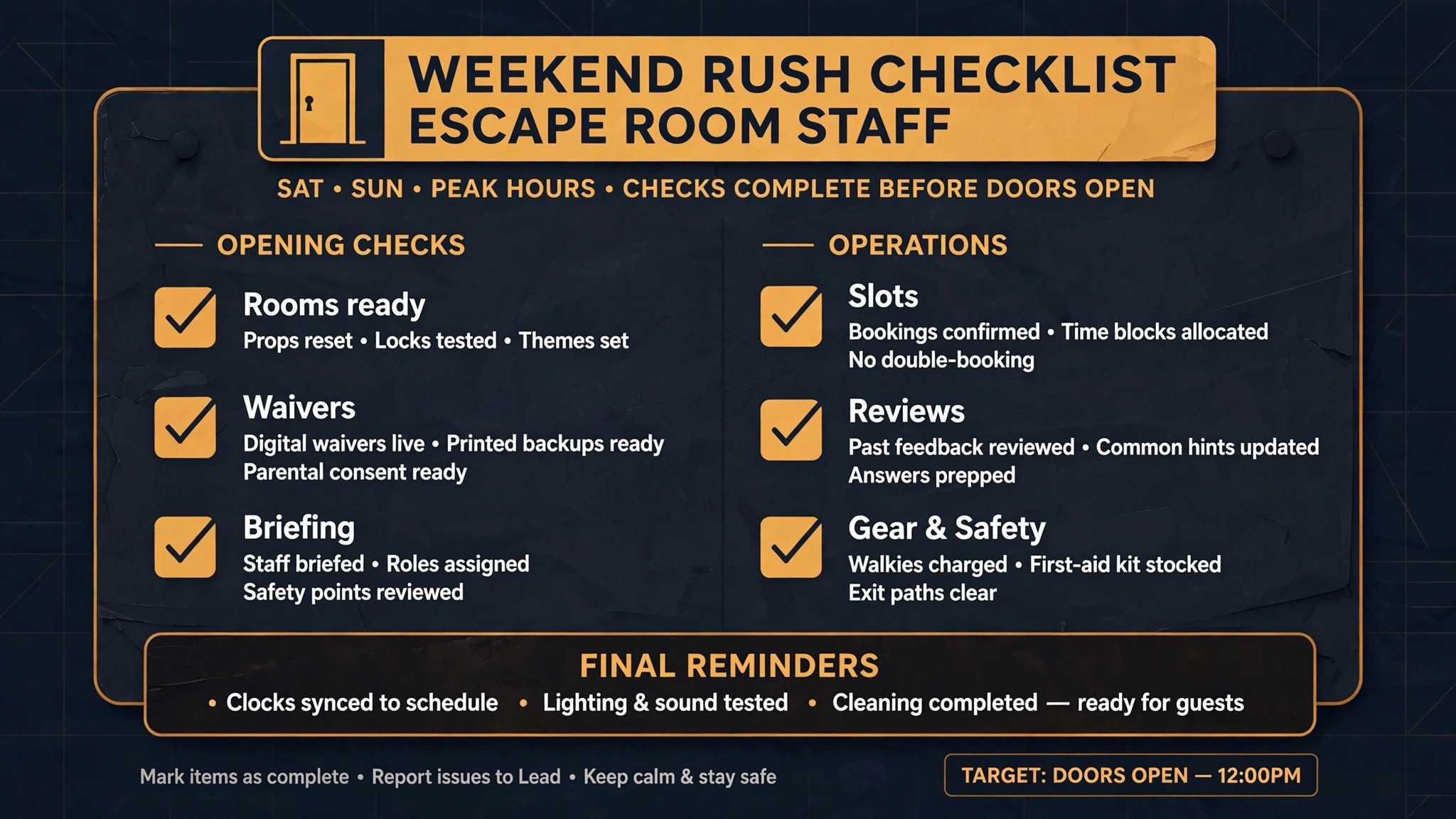
Use this checklist every Friday before the rush, and keep it beside the game master dashboard. A checklist used only when things go wrong is a post mortem, while a checklist used every Friday is prevention.
- Confirm every room, slot, and game master assignment on the weekend calendar
- Check waiver counts for every group and call organisers with half their group unsigned
- Confirm deposits or prepayments for every booking and flag unpaid slots early
- Test room readiness checklists and reset buffers between back to back games
- Prepare second room offers and birthday or corporate notes for returning groups
- Set review request timing and the human reply rule for unhappy groups
- Staff the phone and message queue during the hours automated messages promise
- Review last weekend no shows and send rebooking offers before Friday noon
Operators who use AI for escape room booking management should treat the Friday checklist as the moment the automation gets inspected. Software sends the messages all week, but Friday is when a human confirms the messages worked. A waiver count checked on Friday saves a game on Saturday, while a waiver count discovered on Saturday only documents a delay.
Measuring Whether the System Works
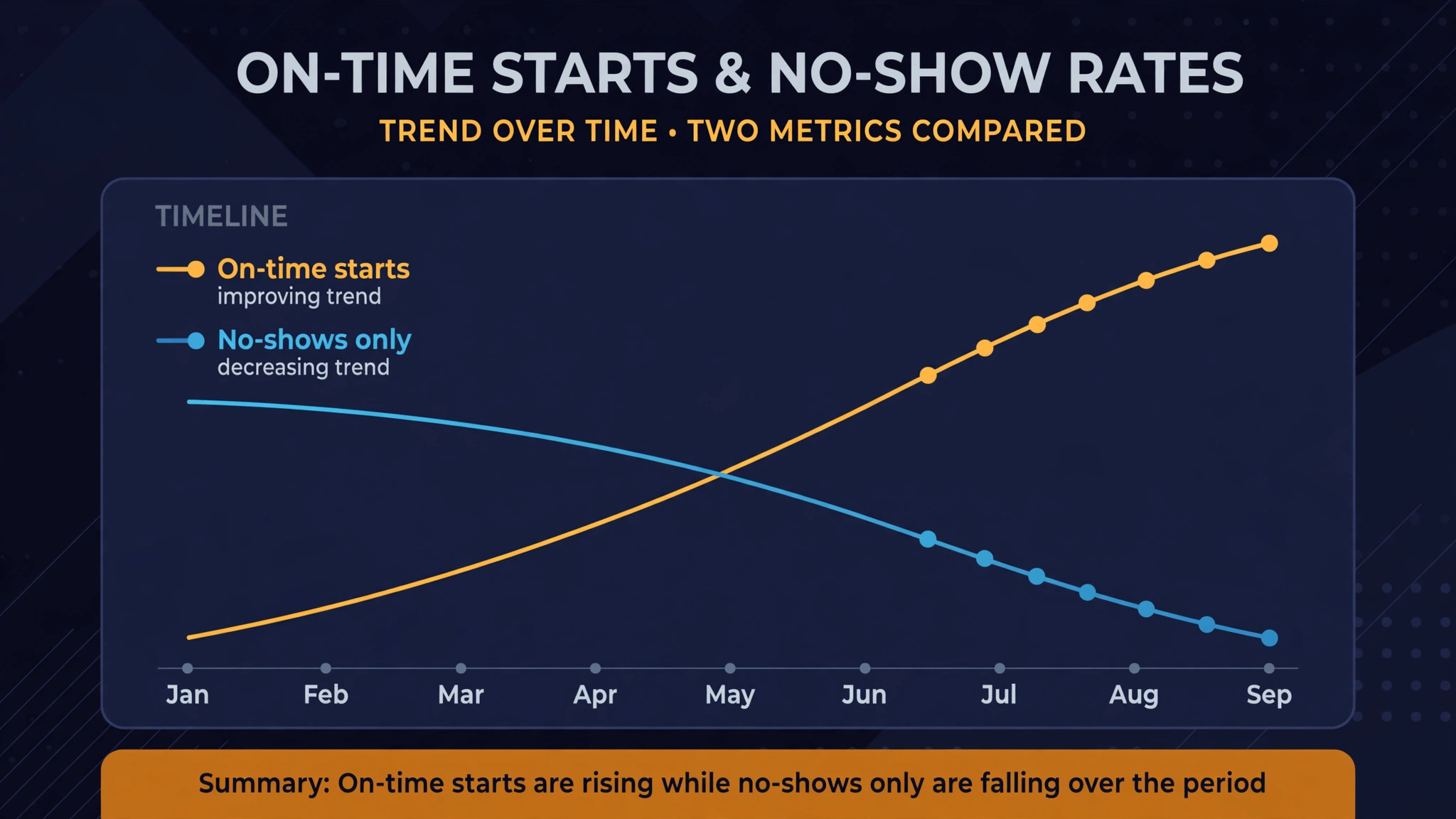
Measure five numbers, and ignore feature lists until these five move. First, on time starts, counted per hundred games. Second, waiver completion before arrival, counted per player. Third, no show rate, counted per hundred bookings. Fourth, rebooking rate after a missed slot. Fifth, review rate and average rating in the month after the change. If those five improve, the system works. If they do not, a new feature will not save it.
Compare each number with the same period before automation, and note season, school holidays, and new rooms beside the numbers, because a new room launch will move every figure and should not be credited to software. Keep the comparison honest by counting the same way before and after, since a no show rate that changes its definition mid year proves nothing.
Mistakes cluster in predictable places. The first is automating a message without a human answer path, which frustrates the group with the unusual problem. The second is chasing waivers without a written policy for unsigned players, which forces game masters to improvise under pressure. The third is asking for reviews before addressing a complaint, which invites the public version of a private problem. Fix the policy and the answer path first, because they protect the business even when the software is busy.
Handling Birthdays, Schools, and Corporate Groups
Special groups are where a generic workflow breaks, because their needs differ from a standard group of friends in ways a template cannot guess. Birthday groups need a room that suits the age range, a clear plan for younger players, and a celebration moment that does not eat into game time. School groups need a booking flow that handles guardians, group supervision, and waiver rules for minors, plus a schedule that fits transport times rather than the other way round. Corporate groups need invoicing that matches their finance process, a single organiser link, and a debrief space after the game.
Operators who use AI for escape room booking management should give each special group type its own intake path, even when the underlying rooms are the same. A birthday intake asks for ages, party size, and celebration needs. A school intake asks for supervisor numbers, age bands, and transport arrival times. A corporate intake asks for billing details, headcount flexibility, and whether the group wants a competitive or collaborative format. AI can sort those intakes and route them to the right staff member, but a human should confirm the booking for any group that touches age rules or billing exceptions.
Communication for special groups should also be longer and earlier than for standard groups. Send the organiser a plain plan a week before the visit, covering arrival time, waiver links, supervision rules, and what happens if numbers change. Then send a shorter confirmation the day before, with only the facts that changed or still need action. A single message sent too late forces the organiser to chase answers, while two well timed messages let the organiser look organised in front of their own group, which is exactly the experience that earns a return booking.
Finally, record what each special group actually needed, because the second visit is where the profit sits. Note the room that suited the age range, the supervision ratio that worked, and the billing detail that caused friction, so the next booking starts from knowledge rather than from scratch. Operators who use AI for escape room booking management well keep those notes in the guest record, where the next game master can find them, rather than in a personal inbox that leaves with a staff member.
Frequently Asked Questions
Can AI replace the game master on a busy night?
No, AI handles work before the game, while the game master runs the game, checks the room, and handles players in person. A game master freed from waiver chasing and phone answering runs a better game, but no automation can judge room readiness, read a group, or rescue a struggling team. Rooms that try to replace the game master discover the gap during the game that matters most.
How do digital waivers work for a group of eight?
One organiser receives a shareable link, each player opens it on their own phone, claims a spot, and signs independently, and the dashboard shows the signed count in real time. The game master then checks the manifest at arrival and starts the briefing without a clipboard. If players remain unsigned, the organiser sees the gap before travelling, which is the whole point of moving signatures home.
What should I do when a group does not show up?
Send a polite rebooking offer within the hour, with two alternative slots and a simple claim step, and watch the waitlist for a matching opening. Handle any dispute or refund request personally, because an automated reply to a charge dispute reads as indifference. Prevention matters more than recovery, so deposits and clear reminders should already be in place before the slot.
Can AI handle corporate groups of twenty or more?
Yes, where the system offers a shared link that lets each employee pick a room, sign a waiver, and confirm independently, with a dashboard showing who is where. The organiser should still have a human contact for last minute number changes, because a department that drops from twenty four to eighteen the day before needs a conversation, not a form. Test the corporate flow with a real group before selling it widely.
Do I need deposits to reduce no shows?
Deposits or prepayment at booking are the strongest single lever against no shows, stronger than reminders alone, because they turn a casual hold into a commitment. Reminders still matter, and they work best alongside a deposit rather than instead of one. Set the deposit and cancellation rule clearly at booking, so no group is surprised by it later.
How soon after a game should I ask for a review?
Ask at a sensible hour after the game, usually the next morning, with one message and a phone friendly link. Asking at midnight reads as noise, and asking during the game interrupts the product. If a group complained, address the complaint personally before any review request, because the order of those two messages decides the tone of the review.
Will AI messages feel impersonal to players?
They feel impersonal when they are frequent, generic, or impossible to answer, and they feel helpful when they are few, specific, and signed by the venue. Use the group name, the room name, the start time, and the arrival time in every message, and offer a human contact in each one. A message that helps a player arrive ready feels like service, not automation.
When should a small escape room start with AI?
Start when waiver chasing, reminder sending, or missed inquiry answering already costs hours every weekend, or when no shows regularly empty prime slots. Start with one job, usually waivers or reminders, and measure it for a month. A room with a handful of bookings a week may not need AI yet, and that is a fine conclusion, because automation should follow volume, not fashion.
Verdict for an Escape Room
Use AI before the game, keep humans during it, and measure on time starts, waiver completion, and no shows. Operators who use AI for escape room booking management well end the weekend with games that start on time, groups that arrive signed and ready, and reviews that mention the game rather than the wait. Start with group routing and waiver follow up, add no show recovery and review requests next, and keep the Friday checklist as the human inspection that makes the whole system trustworthy.
A room that runs this way feels different to players, even if they never notice the software. They notice the briefing that starts on time, the game master who is present instead of distracted, and the follow up that arrives when promised. Those are the details players review, and reviews are the bookings of next month.