

For most pickleball clubs, CourtReserve is the safest first choice, because it was built around court booking, memberships, and club play in a way general membership tools were not. That verdict holds for a single-court club that needs simple booking and for a multi-court club that needs leagues, ladders, and events. It does not hold for every club, and the rest of this guide explains where a general platform, a sports league tool, or a simpler app will fit better. That is why any honest guide to the best membership software for pickleball clubs must start with court booking, not with dues alone.
Pickleball clubs live or die on court time. Members join for play, not for admin, and they judge the club by how easy it is to book a court, join a game, pay dues, and sign up for a league. A club that runs those jobs on spreadsheets and group chats will spend its volunteer hours on admin, and members will feel the friction every time a court is double booked or a league signup gets lost.
This guide compares fourteen tools used by pickleball and racket clubs, from court-specific platforms to general membership and sports league systems. Prices vary by member count and feature tier, so every price entry here says to check the vendor pricing page. Request a written quote for your real member count, and confirm whether court booking, league management, and payment processing are included or charged separately.
Why Court Booking Breaks a General Membership Tool
A general membership tool is good at dues, directories, and email. It is weak at the thing pickleball members care about most, which is a fair system for scarce court time. Courts must be booked by time, by court, by play type, and sometimes by skill level, with rules for how far ahead members can book and how often they can play. A tool that only handles memberships will leave the club to manage that fairness by hand.
League and ladder play adds a second layer. Players need to sign up, be grouped by level, see fixtures, report scores, and follow standings, all without the organiser rebuilding brackets in a spreadsheet each week. A court booking tool without league features will handle the courts but not the competition, while a league tool without court booking will handle the competition but not the courts. Most clubs need both in one place.
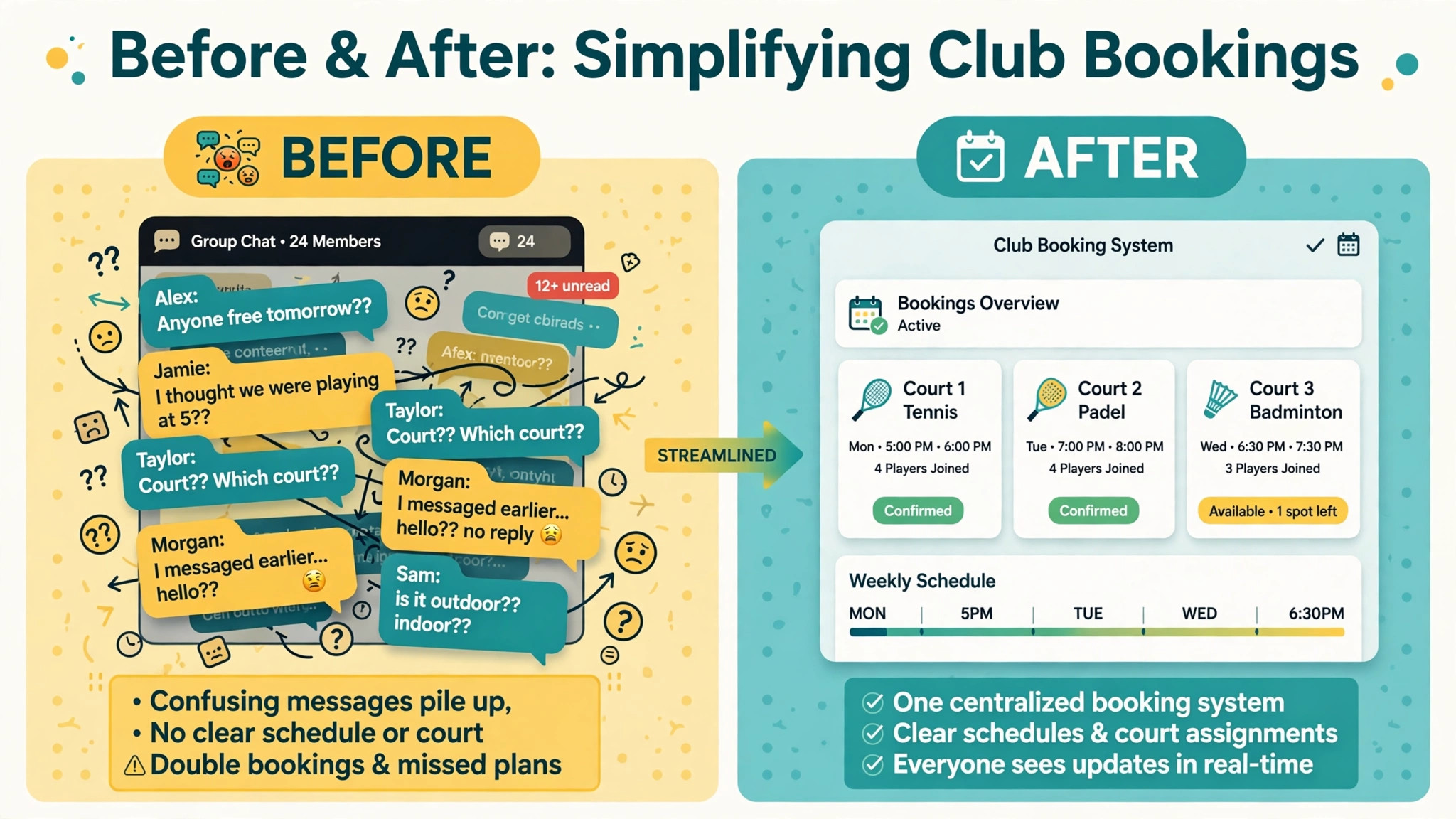
Payments and communication add a third layer. Dues, league fees, guest fees, and event tickets all need to be collected, and members need to hear about court closures, league nights, and social events without the club relying on a single group chat. A platform that ties membership, booking, leagues, and payments together will save volunteer hours every week, while a patchwork of tools will create gaps where members slip through. That patchwork problem is common in growing clubs, because each new tool is added to solve one urgent problem, and nobody owns the job of keeping the tools in sync.
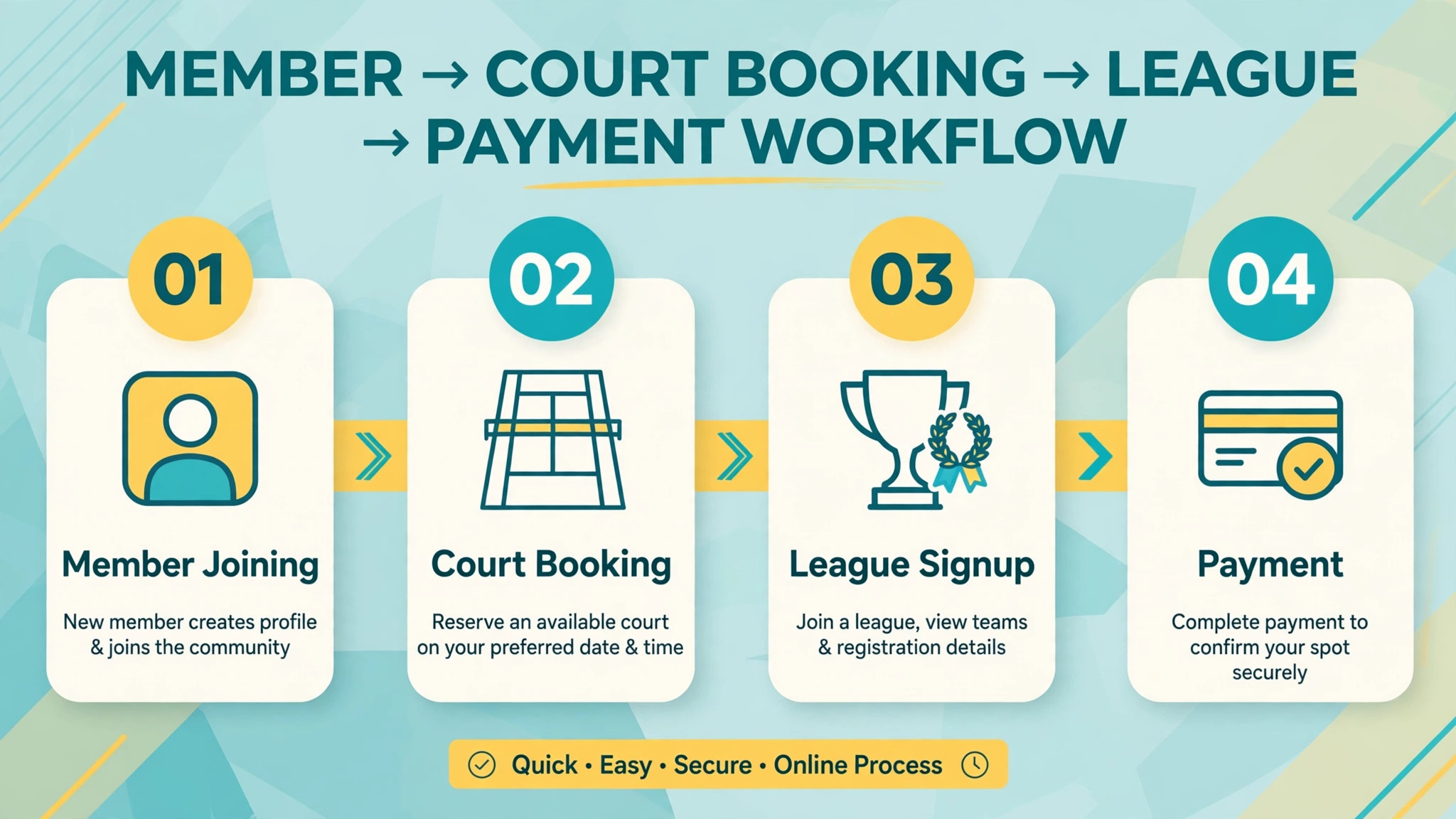
A fourth layer is growth itself. A club that adds twenty members a season needs a joining process that works without a committee member sitting beside each new player. Online joining, payment, court rules, and league information should be available the day a visitor decides to join, because a visitor who must wait a week for a volunteer reply will often join a different club instead.
The 14 Tools at a Glance
| Tool | Starting price | Best for | Club depth |
|---|---|---|---|
| CourtReserve | Check the vendor pricing page | Court booking plus memberships | Strong |
| Playbypoint | Check the vendor pricing page | Court booking and club play | Strong |
| TeamSnap | Check the vendor pricing page | Team and league communication | Good |
| LeagueApps | Check the vendor pricing page | Leagues and registrations | Strong |
| SportsEngine | Check the vendor pricing page | Sports organisations and leagues | Good |
| WildApricot | Check the vendor pricing page | General club memberships | Good |
| MemberClicks | Check the vendor pricing page | Association and club memberships | Good |
| ClubExpress | Check the vendor pricing page | Club websites and memberships | Good |
| Mindbody | Check the vendor pricing page | Class and session bookings | Good |
| Glofox | Check the vendor pricing page | Fitness and club memberships | Good |
| Zen Planner | Check the vendor pricing page | Member management and billing | Good |
| Pike13 | Check the vendor pricing page | Class and membership businesses | Good |
| PerfectMind | Check the vendor pricing page | Recreation and membership management | Good |
| OpenSports | Check the vendor pricing page | Pickup play and group bookings | Good |
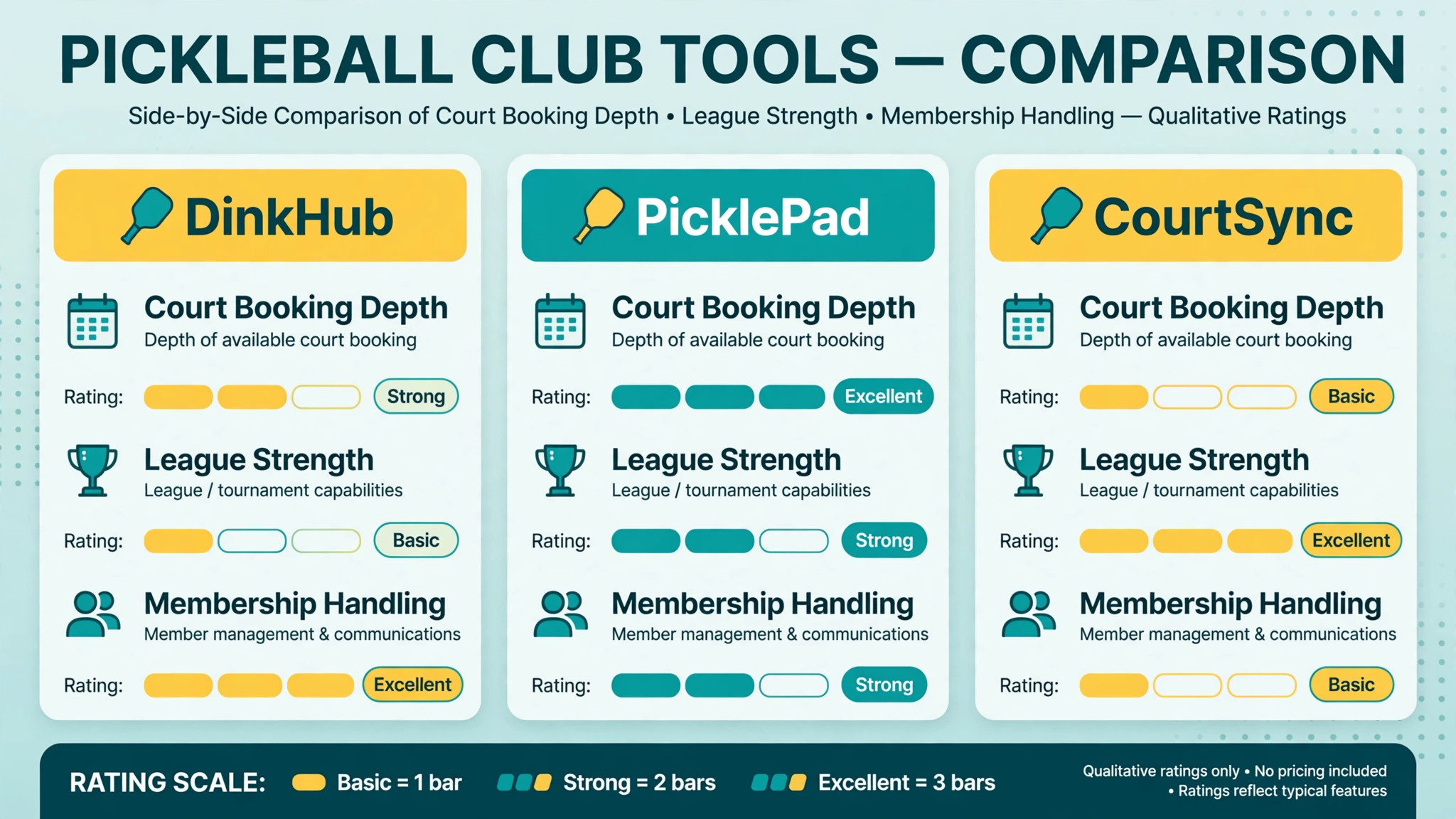
Pricing in this market depends on member count, court count, and whether leagues, events, and payments are included, so a comparison of the best membership software for pickleball clubs should start with a written quote for your real numbers. A low headline price can grow once payment fees and extra features are added, while a court-specific subscription can be cheaper per member once volunteer time is counted.
Best Pick by Job
| Job type | First pick | Why it fits | Watch out for |
|---|---|---|---|
| Single-court club | Playbypoint | Simple court booking with member play | Less depth for large leagues |
| Multi-court club | CourtReserve | Court booking, memberships, and events together | Confirm pricing as member count grows |
| Club with leagues | LeagueApps | Registration, fixtures, and standings built in | Court booking needs checking alongside |
The job type that fills most of your calendar should decide the shortlist for the best membership software for pickleball clubs. A single-court club that buys a large league platform will pay for fixtures it rarely runs, while a league-heavy club that buys a simple booking app will end up running ladders in a spreadsheet. Match the tool to the play your members actually do most.
League Signup Checklist
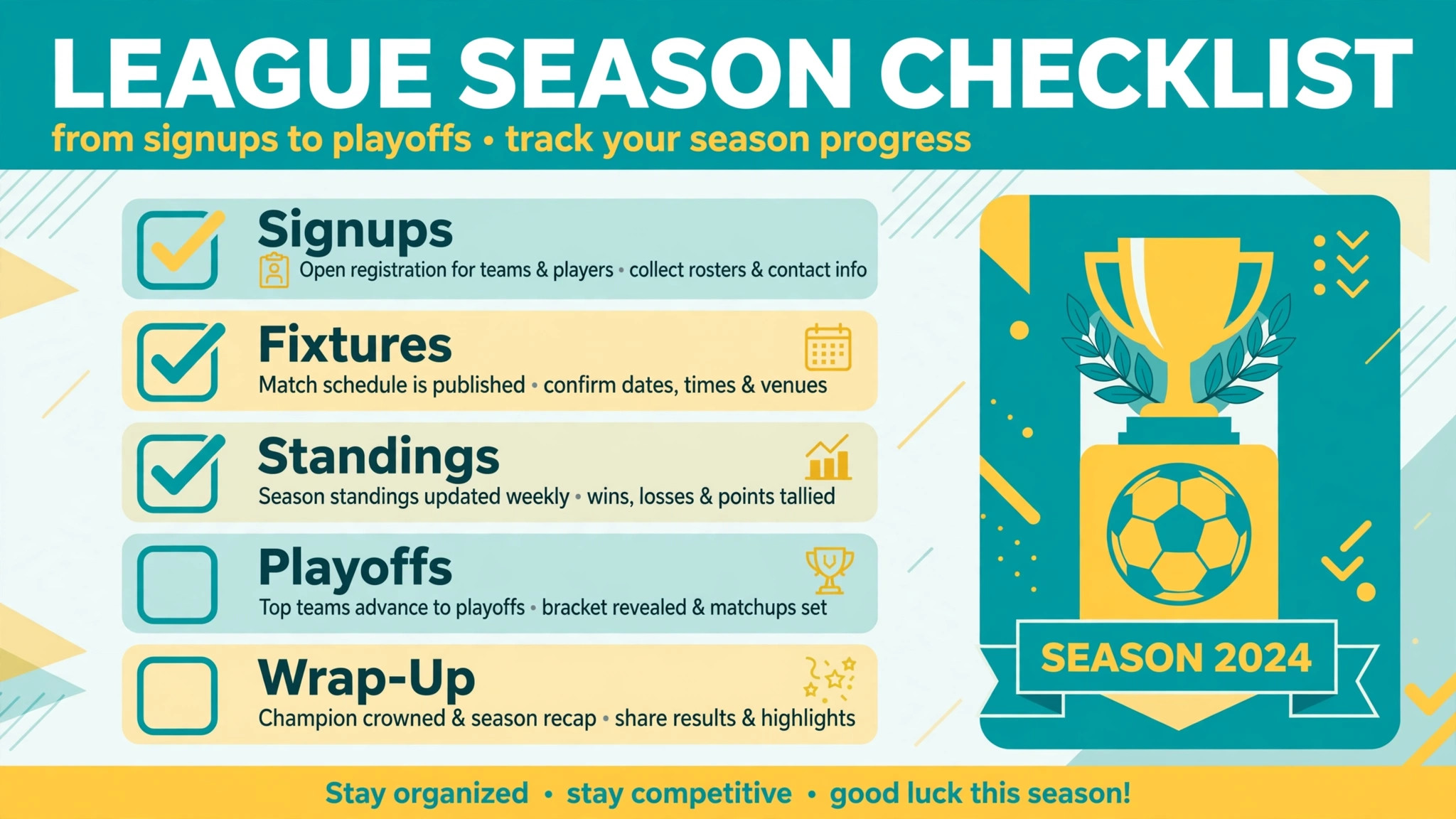
Use this checklist for every league season, so signups, fixtures, and payments are handled the same way each time.
– Confirm the league format, skill levels, dates, and court allocation before signups open, so players know exactly what they are joining. – Open signups with a clear deadline, a member price, a guest policy, and a waiting list for divisions that fill quickly. – Collect skill level and partner preferences at signup, so divisions can be balanced without chasing players by message afterwards. – Take league fees at signup where possible, so unpaid places do not block players on the waiting list. – Publish fixtures, court assignments, and score reporting instructions before the first match, in a place every player can find. – Record scores promptly after each round, and keep standings visible so players stay engaged through the season. – Message players about schedule changes, court closures, and playoff dates from the same system, rather than a separate chat group. – Close the season with final standings, a social event, and early signups for the next season while enthusiasm is still high.
Software helps this checklist only if signups, payments, fixtures, scores, and messages all update from the same league record. If those five live in separate places, the checklist becomes extra volunteer work on top of running the league itself.
The 14 Tools in Detail
1. CourtReserve
CourtReserve is a court booking and club management platform built for racket sports, covering court reservations, memberships, events, leagues, lessons, and payments. Members can book courts online, join events, and manage their membership from a phone, while organisers control booking rules, court availability, and member communication.
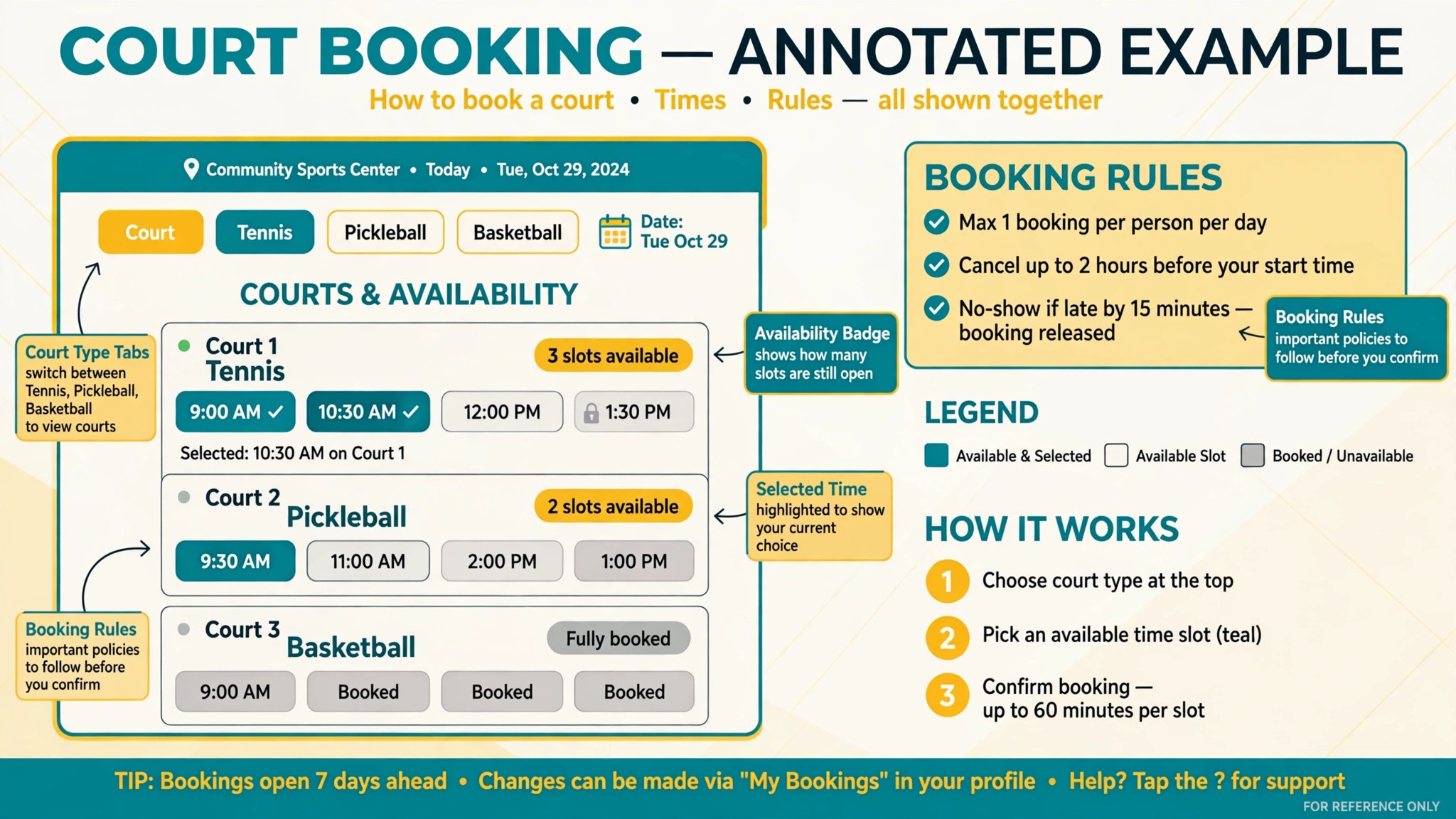
The strength is court-specific depth. Booking rules, play types, and member access can be set per court and per group, which keeps scarce court time fair. The limit is price at scale. Check the vendor pricing page and confirm the cost at your member and court count, since a club-specific platform can cost more than a general membership tool.
2. Playbypoint
Playbypoint is a court booking platform for racket sports clubs, with reservations, memberships, events, and member management. It suits clubs that want a straightforward booking system with clear member access, without a wide set of features the committee will not use.
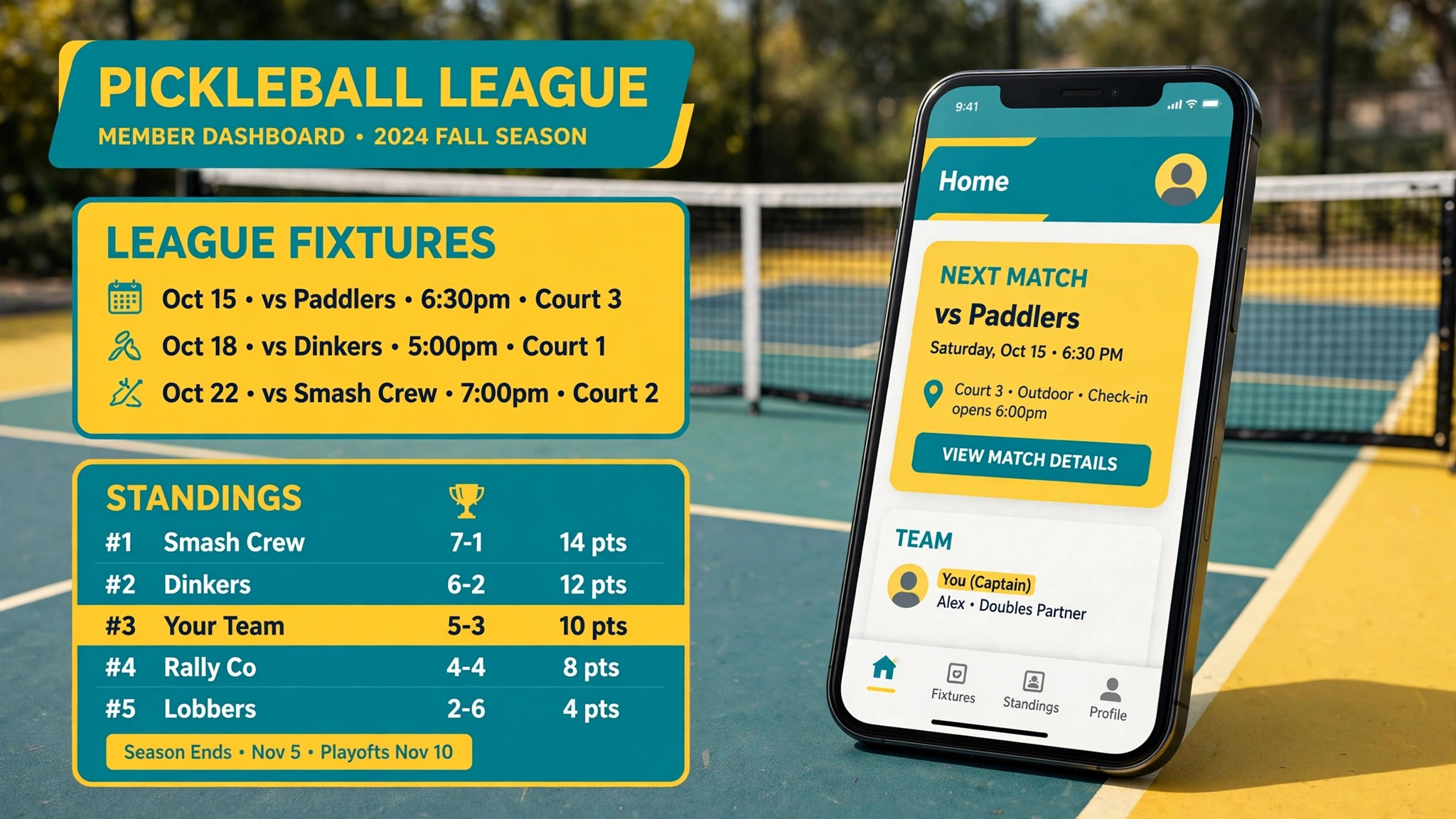
The strength is booking simplicity. Members can see availability, book a court, and join club sessions quickly, which matters for a small club with limited volunteer time. The limit is league depth for a large competitive programme. A club with many leagues and ladders should test fixtures, scoring, and standings explicitly before choosing it.
3. TeamSnap
TeamSnap is a sports team management platform covering scheduling, communication, payments, and registration. It is widely used by teams and leagues that need to keep players informed, collect fees, and manage schedules from a phone.
The strength is communication. Players get schedules, messages, and payment reminders in one app, which reduces the missed messages that plague group chats. The limit is court booking. A pickleball club that needs detailed court rules and reservations should test whether TeamSnap covers that need, or whether a court platform must sit alongside it.
4. LeagueApps
LeagueApps is a sports management platform for leagues and clubs, covering registration, payments, scheduling, communication, and websites. It suits a club with a serious league programme, where signups, divisions, fixtures, and standings must be managed cleanly across a season.
The strength is league operations. Registration and scheduling are built for competition, so organisers spend less time rebuilding brackets and chasing fees. The limit is court specificity. A club should confirm how court booking, court rules, and casual play sit alongside the league features, since both matter to members.
5. SportsEngine
SportsEngine is a sports management platform for organisations, teams, and leagues, with registration, scheduling, communication, websites, and payments. It suits a larger club or an organisation that runs several sports or age groups under one umbrella.
The strength is breadth for a sports organisation. Registration, schedules, and communication can be managed across many teams from one system. The limit is pickleball specificity. Court booking rules and club play features need careful checking, since a general sports platform may treat courts as generic facilities rather than the core of the club.
6. WildApricot
WildApricot is a membership management platform for clubs and associations, covering member directories, dues, events, websites, and email. It suits a club that needs solid membership administration and a professional website, with court booking handled through events or an add-on workflow.
The strength is membership depth for a modest price. Dues, renewals, directories, and events can be managed without a large system. The limit is court booking. A club that lives on daily court reservations should test whether the booking workflow is fair and clear enough for members, or whether a court-specific tool is needed.
7. MemberClicks
MemberClicks is a membership management platform for associations and clubs, with member databases, dues, events, communication, and websites. It suits a club that wants professional membership administration and a member portal, with play organised around events and sessions.
The strength is association-grade membership handling. Renewals, member types, and communication can be managed cleanly as the club grows. The limit is court and league specificity. Test booking and league workflows on real member behaviour before choosing it for a court-heavy club.
8. ClubExpress
ClubExpress is a club management platform covering websites, memberships, dues, events, and communication. It suits volunteer-run clubs that need a professional online home, a member directory, and event management without a complex system.
The strength is value for a volunteer committee. A club can run its website, memberships, and events from one place, with less admin time than a patchwork of tools. The limit is court booking depth. A club with scarce courts and strict booking rules should test reservations carefully, since that daily workflow will decide member satisfaction.
9. Mindbody
Mindbody is a booking and business management platform for fitness, wellness, and class-based businesses, covering bookings, memberships, payments, and client management. It suits a pickleball club that also runs coaching, clinics, and classes alongside open play.
The strength is session booking. Coaching sessions, clinics, and classes can be booked and paid for cleanly, with member passes and packages handled in the same system. The limit is court reservation rules for open play. A club should test whether casual court booking, with its fairness rules, works as well as class booking.
10. Glofox
Glofox is a membership and booking platform for fitness and club businesses, covering memberships, class bookings, payments, and member management. It suits a club that combines pickleball with fitness, coaching, or other session-based activities.
The strength is membership and session handling in one app. Members can manage passes, book sessions, and pay from a phone, which suits a club with a mixed activity programme. The limit is court specificity. Open play booking and league management need explicit testing, since a fitness booking model does not automatically match pickleball court rules.
11. Zen Planner
Zen Planner is a member management platform for fitness and martial arts businesses, covering memberships, billing, scheduling, and member tracking. It suits a club that needs reliable billing and attendance tracking, with sessions and memberships managed together.
The strength is billing reliability. Memberships, packages, and payments can be tracked cleanly, which helps a club that runs on monthly dues and session fees. The limit is pickleball play depth. Court booking and league features should be tested against real member behaviour, since billing strength alone will not satisfy players who cannot book a court fairly.
12. Pike13
Pike13 is a booking and business management platform for class and appointment-based businesses, covering scheduling, memberships, payments, and client management. It suits a pickleball club that runs coaching and clinics as a core part of its offer, with open play alongside.
The strength is client and session management. Coaches can manage clients, packages, and schedules, while members book and pay online. The limit is league and open play depth. A club with a large league programme should test fixtures and court rules before choosing a session-first platform.
13. PerfectMind
PerfectMind is a recreation management platform for clubs, facilities, and parks organisations, covering memberships, bookings, programmes, and payments. It suits a larger club or a facility that runs pickleball alongside other recreation programmes.
The strength is facility breadth. Multiple programmes, memberships, and bookings can be managed from one system, which helps a multi-activity facility. The limit is pickleball specificity for a small club. A single-court club may find the breadth heavier than needed, so confirm which features the committee will actually use each week.
14. OpenSports
OpenSports is a sports booking platform for pickup play, group sessions, and events, covering bookings, payments, and player communication. It suits a club or group that runs pickup games and social sessions, where players join games rather than booking courts alone.
The strength is pickup play. Players can find games, join sessions, and pay in one place, which suits a social club that grows by word of mouth. The limit is formal membership and league depth. A club with dues, divisions, and a full league season should test whether OpenSports covers that structure, or whether it fits better as a pickup companion to a main club platform.
What Members Notice First
Members notice booking fairness before they notice any other feature. A system that lets one group monopolise prime evening courts will create resentment faster than any other flaw, while a system with clear rules, visible availability, and fair advance booking will be praised even when courts are scarce. Booking rules are therefore a member satisfaction tool, not only an admin setting, and they deserve a proper trial with real members.
Members also notice communication. A club that messages court closures, league nights, and social events from one reliable place will feel organised, while a club that spreads news across several chats will feel chaotic even when the play itself is good. A platform that keeps messages tied to membership and booking will reach the right players, including new members who are not yet in the informal chat groups.
A third thing members notice is how easy it is to bring a friend. Guest fees, trial memberships, and social sessions are how clubs grow, and a platform that makes guest booking simple will turn visitors into members more often than a platform that requires a committee member to intervene.
A fourth thing members notice is renewal. A renewal that arrives as a clear message, with a simple payment link and a reminder before expiry, will be paid promptly.
A renewal that requires a form, a bank transfer, and a chase will be delayed, and some members will simply drift away during the delay. That quiet drift is easy to miss in a busy club, but it shows up clearly in the membership numbers at the end of the year, when it is already far too late to win those players back easily. Judged on those three experiences, the best membership software for pickleball clubs is the tool that makes booking fair, messages reliable, and joining easy, not only the tool with the longest feature list.
How to Choose the Best Membership Software for Pickleball Clubs
Start with a real week of play, not a feature list. Take a week that includes prime evening courts, a league night, a coaching session, and a social session, and run it in the trial. Check whether booking rules hold, whether league players can find fixtures, and whether new members can join without committee help.
Next, test the member experience on a phone. Ask a new member to join, pay dues, book a court, and sign up for a league, and count how many steps and how much help they need. A platform that needs a tutorial for basic play will frustrate the very members the club wants to keep, while a platform that feels obvious will grow by itself.
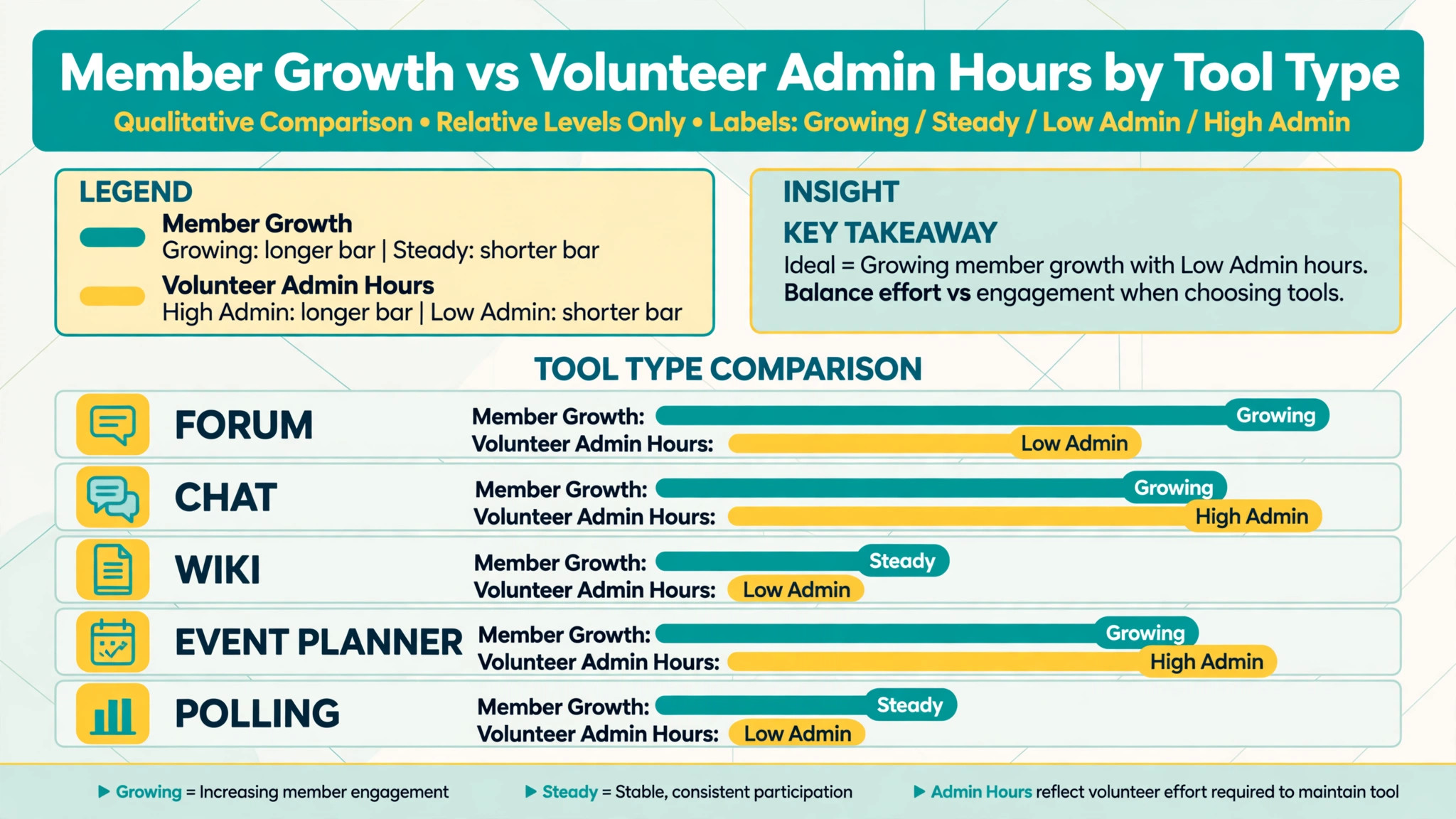
Then price the full stack for the best membership software for pickleball clubs in your club. Add payment fees, extra features, and any per-member charges to the subscription, and model the total at your current member count and at the count you expect next season. A tool that is cheap for fifty members and expensive for two hundred will punish growth.
Common Mistakes When Buying Pickleball Club Software
One mistake is buying a membership tool without court booking. Dues and directories do not solve the daily problem of scarce court time, and a club that buys memberships first will soon buy a second tool for courts. Start with the court problem, and make sure memberships follow from the same system.
Another mistake is ignoring booking rules. A platform with weak rules will let prime courts be monopolised, and the committee will spend its time mediating disputes instead of growing the club. Set rules for advance booking, frequency, and guest play before launch, and test them with real members.
A third mistake is forgetting volunteers. A platform that only the most technical committee member can run will fail when that person steps down. Choose a system that several volunteers can run, document the key jobs, and make sure more than one person can manage bookings, leagues, and payments.
A fourth mistake is skipping guest and trial handling. Guests and trial players are future members, and a clumsy guest process will lose them. Make sure guest booking, trial memberships, and social sessions are easy to run, and track how many guests become members each season.
A fifth mistake is buying for the club you hope to become and ignoring the club you run. A large league platform can overwhelm a small social club, while a simple booking app can be outgrown in a season. Choose the tool that fits this season, and confirm that member data can be exported if you move later.
Frequently Asked Questions
What should a pickleball club look for in membership software?
Look for court booking with fair rules, memberships and dues, league and ladder management, event handling, payments, and member communication in one system. The court booking test matters most, so run a real week of prime-time play in the trial and check whether rules hold and members can book without committee help.
Is a general membership tool enough for a pickleball club?
A general tool can work for a small social club where court booking is simple and leagues are informal, especially if the price fits a volunteer budget. Once courts are scarce, leagues are competitive, or membership grows past a hundred players, a court-specific platform will save more volunteer time than it costs, because booking and league work stay in one place.
How do booking rules keep court time fair?
Booking rules limit how far ahead members can book, how often they can play at prime times, and how guests are handled, and they apply those rules automatically rather than relying on goodwill. A fair system should also show availability clearly, so members can see why a court is taken and when it frees up, rather than suspecting favouritism.
Can members book courts and join leagues from a phone?
Yes, on most platforms in this guide. Members can book courts, join events, sign up for leagues, pay fees, and receive messages from a phone app or a mobile website. Test that full journey as a new member in the trial, including payment, since a booking flow that breaks on a phone will frustrate members quickly.
How long does it take to switch club software?
A small club can switch in two to three weeks if member lists, court rules, and league formats are prepared in advance. A mid-sized club should allow four to six weeks, including member training and parallel running on live bookings. A large club with several leagues should allow longer, including data migration and fixture checks.
Should a club keep a group chat alongside club software?
A group chat can stay for social talk, but it should not be the system of record for bookings, leagues, or payments. When bookings live in software and chat is only for conversation, new members are not excluded, decisions are traceable, and the committee is not hostage to a single chat thread. Make the software the source of truth from day one.
Does club software help with guest players and trial members?
Yes, when guest booking, trial memberships, and social sessions are set up properly. Guests can book, pay a guest fee, and play without committee intervention, and trial members can be tracked through to full membership. That smooth path is one of the best growth tools a club has, and it deserves testing in the trial.
Run a Season Trial, Not Just a Week
Do not choose from a demo court. Run a trial that covers a full league cycle on your two finalists, from signups to fixtures to scores to playoffs. In the first weeks, test booking fairness, member joining, and payment. In the later weeks, test score reporting, standings, schedule changes, and the end-of-season social.
The tool that keeps booking fair, leagues visible, and volunteers calm through that full cycle is the right choice for your club, and it will also be the strongest candidate when you judge the best membership software for pickleball clubs against a full season rather than a demo week.
A final point for committees is succession. Document how bookings, leagues, and payments are run, and make sure at least two volunteers can do each job.
A platform that is easy for several people to run will survive committee changes, while a platform that depends on one expert will become a risk the moment that person steps down. Choose the system that the next committee can run as easily as the current one. Price matters, but a cheap tool that creates booking disputes will cost more in lost members than a court-specific platform that runs quietly. Choose the system that makes play easier to join, easier to organise, and easier to enjoy, because a club that is easy to play in is a club that keeps growing.
More Reading on Stratilyze
– Best Booking Software for Music Schools – Best Booking Software for Escape Rooms – Best Booking Software for Boat Rentals – Best Membership Software for Dance Studios – Best Membership Software for Gyms