

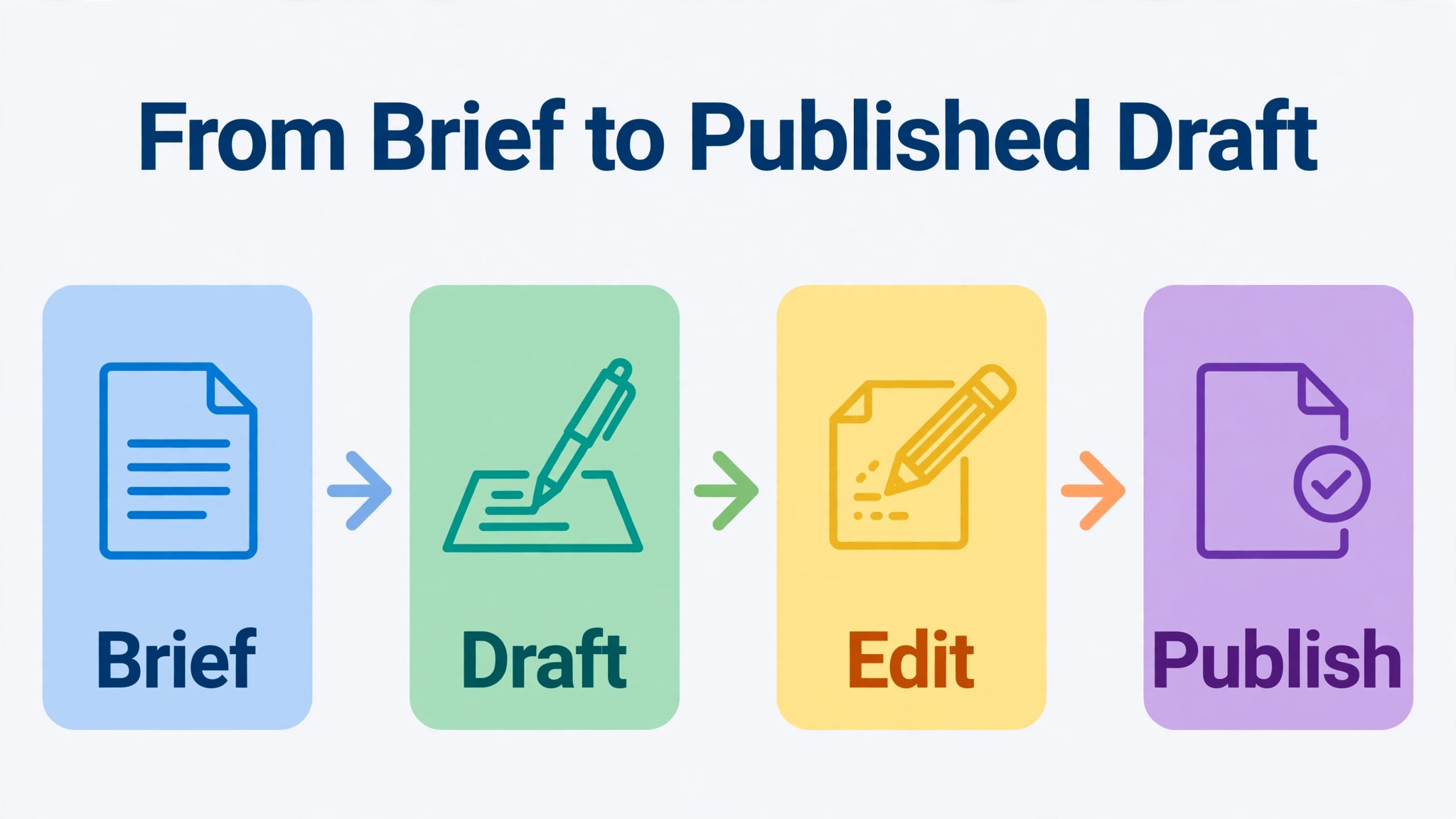
A small marketing team can spend a week writing product pages, email drafts, and social posts, then still face a blank page on Friday afternoon. That gap is the problem Jasper sells a fix for. The tool turns briefs into drafts, rewrites rough copy, and keeps wording close to a set brand voice. The question that decides whether it belongs in a small budget is simpler than any feature list. It is what the monthly bill looks like once every writer who will actually use it has a seat. That is why the cost of Jasper for small business monthly deserves a seat by seat look before signup.
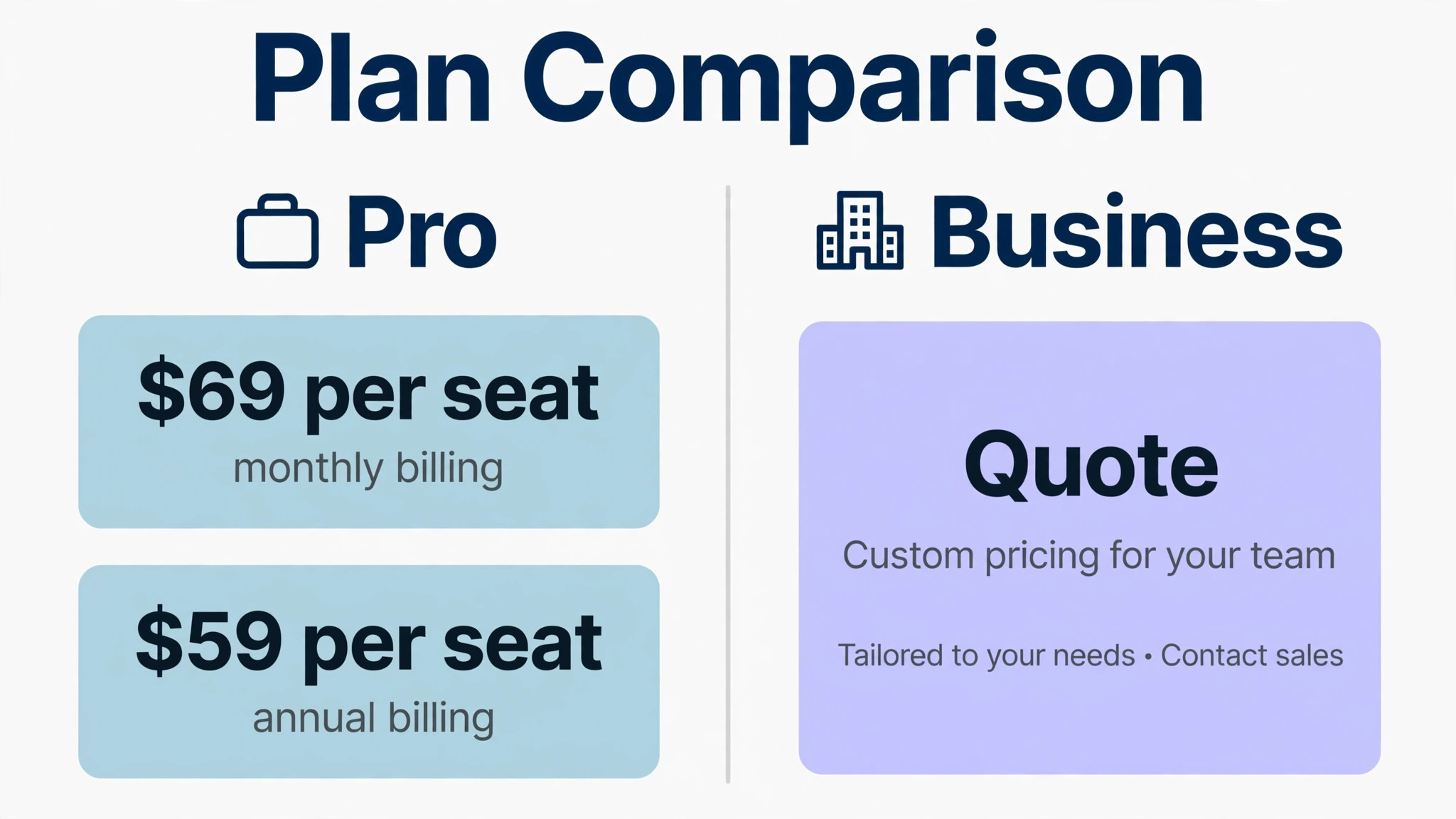
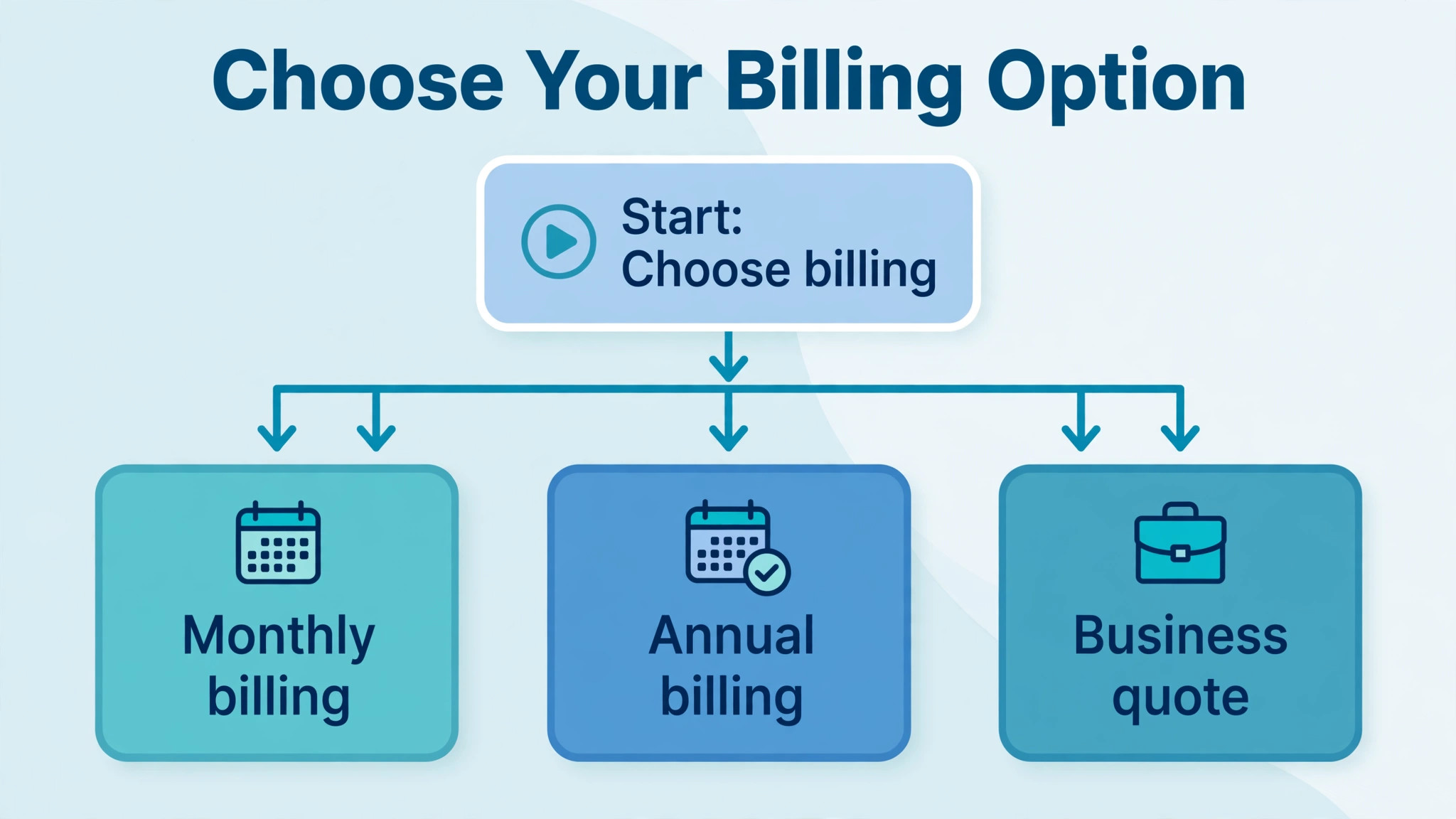
The cost of Jasper for small business monthly starts with one published tier for new buyers. Jasper Pro costs 69 dollars per seat per month on monthly billing and 59 dollars per seat per month on annual billing, according to pricing pages and pricing guides checked in October 2026. Business pricing is quote only, so no published per seat figure exists for that tier. A team that budgets from older guides may still see a Creator tier at 39 to 49 dollars, but recent pricing coverage reports that Creator no longer appears as the entry tier for new buyers, so this guide treats Pro as the real starting point and flags the older figure wherever it could mislead.
That distinction matters because the difference between 49 dollars and 69 dollars is 240 dollars a year for a single seat, before any other cost is added. A solo owner who plans around the older figure will underbudget from the first invoice. A five seat team that plans around it will be 1,200 dollars short across a year. The rest of this guide builds the bill seat by seat, shows where annual billing changes the total, and names the extras that can push the price past the headline rate.
What the cost of Jasper for small business monthly covers
Jasper Pro is a per seat subscription, which means the bill grows with each person who gets access, not with each document the team produces. Pricing coverage checked in October 2026 describes Pro as including Jasper Chat, the Canvas workspace, brand voices, knowledge assets, audiences, AI image tools, and a plagiarism checker, with a seven day free trial and no permanent free plan. The exact counts of brand voices and knowledge assets vary between pricing summaries, so a buyer should confirm the current counts on the pricing page at checkout rather than budgeting around a single review figure.
Business sits above Pro as a quote only tier. It adds unlimited brand voices, knowledge assets, and audiences, plus advanced agents, a no-code agent builder, API access, single sign-on, and admin controls, with a 12 month commitment reported in recent pricing coverage. Because no published price exists, a small business cannot budget Business from a headline figure. The honest way to handle it is to treat Pro as the budgeted tier and to request a written Business quote only when a Pro limit actually blocks the work.
| Tier | Monthly billing | Annual billing | Who it fits |
|---|---|---|---|
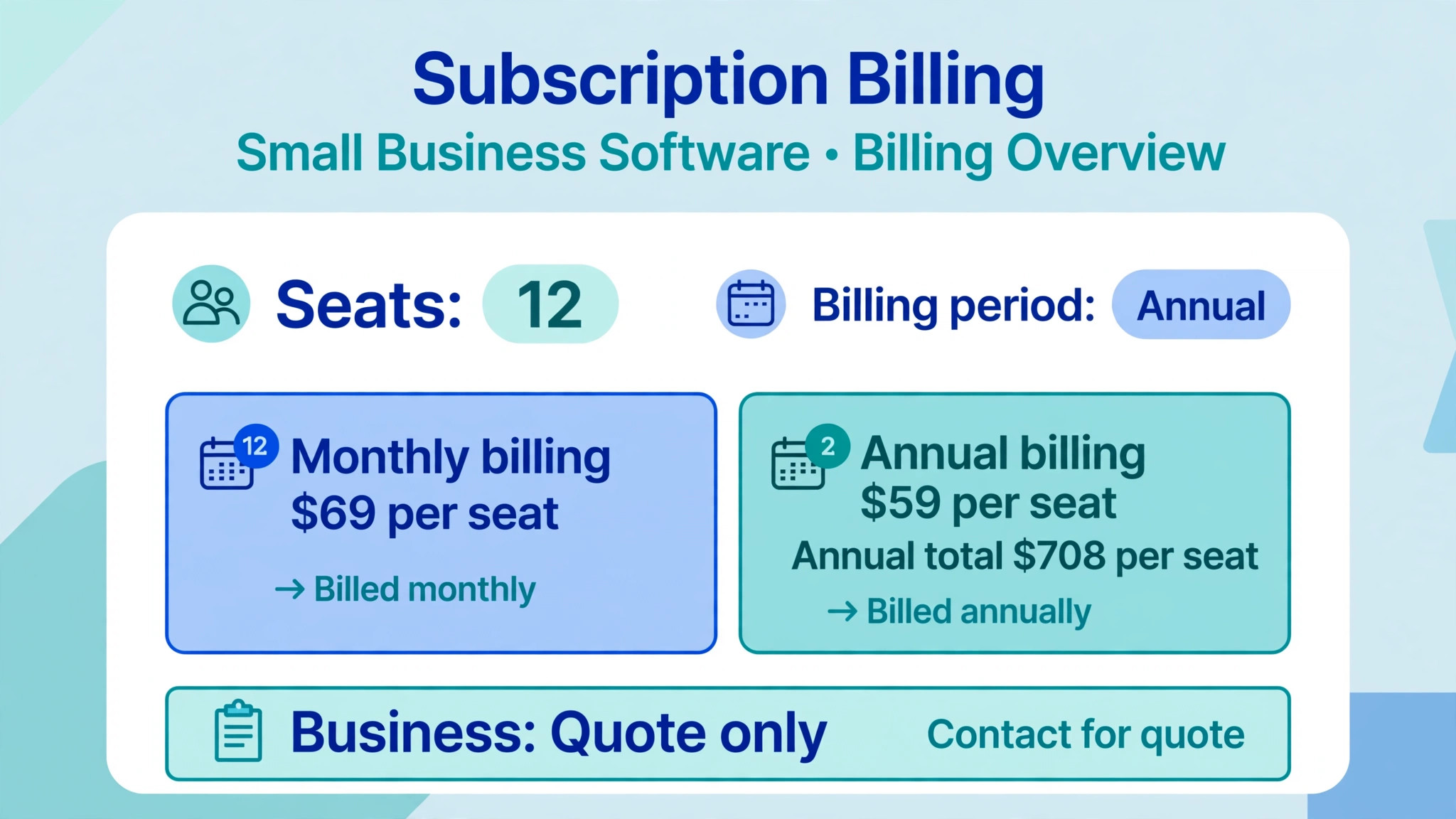
| Pro | 69 dollars per seat per month | 59 dollars per seat per month, 708 dollars per seat for the year | Solo marketers and small teams producing brand governed content weekly |
| Business | Check the vendor pricing page | Check the vendor pricing page | Larger teams needing unlimited assets, API access, and admin controls |
| Free plan | No free plan is published | No free plan is published | Trial users only, through the seven day Pro trial |
When a team models the cost of Jasper for small business monthly, the billing period is the first lever to test. The annual billing saving on Pro is 10 dollars per seat per month, or 120 dollars per seat per year. That saving is the single largest discount available on the published tiers, and it requires paying 708 dollars per seat upfront for the year. A team that is still testing whether Jasper fits its workflow should stay on monthly billing for the first month or two, even though the monthly rate is higher, because the cost of cancelling an annual commitment outweighs the saving from a trial that fails.
Seat discipline matters as much as billing period. Jasper charges per seat, so a seat given to a manager who reads drafts twice a month costs the same as a seat given to a writer who drafts daily. Small teams often hand out seats generously at signup and then wonder why the bill looks large. A better rule is to give seats only to people who will draft, rewrite, or edit in Jasper every week, and to share finished drafts with everyone else through documents or email.
Real monthly totals by team size
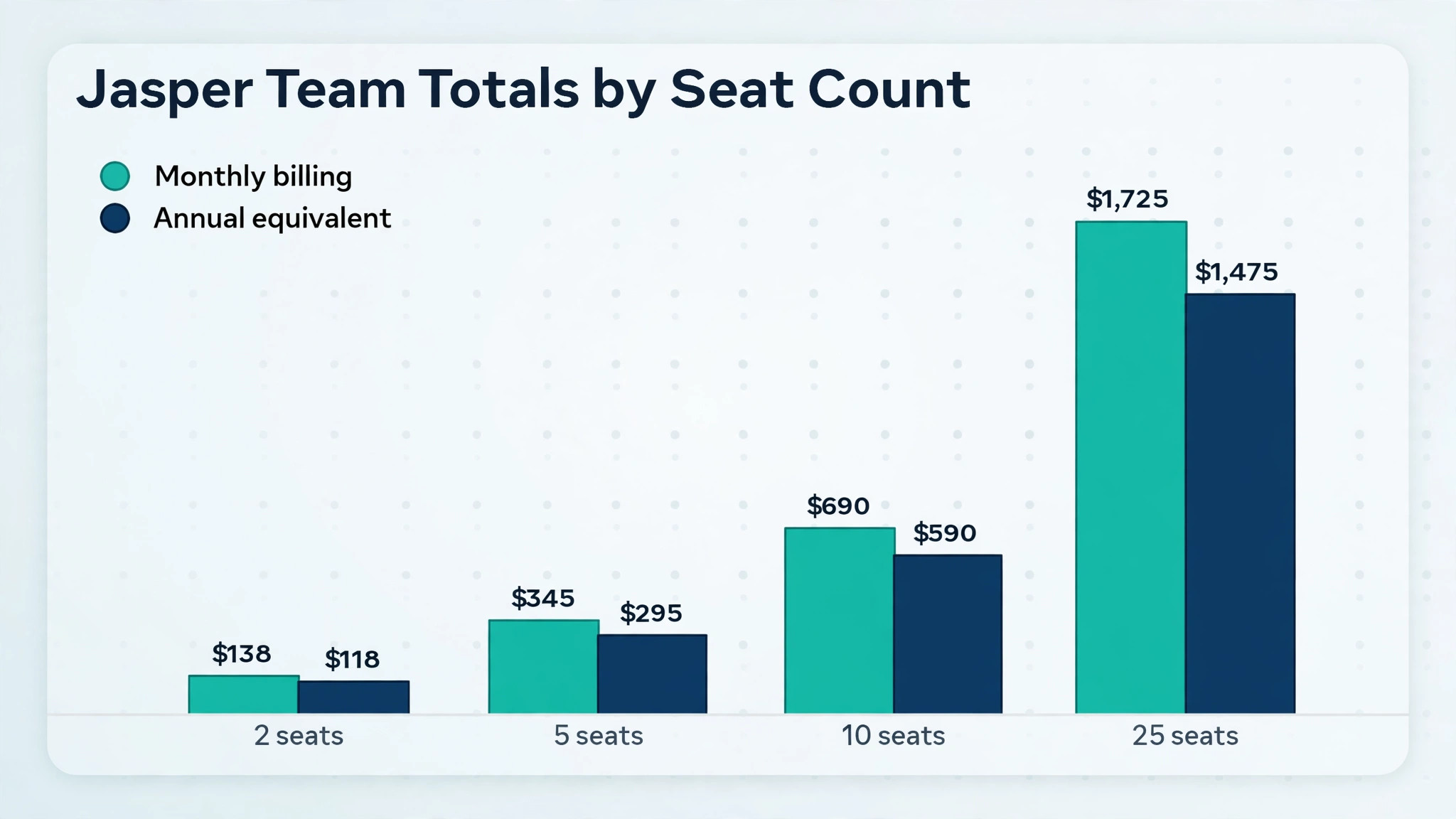
The table below turns the per seat rate into team totals, and it is the clearest way to judge the cost of Jasper for small business monthly at each team size. Annual billing figures show the monthly equivalent of the upfront annual payment, so a team can compare like with like. Business is left as quote only in every row, because inventing a Business figure for larger teams would mislead the reader who needs it most.
| Seats | Monthly billing total | Annual billing equivalent per month | Annual upfront total |
|---|---|---|---|
| 2 | 138 dollars | 118 dollars | 1,416 dollars |
| 5 | 345 dollars | 295 dollars | 3,540 dollars |
| 10 | 690 dollars | 590 dollars | 7,080 dollars |
| 25 | 1,725 dollars | 1,475 dollars | 17,700 dollars |
A two seat team pays 138 dollars a month on monthly billing, which falls to a 118 dollar monthly equivalent on annual billing. The 240 dollar yearly saving is modest in absolute terms, but it is a full free month of Pro for each seat in effect, since annual billing at 59 dollars times 12 equals 708 dollars against 828 dollars on monthly billing. For a team of five, the same choice saves 600 dollars a year, which is more than the cost of one additional annual seat.
At ten seats, the bill reaches 690 dollars a month on monthly billing and 590 dollars on an annual equivalent. That is the point where a finance owner should ask whether all ten people draft weekly. If three of them only review copy, removing those seats saves 207 dollars a month on monthly billing, or 177 dollars on an annual equivalent, without reducing the drafting capacity of the team at all. At 25 seats, the monthly billing total of 1,725 dollars deserves a Business quote comparison, because a volume quote may beat 25 separate Pro seats, but only a written quote can confirm that.
Tax is excluded from the published per seat figures in most pricing coverage, so the checkout total will run higher than the table above in regions where tax applies. Record the checkout total per seat and the team total together when seeking approval, so finance approves the real figure rather than the headline rate. A team that approves 295 dollars a month for five annual seats and then sees a higher invoiced total will treat the tool as a surprise cost, even if the tool itself performs well.
Where the bill grows beyond the seat price
The seat price is the floor, not the ceiling. Several costs sit outside it, and a buyer who ignores them will underbudget even with the right seat count. Work through each item below before signing, because each one can lift the cost of Jasper for small business monthly past the headline rate.
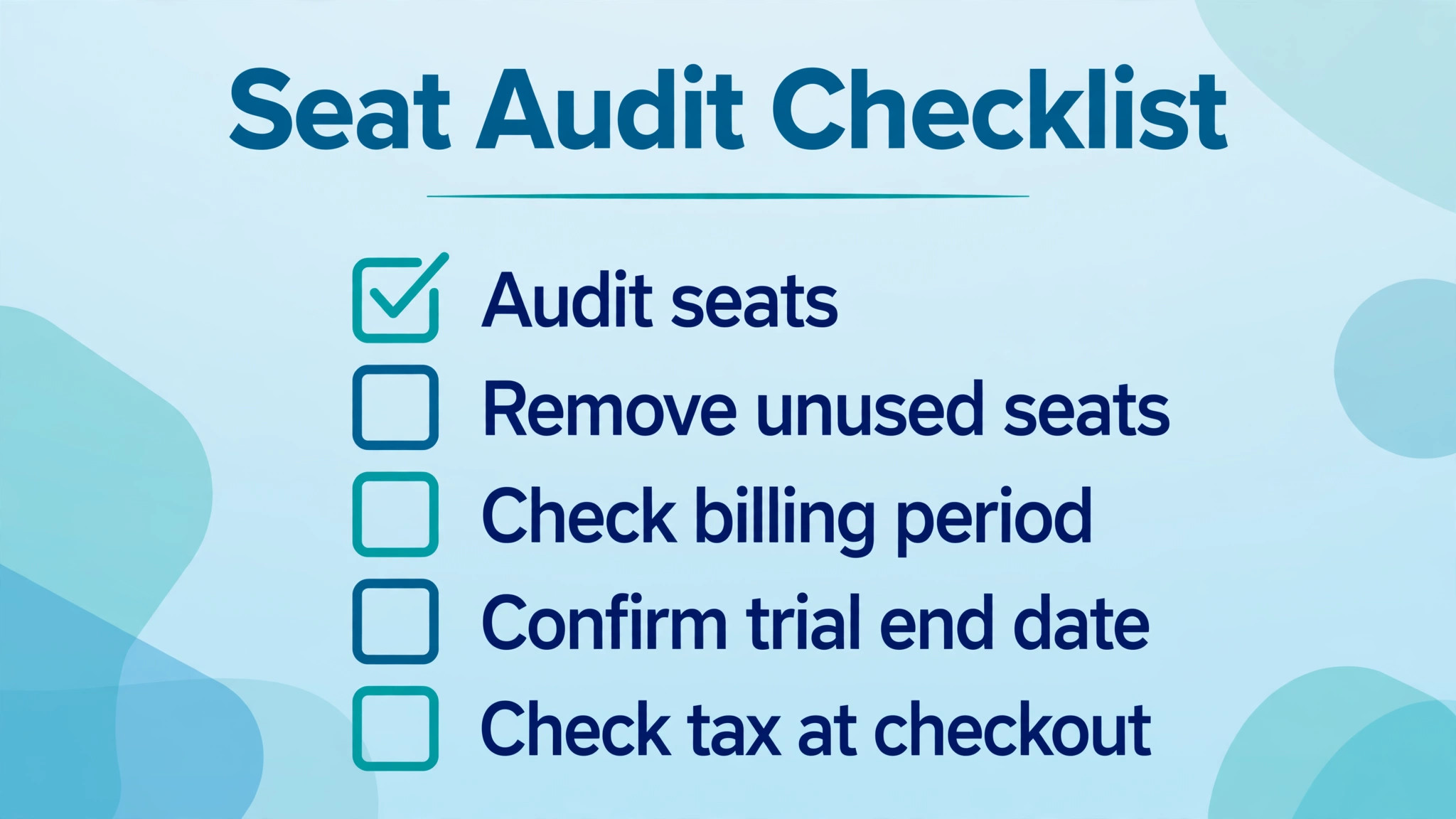
– Unused seats. Seats for leavers, seasonal staff, or staff who rarely draft keep billing until removed. Audit seats every quarter and remove any seat that has not drafted in the past month. – Business quote scope. A Business quote may bundle features the team does not need, such as API access or a dedicated manager. Ask for the quote to separate platform fees from any implementation or support charges. – Annual commitment timing. Annual billing saves 120 dollars per seat per year, but it locks the team in for 12 months. A team that hires, shrinks, or changes tools mid year may pay for seats it no longer needs. – Image and add-on tools. Pricing summaries differ on whether specific image tools sit inside Pro or require a separate arrangement. Confirm at checkout which image features the chosen tier includes. – Trial to paid rollover. The seven day Pro trial converts to paid billing unless cancelled. Set a calendar reminder on day five to decide, so the trial does not become an accidental subscription. – Training time. Jasper only saves time once writers learn to brief it well. Budget a few hours of practice per writer in the first month, because weak briefs produce weak drafts that cost editing time. – Brand voice setup. Building accurate brand voices and knowledge assets takes real work upfront. A team that skips that setup will get generic drafts and may blame the tool for a setup gap.
The largest of these hidden costs is usually unused seats, followed by the annual commitment made too early. Both are avoidable with a short monthly trial and a quarterly seat audit. The smallest hidden cost in cash terms is often the largest in time terms, which is brand voice setup. A team that invests half a day in brand voices, example copy, and knowledge assets will get noticeably closer drafts from the first week, and that setup cost pays back in fewer rewrite rounds.
A second trap is comparing an annual Jasper figure against a monthly rival figure. A rival at 20 dollars a month on monthly billing looks far cheaper than Jasper Pro at 59 dollars on annual billing, but the comparison is only fair when both figures use the same billing period and the same seat count. Write both rivals down as monthly billing totals for the same team size before judging, and include any per seat minimums that apply.
What Pro actually buys a small team
Pro buys drafting speed, not finished copy. A writer can turn a brief into a first draft in minutes, generate several headline or opening options, and rewrite a rough paragraph into clearer wording. That speed matters most for teams that produce similar content repeatedly, such as product descriptions, email sequences, and social posts tied to a regular calendar. The value is measured in drafts started, not in drafts published untouched.
Brand voices are the feature that separates Jasper from a general chatbot for a small business. A brand voice captures tone, vocabulary, and sentence habits from sample copy, so drafts sound closer to the company voice from the start. That matters for client facing copy, where a generic tone can make a careful business sound like every other business online. The limit is that a brand voice only reflects the samples it was given, so a team with thin or inconsistent sample copy will get thin or inconsistent drafts.
Knowledge assets play a similar role for facts. They let the team feed Jasper product details, service descriptions, and company information, so drafts draw on the business own material rather than inventing plausible sounding details. That reduces the risk of a draft that reads well but states a wrong price, feature, or service area. Even with knowledge assets, a human must still check facts, prices, and claims before publication, because an AI draft is a starting point, not a source of truth.
Canvas, the workspace described in Pro coverage, gives writers a place to draft, edit, and organise longer documents rather than working in a single chat thread. That helps for blog posts and guides, where structure matters as much as sentence quality. A team that only writes short social posts may barely use Canvas, while a team that writes weekly long posts will feel its absence in a chat only tool. Judge the workspace by the longest document the team writes each week, not by the shortest.
Two buying paths for a small business
The first path suits a solo owner or a two person team that writes daily. Start on monthly Pro, use the seven day trial to test real briefs, and switch to annual billing once the tool has survived a full month of real work. That path costs 69 dollars per seat for the trial month and then 59 dollars per seat on an annual equivalent, and it avoids paying a year upfront for a tool that may not fit. It also keeps the decision small, which matters when the owner is the writer, the editor, and the approver.
The second path suits a team of five or more where several people draft each week. Run a one month pilot with seats only for the heaviest writers, measure drafts produced and editing time saved, and then decide on annual billing for that proven seat count. A pilot of three seats costs 207 dollars on monthly billing, which is a contained test that produces real evidence. Expanding to five or ten seats after the pilot is easy, while shrinking an annual commitment made too early is not.
Both paths share one rule. Do not buy seats for reviewers, managers, or occasional contributors at the pilot stage. Share drafts through documents and collect feedback there, then add seats only when a reviewer starts drafting regularly. That rule alone can cut a first year Jasper bill by a third for teams that initially request seats for everyone in the department.
A team that writes in more than one brand voice, or serves distinct client groups, should test that specific need during the pilot. Create a second brand voice, draft for a different audience, and check whether the output stays distinct or drifts into one generic tone. If voices blur, the team may need Business features or a different workflow, and learning that during a pilot is far cheaper than learning it after an annual purchase.
A worked month for a five seat team
Take a five person content team on Pro with annual billing. The team pays 295 dollars a month on an annual equivalent, or 3,540 dollars for the year. The same five seats on monthly billing cost 345 dollars a month, or 4,140 dollars for the year. The billing choice alone changes the yearly bill by 600 dollars, which is more than the annual cost of one additional seat at 708 dollars is not, but it is close enough that finance should see the comparison in writing before approving either option.
That worked total is the baseline for the cost of Jasper for small business monthly at five seats. Now add the realistic extras. If one seat belongs to a manager who drafts twice a month, removing that seat saves 59 dollars a month on an annual equivalent, or 69 dollars on monthly billing. If the team forgets to cancel after a failed trial, it pays a full month for seats nobody uses. If the team keeps two unused seats for a full year, it wastes 1,416 dollars on annual billing for no output at all. These are small numbers individually, but they explain why two teams on the same tier can report very different Jasper bills.
The worked month also shows why seat audits beat discount hunting. No published Jasper discount changes the Pro rate as much as removing two unused seats, and no feature negotiation saves as much as choosing annual billing at the right time. A team that audits seats quarterly, switches to annual billing after a proven pilot, and keeps brand voices current will pay the lowest honest price for the output it actually gets.
For a solo writer, the maths is simpler and the decision is sharper. One Pro seat costs 69 dollars on monthly billing or 708 dollars for a year on annual billing. A solo writer who drafts daily and publishes weekly will likely recover that cost in saved drafting time within the first month. A solo writer who drafts twice a month will not, and should either use the trial and stop, or use a cheaper general tool for occasional drafts.
When Jasper earns its seat price, and when it does not
Jasper earns its seat price when the team produces client facing content on a regular schedule and when editing capacity already exists. Blog posts, email sequences, product pages, and social campaigns all benefit from fast first drafts, because the bottleneck is usually starting, not polishing. A team that already has an editor who can check facts, tighten wording, and approve copy will turn Jasper drafts into published work quickly, and the seat price looks small against the output.
It also earns its price when brand consistency matters across several writers. A small team with three writers can drift into three different tones without a shared brand voice, and clients notice that drift even when they cannot name it. Jasper brand voices give those writers a common starting point, which reduces the editing needed to make a set of posts sound like one business. That benefit grows with writer count, which is why a five seat team often gets more value per seat than a solo writer.
Jasper does not earn its price when the team rarely writes, or when no one owns editing. A business that publishes one short post a month will pay 69 dollars for a draft it could write in an afternoon, and the subscription becomes a convenience rather than a capacity tool. A business that publishes Jasper drafts without human review risks factual errors, generic claims, and wording that sounds polished but says little, which can cost more in credibility than the subscription saves in time.
It is also a weak fit when the work is highly technical, regulated, or fact dense and no subject expert checks the output. Jasper can draft around a topic fluently while getting details wrong, and fluency makes errors harder to spot. In that pattern, the team needs expert review time that may erase the drafting saving, and a cheaper drafting aid plus expert time may serve better than a premium seat for every writer.
How to cut the bill without cutting output
Cutting the cost of Jasper for small business monthly starts with billing period, because it is the largest honest lever. Switch from monthly to annual billing once the team has used Pro for a full month and is committed, and the saving is 10 dollars per seat per month, or 120 dollars per seat per year. That saving applies to the same product on the same tier, which makes it the cleanest saving available. Do not switch before the pilot proves the fit, because an annual commitment made to chase a discount can become the most expensive decision in the purchase.
Audit seats quarterly and remove leavers, dormant accounts, and staff who only review drafts. A team that removes two unused seats on annual billing saves 118 dollars a month on an annual equivalent for two seats, or 1,416 dollars a year, without any loss of drafting capacity. Seat audits should be a calendar task owned by one person, because seats accumulate silently when staff change roles or leave.
Use brand voices and knowledge assets properly rather than treating Jasper as a blank chat box. Good briefs, accurate samples, and current product facts produce drafts that need fewer rewrite rounds, which means fewer seats need to be involved in each piece. A team that briefs well can produce the same weekly output with three active seats that a poorly briefed team struggles to produce with five.
Consolidate drafting tools before adding Jasper. A firm that pays for a general chatbot subscription, a separate rewriting tool, and Jasper may duplicate features that Pro already includes. List every writing tool, note what each one does that Pro does not, and cancel the duplicates. The saving is often larger than the Jasper subscription itself, and the workflow becomes simpler for writers who previously switched between three tools.
Finally, review use before renewal. If the team drafts weekly, publishes regularly, and can show editing time saved, annual renewal is easy to justify. If use is thin, the answer may be training, a smaller seat count, or a pause rather than a blanket renewal for the whole team. Data from the pilot month, not habit, should drive the renewal decision.
Checks to run on the pricing page before you pay
Confirm that Pro is the current entry tier for new buyers, because older guides still describe a Creator tier at 39 dollars on annual billing or 49 dollars on monthly billing. Recent pricing coverage reports that Creator no longer appears for new buyers, and the entry point is Pro at 59 dollars on annual billing or 69 dollars on monthly billing. A budget built on the Creator figure will understate the first year cost by 240 dollars per seat, and that gap is large enough to break a small content budget.
Confirm both Pro billing periods before choosing, because a pricing page may default to annual billing and hide the monthly figure. Annual billing is 59 dollars per seat per month with 708 dollars paid upfront per seat, and monthly billing is 69 dollars per seat per month, on the figures checked in October 2026. Record the figure that matches the commitment you intend to make, and do not compare an annual Jasper figure against a monthly rival figure.
Confirm the Business route, because Business is priced by quote only and no published per seat price could be verified at draft time. A team that needs unlimited brand voices, API access, or single sign-on should request a written quote early and get the commitment term in writing, because recent coverage reports a 12 month commitment for Business. Treat any Business estimate without a quote as a placeholder, not a budget.
Confirm the trial terms at signup, because the seven day Pro trial converts to paid billing unless cancelled. Note the trial end date, the billing period selected, and the cancellation steps before entering payment details. Check tax at checkout as well, because published per seat figures exclude tax in most coverage, and the checkout total for the team is the budget figure finance should approve.
Frequently Asked Questions
How much does Jasper Pro cost per month?
Pro costs 69 dollars per seat per month on monthly billing and 59 dollars per seat per month on annual billing, with 708 dollars per seat paid upfront for the year. Those figures come from pricing pages and pricing guides checked in October 2026. Business pricing is quote only, so no published per seat figure exists for that tier.
Is there still a Jasper Creator plan?
Older guides describe a Creator tier at 49 dollars on monthly billing or 39 dollars on annual billing. Recent pricing coverage reports that Creator no longer appears as the entry tier for new buyers, and the current entry point is Pro. A new buyer should budget from Pro figures and confirm the current tiers on the pricing page at signup.
How much does Jasper cost for a team of five?
For the cost of Jasper for small business monthly at five seats, Pro costs 345 dollars a month on monthly billing, or 295 dollars a month on an annual equivalent with 3,540 dollars paid upfront for the year. The billing period alone changes the yearly bill by 600 dollars for a five seat team. Removing unused seats saves more than any published discount on the same tier.
Does Jasper offer a free plan?
No permanent free plan could be verified at draft time. Jasper offers a seven day free trial on Pro, which converts to paid billing unless cancelled. A team that wants to test Jasper should use the trial on real briefs and set a reminder before the trial ends.
How much does Jasper Business cost?
Business pricing is quote only, and no published per seat price could be verified at draft time. It adds unlimited brand voices, knowledge assets, and audiences, plus advanced agents, a no-code agent builder, API access, and admin controls. Request a written quote and confirm the commitment term before budgeting Business.
Can a small team start on one seat and add seats later?
Yes. Pro is sold per seat, so a team can start with one seat, test the workflow, and add seats as more writers draft regularly. That staged approach keeps the first month bill at 69 dollars on monthly billing for a single seat, and it produces real usage evidence before the team commits to annual billing.
Is Jasper worth it for a solo small business owner?
It depends on writing volume. A solo owner who drafts and publishes weekly will likely recover a 69 dollar monthly seat in saved drafting time. A solo owner who writes twice a month will struggle to justify the same seat, and should test the trial honestly before subscribing. Writing volume, not business size, decides the answer.
Verdict
For most small businesses that write weekly, Jasper Pro on annual billing after a proven monthly pilot is the sensible answer for the cost of Jasper for small business monthly, at 59 dollars per seat per month on an annual equivalent, with seats only for staff who draft every week. That shape buys fast first drafts, brand voices, and a shared workspace for less than the cost of a few hours of freelance writing per seat per month. Business should only be priced when a Pro limit actually blocks the work, and its quote only price means it cannot be budgeted from a headline figure.
Start on monthly billing, audit seats quarterly, and switch to annual billing once the pilot proves the fit. Do that, and Jasper becomes a predictable content cost tied to real output. Skip the pilot, buy seats for everyone, and stay on monthly billing by default, and the same tool will cost far more for the same drafts, which is a buying mistake rather than a product failure.
More Reading on Stratilyze
– Cost of Grammarly for a Small Business, Monthly – Cost of DocuSign for a Small Business, Monthly – Cost of Zapier for a Small Business, Monthly – Best Website Builder for Wedding Photographers (12 Tools) – Best Class Management Software for Art Studios (5 Tools)