
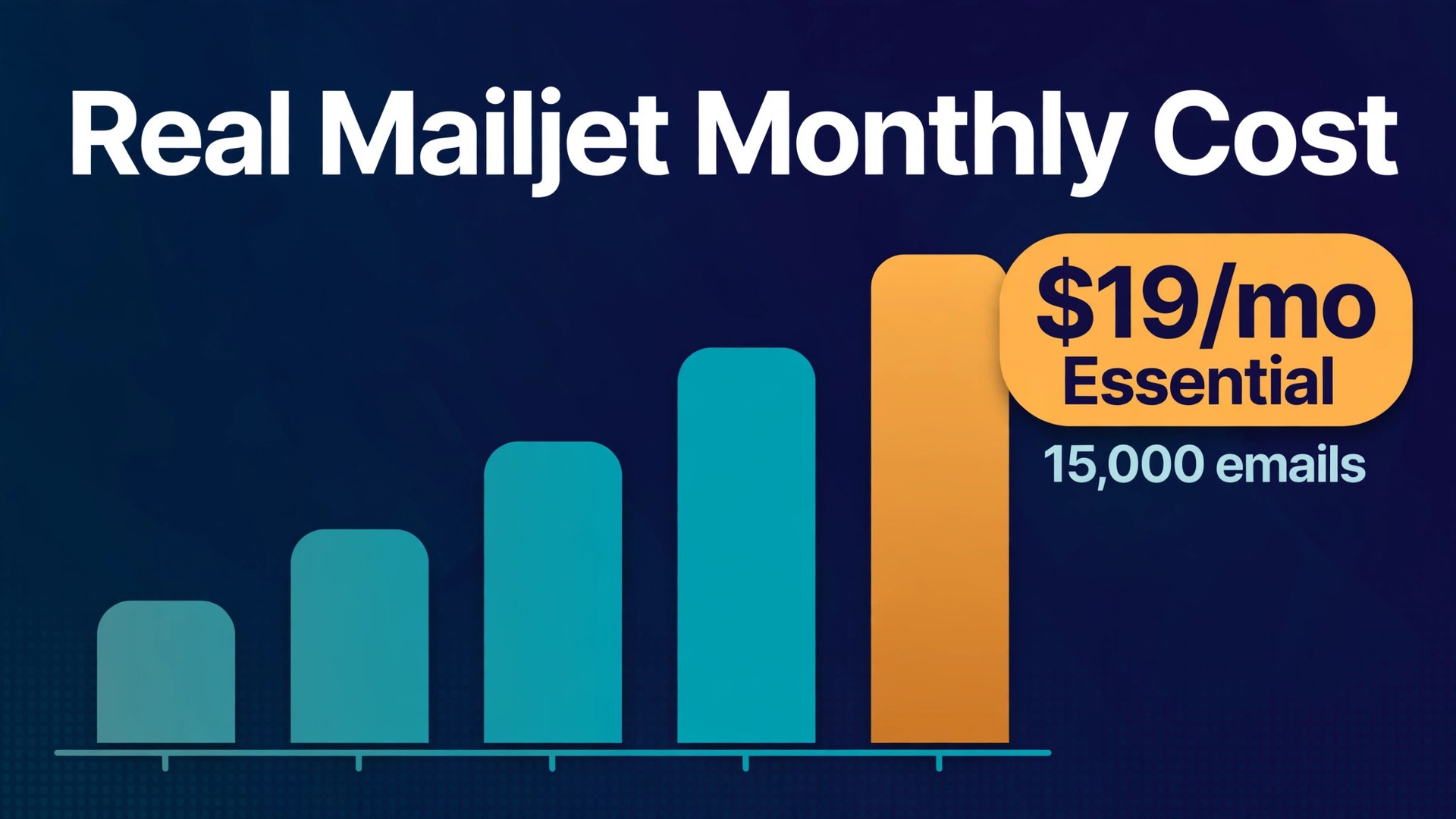
Verdict first. Most small businesses that send a regular newsletter or order emails will land on Essential at 19 dollars a month, and will only need Premium at 29 dollars a month once automations, landing pages, or team controls become part of daily work. That verdict is the short answer to the cost of Mailjet for small business monthly planning, and the rest of this guide tests it against published prices, sending volumes, and the fees that sit outside the headline figure.
Mailjet charges by emails sent, not by contacts stored. That single fact shapes every number in this guide. A shop with a large list that emails rarely can pay less than a shop with a small list that emails every week, because the bill follows sends. From the Essential plan upward, contacts are unlimited, so list growth alone does not push the price up. Sending growth does.
This guide is written for an owner who already has a list, or who is building one, and who wants a straight monthly figure before a trial turns into a subscription. Prices below come from pricing guides that cite the vendor pricing page in September and October 2026, after a price update in September 2026. Confirm the live pricing page before you pay, because Mailjet changes volume rungs and plan names from time to time, and because listed prices exclude taxes.
Verdict on the Cost of Mailjet for Small Business Monthly
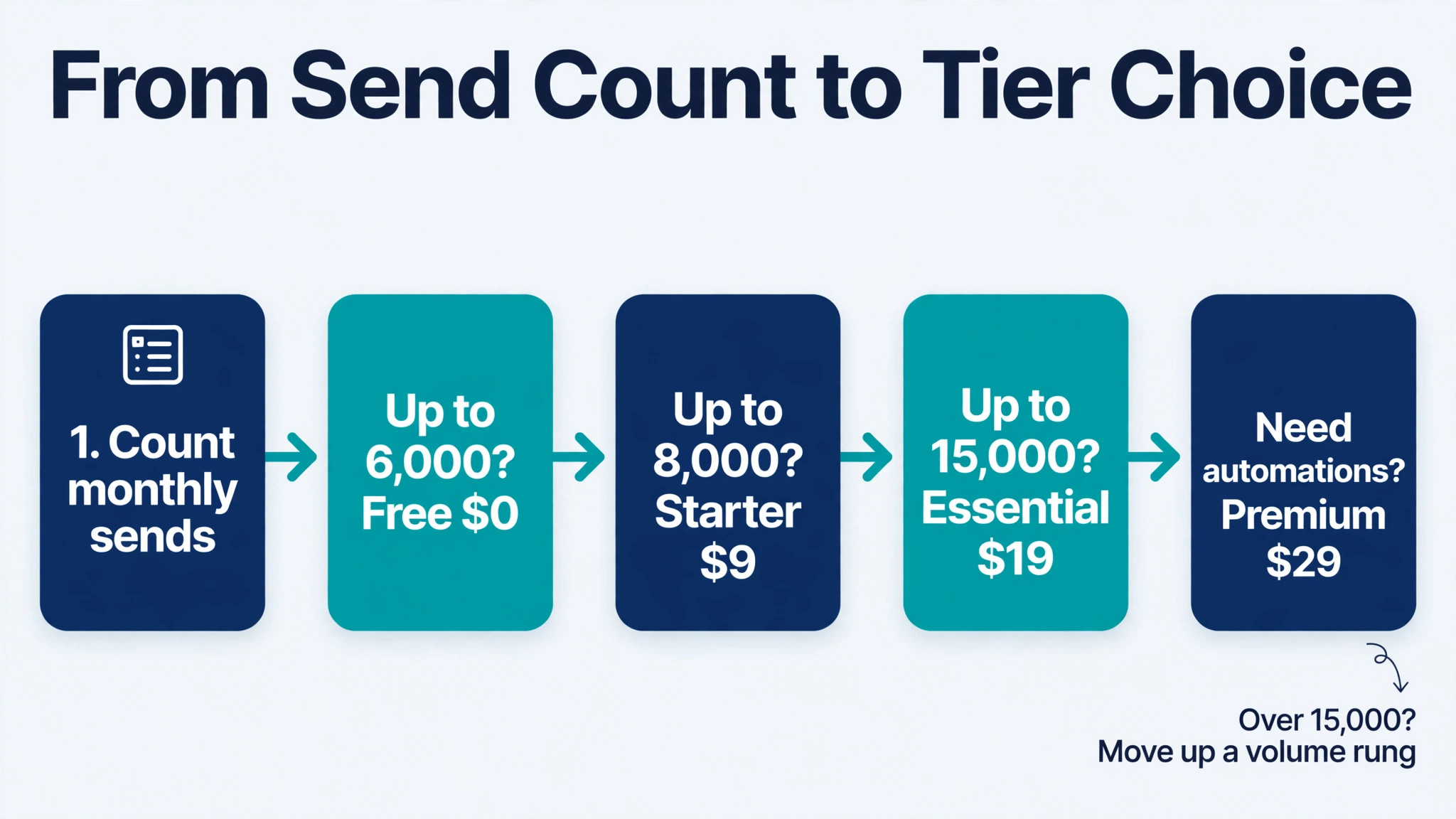
Start with the free plan only if sending stays under 6,000 emails a month and under 200 emails a day. That daily cap is the detail that catches new users. A list of 1,000 contacts mailed once a week needs about 4,000 sends a month, which fits the monthly total, but a single campaign to that whole list in one day would break the daily cap. The free plan therefore suits testing, a tiny list, or transactional mail at low volume, not a growing newsletter.
Starter at 9 dollars a month removes the daily cap and covers 8,000 emails to 2,000 contacts. It suits a solo operator with a small list and simple campaigns. Its limit is not price but scope. It has no segmentation, no automation, and no landing pages, so a business that wants to send different messages to buyers and browsers will outgrow it fast. Paying 9 dollars for a plan that cannot target properly is only cheap if targeting never matters to your sales.
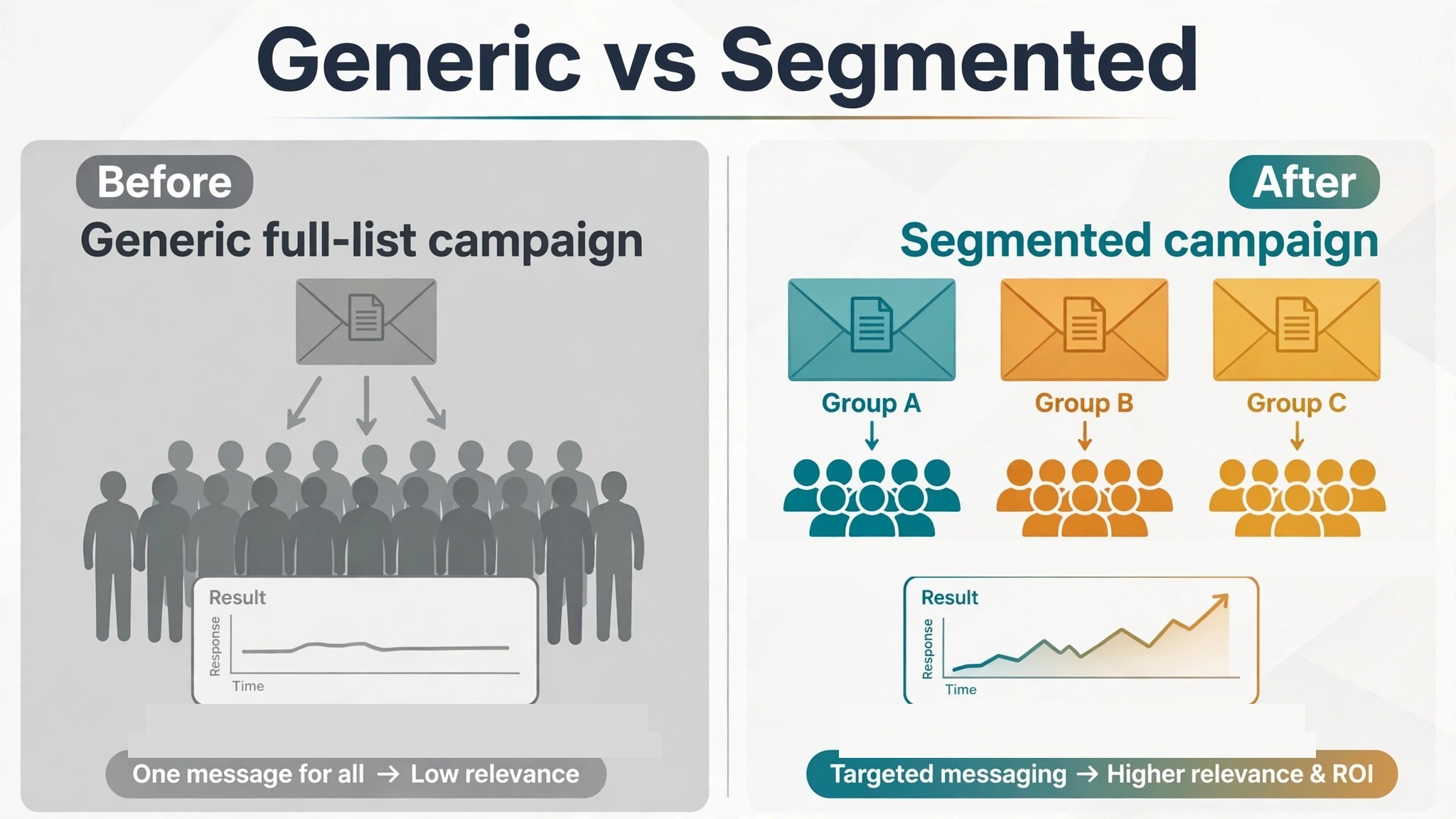
Essential at 19 dollars a month for 15,000 emails is where most small businesses should start. It adds unlimited contacts, segmentation, AI assisted content, email validations, and removal of the Mailjet logo. Those are not decorative extras. Segmentation is what turns a generic newsletter into a message that matches what a customer bought or browsed, and that targeting is where email earns its money. A business that mails a full list with one message every time will get less from Essential than a business that splits the list by behaviour, even though both pay the same price.
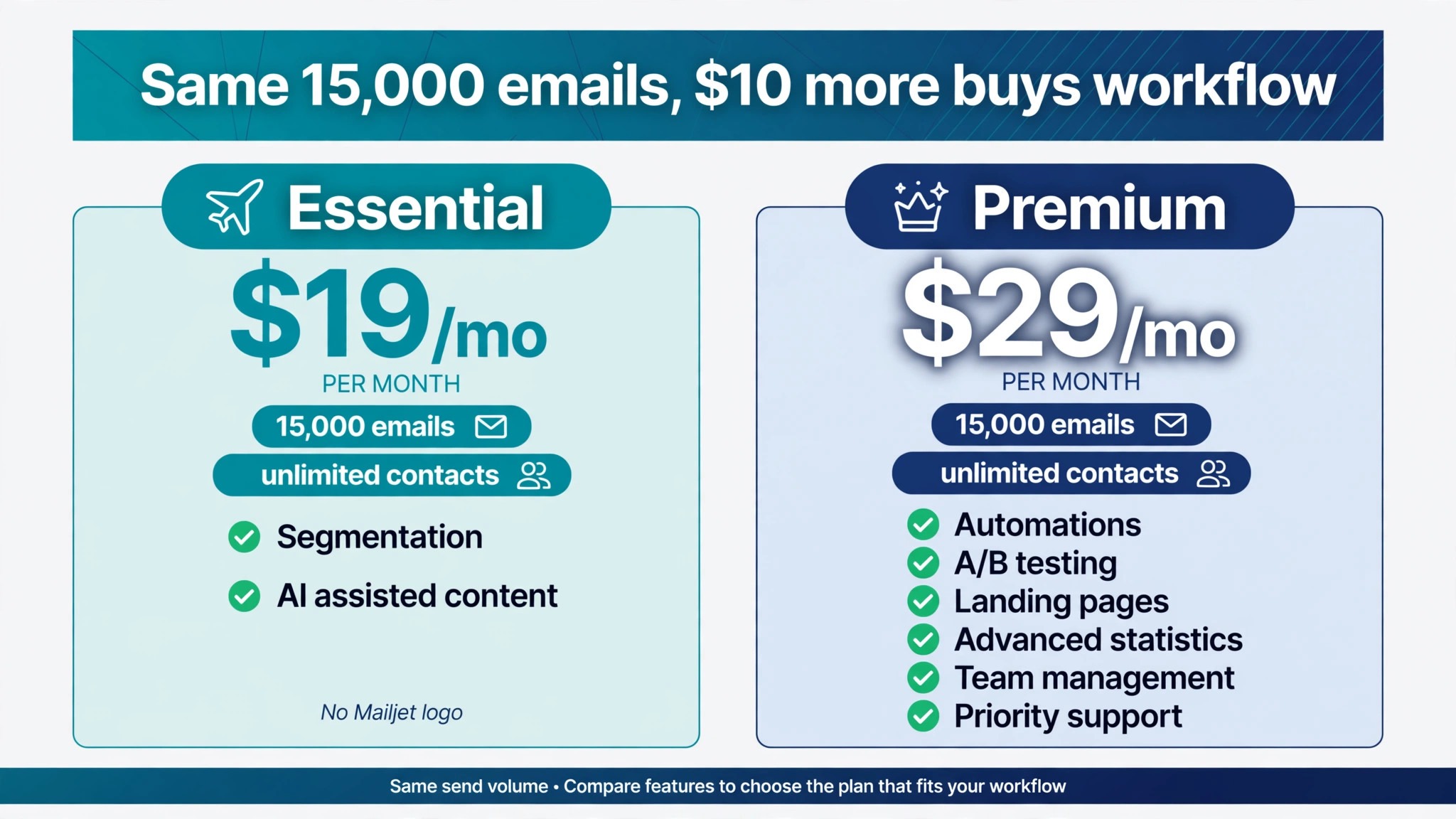
Premium at 29 dollars a month for the same 15,000 emails adds automations, A/B testing, landing pages, advanced statistics, team management, and priority support. The 10 dollar gap between Essential and Premium buys workflow, not volume. If you run a welcome series, an abandoned cart series, or a post purchase series, Premium pays for itself in saved manual work. If you send one newsletter a month by hand, Premium adds cost without adding return, and Essential is the better buy.
Custom pricing covers high volume senders with a dedicated technical account manager, a dedicated IP strategy, and deliverability reports. A small business does not need to price this tier until sending passes 100,000 emails a month or deliverability becomes a specialist problem. Treat it as a later conversation, not as a starting tier.
Published Plans and What Each One Includes
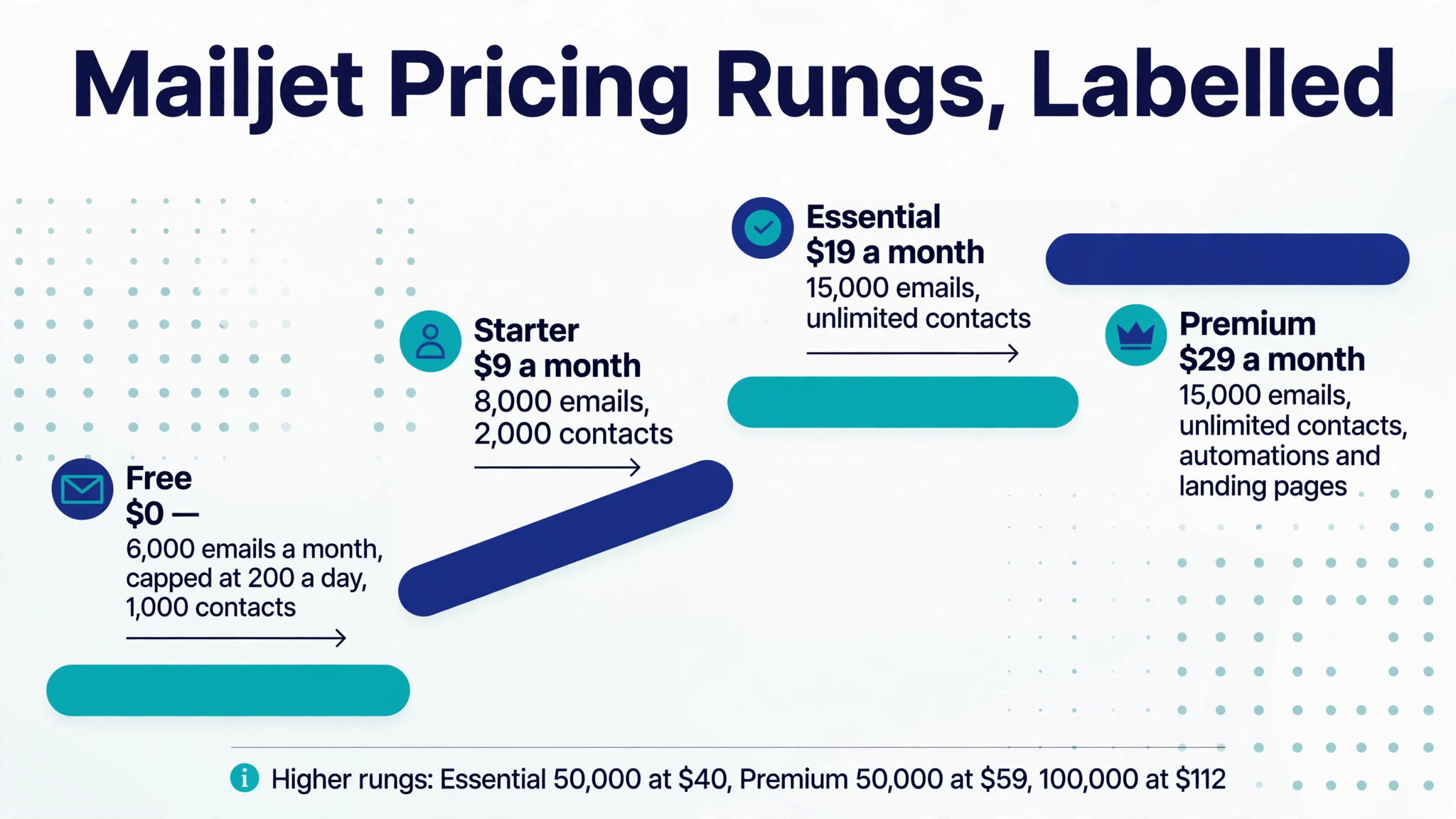
Mailjet sells five levels. Free, Starter, Essential, and Premium carry published starting prices, and Custom is priced by quote. The table below states the starting volume for each plan, because the starting price only covers that volume. Larger volumes cost more on the same plan.
| Plan | Starting price | Monthly emails at starting price | Contacts | Main inclusions |
|---|---|---|---|---|
| Free | 0 dollars | 6,000, capped at 200 per day | 1,000 | API, SMTP relay, editor, form builder |
| Starter | 9 dollars per month | 8,000, no daily cap | 2,000 | Brand kit, online support, 1 subaccount |
| Essential | 19 dollars per month | 15,000 | Unlimited | Segmentation, AI assisted content, no Mailjet logo, 500 validations |
| Premium | 29 dollars per month | 15,000 | Unlimited | Automations, landing pages, advanced statistics, team management, priority support |
| Custom | Priced by quote | High volume | Unlimited | Dedicated technical account manager, dedicated IP strategy, deliverability reports |
Volume rungs above the starting price matter for a growing sender. Pricing guides checked in October 2026 put Essential at 40 dollars a month for 50,000 emails and Premium at 59 dollars a month for the same volume. Premium at 100,000 emails is listed at 112 dollars a month, at 250,000 emails at 265 dollars a month, and at 500,000 emails at 499 dollars a month. Those rungs show why a business should forecast sends for a busy month, not an average month. A seasonal sale that doubles sending can push a business up two rungs in a single month, and the bill follows.
Annual billing saves 10 percent against monthly billing on paid plans, according to pricing guides checked in October 2026. That saving is modest beside the 20 to 30 percent discounts some rivals offer, but it is real money over a year. Essential on annual billing works out at about 17.10 dollars a month, against 19 dollars billed monthly. Premium works out at about 26.10 dollars a month, against 29 dollars billed monthly. The saving is only worth taking once sending volume has settled, because an annual plan locks in a volume rung that a growing list may outgrow.
Transactional email is included from the free plan through the API and SMTP relay, which is a genuine advantage for a small shop. Order confirmations, password resets, and shipping notices can run through the same account as marketing mail, without a second vendor. That matters for budgeting, because a shop that pays one vendor for marketing mail and another for transactional mail often pays two minimums for one job.
When you model the cost of Mailjet for small business monthly use, count both streams together, because a shop that forgets transactional sends will understate its rung. Mailjet also sells transactional SMS, priced by country and volume, with larger volumes costing less per message. SMS is a separate line, not part of the email plan price, so a business that adds SMS should budget it apart from the email subscription.
Real Monthly Cost by Team Size
Email pricing does not follow headcount the way chat pricing does, so a team size table for Mailjet needs a clear basis. The table below pairs each team size with a sending volume and a tier that fits that team in practice. A two person shop usually sends less and needs fewer controls than a 25 person business with several people touching campaigns. Seats alone do not change the Mailjet price, but team size is a fair proxy for volume, list size, and the need for team management on Premium.
| Team size | Assumed monthly sends | Fitting tier | Monthly billing | Annual billing equivalent per month | Add-ons and hidden fees to add |
|---|---|---|---|---|---|
| 2 seats | 15,000 | Essential | 19 dollars | About 17.10 dollars | SMS priced separately by country and volume |
| 5 seats | 15,000 | Premium | 29 dollars | About 26.10 dollars | SMS priced separately, extra sends above the rung |
| 10 seats | 50,000 | Premium | 59 dollars | About 53.10 dollars | SMS priced separately, extra sends above the rung |
| 25 seats | 100,000 | Premium | 112 dollars | About 100.80 dollars | Dedicated IP available on Premium at this volume, SMS priced separately |
Read the table as a planning model, not as a quote. A two seat business that mails 50,000 times a month pays the 50,000 rung, not the two seat figure, because Mailjet bills sends. A 25 seat business that mails only 15,000 times a month pays the 15,000 rung, but will still want Premium for team management and automations. The honest way to judge the cost of Mailjet for small business monthly budgets is to find your real monthly send count first, then read across to the tier and price for that count, and then check whether your team needs the controls that come with Premium.
The annual column uses the published 10 percent discount, so annual totals are 205.20 dollars for the two seat model, 313.20 dollars for the five seat model, 637.20 dollars for the ten seat model, and 1,209.60 dollars for the 25 seat model. Those totals exclude taxes, because Mailjet listed prices exclude VAT, and they exclude SMS. A business in a region where VAT applies should add it to every figure in this guide before comparing Mailjet with a rival that quotes tax inclusive prices.
One more cost hides inside the volume model. Unused email credits do not roll over to the next month. A business on a 15,000 email plan that sends 12,000 emails in a quiet month loses the remaining 3,000 credits at the end of the billing cycle. That rule punishes overbuying, so size the plan for a typical month rather than the busiest month on record, and accept that a rare peak month may cost a rung upgrade rather than paying for unused capacity all year.
Fees and Limits That Change the Total
The daily cap on the free plan is the first trap. It is easy to read 6,000 emails a month and miss the 200 per day limit, then discover that a campaign to 1,000 contacts cannot go out in one send. Paid plans remove the daily cap, which is one of the strongest reasons for a small business to move off free even when the monthly total still fits. A campaign that cannot go out on launch day costs more in lost sales than the 9 dollar Starter price.
Extra emails above a plan rung are billed per additional 1,000, according to Mailjet pricing guides, but the per thousand price for overage is not published as a single headline figure, so a business that regularly exceeds its rung should check the vendor pricing page for the current overage terms before budgeting. The safer habit is to treat the next rung as the real price once sending passes a rung twice in three months. Paying for overage month after month is usually dearer than moving up a rung, and it leaves no headroom for a busy campaign.
The dedicated IP is the second limit to note. It is available only on Premium, and only from 100,000 emails a month, with a request to the support team for approval. A small sender that wants a dedicated IP for reputation reasons cannot buy one at low volume on Mailjet, and should not budget for it. Shared IPs are the norm at small business volume, and sender reputation at that volume depends far more on list hygiene, bounce handling, and complaint rates than on IP ownership.
Email validations are the third small print item. Essential includes 500 validations a month, and Premium at very high volume includes more, but heavy validation use beyond the included amount is not published as a fixed price. A business that imports large lists often, or that cleans a bought list, should confirm validation pricing in writing. The better habit is to validate at signup with a form that blocks obvious typos, which keeps validation use low and list quality high without paying for repeated cleaning.
Taxes are the fourth item. Listed prices exclude VAT, so a European small business will pay more than the headline figure. That is not a hidden fee in the dishonest sense, because it is stated on the pricing page, but it is a real difference when comparing Mailjet with a rival that quotes prices including tax. Always compare tax inclusive totals, or the comparison will favour whichever vendor quotes tax exclusive prices.
Finally, Mailjet offers no refunds on prepaid plans, monthly or annual, except for double payments or service interruptions caused by technical issues, according to pricing guides. That policy makes the trial and the first monthly billing period important. Test sending, deliverability, and the editor on monthly billing before committing to annual billing, because annual billing saves 10 percent but removes the easy exit if the tool does not fit.
A careful buyer also checks the cost of Mailjet for small business monthly billing against a rival quote on the same tax basis, since a tax exclusive price can look cheaper than a tax inclusive price for the same service. Add a paragraph to your budget note for taxes, SMS, and overage, so the headline price never becomes the whole budget by accident.
A Small Shop Worked Out in Sends and Dollars
A two person online shop with 3,000 contacts shows how the volume maths works. Mailed once a week, that list needs about 12,000 sends a month, which fits Essential at 19 dollars a month, or about 17.10 dollars on annual billing. Add a welcome series for new subscribers, and sending rises, but only by the number of new subscribers times the number of messages in the series. If 200 new subscribers join each month and the welcome series has three messages, that adds 600 sends, taking the total to about 12,600, still inside Essential.
Now add a monthly sale campaign. A sale week that mails the full list three times instead of once adds about 6,000 extra sends in that month, taking the total to about 18,600. That month exceeds the 15,000 rung, so the shop either pays overage or moves to the next rung for that month. Over a year with four sale months, the shop should budget for the higher rung in those months rather than pretending every month costs 19 dollars. That single adjustment is the difference between a budget that holds and a budget that surprises the owner four times a year.
A five person shop with automations tells a different story. The same 3,000 contact list on Premium at 29 dollars a month gets the welcome series, the abandoned cart series, and the post purchase series without manual sends. Each automation adds sends, but each automation also recovers sales that manual newsletters miss. An abandoned cart series that mails 500 carts a month with three messages adds 1,500 sends, which still fits inside 15,000 for a shop of this size. The Premium price is justified not by volume but by the work the automations do while the team serves customers.
A ten person business mailing 50,000 times a month shows the rung jump clearly. At 59 dollars a month on Premium, or about 53.10 dollars on annual billing, the business pays roughly three times the starting Premium price for roughly three times the volume. That scaling is fair, but it means growth in sending is growth in cost at nearly the same rate.
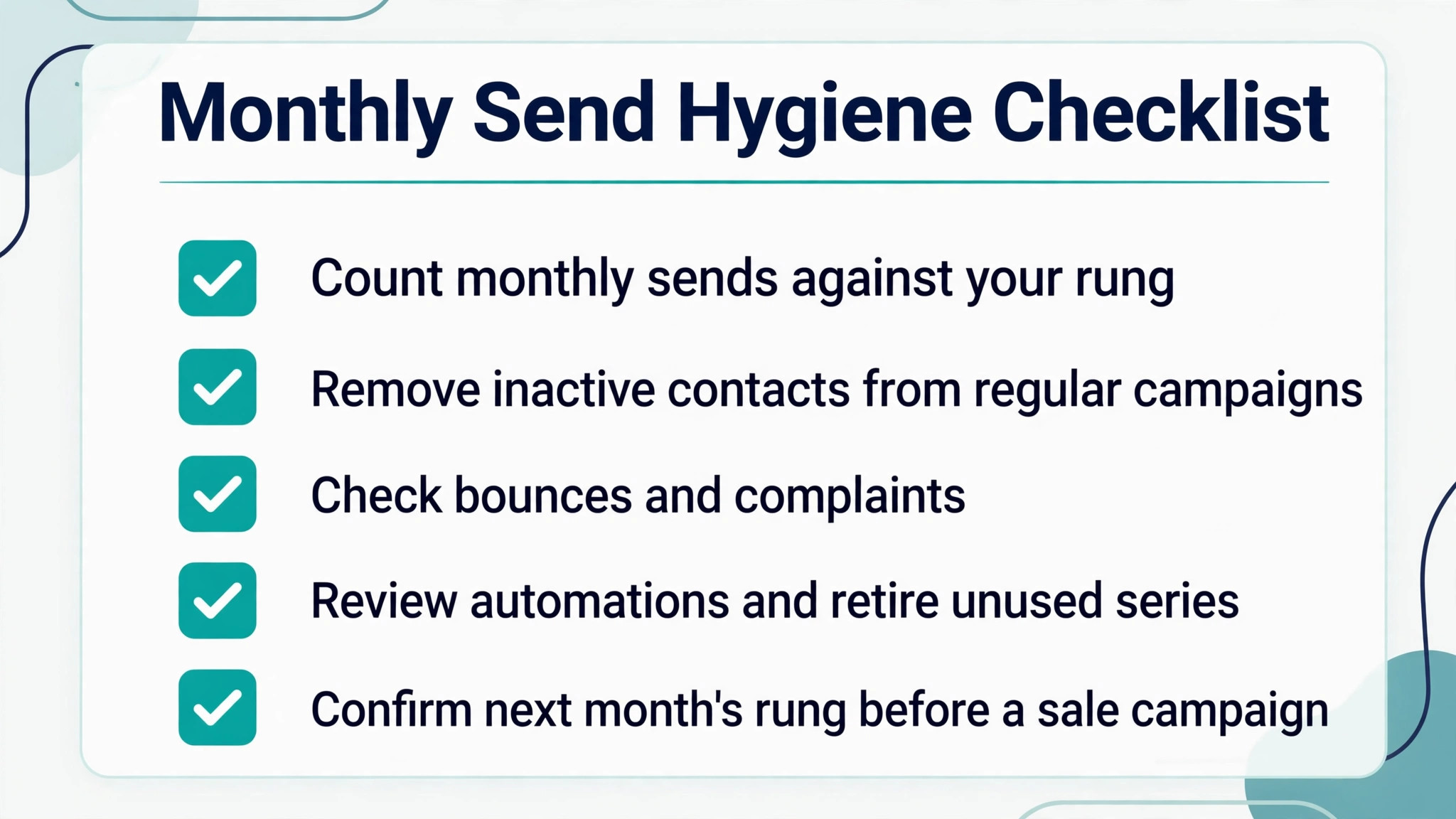
When you forecast the cost of Mailjet for small business monthly growth, model the next rung as well as the current rung, because a business that only budgets the rung it sits on today will be surprised by the first month it crosses into the next rung. The control for that cost is list hygiene. Removing inactive contacts does not reduce the Mailjet bill directly, because billing follows sends, but it does reduce wasted sends. Every campaign mailed only to contacts who opened in the last six months sends fewer emails for the same sales, which keeps the business on a lower rung for longer.
When Mailjet Is Worth It and When It Is Not
Mailjet is worth the price when sending volume is the main cost driver and the list is large relative to sending frequency. A business with 20,000 contacts that mails twice a month pays for 40,000 sends, not for 20,000 contacts, and on Mailjet that is cheaper than on a rival that charges per contact.
The same logic favours a business that stores a large list for seasonal campaigns but mails rarely. Judged purely on the cost of Mailjet for small business monthly sending, a seasonal business wins twice, because contacts sit free from Essential upward and quiet months cost only the base rung. Contacts sit free from Essential upward, so a seasonal business does not pay a storage tax in quiet months.
Mailjet is also worth the price when transactional email matters. A shop that needs order confirmations, shipping notices, and password resets through an API can run those through the same account, with the same sender reputation work, rather than managing a second vendor. That consolidation saves both money and setup time, and it keeps transactional mail under the same deliverability practices as marketing mail.
Mailjet is not worth the price when automation is the core need and the budget only stretches to Essential. Essential has no automations, so a business that buys Essential expecting a welcome series will be disappointed on day one. That business should either pay for Premium or choose a rival that includes automations at a lower tier. Buying the wrong tier and then paying for a second tool to cover automations is the most expensive outcome in this guide.
Mailjet is also a weak fit when SMS is central. SMS is sold separately by country and volume, and Mailjet is an email specialist, not an SMS platform. A business that wants email, SMS, and push in one plan with one allowance should compare rivals that bundle those channels, and should price SMS at its real monthly volume before deciding. An email plan that looks cheap becomes dear once SMS is added at per message rates.
A third weak fit is a business that needs a dedicated IP at low volume, or that needs advanced deliverability consulting from day one. Those services sit on Custom or at high volume on Premium, so a small sender with a deliverability problem will not solve it by paying more for the same plan. That sender should fix list quality, authentication, and sending practices first, because those fixes cost time rather than a higher tier.
How to Cut the Bill Without Losing Reach
Cut wasted sends before cutting tiers, because wasted sends are the cost that a tier change alone cannot fix. Mail only to contacts who have engaged in the last six to twelve months for regular campaigns, and move older contacts to a re-engagement campaign with a clear opt in step. A list that shrinks by a third but keeps its buyers will cost less to mail and will usually produce the same sales, because the removed contacts were not opening anyway. That single habit can hold a business on a lower volume rung for a year or more.
Size the plan for a typical month, not for a peak month, and accept a rung upgrade in a sale month. The no rollover rule means unused credits are wasted money, so a plan sized for the busiest month wastes capacity in every quiet month. Track sends monthly for three months before choosing annual billing, because annual billing locks in a rung. A business that is still growing should stay on monthly billing until the send pattern is stable, even though annual billing saves 10 percent.
Use automations only where they replace manual work with a clear return. A welcome series and an abandoned cart series earn their sends, because each send goes to a person who just acted. A long nurture series mailed to every new subscriber regardless of interest burns sends on people who never open. Review automation sends each quarter, retire series that nobody opens, and shorten series that lose readers after the second message. That review is the most honest control on the cost of Mailjet for small business monthly spending, because it ties every send to a result.
Finally, keep transactional and marketing mail on the same account where it fits, but keep their reputations separate in practice. Use a separate sending domain or subdomain for transactional mail, authenticate it properly, and monitor bounces and complaints for each stream. A marketing campaign that hurts reputation should not block order confirmations, and a transactional stream with clean engagement can protect overall deliverability. That separation costs setup time, not subscription money, and it protects revenue far beyond the monthly plan price.
Frequently Asked Questions
How much does Mailjet cost per month for a small business?
Most small businesses pay 19 dollars a month for Essential at 15,000 emails, or 29 dollars a month for Premium at the same volume, with annual billing working out at about 17.10 dollars and 26.10 dollars a month respectively. Starter at 9 dollars a month covers 8,000 emails, and the free plan covers 6,000 emails a month capped at 200 per day. Higher volumes cost more on the same plan, with Premium at 50,000 emails listed at 59 dollars a month and at 100,000 emails at 112 dollars a month.
Does Mailjet charge by contacts or by emails sent?
Mailjet charges by emails sent, not by contacts stored, and contacts are unlimited from the Essential plan upward. That makes it cheaper than contact based rivals for a large list mailed rarely, and dearer for a small list mailed very often. Forecast monthly sends, not list size, before choosing a tier, and recheck the cost of Mailjet for small business monthly totals after your first three months of real sends, because the forecast and the real send count rarely match in the first quarter.
Is the Mailjet free plan enough for a small business?
The free plan suits testing and very low volume sending, with 6,000 emails a month, 1,000 contacts, and a 200 per day cap. It does not suit a regular newsletter to a growing list, because a single campaign can break the daily cap, and it has no segmentation or automations. Treat it as a trial, not as a permanent tier for a trading business.
Essential and Premium start at the same 15,000 email volume, so the 10 dollar gap buys features, not sends. Essential adds segmentation, AI assisted content, logo removal, and validations. Premium adds automations, A/B testing, landing pages, advanced statistics, team management, and priority support. Choose Premium when automations or team controls are part of daily work, and Essential when a monthly newsletter is the main job.
Does Mailjet include a dedicated IP?
A dedicated IP is available only on Premium and only from 100,000 emails a month, with approval from the support team. Small senders use shared IPs, and at small business volume, list hygiene and authentication matter more for deliverability than IP ownership. Do not budget for a dedicated IP until sending reaches that volume.
Can a small business pay annually for Mailjet?
Yes, annual billing saves 10 percent against monthly billing on paid plans. Essential works out at about 17.10 dollars a month on annual billing, and Premium at about 26.10 dollars a month. Pay monthly for two or three months first, until sending volume is stable, then switch to annual billing on the rung that fits.
Does Mailjet charge extra for SMS?
Yes, transactional SMS is priced separately by country and volume, with larger volumes costing less per message. SMS is not part of the email plan price, so a business that adds SMS should budget it as a separate line and compare bundled SMS rivals at its real monthly SMS volume.
Verdict
Essential at 19 dollars a month is the right starting tier for most small businesses, because it covers 15,000 sends with unlimited contacts and segmentation, and annual billing brings it to about 17.10 dollars a month once volume is stable. Premium at 29 dollars a month becomes the right tier when automations, landing pages, or team controls do daily work, and Custom remains a later conversation for high volume senders. Size the plan by sends, watch the volume rungs in sale months, and confirm the live pricing page before you commit, and the cost of Mailjet for small business monthly spending will stay close to the figures in this guide.
More Reading on Stratilyze
– Email List Growth Strategy for Small Business – Fix Mailchimp Audience Not Syncing for Small Business – Switch Mailchimp to Brevo for Small Business – Cost of Zapier for Small Business Monthly – Best Booking Software for Nail Salons