

A full set takes two to three hours, a fill takes ninety minutes, and a no-show costs you the whole block plus the client who could have taken it. That is the daily maths of a lash studio, and it is why the best software for lash studios is not a generic booking tool with a beauty label on it. A lash booking system must handle long appointments, deposits big enough to protect a three hour block, intake forms for a chemical service, and a rebooking rhythm of every two to three weeks.
This guide compares thirteen tools that lash studios actually use in 2026, judged on booking flow, deposits and no-show protection, forms and client records, payment processing, and how the monthly bill grows as you add artists. Prices come from vendor pricing pages and independent comparisons checked in late 2026, so check the vendor pricing page before committing, because prices and marketplace terms change often.
The thirteen tools split into four groups, and the group matters more than any single feature. Marketplaces such as Fresha and Booksy bring new clients at a commission cost. All in one suites such as Vagaro and Mangomint run the whole studio. Polished solo tools such as GlossGenius and Goldie serve one artist beautifully. Simple schedulers such as Setmore and Acuity cover booking without the beauty specific extras. Your choice should follow which group matches how you win clients today.
Best Software for Lash Studios at a Glance
| Tool | Main job | Best for | Starting price |
|---|---|---|---|
| Fresha | Booking plus marketplace | Studios that need new clients | 19 dollars and 95 cents a month |
| Vagaro | All in one studio platform | Multi-artist studios | 30 dollars a month per calendar |
| Booksy | Booking plus marketplace | Artists with an established book | 29 dollars and 99 cents a month |
| GlossGenius | Polished booking and payments | Solo artists and small teams | 24 dollars a month billed annually |
| Square Appointments | Free booking for Square users | Solo artists starting at zero | Free |
| Goldie | Simple booking and reminders | Solo artists who want light software | Free, Pro from around 15 dollars a month |
| Setmore | Simple scheduling | Small teams on a budget | Free, paid from around 12 dollars a month |
| Acuity Scheduling | Appointment scheduling | Studios that sell packages | From 20 dollars a month |
| Mangomint | Premium salon platform | High end multi-artist studios | From around 165 dollars a month |
| Boulevard | Premium salon platform | Luxury studios with front desk needs | Custom quote |
| Schedulicity | Booking plus marketplace | Studios that want discovery | From around 35 dollars a month |
| StyleSeat | Marketplace discovery | Artists who want new clients | Free to list, commission on bookings |
| Meevo | Enterprise salon software | Large multi-location studios | Custom quote |
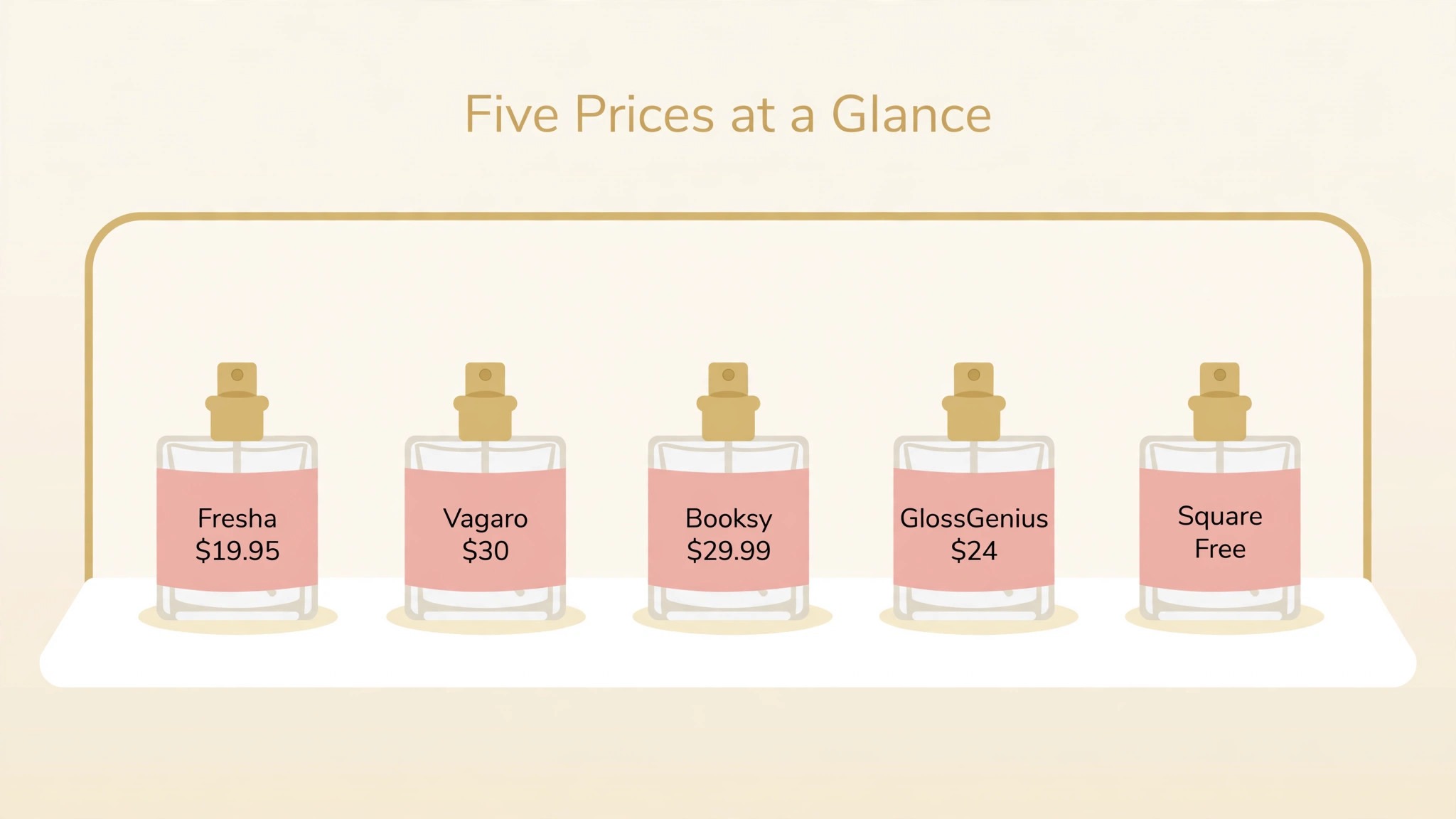
The table shows thirteen tools at very different prices, and the cheapest headline is rarely the cheapest system once processing and marketplace commissions are added. Fresha at 19 dollars and 95 cents looks cheap until the 20 percent commission on new marketplace clients is counted. Mangomint at around 165 dollars looks expensive until you count what it replaces. Read the whole guide before judging any price, because the real cost sits in the columns this table cannot show.
Best Pick by Job
| Job type | First pick | Second tool | Why this pair works |
|---|---|---|---|
| Solo lash artist | GlossGenius | Goldie | Polished page plus a light backup |
| New studio needing clients | Fresha | StyleSeat | Marketplace discovery on two fronts |
| Multi-artist studio | Vagaro | Mangomint | Broad features plus premium polish |
| Budget conscious start | Square Appointments | Setmore | Free start plus cheap scheduling |
| Luxury studio | Boulevard | Mangomint | Front desk depth plus premium experience |
A solo artist running the best software for lash studios needs a beautiful booking page and a deposit that protects a three hour block, and GlossGenius gives exactly that for 24 dollars a month billed annually. Goldie covers the same job more lightly, with a free tier that a new artist can start on tomorrow. Together they cover the solo journey from first client to full book without a marketplace commission eating the margin.
A new studio that needs clients fast should start with Fresha, because its marketplace brings people searching for lash services nearby, and StyleSeat adds a second discovery channel for the same effort. A multi-artist studio needs Vagaro breadth first, with Mangomint as the premium step up when the studio outgrows it. Match the pick to the job, and the price stops looking expensive, because the tool is doing the job you actually need done.
How to Judge the Best Software for Lash Studios
Start with the appointment that breaks generic calendars, which is a full set with a patch test, a consultation, and a three hour block on one bed. Book it in the trial and watch whether the system blocks the right bed, leaves a buffer, and prevents a second booking from landing on the same artist. A system that treats a full set as a generic hour will double book the artist, strand the client, and leave a gap nobody can fill. If staff must add notes to stop double booking, the system has failed the core job.
Next, test the deposit and the form together, because lash work is a chemical service and the paperwork matters. The deposit should be big enough to protect a three hour block, stated plainly at booking, and taken without a phone call. The intake form should capture allergies, patch test results, and aftercare consent before the client arrives, not on a clipboard in the waiting room. GlossGenius gates its forms feature behind the Gold tier at 48 dollars a month billed annually, which is more than double the Standard price, so check which tier your forms live on before you buy.
Then model the total monthly cost at your real artist count and new client count. A four artist studio on Vagaro pays the base plus three extra calendars, while the same studio on Booksy pays the base plus three extra members, and on Fresha it pays per member plus commission on every new marketplace client. Work through a month with your actual numbers, including processing on your average ticket, before comparing headline subscriptions. A 20 dollar subscription difference disappears quickly against a single marketplace commission on a high value full set.
Finally, test rebooking as a client, because a lash studio lives on fills every two to three weeks, and the moment to secure the next visit is at checkout. Book online from a phone, pay a deposit, reschedule once, and rebook at checkout, and note every step that feels slow or confusing.
The 13 Tools in Detail
1. Fresha
Fresha is a beauty and wellness booking platform with a large marketplace, and its appeal is discovery. Clients find studios through the Fresha marketplace, book online, and pay through the platform, while studios manage calendars, staff, payments, and marketing in one system. Third party comparisons report 35 million or more appointments booked monthly through the marketplace, which is a real acquisition channel for a new studio.
Pricing is 19 dollars and 95 cents a month for an independent location, with team plans at 14 dollars and 95 cents per team member, so check the vendor pricing page for current rates. The cost that matters most is the one time 20 percent commission, with a 6 dollar minimum, on new clients who arrive through the marketplace. A studio gaining many marketplace clients should model that commission monthly, because it can exceed the subscription several times over.
2. Vagaro
Vagaro is the all in one salon, spa, and wellness platform in this guide, covering booking, point of sale, customer records, marketing, payroll reports, and a business app in one price. Its strength is breadth without a marketplace commission, which makes the monthly bill predictable as the studio grows. A multi-artist studio can run calendars, retail, packages, memberships, and marketing from one login.
Pricing is 30 dollars a month for one bookable calendar, with a promotional 23 dollars and 99 cents for the first six months reported in 2026 comparisons, plus 10 dollars per extra calendar up to seven, so check the vendor pricing page for the current promotion. Processing is reported at 2 dollars and 60 cents per hundred plus 10 cents for smaller merchants. That per calendar shape caps costs around 84 dollars for seven calendars, which is why mid-size studios find Vagaro predictable.
3. Booksy
Booksy pairs booking software with a consumer marketplace of tens of millions of users, and its pitch is new client discovery plus full business management. Studios get online booking, calendars, payments, marketing messages, reminders, gift cards, and memberships, with clients discovering the studio through the Booksy app. That combination appeals to independent artists and small studios that want both software and a stream of new bookings.
Pricing is 29 dollars and 99 cents a month plus tax for a solo plan, plus 20 dollars per extra team member, so check the vendor pricing page for current rates. The optional Boost program charges a one time 30 percent fee on a new client first visit, up to 100 dollars, which is the line to model carefully. A studio using Boost heavily can pay far more in commissions than in subscription, while a studio that keeps Boost off pays a straightforward per artist fee.
4. GlossGenius
GlossGenius is the polished booking and payments platform for solo artists and small teams, and its booking pages look premium, its checkout is fast, and its pricing is deliberately simple. There is one subscription, a flat processing rate, and no marketplace commission to calculate. That clarity is the product, and it shows in every part of the experience, from setup to client payment.
Pricing is 24 dollars a month billed annually, or 28 dollars monthly, for Standard plans covering up to two users, with Gold at 48 dollars billed annually for up to nine staff and Platinum at 148 dollars for teams of ten or more, so check the vendor pricing page for current tiers. The catch is that forms and waivers, which a lash studio needs for patch tests and consent, first appear on Gold, more than double the Standard price. Budget for Gold if forms matter to you.
5. Square Appointments
Square Appointments is the booking layer for studios already running Square hardware and payments, and its headline advantage is a free tier that a solo artist can genuinely use. Individual booking pages, calendar management, reminders, and card payments come from the same Square account that runs the counter, so a new studio avoids a second vendor, a second payout schedule, and a second support line.
Pricing starts at zero for the free tier, with paid Plus tiers reported from 49 dollars a month in third party guides, so check the vendor pricing page for current plan limits. Square has no marketplace, which means no discovery commission, but also no new client stream beyond your own marketing. A studio that fills beds from Instagram, referrals, and walk-ins will not miss the marketplace, while a new studio in a crowded market may need paid discovery elsewhere.
6. Goldie
Goldie is the light booking app for solo artists who want scheduling without a heavy platform. It covers online booking, reminders, and client records in a clean mobile first interface, and it does the core job with very little setup. A new lash artist can be taking bookings the same afternoon, without a trial that demands a week of configuration.
Pricing starts free, with a Pro tier from around 15 dollars a month in 2026 comparisons, so check the vendor pricing page for current limits. The free tier suits an artist with a small book who needs reminders and a booking link, while Pro adds the features that matter as the book grows. Goldie fits artists who want software that stays out of the way, and it fits poorly for a multi-artist studio that needs payroll, packages, and front desk depth.
7. Setmore
Setmore is a simple scheduling tool that covers booking, reminders, and payments without beauty specific extras. It suits a small team that wants a reliable calendar and a booking page at a low price, and it integrates with common payment tools and calendars. The interface is straightforward, and the setup takes an afternoon rather than a week.
Pricing starts free, with paid plans from around 12 dollars a month per user in 2026 comparisons, so check the vendor pricing page for current tiers. The low price is the appeal, and the trade off is that lash specific needs, such as intake forms, patch test records, and package management, need workarounds or a second tool. Setmore fits a budget conscious start, and it fits poorly as a long term home for a studio that outgrows simple scheduling.
8. Acuity Scheduling
Acuity Scheduling, part of Squarespace, is a strong appointment scheduler with good support for packages, memberships, and intake forms. A lash studio can sell a package of fills, collect a deposit, and gather client information through custom forms before the appointment, all from one booking flow. The scheduling logic handles buffers, resources, and multi-service visits well.
Pricing starts from 20 dollars a month for the Emerging plan, with Growing around 34 dollars and Powerhouse around 61 dollars in 2026 comparisons, so check the vendor pricing page for current tiers. The higher tiers add more calendars, more integrations, and HIPAA compliance for studios that need it. Acuity fits studios that sell packages and value form depth, and it fits poorly for a studio that wants marketplace discovery, because Acuity brings no new clients on its own.
9. Mangomint
Mangomint is the premium salon platform in this guide, built for high end multi-artist studios that want polish, depth, and a front desk that runs smoothly. It covers booking, client records, payments, marketing, and reporting in a modern interface, with strong support for commissions, service providers, and multi-location work. Studios that switch to Mangomint usually do so for the experience, not the price.
Pricing starts from around 165 dollars a month in 2026 comparisons, with higher tiers for larger teams, so check the vendor pricing page for a current quote. That price is several times a Vagaro subscription, and it buys a faster interface, better reporting, and a level of polish that clients notice. Mangomint fits a studio with four or more artists and a premium ticket price, and it fits poorly for a solo artist, where the monthly cost would eat the margin on every set.
10. Boulevard
Boulevard is the luxury salon platform, built for studios where the front desk is a real job and the client experience is the product. It offers deep scheduling, client management, payments, and reporting, with a focus on high volume, high touch service businesses. The platform is designed for studios that treat operations as a craft, and the feature set reflects that ambition.
Pricing is a custom quote, which means a sales conversation rather than a published number, and the total will sit at the premium end of this guide. Boulevard fits luxury studios with a dedicated front desk and a ticket price that justifies the spend. It fits poorly for a small or new studio, where the quote alone signals that the platform is built for a later stage. Ask for the quote when the studio is ready, not before.
11. Schedulicity
Schedulicity pairs booking software with a marketplace, giving studios a booking page, reminders, payments, and a directory where new clients can find them. It suits studios that want discovery without the higher commissions of the bigger marketplaces, and its interface is friendly for a small team. The platform covers the core booking job well, with class and package support for studios that sell more than single appointments.
Pricing starts from around 35 dollars a month in 2026 comparisons, so check the vendor pricing page for current tiers and marketplace terms. The marketplace is smaller than Fresha or Booksy, which means less discovery, but the cost is lower and the terms are simpler. Schedulicity fits a studio that wants some discovery at a modest price, and it fits poorly for a studio that needs deep salon workflow or premium reporting.
12. StyleSeat
StyleSeat is a marketplace first and foremost, where clients search for beauty professionals by service, location, and review, and book directly through the platform. For a lash artist, it is a discovery channel rather than a full booking system, and many artists use it alongside a separate scheduler. The audience is large, and the reviews on the platform carry weight with new clients.
Pricing is free to list, with StyleSeat taking a commission on bookings made through the marketplace, so check the current commission terms before relying on it. The commission model means the cost scales with success, which is fair for a new artist and expensive for a busy one. StyleSeat fits artists who need new clients now and are happy to pay per booking, and it fits poorly as a sole system, because it does not run the whole studio.
13. Meevo
Meevo is enterprise salon software for large multi-location studios, with deep features for scheduling, payroll, inventory, marketing, and reporting across many sites. It is built for businesses with a front desk team, a manager, and an owner who needs consolidated reporting, and its feature set reflects that scale. A studio that runs Meevo has outgrown the tools most lash artists use.
Pricing is a custom quote, and the total will reflect the enterprise scope, with implementation and training included in the conversation. Meevo fits large studios with several locations and a team that needs one system across all of them. It fits poorly for any studio under ten artists, where the depth would go unused and the price would dominate the budget. Consider it when the studio grows up, not before.
Deposits and Forms, the Lash Specific Tests
A lash studio is a chemical service business, and the software must treat it like one. The deposit is the first test, because a full set blocks a bed for three hours, and a no-show on that block costs more than a missed haircut. The deposit should be large enough to matter, stated plainly on the booking page, and collected at booking without a phone call. A system that makes deposits awkward will cost the studio real money every month, because clients who pay a deposit show up, and clients who do not pay one cancel more often.
The intake form is the second test, and it matters for safety as well as for service. Allergies, previous reactions, patch test results, and aftercare consent should live on the client record where the artist can see them before the client lies down, not on a paper form in a drawer. The best software for lash studios keeps that record attached to the booking, visible on the artist calendar, and updated at every visit, so the artist never has to ask a question the client already answered.
The third test is the record itself, because lash work is personal and repeat business depends on memory. Lash map, curl, length, adhesive used, and the client preference from last time should all be on the record, ready for the next fill. A system that keeps good records turns a fill into a continuation of the last visit. Test the record in the trial with a real client, and judge the software on whether the artist can see the last visit at a glance.
The Total Monthly Cost, Worked Honestly
A studio bill has four parts, and comparing subscriptions alone hides three of them. The subscription is the smallest part for most studios. Processing fees apply to every card payment and scale with ticket size and volume. Marketplace commissions apply to new clients from Fresha, Booksy Boost, and StyleSeat, and they scale with acquisition. Add-ons for texts, forms, and marketing sit on top, at 10 to 55 dollars a month each in third party estimates.
Work an example with real numbers. A four artist studio with a 120 dollar average ticket, 300 appointments a month, and 25 new marketplace clients faces very different totals across these tools. On Fresha, commission alone on those new clients runs into hundreds of dollars before the subscription is counted. On Vagaro or GlossGenius, the same month costs a flat subscription plus processing, with no commission line at all. That is why the best software for lash studios must be ranked by total cost of ownership rather than sticker price.
The practical rule is simple. If new clients come mainly from referrals, repeats, and your own social pages, choose a flat priced tool and keep the commission at zero. If new clients come mainly from a marketplace because you are new or in a saturated area, accept the commission as an acquisition cost and measure it against the lifetime value of a retained client. A marketplace client who returns every three weeks for a year is worth the first visit commission. A client who visits once and never returns is not.

Mistakes Studios Make When Switching Systems
The first mistake is switching during a busy season without a parallel run. Artists learn the new calendar while serving a full book, old appointments sit in the old system, and clients receive reminders from both. Run both systems for two weeks, move new bookings only to the new system, and keep the old calendar visible until every old appointment has passed.
The second mistake is importing a messy client list without cleaning it. Duplicate records, missing phone numbers, and outdated lash maps make reminders fail and fills go wrong. Clean the list before import, merge duplicates, and confirm mobile numbers for your top hundred clients personally. A system is only as good as the client data it reminds, and a clean import pays off every week after launch.
The third mistake is setting no deposit policy on day one and adding it later after a run of no-shows. Clients accept a deposit policy stated at booking far more readily than a policy introduced after they have booked freely for months. Set deposits and cancellation terms before the first new booking, state them on the booking page, and train artists to explain them once, kindly, at checkout. The best software for lash studios still fails when the deposit policy is missing, because no feature replaces a clear rule stated at the right moment.
Setup Checklist
Use this checklist when you move a studio to new software, and keep a copy at the front desk.
1. Import and clean the client list, merging duplicates and confirming mobile numbers. 2. Build every service with correct duration, buffer, price, and artist skill. 3. Set deposits, card on file rules, and cancellation terms before the first booking. 4. Build intake forms with allergies, patch test, and consent fields. 5. Connect payments, test a deposit, a refund, and a package purchase. 6. Turn on reminders with a two day and same day schedule. 7. Train every artist on their calendar, rebooking prompts, and client notes. 8. Run both systems for two weeks until all old appointments pass.

Related Guides
Keep exploring with these guides on Stratilyze:
- Best Gym Management Software for Yoga Studios (8 Tools)
- Best Membership Software for Yoga Studios (10 Tools)
- Best Software for Tattoo Studios (11 Tools)
Frequently Asked Questions
What is the cheapest software for a lash studio?
Square Appointments at zero cost is the cheapest credible start for a solo artist, especially one already on Square. Goldie free and Setmore free also cover basic booking at no cost. GlossGenius at 24 dollars a month billed annually is the cheapest polished option with a flat processing rate and no commission.
Do marketplace fees apply to all my clients?
No, and that distinction matters. Fresha commission applies to new clients who arrive through its marketplace, not to your existing clients or direct bookings. Booksy Boost commission applies only when you use Boost for new clients, not to standard plan bookings. StyleSeat commission applies to bookings made through its marketplace. A studio that fills beds from repeats and referrals can therefore run a marketplace tool with little or no commission, while a studio leaning on discovery should budget the commission as an acquisition cost.
How do deposits reduce no-shows in a lash studio?
Deposits change the booking from a vague intention into a paid commitment, and clients who have paid show up far more reliably, which matters most when the block is three hours long. Card on file has a similar effect, since the cancellation policy becomes enforceable without a confrontation. The key is stating the policy at booking, in plain language on the booking page, so clients agree before they book rather than learning about it after they cancel.
Can booking software handle lash maps and patch tests?
The stronger tools can, but test your exact workflow rather than trusting a feature list. Vagaro, Mangomint, and Boulevard handle client records, notes, and custom fields well in most studio setups, while GlossGenius covers standard records cleanly once the Gold tier forms are included. Build a client record with a lash map, allergy notes, and patch test date in the trial, and check that the artist can see it from the calendar before you commit.
Should a multi-artist studio use one system or one per artist?
One system, in almost every case. Separate systems per artist create separate client records, separate reminders, and a checkout that cannot sell a package across artists. Vagaro breadth fits that single system job best in this guide, with Mangomint as the premium step up.
How long does it take to switch lash studio software?
Plan two to four weeks from import to full cutover, including a two week parallel run. Data cleaning takes longer than software setup for most studios, and artist training on real bookings takes longer than a demo call suggests. The best software for lash studios still fails when the client list is messy and artists have had one rushed training session, so budget time for both before launch day.
A Final Word Before You Choose
There is no universal winner among these thirteen, because the right tool follows how your studio wins clients and fills beds. A solo artist who wants beauty and predictability should start with GlossGenius or Square. A multi-artist studio that wants breadth and a capped bill should start with Vagaro. A studio that needs new clients fast should start with Fresha or StyleSeat, with eyes open on commission, and measure retention on every marketplace client.
Whichever you choose, test your hardest service, model the total monthly cost at your real artist and client numbers, and set deposits before the first booking. A booking system earns its fee in quiet Tuesdays filled, no-shows reduced, and fills rebooked at checkout. The best software for lash studios does those three jobs on your busiest Saturday, and the rest of the feature list will take care of itself.