

Which course is worth the money? Magoosh is the best test preparation software for students pick for most self study students, because its SAT Premium course costs 129 dollars for 12 months and covers 1,750 practice questions with short video lessons. UWorld is the pick for students who want the hardest question bank, with SAT prep at 449 dollars for 360 days. The twelve tools below compare price, question count and study style, so a student can pick the course that matches how they actually learn.
Test prep is a strange purchase, because the buyer is a student and the payer is often a parent, and both want a score gain they can measure. The market ranges from free Khan Academy to live courses above 2,000 dollars, and the price does not predict the score gain. What predicts the gain is practice volume, realistic questions and a study plan the student actually follows.
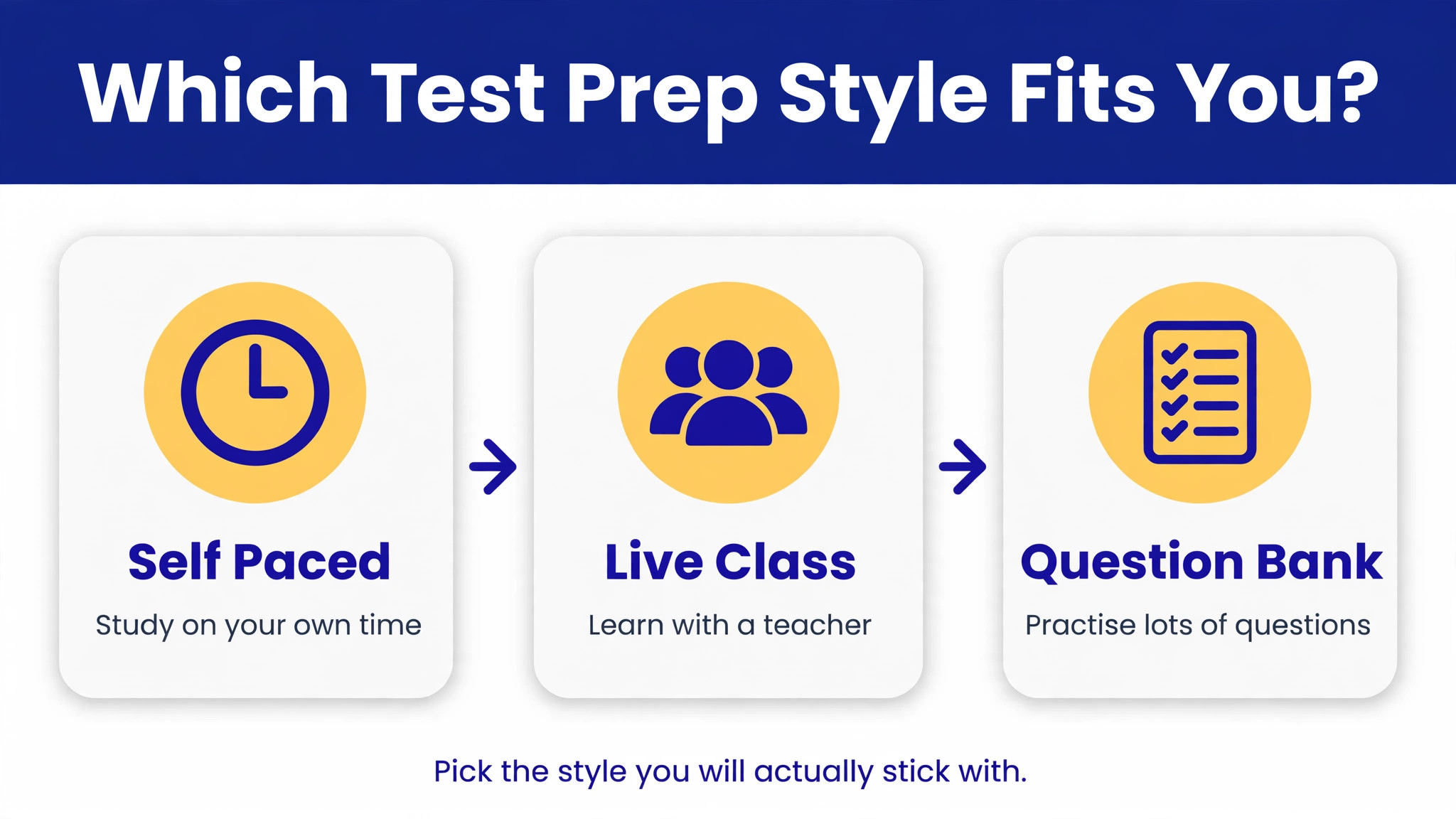
The tools split three ways. Self paced courses like Magoosh and UWorld give videos and question banks for a flat fee. Live and tutor led options like Kaplan and Varsity Tutors add a teacher. Free and low cost tools like Khan Academy and AlphaTest cover the basics for students who cannot spend hundreds of dollars. A student should pick the format first, because a course that does not fit the study habit will not be finished.
The 12 Tools at a Glance
| Tool | Main job | Best for | Starting price |
|---|---|---|---|
| Magoosh | Self paced video courses | Budget self study | 129 dollars a year |
| Kaplan | Brand name courses and live classes | Structured learners | 199 dollars for 6 months |
| UWorld | Hard question banks | Practice heavy students | 99 dollars for a Qbank |
| Princeton Review | Self paced and live courses | Classroom style prep | 899 dollars self paced |
| PrepScholar | Guided study plans | Students who want a plan | 995 dollars |
| Blueprint | Modern prep, MCAT focus | Visual learners | 1,699 dollars self paced |
| Khan Academy | Free practice | Free SAT prep | Free |
| Varsity Tutors | Tutoring and live classes | One to one help | Quote-based |
| Test Innovators | Practice tests, SSAT and ISEE | Private school admissions | Quote-based |
| EdisonOS | Tutoring business platform | Tutors and prep centres | 49 dollars a month |
| AlphaTest | Adaptive SAT prep | AI guided practice | 9.99 dollars a week |
| Achievable | Mobile first courses | Phone based study | 199 dollars |
Entry prices run from free to 1,699 dollars, and the spread reflects format rather than quality. A student who studies on a phone needs a different tool than a student who sits in a live class, and the cheapest course the student finishes beats the most expensive course the student abandons.
Best Pick by Job
| Job type | First pick | Second tool | Why this pair works |
|---|---|---|---|
| Budget self study | Magoosh | Khan Academy | Magoosh adds videos, Khan Academy is free |
| Hardest practice questions | UWorld | Princeton Review | UWorld owns the Qbank, Princeton Review adds structure |
| Structured live classes | Kaplan | Varsity Tutors | Kaplan has the brand, Varsity Tutors adds one to one |
| Visual and modern prep | Blueprint | AlphaTest | Blueprint owns MCAT visuals, AlphaTest adapts SAT |
| Private school admissions | Test Innovators | Kaplan | Test Innovators owns SSAT, Kaplan covers the rest |
Magoosh wins the budget pick because it gives a complete self paced course at a price most families can afford. The SAT Premium course costs 129 dollars for 12 months, with 1,750 practice questions, short video lessons and a 7 day free trial. The mobile app is strong, so a student can study on a bus or between classes, and the video explanations are the feature reviewers praise most.
UWorld wins for practice heavy students because its question bank is the hardest and the most detailed in this guide. The SAT Qbank starts at 99 dollars, the full prep course costs 449 dollars for 360 days, and the interface resembles Bluebook, the real digital SAT app. That realism is the reason a student who already knows the content should look here first, and it is the sharpest contrast in this look at the best test preparation software for students for a student who learns by doing questions rather than watching lessons.
Which Test Prep Software Helps a Self-Study Student Most?
Magoosh helps a self study student most, because the course is built for a student alone with a phone. The short video lessons explain one idea at a time, the practice questions come with video explanations, and the study schedule tells the student what to do each day. The 129 dollar price for 12 months is low enough that a student can buy it without a family debate, and the 7 day free trial lets them test the style first.
Khan Academy is the better pick for a student with no budget at all. The SAT prep is free, the practice is official, and the platform adapts to the student level. The limit is the depth, because Khan Academy covers practice and review rather than a full course with strategy lessons, so a student who needs structure should pair it with a paid course.
AlphaTest is the third option for a student who wants adaptive guidance. The platform costs 9.99 dollars a week, with an adaptive plan, an up to date question bank and an AI tutor. The weekly price suits a student with a short runway to test day, because they pay for the weeks they need rather than a full year.
A fourth path suits a student who studies mostly on a phone. Achievable costs 199 dollars for a mobile first course with spaced repetition, and the app is built for short study sessions. A student who studies on a bus or between classes will open Achievable more often than a desktop course, and the course that gets opened is the course that works.
How to Choose the Best Test Preparation Software For Students
Start with the exam. A student taking the SAT needs a different question bank than a student taking the MCAT, and a student taking the SSAT needs a different tool again. Magoosh, Kaplan, UWorld and Princeton Review cover the SAT and ACT, Blueprint and UWorld cover the MCAT, and Test Innovators covers the SSAT and ISEE. Pick the tool that covers the exact exam first, because a general prep tool wastes time on the wrong questions.
Next, match the study style. A student who learns by watching needs Magoosh video lessons, a student who learns by doing questions needs UWorld, and a student who needs a teacher needs Kaplan live classes or Varsity Tutors. Ask the student how they studied for their last exam, because the answer predicts which format they will finish.
Then check the question count and the practice tests. Magoosh SAT gives 1,750 questions and 3 practice tests, UWorld SAT gives about 1,650 questions and 1 practice test, and Kaplan SAT gives 500 questions and 4 practice tests. A student who needs volume should weigh the question count, while a student who needs test day realism should weigh the practice test count.
Finally, check the score guarantee and the refund terms. Several vendors offer a score improvement guarantee, but the terms differ, and a guarantee that needs a completed course and a documented score is harder to claim than it sounds. Read the terms before paying, because the guarantee is only worth what the fine print allows.
One more check matters for a student with a tight deadline. Ask how long the access lasts, because Magoosh gives 12 months, Kaplan self paced gives six months, and UWorld gives 360 days. A student with three months to test day should not pay for a year of access, while a student with a year to prepare should not buy a course that expires in six months.
The 12 Tools in Detail
The twelve tools below cover self paced courses, live classes, question banks and free practice. Each one is judged on price, question volume, study style and exam coverage, so this roundup of the best test preparation software for students stays honest about what each course includes and what it leaves out.
1. Magoosh
Magoosh is a budget friendly self paced test prep program known for short video lessons and a strong mobile app. The SAT Premium course costs 129 dollars for 12 months, with 1,750 practice questions and 3 practice tests, while Premium plus on demand classes costs 399 dollars. The MCAT 12 month plan costs 399 dollars, and a one month plan costs 379 dollars. A 7 day free trial is included.
The strength is value, because the price is a fraction of Kaplan or Princeton Review while the video explanations are among the best in this guide. The drawback is the lack of adaptivity, because the course does not reshape itself around the student level the way AlphaTest does. It suits budget conscious students who study on a phone and learn by watching short lessons.
2. Kaplan
Kaplan is the most established name in test prep, offering self paced courses, live online instruction and tutoring for major standardised exams. The SAT self paced course starts at 199 dollars for six months, with 500 practice questions and 4 practice tests, while the live online SAT course costs 799 dollars and tutoring plus course costs 1,700 dollars. The ACT self paced plan starts at 179 dollars.
The strength is the brand and the structure, because a student gets a proven curriculum, live classes and a score guarantee on many courses. The drawback is the price, because the live courses cost several times the self paced options in this guide. It suits students who want a trusted brand and a structured classroom style.
3. UWorld
UWorld is a question bank first platform known for difficult questions and excellent written explanations. The SAT Qbank starts at 99 dollars, the full SAT prep course costs 449 dollars for 360 days with about 1,650 questions and 1 practice test, and the MCAT self paced course starts at around 599 dollars with more than 3,000 questions. The interface resembles Bluebook, the real digital SAT app.
The strength is the question quality, because the explanations teach the concept behind each answer rather than just the answer. The drawback is the narrow job, because UWorld is mostly questions with limited video teaching, so a student who needs lessons should pair it with Magoosh or Khan Academy. It suits self paced students who learn by doing hard questions.
4. Princeton Review
Princeton Review is a long standing test prep provider with self paced and live courses for the SAT, ACT and graduate exams. The SAT self paced course starts at 899 dollars, with live courses above 1,000 dollars and tutoring higher still. The courses include strategy lessons, practice tests and a score guarantee on many plans.
The strength is the classroom structure, because the courses feel like a class with a teacher and a schedule. The drawback is the price, because the self paced course costs nearly seven times Magoosh for a similar question volume. It suits students who want a structured classroom style and a family budget that covers it.
5. PrepScholar
PrepScholar is a guided test prep program with adaptive study plans and a score guarantee. The SAT course costs 995 dollars, with a guided plan that adapts to the student level and a large question bank. The platform tracks progress closely and tells the student exactly what to study next.
The strength is the guidance, because a student who does not know what to study gets a clear daily plan. The drawback is the price for a self paced course, because 995 dollars is close to a live class at Kaplan. It suits students who want a guided plan and a score guarantee without a live teacher.
6. Blueprint
Blueprint, formerly Next Step Test Prep, is a modern prep provider known for visual lessons and AI driven study plans. The MCAT self paced course costs 1,699 dollars, live online costs 2,299 dollars, and the 515 plus course costs 3,499 dollars. A practice exam bundle starts at 159 dollars. The platform suits visual learners who want modern design and adaptive planning.
The strength is the modern feel, because the lessons are visual and the platform adapts well. The drawback is the price and the MCAT focus, because Blueprint is strongest on the MCAT and less proven on the SAT. It suits MCAT students who want a modern, visual course and can afford the higher price.
7. Khan Academy
Khan Academy is the free practice platform in this guide, with official SAT practice, video lessons and adaptive exercises at no cost. The SAT prep is built with the College Board, so the practice material is official, and the platform adapts to the student level. The mobile app covers study on the go.
The strength is the price, because free official practice is the best value in test prep. The drawback is the depth, because Khan Academy covers practice and review rather than a full strategy course with timed sections and score guarantees. It suits every student as a starting point, and many students need nothing else for a first attempt.
8. Varsity Tutors
Varsity Tutors is a tutoring platform with one to one help and live classes for the SAT, ACT and other exams. Pricing is quote based, because tutoring is priced by the hour and the tutor, and the platform matches students with tutors by subject and style. The live classes cover the major exams with a teacher and a schedule.
The strength is the personal help, because a tutor can find the exact gap in a student understanding and fix it in one session. The drawback is the cost, because one to one tutoring is the most expensive format in this guide. It suits students who need personal help on a specific weak area.
9. Test Innovators
Test Innovators is a practice test platform for SSAT and ISEE admissions, popular with families applying to private schools. Pricing is quote based, and the platform offers official style practice tests, detailed analytics and a student dashboard. The test format matches the real admissions exams closely.
The strength is the admissions focus, because few tools cover the SSAT and ISEE well. The drawback is the narrow scope, because the platform does not cover the SAT, ACT or graduate exams. It suits families preparing a child for private school admissions.
10. EdisonOS
EdisonOS is a platform for tutoring businesses and test prep centres, with white labelled assessments, tutor analytics and student management. The price starts at 49 dollars a month, with usage based tiers above that. The platform covers ACT prep with a real ACT like interface and an in house question bank.
The strength is the business tooling, because a tutoring centre can run assessments, track students and brand the platform as its own. The drawback is the audience, because EdisonOS is built for tutors rather than for a single student. It suits tutoring businesses and prep centres, not a solo student.
11. AlphaTest
AlphaTest is an adaptive SAT prep app with an AI tutor, an up to date question bank and a study plan that adapts to the student. The price is 9.99 dollars a week, with a freemium tier, and the platform covers the digital SAT with module adaptive practice. The weekly price suits a student with a short runway to test day.
The strength is the adaptivity and the low weekly cost, because a student pays for the weeks they need. The drawback is the young brand, because the question bank and the track record are smaller than Magoosh or Kaplan. It suits a student who wants AI guided practice at a low weekly price.
12. Achievable
Achievable is a mobile first test prep course with a clean app, spaced repetition and a low flat price. The ACT and SAT courses start at 199 dollars, with a money back guarantee on many plans. The platform is built for phone study, with short lessons and adaptive review.
The strength is the mobile experience, because the app is designed for study in short sessions. The drawback is the exam coverage, because Achievable covers fewer exams than Kaplan or Magoosh. It suits a student who studies mostly on a phone and wants a simple flat price.
Magoosh vs Kaplan, Budget Self-Study Against a Big Brand
The price is the first difference. Magoosh SAT Premium costs 129 dollars for 12 months, while Kaplan SAT self paced starts at 199 dollars for six months and live online costs 799 dollars. A family that buys Magoosh saves hundreds of dollars, and the saving buys a second test attempt or a tutor for a weak subject.
The second difference is the teaching style. Magoosh teaches through short video lessons and video explanations, with a mobile app built for study in short sessions. Kaplan teaches through a structured curriculum with live classes, a teacher and a schedule, which suits a student who needs a classroom to stay on track.
The deciding factor is the student habit. A disciplined student who studies alone should take Magoosh, because the price is low and the video lessons are strong. A student who needs a teacher and a schedule should take Kaplan, because the structure is what they are paying for. That split is the cleanest way to read the best test preparation software for students when the choice narrows to these two.
A third difference is the trial. Magoosh offers a 7 day free trial, Kaplan offers a free class, and both let a student test the teaching style before paying. A student should use the trial to watch a real lesson, not just to browse the dashboard, because the lesson style is what they will live with for months.
How Much Should a Student Spend on Test Prep?
A student can start free. Khan Academy costs nothing, AlphaTest has a freemium tier, and Magoosh offers a 7 day free trial. A student who uses Khan Academy alone spends zero dollars, and many students improve their score with free official practice alone, because the practice material is real and the platform adapts to their level.
A student with a modest budget should spend 100 to 200 dollars. Magoosh at 129 dollars for 12 months, UWorld Qbank from 99 dollars, and Achievable at 199 dollars all fit that range, and any of them gives a full course with questions, lessons and practice tests. That range is the sweet spot for most families, because it buys a real course without a major financial decision, and it is where the best test preparation software for students usually sits.
A student who wants live teaching should budget 500 to 2,000 dollars. Kaplan live online SAT costs 799 dollars, Princeton Review live courses cost above 1,000 dollars, and Blueprint MCAT live online costs 2,299 dollars. The live price buys a teacher and a schedule, and a family should only pay it when the student needs that structure, because the score gain comes from the practice, not from the price tag.
How Do I Know If a Prep Course Is Working?
Take a full practice test before starting, and take another after four weeks of study. A course that works shows a score gain on the second test, while a course that does not work shows a flat score even when the student studied. The practice test is the only honest measure, because study hours without a score gain are just busy work.
Check the weak areas too, because a good course should lift the weakest section first. UWorld and AlphaTest both show analytics by topic, so a student can see whether the weak section is improving. A course that improves the strong section and leaves the weak section flat is not doing its job, and the student should switch the study focus rather than the course.
Finally, check the study habit. A course works when the student uses it four or more days a week, and it fails when the student opens it once a week. The best course is the one the student actually opens, so a parent should check the usage, not just the price, before judging whether the money was well spent.
A 12-Week Study Plan Built Around Practice Tests
Weeks one to two are the baseline. Take a full practice test under timed conditions, record the score by section, and list the three weakest topics. The baseline test is the most important step in the plan, because every later decision depends on it.
Weeks three to eight are the build. Study the weakest topics first, with video lessons from Magoosh or Khan Academy, then practise with UWorld or Magoosh questions. A student should study four days a week for 45 minutes, because short regular sessions beat long weekend cramming. Take a second practice test at week six to check the gain.
Weeks nine to twelve are the polish. Take a full practice test every week, review every wrong answer, and study only the topics that still cost points. The last week should be light, with one final practice test and a rest day before the real exam. A student who follows this plan will walk into test day knowing their score range, and that confidence is worth as much as the preparation itself, which is why the best test preparation software for students is the one that makes a plan like this easy to follow.

Frequently Asked Questions
Is Magoosh enough for the SAT?
Yes, for most self study students. Magoosh SAT Premium costs 129 dollars for 12 months, with 1,750 practice questions, short video lessons and 3 practice tests. A student who finishes the course and reviews every wrong answer will cover the content, though a student who needs a teacher should add a live class, and that finish rate is the real test of the best test preparation software for students.
Is UWorld worth 449 dollars?
For a practice heavy student, yes. UWorld SAT costs 449 dollars for 360 days, with about 1,650 hard questions and an interface that resembles Bluebook. The Qbank alone starts at 99 dollars, so a student who only wants questions can pay less and still get the hardest practice in this guide.
Can I prepare for the SAT for free?
Yes. Khan Academy offers free official SAT practice with video lessons and adaptive exercises, built with the College Board. The free practice is real and adaptive, though it lacks a full strategy course, so a student who needs structure should pair it with a paid course like Magoosh.
How many practice tests should I take?
At least three full tests before exam day, with the first as a baseline, one midway to check progress, and one in the final week. Magoosh gives 3 practice tests, Kaplan gives 4, and UWorld gives 1, so a student who wants many tests should weigh the practice test count when choosing.
Does Kaplan have a score guarantee?
Yes, on many courses, though the terms differ by course and exam. A guarantee usually needs a completed course and a documented score, so a student should read the terms before paying. The guarantee is only worth what the fine print allows, and the practice test gain is a better measure of whether the course works.
Which prep is best for the MCAT?
UWorld and Blueprint lead for the MCAT. UWorld MCAT starts at around 599 dollars with more than 3,000 questions, while Blueprint MCAT self paced costs 1,699 dollars with visual lessons and adaptive planning. Magoosh MCAT at 399 dollars for 12 months is the budget option, and Kaplan MCAT on demand costs 1,999 dollars.
Practice Tests Decide, Not Brand Names
A self study student should take Magoosh, because 129 dollars buys a complete course with video lessons that the student will actually finish. A practice heavy student should take UWorld, because the hardest question bank builds the deepest understanding. A student who needs a teacher should take Kaplan, because the live classes give the structure that self study cannot.
Take a baseline test, study four days a week, and take a second test after a month. The best test preparation software for students is the one that lifts the score on that second test, and the brand name on the course matters far less than the practice it contains.