

Ticket Tailor is the best event ticketing software for small events pick for most small organisers, because it charges a flat fee from 0.22 pounds per ticket with prepaid credits instead of a percentage, and free tickets are free up to 5,000 a year. Eventbrite is the pick for organisers with no audience yet, because its marketplace brings discovery that a cheap checkout cannot. The ten tools below compare fees on a real ticket, payout speed and audience reach, so an organiser can pick the platform that keeps the most of every sale.
Ticketing fees decide whether a small event makes money. A 25 dollar ticket can cost 1.78 dollars in fees on one platform and 3.52 dollars on another, and on 200 tickets that gap is 348 dollars back in the organiser pocket. A small event with thin margins cannot afford the wrong fee model, because the fee is the difference between a profit and a loss.
The tools split two ways. Low fee checkouts like Ticket Tailor, Tito and Universe charge little per ticket and bring no audience, while marketplaces like Eventbrite and DICE charge more and bring discovery. An organiser with an audience should take the cheap checkout, while an organiser with no audience should pay for the marketplace.
The 10 Tools at a Glance
| Tool | Main job | Best for | Fee on a 25 dollar ticket |
|---|---|---|---|
| Ticket Tailor | Low flat fee checkout | Most small events | About 1.78 dollars |
| Eventbrite | Marketplace plus ticketing | Discovery and sell through | About 3.52 dollars |
| Humanitix | Mission driven ticketing | Schools and charities | About 3.29 dollars |
| Tito | Simple checkout | Workshops and conferences | About 1.78 dollars |
| Zeffy | Free nonprofit ticketing | Registered nonprofits | 0 dollars |
| TryBooking | Community ticketing | Schools and theatre | About 1.88 dollars |
| Universe | Self service ticketing | Small venues | About 1.39 dollars |
| DICE | Fan first ticketing | Music and nightlife | About 3.25 dollars |
| Ticketleap | Simple low fee sales | Occasional sellers | About 1.78 dollars |
| Eventzilla | Budget event ticketing | Classes and meetups | About 1.55 dollars |
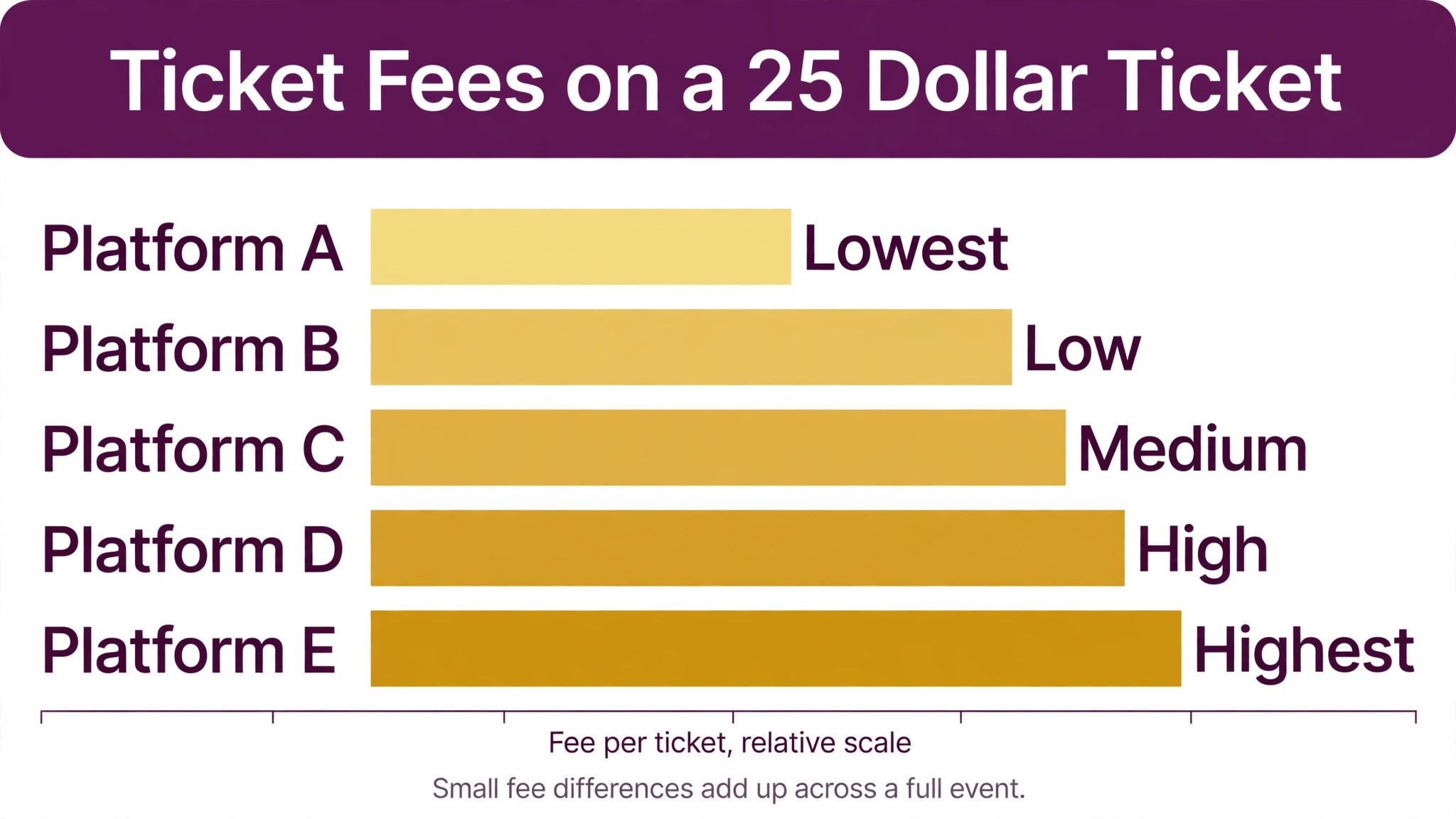
The fee column above adds the platform fee and standard card processing for a single 25 dollar ticket, with Stripe at 2.9 percent plus 30 cents where it applies. The gap between the cheapest and dearest is about 1.74 dollars per ticket, which is 348 dollars on 200 tickets and 1,740 dollars on 1,000 tickets.
Best Pick by Job
| Job type | First pick | Second tool | Why this pair works |
|---|---|---|---|
| Most small events | Ticket Tailor | Tito | Ticket Tailor is cheapest, Tito is simplest |
| No audience yet | Eventbrite | DICE | Eventbrite owns discovery, DICE owns music fans |
| Nonprofit or school | Zeffy | Humanitix | Zeffy is free, Humanitix gives to charity |
| Workshops and classes | Tito | TryBooking | Tito is clean, TryBooking is community priced |
| Music and nightlife | DICE | Universe | DICE brings fans, Universe is cheapest |
Ticket Tailor wins the general pick because the fee model is the fairest in this guide. The platform charges a flat fee per ticket, never a percentage of the price, with pay as you go at 0.60 pounds per ticket plus VAT and prepaid credits from 0.22 pounds per ticket. Free tickets are free up to 5,000 a year, and charities get 50 percent off. Card fees are paid separately to the payment processor, so the organiser sees exactly what each sale costs.
Eventbrite wins for discovery because it is the largest self service ticketing marketplace, with 258 million tickets sold in 2025. The fee is higher, at 3.7 percent plus 1.79 dollars per paid ticket plus 2.9 percent processing, but the marketplace brings buyers an organiser could not reach alone. That discovery is the reason an unknown organiser should look here first, and it is the sharpest contrast in this look at the best event ticketing software for small events for an organiser who needs an audience more than a low fee.
Which Ticketing Tool Keeps the Most of a 25 Dollar Ticket?
Ticket Tailor keeps the most of a 25 dollar ticket for a paid event, because the flat fee is about 0.75 dollars plus Stripe processing at 2.9 percent plus 30 cents, giving a total of about 1.78 dollars. Tito ties at about 1.78 dollars, with a 3 percent platform fee plus Stripe, while Universe is cheaper still at about 1.39 dollars on a 25 dollar ticket, with a 2 percent plus 0.59 dollar fee before processing.
Eventbrite keeps the least, at about 3.52 dollars on a single 25 dollar ticket, with 3.7 percent plus 1.79 dollars plus 2.9 percent processing. The gap between Ticket Tailor and Eventbrite is 1.74 dollars per ticket, which is 348 dollars on 200 tickets. An organiser who already has an audience should never pay the Eventbrite fee, because the discovery is worth nothing when the buyers already know the event.
Zeffy keeps all of it, because the platform is free for eligible nonprofits, with no mandatory fee at all. A registered nonprofit that pays any ticketing fee is wasting money, because Zeffy covers the same checkout for free. The catch is the eligibility, because Zeffy only serves registered nonprofits.
A fourth path suits a small venue that wants a known name at a low fee. Universe charges 2 percent plus 0.59 dollars per ticket, giving about 1.39 dollars on a 25 dollar ticket before processing, which is the cheapest paid total in this guide. The Ticketmaster connection gives buyers confidence, though the platform is the self service tier rather than the full enterprise product.
How to Choose the Best Event Ticketing Software For Small Events
Start with the audience. An organiser with an email list, a social following or a regular crowd should take the cheapest checkout, because the audience already exists and the platform only needs to sell the ticket. An organiser with no audience should take Eventbrite or DICE, because the marketplace brings buyers the organiser cannot reach alone. The audience question decides the fee the organiser should pay.
Next, count the fee on a real ticket. A 25 dollar ticket costs about 1.78 dollars on Ticket Tailor and Tito, about 1.39 dollars on Universe, and about 3.52 dollars on Eventbrite. Multiply the per ticket fee by the expected ticket count, because the total fee is the number that matters, and a small per ticket gap becomes a large total on a big event.
Then check the payout speed. Eventbrite sends money three business days after the event ends, and first time sellers cannot get paid sooner, while DICE pays out within five business days. An organiser who needs the money before the event for deposits and supplies should check the payout terms, because a slow payout can break a small event budget.
Finally, check the fee rules. Since May 12, 2025, the FTC junk fee rule has required anyone selling live event tickets in the US to show the total price up front, with mandatory fees included. A platform that hides fees until checkout is breaking the rule, so the organiser should pick a platform that shows the full price from the start.
One more check matters for an organiser who sells at the door as well as online. Ask whether the platform handles door sales and cash, because a tool that only sells online leaves the door sales in a separate list. Ticket Tailor, Eventbrite and Tito all handle door check in, while the simpler tools may need a manual list for walk up buyers.
The 10 Tools in Detail
The ten tools below cover low fee checkouts, marketplaces and nonprofit ticketing. Each one is judged on the fee per ticket, the payout, the audience reach and the features, so this roundup of the best event ticketing software for small events stays honest about what each platform takes from every sale.
1. Ticket Tailor
Ticket Tailor is the low flat fee checkout in this guide, charging a flat fee per ticket rather than a percentage of the price. Pay as you go runs at 0.60 pounds per ticket plus VAT, prepaid credits start at 0.22 pounds per ticket, and free tickets are free up to 5,000 a year. Card fees are paid separately to the payment processor, and charities get 50 percent off. In the US, pay as you go runs about 0.75 dollars per paid ticket.
The strength is the fee model, because a flat fee costs less as the ticket price rises, and a 100 dollar ticket costs the same fee as a 25 dollar ticket. The drawback is the discovery, because Ticket Tailor brings no audience, so the organiser must bring their own buyers. It suits independent organisers with their own audience who want the lowest fee.
2. Eventbrite
Eventbrite is the largest self service ticketing marketplace, with 258 million tickets sold in 2025 and the strongest discovery in this guide. The US pricing is 3.7 percent plus 1.79 dollars per ticket in service fees, plus 2.9 percent in payment processing, and free events are free. Pro email marketing starts at 15 dollars a month. The platform was taken private by Bending Spoons in March 2026, so organisers should watch for plan changes.
The strength is the marketplace, because Eventbrite brings buyers who browse for events. The drawback is the fee, because 3.52 dollars on a 25 dollar ticket is the highest in this guide. It suits organisers with no audience who need discovery and sell through more than a low fee.
3. Humanitix
Humanitix is a mission driven ticketing platform that routes its profits to charity, with a fee of 2.1 percent plus 0.99 dollars per ticket, plus 2.9 percent plus 0.30 dollars processing. Charities and schools pay 1 percent plus 0.99 dollars. The total on a 25 dollar ticket is about 3.29 dollars, which is cheaper than Eventbrite and more expensive than Ticket Tailor.
The strength is the mission, because every ticket sold funds education projects, and the brand suits schools, charities and community events. The drawback is the fee, because the percentage model costs more on high value tickets than a flat fee. It suits schools, charities and mission driven events.
4. Tito
Tito is a simple ticketing checkout for workshops, conferences and small events, with a 3 percent platform fee plus Stripe processing. The total on a 25 dollar ticket is about 1.78 dollars, tying Ticket Tailor as one of the cheapest in this guide. The interface is clean, the setup is quick, and the tool handles multi day events and discount codes well.
The strength is the simplicity, because an organiser can set up a workshop in minutes. The drawback is the discovery, because Tito brings no audience and has no marketplace. It suits workshops, classes and conferences where the organiser brings the attendees.
5. Zeffy
Zeffy is the free ticketing platform for registered nonprofits, with no mandatory fee at all. The platform covers ticketing, donations, memberships and fundraising in one place, and the organiser keeps the full ticket price. The total fee on a 25 dollar ticket is zero dollars for an eligible nonprofit.
The strength is the price, because free is unbeatable for a nonprofit. The drawback is the eligibility, because Zeffy only serves registered nonprofits, so a commercial organiser cannot use it. It suits registered nonprofits running galas, fundraisers and community events.
6. TryBooking
TryBooking is a community ticketing platform for schools, theatre and local events, with a fee of 1 dollar per ticket plus 3.5 percent in the US. The total on a 25 dollar ticket is about 1.88 dollars, and free events are free. The platform handles reserved seating, season tickets and group bookings well.
The strength is the community fit, because the tool is built for schools and local groups rather than for promoters. The drawback is the brand, because TryBooking is less known outside its home markets, so buyers may not recognise it. It suits schools, theatre groups and community events.
7. Universe
Universe is the self service arm of Ticketmaster, built for small events, venues and promoters. The Starter and Standard plans list at 2 percent plus 0.59 dollars per ticket, with Pro on custom pricing, and the total on a 25 dollar ticket is about 1.39 dollars before processing. The platform brings the Ticketmaster name and a clean mobile checkout.
The strength is the low fee and the brand, because Universe is the cheapest paid option in this guide. The drawback is the connection to Ticketmaster, because the enterprise business is quote based and the small event tool is the self service tier. It suits small venues and promoters who want a low fee with a known name.
8. DICE
DICE is a fan first ticketing platform for music and nightlife, with a 13 percent service fee folded into an all in fan price. The total on a 25 dollar ticket is about 3.25 dollars, and the platform pays out within five business days. The discovery is strong for music fans, because DICE users browse for gigs and shows.
The strength is the fan audience, because DICE brings music lovers who buy tickets on impulse. The drawback is the fee, because 13 percent is the highest percentage in this guide. It suits music venues, promoters and nightlife events where the audience matters more than the fee.
9. Ticketleap
Ticketleap is a simple low fee ticketing tool for occasional sellers, with a fee of 1 dollar plus 2 percent per ticket. The total on a 25 dollar ticket is about 1.78 dollars, tying the cheapest in this guide. The setup is quick, the checkout is clean, and the tool handles reserved seating and discount codes.
The strength is the low fee and the simplicity, because an occasional seller can set up an event in minutes. The drawback is the feature depth, because Ticketleap has fewer marketing and reporting tools than Eventbrite. It suits occasional sellers who run a few events a year.
10. Eventzilla
Eventzilla is a budget event ticketing platform for classes, meetups and small conferences, with a fee from 1.25 dollars per ticket plus processing. The total on a 25 dollar ticket is about 1.55 dollars, making it one of the cheapest in this guide. The platform covers registration, discount codes and attendee management.
The strength is the price, because the per ticket fee is low and the feature set covers the basics well. The drawback is the discovery, because Eventzilla brings no audience. It suits classes, meetups and small conferences where the organiser brings the attendees.
Eventbrite vs Ticket Tailor, Discovery Against Low Fees
The fee is the first difference. Eventbrite charges 3.7 percent plus 1.79 dollars per ticket plus 2.9 percent processing, giving about 3.52 dollars on a 25 dollar ticket. Ticket Tailor charges a flat fee from 0.22 pounds per ticket with prepaid credits, giving about 1.78 dollars on the same ticket. On 200 tickets, Eventbrite takes about 704 dollars in fees and Ticket Tailor takes about 356 dollars, so the gap is 348 dollars on one show.
The second difference is the audience. Eventbrite is the largest self service marketplace, with 258 million tickets sold in 2025, and its discovery brings buyers an organiser could not reach alone. Ticket Tailor brings no audience at all, so the organiser must bring every buyer through their own email list or social following.
The deciding factor is the audience the organiser already has. An organiser with an email list and a following should take Ticket Tailor, because the low fee keeps more of every sale and the discovery is worth nothing. An organiser with no audience should take Eventbrite, because the marketplace can fill seats that would otherwise stay empty. That split is the cleanest way to read the best event ticketing software for small events when the choice narrows to these two.
A third difference is the payout. Eventbrite pays three business days after the event ends, while Ticket Tailor pays through the organiser own payment processor, so the timing depends on the processor. An organiser who needs the money before the event for deposits should check the payout terms on both, because a slow payout can break a small event budget.
What Do Ticketing Fees Add Up to Over a Season?
A single show shows the gap clearly. On 200 tickets at 25 dollars, Eventbrite takes about 704 dollars in fees, Ticket Tailor takes about 356 dollars, and Zeffy takes nothing for a nonprofit. The gap between Eventbrite and Ticket Tailor is 348 dollars on one show, which is a poster run, a sound hire or a profit the organiser keeps, and that single show math is the first thing to check when comparing the best event ticketing software for small events.
A season of ten shows multiplies the gap. Ten shows at 200 tickets each is 2,000 tickets, and the Eventbrite fee totals about 7,040 dollars against about 3,560 dollars on Ticket Tailor, a gap of 3,480 dollars. A small venue that runs weekly shows should count the season total, because the per ticket gap that looks small becomes a large annual cost.
A high value ticket widens the gap further. A 100 dollar gala ticket costs about 6.49 dollars in fees on Eventbrite and about 1.78 dollars on Ticket Tailor, because the flat fee stays flat while the percentage fee grows with the price. A gala organiser with 100 tickets at 100 dollars saves about 471 dollars by choosing the flat fee, which is more than the cost of the venue hire for many small events.
A free event has no fee on most platforms. Eventbrite, Ticket Tailor and TryBooking all charge nothing on free tickets, with Ticket Tailor free up to 5,000 tickets a year. An organiser who runs free community events should pick the platform with the best check in tools rather than the lowest fee, because the fee is zero either way.
How Do I Pass Fees to Buyers Without Losing Sales?
Start with the total price. Since May 12, 2025, the FTC junk fee rule has required anyone selling live event tickets in the US to show the total price up front, with mandatory fees included. A buyer who sees 25 dollars and pays 29 dollars at checkout will feel cheated, while a buyer who sees 28.52 dollars from the start will buy calmly. Show the full price on the first screen.
Next, decide who pays. Eventbrite and Universe pass fees to the buyer by default and let organisers absorb them, while Ticket Tailor lets the organiser choose. An organiser who absorbs the fee sells more tickets at a lower headline price, while an organiser who passes the fee keeps more per ticket but may sell fewer. The choice depends on the audience, because a loyal audience will pay the fee and a new audience will not.
Then test the price. A 25 dollar ticket with a 3.52 dollar fee becomes a 28.52 dollar ticket, which is a 14 percent increase on the headline price. A small increase in the ticket price can cover the fee without a visible surcharge, because a 28 dollar ticket with fees included looks better than a 25 dollar ticket plus fees. The organiser who sets the ticket price with the fee already in mind sells more tickets than the one who adds the fee at checkout.
A final check matters for repeat events. An organiser who runs the same event every month should compare the fee on the whole season rather than one show, because a platform that looks cheap for one night can cost more over a year. The season total is the number that decides the platform, not the single ticket fee.
A Pre-Sale Checklist for a Small Event
Four weeks before the event, set up the ticketing page. Add the event details, the ticket types, the prices and the refund policy, then test the checkout with a real purchase. A page that looks good but fails at checkout will lose the first buyers, and the first buyers are the ones who tell their friends.
Two weeks before, send the first email. Tell the list the tickets are on sale, show the total price with fees included, and link straight to the checkout. A second email a week later reminds the list, and a final email the day before the event catches the late buyers. An organiser who emails three times sells more than one who emails once, because most buyers need a reminder.
On the day, check the door list. Print the attendee list, test the check in app, and confirm the payout timing with the platform. Eventbrite pays three business days after the event, DICE pays within five business days, and Ticket Tailor pays through the organiser own payment processor. A door list that works and a payout that arrives on time are the two things that make a small event feel professional, and that preparation is what the best event ticketing software for small events should make easy.
After the event, send one thank you email. Thank the buyers, share photos, and tell them about the next event while the night is still fresh. A thank you email that arrives the next morning sells more tickets to the next event than any advert, because the buyers already enjoyed the last one.

Frequently Asked Questions
Is Ticket Tailor really cheaper than Eventbrite?
Yes, by about half on a 25 dollar ticket. Ticket Tailor costs about 1.78 dollars per ticket including Stripe processing, while Eventbrite costs about 3.52 dollars. On 200 tickets, Eventbrite takes about 704 dollars and Ticket Tailor takes about 356 dollars, a gap of 348 dollars on one show, and that gap is the usual answer when organisers compare the best event ticketing software for small events.
Is Eventbrite free for free events?
Yes. Eventbrite charges no fees on free events, and the platform is free to list them. The fees apply only to paid tickets, at 3.7 percent plus 1.79 dollars per ticket plus 2.9 percent processing in the US.
Can a nonprofit sell tickets for free?
Yes, with Zeffy. Zeffy is free for eligible registered nonprofits, with no mandatory fee on tickets, donations or memberships. Ticket Tailor also gives charities 50 percent off, and Humanitix charges charities 1 percent plus 0.99 dollars per ticket.
How fast does Eventbrite pay out?
Eventbrite sends money three business days after the event ends, and first time sellers cannot get paid sooner. DICE pays out within five business days, while Ticket Tailor pays through the organiser own payment processor, so the timing depends on the processor rather than the platform.
Does Ticket Tailor work in the US?
Yes. Ticket Tailor lists prices in pounds plus VAT, with pay as you go at about 0.75 dollars per paid ticket in the US, and card processing paid separately to the payment processor. The flat fee model works the same in the US as in the UK, with the currency converted at the day rate.
Which ticketing tool is best for a workshop?
Tito is the best pick for a workshop, because the checkout is clean, the setup takes minutes, and the fee is about 1.78 dollars on a 25 dollar ticket. Ticket Tailor is the cheaper alternative at the same total fee, while Eventbrite is the better pick when the workshop needs discovery to fill seats.
Low Fees Win When You Bring the Audience
An organiser with an audience should take Ticket Tailor, because the flat fee keeps the most of every sale and the gap grows with every ticket sold. An organiser with no audience should take Eventbrite, because the marketplace can fill seats that would otherwise stay empty. A nonprofit should take Zeffy, because free beats every fee model in this guide.
Count the fee on a real ticket, multiply it by the season total, and pick the platform that fits the audience the organiser actually has. The best event ticketing software for small events is the one that leaves the most money in the organiser pocket after the last ticket is sold. A small event that keeps its fees low can afford better sound, better food and a better night for everyone who came.