
A recruiter who reads a hundred applications a day cannot tell by eye which ones a candidate wrote and which ones a chatbot drafted. In 2025 the US Federal Trade Commission found that a detector marketed as 98 percent accurate scored just 53 percent on general content in independent testing, which is barely better than a coin toss. That gap between the marketing and the evidence is why the top 10 ai content detectors for recruiters need a careful, honest comparison.
The stakes are real. A false positive can cost a good candidate a job, while a false negative lets a candidate who cannot write pass a writing test. A detector is a useful signal when it is treated as one, and a dangerous one when it is treated as proof. The recruiter who understands that difference will use these tools well, while the one who does not will make hiring mistakes with confidence.
This guide compares ten detectors that recruiters actually use, from a purpose-built resume scanner to an academic integrity platform. You will see the price, the accuracy evidence, the strengths, the honest limits, and the kind of hiring each one suits, so the choice comes down to evidence rather than a vendor claim.
Why Recruiters Cannot Trust a Single Score
A detector score looks like a fact. It arrives as a number, a percentage, or a color, and it invites the recruiter to treat it as a verdict. The research says otherwise. Independent studies in 2026 found the same document scoring 0 percent on one detector and 100 percent on another, and a detector that caught 83 percent of AI texts still missed most hybrid texts that mixed human and machine writing.
The false positive problem is the sharpest edge. Studies have shown detectors flagging non-native English speakers at far higher rates than native speakers, which means a recruiter who auto-rejects on a detector score will screen out exactly the candidates a diverse hiring policy is meant to protect. The top 10 ai content detectors for recruiters differ widely in their false positive rates, and that difference matters more than the headline accuracy.
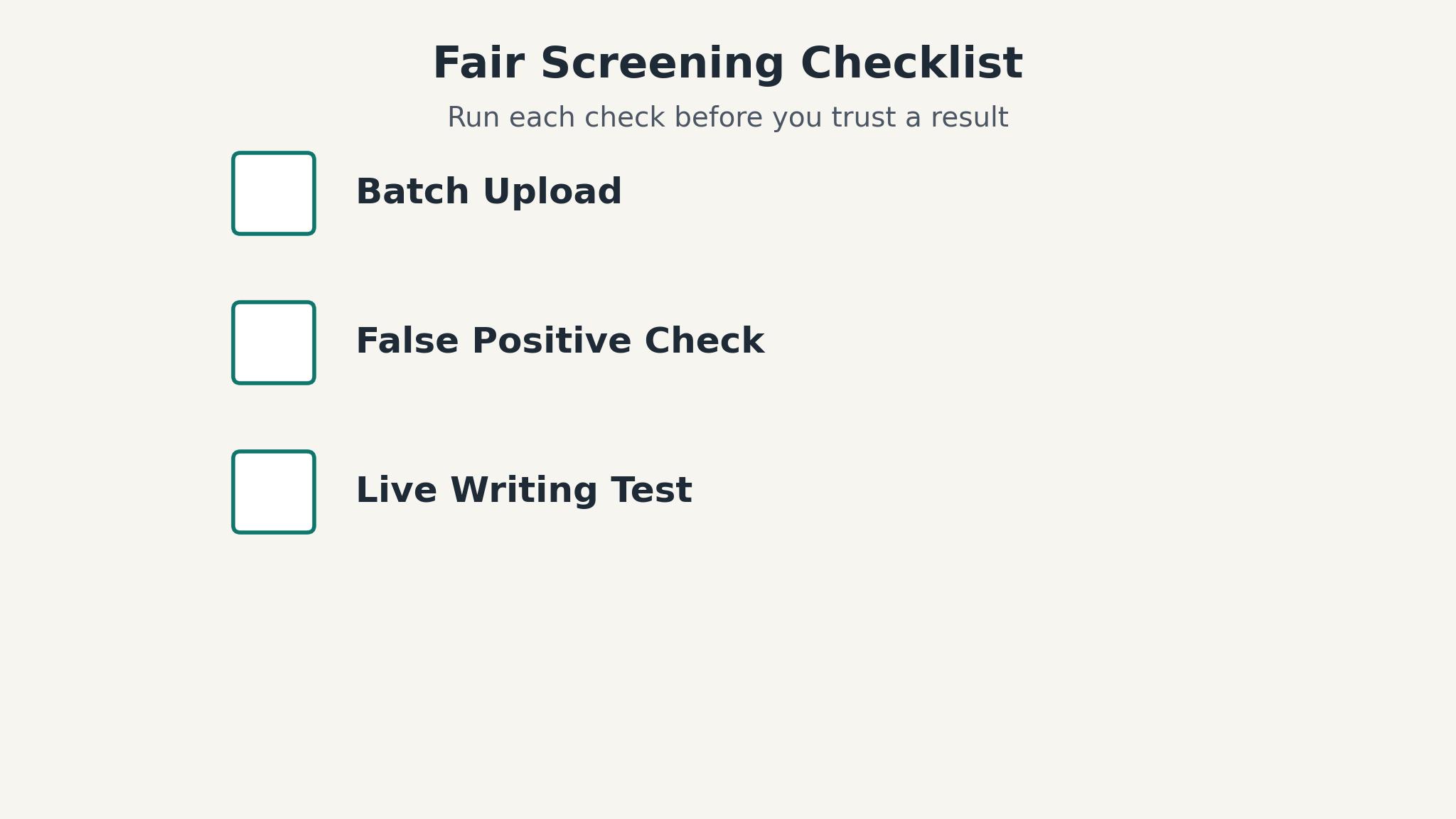
The right way to use a detector is as a conversation starter. A high score means the recruiter should ask the candidate to write live, or to talk through the sample in an interview, not that the recruiter should reject the application unseen. The tools in this guide are ranked with that use in mind.
The 10 Tools at a Glance
Ten tools, four kinds. Some are standalone subscriptions built for detection, some are free web checkers, one is a suite feature, and one is an institution-only platform. The top 10 ai content detectors for recruiters in the table below show the starting price and the main job of each one.
| Tool | Main job | Best for | Starting price |
|---|---|---|---|
| GPTZero | Resume and essay detection | Recruiters running resume batches | 15 dollars a month |
| Originality.ai | AI, plagiarism and fact-check | Agencies checking content at volume | 15 dollars a month |
| Copyleaks | Multilingual detection at scale | High-volume corporate teams | 17 dollars a month |
| Winston AI | Shareable reports for small teams | Small teams wanting reports | 18 dollars a month |
| Pangram | High-stakes long document review | Recruiters who cannot risk a false flag | 20 dollars a month |
| Turnitin | Academic integrity platform | Institutions hiring academics | Quote |
| Scribbr | Free detector for quick checks | A fast free check on one sample | Free plan available |
| QuillBot | Detector inside a writing suite | Teams already using QuillBot | 10 dollars a month |
| Sapling | Real-time checks inside tools | Support and product hiring teams | 25 dollars a month |
| ZeroGPT | Free checker with paid tiers | A free first check on many samples | Free plan available |
Best Pick by Job
| Job type | First pick | Second tool | Why this pair works |
|---|---|---|---|
| Screening resume batches | GPTZero | Originality.ai | GPTZero offers batch CV upload and Originality.ai adds the strongest independent accuracy |
| High-volume corporate hiring | Copyleaks | Pangram | Copyleaks integrates with the ATS at scale and Pangram adds the lowest false positive rate |
| Small team on a budget | Winston AI | Scribbr | Winston AI gives shareable reports cheaply and Scribbr adds a free check |
| Academic hiring | Turnitin | Originality.ai | Turnitin covers the academic record and Originality.ai adds a fact-check layer |
The top 10 ai content detectors for recruiters split by the risk you can accept. A recruiter who screens a hundred resumes a day needs batch upload and a low false positive rate, while a recruiter who checks one writing sample a week can use a free tool. Match the tool to the volume and the risk first.
How to Judge the top 10 ai content detectors for recruiters
Start with the independent evidence, not the vendor claim. A vendor that markets 99 percent accuracy should be asked for the study behind the number, and the recruiter should check whether the study tested the kind of document the team actually screens. The top 10 ai content detectors for recruiters in this group carry accuracy claims from 53 percent to 99 percent, and the independent numbers tell a different story.
Next, test the tool on your own samples. Take five writing samples you know are human, five you know are AI-written, and five that mix the two, then run them all through the detector and count the mistakes. The tool that flags the fewest human samples is the one worth paying for, because a false positive costs a candidate a job.
Finally, check the workflow. A detector that needs a manual paste for every resume will slow a recruiter who screens a hundred a day, while a detector with batch upload and an API will fit the pipeline. Ask whether the tool accepts PDF and DOCX files, whether it returns a shareable report, and whether the results land in the ATS without a copy and paste.
The 10 Tools in Detail
The ten tools below range from a free web checker to a quote-only institution platform. The top 10 ai content detectors for recruiters among them differ most in false positive rate, batch handling, and the evidence behind the accuracy claim.
1. GPTZero
GPTZero is the most purpose-built tool for recruiters in this group, with a dedicated recruiter page, batch CV scanning, and native support for PDF, DOCX, and TXT resume files. The Essential plan runs at 15 dollars a month, the Premium plan at 24 dollars a month, and the Professional plan at 46 dollars a month with a 250-file batch and API access. The free tier covers 10,000 words a month.
The recruiter features are the strength. A hiring team can upload a batch of resumes, run the detection on all of them at once, and share the team credits across seats, which suits a team that screens in volume. The sentence-level highlights show exactly which passages look machine-written, so the recruiter can judge the sample rather than just the score.
The weakness is the accuracy evidence. GPTZero markets high accuracy, but independent studies have found it scoring 0 percent on fully AI-written papers in one strict test and 90 percent on non-native-style AI rewrites in another, which shows how much the result depends on the document. The tool is also now part of a larger writing ecosystem after a 2026 acquisition, which may change the product over time.
GPTZero fits a recruiter who screens resume batches and wants a tool built for that job. A team that runs dedicated screening batches will get the most from the batch upload, while a recruiter who checks one sample at a time can use the free tier.
2. Originality.ai
Originality.ai carries the best independent accuracy result of any tool tested here, at 97.5 percent mean accuracy on the University of Florida academic test set, which is closer to its own marketing claim than any rival. The Pro plan runs at 15 dollars a month for 2,000 credits, with one credit covering roughly 100 words, and the Enterprise tier runs at 179 dollars a month with API access. A single scan returns an AI probability score, a plagiarism check, and a fact-check layer.
The accuracy is the selling point. A recruiter who needs the most reliable signal available should start here, because the independent evidence is stronger than the vendor claims of its rivals. The three-in-one scan also removes the need to run two or three tools on every sample, which saves time on a busy hiring day.
The drawback is the credit model and the lack of a recruiter-specific mode. The credits expire monthly, so a team that screens in bursts will waste them, and there is no resume-specific batch mode for ATS work. The Pro plan at 15 dollars a month covers only 2,000 credits, which is about 200,000 words, and a high-volume team will need the Enterprise tier.
Originality.ai fits an agency that already runs content verification and screens resumes as a side use. A team that checks freelancer work and candidate samples in the same week will get the most from the three-in-one scan, while a recruiter who only screens resumes should test GPTZero too.
3. Copyleaks
Copyleaks is the enterprise detector built to scale, with the strongest ATS and HRIS integration story in this group. The Personal plan runs at about 17 dollars a month, the Pro plan at about 100 dollars a month, and the enterprise tiers are priced per scan. The platform detects AI text in more than 30 languages, which matters to a team hiring across borders.
The integration is the strength. A high-volume corporate team can pipe the detection into the hiring pipeline, so the score lands beside the resume without a manual step. The multilingual coverage means a team hiring in several languages can use one tool, and the API handles the volume that a manual checker never could.
The weakness is the price at scale and the thin independent evidence. The Pro plan at 100 dollars a month is dearer than the rivals, and the accuracy claim rests on vendor numbers rather than an independent benchmark on the same document set. A team that wants proof should run its own test before committing.
Copyleaks fits a high-volume corporate team that needs pipeline integration. A talent acquisition team screening thousands of applications will value the API, while a small team should start with a cheaper subscription.
4. Winston AI
Winston AI is a mid-tier detector with shareable reports for a small team, and it prices itself below the bigger platforms. The Essential plan runs at 18 dollars a month, the Advanced plan at 29 dollars a month, and the Elite plan at 49 dollars a month, with a 2,000-credit trial for 14 days. The platform also detects AI images and scanned documents with OCR, which the text-only tools cannot do.
The reports are the selling point. A small team can run a check, share the report with the hiring manager, and keep a record of the decision, which matters when a candidate questions the result. The price is low enough for a team to run it as a second check beside a primary tool.
The drawback is the accuracy gap. Winston AI markets 99.98 percent accuracy, but the independent University of Florida benchmark found 75.9 percent mean accuracy on the same document set, which is about 24 points below the claim. A recruiter who treats the Winston score as proof will make mistakes.
Winston AI fits a small team that wants a cheap secondary check, not a primary decision tool. A team that already uses GPTZero or Originality.ai can add Winston for the reports, while a team that needs one reliable detector should look elsewhere.
5. Pangram
Pangram is the most accurate detector in this group for high-stakes review, with the lowest false positive rate in the 2025 Chicago study at 0.1 percent. The Individual plan runs at 20 dollars a month for 300,000 words, with a 7-day trial and 20 free checks a day after sign-up. The platform is built for professionals who cannot afford a false accusation, and it refuses to predict on documents under 50 words.
The false positive rate is the headline. A recruiter who screens candidates from many backgrounds needs a detector that rarely flags a human, and Pangram’s 0.1 percent rate is the best in this group by a wide margin. The tool also scored 65 percent strict accuracy on fully AI-written papers in a Springer study, where three rivals scored zero.
The weakness is the minimum word count and the price per word. A short cover letter under 50 words cannot be checked, and the 20 dollar plan covers fewer words than some rivals at the same price. The platform is also built for long documents, so a recruiter who screens short samples will find it less useful.
Pangram fits a recruiter who cannot risk a false flag. A team hiring for a role where a wrong accusation could cause real harm should start here, while a team that screens short samples should test a different tool.
6. Turnitin
Turnitin is the academic integrity platform that institutions trust by default, and it now includes an AI writing report beside the plagiarism check. The platform is sold to institutions, not to individuals, so a recruiter cannot buy a single seat, and the price is quoted per institution. The system covers the academic record, which matters when hiring for a university or a research role.
The institutional depth is the strength. A university hiring committee can check a candidate’s writing against the academic database, see the similarity report, and review the AI writing signal in one place. The platform is built for the academic workflow, with the controls and the audit trail that a university needs.
The drawback is the access and the false positive record. Turnitin is institution-only, so a corporate recruiter cannot buy it, and several universities, including UC Berkeley, Vanderbilt, and Johns Hopkins, have disabled the AI detector over false positive concerns. A recruiter who relies on the Turnitin score alone will repeat the mistake those universities already caught.
Turnitin fits an institution hiring academics. A university committee will find it the natural choice, while a corporate recruiter should use a tool built for hiring.
7. Scribbr
Scribbr is a free detector that gives a quick check on one sample without a subscription. The tool is built for students and editors, with a simple paste-and-check interface and no account needed for a basic scan. The paid features sit behind a subscription, but the free check covers the common case.
The free access is the selling point. A recruiter who wants a fast second opinion on a single writing sample can run it in a minute without a login, a credit, or a bill. The interface is clear, and the result arrives as a simple score with highlights.
The weakness is the depth. Scribbr is a free web checker, not a hiring platform, so it offers no batch upload, no API, and no shareable report for the hiring file. A team that screens in volume will outgrow it in a day, and the accuracy evidence is thinner than the subscription tools.
Scribbr fits a recruiter who needs a fast free check on one sample. A hiring manager who wants a second opinion before an interview will find it useful, while a team that screens batches should buy a subscription tool.
8. QuillBot
QuillBot is a writing suite that includes an AI detector beside its paraphrasing and grammar tools, and it suits a team that already uses QuillBot for writing. The Premium plan runs at about 10 dollars a month, with the detector available as part of the suite. The tool checks a sample quickly and returns a score with highlights.
The suite is the draw. A team that already pays for QuillBot gets the detector without a second subscription, and the writing tools beside it help the team draft job ads and feedback. The price is low, and the interface is familiar to anyone who has used the paraphraser.
The drawback is the detector depth. QuillBot is a writing tool first, and the detector is a feature rather than a product, so the accuracy evidence is thinner than the dedicated tools. A recruiter who needs a reliable hiring signal should not rely on it alone.
QuillBot fits a team already using QuillBot for writing. A small team that wants a cheap detector beside its writing tools will find it convenient, while a team that needs a primary detector should buy a dedicated tool.
9. Sapling
Sapling is a real-time detection tool that checks text inside the applications a team already uses, with a free web checker and a paid plan from 25 dollars a month. The platform targets support and product teams, with integrations that bring the check into the workflow rather than a separate website. The detector covers AI text and grammar in one pass.
The real-time check is the strength. A recruiter who reads applications inside the ATS can check a sample without leaving the tool, which saves the copy and paste that slows a busy screening day. The free web checker also lets a team test the tool before paying.
The weakness is the hiring fit. Sapling is built for support and product teams, not for recruiters, so the batch resume features are thinner than GPTZero. The 25 dollar price is also higher than several rivals, and the accuracy evidence is less documented.
Sapling fits a support or product hiring team that wants checks inside its tools. A team that screens writing samples inside the ATS will value the integration, while a recruiter who screens resume batches should look at GPTZero.
10. ZeroGPT
ZeroGPT is a free checker with paid tiers, and it suits a recruiter who wants a free first check on many samples. The free tier covers a useful number of checks, and the paid plans start from about 8 dollars a month for higher limits and batch features. The interface is simple, with a paste-and-check flow and a score in seconds.
The free tier is the headline. A recruiter can check dozens of samples without a bill, and the paid plan stays cheap when the volume grows. The tool is easy to explain to a colleague, and the result arrives fast enough to use during a screening session.
The drawback is the accuracy evidence. ZeroGPT carries less independent testing than the leaders, and the free tier is the thinnest in this group for a team that needs a defensible hiring record. A recruiter who treats a free score as proof will make the same mistake as one who trusts a vendor claim.
ZeroGPT fits a recruiter who wants a free first check. A small team with a tight budget can start here and upgrade when the hiring volume grows, while a team that needs a defensible signal should test the paid leaders.
What Detection Really Costs a Hiring Team
The monthly subscription is only part of the bill. The real cost is the time the team spends checking, the candidates lost to a false positive, and the bad hires that slip through a false negative. The top 10 ai content detectors for recruiters in this group range from free to 100 dollars a month, so the subscription spread is small, but the cost of a wrong decision is large.
Work out the cost per hire. A team that screens a hundred resumes for one role and pays 15 dollars a month for a detector spends less than a dollar per resume, while a single bad hire costs thousands in salary, training, and replacement. The detector pays for itself if it prevents one bad hire a year, and it costs the team dearly if it rejects one good candidate a month.
Then add the workflow cost. A detector with batch upload and an API saves the recruiter hours a week, while a detector that needs a manual paste for every resume costs the team a day a month. Ask each vendor for the batch limits and the API price in writing, and confirm the number on the vendor page before you pay, because a free tier that covers ten checks a month will not survive a real hiring round.

Mistakes That Cost Good Candidates Their Shot
The first mistake is auto-rejecting on a detector score. A high score means the recruiter should ask the candidate to write live, not that the recruiter should delete the application. The top 10 ai content detectors for recruiters all warn against using the score as a sole criterion, and the teams that ignore that warning will lose good people.
The second mistake is checking only the candidates you already doubt. A detector run on a few suspicious applications and skipped on the rest creates a biased process, where some candidates face a test that others never see. Run the same check on every application for the role, or run it on none, and keep the process consistent.
The third mistake is keeping no record. A candidate who is rejected on a detector score deserves a record of the score, the sample, and the reason, because the decision may be questioned later. Save the report, note the follow-up test, and keep the file for the hiring round.
Frequently Asked Questions
How accurate are AI content detectors?
The accuracy varies widely by tool and by document type. Independent studies in 2026 found scores from 0 percent to 100 percent on the same document across different detectors, and the best independent result was 97.5 percent for Originality.ai on an academic test set. Treat every score as a signal, not as proof, and follow up with a live writing test.
Can a detector tell if a resume was written by AI?
A detector can flag a resume that looks machine-written, but it cannot prove who wrote it. A candidate may have used AI to polish a resume they wrote themselves, and the detector cannot tell the difference between a polish and a full draft. Ask the candidate to talk through the resume in an interview rather than rejecting on the score alone.
What is a false positive, and why does it matter?
A false positive is a human-written text that the detector flags as AI-written. It matters because it can cost a good candidate a job, and studies show it happens more often to non-native English speakers. A detector with a low false positive rate, such as Pangram at 0.1 percent, is safer for diverse hiring than one with a higher rate.
Should every application be checked?
A team should check every application for a role, or none, to keep the process fair. Checking only the suspicious ones creates a biased process, and checking none leaves the team blind. The batch tools in this group make it practical to check every resume in a hiring round.
Can candidates cheat a detector?
Candidates can paraphrase AI text, mix human and machine writing, or use a tool that humanizes the output, and most detectors struggle with hybrid text. A detector that catches 83 percent of AI texts may catch only a small share of hybrid texts. A live writing test in the interview is harder to cheat than any detector.
Do detectors work on short cover letters?
Most detectors need a minimum length to give a reliable score, and Pangram refuses to predict on documents under 50 words. A short cover letter of a few sentences will produce a weak signal at best, and a recruiter should judge it on its content rather than a detector score.
Your Next Hiring Round Starts With a Test
Start with GPTZero if your team screens resume batches and wants a tool built for that job, and add Originality.ai when the accuracy evidence matters most. A recruiter who cannot risk a false flag should test Pangram first, because the 0.1 percent false positive rate is the best in this group. The top 10 ai content detectors for recruiters all give a signal, but the right one is the one your team uses as a starting point for a conversation, not as a verdict, so run your own five human and five AI samples through the trial this week and count the mistakes yourself.