
Toast is the most widely used restaurant POS in the United States, and its depth shows in the details that matter during a rush, from coursing and tip pooling to kitchen display screens that keep the line organized. A food hall is a harder test than a single restaurant, because ten vendors share one room, one lunch rush and one set of customers, and the best pos systems for food halls have to serve all ten without slowing any of them down.
Each vendor needs its own menu, its own kitchen tickets, its own payouts and its own reports, while the hall itself needs one ordering flow, one payment experience and one set of shared tables.
This guide compares fifteen POS systems that fit a food hall in 2026. The figures below come from vendor pricing pages and 2026 buyer guides, all checked in November 2026. PAR Brink, Oracle MICROS, NCR Aloha, Revel and several others do not publish prices, so this guide says custom quote rather than inventing a number. The verdict at the end names one pick for a new food hall and one for an established hall with many vendors.
A food hall operator does not need the POS with the longest feature list. The operator needs the one that keeps ten kitchens moving during a Friday lunch rush without a single ticket lost.
What a Food Hall POS Has to Get Right
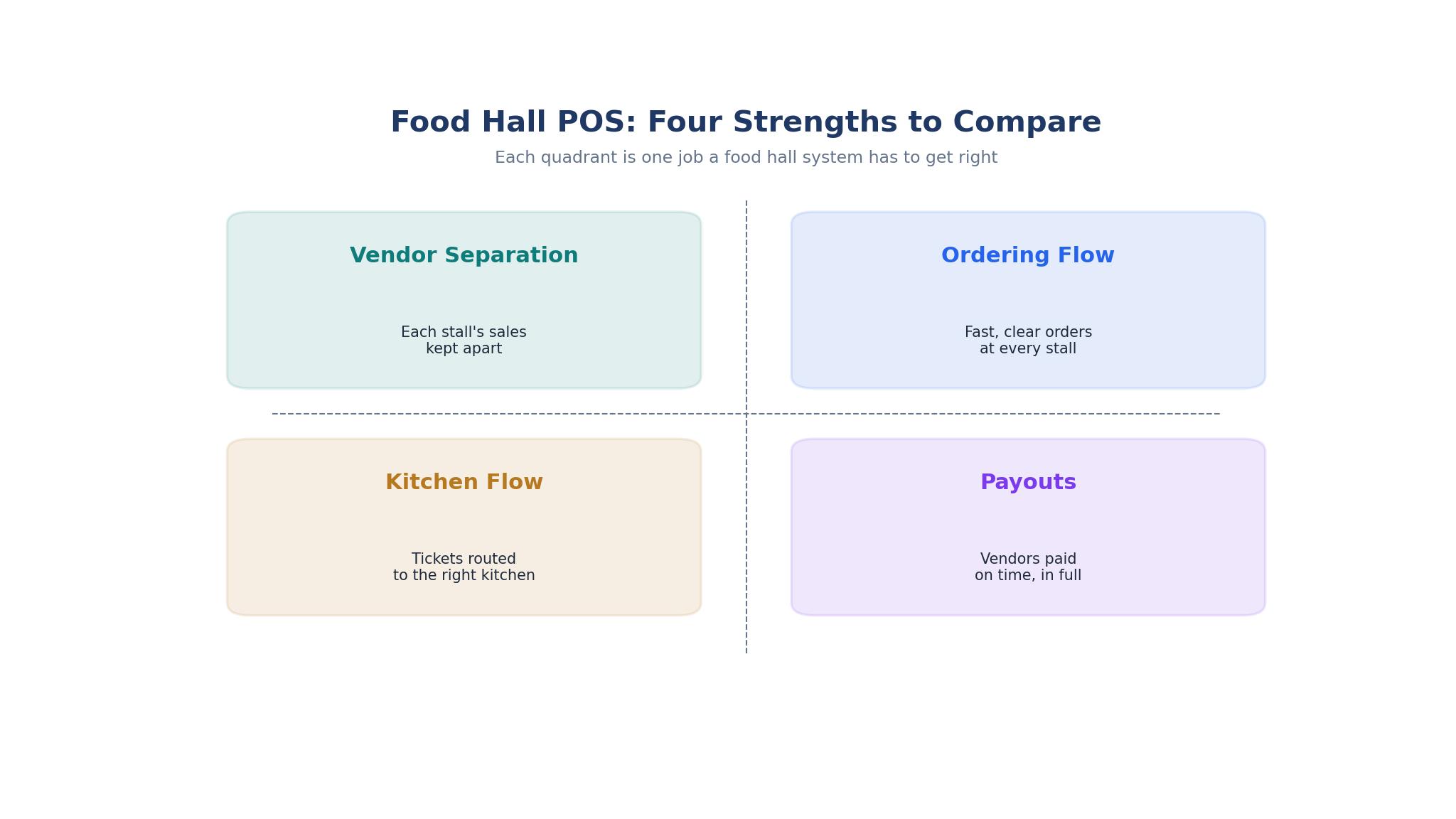
Vendor separation comes first. Each stall needs its own menu, its own modifiers, its own kitchen display and its own end-of-day report, while the hall needs a single view of total sales. The best pos systems for food halls keep those two views clean, so a vendor sees only their own numbers and the operator sees everything.
Second, ordering has to fit the way customers actually move. Some order at a counter, some order from a table with a QR code, some order ahead on a phone and pick up at the stall.
Third, the kitchen flow has to survive the rush. Kitchen display screens, ticket routing, coursing and auto-86ing decide whether ten kitchens can share one room without chaos.
The Real Cost Is Processing, Not the Subscription
The sticker price misleads buyers in this category more than in any other. Square POS is free, with Plus at 49 dollars a month per location and Premium at 149 dollars, and Toast starts at 0 dollars a month on Starter Kit and 69 dollars a month on Point of Sale. Those numbers look cheap until the processing rates arrive, because Square charges 2.6 percent plus 10 cents in person, while Toast charges 2.49 percent plus 15 cents on its Point of Sale plan.
The modules add up faster than the subscription. Toast online ordering runs about 75 dollars a month, loyalty about 50 dollars, gift cards about 50 dollars, email marketing about 75 dollars and the kitchen display about 25 dollars, so a 69 dollar plan quietly becomes 200 to 400 dollars a month with the modules most operators actually use. The 0 dollar Starter Kit moves the cost into a 3.09 to 3.69 percent processing rate, which costs more than the subscription above modest volume.
Hardware is the third line. Toast runs on its own Android hardware, so switching later means replacing terminals, and the more capable plans commonly run on multi-year terms with four-figure termination fees. Lightspeed Restaurant starts at 69 dollars a month, TouchBistro at 69 dollars a month, and Clover restaurant bundles run from 89.95 dollars a month with hardware included. A buyer should price the hardware, the processing and the modules together, because the subscription alone tells almost nothing.
The 15 Tools at a Glance
The table below gives the short version of the best pos systems for food halls, with the starting price each vendor lists or a note where pricing is quote-only. Read it as a shortlist, then use the detailed sections to check vendor separation, kitchen flow and hardware before choosing.
| Tool | Main job | Best for | Starting price |
|---|---|---|---|
| Square for Restaurants | Restaurant POS | Small halls and new operators | Free |
| Toast | Full restaurant POS | Established halls with many vendors | $0 per month |
| Lightspeed Restaurant | Multi-location restaurant POS | Halls with several locations | $69 per month |
| TouchBistro | iPad-based restaurant POS | Full-service halls with table service | $69 per month |
| Clover | Bundled POS and hardware | Operators wanting one vendor | From $14.95 per month |
| SpotOn | POS with marketing | Halls wanting loyalty built in | $55 per station |
| PAR Brink | Enterprise restaurant POS | Large halls and chains | Custom quote |
| Oracle MICROS | Enterprise hospitality POS | Big hospitality groups | Custom quote |
| NCR Aloha | Restaurant POS | Established restaurant groups | Custom quote |
| Revel | Cloud POS | Halls wanting cloud reporting | Custom quote |
| Epos Now | Retail and hospitality POS | Small halls on a budget | Custom quote |
| GoTab | Ordering and POS for halls | Halls built around QR ordering | Custom quote |
| Shopify POS | Retail POS with restaurant add-ons | Halls already on Shopify | $89 per month |
| Zettle | Mobile card payments | Pop-ups and small stalls | Free |
| SumUp | Mobile card payments | Micro vendors and market stalls | Free |
Best Pick by Job
No single POS fits every hall, so the table below matches the best pos systems for food halls to the five most common buying situations. Find the row that describes the hall, then test the two tools named there during a real lunch rush before paying.
| Job type | First pick | Second tool | Why this pair works |
|---|---|---|---|
| New food hall, tight budget | Square for Restaurants | Toast | Square starts free with no contract, while Toast adds depth when volume grows |
| Established hall, many vendors | Toast | Lightspeed Restaurant | Toast leads on kitchen depth, while Lightspeed adds multi-location reporting |
| Hall with table service | TouchBistro | Toast | TouchBistro runs iPad table service well, while Toast covers the full stack |
| Hall built around QR ordering | GoTab | Square for Restaurants | GoTab is built for QR and mobile ordering, while Square covers the counter |
| Pop-up stalls and market vendors | Zettle | SumUp | Zettle takes cards with no monthly fee, while SumUp covers the smallest stalls |
How to Judge the Best POS Systems for Food Halls
Judging the best pos systems for food halls starts with a rush, not a demo. Run a Friday lunch service with ten vendors, a hundred orders and a full dining room, and count how many tickets reach the wrong kitchen, how many modifiers get lost and how long the longest order takes. The tools that survive that hour without a lost ticket are the ones worth paying for.
Next, test the payout. Close the day, run each vendor report, and check that every vendor sees only their own sales and that the hall total ties to the sum of the vendors. A system that cannot split the day cleanly will create a dispute every week, and the dispute will cost more than the software.
Finally, test the failure. Turn off the internet for ten minutes during service and watch what happens. A POS with offline mode keeps taking orders and syncs later, while a POS that needs the cloud stops the whole hall.
The 15 Tools in Detail
Each entry below covers what the tool does best, where it falls short, and who it fits, plus a practical test to run during the trial. The order follows the glance table, and the prices are the starting figures from the best pos systems for food halls shortlist above.
1. Square for Restaurants
Square for Restaurants takes the familiar Square POS and adds table management, modifiers, coursing, kitchen tickets and auto-86ing on paid plans. The free plan covers a single location with core features, processing runs at 2.6 percent plus 10 cents in person, and the Plus plan costs 49 dollars a month per location with Premium at 149 dollars.
The drawback is depth at scale. Square is the easiest POS to set up and the lowest-commitment way to start, but its flat processing rates get expensive at volume, and the multi-vendor reporting is lighter than Toast or Lightspeed. A hall with ten busy vendors may outgrow it.
Square for Restaurants suits a new food hall, a small hall or a pop-up hall that wants to start with no contract and no monthly fee. It is the best first POS for an operator testing the concept.
To test it honestly, run a full lunch rush with three vendors on the trial, and check that each vendor report separates cleanly at close.
2. Toast
Toast is the restaurant POS by which others are judged, and its core platform covers menu management, table and course management, handheld ordering, a kitchen display system and online ordering in one stack. The Point of Sale plan starts at 69 dollars a month with 2.49 percent plus 15 cents card-present processing, while the Starter Kit costs 0 dollars a month with a higher processing rate.
The drawback is lock-in and cost. Toast runs on its own Android hardware, so switching later means replacing terminals, and the more capable plans commonly run on multi-year terms with four-figure termination fees. The modules add up fast, and a 69 dollar plan can reach 200 to 400 dollars a month with the add-ons most operators use.
Toast suits an established food hall with many vendors, high volume and a need for deep kitchen and ordering features. It is the strongest pick for a hall that has proven the concept and now needs the full stack.
To test it honestly, run the busiest hour of the week with every vendor live, and watch the kitchen display screens for a lost ticket or a wrong routing.
3. Lightspeed Restaurant
Lightspeed Restaurant suits operators who think in terms of groups rather than single rooms, with menus, reporting and inventory managed across locations from one back office. The Essentials plan starts at 69 dollars a month per location, with Essential at 189 dollars and Premium at 399 dollars on its pricing page.
The drawback is that it is a full-service POS first, and its counter-service mode, while capable, is not as sharp as Toast for a pure quick-service hall. The price also climbs with the tiers, and a hall that needs the higher plans pays significantly more than the starting figure.
Lightspeed Restaurant suits a food hall group with several locations, or a hall with full-service crossover where guests order at the counter but are served at the table. It fits an operator who lives in the data.
To test it honestly, manage the menus for two locations from one back office in the trial, and check that a price change reaches both halls without a second entry. The multi-location control is the reason to buy this tool.
4. TouchBistro
TouchBistro is the strongest iPad-based option for full-service rooms, starting at 69 dollars a month for Point of Sale and 119 dollars a month for the Essentials Bundle. It covers table management, coursing, modifiers and kitchen display on iPad hardware that staff learn quickly, and it fits a hall where guests sit down and a server takes the order.
The drawback is that table service comes first in its design. A pure counter-service food hall will find the table features unnecessary, and the price sits above Square for the same counter job.
TouchBistro suits a food hall with table service, a hall with a bar, or a hall where guests order at the table and food is run to them. It is the best pick when the dining room matters as much as the counter.
To test it honestly, run a full table service with coursing and split checks in the trial, and check that the kitchen display keeps the courses in order. Coursing is the feature being bought here.
5. Clover
Clover competes on bundling hardware and processing, with restaurant plans from 89.95 dollars a month and full-service bundles listed from 179 dollars a month on a 36-month term, or from 1,799 dollars upfront plus 89.95 dollars a month.
The drawback is the contract. The 36-month terms and the bundled processing mean the buyer should read the contract carefully, because the hardware bundle locks the operator into Clover processing and Clover hardware for years. The restaurant depth is also lighter than Toast.
Clover suits an operator who wants one vendor for hardware, software and processing, with a predictable monthly bill. It fits a hall that values a single contract over best-in-class depth.
To test it honestly, ask for the full contract in writing, including the term, the termination fee and the processing rate, and compare the three-year total against Toast and Square. The contract is the real price here.
6. SpotOn
SpotOn starts at 55 dollars per station and bundles POS with marketing, loyalty and online ordering in a way that suits a food hall that wants to bring customers back.
The drawback is that SpotOn is less widely used than Toast or Square, so the integration list and the community knowledge are thinner. A hall that needs a specific third-party tool should check the integration before committing.
SpotOn suits a food hall that wants loyalty and marketing built into the POS, especially a hall in a competitive neighborhood where repeat visits decide the business. It fits an operator who will actually use the marketing tools.
To test it honestly, run a loyalty campaign for a week in the trial, and check how many repeat customers the system identifies and how many redeem. The loyalty loop is the value here.
7. PAR Brink
PAR Brink is an enterprise restaurant POS built for large halls and chains, with deep kitchen management, multi-location control and the reliability a high-volume operation needs.
The drawback is price transparency and scale. PAR Brink does not publish pricing, with third-party guides placing it at roughly 200 to 350 dollars a month per location at scale, and the implementation is an enterprise project rather than a self-serve setup. A small hall will pay an enterprise price for features it never opens.
PAR Brink suits a large food hall, a hall group or a chain operator with the volume to justify enterprise software. It is the wrong tool for a new hall with three vendors.
To test it honestly, ask the vendor to model the full cost for the hall size, including hardware, implementation and processing, and compare the three-year total against Toast. The enterprise price only earns its place at enterprise volume.
8. Oracle MICROS
Oracle MICROS is the enterprise hospitality POS, built for big hotel groups, resorts and large food halls where the POS must connect to property management, inventory and enterprise reporting.
The drawback is the obvious one. Oracle MICROS is quote-priced, enterprise-weighted and expensive to implement, and a food hall that does not need hotel integration will pay for a system built for a different business. The setup takes weeks and needs specialist help.
Oracle MICROS suits a food hall inside a hotel, a resort or a large hospitality group that already runs Oracle. It is a poor fit for an independent hall.
To test it honestly, ask the vendor to show the integration with the property system the hall already runs, and check that a room charge or a hotel folio posts correctly. The integration is the only reason to buy this tool.
9. NCR Aloha
NCR Aloha is an established restaurant POS with deep roots in full-service and quick-service operations, covering ordering, kitchen display, payments and reporting in a proven package.
The drawback is that pricing is custom quote, and the platform is older than the cloud-native tools in this guide, so the interface and the setup feel heavier. A new operator may find the cloud tools faster to learn and cheaper to start.
NCR Aloha suits an established restaurant group or a food hall run by an operator who already knows Aloha. It fits a business that values a proven system over a modern interface.
To test it honestly, run a full service with the existing staff in the trial, and time how long it takes a new hire to take their first order. The learning curve is the test for an older system.
10. Revel
Revel is a cloud POS built for restaurants and retail, with strong cloud reporting, inventory and multi-location control.
The drawback is price transparency. Revel does not publish pricing, so the cost only appears after a sales conversation, and the restaurant depth is lighter than Toast for a high-volume kitchen. A hall should get a written quote and compare it against the published prices in this guide.
Revel suits a food hall that values cloud reporting and multi-location control, especially a hall with several sites. It fits an operator who checks the numbers from a phone every night.
To test it honestly, check the cloud reports from a phone during the trial, and confirm the sales, the vendor splits and the inventory all update in real time. The cloud access is the promise here.
11. Epos Now
Epos Now is a retail and hospitality POS that suits a small food hall on a budget, with a simple setup, a low entry cost and a wide app marketplace for add-ons.
The drawback is depth. Epos Now is a general POS rather than a restaurant specialist, so the kitchen display, the coursing and the multi-vendor features are lighter than Toast or Lightspeed. A busy hall will outgrow it.
Epos Now suits a small food hall, a market hall or a new operator testing the concept on a budget. It is a sensible first system before the hall grows into a specialist POS.
To test it honestly, run a lunch rush with three vendors in the trial, and check whether the kitchen tickets route correctly and the vendor reports separate. The rush is the test even for a budget tool.
12. GoTab
GoTab is built around QR ordering and mobile-first service, which makes it the most interesting pick in this guide for a hall designed around phones. Customers scan, order, pay and get notified when the food is ready, and the kitchen sees the order on a display without a counter queue.
The drawback is that pricing is custom quote, and the platform is ordering-led rather than full-POS, so a hall that needs deep back-office accounting may still need another system. A hall with many walk-in customers who prefer a counter may also find the QR focus limiting.
GoTab suits a food hall built around QR ordering, a hall with a young audience, or a hall where the counter queue is the main problem. It fits an operator who wants the phone to be the till.
To test it honestly, run a full lunch service with QR ordering only, and count how many customers need staff help to order. If more than one in ten needs help, the hall still needs a counter option.
13. Shopify POS
Shopify POS Pro costs 89 dollars a month per location and makes sense only if the hall already runs on Shopify, because the shared inventory is its whole argument.
The drawback is that it is a retail POS with restaurant add-ons, not a restaurant POS. The kitchen display, the coursing and the multi-vendor food hall features are lighter than Toast or Square for Restaurants, and the price only makes sense inside a Shopify business.
Shopify POS suits a food hall that is also a retail business, with packaged goods, merchandise or online sales alongside the stalls. It is a poor fit for a pure food hall with no Shopify store.
To test it honestly, sell a packaged product online and at the stall in the same hour, and check that the inventory drops correctly in both places. One inventory is the promise being bought.
14. Zettle
Zettle costs nothing per month and takes cards with a simple reader, which makes it the cheapest serious option for a pop-up stall or a micro vendor. There is no contract, no monthly fee and no setup, and a vendor can start taking cards in an afternoon.
The drawback is that it is a card reader, not a POS. There is no kitchen display, no vendor separation, no table management and no reporting depth, so a hall cannot run on Zettle alone. It is a payment tool, not a food hall system.
Zettle suits a pop-up stall, a market vendor or a single stall inside a hall that needs its own card reader. It fits a micro business that just needs to take cards.
To test it honestly, run a busy hour with the reader and check that every payment lands in the right account with the right fee. The simplicity is the value, and the test is whether it holds up under volume.
15. SumUp
SumUp is the other free mobile payment option in this guide, with no monthly fee and a simple reader that takes cards anywhere. It suits a micro vendor, a market stall or a food truck that needs to take payments without a contract or a subscription, and it is one of the cheapest ways to start selling.
The drawback is the same as Zettle. SumUp is a payment tool, not a POS, with no kitchen display, no vendor separation and no reporting depth. A hall that tries to run on SumUp alone will have no record of what each vendor sold.
SumUp suits the smallest vendors in a hall, the ones who sell a single product and need nothing more than a card reader. It is a complement to a hall POS, not a replacement for one.
To test it honestly, take fifty payments in a busy hour and reconcile them against the cash record at the end of the day. If the reconciliation takes more than ten minutes, the vendor needs a real POS.
What the First Year Costs a Food Hall
Price a hall with ten vendors on the best pos systems for food halls and the differences sharpen. Square for Restaurants on the free plan costs nothing in subscription, and the hall pays only processing at 2.6 percent plus 10 cents per transaction. Toast on Point of Sale at 69 dollars a month per terminal costs far more in subscription, but the processing at 2.49 percent plus 15 cents is slightly cheaper per sale.
Lightspeed Restaurant at 69 dollars a month per location and TouchBistro at 69 dollars a month sit in the same range as Toast for the subscription, while Clover at 89.95 dollars a month with hardware included looks higher until the hardware cost is added to the others.
The lesson is to price the processing first. A hall that does 100,000 dollars a month in card sales will pay more in processing in one month than in subscriptions all year, and a half-point difference in the rate is worth more than any feature.

Errors That Cost a Hall Its First Season
The most common mistake is choosing the POS before choosing the ordering flow. A hall that wants QR ordering, counter ordering and table service needs a system that does all three, and a system that does one well and the others badly will force the hall to change its flow to fit the software.
The second mistake is signing a multi-year contract before the first rush. A POS that looks good in a demo can fail under a Friday lunch load, and a three-year contract with a four-figure termination fee turns a bad choice into a bad three years. Run a full month on a monthly plan first, and only sign a term when the rush has proven the system.
The third mistake is forgetting the vendor payout. A hall that cannot split the day cleanly by vendor will spend every Monday reconciling disputes, and the vendors will lose trust in the operator. Test the payout in the trial with real sales, and confirm every vendor sees only their own numbers.
Frequently Asked Questions
How much does a food hall POS cost?
A new hall can start on Square for Restaurants for free, paying only processing at 2.6 percent plus 10 cents in person. Toast Point of Sale starts at 69 dollars a month per terminal with 2.49 percent plus 15 cents processing, while Lightspeed and TouchBistro start at 69 dollars a month. The modules add 200 to 400 dollars a month on Toast, and the processing bill at volume is larger than the subscription, so buyers should price the total rather than the sticker.
Is Toast or Square better for a food hall?
Toast is better for an established hall with many vendors and high volume, because its kitchen display, coursing and ordering depth are the strongest in this guide. Square is better for a new hall or a small hall, because it starts free with no contract and no monthly fee.
Do food halls need a special POS?
Yes, because a food hall is ten vendors sharing one room, not one restaurant with ten tables. The POS must separate each vendor menu, kitchen tickets, reports and payouts while giving customers one ordering flow and one payment experience. A single-restaurant POS that forces every vendor onto one menu will fail, and a set of separate tills will confuse every customer.
Can a food hall run on QR ordering alone?
It can, and GoTab is built for exactly that, with customers scanning, ordering, paying and getting notified when the food is ready. The risk is that some customers prefer a counter, and a hall with no counter option will lose them. Most halls should offer QR ordering alongside a counter, and test how many customers need staff help before removing the counter entirely.
What is the cheapest POS for a food hall?
Square for Restaurants is the cheapest honest start, with a free plan and no contract, paying only processing. Zettle and SumUp are free for a single stall, but they are card readers rather than a full POS.
How do vendors get paid in a food hall?
The POS should split the day by vendor, with each vendor seeing only their own sales and the operator seeing the total. Square, Toast and Lightspeed all produce vendor reports, and the operator pays each vendor from those reports, usually weekly or monthly. A buyer should test the payout in the trial with real sales, because a system that cannot split the day cleanly will create a dispute every week.
Our Verdict for a Food Hall Operator Buying a POS in 2026
For a new food hall, Square for Restaurants is the pick. It starts free, needs no contract, and lets the operator prove the concept before spending on a full system. An established hall with many vendors and a busy lunch rush should buy Toast instead, because the kitchen depth, the ordering tools and the reliability earn the price at volume.
The decision rule is simple. Run a Friday lunch rush on the trial, check that no ticket is lost and every vendor report separates cleanly, then price the processing at real volume before signing.