
If you want to know how to use AI to prepare for an exam, start with a fact that surprises most students. AI can cut the time it takes to turn a chapter into flashcards, a practice quiz, or a clean summary from an hour to a few minutes. What it cannot do is learn the material for you. The students who get real value from AI in 2026 use it as a study partner that tests them, organises their revision, and exposes the gaps in what they know. The students who get hurt by it use it as a shortcut, copying answers they never understood and walking into the exam with false confidence. This guide shows you the first approach, step by step, with a realistic plan, honest tool comparisons, and the traps to avoid.
The Short Answer: What Works and What Hurts
AI helps most when it makes you practise recall. Asking a chatbot to explain a topic, then closing the chat and writing the explanation from memory, builds knowledge. Asking it to generate flashcards from your notes and then testing yourself daily builds knowledge. Asking it to write practice questions in exam style, then answering them under timed conditions, builds knowledge. Each of these uses forces your brain to retrieve information, and retrieval is what exam performance depends on.
AI hurts when it replaces that retrieval. Reading an AI summary and feeling that you understand a topic is not the same as being able to reproduce it under pressure. Copying AI written essay answers teaches you nothing about structuring an argument in the exam hall. Letting a chatbot solve every practice problem means you never practise the working, and the working is where most marks are lost. A useful rule: if AI did the thinking, you did not study. If AI set the question and you did the thinking, you studied well.
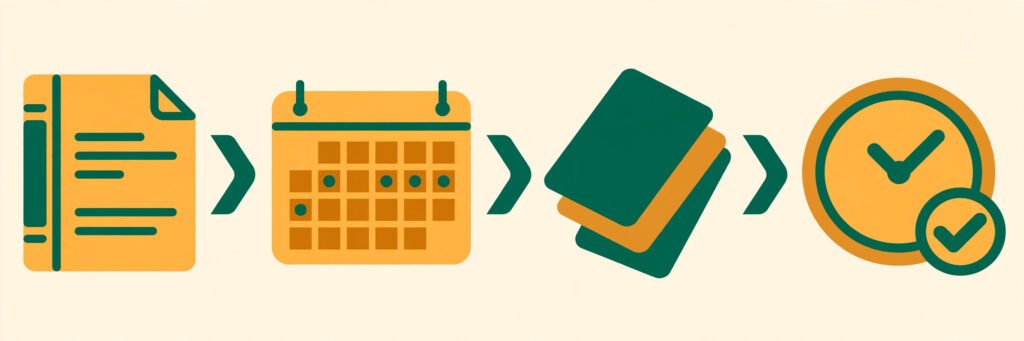
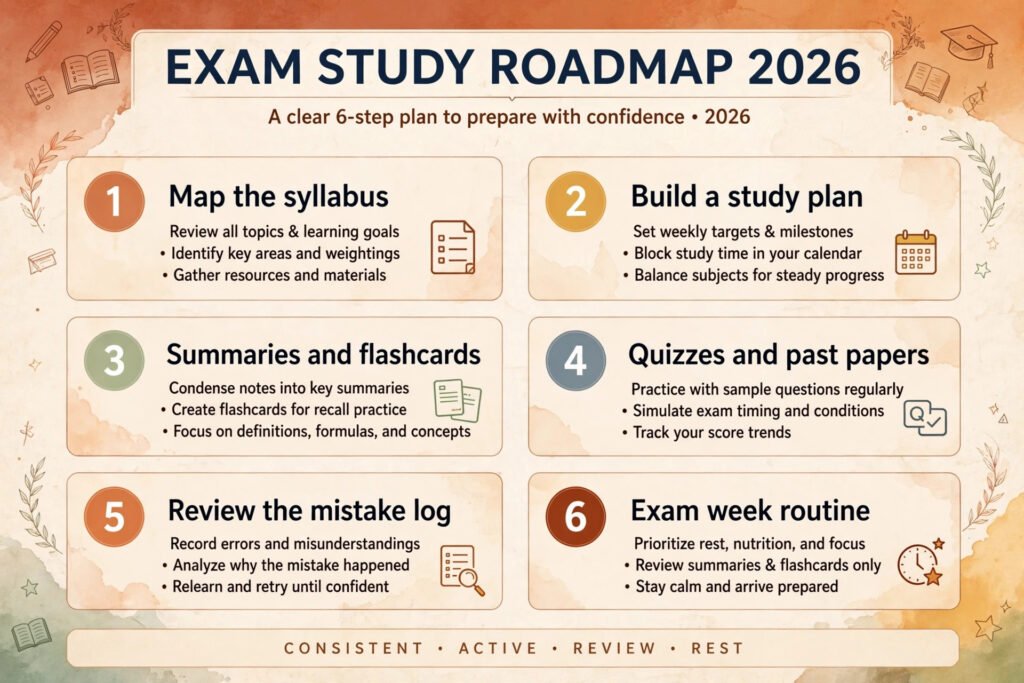
A realistic plan for a typical exam, such as a school final, a university module, or a professional certification, looks like this. Spend the first week mapping the syllabus and gathering materials. Spend the middle weeks learning in short daily sessions, with AI generated quizzes every second or third day. Spend the final two weeks on timed past papers and mistake review, with AI used only to explain the questions you got wrong. Total study time depends on the exam, but most students do better with 90 minutes of focused daily study for four weeks than with 10 hour cramming sessions in the final three days. AI makes the focused version easier because it removes the slow jobs, such as making cards and finding questions, that used to eat half the session.
How to use AI to prepare for an exam, step by step
Step 1: Map the Syllabus Before You Open Any AI Tool
Every strong revision plan starts on paper, or at least in a plain document, not inside a chatbot. Download or copy the official syllabus, the list of topics, and the mark scheme if one is published. Break the syllabus into topics and give each one a weight based on how many marks it carries and how confident you already feel. A topic worth 30 percent of the exam deserves roughly 30 percent of your study time, unless you already know it well.
Now turn each topic into a question. “Cell respiration” becomes “How does a cell release energy from glucose, and what happens at each stage?” “Contract law” becomes “When is a contract formed, and what makes it unenforceable?” This matters because AI tools work far better when you feed them precise questions than vague topics. Paste one topic question at a time into your AI tool and ask for a structured outline of the answer, not the full answer. Check that outline against your textbook or class notes. If the AI outline misses a point your notes include, your notes win. This checking habit, done from day one, protects you from the single biggest risk of AI study: confident sounding errors.
At the end of this step you should have three things: a topic list with weights, a set of topic questions, and a folder of source materials, meaning your notes, slides, textbook chapters, and past papers. AI will work from these materials from now on. Never let it work from memory alone when your own notes are available, because your notes describe what your examiner actually tests.
Step 2: Build a Study Plan AI Can Actually Run
A plan that says “study biology” fails. A plan that says “Tuesday 7pm: 25 minutes on Topic 3 flashcards, 20 minutes on 10 practice questions, 10 minutes reviewing yesterday’s mistakes” succeeds, because it tells you exactly what to do when you sit down. Build your plan in a simple table with four columns: date, topic, task, and time. Aim for five or six study days per week, with one rest day. Short daily sessions beat long weekend sessions for memory, and the research on spaced repetition backs this up clearly.
This is where AI earns its place. Give your AI tool the topic list and ask it to spread the topics across your available days, repeating each topic three times with growing gaps: first review after one day, second after three days, third after a week. This spacing pattern is the core of effective revision, and it is tedious to schedule by hand. Ask the tool to output the plan as a table you can paste into a notes app or print. Then check it: does every high weight topic appear at least three times? Is any day overloaded? Adjust by hand where needed. The plan belongs to you, not to the tool.
Set two rules for the plan and keep them. First, no session longer than 50 minutes without a 10 minute break. Second, every session ends with five minutes of self testing, even if it is only writing down three things you learned. These two rules do more for retention than any tool feature, and they cost nothing.
Step 3: Learn With Summaries and Flashcards You Verify
Summaries are the most misused AI study feature. A good AI summary is short, structured, and tied to your source material. A bad one is long, vague, and full of details your exam will never ask about. Get good summaries by giving the tool your notes and a strict instruction: summarise this chapter in no more than 300 words, keep every definition exact, and list the three ideas most likely to appear in an exam question. Then read the summary against your notes and correct anything wrong. The correction step is where learning happens, so do not skip it.
Flashcards work differently and better, because they test you. Ask your AI tool to turn one topic into 15 to 20 flashcards, each with one question on the front and one short answer on the back. One fact per card is the rule: a card that asks three things teaches none of them well. Import the cards into a spaced repetition app such as Anki, which schedules reviews automatically, or use a quiz app such as Quizlet if you prefer a simpler setup. Review new cards daily and old cards on the schedule the app sets. When you get a card wrong, do not just flip it and move on. Write the correct answer out once by hand, or say it aloud, before continuing. That extra effort is what moves the fact from short term to long term memory.
Diagrams and processes deserve special treatment. For a biology cycle, a physics process, or a history timeline, ask the AI tool to describe the diagram step by step in words, then draw it yourself from memory and compare. Students who can redraw a process from memory almost always score higher on questions about it than students who only read about it. AI can also quiz you on diagrams: describe a diagram in words, then ask it to ask you questions about each part. This turns a passive topic into an active one.

Step 4: Practise With Quizzes and Past Papers Under Exam Conditions
Practice questions are where AI preparation either pays off or falls apart. Start with AI generated quizzes for each topic: 10 questions, mixed formats, with answers hidden until you finish. Answer them without notes, then check your score and read the explanation for every question you missed. If an explanation contradicts your textbook, trust the textbook and note the AI error. Over a few weeks, you will learn which of your tools is most reliable for your subject, and that knowledge is worth keeping.
Past papers matter more than any AI quiz, because they show the real question style, mark allocation, and wording of your examiner. Do at least three full past papers before exam week, under timed conditions, in a quiet room, with no phone and no AI help during the paper. Only after finishing should you bring AI in, and then only for one job: explaining the questions you got wrong. Paste a question and your answer, ask where your reasoning went wrong, and compare the explanation with the mark scheme. This post paper review is the highest value use of AI in the whole plan, because it targets exactly the gaps that cost you marks.
For essay subjects, practise writing under time pressure too. Use AI to generate essay titles in exam style, write a timed plan in 10 minutes, then a full answer if time allows. Ask the AI tool to check your plan against the mark scheme: did you cover every required point, is your structure clear, did you use evidence? Do not ask it to rewrite your essay. A rewritten essay feels better but teaches less than a marked plan you then improve yourself. The same discipline applies to writing in general, and our guide to the best AI tools for freelance writers covers the drafting tools that help with structure and editing without replacing your own thinking.
Step 5: Review Your Mistakes Like a Coach, Not a Fan
Most students review mistakes by reading the correct answer once and moving on. That feels productive and achieves little. A better method is the mistake log: a simple document with four columns, being the question, your answer, the correct answer, and the reason you got it wrong. Reasons fall into a small set of categories: you did not know the fact, you knew it but misread the question, you knew it but ran out of time, or you knew it but wrote it unclearly. Each category needs a different fix. Unknown facts go back into flashcards. Misread questions mean you need to practise underlining command words such as explain, compare, and evaluate. Time problems mean more timed practice. Unclear writing means more planned answers.
Ask AI to help you find patterns in your log. Paste ten logged mistakes and ask which reason appears most often and which topic appears most often. The answer tells you where your next week of study should go, and it is often surprising. Students commonly discover that half their lost marks come from two topics they thought they knew, or from rushing the final question. Fixing one pattern can add more marks than learning ten new facts, which is why this step sits near the end of the plan, when your log is full enough to show patterns.
Revisit your mistake log every three days in the final two weeks. Each time, re-answer the questions you previously got wrong without looking at the answers. When you can answer a logged question correctly twice in a row, remove it from the active log. Watching the log shrink is also useful motivation in the final stretch, when energy usually drops.
Step 6: Exam Week Routine
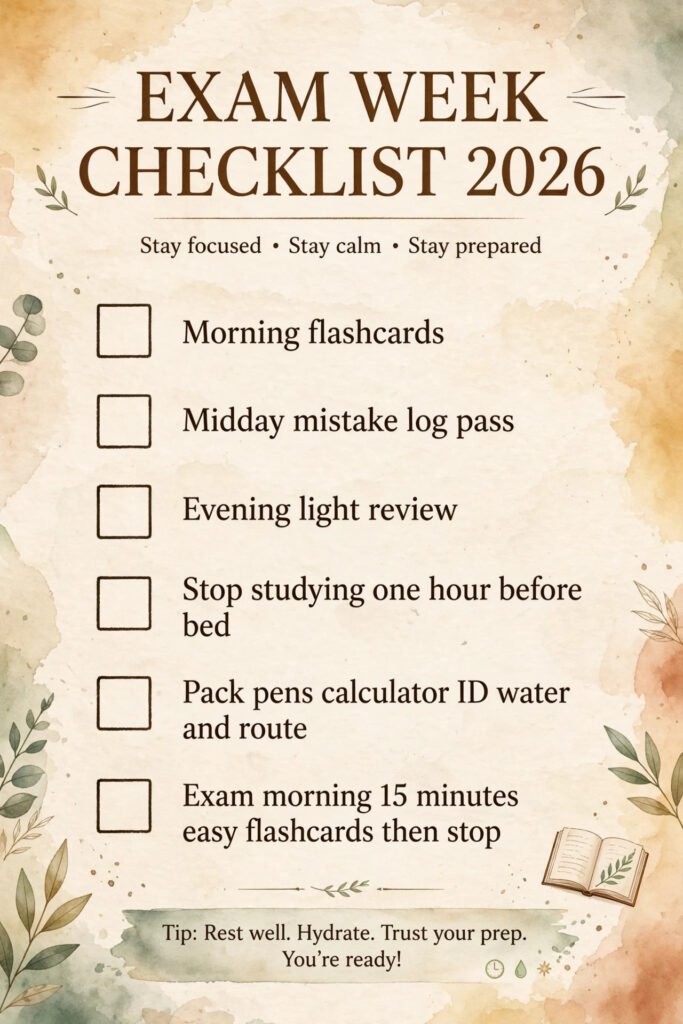
Exam week is not the time to learn new material. It is the time to protect what you already know. Reduce study to short review sessions: flashcards in the morning, one mistake log pass at midday, and a light review of your topic outlines in the evening. Stop studying at least an hour before bed so sleep can consolidate memory. Sleep is not wasted time during exam week; it is when the day’s revision becomes durable knowledge, and students who cut sleep to cram consistently perform worse the next day.
The day before the exam, prepare everything physical: pens, calculator, ID, water, and the route to the venue. Read your one page summary for each topic, which you should have built during Step 3, and nothing else. On exam morning, do 15 minutes of easy flashcards to warm up, then stop. Do not learn a new topic on exam morning. If a question in the exam covers something you never studied, write what you do know about the nearest topic, structured clearly, because partial credit often comes from a clear structure even when the content is incomplete.
After the exam, write down the questions you remember while they are fresh. This helps classmates who sit the exam later, helps you if there is a resit, and closes the loop on your study plan. It also gives you honest feedback on which parts of your AI assisted plan worked, so your next exam preparation starts stronger.

AI Study Tools Compared
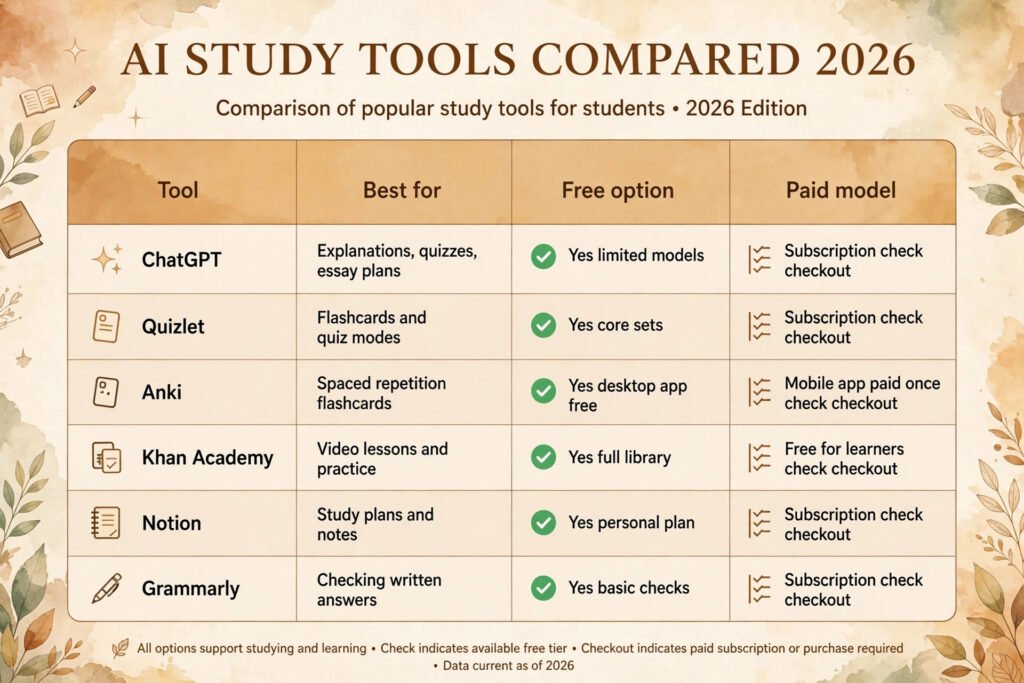
The tools below cover the main jobs in this guide. Prices are October 2026 plan models, and you should check checkout for current pricing, because student discounts and plan names change often. No tool here replaces your textbook or your teacher, and the best choice depends on your subject, covered below.
| Tool | Best for | Free option | Paid model |
|---|---|---|---|
| ChatGPT | Explanations, quizzes, essay plans | Yes, limited models | Subscription, check checkout |
| Quizlet | Flashcards and quiz modes | Yes, core sets | Subscription, check checkout |
| Anki | Spaced repetition flashcards | Yes, desktop app free | Mobile app paid once, check checkout |
| Khan Academy | Video lessons and practice | Yes, full library | Free for learners, check checkout |
| Notion | Study plans and notes | Yes, personal plan | Subscription, check checkout |
| Grammarly | Checking written answers | Yes, basic checks | Subscription, check checkout |
ChatGPT is the most flexible tool on the list, because it can explain, quiz, summarise, and mark plans, but it is also the one most likely to produce confident errors, so every output needs checking against your notes. Quizlet is the simplest route to flashcards, with a large library of shared sets, but shared sets vary in quality, so prefer sets you make yourself or that match your syllabus. Anki has the strongest spaced repetition system and is free on desktop, but it takes an hour or two to learn properly, which pays off only if your exam is weeks away. Khan Academy is free and excellent for maths and science foundations, though it does not cover every syllabus. Notion works well as the home for your plan, topic list, and mistake log in one place. Grammarly helps polish written practice answers, but it cannot judge whether your argument answers the question, so use it for language, not for content.
Try it at the official sites: ChatGPT, Quizlet, Anki, Khan Academy, Notion.

How to Choose Tools for Your Subject
Maths and science students should weight practice questions and mistake review above everything else. Anki for formulas and definitions, plus timed past papers, covers most of the plan. Use a chatbot only to explain a worked solution step by step, and always verify the working yourself, because a single wrong sign in an AI solution can waste an hour if you trust it blindly.
Essay and humanities students should weight planning and writing practice above flashcards. Use AI to generate essay titles and to check your plans against mark schemes, and use a notes app to store quotations and evidence with sources. Flashcards still help for dates, definitions, and key terms, but they should not dominate your time.
Language students get special value from AI conversation practice. Ask a chatbot to hold a short conversation in the target language at your level, correct your errors, and then quiz you on the corrected phrases. Combine this with vocabulary flashcards and listening practice from real sources, because AI conversation alone does not train your ear for native speed speech.
Professional exam candidates, such as those sitting accountancy, law, or medical licensing exams, should check whether their exam body restricts AI use in any way and should weight official question banks above AI generated questions. AI is still useful for explaining official answers and for organising a long study schedule, but the question bank, not the chatbot, defines the standard.
Mistakes to Avoid
The first mistake is studying with AI open beside you for every question. If you check the answer before struggling, you remove the struggle that creates memory. Try for at least two minutes before asking for a hint, and ask for a hint, not the answer, when you do ask.
The second mistake is trusting AI summaries of topics you have never studied. A summary of unknown material feels clear precisely because you have nothing to compare it against. Always read the textbook section first, then use the summary to test whether you can recognise the key points.
The third mistake is collecting tools instead of studying. Downloading five apps, importing three flashcard decks, and setting up two planners feels like progress and produces none. Pick one tool per job, set them up in a single afternoon, and then stop shopping for tools.
The fourth mistake is skipping past papers because AI quizzes feel easier. AI quizzes feel easier because they are easier: they match what you already know and rarely reproduce the awkward wording of real exam questions. Past papers are uncomfortable for exactly the reason they are useful.
The fifth mistake is cramming with AI the night before. A chatbot can generate a 50 page summary overnight, but your brain cannot absorb it overnight. The final night belongs to your mistake log, your one page summaries, and sleep.
The sixth mistake is ignoring the mark scheme. Students lose marks by writing long answers to short questions, or short answers to long questions, more often than by missing facts. Read the mark scheme for at least one past paper in full, and note how marks are allocated across knowledge, application, and evaluation.
Frequently Asked Questions
Can AI write my revision notes for me?
It can draft them, but you should treat the draft as a starting point, not a finished product. Read it against your textbook, correct errors, and rewrite the key points in your own words. Notes you have checked and rewritten are far more useful in an exam than notes you printed without reading.
Is using AI to study cheating?
Using AI to explain, quiz, and organise your study is standard study help, similar to using a textbook or a tutor. Using AI to complete assessed coursework, or to produce work you submit as your own, is academic misconduct at most institutions. Check your school or university rules before using AI for any assessed work, and never use it during an exam unless it is explicitly allowed.
How much time should I study with AI each day?
Aim for 60 to 90 minutes of focused study, with AI handling the setup jobs such as making cards and questions. Longer sessions help only if they stay focused, so take a break every 50 minutes and end each session with self testing. Total time matters less than consistency across weeks.
Which AI tool is best for flashcards?
Anki has the strongest spaced repetition system and is free on desktop, which makes it the best choice for long revision periods. Quizlet is simpler to start with and better for quick shared sets. Either works if you test yourself daily and review mistakes properly.
Can AI predict exam questions?
No tool can reliably predict your exam questions, and any claim that it can should be treated with suspicion. AI can generate questions in exam style on your syllabus topics, which is useful practice, but the real questions come from your exam board, so past papers remain the best guide to what will be asked.
What should I do if AI gives me a wrong answer?
Note it in your mistake log, check the correct answer in your textbook, and adjust how you use that tool. If a tool makes repeated errors in your subject, switch tools or use it only for jobs where you can verify every output, such as turning your own notes into flashcards rather than generating facts from scratch.
Conclusion
Learning how to use AI to prepare for an exam comes down to one division of labour: AI prepares the materials, and you do the learning. Let it build your plan, generate your quizzes, and explain your mistakes, but keep the testing, the writing, and the checking in your own hands. Start with the syllabus, study in short daily sessions, practise under timed conditions, and review your mistakes until the log shrinks. Done this way, AI saves you hours of setup work and gives you more practice questions than any previous generation of students had. Done the other way, as a shortcut to answers, it costs you the very knowledge the exam is designed to test. Pick the first way, and start with Step 1 today, while there is still time for spaced repetition to do its work.