
Couples married in 2025 paid about $3,000 on average for wedding photography, according to The Knot Real Weddings Study, and most full day bookings fell between $2,500 and $4,500. That single figure hides a wide spread. A short elopement package can cost under $2,000, while a full day booking with two photographers, a fine art album, and drone coverage can pass $10,000. Understanding wedding photography pricing packages means looking past the headline price and checking hours, shooters, edited images, delivery time, and print rights, because two packages priced $1,000 apart can deliver very different days.
This guide breaks down what each tier usually includes, what add-ons really cost, and how to read a quote without missing the lines that change the total. Prices here are published ranges from photographer pricing guides and real photographer price pages, checked at draft time. They are starting points for comparison, not quotes for your date and city. Confirm every figure in writing with the photographer you book, because rates vary by region, season, experience, and the exact coverage you request.
What the National Averages Actually Mean
An average is useful only if you know what sits behind it. The Knot figure near $3,000 reflects full day coverage for a typical wedding, not a two hour elopement and not a luxury destination booking. Pricing guides that break the market into tiers tell a clearer story. Budget photographers, often newer professionals building a portfolio, commonly list $1,000 to $2,500 for shorter coverage. Mid range professionals with several years of full wedding experience commonly list $2,500 to $6,000. Established professionals commonly list $6,000 to $12,000, and luxury or destination specialists can list $12,000 to $50,000 or more.
Region moves those bands a lot. Guides put Northeast bookings around $3,200 to $6,500 and West Coast bookings around $3,500 to $7,000, with major metro markets such as New York commonly reaching $8,000 to $10,000 or more for experienced photographers. Midwest ranges run lower, around $2,200 to $4,500, and rural markets often fall between $1,500 and $2,500. A photographer in a high cost city pays more for studio space, insurance, assistants, and gear maintenance, and faces stronger demand on peak Saturdays, so the same eight hours can legitimately cost twice as much as in a smaller market.
Season and weekday matter too. Peak season Saturdays from May through October commonly carry a premium of 15 to 40 percent over off peak dates in published guides. A Friday or Sunday wedding, or a winter date, can save $1,000 to $2,000 against the following Saturday at the same venue, though the saving depends on the photographer and how full their calendar already is. Guest count matters in a quieter way. A 200 guest wedding needs more time for group portraits, a longer reception, and often a second shooter, so it tends to land at the upper end of its tier even when the couple wants a modest package.
Photography also takes a defined share of the total wedding budget. Guides commonly put it at 8 to 12 percent of total spend. For a $30,000 wedding, that points to $2,400 to $3,600 for photography. That share is a planning aid, not a rule. Couples who value photographs above flowers, decor, or a larger guest list often spend more, and couples planning a small ceremony with a short reception often spend less. That is why wedding photography pricing packages vary so much between cities. The right question is not whether your quote matches the national average. It is whether the hours, images, and products in the quote match the day you are actually planning.
How wedding photography pricing packages are built
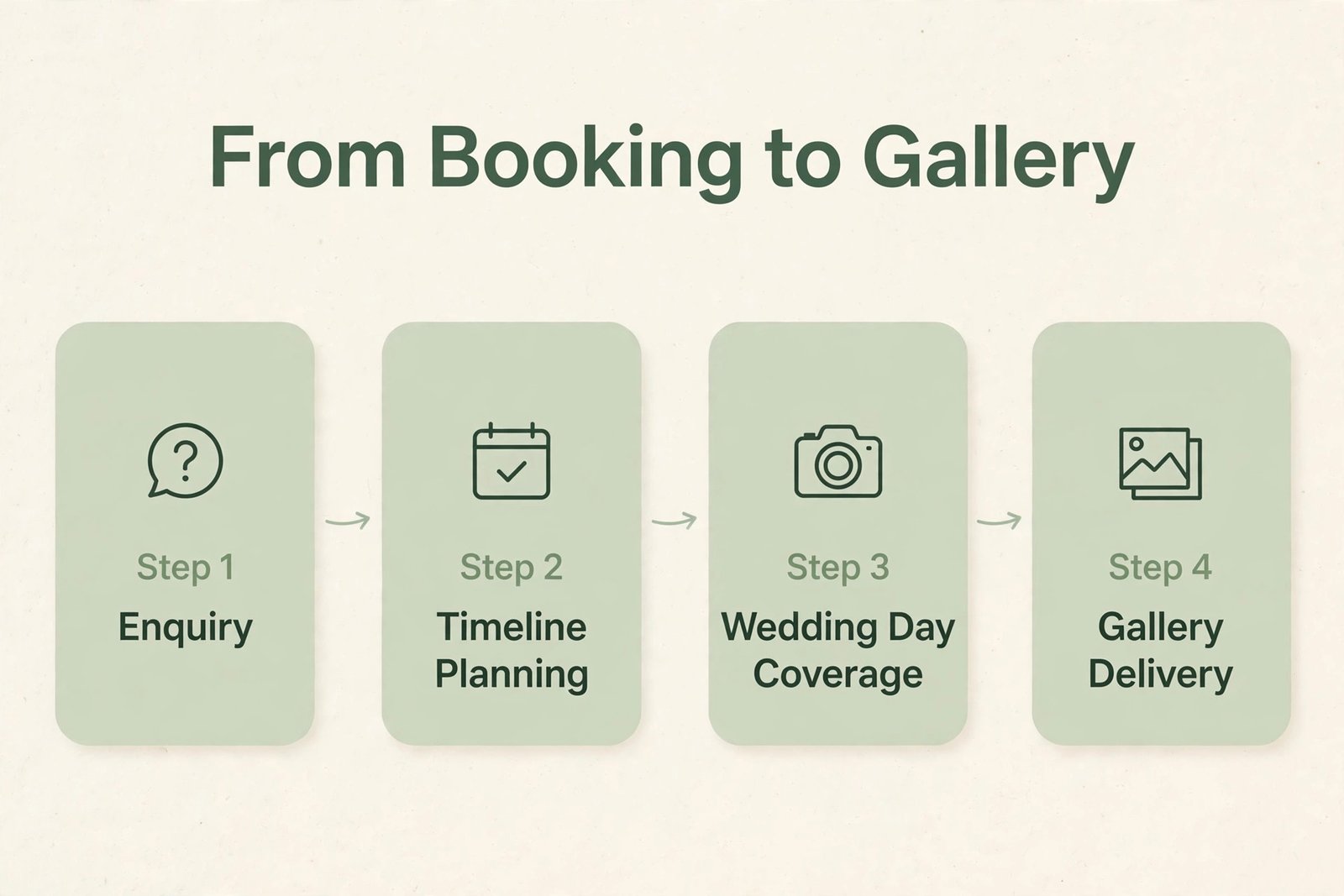
A package price is built from four blocks, and photographers weight them differently. The first block is time on the day, measured in coverage hours. The second block is people, meaning one photographer or two, plus any assistant. The third block is post production, meaning culling, editing, and gallery delivery, which often takes far longer than the wedding itself. The fourth block is products, meaning albums, prints, wall art, and parent copies. When a package looks cheap, one of those blocks is usually smaller, and the quote will show it if you read carefully.
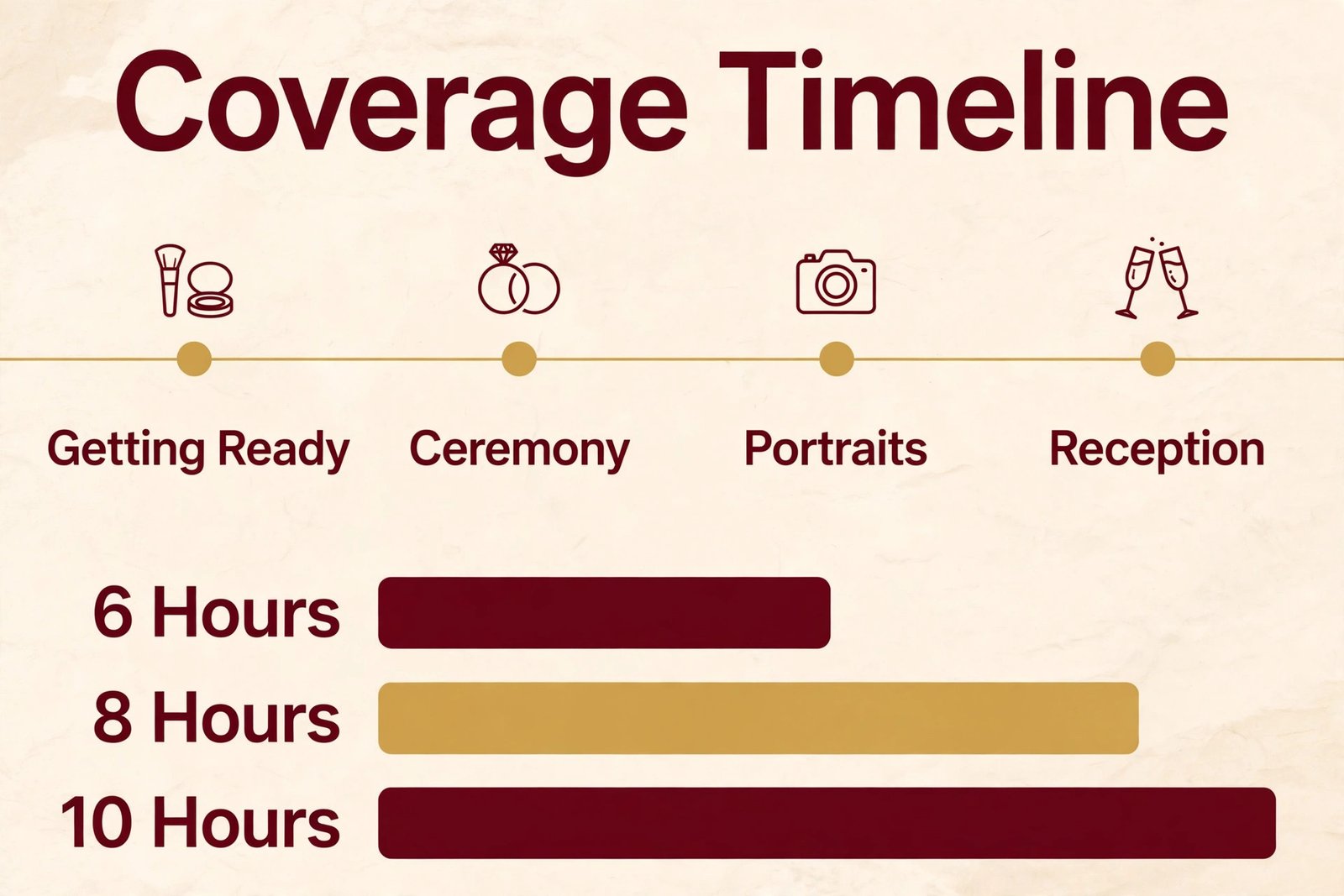
Coverage hours are the backbone. A six hour package might cover ceremony and part of the reception, but it will miss getting ready moments or the late reception unless the timeline is tight. An eight hour package is the common full day shape, covering getting ready through first dance, toasts, and cake. A ten to twelve hour package covers the full arc, from early preparation through the send off, with room for travel between venues and unhurried portraits. Extra hours are not a luxury for a long day. They are the difference between a photographer who leaves before the party peaks and one who stays for it.
People are the second lever. A single photographer can cover a small wedding well, especially at one venue with a simple timeline. A second shooter adds a second angle during the ceremony, covers the partner getting ready at the same time, and keeps reception candids flowing while the lead photographer runs portraits. Published guides put a second shooter at $300 to $1,500 for a full day, with $500 to $1,200 the most common band. If your wedding has two getting ready locations, a large guest list, or a ceremony and reception at different venues, a second shooter is usually worth more than extra prints.
Post production is the hidden cost most couples underestimate. A photographer may shoot several thousand frames, select 400 to 800 final edited images, and spend days on colour, exposure, retouching, and gallery preparation. Standard delivery runs 4 to 8 weeks in most guides, with sneak peeks often arriving within a few days. Faster delivery is priced as a rush service, commonly $200 to $500 extra or 15 to 30 percent of the package.
Products are the fourth block, and they are where totals climb after the wedding. A fine art album from a professional lab commonly costs $500 to $2,500, with standard 10 by 10 albums around $800 to $2,500 in add-on tables and parent replica albums around $300 to $800 each. Wall art, fine art prints, and extra album spreads add further lines. Albums bought at booking are often cheaper than albums ordered later, because the photographer can design them while the edit is fresh and labs offer booking time pricing. If an album matters to you, price it at booking time, not as an afterthought.
The Package Comparison at a Glance
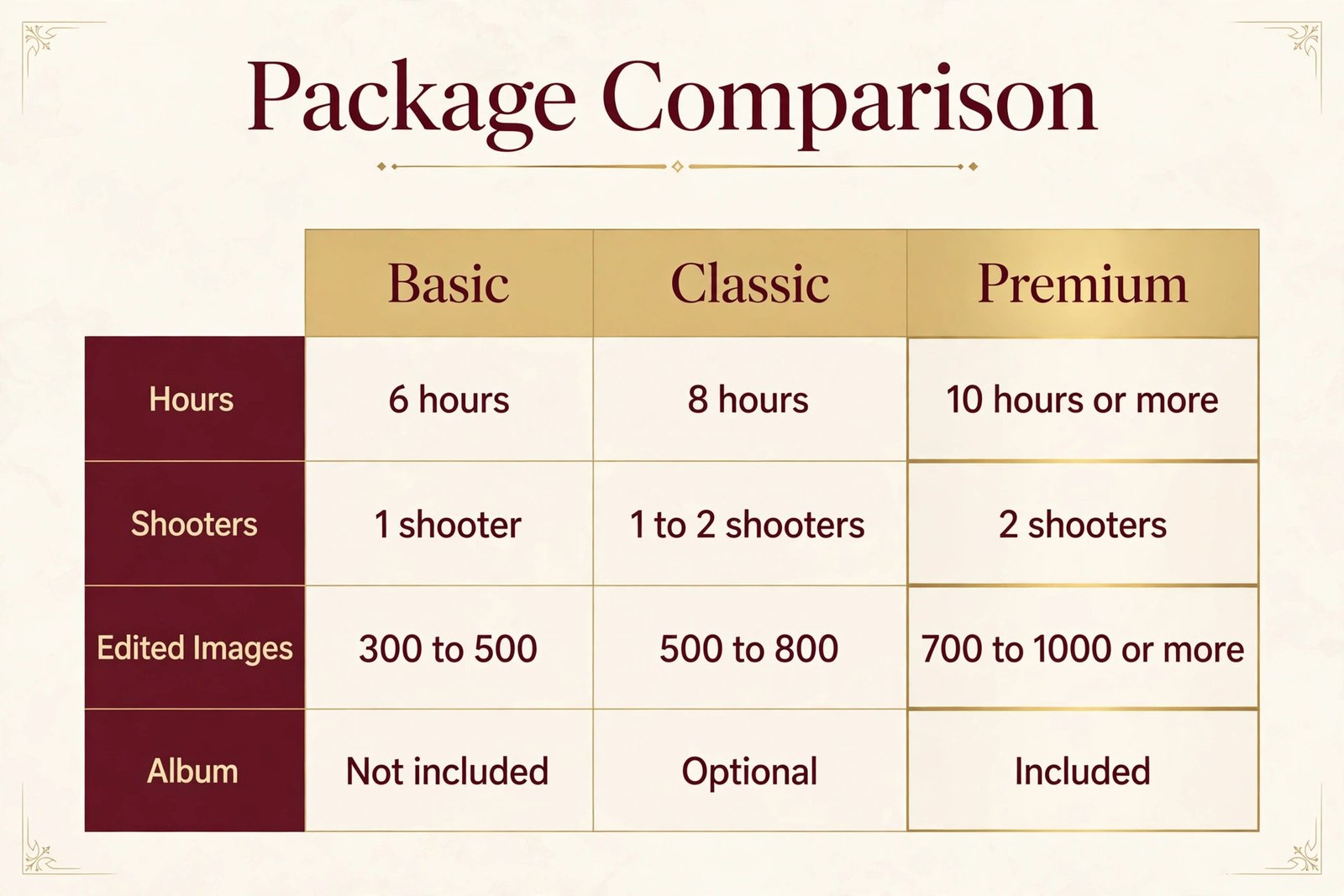
The table below sets out the shapes most photographers use. Your photographer may name tiers differently, and may move an item from one tier to another, but the pattern of hours, shooters, images, and products is consistent across published guides. Use this view of wedding photography pricing packages to compare quotes on equal terms, not to demand an exact match from every photographer.
| Package shape | Typical price range | Coverage | Shooters | Edited images | Common extras |
|---|---|---|---|---|---|
| Short or elopement | $1,000 to $2,500 | 2 to 4 hours | 1 | 150 to 300 | Online gallery, print rights |
| Essential | $2,000 to $4,500 | 6 hours | 1 | 300 to 500 | Online gallery, sneak peeks |
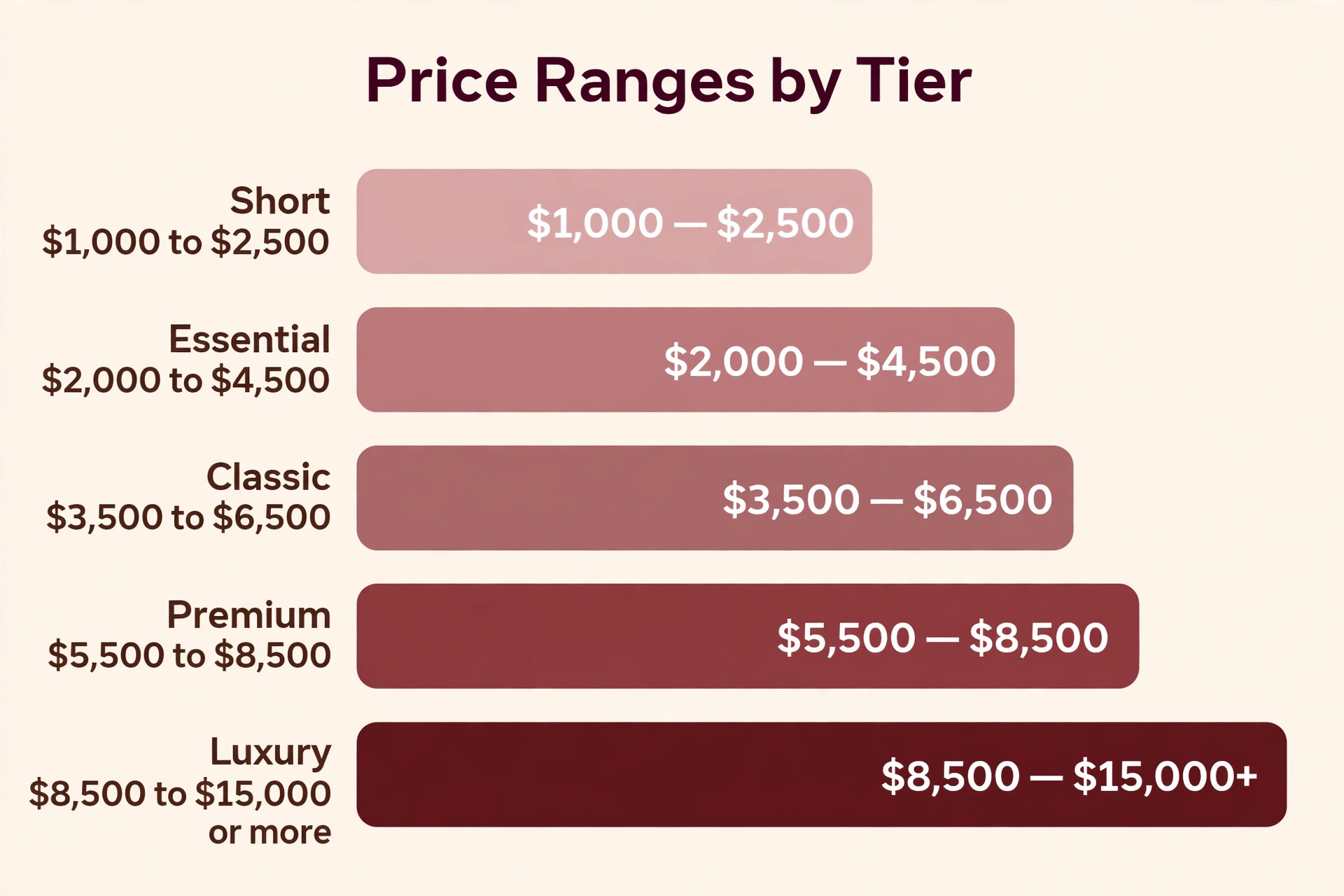
| Classic full day | $3,500 to $6,500 | 8 hours | 1 to 2 | 500 to 800 | Engagement session, second shooter option |
| Premium | $5,500 to $8,500 | 10 hours or more | 2 | 700 to 1,000 or more | Album, engagement, rehearsal option |
| Luxury or editorial | $8,500 to $15,000 or more | Full day, flexible | 2 or more | 800 or more | Custom album, video, drone, priority delivery |
Read the table as a map, not a promise. A $3,700 six hour package from an experienced photographer in a mid sized city can be better value than a $2,500 eight hour package from a photographer with little low light reception experience. The number of edited images also needs context. A photographer who delivers 400 carefully edited images from a six hour wedding may give you a stronger gallery than one who delivers 900 lightly edited images from the same day. Ask how many images you should expect per hour, usually 50 to 80 in published photographer guides, and ask whether every delivered image receives full editing or a lighter pass.
What Each Tier Usually Includes
Short and elopement packages
Short packages suit courthouse weddings, elopements, and micro weddings with a simple timeline. Expect 2 to 4 hours, one photographer, an online gallery, and print rights for personal use. Some include a short portrait session after the ceremony. What they usually leave out is a second shooter, an engagement session, and an album. Travel may be limited to a set radius, commonly 30 to 60 miles, with mileage beyond that charged separately. If your elopement involves a hike, a boat, or a remote location, confirm travel, permits, and extra time before you book, because those details change the price more than the package name suggests.
Essential packages
Essential packages are the entry point for a traditional wedding day, usually 6 hours with one photographer. They cover the ceremony, portraits, and the early reception, including first dance and toasts if the timeline is planned around them. Edited image counts run 300 to 500, with an online gallery and print rights. Sneak peeks are common. What is often missing is a second shooter, an album, and an engagement session, though each can be added. This tier works best for a single venue, a guest list under 100, and a couple who are happy to prioritise ceremony and portraits over late reception coverage.
Classic full day packages
Classic full day wedding photography pricing packages are the most common booking shape, usually 8 hours with one or two photographers. A real example from a published photographer price page lists an 8 hour classic package at $4,500 with a lead photographer for 8 hours, a second photographer for 6 hours, a 60 minute engagement style session, a curated gallery with print rights, and sneak peeks. Another published page lists an 8 hour package at $3,200 with a second photographer, engagement session, and online gallery, with an album version at $3,800. The spread between those two real listings shows why city, experience, and included products matter more than the tier name.
Expect 500 to 800 edited images, a longer gallery, and more flexibility on timeline changes. This tier suits couples who want getting ready coverage, family portraits without rushing, and reception coverage through the main events. If your ceremony and reception are at different venues, or your guest list passes 120, ask whether the second shooter is included or priced as an add-on, because that single line can change the value of the package by $500 or more.
Premium packages, commonly $5,500 to $8,500, extend coverage to 10 hours or more, include two shooters, and often bundle an engagement session, a rehearsal dinner option, and an album. Luxury packages, commonly $8,500 to $15,000 or more, add flexible full day coverage, multiple shooters, custom albums, priority editing, and sometimes video or drone coverage. The real difference at this level is rarely the camera gear. It is experience under pressure, consistency across difficult light, a calm approach to a delayed timeline, and a track record at venues like yours.
Ask for full galleries from weddings in similar light and at a similar scale, not just highlight reels, because a full gallery shows how a photographer handles the unglamorous middle of the day.
What Drives the Price Up or Down
Experience is the largest driver, and it is also the hardest to price from a website alone. A photographer who has shot 200 weddings has solved problems a newer photographer has not yet met, from harsh midday sun to a dark reception with mixed coloured lights. That experience shows in consistent skin tones, sharp low light images, and calm handling of a slipped timeline. It does not guarantee a style you love, so portfolio fit still matters, but it explains why similar packages can carry very different rates.
Location is the second driver. Major metro markets command 40 to 60 percent higher prices than smaller markets in published guides, and destination weddings add travel fees commonly listed at $500 to $3,000 on top of the photography fee. Even within one city, venue access matters. A venue with a long drive, a parking fee, an early load in time, or a second location for portraits adds time and cost. Photographers who include 50 or 60 miles of travel in the base price are common, so check the included radius and the mileage rate beyond it before you assume travel is free.
The number of hours and shooters is the third driver, and it is the easiest to control. Cutting two hours from a package can save several hundred dollars, but it can also cut the moments you most want, such as getting ready or the late reception. Adding a second shooter costs less than adding a whole tier, and it often adds more coverage value than an extra hour with one photographer. If your budget is tight, protect hours and shooters first, and treat albums and wall art as items you can order after the wedding, when you have seen the gallery.
Style and demand are quieter drivers. Film photography, editorial posing, and drone coverage each add cost, because film, scanning, and licensed drone operation carry their own expenses. A photographer with a long waiting list may book 12 to 18 months ahead for peak Saturdays. That demand is a useful signal, but it is not proof of fit.
Add-On Costs, the Lines That Change the Total
Add-ons are where a $3,500 quote becomes a $5,000 total, so wedding photography pricing packages must be compared with add-ons included, priced before you sign, not after the wedding. The table below gathers published add-on ranges from photographer pricing guides and add-on tables. Use it to build your own total, and ask your photographer to confirm each line in the contract.
| Add-on | Published range | Notes |
|---|---|---|
| Second shooter, full day | $300 to $1,500 | Most common band $500 to $1,200 |
| Extra coverage hour | $150 to $600 | Per hour, per shooter in some quotes |
| Engagement session, standalone | $300 to $1,500 | Often $300 to $800, sometimes bundled |
| Rehearsal dinner coverage | $500 to $1,500 | Usually 2 to 3 hours |
| Standard album, 10 by 10 | $500 to $2,500 | Design and lab printing included |
| Parent replica album | $300 to $800 | Each, smaller size than main album |
| Extra album spreads | $100 per spread | Two pages per spread in one published example |
| Drone coverage | $500 to $1,000 | Venue permission and weather dependent |
| Rush delivery | $200 to $500 or 15 to 30 percent | Versus standard 4 to 8 weeks |
| Travel beyond included radius | $500 to $3,000 for destination | Mileage or day rate for nearer venues |
| Extra prints and wall art | Varies by size and lab | Price after gallery delivery |
Three add-ons deserve extra attention. First, print rights. Most packages now include personal print rights, but commercial use is separate, so confirm commercial rights and pricing in writing if you plan business or publication use. Second, raw files. Most photographers do not deliver unedited raw files, so ask before booking if they matter to you. Third, overtime on the day. Agree in advance how overtime is authorised and billed, so nobody has to negotiate during the first dance.
A useful exercise is to build three totals for each photographer you shortlist. Total one is the base package alone. Total two is base plus the add-ons you know you want, such as a second shooter and an album. Total three is base plus add-ons plus likely extras, such as overtime and travel. Comparing total three across photographers is far more honest than comparing base prices, because it reflects the wedding you will actually have.
How to Read a Quote Line by Line
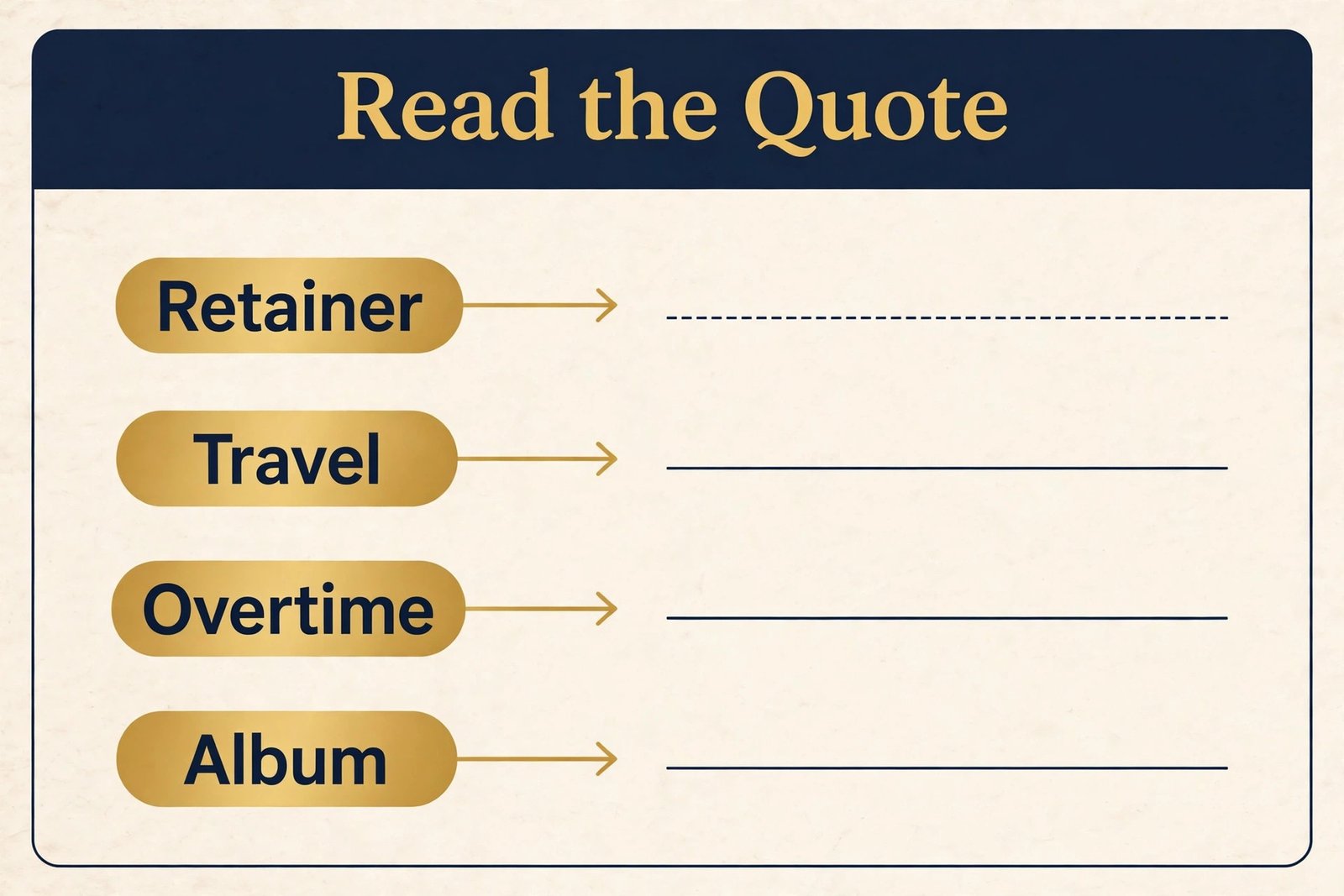
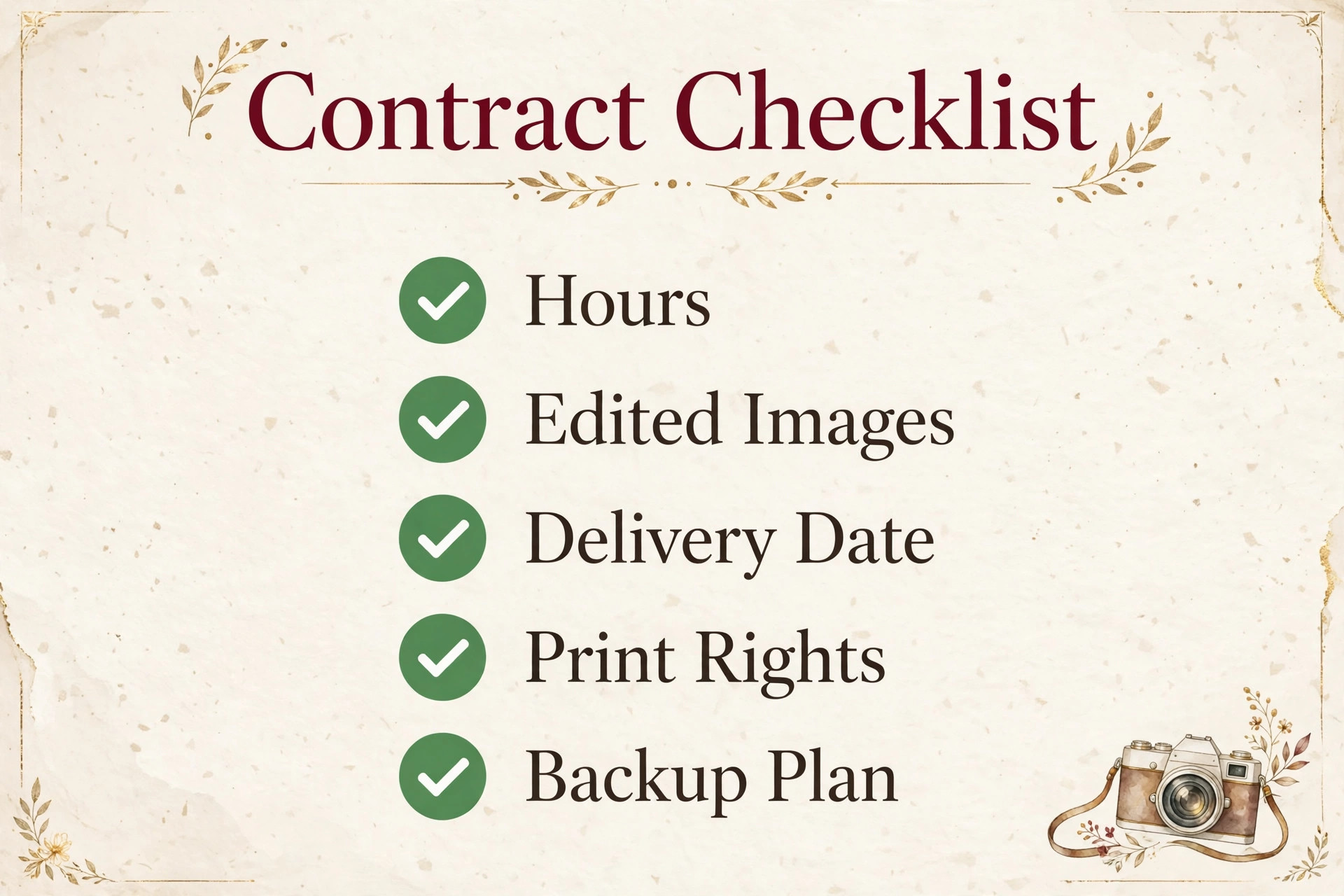
Start with the coverage window, not the price, because wedding photography pricing packages are only comparable when hours and shooters match. The quote should state start and end times, or total hours, and whether travel between venues counts inside those hours. A quote that says 8 hours but starts counting at arrival at the first venue is different from one that starts counting at the first getting ready location after a 45 minute drive. Ask for the timeline the photographer has assumed, and check it against your venue schedule, including hair and makeup, ceremony, portraits, and reception events.
Next, check deliverables in plain numbers. How many edited images should you expect, what resolution will they be, and will they arrive in an online gallery you can share with family. Ask whether sneak peeks are included, how many, and when they arrive. Ask about backup, because a professional should back up images on the day and during editing, and should be able to explain the backup plan in one clear paragraph. If the quote is vague on image count or delivery time, ask for a written clarification before you pay a retainer.
Then check rights and usage. Personal print rights are standard in most modern packages, but the quote should still say so. Check whether the photographer may use your images for portfolio and marketing, and whether you can opt out or limit that use. Check whether family members can order prints directly from the gallery, and whether the gallery has an expiry date or a download deadline. A gallery that expires after 90 days is fine if you know about it, and a problem if you discover it after the link stops working.
Payment terms are the final line to read with care. Published pages commonly require a retainer of 30 to 50 percent to reserve the date, with the balance split into instalments and the final payment due 14 days before the wedding in one published example. Retainers are usually non refundable, because the photographer turns away other bookings for your date, so check cancellation, postponement, and illness terms before you sign, including whether a named backup photographer is part of the contract.
How to Choose the Right Package for Your Wedding
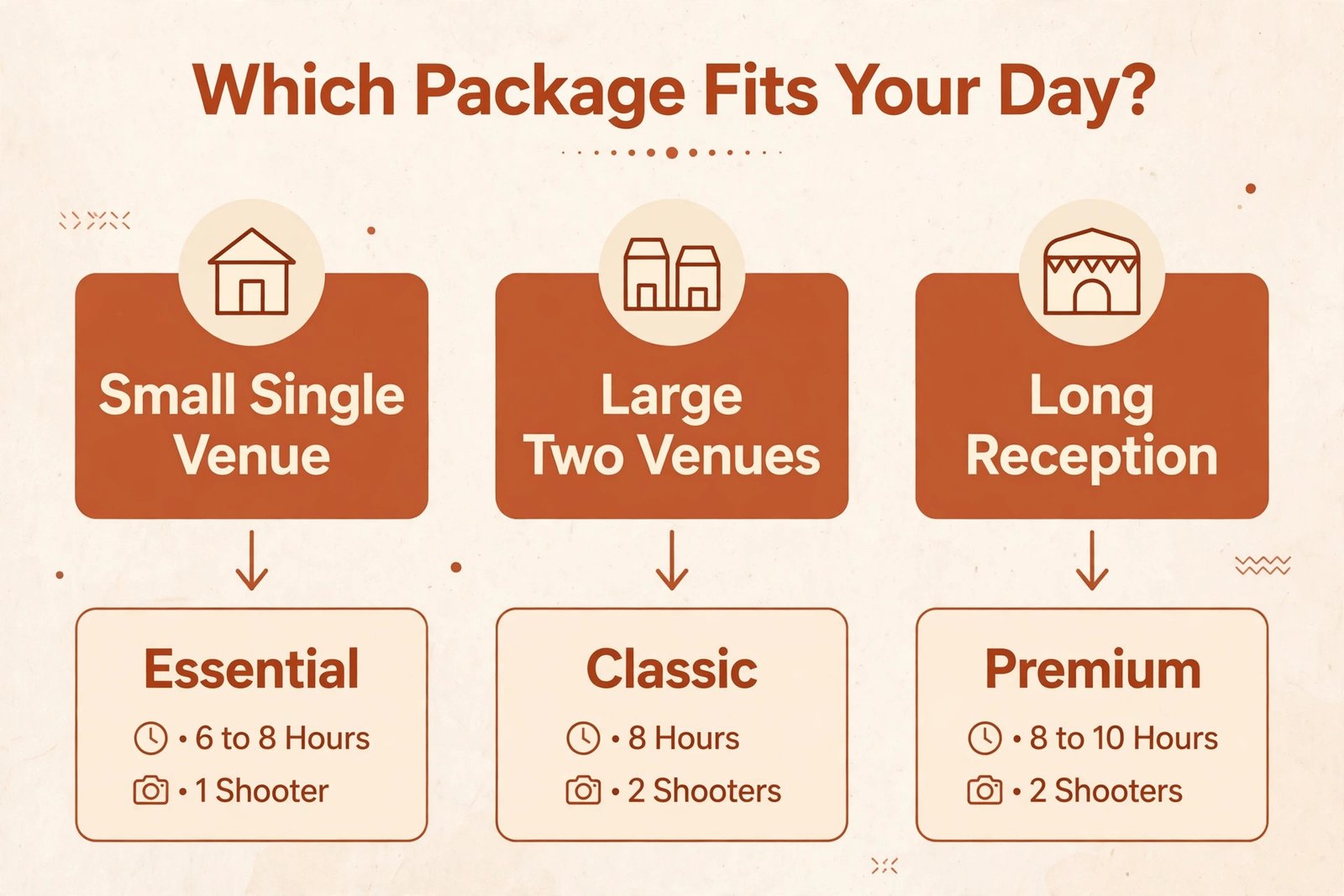
Match the package to the shape of your day, not to the tier name, and judge wedding photography pricing packages by the moments they cover. A small wedding with 40 guests, one venue, and a four hour timeline does not need a ten hour premium package, and a large wedding with two venues, 180 guests, and a long reception will strain a six hour essential package. Write down your must have moments first, such as getting ready, ceremony, family portraits, golden hour portraits, first dance, toasts, and send off. Then find the smallest package that covers those moments with breathing room, not the largest package you can afford.
Use guest count and venue count as a quick filter. One venue and under 80 guests often works with one photographer and 6 to 8 hours. Two venues, or 100 to 150 guests, usually benefits from a second shooter and 8 hours. Over 150 guests, a long reception, or venues far apart usually needs 8 to 10 hours and two shooters. A photographer who knows your venue can refine this in a planning call, and that call is also a test. One who asks about light, timeline, and venue restrictions is planning your day.
Style fit should break ties between similar quotes. Look at full galleries, not only social media highlights, and check three things. Skin tones should look natural across indoor and outdoor light. Low light reception images should be sharp, not washed out by harsh flash or muddy from noise. Group portraits should look organised, with everyone visible and relaxed, not stiff or rushed. If one photographer passes all three checks and another only passes one, the stronger gallery is usually worth the higher price, because you cannot re-shoot a wedding day.
Budget discipline helps here too. Set a photography budget range before you enquire, and tell photographers your range honestly. A good photographer will show you the package that fits, suggest one add-on worth paying for, and name one you can skip. If every quote sits far above your range, your timeline, guest list, or city market may need a second look.
Where a Wedding Quote Quietly Grows
The first mistake is comparing wedding photography pricing packages on base prices without add-ons. A $2,800 package that needs a $900 second shooter, a $700 album, and $400 of travel costs more than a $3,800 package that includes all three. Always build the three totals described earlier, and compare those totals. The second mistake is cutting coverage hours to save money, then paying overtime on the day at a higher rate. A timeline that runs 30 minutes late is normal, so book a buffer hour if your schedule is tight, or agree a clear overtime rate in advance.
The third mistake is booking on portfolio highlights alone. Highlight reels show the best 40 images from a wedding, not the full 600 image gallery. Ask for two full galleries from weddings similar to yours, and look at the middle of the day, where light changes, guests move, and timelines slip. The fourth mistake is ignoring delivery time and gallery expiry. A gallery delivered in 12 weeks may be fine, but if you need images for thank you cards, an album, or a publication, a rush fee or a faster photographer may be worth paying for.
The fifth mistake is ordering every product at booking time. Albums, parent copies, and wall art are easier to choose after you have seen the gallery and know which images you love. The exception is when booking time album pricing is clearly lower, as in one published example where an album cost $600 at booking versus $850 later. In that case, price the saving against the risk of choosing an album before you know your favourite images, and decide with the numbers in front of you.
The sixth mistake is skipping the contract details. Confirm the lead photographer by name, whether a second shooter is guaranteed, what happens if the photographer is ill, how postponement works, and when the final payment is due. A friendly email is not a substitute for a signed contract. The seventh mistake is forgetting family needs. Parents and grandparents often want prints, so plan gallery ordering or parent albums in the package, not as a surprise cost later.
For related reading, couples planning the wider day can use best AI tools for wedding planners for planning support, how to use AI for wedding planning for timeline and checklist help, and photographers building their own business can read best AI tools for photographers for editing and gallery tools. Couples who want stronger edits or print ready files can also check best AI photo enhancers before ordering large prints.
Frequently Asked Questions
How much should I budget for wedding photography?
Budget $2,500 to $4,500 for a typical full day booking in the United States, with $3,000 as a useful national average from The Knot 2025 study, and remember that wedding photography pricing packages at the same price can still differ on hours, shooters, and albums. Small weddings and shorter coverage can cost $1,000 to $2,500, while premium and luxury bookings run $5,500 to $15,000 or more. Set your range by hours, shooters, city, and products, not by the average alone.
What is usually included in a standard package?
A standard full day package usually includes 8 hours of coverage, one or two photographers, 500 to 800 edited images, an online gallery, personal print rights, and sneak peeks. Many include an engagement session or an album at higher tiers. Always confirm hours, image count, delivery time, and print rights in the written quote, because package names vary between photographers.
Is a second shooter worth the extra cost?
A second shooter is usually worth it for weddings with two getting ready locations, more than 100 guests, or a ceremony and reception at different venues. Published add-on ranges run $300 to $1,500 for a full day, with $500 to $1,200 the most common band. For a small, single venue wedding with a simple timeline, one experienced photographer is often enough.
How many edited photos will I receive?
Expect roughly 50 to 80 edited images per hour of coverage, so a 6 hour wedding often yields 300 to 500 images and an 8 hour wedding often yields 500 to 800. Ask whether every delivered image receives full editing or a lighter pass, and ask to see a full gallery, because a curated set of strong images is more useful than a large set of lightly edited frames.
How long does delivery take, and can I get photos faster?
Standard delivery runs 4 to 8 weeks, with sneak peeks often arriving within a few days. Rush delivery is available from many photographers for $200 to $500 extra, or 15 to 30 percent of the package price in published add-on tables. If you need images for thank you cards or an album deadline, agree the delivery date in the contract.
Do I need to buy an album at booking time?
You do not have to buy an album at booking time, and many couples choose better after seeing the gallery. Booking time pricing can be lower, with one published example showing a $600 booking price versus $850 later, so compare the saving against the benefit of choosing after you know your favourite images. Parent albums, commonly $300 to $800 each, can also be ordered later.
Buy the Coverage You Will Still Value in Ten Years
A wedding day passes quickly, and the photographs are what remain when the flowers fade and the venue lights go out, which is why wedding photography pricing packages deserve a careful read rather than a quick glance at the headline price. That does not mean buying the most expensive package. It means buying the hours, shooters, and delivery terms that protect the moments you care about, and skipping the extras that only look good on a price list. Compare total costs, not base prices, read the quote line by line, and ask for full galleries before you pay a retainer.
Start with your must have moments, match them to a package with breathing room, and confirm travel, overtime, backup, and delivery in writing. Prices here are published ranges checked at draft time, so confirm your final quote before you commit. The right package covers your day fully, delivers images you will still love in ten years, and leaves no surprise line on the final invoice.