

You learned 30 new words last week. Today you can recall 12 of them, and the other 18 feel familiar when you see them but will not come to mind when you need them in a sentence. That gap between recognising a word and producing it is where most language study quietly fails. If you want to use Anki for language learning vocabulary, the fix is not to study harder in one long session. The fix is a system that brings each word back just before you would forget it, and that tests you in the direction you will actually need the word.
This guide builds that system from scratch. It covers what Anki costs on each device, how to structure decks and note types, how to write cards that test recall rather than recognition, how many new cards and reviews to set each day, how to handle lapses, when a shared deck beats self-made cards, and how to check retention by week so you know whether the system is working or only feels like it is working.
Why Vocabulary Vanishes After a Week
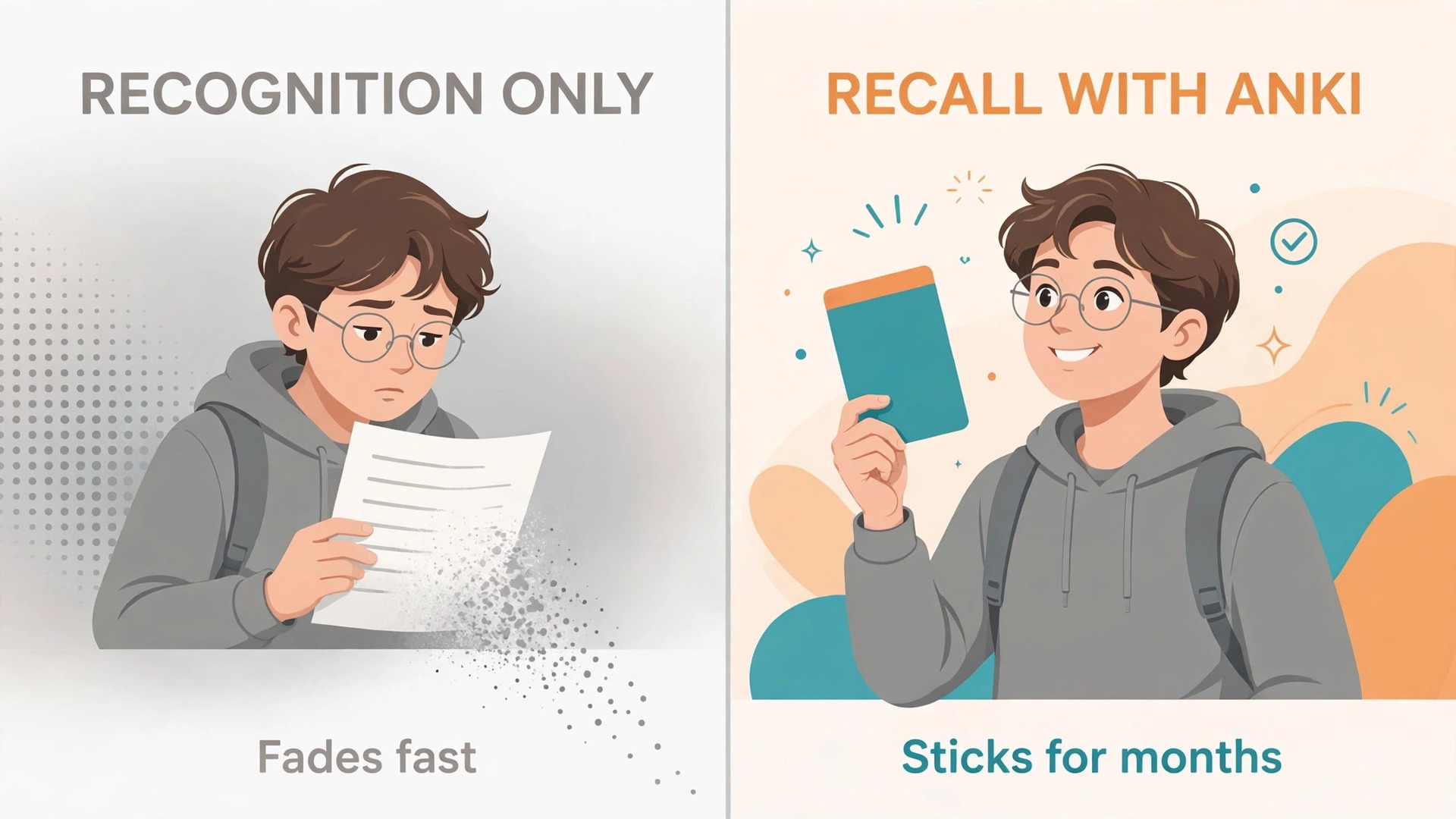
Most vocabulary study rewards the wrong skill. Reading a word list or flipping through flashcards with the answer visible trains recognition. Recognition feels easy because the answer is in front of you. Production is harder because you must build the word from memory, with the right spelling and the right place in a sentence. Speaking and writing demand production, so recognition-only study flatters you in practice and disappoints you in conversation.
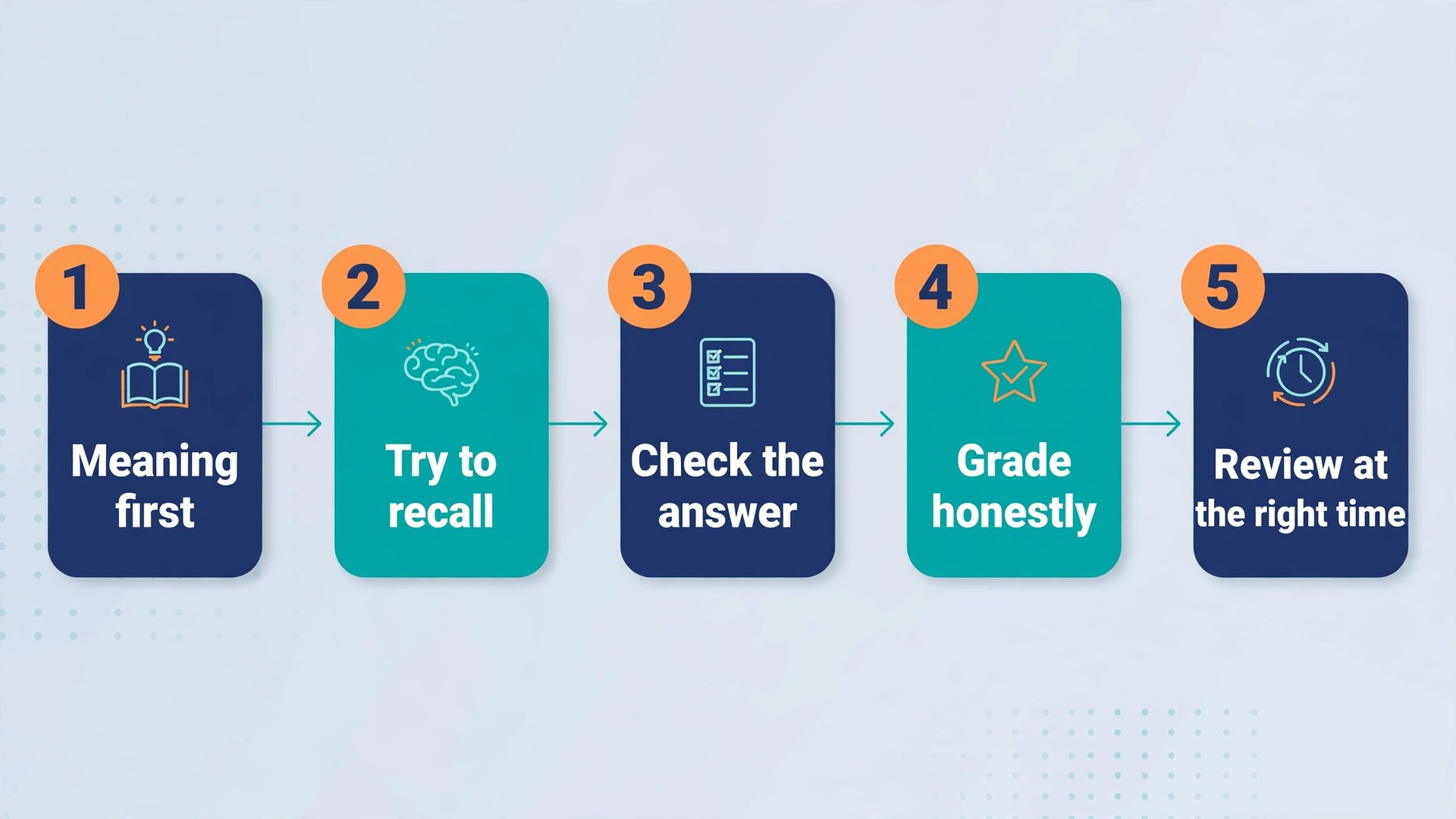
Spaced repetition reverses the order. Anki shows a prompt, you try to answer before you look, and then you grade yourself honestly. Words you know well return after longer gaps. Words you struggle with return sooner. That only works if your cards ask one clear question, your daily load is small enough to finish every day, and you press Again when you truly forgot.
What Anki Costs and How to Set It Up
Anki is free on desktop and free on Android, which surprises many new users who first meet the app through a paid listing. The desktop program for Windows, Mac and Linux is free and open source. AnkiDroid for Android is also free. AnkiWeb, the free sync service, keeps decks, progress and media in step across devices. The one paid version is AnkiMobile for iPhone and iPad, listed at 24.99 dollars as a one time purchase on the App Store at draft time. Check checkout before you pay, because prices vary by region and change over time.
| Device | Version | Cost at draft time |
|---|---|---|
| Windows, Mac or Linux | Anki desktop | Free |
| Android phone or tablet | AnkiDroid | Free |
| iPhone or iPad | AnkiMobile | 24.99 dollars, one time |
| Any browser | AnkiWeb sync and review | Free |
Set up takes about 15 minutes. Install the desktop app, create a free AnkiWeb account, and sync before you add a card. Then create one parent deck for the language, for example Spanish, with subdecks under it as in the next section. One parent deck lets you study everything at once or one topic at a time, with one daily limit governing the session.
Turn on FSRS, the current scheduling algorithm built into Anki, in your deck options. FSRS models how likely you are to remember each card and schedules the next review for the point where that probability falls to your target. The manual gives desired retention a default of 90 percent, described as a good balance of retention and workload, with workload rising very quickly above 90 percent. Start at 90 percent and use it for at least a month.
Build Your Deck Structure Before You Add Cards
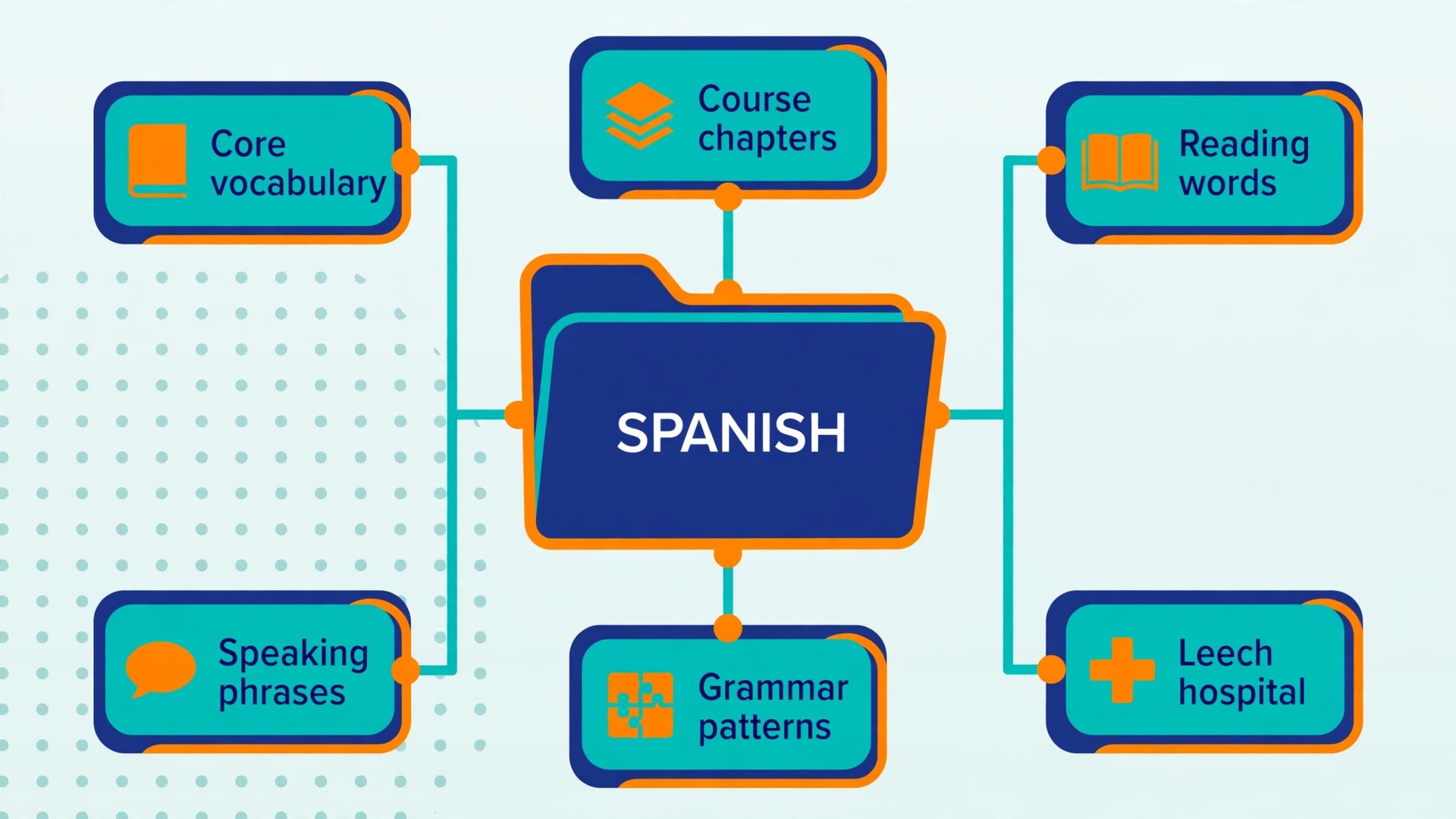
Deck structure is the part most learners skip, and the part that saves the most time later. A single deck called Vocabulary with 5,000 unsorted cards is hard to study from, hard to suspend by topic, and hard to adjust when one area falls behind. The template below is designed for one language, and you can adapt the topic names to your course without changing the logic. If you use Anki for language learning vocabulary in this shape, every new word has a home on the day you meet it.
| Parent deck and subdeck | What goes in it | Why it is separate |
|---|---|---|
| Language, for example Spanish | Nothing directly, only subdecks | One daily limit governs the whole session |
| Spanish, Core vocabulary | The 1,000 to 2,000 most frequent words | This is the deck you never suspend |
| Spanish, Course chapters | Words in chapter order | Easy to suspend a finished chapter |
| Spanish, Reading words | Words met in books, articles and subtitles | Keeps real reading separate from coursework |
| Spanish, Speaking phrases | Whole phrases and collocations | Phrases need different cards from single words |
| Spanish, Grammar patterns | Verb forms and sentence patterns | Tested with cloze cards, not word cards |
| Spanish, Leech hospital | Cards you keep failing, moved here for repair | Repair work stays out of the daily review flow |
Tags do work that decks should not do. Use tags for the source of a word, such as a textbook chapter or a podcast episode. Tags let you find all words from one source without moving cards between decks. Decks control scheduling and daily study. Tags control finding and filtering.
Design Cards That Test Recall, Not Recognition
A card that shows a word in your target language and asks for the meaning tests recognition. You see the hard part and produce the easy part. A card that shows the meaning and asks for the target word tests production, the skill you need when you speak. You need both directions, but production must be the main direction and must come first in your study order.
The simplest strong note type is Basic and reversed, which creates two cards from one note. One card asks for the meaning, and the reversed card asks for the target word. Add a third direction only when it earns its place. A listening card, with audio on the front and no written word, tests whether you recognise the word by ear. That matters for conversation, but it doubles or triples your card count, so add listening cards only for words you actually need to hear in real life, such as numbers, directions, and common verbs.
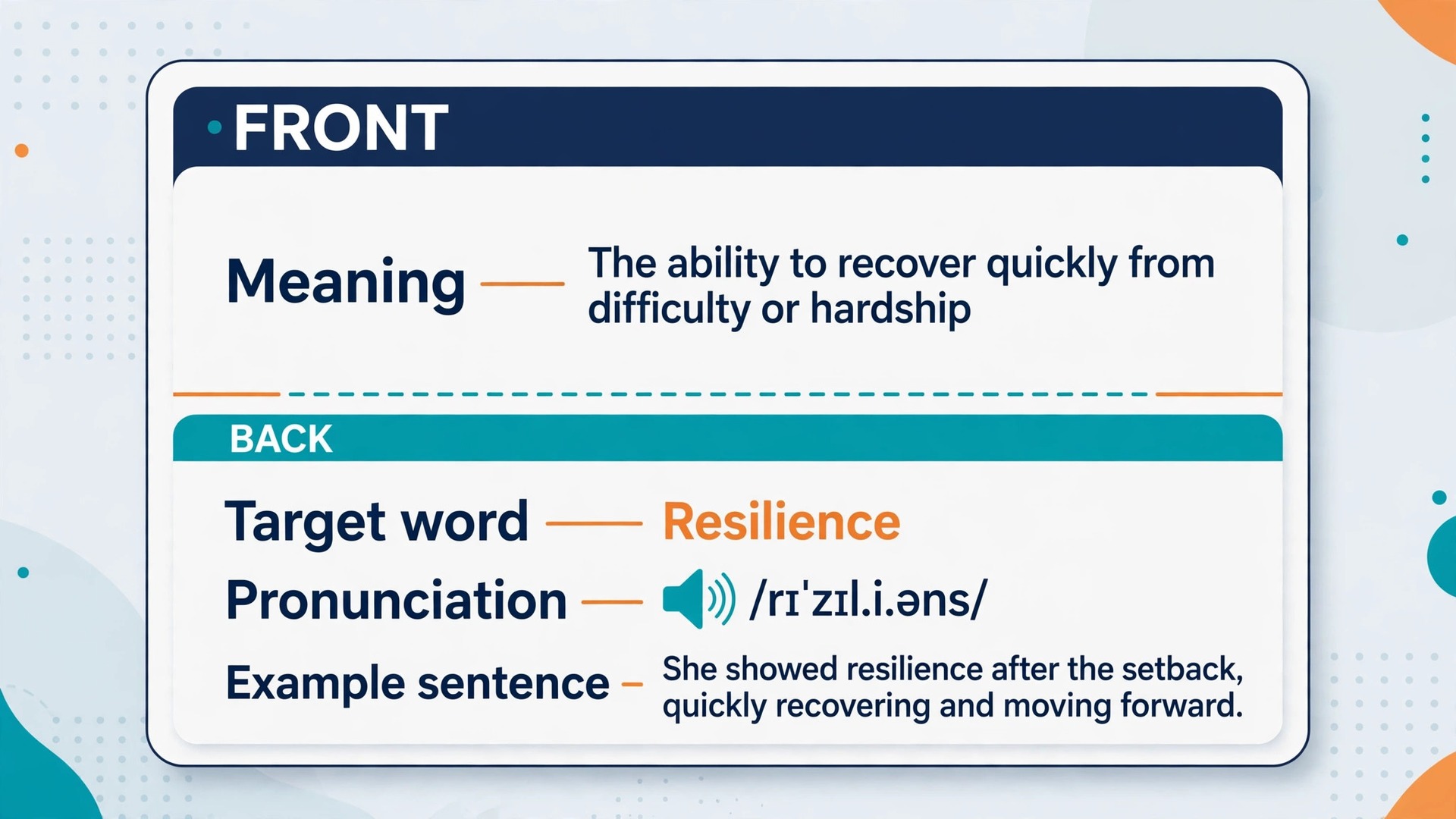
Fields matter more than most learners expect. A good vocabulary note has six fields, each with one job. The word field holds the target word alone. The meaning field holds a short translation. The example sentence field holds one real sentence. The pronunciation field holds audio or a phonetic guide. The image field holds a picture only when it adds meaning. The extra field holds grammar notes and mnemonics, and appears only after you answer.
Write the example sentence yourself whenever you can, or take it from something you actually read. A sentence from your own reading ties the word to a situation you understand. Keep each sentence short, keep the target word in a natural position, and keep only one new word per sentence.
Cloze deletion cards work well for grammar patterns and collocations, but they need care for vocabulary. A cloze card hides one word inside a sentence and asks you to fill it in, which tests recall inside context. The trap is a sentence where several words would fit. Before you save a cloze card, cover the answer and check that only your target word fits sensibly.
- Production card. Front shows the meaning plus a situation hint. Back shows the target word, the example sentence, and the pronunciation.
- Recognition card. Front shows the target word alone. Back shows the meaning and the example sentence. Use this second, not only.
- Listening card. Front plays audio only. Back shows the word, the meaning, and the sentence. Add this only for high frequency spoken words.
- Cloze card. Front shows a sentence with one word hidden. Back shows the full sentence. Use this for phrases and grammar patterns.
- Picture card. Front shows an image with no word. Back shows the word and the meaning. Use this only for concrete nouns.
- Avoid this pattern. A front that shows the word, the meaning, a picture, and the example sentence all at once. That card tests nothing, because the answer is already on the front.
Keep every card to one fact. If a word has two unrelated meanings, make two notes, one for each meaning, with a different example sentence for each. Long cards that ask for a word, its plural, its past tense, and an example sentence in one go fail often, and each failure resets the whole bundle even if you knew three parts of it.
How to Use Anki for Language Learning Vocabulary Without Burning Out
Burnout in Anki rarely comes from one bad day. It comes from a daily load that grows quietly until it takes over the whole study session. A learner adds 50 new words a day for two weeks, feels productive, then discovers that each new word creates several future reviews. By week four, reviews alone take an hour, and the learner skips days or quits. Set the daily target from the review load backwards, not from enthusiasm forwards.
Anki ships with a default of 20 new cards per day, and the official guidance warns that this pace can build to around 200 reviews per day in the early stages. That is a useful warning, not a target. Your right number depends on your available time, not on the default. Use the tiers below as a starting point, and adjust after two weeks of real data, not after two days of optimism.
| Daily situation | New cards per day | Expected review load after two weeks | Best for |
|---|---|---|---|
| Tight schedule, 15 minutes a day | 5 | About 30 to 50 reviews | Busy learners and long term maintenance |
| Steady schedule, 25 minutes a day | 10 | About 60 to 100 reviews | Most learners starting a new language |
| Generous schedule, 40 minutes a day | 20 | About 120 to 200 reviews | Full time study or an exam deadline |
| Catch up week, reviews piling up | 0 | Reviews only, no new cards | Any learner with a backlog |
Set maximum reviews per day to 9999, which in practice means no cap. Capping reviews at a small number feels manageable, but the cards over the cap do not go away. They become overdue and pile up. If reviews feel too heavy, the honest fix is to set new cards to zero for a few days, not to hide due reviews behind a cap.
Learning steps control how a new card behaves on its first day. The common default of 1 minute then 10 minutes works well for vocabulary, because it gives you two quick chances to fix a word you just met before it leaves the session. Keep learning steps short and few, and keep relearning steps under one day, so a lapsed card returns in the same session for a quick repair.
Study new cards after reviews, not before them. Reviews are the promise you made to your past self, and they protect words you already invested time in. New cards are optional by comparison. If you study new cards first and run out of time, reviews slip, and slipped reviews are what create backlogs. Anki lets you set new cards to appear after reviews in the deck options, and for most learners that one setting prevents more backlogs than any other change.
Grade honestly, and grade fast. Press Again when you could not produce the answer, even if you recognised it the moment you saw it. Press Good when you produced it with normal effort. Press Easy only when the answer came instantly. Pressing Hard instead of Again when you forgot is the one habit the Anki manual specifically warns against with FSRS.
The Daily Routine Template
A routine you can repeat on a tired day is worth more than a perfect routine you only follow on fresh days. The template below is built for a learner with 25 minutes a day and 10 new cards a day. Scale the minutes up or down with your new card tier, but keep the order the same, because the order protects reviews first and adds new learning only after the old learning is safe.
| Block | Minutes | What you do | Rule for this block |
|---|---|---|---|
| Warm up | 2 | Open the parent deck and check the due count | If due reviews exceed 150, set new cards to zero today |
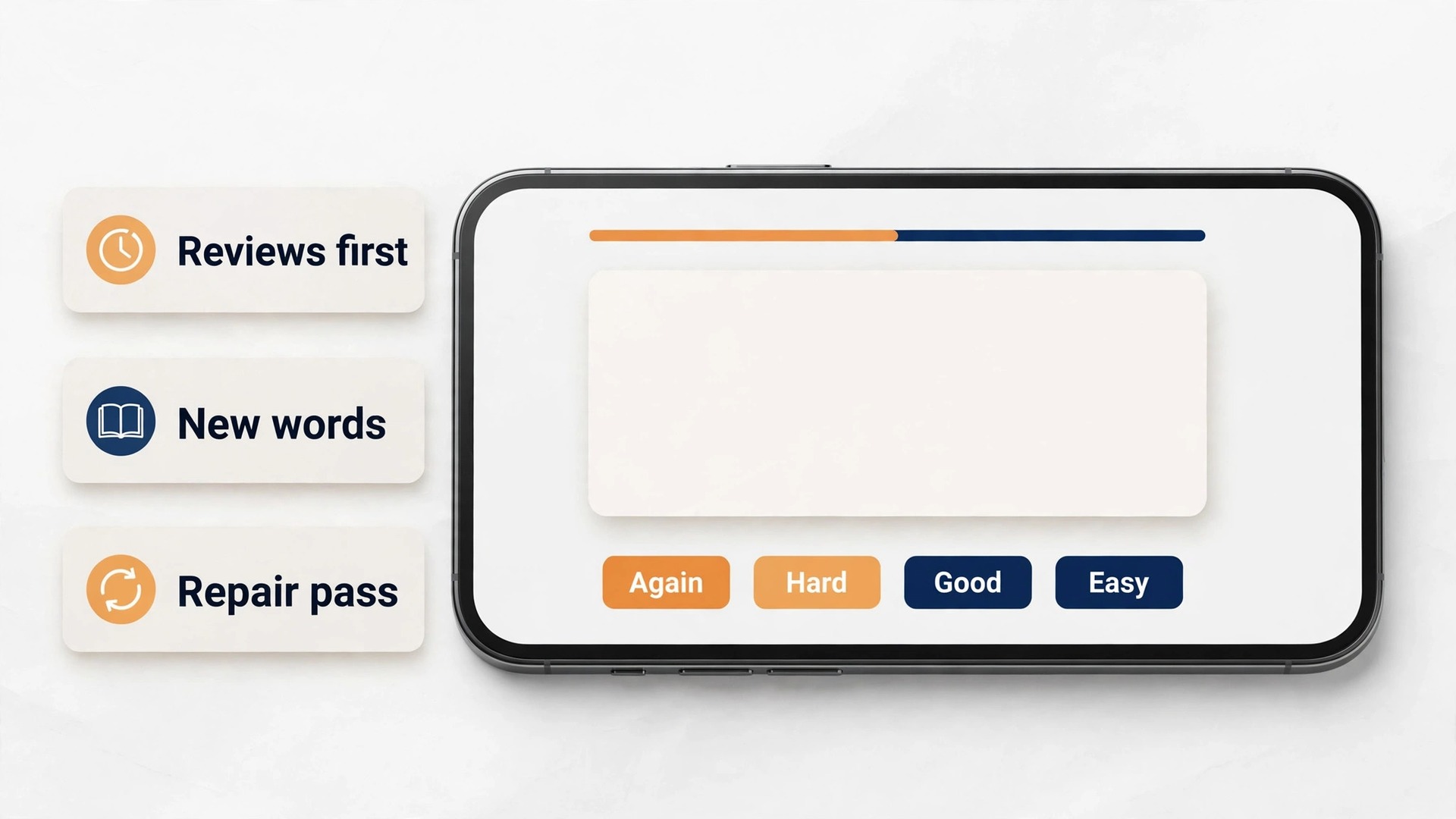
| Reviews first | 15 | Answer every due review, grading honestly | Do not add new cards until reviews are finished |
| New words | 5 | Study the daily batch of new cards | Stop at the target, even if you feel fresh |
| Repair pass | 3 | Edit or suspend any card you failed twice today | One fix per card, no long rewriting sessions |
The repair pass is where most learners either do nothing or do far too much. When a card fails twice in one day, it is telling you something specific. Either the card asks too much, the example sentence is unclear, or the word needs a stronger memory hook. Fix one of those things, then move on. Do not rewrite the whole deck, and do not add five new cards about the same word. One fix, made in the moment, beats a grand reorganisation planned for a weekend that never comes.
Place Anki in a fixed slot in your day, not in the gaps between other tasks. A fixed slot, such as the first 25 minutes after breakfast, turns reviews into a habit rather than a decision. Pair Anki with real language use on the same day, even briefly. Read one short paragraph, listen to one short clip, or write three sentences using words from today’s batch.
When you use Anki for language learning vocabulary inside a fixed daily slot, the routine itself becomes the retention strategy. You do not need motivation every morning. You need a slot, a due count check, reviews before new cards, and a short repair pass. That is the whole system, and it scales from 5 new cards a day to 20 without changing its shape.
Handle Lapses Before They Become Leeches
A lapse is a card you once knew and then forgot. Lapses are normal, and a healthy deck has plenty of them. A lapse tells you that the interval grew too long for that word, or that the card itself is weak. FSRS responds to a lapse by shortening the next interval. When you use Anki for language learning vocabulary, your job after a lapse is to fix the card if it needs fixing, and to grade honestly.
A leech is different. Anki tags a card as a leech after you forget it 8 times, and by default it suspends the card. That threshold is a useful alarm, because a card that fails 8 times is almost never failing for lack of effort. It is failing because it asks too much, lacks context, or collides with a similar word.
- The card asks for two facts at once. Split it into two cards, one fact each, and suspend the original.
- The card has no context. Add a real example sentence, or move the word into a phrase card where the surrounding words disambiguate it.
- The card collides with a similar word. Add a distinguishing note to the extra field, such as a different example, and study the pair together for a few days.
- The word is rare or no longer useful. Suspend it without guilt. A deck full of words you will never use is a tax on the words you will use every day.
Move leeches into the leech hospital subdeck from the deck structure above, so repair work has its own place and does not interrupt daily reviews. Set aside 10 minutes once a week to work through that subdeck. Fix what you can, suspend what you cannot fix yet, and delete what you no longer need.
A shared deck, downloaded from AnkiWeb, gives you coverage fast. You do not have to write thousands of cards before you can start reviewing. That speed matters when you are starting a language and need the most frequent words quickly. The weakness is fit. A shared deck may use a different variety of the language, or include words you will never use.
The fix is to suspend what you do not need rather than deleting it, and to edit or suspend weak cards as you meet them, instead of trying to clean a deck of 5,000 cards before you start. A shared deck you actively prune becomes your deck within a month. A shared deck you passively accept stays someone else’s deck.
Your own cards fit your life exactly, because you write them from your course, your reading, and your own mistakes. That fit is valuable for words you met in real situations and phrases you actually want to say. The weakness is time. Card only what must be recalled on demand, such as high frequency words and phrases you need for a trip or a job.
Most learners do best with a combined approach, and that is the approach to use Anki for language learning vocabulary with the least waste. Use a shared deck as the spine for the most frequent words, and add your own cards for words from your reading, for topics you keep getting wrong, and for phrases tied to your own life. Tag your own cards clearly, so you can find them later and suspend them separately if your course changes. That combination gives you speed where speed helps and precision where precision matters, without asking you to write everything from scratch.
Retention Checks by Week
Anki statistics are useful only if you check them on a schedule and act on one thing at a time. Checking statistics every day leads to constant setting changes, and you never learn what any single change did. Checking them once a week, on the same day, gives you a trend you can trust.
In week 1, check whether you are finishing reviews every day. Open the forecast and look at the due counts for the next seven days. If the forecast climbs every day, your new card rate is too high, and you should cut it before the pile grows. Week 1 is about habit and load, not retention percentages.
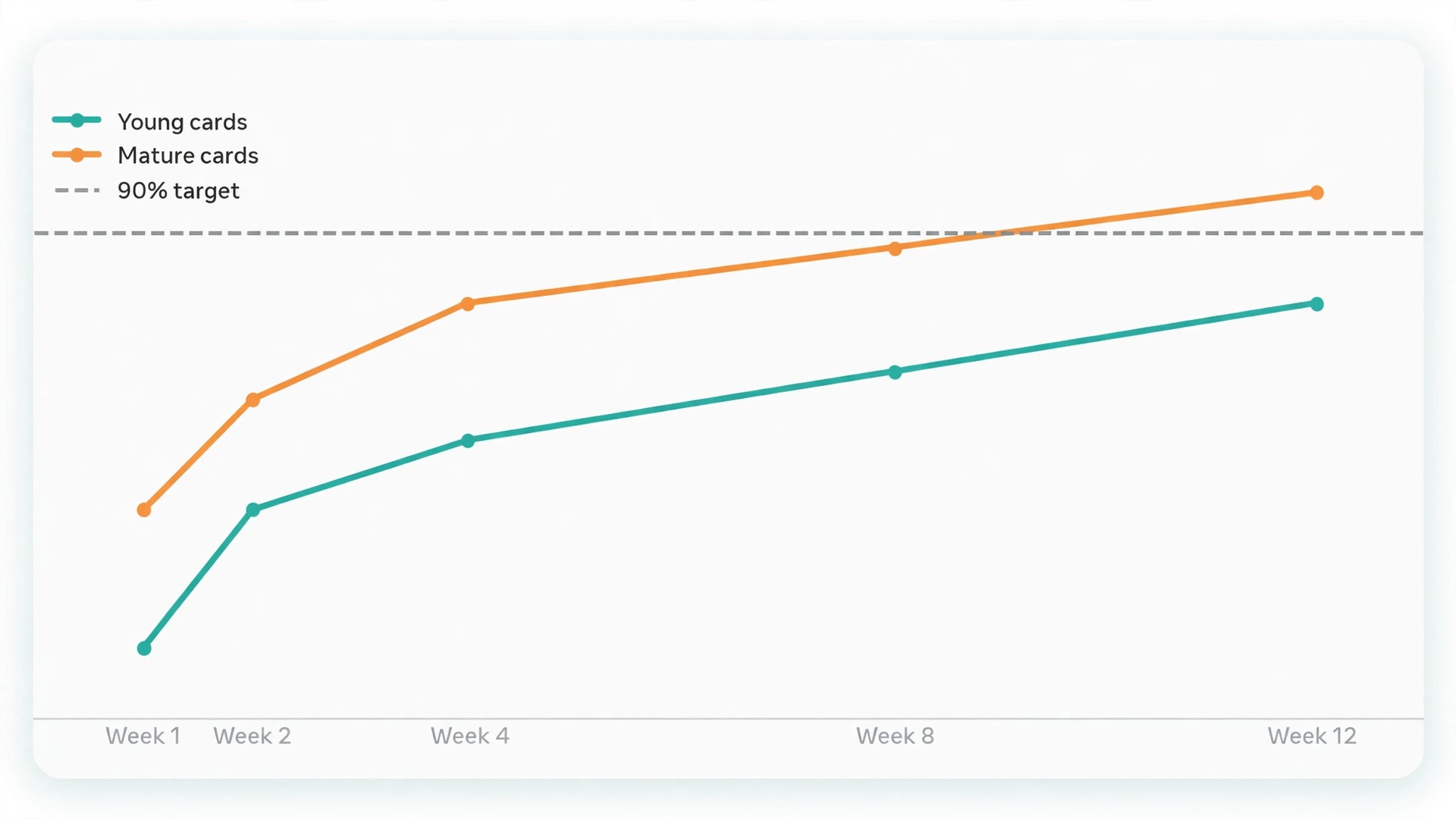
In week 2, check your young card retention. Young cards are cards with intervals under 21 days, and they are the cards most sensitive to card quality. If young retention sits near 85 to 90 percent, your cards and grading are working. If it sits below 80 percent, your cards are probably too hard, too vague, or too similar. Fix the cards, not the scheduler.
In week 4, check your mature card retention. Mature cards are cards with intervals of 21 days or more, and they show whether words survive a meaningful gap. Compare mature retention with your FSRS desired retention of 90 percent. A mature retention near 85 to 92 percent means the system is calibrated. A result near 70 percent usually means generous grading or recognition-only cards.
In week 8, check your total counts and your time per card. A learner adding 10 new cards a day will have roughly 560 new words after 8 weeks, plus reviews. If reviews still take more than 10 seconds per card on average, shorten your cards. The answer field should be checkable in a glance, not read like a paragraph.
In week 12, run a real world check outside Anki. Read a short article, listen to a short clip, or hold a short conversation, and notice which words appear without effort and which are missing entirely. When you use Anki for language learning vocabulary, the week 12 check turns statistics into decisions, showing which words to suspend and which missing words to add next.
Mistakes That Quietly Break a Vocabulary Deck
Most failed Anki decks do not fail because the learner lacked discipline. They fail because of a small set of avoidable mistakes, repeated daily. Check your deck against this list once a month, and fix whatever you find before it compounds.
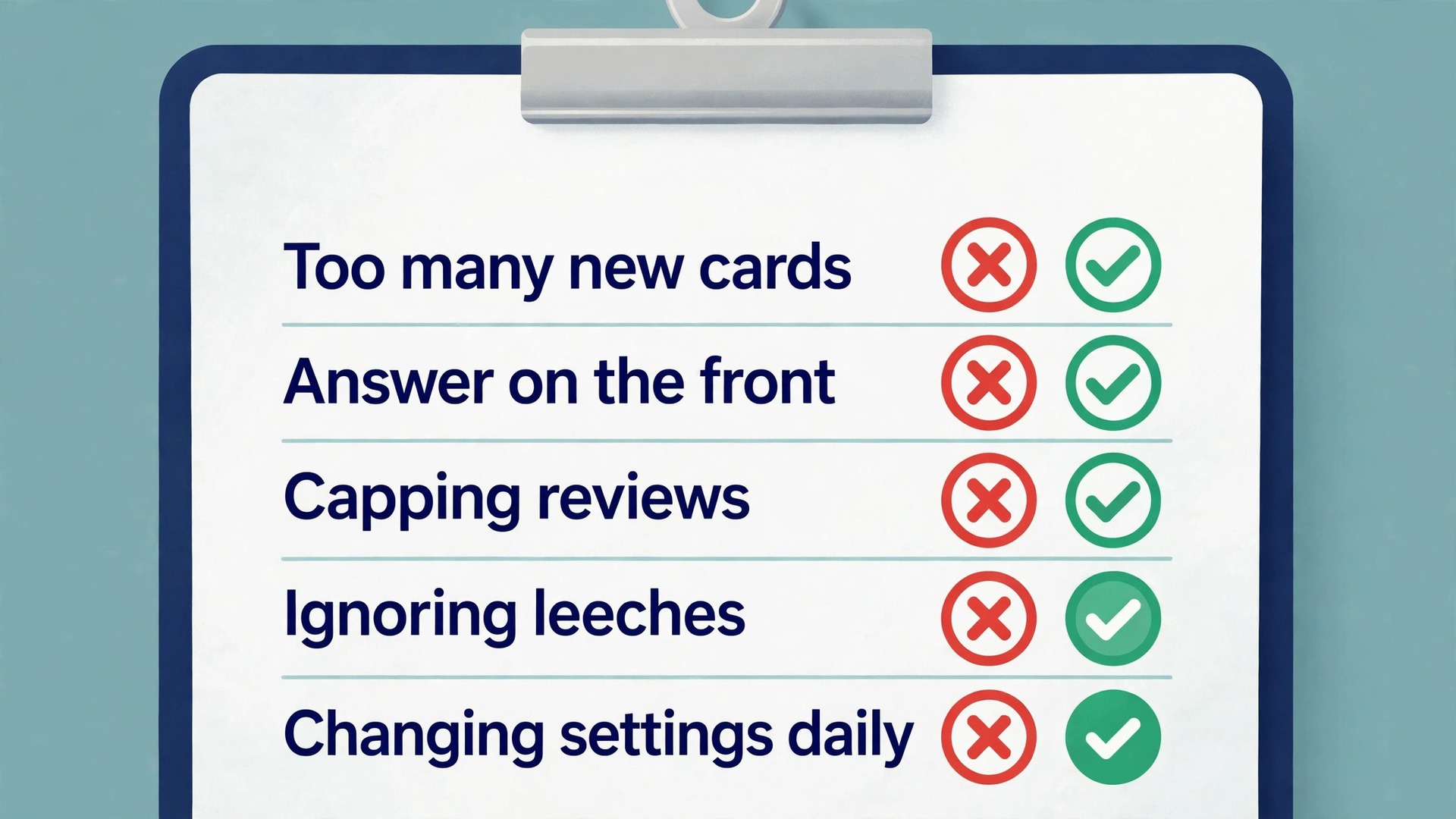
- Adding too many new cards on good days. Enthusiasm is not a schedule. Keep the daily target fixed, and let extra energy go to reading instead.
- Grading recognition as recall. If you recognised the word when you saw it but could not have produced it, press Again.
- Capping reviews instead of cutting new cards. Hidden reviews become overdue reviews, and overdue reviews arrive together.
- Writing cards with the answer on the front. That turns a test into a reading exercise.
- Carding every word you meet. A word you saw once in a novel does not need a card. A word you need for daily life does.
- Studying only in Anki. Flashcards build memory, but reading, listening, and speaking build the connections that let you use the memory.
- Changing settings every day. FSRS needs weeks of stable data. Change one setting, wait a week, then judge.
- Ignoring leeches. A card that fails 8 times will keep costing you time until you split it, fix it, or suspend it.
If you recognise yourself in three or more items on this list, do not rebuild the deck. Pick the one mistake that costs you the most time, fix it this week, and pick the next one next week. When you use Anki for language learning vocabulary, steady repair beats grand redesigns.
Related reading. If you are choosing tools around Anki, read the guide to the best AI language learning tools and how to learn a language with AI for a broader study plan. If you want to use Anki for language learning vocabulary as part of that broader plan, keep Anki as the memory system and let reading and conversation supply the words worth memorising.
Frequently Asked Questions
How many new words should I add to Anki each day?
Start with 10 new cards a day if you have about 25 minutes, or 5 a day if you have about 15 minutes. Anki defaults to 20 new cards a day, but that pace can build to around 200 reviews a day in the early stages, which is too much for most learners. Finish reviews every day for two weeks, then adjust the rate by 5 based on the forecast.
Use both, for different jobs. A shared deck is the fastest spine for the most frequent words, because someone else has already done the listing work. Your own cards are better for words from your reading, your course, and your own life, because they carry context you already understand. Suspend the parts of a shared deck that do not fit your level.
What FSRS desired retention should I set for vocabulary?
Start at 90 percent, which is the default in Anki and is described in the manual as a good balance of retention and workload. Workload rises very quickly above 90 percent, so a higher target buys a small recall gain at a large review cost. Use 90 percent for at least a month, check your mature retention, and only move the target if the checks show a clear reason.
How do I stop reviews from piling up when I miss days?
Set new cards to zero until the due count is back near normal, and work through reviews in daily chunks rather than trying to clear everything in one exhausting session. Do not cap maximum reviews to hide the pile, and do not reset the deck, because that destroys scheduling data. A few days of reviews only is the fastest honest recovery.
Why do I recognise words in Anki but forget them when speaking?
Recognition and production are different skills, and most decks train recognition far more than production. If your cards show the target word and ask for the meaning, you practise the easy direction. Add reversed cards that show the meaning and ask for the target word, and make production the first direction you study.
How long does it take to build a usable vocabulary with Anki?
A learner adding 10 new cards a day will meet roughly 300 new words in a month and roughly 900 in three months, before counting reviews and lapses. That is enough for basic conversation in many languages if the words are high frequency and practised in both directions. Judge progress by the week 12 real world check, not by the raw card count.
Your First 90 Days With Anki, Mapped Out
The first 90 days are where a vocabulary system either becomes a habit or becomes another abandoned app. Days 1 to 7 are for setup and load, not for speed. Install Anki, sync with AnkiWeb, build the deck structure, set FSRS desired retention to 90 percent, and start with 10 new cards a day or 5 if your schedule is tight.
Days 8 to 30 are for card quality. Watch young retention, fix cards that fail twice, move leeches to their hospital deck, and prune the shared deck parts that do not fit. Resist raising new cards until week 4, when mature retention gives you real evidence about whether the load is sustainable.
Days 31 to 90 are for real use and retention checks. Run the week 4, week 8, and week 12 checks, pair Anki with reading and speaking on the same day, and let the deck grow at the rate your reviews allow. By day 90 you should have a deck you trust and words you can actually produce in conversation.
Start today with one small step. Create the parent deck, add 10 words you already know you need, and finish tomorrow’s reviews before you add anything new.